


ASTM A910/A910M-18
(Specification)Standard Specification for Uncoated, Weldless, 2-Wire and 3-Wire Steel Strand for Prestressed Concrete
Standard Specification for Uncoated, Weldless, 2-Wire and 3-Wire Steel Strand for Prestressed Concrete
ABSTRACT
This specification covers two types and two grades of 2- and 3-wire, uncoated weldless steel and strand for use in pretensioned and posttensioned prestressed concrete construction. One specimen for test shall be taken from each production lot of finished strand and tested for breaking strength, yield strength and elongation. Strands of Grades 250 and 270 shall conform to specified breaking strength and yield strength requirements. Low relaxation strand shall also be tested as prescribed.
SCOPE
1.1 This specification covers two types and two grades of 2-wire and 3-wire, uncoated steel strand for use in prestressed concrete construction. The two types of strand are low-relaxation and stress-relieved (normal-relaxation). Low-relaxation is to be regarded as the standard type. Stress-relieved (normal-relaxation) strand will not be furnished unless specifically ordered. The two grades are 250 [1725] and 270 [1860]. Grades 250 [1725] and 270 [1860] have minimum tensile strengths of 250 ksi [1725 MPa] and 270 ksi [1860 MPa] respectively, based on the nominal area of the strand.
1.2 This specification is applicable for orders in either inch-pound units (as Specification A910) or in SI units (as Specification A910M).
1.3 The values stated in either inch-pound units or SI units are to be regarded separately as standard. Within the text, the SI units are shown in brackets. The values stated in each system are not exact equivalents; therefore, each system shall be used independently of the other. Combining values from the two systems may result in non-conformance with the specification.
1.4 This international standard was developed in accordance with internationally recognized principles on standardization established in the Decision on Principles for the Development of International Standards, Guides and Recommendations issued by the World Trade Organization Technical Barriers to Trade (TBT) Committee.
General Information
- Status
- Published
- Publication Date
- 28-Feb-2018
- Technical Committee
- A01 - Steel, Stainless Steel and Related Alloys
- Drafting Committee
- A01.05 - Steel Reinforcement
Relations
- Effective Date
- 01-May-2020
- Effective Date
- 01-Jun-2009
Overview
ASTM A910/A910M-18 is the standard specification developed by ASTM International for uncoated, weldless 2-wire and 3-wire steel strand used in prestressed concrete construction. This standard covers both low-relaxation and stress-relieved (normal-relaxation) strand types, in two strength grades: 250 [1725 MPa] and 270 [1860 MPa]. These steel strands are primarily utilized for pretensioned and posttensioned applications in prestressed concrete structures, providing the essential tensile strength and durability needed for modern construction.
The specification details the mechanical properties, manufacturing process, and testing requirements to ensure reliability and performance. This standard supports global construction practices by providing clear guidelines for both inch-pound and SI unit measurements.
Key Topics
Product Scope
- Applies to 2-wire and 3-wire, uncoated, weldless steel strand
- Covers low-relaxation (standard) and stress-relieved (by order) types
- Two strength grades: 250 (min. 250 ksi / 1725 MPa) and 270 (min. 270 ksi / 1860 MPa)
Technical Requirements
- Tensile and yield strength: Each production lot must meet minimum breaking and yield strength per grade
- Elongation: Minimum requirements specified to ensure ductility
- Relaxation: Specifies maximum stress losses under sustained load for low-relaxation strand
- Dimensional tolerances: Nominal diameters and permissible variations defined for each strand size
Manufacturing and Quality Assurance
- Strands must be weldless and made from carbon steel with appropriate thermal/mechanical treatments
- No strand splices or post-drawing welds allowed
- Sampling, inspection, and certification protocols ensure material compliance
- Packaging and labeling requirements outlined for traceability and protection during shipment
Applications
ASTM A910/A910M steel strand is vital for prestressed concrete construction, supporting both pretensioned and posttensioned methods. Key practical applications include:
- Bridges: Used in concrete bridge girders and decks, where high tensile strength is essential for load-bearing elements
- Parking Structures: Provides the necessary reinforcement for large-span concrete beams and floors
- Buildings: Supports posttensioned slabs and beams in high-rise and commercial construction
- Precast Concrete Elements: Reinforces a variety of factory-produced components such as hollow-core slabs and piles
Utilizing uncoated, weldless steel strand conforming to ASTM A910/A910M helps engineers and contractors achieve long-lasting, safe, and efficient concrete structures. The standard ensures consistency in mechanical performance-critical to meeting project specifications and building code requirements.
Related Standards
For comprehensive quality and performance in prestressed concrete, the following standards are often referenced alongside ASTM A910/A910M:
- ASTM A1061/A1061M: Test methods for assessing the mechanical properties of multi-wire steel prestressing strand
- MIL-STD-129: U.S. military standard for marking shipments
- Fed. Std. No. 123: Federal standard for civilian agency shipments
For best results in construction applications, always reference the latest editions of ASTM and related international standards. Adhering to ASTM A910/A910M-18 ensures that prestressed concrete structures are reinforced with reliable, high-performance steel strand designed for modern engineering challenges.
Keywords: ASTM A910/A910M, 2-wire steel strand, 3-wire steel strand, prestressed concrete, low-relaxation steel strand, uncoated wire, tensile strength, weldless steel strand, construction standards.
Buy Documents
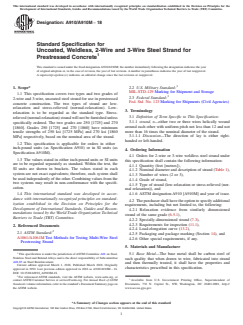
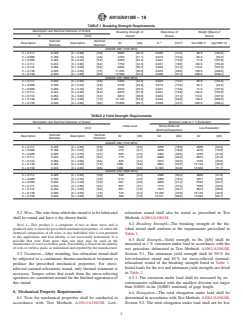
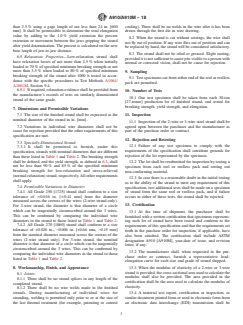

ASTM A910/A910M-18 - Standard Specification for Uncoated, Weldless, 2-Wire and 3-Wire Steel Strand for Prestressed Concrete
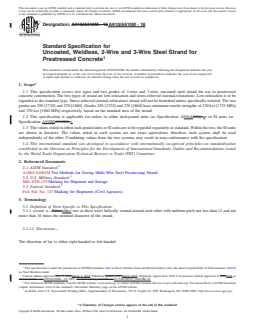
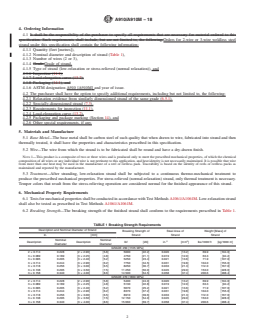
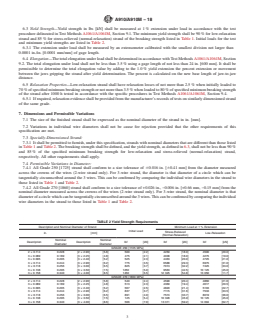
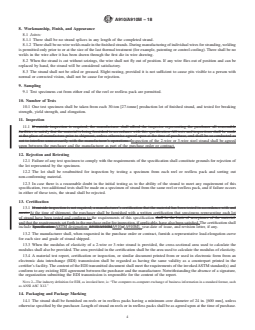
REDLINE ASTM A910/A910M-18 - Standard Specification for Uncoated, Weldless, 2-Wire and 3-Wire Steel Strand for Prestressed Concrete
Get Certified
Connect with accredited certification bodies for this standard

Element Materials Technology
Materials testing and product certification.

Inštitut za kovinske materiale in tehnologije
Institute of Metals and Technology. Materials testing, metallurgical analysis, NDT.
Sponsored listings
Frequently Asked Questions
ASTM A910/A910M-18 is a technical specification published by ASTM International. Its full title is "Standard Specification for Uncoated, Weldless, 2-Wire and 3-Wire Steel Strand for Prestressed Concrete". This standard covers: ABSTRACT This specification covers two types and two grades of 2- and 3-wire, uncoated weldless steel and strand for use in pretensioned and posttensioned prestressed concrete construction. One specimen for test shall be taken from each production lot of finished strand and tested for breaking strength, yield strength and elongation. Strands of Grades 250 and 270 shall conform to specified breaking strength and yield strength requirements. Low relaxation strand shall also be tested as prescribed. SCOPE 1.1 This specification covers two types and two grades of 2-wire and 3-wire, uncoated steel strand for use in prestressed concrete construction. The two types of strand are low-relaxation and stress-relieved (normal-relaxation). Low-relaxation is to be regarded as the standard type. Stress-relieved (normal-relaxation) strand will not be furnished unless specifically ordered. The two grades are 250 [1725] and 270 [1860]. Grades 250 [1725] and 270 [1860] have minimum tensile strengths of 250 ksi [1725 MPa] and 270 ksi [1860 MPa] respectively, based on the nominal area of the strand. 1.2 This specification is applicable for orders in either inch-pound units (as Specification A910) or in SI units (as Specification A910M). 1.3 The values stated in either inch-pound units or SI units are to be regarded separately as standard. Within the text, the SI units are shown in brackets. The values stated in each system are not exact equivalents; therefore, each system shall be used independently of the other. Combining values from the two systems may result in non-conformance with the specification. 1.4 This international standard was developed in accordance with internationally recognized principles on standardization established in the Decision on Principles for the Development of International Standards, Guides and Recommendations issued by the World Trade Organization Technical Barriers to Trade (TBT) Committee.
ABSTRACT This specification covers two types and two grades of 2- and 3-wire, uncoated weldless steel and strand for use in pretensioned and posttensioned prestressed concrete construction. One specimen for test shall be taken from each production lot of finished strand and tested for breaking strength, yield strength and elongation. Strands of Grades 250 and 270 shall conform to specified breaking strength and yield strength requirements. Low relaxation strand shall also be tested as prescribed. SCOPE 1.1 This specification covers two types and two grades of 2-wire and 3-wire, uncoated steel strand for use in prestressed concrete construction. The two types of strand are low-relaxation and stress-relieved (normal-relaxation). Low-relaxation is to be regarded as the standard type. Stress-relieved (normal-relaxation) strand will not be furnished unless specifically ordered. The two grades are 250 [1725] and 270 [1860]. Grades 250 [1725] and 270 [1860] have minimum tensile strengths of 250 ksi [1725 MPa] and 270 ksi [1860 MPa] respectively, based on the nominal area of the strand. 1.2 This specification is applicable for orders in either inch-pound units (as Specification A910) or in SI units (as Specification A910M). 1.3 The values stated in either inch-pound units or SI units are to be regarded separately as standard. Within the text, the SI units are shown in brackets. The values stated in each system are not exact equivalents; therefore, each system shall be used independently of the other. Combining values from the two systems may result in non-conformance with the specification. 1.4 This international standard was developed in accordance with internationally recognized principles on standardization established in the Decision on Principles for the Development of International Standards, Guides and Recommendations issued by the World Trade Organization Technical Barriers to Trade (TBT) Committee.
ASTM A910/A910M-18 is classified under the following ICS (International Classification for Standards) categories: 77.140.15 - Steels for reinforcement of concrete. The ICS classification helps identify the subject area and facilitates finding related standards.
ASTM A910/A910M-18 has the following relationships with other standards: It is inter standard links to ASTM A1061/A1061M-20, ASTM A1061/A1061M-09. Understanding these relationships helps ensure you are using the most current and applicable version of the standard.
ASTM A910/A910M-18 is available in PDF format for immediate download after purchase. The document can be added to your cart and obtained through the secure checkout process. Digital delivery ensures instant access to the complete standard document.
Standards Content (Sample)
This international standard was developed in accordance with internationally recognized principles on standardization established in the Decision on Principles for the
Development of International Standards, Guides and Recommendations issued by the World Trade Organization Technical Barriers to Trade (TBT) Committee.
Designation:A910/A910M −18
Standard Specification for
Uncoated, Weldless, 2-Wire and 3-Wire Steel Strand for
Prestressed Concrete
This standard is issued under the fixed designationA910/A910M; the number immediately following the designation indicates the year
of original adoption or, in the case of revision, the year of last revision.Anumber in parentheses indicates the year of last reapproval.
A superscript epsilon (´) indicates an editorial change since the last revision or reapproval.
1. Scope* 2.2 U.S. Military Standard:
MIL-STD-129Marking for Shipment and Storage
1.1 This specification covers two types and two grades of
2.3 Federal Standard:
2-wire and 3-wire, uncoated steel strand for use in prestressed
Fed. Std. No. 123Marking for Shipments (Civil Agencies)
concrete construction. The two types of strand are low-
relaxation and stress-relieved (normal-relaxation). Low-
3. Terminology
relaxation is to be regarded as the standard type. Stress-
3.1 Definition of Term Specific to This Specification:
relieved(normal-relaxation)strandwillnotbefurnishedunless
3.1.1 strand, n—either two or three wires helically wound
specifically ordered. The two grades are 250 [1725] and 270
around each other with uniform pitch not less than 12 and not
[1860]. Grades 250 [1725] and 270 [1860] have minimum
more than 16 times the nominal diameter of the strand.
tensile strengths of 250 ksi [1725 MPa] and 270 ksi [1860
3.1.1.1 Discussion—The direction of lay is either right-
MPa] respectively, based on the nominal area of the strand.
handed or left-handed.
1.2 This specification is applicable for orders in either
inch-pound units (as Specification A910) or in SI units (as
4. Ordering Information
Specification A910M).
4.1 Orders for 2-wire or 3-wire weldless steel strand under
1.3 The values stated in either inch-pound units or SI units
this specification shall contain the following information:
are to be regarded separately as standard. Within the text, the
4.1.1 Quantity (feet [metres]),
SI units are shown in brackets. The values stated in each
4.1.2 Nominal diameter and description of strand (Table 1),
system are not exact equivalents; therefore, each system shall
4.1.3 Number of wires (2 or 3),
beusedindependentlyoftheother.Combiningvaluesfromthe
4.1.4 Grade of strand,
two systems may result in non-conformance with the specifi-
4.1.5 Type of strand (low-relaxation or stress-relieved (nor-
cation.
mal relaxation)), and
1.4 This international standard was developed in accor- 4.1.6 ASTM designationA910 [A910M] and year of issue.
dance with internationally recognized principles on standard-
4.2 Thepurchasershallhavetheoptiontospecifyadditional
ization established in the Decision on Principles for the
requirements, including but not limited to, the following:
Development of International Standards, Guides and Recom-
4.2.1 Relaxation evidence from similarly dimensioned
mendations issued by the World Trade Organization Technical
strand of the same grade (6.5.1),
Barriers to Trade (TBT) Committee.
4.2.2 Specially-dimensioned strand (7.3),
4.2.3 Requirements for inspection (11.1),
2. Referenced Documents
4.2.4 Load-elongation curve (13.2),
2.1 ASTM Standard:
4.2.5 Packaging and package marking (Section 14), and
A1061/A1061MTest Methods for Testing Multi-Wire Steel
4.2.6 Other special requirements, if any.
Prestressing Strand
5. Materials and Manufacture
5.1 Base Metal—The base metal shall be carbon steel of
This specification is under the jurisdiction ofASTM Committee A01 on Steel,
Stainless Steel and RelatedAlloys and is the direct responsibility of Subcommittee
such quality that when drawn to wire, fabricated into strand
A01.05 on Steel Reinforcement.
and then thermally treated, it shall have the properties and
Current edition approved March 1, 2018. Published March 2018. Originally
characteristics prescribed in this specification.
approved in 1992. Last previous edition approved in 2016 as A910/A910M–16.
DOI: 10.1520/A0910_A0910M-18.
For referenced ASTM standards, visit the ASTM website, www.astm.org, or
contact ASTM Customer Service at service@astm.org. For Annual Book of ASTM Available from U.S. Government Printing Office, Superintendent of
Standards volume information, refer to the standard’s Document Summary page on Documents, 732 N. Capitol St., NW, Washington, DC 20401-0001, http://
the ASTM website. www.access.gpo.gov.
*A Summary of Changes section appears at the end of this standard
Copyright © ASTM International, 100 Barr Harbor Drive, PO Box C700, West Conshohocken, PA 19428-2959. United States
A910/A910M−18
TABLE 1 Breaking Strength Requirements
Description and Nominal Diameter of Strand
Breaking Strength of Steel Area of Weight [Mass] of
Strand Strand Strand
in. [mm]
Nominal Nominal
2 2
Description Description lbf [kN] in. [mm ] lbs/1000 ft [kg/1000 m]
Diameter Diameter
GRADE 250 [1725 MPa]
2 × 0.114 0.228 [2 × 2.90] [5.8] 5000 [22.2] 0.020 [13.2] 69.9 [104.0]
3 × 0.089 0.189 [3 × 2.25] [4.8] 4750 [21.1] 0.019 [12.0] 63.3 [94.2]
3 × 0.095 0.205 [3 × 2.40] [5.2] 5250 [23.4] 0.021 [13.6] 71.9 [107.0]
3 × 0.114 0.244 [3 × 2.90] [6.2] 7750 [34.5] 0.031 [19.8] 104.0 [155.0]
3 × 0.118 0.256 [3 × 3.00] [6.5] 8250 [36.7] 0.033 [21.3] 112.0 [167.0]
3 × 0.138 0.295 [3 × 3.50] [7.5] 11 250 [50.0] 0.045 [29.0] 153.0 [228.0]
3 × 0.158 0.340 [3 × 4.00] [8.6] 14 500 [64.5] 0.058 [37.4] 200.6 [298.4]
GRADE 270 [1860 MPa]
2 × 0.114 0.228 [2 × 2.90] [5.8] 5400 [24.0] 0.020 [13.2] 69.9 [104.0]
3 × 0.089 0.189 [3 × 2.25] [4.8] 5130 [22.8] 0.019 [12.0] 63.3 [94.2]
3 × 0.095 0.205 [3 × 2.40] [5.2] 5670 [25.2] 0.021 [13.6] 71.9 [107.0]
3 × 0.114 0.244 [3 × 2.90] [6.2] 8370 [37.2] 0.031 [19.8] 104.0 [155.0]
3 × 0.118 0.256 [3 × 3.00] [6.5] 8910 [39.6] 0.033 [21.3] 112.0 [167.0]
3 × 0.138 0.295 [3 × 3.50] [7.5] 12 150 [54.0] 0.045 [29.0] 153.0 [228.0]
3 × 0.158 0.340 [3 × 4.00] [8.6] 15 660 [69.7] 0.058 [37.4] 200.6 [298.4]
TABLE 2 Yield Strength Requirements
Description and Nominal Diameter of Strand Minimum Load at 1 % Extension
Initial Load
Stress-Relieved
in. [mm] Low-Relaxation
(Normal-Relaxation)
Nominal Nominal
Description Description lbf [kN] lbf [kN] lbf [kN]
Diameter Diameter
GRADE 250 [1725 MPa]
2 × 0.114 0.228 [2 × 2.90] [5.8] 500 [2.2] 4250 [18.9] 4500 [20.0]
3 × 0.089 0.189 [3 × 2.25] [4.8] 475 [2.1] 4038 [18.0] 4275 [19.0]
3 × 0.095 0.205 [3 × 2.40] [5.2] 525 [2.3] 4463 [20.0] 4725 [21.0]
3 × 0.114 0.244 [3 × 2.90] [6.2] 775 [3.5] 6588 [29.3] 6975 [31.0]
3 × 0.118 0.256 [3 × 3.00] [6.5] 825 [3.7] 7013 [32.2] 7425 [33.0]
3 × 0.138 0.295 [3 × 3.50] [7.5] 1250 [5.0] 9563 [42.5] 10 125 [45.0]
3 × 0.158 0.340 [3 × 4.00] [8.5] 1450 [6.5] 12 325 [54.8] 13 050 [11.7]
GRADE 270 [1860 MPa]
2 × 0.114 0.228 [2 × 2.90] [5.8] 540 [2.4] 4590 [20.4] 4860 [21.6]
3 × 0.089 0.189 [3 × 2.25] [4.8] 513 [2.3] 4360 [19.4] 4617 [20.5]
3 × 0.095 0.205 [3 × 2.40] [5.2] 567 [2.5] 4820 [21.4] 5103 [22.7]
3 × 0.114 0.244 [3 × 2.90] [6.2] 837 [3.7] 7115 [31.6] 7533 [33.5]
3 × 0.118 0.256 [3 × 3.00] [6.5] 891 [4.0] 7574 [33.7] 8019 [36.0]
3 × 0.138 0.295 [3 × 3.50] [7.5] 125 [5.4] 10 328 [45.9] 10 125 [45.0]
3 × 0.158 0.340 [3 × 4.00] [8.6] 566 [7.0] 13 311 [59.2] 14 094 [62.7]
5.2 Wire—Thewirefromwhichthestrandistobefabricated relaxation strand shall also be tested as prescribed in Test
shall be round and have a dry-drawn finish. Methods A1061/A1061M.
6.2 Breaking Strength—The breaking strength of the fin-
NOTE 1—This product is a composite of two or three wires and is
produced only to meet the prescribed mechanical properties, of which the ished strand shall conform to the requirements prescribed in
chemical composition of all wires or any individual wire is not pertinent
Table 1.
to this application, and heat identity is not necessarily maintained. It is
6.3 Yield Strength—Yield strength in lbs [kN] shall be
possible that wire from more than one heat may be used in the
manufactureofareelorreellesspack.Traceabilityisbasedontheidentity measured at 1% extension under load in accordance with the
of reels or reelless packs as maintained and reported by the manufacturer.
test procedure delineated in Test Methods A1061/A1061M,
Section 9.1. The minimum yield strength shall be 90% for
5.3 Treatment—After stranding, low-relaxation strand shall
low-relaxation strand and 85% for stress-relieved (normal-
be subjected to a continuous thermo-mechanical treatment to
relaxation) strand of the breaking strength listed in Table 1.
produce the prescribed mechanical properties. For stress-
Initialloadsforthetestandminimumyieldstrengthsarelisted
relieved (normal-relaxation) strand, only thermal treatment is
in Table 2.
necessary. Temper colors that result from the stress-relieving
6.3.1 The extension under load shall be measured by an
operation are considered normal for the finished appearance of
extensometer calibrated with the smallest division not larger
this strand.
than 0.0001 in./in. [0.0001 mm/mm] of gage length.
6. Mechanical Property Requirements
6.4 Elongation—The total elongation under load shall be
6.1
...
This document is not an ASTM standard and is intended only to provide the user of an ASTM standard an indication of what changes have been made to the previous version. Because
it may not be technically possible to adequately depict all changes accurately, ASTM recommends that users consult prior editions as appropriate. In all cases only the current version
of the standard as published by ASTM is to be considered the official document.
Designation: A910/A910M − 16 A910/A910M − 18
Standard Specification for
Uncoated, Weldless, 2-Wire and 3-Wire Steel Strand for
Prestressed Concrete
This standard is issued under the fixed designation A910/A910M; the number immediately following the designation indicates the year
of original adoption or, in the case of revision, the year of last revision. A number in parentheses indicates the year of last reapproval.
A superscript epsilon (´) indicates an editorial change since the last revision or reapproval.
1. Scope*
1.1 This specification covers two types and two grades of 2-wire and 3-wire, uncoated steel strand for use in prestressed
concrete construction. The two types of strand are low-relaxation and stress-relieved (normal-relaxation). Low-relaxation is to be
regarded as the standard type. Stress-relieved (normal-relaxation) strand will not be furnished unless specifically ordered. The two
grades are 250 [1725] and 270 [1860]. Grades 250 [1725] and 270 [1860] have minimum tensile strengths of 250 ksi [1725 MPa]
and 270 ksi [1860 MPa] respectively, based on the nominal area of the strand.
1.2 This specification is applicable for orders in either inch-pound units (as Specification A910A910)) or in SI units (as
Specification A910MA910M).).
1.3 The values stated in either inch-pound units or SI units are to be regarded separately as standard. Within the text, the SI units
are shown in brackets. The values stated in each system are not exact equivalents; therefore, each system shall be used
independently of the other. Combining values from the two systems may result in non-conformance with the specification.
1.4 This international standard was developed in accordance with internationally recognized principles on standardization
established in the Decision on Principles for the Development of International Standards, Guides and Recommendations issued
by the World Trade Organization Technical Barriers to Trade (TBT) Committee.
2. Referenced Documents
2.1 ASTM Standard:
A1061/A1061M Test Methods for Testing Multi-Wire Steel Prestressing Strand
2.2 U.S. Military Standard:
MIL-STD-129 Marking for Shipment and Storage
2.3 Federal Standard:
Fed. Std. No. 123 Marking for Shipments (Civil Agencies)
3. Terminology
3.1 Definition of Term Specific to This Specification:
3.1.1 strand, n—Eithereither two or three wires helically wound around each other with uniform pitch not less than 12 and not
more than 16 times the nominal diameter of the strand.
3.1.1.1 Discussion—
The direction of lay is either right-handed or left-handed.
This specification is under the jurisdiction of ASTM Committee A01 on Steel, Stainless Steel and Related Alloys and is the direct responsibility of Subcommittee A01.05
on Steel Reinforcement.
Current edition approved Dec. 1, 2016March 1, 2018. Published January 2017March 2018. Originally approved in 1992. Last previous edition approved in 20122016 as
A910/A910M – 12.A910/A910M – 16. DOI: 10.1520/A0910_A0910M-16.10.1520/A0910_A0910M-18.
For referenced ASTM standards, visit the ASTM website, www.astm.org, or contact ASTM Customer Service at service@astm.org. For Annual Book of ASTM Standards
volume information, refer to the standard’s Document Summary page on the ASTM website.
Available from U.S. Government Printing Office, Superintendent of Documents, 732 N. Capitol St., NW, Washington, DC 20401-0001, http://www.access.gpo.gov.
*A Summary of Changes section appears at the end of this standard
Copyright © ASTM International, 100 Barr Harbor Drive, PO Box C700, West Conshohocken, PA 19428-2959. United States
A910/A910M − 18
4. Ordering Information
4.1 It shall be the responsibility of the purchaser to specify all requirements that are necessary for material ordered to this
specification. Such requirements shall include, but are not limited to, the following:Orders for 2-wire or 3-wire weldless steel
strand under this specification shall contain the following information:
4.1.1 Quantity (feet [metres]),
4.1.2 Nominal diameter and description of strand (Table 1),
4.1.3 Number of wires (2 or 3),
4.1.4 Grade,Grade of strand,
4.1.5 Type of strand (low-relaxation or stress-relieved (normal relaxation)), and
4.1.6 Inspection (11.1),
4.1.7 Load-elongation curve (13.2),
4.1.8 Packaging (14.1), and
4.1.6 ASTM designation A910 [A910M] and year of issue.
4.2 The purchaser shall have the option to specify additional requirements, including but not limited to, the following:
4.2.1 Relaxation evidence from similarly dimensioned strand of the same grade (6.5.1),
4.2.2 Specially-dimensioned strand (7.3),
4.2.3 Requirements for inspection (11.1),
4.2.4 Load-elongation curve (13.2),
4.2.5 Packaging and package marking (Section 14), and
4.2.6 Other special requirements, if any.
5. Materials and Manufacture
5.1 Base Metal—The base metal shall be carbon steel of such quality that when drawn to wire, fabricated into strand and then
thermally treated, it shall have the properties and characteristics prescribed in this specification.
5.2 Wire—The wire from which the strand is to be fabricated shall be round and have a dry-drawn finish.
NOTE 1—This product is a composite of two or three wires and is produced only to meet the prescribed mechanical properties, of which the chemical
composition of all wires or any individual wire is not pertinent to this application, and heat identity is not necessarily maintained. It is possible that wire
from more than one heat may be used in the manufacture of a reel or reelless pack. Traceability is based on the identity of reels or reelless packs as
maintained and reported by the manufacturer.
5.3 Treatment—After stranding, low-relaxation strand shall be subjected to a continuous thermo-mechanical treatment to
produce the prescribed mechanical properties. For stress-relieved (normal-relaxation) strand, only thermal treatment is necessary.
Temper colors that result from the stress-relieving operation are considered normal for the finished appearance of this strand.
6. Mechanical Property Requirements
6.1 Tests for mechanical properties shall be conducted in accordance with Test Methods A1061/A1061M. Low-relaxation strand
shall also be tested as prescribed in Test Methods A1061/A1061M.
6.2 Breaking Strength—The breaking strength of the finished strand shall conform to the requirements prescribed in Table 1.
TABLE 1 Breaking Strength Requirements
Description and Nominal Diameter of Strand
Breaking Strength of Steel Area of Weight [Mass] of
Strand Strand Strand
in. [mm]
Nominal Nominal
2 2
Description Description lbf [kN] in. [mm ] lbs/1000 ft [kg/1000 m]
Diameter Diameter
GRADE 250 [1725 MPa]
2 × 0.114 0.228 [2 × 2.90] [5.8] 5000 [22.2] 0.020 [13.2] 69.9 [104.0]
3 × 0.089 0.189 [3 × 2.25] [4.8] 4750 [21.1] 0.019 [12.0] 63.3 [94.2]
3 × 0.095 0.205 [3 × 2.40] [5.2] 5250 [23.4] 0.021 [13.6] 71.9 [107.0]
3 × 0.114 0.244 [3 × 2.90] [6.2] 7750 [34.5] 0.031 [19.8] 104.0 [155.0]
3 × 0.118 0.256 [3 × 3.00] [6.5] 8250 [36.7] 0.033 [21.3] 112.0 [167.0]
3 × 0.138 0.295 [3 × 3.50] [7.5] 11 250 [50.0] 0.045 [29.0] 153.0 [228.0]
3 × 0.158 0.340 [3 × 4.00] [8.6] 14 500 [64.5] 0.058 [37.4] 200.6 [298.4]
GRADE 270 [1860 MPa]
2 × 0.114 0.228 [2 × 2.90] [5.8] 5400 [24.0] 0.020 [13.2] 69.9 [104.0]
3 × 0.089 0.189 [3 × 2.25] [4.8] 5130 [22.8] 0.019 [12.0] 63.3 [94.2]
3 × 0.095 0.205 [3 × 2.40] [5.2] 5670 [25.2] 0.021 [13.6] 71.9 [107.0]
3 × 0.114 0.244 [3 × 2.90] [6.2] 8370 [37.2] 0.031 [19.8] 104.0 [155.0]
3 × 0.118 0.256 [3 × 3.00] [6.5] 8910 [39.6] 0.033 [21.3] 112.0 [167.0]
3 × 0.138 0.295 [3 × 3.50] [7.5] 12 150 [54.0] 0.045 [29.0] 153.0 [228.0]
3 × 0.158 0.340 [3 × 4.00] [8.6] 15 660 [69.7] 0.058 [37.4] 200.6 [298.4]
A910/A910M − 18
6.3 Yield Strength—Yield strength in lbs [kN] shall be measured at 1 % extension under load in accordance with the test
procedure delineated in Test Methods A1061/A1061M, Section 9.1. The minimum yield strength shall be 90 % for low-relaxation
strand and 85 % for stress-relieved (normal-relaxation) strand of the breaking strength listed in Table 1. Initial loads for the test
and minimum yield strengths are listed in Table 2.
6.3.1 The extension under load shall be measured by an extensometer calibrated with the smallest division not larger than
0.0001 in./in. [0.0001 mm/mm] of gage length.
6.4 Elongation—The total elongation under load shall be determined in accordance with Test Methods A1061/A1061M, Section
9.2. The total elongation under load shall not be less than 3.5 % using a gage length of not less than 24 in. [600 mm]. It shall be
permissible to determine the total elongation value by adding to the 1.0 % yield extension the percent extension or movement
between the jaws gripping the strand after yield determination. The percent is calculated on the new base length of jaw-to-jaw
distance.
6.5 Relaxation Properties—Low-relaxation strand shall have relaxation losses of not more than 2.5 % when initially loaded to
70 % of specified minimum breaking strength or not more than 3.5 % when loaded to 80 % of specified minimum breaking strength
of the strand after 1000 h tested in accordance with the specific procedures in Test Methods A1061/A1061M, Section 9.4.
6.5.1 If required, relaxation evidence shall be provided from the manufacturer’s records of tests on similarly dimensioned strand
of the same grade.
7. Dimensions and Permissible Variations
7.1 The size of the finished strand shall be expressed as the nominal diameter of the strand in in. [mm].
7.2 Variations in individual wire diameters shall not be cause for rejection provided that the other requirements of this
sp
...
Questions, Comments and Discussion
Ask us and Technical Secretary will try to provide an answer. You can facilitate discussion about the standard in here.
Loading comments...