

ASTM E2203-14(2018)
(Specification)Standard Specification for Dense Thermoplastic Elastomers Used for Compression Seals, Gaskets, Setting Blocks, Spacers and Accessories
General Information
- Abstract
ABSTRACT
This specification covers the properties of products made from dense thermoplastic elastomers used for compression seals, gaskets, setting blocks, spacers, and accessories for building construction sealing and glazing applications. The products are categorized into types according to resistance to tearing and compression set, grades based on durometer hardness, classes by flame propagation requirements, and into surfaces according to the surface characteristics. All products should be a performed extrusion manufactured from a thermoplastic vulcanizate and should conform to the specified requirements for tensile strength, elongation at break, hardness, ozone resistance, compression set, heat aging, tear resistance, brittleness temperature, and water absorption.
SCOPE
1.1 This specification describes products composed of dense thermoplastic elastomers that are fabricated into gaskets and accessories (such as compression seals, setting blocks, spacers, and shims) for use in sealing and glazing applications in building construction. These products are used to seal or serve as components of compression sealing systems between mechanically restrained surfaces in building construction.
1.2 The values stated in metric (SI) units are to be regarded as the standard. The inch-pound values given in parentheses are provided for information purposes only.
1.3 Test Method C1166, as referenced in this specification, should be used to measure and describe the properties of materials, products, or assemblies in response to heat and flame under controlled laboratory conditions and should not be used to describe or appraise the fire hazard or fire risk of materials, products, or assemblies under actual fire conditions. However, results of this test may be used as elements of a fire risk assessment that takes into account all of the factors which are pertinent to an assessment of the fire hazard of a particular end use.
1.4 This standard does not purport to address all of the safety concerns, if any, associated with its use. It is the responsibility of the user of this standard to establish appropriate safety, health, and environmental practices and determine the applicability of regulatory limitations prior to use.
1.5 This international standard was developed in accordance with internationally recognized principles on standardization established in the Decision on Principles for the Development of International Standards, Guides and Recommendations issued by the World Trade Organization Technical Barriers to Trade (TBT) Committee.
- Status
- Published
- Publication Date
- 31-Jul-2018
- Technical Committee
- C24 - Building Seals and Sealants
- Drafting Committee
- C24.73 - Compression Seal and Lock Strip Gaskets
Overview
ASTM E2203-14(2018) is the standard specification for dense thermoplastic elastomers (TPEs) used in compression seals, gaskets, setting blocks, spacers, and accessories for building construction sealing and glazing applications. Developed by ASTM, this specification ensures the quality and performance of TPE-based products used as critical components in compression sealing systems within building envelopes. The standard is widely recognized for enhancing long-term sealing performance and durability in both new construction and renovation projects.
Key Topics
- Material Composition: Specifies extruded products manufactured from thermoplastic vulcanizate (TPV), emphasizing the need for virgin polymer to achieve consistent physical and mechanical properties.
- Classification System: Products are categorized by:
- Type: Based on resistance to tearing (Type T) or compression set (Type C).
- Grade: Defined by nominal durometer hardness (e.g., Grade H3, H6).
- Class: Dictated by flame propagation requirements (Class F or none).
- Surface: Designated by surface characteristics and requirements for adhesion or cleanliness (S1, S2, S3).
- Performance Requirements: The standard outlines essential performance criteria, including:
- Tensile strength and elongation at break
- Hardness (durometer)
- Ozone resistance
- Compression set resistance
- Heat aging
- Tear resistance
- Brittleness temperature
- Water absorption
- Testing and Inspection: References robust test methods (e.g., ASTM D412, D2240, C1166) for verifying material and product compliance, as well as guidelines for sampling, preparation, and inspection of finished products.
Applications
ASTM E2203-compliant dense thermoplastic elastomers are used in a variety of building envelope elements that demand resilience and reliability:
- Compression Seals and Gaskets: Provide weather, air, and water barriers in fenestration systems, curtain walls, storefronts, and window assemblies.
- Setting Blocks and Spacers: Used to support glazing units and maintain correct spacing, contributing to system integrity and longevity.
- Shims and Accessories: Serve as support or alignment components in glazing and sealing assemblies to ensure optimal performance.
- Flame Resistant Applications: Products can be designated for locations requiring specified flame propagation resistance, expanding their use in safety-critical environments.
Products manufactured and tested according to ASTM E2203 are ideal for commercial, institutional, and residential building projects where reliable and durable compression sealing is necessary.
Related Standards
To provide comprehensive product specifications, manufacturers and users should consider the following related ASTM and industry standards:
- ASTM C717: Terminology of Building Seals and Sealants
- ASTM C864: Specification for Dense Elastomeric Compression Seal Gaskets, Setting Blocks, and Spacers
- ASTM C1087: Compatibility of Liquid-Applied Sealants with Accessories in Structural Glazing
- ASTM D2240: Test Method for Rubber Property - Durometer Hardness
- ASTM C1166: Test Method for Flame Propagation of Dense and Cellular Elastomeric Gaskets
- ASTM D471, D573, D624, D746, D792, D865, D925, D1149, D2000, D2137, D3182: Various test methods pertinent to durability, chemical resistance, and physical properties
By referencing ASTM E2203-14(2018) and related standards, stakeholders-including architects, engineers, manufacturers, and contractors-ensure the selection and implementation of high-performance dense thermoplastic elastomer components in building envelopes for optimal long-term performance and safety.
Relations
- Effective Date
- 01-Aug-2018
- Effective Date
- 01-May-2019
- Effective Date
- 01-Mar-2019
- Effective Date
- 01-Mar-2018
- Effective Date
- 01-Nov-2017
- Effective Date
- 01-Jan-2017
- Effective Date
- 15-Nov-2016
- Effective Date
- 01-Sep-2016
- Effective Date
- 01-Dec-2015
- Effective Date
- 01-May-2014
- Effective Date
- 01-Feb-2014
- Effective Date
- 01-Nov-2013
- Refers
ASTM D746-13 - Standard Test Method for Brittleness Temperature of Plastics and Elastomers by Impact - Effective Date
- 01-Jun-2013
- Effective Date
- 01-Dec-2012
- Effective Date
- 01-May-2012
Get Certified
Connect with accredited certification bodies for this standard

DIN CERTCO
DIN Group product certification.

Smithers Quality Assessments
US management systems and product certification.
Sponsored listings
Frequently Asked Questions
ASTM E2203-14(2018) is a technical specification published by ASTM International. Its full title is "Standard Specification for Dense Thermoplastic Elastomers Used for Compression Seals, Gaskets, Setting Blocks, Spacers and Accessories". This standard covers: ABSTRACT This specification covers the properties of products made from dense thermoplastic elastomers used for compression seals, gaskets, setting blocks, spacers, and accessories for building construction sealing and glazing applications. The products are categorized into types according to resistance to tearing and compression set, grades based on durometer hardness, classes by flame propagation requirements, and into surfaces according to the surface characteristics. All products should be a performed extrusion manufactured from a thermoplastic vulcanizate and should conform to the specified requirements for tensile strength, elongation at break, hardness, ozone resistance, compression set, heat aging, tear resistance, brittleness temperature, and water absorption. SCOPE 1.1 This specification describes products composed of dense thermoplastic elastomers that are fabricated into gaskets and accessories (such as compression seals, setting blocks, spacers, and shims) for use in sealing and glazing applications in building construction. These products are used to seal or serve as components of compression sealing systems between mechanically restrained surfaces in building construction. 1.2 The values stated in metric (SI) units are to be regarded as the standard. The inch-pound values given in parentheses are provided for information purposes only. 1.3 Test Method C1166, as referenced in this specification, should be used to measure and describe the properties of materials, products, or assemblies in response to heat and flame under controlled laboratory conditions and should not be used to describe or appraise the fire hazard or fire risk of materials, products, or assemblies under actual fire conditions. However, results of this test may be used as elements of a fire risk assessment that takes into account all of the factors which are pertinent to an assessment of the fire hazard of a particular end use. 1.4 This standard does not purport to address all of the safety concerns, if any, associated with its use. It is the responsibility of the user of this standard to establish appropriate safety, health, and environmental practices and determine the applicability of regulatory limitations prior to use. 1.5 This international standard was developed in accordance with internationally recognized principles on standardization established in the Decision on Principles for the Development of International Standards, Guides and Recommendations issued by the World Trade Organization Technical Barriers to Trade (TBT) Committee.
ABSTRACT This specification covers the properties of products made from dense thermoplastic elastomers used for compression seals, gaskets, setting blocks, spacers, and accessories for building construction sealing and glazing applications. The products are categorized into types according to resistance to tearing and compression set, grades based on durometer hardness, classes by flame propagation requirements, and into surfaces according to the surface characteristics. All products should be a performed extrusion manufactured from a thermoplastic vulcanizate and should conform to the specified requirements for tensile strength, elongation at break, hardness, ozone resistance, compression set, heat aging, tear resistance, brittleness temperature, and water absorption. SCOPE 1.1 This specification describes products composed of dense thermoplastic elastomers that are fabricated into gaskets and accessories (such as compression seals, setting blocks, spacers, and shims) for use in sealing and glazing applications in building construction. These products are used to seal or serve as components of compression sealing systems between mechanically restrained surfaces in building construction. 1.2 The values stated in metric (SI) units are to be regarded as the standard. The inch-pound values given in parentheses are provided for information purposes only. 1.3 Test Method C1166, as referenced in this specification, should be used to measure and describe the properties of materials, products, or assemblies in response to heat and flame under controlled laboratory conditions and should not be used to describe or appraise the fire hazard or fire risk of materials, products, or assemblies under actual fire conditions. However, results of this test may be used as elements of a fire risk assessment that takes into account all of the factors which are pertinent to an assessment of the fire hazard of a particular end use. 1.4 This standard does not purport to address all of the safety concerns, if any, associated with its use. It is the responsibility of the user of this standard to establish appropriate safety, health, and environmental practices and determine the applicability of regulatory limitations prior to use. 1.5 This international standard was developed in accordance with internationally recognized principles on standardization established in the Decision on Principles for the Development of International Standards, Guides and Recommendations issued by the World Trade Organization Technical Barriers to Trade (TBT) Committee.
ASTM E2203-14(2018) is classified under the following ICS (International Classification for Standards) categories: 83.080.20 - Thermoplastic materials. The ICS classification helps identify the subject area and facilitates finding related standards.
ASTM E2203-14(2018) has the following relationships with other standards: It is inter standard links to ASTM E2203-14, ASTM C864-05(2019), ASTM C717-19, ASTM C717-18, ASTM C717-17a, ASTM C717-17, ASTM C717-16a, ASTM C717-16, ASTM C864-05(2015), ASTM C717-14a, ASTM C717-14, ASTM C717-13, ASTM D746-13, ASTM C717-12b, ASTM C717-12a. Understanding these relationships helps ensure you are using the most current and applicable version of the standard.
ASTM E2203-14(2018) is available in PDF format for immediate download after purchase. The document can be added to your cart and obtained through the secure checkout process. Digital delivery ensures instant access to the complete standard document.
Standards Content (Sample)
This international standard was developed in accordance with internationally recognized principles on standardization established in the Decision on Principles for the
Development of International Standards, Guides and Recommendations issued by the World Trade Organization Technical Barriers to Trade (TBT) Committee.
Designation: E2203 −14 (Reapproved 2018)
Standard Specification for
Dense Thermoplastic Elastomers Used for Compression
Seals, Gaskets, Setting Blocks, Spacers and Accessories
This standard is issued under the fixed designation E2203; the number immediately following the designation indicates the year of
original adoption or, in the case of revision, the year of last revision. A number in parentheses indicates the year of last reapproval. A
superscript epsilon (´) indicates an editorial change since the last revision or reapproval.
1. Scope 2. Referenced Documents
2.1 ASTM Standards:
1.1 Thisspecificationdescribesproductscomposedofdense
C717 Terminology of Building Seals and Sealants
thermoplastic elastomers that are fabricated into gaskets and
C864 SpecificationforDenseElastomericCompressionSeal
accessories (such as compression seals, setting blocks, spacers,
Gaskets, Setting Blocks, and Spacers
and shims) for use in sealing and glazing applications in
C1087 Test Method for Determining Compatibility of
building construction. These products are used to seal or serve
Liquid-Applied Sealants with Accessories Used in Struc-
as components of compression sealing systems between me-
tural Glazing Systems
chanically restrained surfaces in building construction.
C1166 Test Method for Flame Propagation of Dense and
Cellular Elastomeric Gaskets and Accessories
1.2 The values stated in metric (SI) units are to be regarded
D395 Test Methods for Rubber Property—Compression Set
asthestandard.Theinch-poundvaluesgiveninparenthesesare
D412 Test Methods forVulcanized Rubber andThermoplas-
provided for information purposes only.
tic Elastomers—Tension
1.3 Test Method C1166, as referenced in this specification,
D471 Test Method for Rubber Property—Effect of Liquids
should be used to measure and describe the properties of
D573 Test Method for Rubber—Deterioration in an Air
materials,products,orassembliesinresponsetoheatandflame
Oven
under controlled laboratory conditions and should not be used
D624 Test Method for Tear Strength of Conventional Vul-
to describe or appraise the fire hazard or fire risk of materials, canized Rubber and Thermoplastic Elastomers
products, or assemblies under actual fire conditions. However, D746 Test Method for Brittleness Temperature of Plastics
and Elastomers by Impact
results of this test may be used as elements of a fire risk
D792 Test Methods for Density and Specific Gravity (Rela-
assessment that takes into account all of the factors which are
tive Density) of Plastics by Displacement
pertinent to an assessment of the fire hazard of a particular end
D865 Test Method for Rubber—Deterioration by Heating in
use.
Air (Test Tube Enclosure)
1.4 This standard does not purport to address all of the
D925 Test Methods for Rubber Property—Staining of Sur-
safety concerns, if any, associated with its use. It is the
faces (Contact, Migration, and Diffusion)
responsibility of the user of this standard to establish appro-
D1149 Test Methods for Rubber Deterioration—Cracking in
priate safety, health, and environmental practices and deter-
an Ozone Controlled Environment
mine the applicability of regulatory limitations prior to use.
D1566 Terminology Relating to Rubber
D2000 Classification System for Rubber Products in Auto-
1.5 This international standard was developed in accor-
motive Applications
dance with internationally recognized principles on standard-
D2137 TestMethodsforRubberProperty—BrittlenessPoint
ization established in the Decision on Principles for the
of Flexible Polymers and Coated Fabrics
Development of International Standards, Guides and Recom-
D2240 Test Method for Rubber Property—Durometer Hard-
mendations issued by the World Trade Organization Technical
ness
Barriers to Trade (TBT) Committee.
D3182 PracticeforRubber—Materials,Equipment,andPro-
cedures for Mixing Standard Compounds and Preparing
This specification is under the jurisdiction of ASTM Committee C24 on
Building Seals and Sealants and is the direct responsibility of Subcommittee C24.73
on Compression Seal and Lock Strip Gaskets. For referenced ASTM standards, visit the ASTM website, www.astm.org, or
Current edition approved Aug. 1, 2018. Published August 2018. Originally contact ASTM Customer Service at service@astm.org. For Annual Book of ASTM
approved in 2002. Last previous edition approved in 2014 as E2203-14. DOI: Standards volume information, refer to the standard’s Document Summary page on
10.1520/E2203-14R18. the ASTM website.
Copyright © ASTM International, 100 Barr Harbor Drive, PO Box C700, West Conshohocken, PA 19428-2959. United States
E2203 − 14 (2018)
Standard Vulcanized Sheets to conditions of exposure or usage; and as setting blocks,
2.2 Other Documents: spacers, shims, or other accessories in glazing and sealing
systems.
Rubber Manufacturers Association (RMA) Standard; Rub-
ber Handbook, Fourth ed. December 1984
5.3 Grade—Each type described in 5.2 is subdivided into
Uniform Freight Classification Rules
various hardnesses, based on nominal durometer hardness as
National Motor Freight Classification Rules
shown in Tables 1 and 2. For example, Grade H3 is 30
durometer.
3. Terminology
3.1 Refer to Terminology C717 for definitions of the fol- 5.4 Class:
lowing terms used in this specification: compound, compres-
5.4.1 Flamepropagationcharacteristicsofthefinishedprod-
sion gasket, edge spacer, elastomer, elastomeric, expansion
ucts can be varied depending on the degree of exposure,
gasket, gasket, hardness, seal, setting block, shim spacer,
expected usage, and intended durability desired. Products
standard conditions, and spacer.
described by this specification shall be classified as to flame
propagation as follows:
3.2 Refer to Terminology D1566 for definitions of the
following terms used in this specification: compression set,
5.4.1.1 Class F—Resistance to flame propagation is re-
ultimate elongation, tear strength, tensile strength, and poly- quired (reference Specification C864, 4.1, Table 1).
mer.
5.4.1.2 Class designation is not needed when flame propa-
gation resistance is not required.
4. Significance and Use
5.5 Surface:
4.1 This specification describes types (based on resistance
5.5.1 Consideration of product surface requirements may be
to tearing and compression set), grades (based on durometer
necessary. During the production of these products the use of
hardness), class (based on flame propagation requirements),
various lubricants, release agents, dusting agents, and other
and surfaces (based on surface characteristics) of products as
solutionsmayberequired.Itmaybenecessarytoremovethese
listed in Section 5 for various applications. It is essential,
materials from the surfaces of the product because of appear-
therefore, that the applicable type, grade, class, and surface be
ance fabrication, or usage requirements. All products do not
specified, as well as other options stated, so that the proper
require removal of these materials or removal to the same
product is provided for the intended use.
degree of cleanliness.
5. Classification
5.5.2 Products may also be required to develop adhesion or
5.1 The products described by this specification are classi-
to not develop adhesion to sealants with which they are in
fied by type, hardness, class, and surface.
contact.
5.5.3 Products described by this specification shall be clas-
5.2 Type:
sified as to surface condition as follows:
5.2.1 TypeT,TearResistant—Ingeneraltheseproductshave
a higher level of tear resistance. This type is applicable where
5.5.3.1 Surface S1—The surface of the product shall be
finishedproductsareintendedtobridgeortocoveraspace(for
smooth,clean,freefromanyforeignmatter,andshallnotallow
example, expansion joint gaskets), or where high tear strength
adhesion of sealants (see Note 1).
is required due to conditions of exposure or usage.
5.5.3.2 Surface S2—The surface of the product shall be
5.2.2 Type C, Compression Set Resistant—In general, these
smooth, clean, free from any foreign matter, and shall allow
productshaveahigherlevelofcompressionsetresistance.This
adhesion of sealants (see Note 1).
type is applicable where finished products are used as com-
NOTE 1—Applied treatments, such as dusting or coating to the adhesion
pression gaskets, or where low compression set is required due
surface may be necessary to meet this requirement.
5.5.3.3 Surface S3—The product shall have a surface that is
Available from the Rubber Manufacturers Association, 1400 K Street, NW,
smooth, clean, and free from any foreign matter.
Washington, DC 20005.
Available from the Western Railroad Association, Department of Services and
5.5.4 Surface designation code is not needed for products
Supply, Room 1150, 222 S. Riverside Plaza, Chicago, IL 60606-5945.
not requiring special cleaning for removal of processing agents
Available from the National Motor Freight Association, 2200 Mill Road,
and materials.
Alexandria, VA 22314.
TABLE 1 Requirements for Fully Cured Elastomeric Alloy Injection Molded Plaques
Requirement
Property Test Method
Type I Type II Type III Type IV Type V Type VI
Tensile strength, min, MPa (psi) 13.8 (2000) 9.7 (1400) 7.2 (1050) 6.0 (870) 5.8 (850) 5.8 (850) D412
Elongation at break, min, % 500 460 380 350 340 340 D412
Hardness, Type A durometer, points (5 s delay) 87 ± 3 80 ± 3 73 ± 3 70 ± 3 67 ± 3 64 ± 3 D2240
Relative Density at 23°C (73°F) 0.95 ± 0.02 0.96 ± 0.02 0.97 ± 0.02 0.97 ± 0.02 0.97 ± 0.02 0.97 ± 0.02 D792
100% Modulus, min, MPa (psi) 6.1 (890) 3.8 (550) 2.8 (400) 2.2 (320) 1.9 (280) 1.9 (280) D412
Mass gain, max. %, (24 h at 121°C (250°F) ASTM No.3 60 75 80 90 95 95 D471
Oil)
E2203 − 14 (2018)
TABLE 2 Material Requirements for Finished Products
Requirement
Property Test Method
Type I Type II Type III Type IV Type V Type VI
Tensile strength, min, MPa (psi) 13.8 (2000) 9.7 (1400) 7.2 (1050) 6.0 (870) 5.8 (850) 5.8 (850) D412
Elongation at break, min, % 500 460 380 350 340 340 D412
Hardness, Type A durometer, points (5 s delay) 87 ± 3 80 ± 3 73 ± 3 70 ± 3 67 ± 3 64 ± 3 D2240
Ozone resistance 1 ppm 100 h at 40°C (104°F) 7× mag No cracks No cracks No cracks No cracks No cracks No cracks D792
Compression set, % max. 22 h at 100°C (212°F) 45 40 38 35 35 35 D412
Compression set, % max, 70h at 100°C (212°F) 50 45 43 40 40 40 D471
Heat Aging, 70h at 100°C (212°F) change in: D865
Hardness, Shore A, max, points (5 s delay) 3 3 3 3 3 3
Ultimate Tensile Strength max, % loss 5 5 5 5 5 5
Ultimate Elongation max, % loss 5 5 5 5 5 5
Tear resistance, min, N/mm (lb/in.) 45 (257) 30 (171) 20 (114) 20 (114) 20 (114) 20 (114) D624
Brittleness temperature, min, °C (°F) -61 (-78) -62 (-80) -60 (-76) -56 (-69) -62 (-81) -62 (-81) D746
Water absorption, max, % loss/gain 5 5 6 6 7 7 D471
5.6 The following is an illustration of the use of the humidity variations. Prior to measuring the product, it shall be
classification system for a line call-out. Expansion gaskets unpacked and conditioned in an unstressed state for 24 h at
shall be ASTM E2203, TH5FS3. standard conditions.
5.6.1 Other examples of line call-outs would be: edge
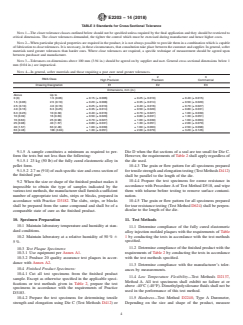
8.3 Tolerance for cross-sectional dimensions of extruded
spacers for structural thermoplastic glazing shall be ASTM
products shall be as described by Table 3 unless otherwise
E2203, CH6S1; compression seal gaskets shall be ASTM
agreed upon between the purchaser and the supplier.
E2203, CH7S2; and setting blocks shall be ASTM E2203,
8.4 Tolerances for squareness and flatness are not included
CH9.These examples are not to be construed as a specification
in this specification, due to the difficulty of establishing
for these items.
meaningful limits to satisfy a wide variety of applications.
These tolerances should be as agreed upon between the
6. Materials and Manufacture
supplier and purchaser.
6.1 The products described by this specification shall be a
8.5 The color of the seal shall be as agreed upon by the
preformed extrusion manufactured from a thermoplastic vul-
purchaser and the producer or supplier.
canizate (TPV). This TPV shall be classified under Classifica-
tion System D2000.
8.6 The finished product shall be free of defects in work-
6.1.1 The pre-compounded TPV shall be manufactured
manship.
fromvirginpolymer,thatwhenproperlyextruded,willresultin
8.6.1 Surface imperfections are acceptable provided they
an elastomer that will comply with this specification.
are less than 3 mm (0.125 in.) in diameter and less than 5 % of
6.2 The compound in its final shape shall be free of visible the depth of the cross-sectional thickness.
internal porosity, surface defects, and dimensional irregulari-
8.6.2 Defects in the extrusion shall consist of the following:
ties that affect serviceability and durability. 8.6.2.1 Holes greater than 8.6.1,
8.6.2.2 Air bubbles greater than 8.6.1, and
6.3 Unless otherwise specified, the compound color shall be
8.6.2.3 Pans not conforming to 8.1.
black. If colors other than black are specified, the compound in
the color specified shall also meet the requirements of this
9. Sampling
specification.
9.1 Samples for testing to the requirements of this specifi-
7. Requirements
cation shall be taken from the finished product wherever
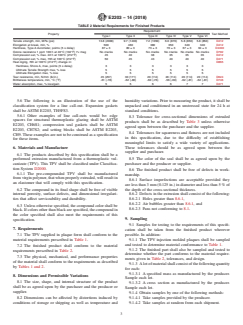
7.1 The TPV supplied in plaque form shall conform to the possible. In addition:
material requirements prescribed in Table 1. 9.1.1 The TPV injection molded plaques shall be sampled
and tested to determine material conformance to Table 1.
7.2 The finished product shall conform to the material
9.1.2 The finished part shall also be sampled and tested to
requirements prescribed in Table 2.
determine whether the part conforms to the material require-
7.3 The physical, mechanical, and performance properties
ments given in Table 2, tolerances, and design.
of the material shall conform to the requirements as described
9.1.3 Alotofmaterialshallconsistofthefollowingquantity
by Tables 1 and 2.
for each:
9.1.3.1 A specified mass as manufactured by the producer.
8. Dimensions and Permissible Variations
Sample each lot.
8.1 The size, shape, and internal structure of the product
9.1.3.2 A cross section as manufactured by the producer.
shall be as agreed upon by the purchaser and the producer or
Sample each lot.
supplier.
9.1.4 Obtain samples by one of the following methods:
9.1.4.1 Take samples provided by the producer.
8.2 Dimensions can be affected by distortions induced by
conditions of storage or shipping as well as temperature and 9.1.4.2 Take samples at random from each shipment.
E2203 − 14 (2018)
TABLE 3 Standards for Cross Sectional Tolerance
NOTE 1—The closer tolerance classes outlined below should not be specified unless required by the final application and they should be restricted to
critical dimensions. The closer tolerances demanded, the tighter the control which must be exercised during manufacture and hence higher costs.
NOTE 2—When particular physical properties are required in the product, it is not always possible to provide them in a combination which is capable
of fabrication to close tolerances. It is necessary, in these circumstances, that consultation take place betwee
...