


ASTM D5847-02(2020)
(Practice)Standard Practice for Writing Quality Control Specifications for Standard Test Methods for Water Analysis
Standard Practice for Writing Quality Control Specifications for Standard Test Methods for Water Analysis
SIGNIFICANCE AND USE
5.1 In order to be certain that the end user of analytical results obtained from using an ASTM Committee D19 test method can be confident that the values have been obtained through a competent application of the test method, a demonstration of the proficiency of the analytical system must be performed. Appropriate proficiency is demonstrated by achievement of performance criteria derived from results of the test method collaborative study. The QC measures specified in this practice must be included in each ASTM test method, as applicable, to ensure the quality of measurements.
5.2 In order for users of D19 test methods to achieve consistently valid results, a minimum level of QC must be performed. This minimum level of QC is stipulated in this practice and by the task groups developing D19 test methods. If the specific requirements outlined in this practice are not applicable to the test method, alternative QC must be defined in the test method.
SCOPE
1.1 This practice provides specific, mandatory requirements for incorporating quality control (QC) procedures into all test methods under the jurisdiction of Committee D19.
1.2 ASTM has adopted the following:
Policy on implementation of requirements for a quality control section in standard test methods generated by Committee D19 on Water.
GENERAL—By July 29, 1998, or at the next reapproval or revision, whichever is later, every D19 Standard Test Method shall contain a QC section that is in full compliance with the requirements of this practice.
NEW COLLABORATIVE TESTING—As of July 29, 1998, each collaborative study design shall include a QC section as part of the method to be tested. Prior to approval of the study design, the Results Advisor shall ascertain the appropriateness of the QC section in meeting the requirements of this practice and Practice D2777, and shall advise the designer of the study of any changes needed to fulfill the requirements of these practices. Before a collaborative study may be conducted, approval of the study design by the Results Advisor must be obtained.
OLDER VALIDATED METHODS—Standard test methods that were validated using Practices D2777 – 77, D2777 – 86, or D2777 – 94, when balloted for reapproval or revision, shall contain a QC section based upon the best information from the historical record. Where appropriate, information derived from the record of the collaborative study shall be utilized for this purpose. The introduction of the QC section into these standard test methods shall not be construed as a requirement for a new collaborative study, though the Subcommittee may opt for such a study. Any information available regarding QC or precision/bias testing shall be included in the appropriate sections of the published test method.
1.3 Required QC sections in all applicable test methods are intended to achieve two goals. First, users of Committee D19 test methods will be able to demonstrate a minimum competency in the performance of these test methods by comparison with collaborative study data. Second, all users of test methods will be required to perform a minimum level of QC as part of proper implementation of these test methods to ensure ongoing competency.
1.4 This practice contains the primary requirements for QC of a specific test method. In many cases, it may be desirable to implement additional QC requirements to assure the desired quality of data.
1.5 The specific requirements in this practice may not be applicable to all test methods. These requirements may vary depending on the type of test method used as well as the analyte being determined and the sample matrix being analyzed. See Explanation 1 in Appendix X1.
1.5.1 If there are compelling reasons why any of the specific QC requirements listed in this practice are not applicable to a specific test method, these reasons must be do...
General Information
Buy Standard


Standards Content (Sample)
NOTICE: This standard has either been superseded and replaced by a new version or withdrawn.
Contact ASTM International (www.astm.org) for the latest information
Designation:D5847 −02 (Reapproved 2020)
Standard Practice for
Writing Quality Control Specifications for Standard Test
Methods for Water Analysis
This standard is issued under the fixed designation D5847; the number immediately following the designation indicates the year of
original adoption or, in the case of revision, the year of last revision. A number in parentheses indicates the year of last reapproval. A
superscript epsilon (´) indicates an editorial change since the last revision or reapproval.
1. Scope 1.4 This practice contains the primary requirements for QC
of a specific test method. In many cases, it may be desirable to
1.1 This practice provides specific, mandatory requirements
implement additional QC requirements to assure the desired
for incorporating quality control (QC) procedures into all test
quality of data.
methods under the jurisdiction of Committee D19.
1.2 ASTM has adopted the following: 1.5 The specific requirements in this practice may not be
applicable to all test methods. These requirements may vary
Policy on implementation of requirements for a quality control
section in standard test methods generated by Committee D19
depending on the type of test method used as well as the
on Water.
analyte being determined and the sample matrix being ana-
GENERAL—By July 29, 1998, or at the next reapproval or revision,
lyzed. See Explanation 1 in Appendix X1.
whichever is later, every D19 Standard Test Method shall contain a
1.5.1 Iftherearecompellingreasonswhyanyofthespecific
QC section that is in full compliance with the requirements of this
practice.
QC requirements listed in this practice are not applicable to a
specific test method, these reasons must be documented in the
NEW COLLABORATIVE TESTING—As of July 29, 1998, each
collaborative study design shall include a QC section as part of the
QC section of the test method.
method to be tested. Prior to approval of the study design, the
1.5.2 With the approval of Committee D19 on the recom-
Results Advisor shall ascertain the appropriateness of the QC
section in meeting the requirements of this practice and Practice
mendation of the D19 Results Advisor and the Technical
D2777, and shall advise the designer of the study of any changes
OperationssectionoftheExecutiveSubcommittee,astatement
needed to fulfill the requirements of these practices. Before a collab-
orative study may be conducted, approval of the study design by the giving the compelling reasons why compliance with all or
Results Advisor must be obtained.
specificpointsofthispracticecannotbeachievedwillmeetthe
requirements of both ASTM and this practice.
OLDER VALIDATED METHODS—Standard test methods that were
validated using Practices D2777 – 77, D2777 – 86, or D2777 – 94,
1.5.3 Test methods developed prior to the approval of this
when balloted for reapproval or revision, shall contain a QC section
practice with a QC section that meet the requirements of
based upon the best information from the historical record. Where
appropriate, information derived from the record of the collaborative
Practice D5789 are considered in compliance with this prac-
study shall be utilized for this purpose. The introduction of the QC
tice.
section into these standard test methods shall not be construed as a
requirement for a new collaborative study, though the Subcommittee
1.6 This practice is for use with quantitative test methods
may opt for such a study. Any information available regarding QC or
precision/bias testing shall be included in the appropriate sections of
and may not be applicable to qualitative test methods.
the published test method.
1.7 Presently, this practice is applicable primarily to chemi-
1.3 Required QC sections in all applicable test methods are
cal test methods. It is intended that, in future revisions, the
intended to achieve two goals. First, users of Committee D19
test methods will be able to demonstrate a minimum compe- practice will be expanded to include other test methods such as
tency in the performance of these test methods by comparison microbiological test methods.
with collaborative study data. Second, all users of test methods
1.8 The values stated in SI units are to be regarded as
will be required to perform a minimum level of QC as part of
standard. No other units of measurement are included in this
proper implementation of these test methods to ensure ongoing
standard.
competency.
1.9 This international standard was developed in accor-
dance with internationally recognized principles on standard-
This practice is under the jurisdiction ofASTM Committee D19 on Water and
is the direct responsibility of Subcommittee D19.02 on Quality Systems, ization established in the Decision on Principles for the
Specification, and Statistics.
Development of International Standards, Guides and Recom-
Current edition approved May 1, 2020. Published May 2020. Originally
mendations issued by the World Trade Organization Technical
approved in 1999. Last previous edition approved in 2012 as D5847 – 02 (2012).
DOI: 10.1520/D5847-02R20. Barriers to Trade (TBT) Committee.
Copyright © ASTM International, 100 Barr Harbor Drive, PO Box C700, West Conshohocken, PA 19428-2959. United States
D5847−02 (2020)
2. Referenced Documents 3.2.5 laboratory control sample (LCS), n—a sample of
2 known concentration and composition that is taken through the
2.1 ASTM Standards:
entire test method to determine whether the analytical system
D1129 Terminology Relating to Water
is in control. The LCS must be prepared in the appropriate
D1141 Practice for the Preparation of Substitute Ocean
ASTM-grade water from a material that sufficiently challenges
Water
thetest.SeeExplanation3inAppendixX1.TheLCScanbean
D1193 Specification for Reagent Water
IRM obtained from an outside source or prepared in-house
D2777 Practice for Determination of Precision and Bias of
from materials of known purity and concentration.
Applicable Test Methods of Committee D19 on Water
Alternatively, the LCS may be a real sample of the matrix that
D3648 Practices for the Measurement of Radioactivity
is typically analyzed and which has been fully characterized.
D3856 Guide for Management Systems in Laboratories
3.2.5.1 Discussion—The LCS may also be commonly
Engaged in Analysis of Water
known as a “quality control sample” or an “ongoing precision
D4375 Practice for Basic Statistics in Committee D19 on
and recovery sample” (OPR).
Water (Withdrawn 2018)
D5789 Practice for Writing Quality Control Specifications
3.2.6 matrix spike (MS), n—addition of a known concentra-
for Standard Test Methods for Organic Constituents
tion of analyte to a routine sample representing a specific
(Withdrawn 2002)
matrix for the purpose of evaluating interference from matrix
D5810 Guide for Spiking into Aqueous Samples
components. (See Guide D5810.)
3.2.7 method blank (blank), n—reagent water (see Specifi-
3. Terminology
cation D1193) either known to be free of the constituent(s) of
3.1 Definitions:
interest or containing only a low, known concentration of the
3.1.1 For definitions of terms used in this standard, refer to
constituent(s)ofinterestnotexceedingfivetimestheestimated
Terminology D1129 and Practice D4375.
detection limit.
3.2 Definitions of Terms Specific to This Standard:
3.2.7.1 Discussion—The purpose of analysis of the method
3.2.1 batch, n—a set (group) of samples analyzed such that
blank is to confirm that the reagents or analytical system, or
results of analysis of the QC samples (laboratory control
both, do not contribute a measurable amount of the constitu-
sample, method blank, matrix spike, and duplicate or matrix
ent(s) of interest during analysis of routine samples or, if they
spike duplicate) analyzed with the batch are indicative of the
do, to determine what the contribution is.
quality of the results of analysis of samples in the batch. The
3.2.8 quantitation limit, n—the minimum concentration or
number of samples in the batch is defined by the task group
amount of a substance that can be measured with a known
responsible for the test method. See 6.4 and Explanation 2 in
degree of confidence.
Appendix X1.
3.2.9 sample pretreatment (pretreatment), n—any handling,
3.2.1.1 Discussion—When results from tests of any of the
QC samples associated with batch the fail to meet the perfor- manipulation or treatment of a sample prior to subjecting the
sample to the analysis. Examples are filtration, digestion,
mance criteria, the test method should define the appropriate
corrective action. To make such a response valid, the batch dilution, pH adjustment and extraction.
mustbeconstructedinsuchawayastoassurethatallvariables
affecting the batch will affect all samples in the batch in a 4. Summary of Practice
statistically equivalent manner.
4.1 This practice provides the writer of a test method in
3.2.2 calibration standard, n—a solution containing the
Committee D19 specific steps to be included in the QC section
analyte of interest at a known concentration either purchased
of the test method. A QC section is required in all applicable
from an external source or prepared in-house from materials of
standard test methods that mandates use of the following QC
known purity or concentration, or both, and used to calibrate
measures:
the measurement system.
4.1.1 Periodiccalibrationorverificationofcalibrationofthe
3.2.3 detection limit, n—the minimum concentration or
measurement system,
amount of a substance that can be detected with a known
4.1.2 Initial demonstration of laboratory capability,
degree of confidence.
4.1.3 Analysis of at least one blank per batch,
3.2.4 independent reference material (IRM), n—a material
4.1.4 Analysis of at least one LCS per batch,
of known purity and concentration obtained either from the
4.1.5 Analysis of at least one MS per batch, where
NationalInstituteofStandardsandTechnology(NIST)orother
applicable, and
reputable supplier. The IRM shall be obtained from a different
4.1.6 Periodic analysis of an IRM.
lot of material than is used for calibration.
4.2 Duplicate analysis of at least one sample per batch is
suggested. The duplicate analysis may be of a sample or of a
For referenced ASTM standards, visit the ASTM website, www.astm.org, or
matrix spike (matrix spike duplicate; MSD). See Explanation 4
contact ASTM Customer Service at service@astm.org. For Annual Book of ASTM
in Appendix X1.
Standards volume information, refer to the standard’s Document Summary page on
the ASTM website.
4.3 If there are valid reasons why any of the above QC
The last approved version of this historical standard is referenced on
www.astm.org. requirements are inapplicable to a specific test method (see
D5847−02 (2020)
Section 1), these reasons must be documented in the QC 6.1.4 The operational principles and characteristics of de-
section of the test method. See 1.5 and Explanation 1 in tectors used for radioactivity measurements are somewhat
Appendix X1. different from those of instruments used for measurements of
chemical and physical properties. Therefore, authors ofASTM
5. Significance and Use
test methods for radioactivity measurements should provide
5.1 In order to be certain that the end user of analytical
specific guidance within each test method, practice, or guide
results obtained from using an ASTM Committee D19 test
relative to applicable QC program requirements. Guidance on
method can be confident that the values have been obtained
the preparation and use of instrument tolerance and control
through a competent application of the test method, a demon-
charts can be found in Practices D3648, Guide D3856, and
stration of the proficiency of the analytical system must be
ASTM MNL 7.
performed. Appropriate proficiency is demonstrated by
6.2 Calibration and Calibration Verification—For test
achievementofperformancecriteriaderivedfromresultsofthe
methods requiring calibration of instrumentation, an appropri-
test method collaborative study. The QC measures specified in
ate number of calibration standards must be analyzed during
this practice must be included in each ASTM test method, as
daythatananalysisisperformedtoconfirmthattheinstrument
applicable, to ensure the quality of measurements.
is properly set up and required sensitivity is being obtained.
5.2 In order for users of D19 test methods to achieve
The actual number of standards required will depend on the
consistently valid results, a minimum level of QC must be
requirements of the test method. For tests run infrequently,
performed. This minimum level of QC is stipulated in this
analysis of a single calibration standard to verify an existing
practice and by the task groups developing D19 test methods.
calibration curve may suffice. For tests run frequently, it may
If the specific requirements outlined in this practice are not
be necessary to intersperse verification standards with test
applicabletothetestmethod,alternativeQCmustbedefinedin
samples. Under these circumstances, it is recommended that a
the test method.
different standard concentration be used each time calibration
is verified. Raw data (absorbance, intensity, etc.) should be
6. Requirements for QC Specifications in Test Methods
compared to data generated in the past under the same
6.1 Every test method must have a quality control (QC)
conditions and should fall within three standard deviations of
section. Listed below are requirements applicable to nearly all
the mean value found in the past based on the pooled single
chemical test methods and that must be followed to ensure that
operator precision. Alternatively, data should be compared to
thetestmethodisincontrolandtovalidatetheaccuracyofdata
the calibration limits stated in the test method or should be
generated for a specific matrix.
developed from collaborative study data. Refer to Guide
6.1.1 The measures that must be specified in the QC section
D3856 and Practices D3648 for further information on calibra-
of test methods and the reasons for these measures are as
tion checks.
follows:
6.2.1 For titrimetric test methods, titrants must be standard-
6.1.1.1 Calibrationandcalibrationverificationarenecessary
ized on a scheduled basis against a standard solution of known
to ensure that the analytical system is properly calibrated
concentration in duplicate or triplicate. The average normality/
during the period that the analysis is performed.
molarity is then used for calculation. The frequency of stan-
6.1.1.2 An initial demonstration of laboratory capability is
dardization is left to the judgment of the writer of the test
necessary to prevent errors as a result of unfamiliarity with the
method and should be based on the stability of the titrant.
test.
6.2.2 An alternate calibration procedure, such as an internal
6.1.1.3 Analy
...
This document is not an ASTM standard and is intended only to provide the user of an ASTM standard an indication of what changes have been made to the previous version. Because
it may not be technically possible to adequately depict all changes accurately, ASTM recommends that users consult prior editions as appropriate. In all cases only the current version
of the standard as published by ASTM is to be considered the official document.
Designation: D5847 − 02 (Reapproved 2012) D5847 − 02 (Reapproved 2020)
Standard Practice for
Writing Quality Control Specifications for Standard Test
Methods for Water Analysis
This standard is issued under the fixed designation D5847; the number immediately following the designation indicates the year of
original adoption or, in the case of revision, the year of last revision. A number in parentheses indicates the year of last reapproval. A
superscript epsilon (´) indicates an editorial change since the last revision or reapproval.
1. Scope
1.1 This practice provides specific, mandatory requirements for incorporating quality control (QC) procedures into all test
methods under the jurisdiction of Committee D-19.D19.
1.2 ASTM has adopted the following:
This practice is under the jurisdiction of ASTM Committee D19 on Water and is the direct responsibility of Subcommittee D19.02 on Quality Systems, Specification,
and Statistics.
Current edition approved June 15, 2012May 1, 2020. Published June 2012May 2020. Originally approved in 1999. Last previous edition approved in 20072012 as
D5847 – 02 (2012).(2007). DOI: 10.1520/D5847-02R12.10.1520/D5847-02R20.
Copyright © ASTM International, 100 Barr Harbor Drive, PO Box C700, West Conshohocken, PA 19428-2959. United States
D5847 − 02 (2020)
Policy on implementation of requirements for a quality control
section in standard test methods generated by Committee D-19
on Water.
Policy on implementation of requirements for a quality control
section in standard test methods generated by Committee D19
on Water.
GENERAL—By July 29, 1998, or at the next reapproval or revision,
whichever is later, every D-19 Standard Test Method shall contain a
QC section that is in full compliance with the requirements of this
practice.
GENERAL—By July 29, 1998, or at the next reapproval or revision,
whichever is later, every D19 Standard Test Method shall contain a
QC section that is in full compliance with the requirements of this
practice.
NEW COLLABORATIVE TESTING—As of July 29, 1998, each
collaborative study design shall include a QC section as part of the
method to be tested. Prior to approval of the study design, the
Results Advisor shall ascertain the appropriateness of the QC
section in meeting the requirements of this Practice and Practice
D2777, and shall advise the designer of the study of any changes
needed to fulfill the requirements of these practices. Before a collab-
orative study may be conducted, approval of the study design by the
Results Advisor must be obtained.
NEW COLLABORATIVE TESTING—As of July 29, 1998, each col-
laborative study design shall include a QC section as part of the
method to be tested. Prior to approval of the study design, the Re-
sults Advisor shall ascertain the appropriateness of the QC section in
meeting the requirements of this practice and Practice D2777, and
shall advise the designer of the study of any changes needed to ful-
fill the requirements of these practices. Before a collaborative study
may be conducted, approval of the study design by the Results Advi-
sor must be obtained.
OLDER VALIDATED METHODS—Standard test methods that were
validated using D-2777-77, D-2777-86, or D-2777-94, when ballotted
for reapproval or revision, shall contain a QC section based upon the
best information from the historical record. Where appropriate, infor-
mation derived from the record of the collaborative study shall be
utilized for this purpose. The introduction of the QC section into
these standard test methods shall not be construed as a requirement
for a new collaborative study, though the Subcommittee may opt for
such a study. Any information available regarding QC or precision/
bias testing shall be included in the appropriate sections of the pub-
lished method.
OLDER VALIDATED METHODS—Standard test methods that were
validated using Practices D2777 – 77, D2777 – 86, or D2777 – 94,
when balloted for reapproval or revision, shall contain a QC section
based upon the best information from the historical record. Where
appropriate, information derived from the record of the collaborative
study shall be utilized for this purpose. The introduction of the QC
section into these standard test methods shall not be construed as a
requirement for a new collaborative study, though the Subcommittee
may opt for such a study. Any information available regarding QC or
precision/bias testing shall be included in the appropriate sections of
the published test method.
1.3 Required QC sections in all applicable test methods are intended to achieve two goals. First, users of Committee D-19D19
test methods will be able to demonstrate a minimum competency in the performance of these test methods by comparison with
collaborative study data. Second, all users of test methods will be required to perform a minimum level of QC as part of proper
implementation of these test methods to ensure ongoing competency.
1.4 This practice contains the primary requirements for QC of a specific test method. In many cases, it may be desirable to
implement additional QC requirements to assure the desired quality of data.
1.5 The specific requirements in this practice may not be applicable to all test methods. These requirements may vary depending
on the type of test method used as well as the analyte being determined and the sample matrix being analyzed. See Explanation
1 in Appendix X1.
1.5.1 If there are compelling reasons why any of the specific QC requirements listed in this practice are not applicable to a
specific test method, these reasons must be documented in the QC section of the test method.
1.5.2 With the approval of Committee D-19D19 on the recommendation of the D-19D19 Results Advisor and the Technical
Operations section of the Executive Subcommittee, a statement giving the compelling reasons why compliance with all or specific
points of this practice cannot be achieved will meet the requirements of both ASTM and this practice.
D5847 − 02 (2020)
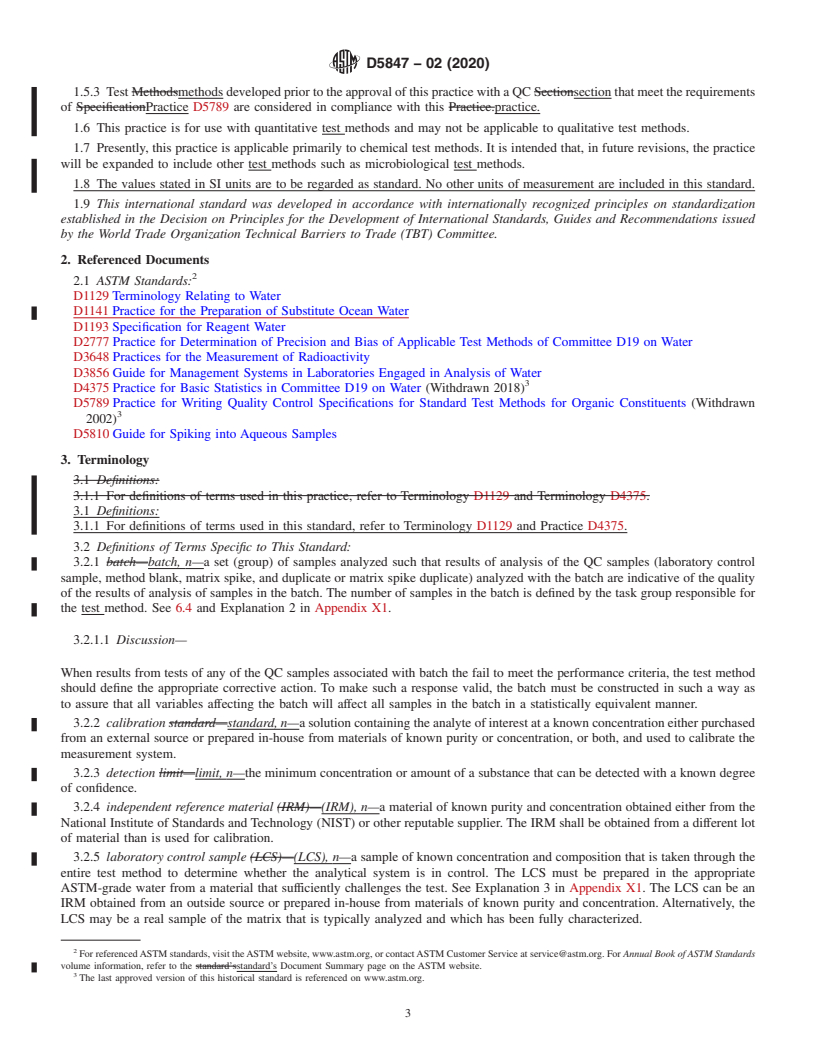
1.5.3 Test Methodsmethods developed prior to the approval of this practice with a QC Sectionsection that meet the requirements
of SpecificationPractice D5789 are considered in compliance with this Practice.practice.
1.6 This practice is for use with quantitative test methods and may not be applicable to qualitative test methods.
1.7 Presently, this practice is applicable primarily to chemical test methods. It is intended that, in future revisions, the practice
will be expanded to include other test methods such as microbiological test methods.
1.8 The values stated in SI units are to be regarded as standard. No other units of measurement are included in this standard.
1.9 This international standard was developed in accordance with internationally recognized principles on standardization
established in the Decision on Principles for the Development of International Standards, Guides and Recommendations issued
by the World Trade Organization Technical Barriers to Trade (TBT) Committee.
2. Referenced Documents
2.1 ASTM Standards:
D1129 Terminology Relating to Water
D1141 Practice for the Preparation of Substitute Ocean Water
D1193 Specification for Reagent Water
D2777 Practice for Determination of Precision and Bias of Applicable Test Methods of Committee D19 on Water
D3648 Practices for the Measurement of Radioactivity
D3856 Guide for Management Systems in Laboratories Engaged in Analysis of Water
D4375 Practice for Basic Statistics in Committee D19 on Water (Withdrawn 2018)
D5789 Practice for Writing Quality Control Specifications for Standard Test Methods for Organic Constituents (Withdrawn
2002)
D5810 Guide for Spiking into Aqueous Samples
3. Terminology
3.1 Definitions:
3.1.1 For definitions of terms used in this practice, refer to Terminology D1129 and Terminology D4375.
3.1 Definitions:
3.1.1 For definitions of terms used in this standard, refer to Terminology D1129 and Practice D4375.
3.2 Definitions of Terms Specific to This Standard:
3.2.1 batch—batch, n—a set (group) of samples analyzed such that results of analysis of the QC samples (laboratory control
sample, method blank, matrix spike, and duplicate or matrix spike duplicate) analyzed with the batch are indicative of the quality
of the results of analysis of samples in the batch. The number of samples in the batch is defined by the task group responsible for
the test method. See 6.4 and Explanation 2 in Appendix X1.
3.2.1.1 Discussion—
When results from tests of any of the QC samples associated with batch the fail to meet the performance criteria, the test method
should define the appropriate corrective action. To make such a response valid, the batch must be constructed in such a way as
to assure that all variables affecting the batch will affect all samples in the batch in a statistically equivalent manner.
3.2.2 calibration standard—standard, n—a solution containing the analyte of interest at a known concentration either purchased
from an external source or prepared in-house from materials of known purity or concentration, or both, and used to calibrate the
measurement system.
3.2.3 detection limit—limit, n—the minimum concentration or amount of a substance that can be detected with a known degree
of confidence.
3.2.4 independent reference material (IRM)—(IRM), n—a material of known purity and concentration obtained either from the
National Institute of Standards and Technology (NIST) or other reputable supplier. The IRM shall be obtained from a different lot
of material than is used for calibration.
3.2.5 laboratory control sample (LCS)—(LCS), n—a sample of known concentration and composition that is taken through the
entire test method to determine whether the analytical system is in control. The LCS must be prepared in the appropriate
ASTM-grade water from a material that sufficiently challenges the test. See Explanation 3 in Appendix X1. The LCS can be an
IRM obtained from an outside source or prepared in-house from materials of known purity and concentration. Alternatively, the
LCS may be a real sample of the matrix that is typically analyzed and which has been fully characterized.
For referenced ASTM standards, visit the ASTM website, www.astm.org, or contact ASTM Customer Service at service@astm.org. For Annual Book of ASTM Standards
volume information, refer to the standard’sstandard’s Document Summary page on the ASTM website.
The last approved version of this historical standard is referenced on www.astm.org.
D5847 − 02 (2020)
3.2.5.1 Discussion—
The LCS may also be commonly known as a “quality control sample” or an “ongoing precision and recovery sample” (OPR).
3.2.6 matrix spike (MS)—(MS), n—addition of a known concentration of analyte to a routine sample representing a specific
matrix for the purpose of evaluating interference from matrix components. (See Guide D5810.)
3.2.7 method blank (blank)—(blank), n—reagent water (see Specification D1193) either known to be free of the constituent(s)
of interest or containing only a low, known concentration of the constituent(s) of interest not exceeding five times the estimated
detection limit.
3.2.7.1 Discussion—
The purpose of analysis of the method blank is to confirm that the reagents or analytical system, or both, do not contribute a
measurable amount of the constituent(s) of interest during analysis of routine samples or, if they do, to determine what the
contribution is.
3.2.8 quantitation limit—limit, n—the minimum concentration or amount of a substance that can be measured with a known
degree of confidence.
3.2.9 sample pretreatment (pretreatment)—(pretreatment), n—any handling, manipulation or treatment of a sample prior to
subjecting the sample to the analysis. Examples are filtration, digestion, dilution, pH adjustment and extraction.
4. Summary of Practice
4.1 This practice provides the writer of a test method in Committee D19 specific steps to be included in the QC section of the
test method. A QC section is required in all applicable standard test methods that mandates use of the following QC measures:
4.1.1 Periodic calibration or verification of calibration of the measurement system,
4.1.2 Initial demonstration of laboratory capability,
4.1.3 Analysis of at least one blank per batch,
4.1.4 Analysis of at least one LCS per batch,
4.1.5 Analysis of at least one MS per batch, where applicable, and
4.1.6 Periodic analysis of an IRM.
4.2 Duplicate analysis of at least one sample per batch is suggested. The duplicate analysis may be of a sample or of a matrix
spike (matrix spike duplicate; MSD). See Explanation 4 in Appendix X1.
4.3 If there are valid reasons why any of the above QC requirements are inapplicable to a specific test method (see Section 1),
these reasons must be documented in the QC section of the test method. See 1.5 and Explanation 1 in Appendix X1.
5. Significance and Use
5.1 In order to be certain that the end user of analytical results obtained from using an ASTM Committee D-19D19 test method
can be confident that the values have been obtained through a competent application of the test method, a demonstration of the
proficiency of the analytical system must be performed. Appropriate proficiency is demonstrated by achievement of performance
criteria derived from results of the test method collaborative study. The QC measures specified in this practice must be included
in each ASTM test method, as applicable, to ensure the quality of measurements.
5.2 In order for users of D-19D19 test methods to achieve consistently valid results, a minimum level of QC must be performed.
This minimum level of QC is stipulated in this practice and by the taskgroups task groups developing D-19D19 test methods. If
the specific requirements outlined in this practice are not applicable to the test method, alternative QC must be defined in the test
method.
6. Requirements for QC Specifications in Test Methods
6.1 Every test method must have a quality control (QC) section. Listed below are requirements applicable to nearly all chemical
test methods and that must be followed to ensure that the test method is in control and to validate the accuracy of data generated
for a specific matrix.
6.1.1 The measures that must be specified in the QC section of test methods and the reasons for these measures are as follows:
6.1.1.1 Calibration and calibration verification are necessary to ensure that the analytical system is properly calibrated during
the
...
Questions, Comments and Discussion
Ask us and Technical Secretary will try to provide an answer. You can facilitate discussion about the standard in here.