


ASTM A973/A973M-07(2012)
(Specification)Standard Specification for Grade 100 Alloy Steel Chain
Standard Specification for Grade 100 Alloy Steel Chain
ABSTRACT
This specification covers Grade 100 heat-treated alloy steel chain for such applications as slings, lifting assemblies, and load binding. The alloy steel shall be fully killed and have an austenitic grain size of five or finer. The steel shall be made by the electric welding or gas welding process. After welding, alloy steel chain shall be heat treated before applying the proof test. Heat and product analysis shall be performed and shall meet the required chemical composition in carbon, phosphorus, and sulfur. All chain shall be tested to at least the proof load and breaking force test specimen shall consist of a length from the lot containing at least the number of links. All chain shall be in the quenched and tempered condition before the elongation is measured.
SCOPE
1.1 This specification covers Grade 100 heat-treated alloy steel chain for such applications as slings, lifting assemblies, and load binding.Note 1—This specification does not cover alloy steel chain for pocket wheel applications.
1.2 This specification is a performance standard for Grade 100 chain used between −20 and 400°F [−29 and 205°C]. The chain manufacturer should be contacted for use at temperatures outside this range.
1.3 The Grade designation is 1/10 of the minimum breaking strength in newtons divided by two times the nominal cross-sectional area of the chain in square millimetres.
1.4 The values stated in either SI units or in other units shall be regarded separately as standard. The values stated in each system may not be exact equivalents; therefore, each system must be used independently of the other, without combining values in any way.
General Information
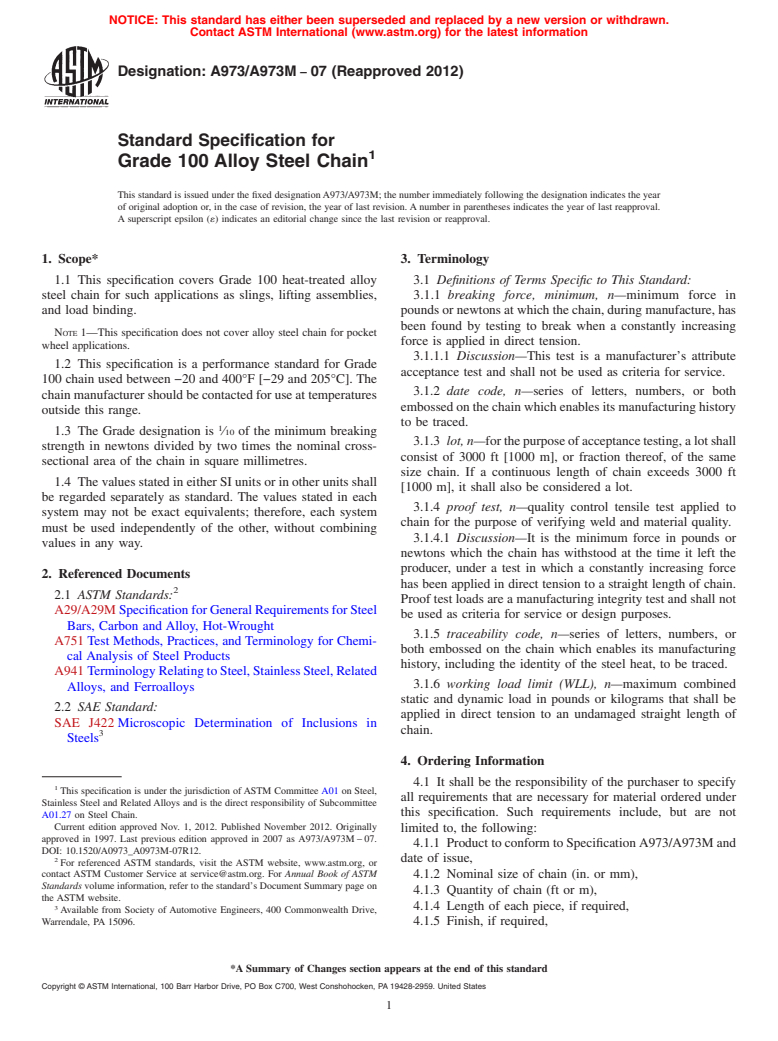

Standards Content (Sample)
NOTICE: This standard has either been superseded and replaced by a new version or withdrawn.
Contact ASTM International (www.astm.org) for the latest information
Designation:A973/A973M −07 (Reapproved 2012)
Standard Specification for
Grade 100 Alloy Steel Chain
This standard is issued under the fixed designationA973/A973M; the number immediately following the designation indicates the year
of original adoption or, in the case of revision, the year of last revision.Anumber in parentheses indicates the year of last reapproval.
A superscript epsilon (´) indicates an editorial change since the last revision or reapproval.
1. Scope* 3. Terminology
1.1 This specification covers Grade 100 heat-treated alloy 3.1 Definitions of Terms Specific to This Standard:
steel chain for such applications as slings, lifting assemblies, 3.1.1 breaking force, minimum, n—minimum force in
and load binding.
poundsornewtonsatwhichthechain,duringmanufacture,has
been found by testing to break when a constantly increasing
NOTE 1—This specification does not cover alloy steel chain for pocket
force is applied in direct tension.
wheel applications.
3.1.1.1 Discussion—This test is a manufacturer’s attribute
1.2 This specification is a performance standard for Grade
acceptance test and shall not be used as criteria for service.
100 chain used between −20 and 400°F [−29 and 205°C]. The
3.1.2 date code, n—series of letters, numbers, or both
chainmanufacturershouldbecontactedforuseattemperatures
embossedonthechainwhichenablesitsmanufacturinghistory
outside this range.
to be traced.
1.3 The Grade designation is ⁄10 of the minimum breaking
3.1.3 lot,n—forthepurposeofacceptancetesting,alotshall
strength in newtons divided by two times the nominal cross-
consist of 3000 ft [1000 m], or fraction thereof, of the same
sectional area of the chain in square millimetres.
size chain. If a continuous length of chain exceeds 3000 ft
1.4 ThevaluesstatedineitherSIunitsorinotherunitsshall
[1000 m], it shall also be considered a lot.
be regarded separately as standard. The values stated in each
3.1.4 proof test, n—quality control tensile test applied to
system may not be exact equivalents; therefore, each system
chain for the purpose of verifying weld and material quality.
must be used independently of the other, without combining
3.1.4.1 Discussion—It is the minimum force in pounds or
values in any way.
newtons which the chain has withstood at the time it left the
producer, under a test in which a constantly increasing force
2. Referenced Documents
has been applied in direct tension to a straight length of chain.
2.1 ASTM Standards:
Proof test loads are a manufacturing integrity test and shall not
A29/A29MSpecificationforGeneralRequirementsforSteel
be used as criteria for service or design purposes.
Bars, Carbon and Alloy, Hot-Wrought
3.1.5 traceability code, n—series of letters, numbers, or
A751Test Methods, Practices, and Terminology for Chemi-
both embossed on the chain which enables its manufacturing
cal Analysis of Steel Products
history, including the identity of the steel heat, to be traced.
A941TerminologyRelatingtoSteel,StainlessSteel,Related
3.1.6 working load limit (WLL), n—maximum combined
Alloys, and Ferroalloys
static and dynamic load in pounds or kilograms that shall be
2.2 SAE Standard:
applied in direct tension to an undamaged straight length of
SAE J422 Microscopic Determination of Inclusions in
chain.
Steels
4. Ordering Information
4.1 It shall be the responsibility of the purchaser to specify
This specification is under the jurisdiction ofASTM Committee A01 on Steel,
all requirements that are necessary for material ordered under
Stainless Steel and RelatedAlloys and is the direct responsibility of Subcommittee
this specification. Such requirements include, but are not
A01.27 on Steel Chain.
Current edition approved Nov. 1, 2012. Published November 2012. Originally
limited to, the following:
approved in 1997. Last previous edition approved in 2007 as A973/A973M–07.
4.1.1 ProducttoconformtoSpecificationA973/A973Mand
DOI: 10.1520/A0973_A0973M-07R12.
2 date of issue,
For referenced ASTM standards, visit the ASTM website, www.astm.org, or
contact ASTM Customer Service at service@astm.org. For Annual Book of ASTM
4.1.2 Nominal size of chain (in. or mm),
Standards volume information, refer to the standard’s Document Summary page on
4.1.3 Quantity of chain (ft or m),
the ASTM website.
3 4.1.4 Length of each piece, if required,
Available from Society of Automotive Engineers, 400 Commonwealth Drive,
Warrendale, PA 15096. 4.1.5 Finish, if required,
*A Summary of Changes section appears at the end of this standard
Copyright © ASTM International, 100 Barr Harbor Drive, PO Box C700, West Conshohocken, PA 19428-2959. United States
A973/A973M−07 (2012)
TABLE 2 Mechanical Test Sample Length Requirements
4.1.6 Certification of test(s), if required,
4.1.7 Acceptance of inspection by purchaser, if required, Minimum Number of
Size of Chain Links
and
in Test Specimen
4.1.8 Supplementary requirements, if required.
⁄32 in. [5.5 mm] 9
Larger than ⁄32 in. [5.5 mm] but less 7
5. Manufacturing 3
than ⁄4 in. [20.0 mm]
⁄4 in. [20.0 mm] and larger 3
5.1 Melting Process—The alloy steel shall be fully killed
and have an austenitic grain size of five or finer.
5.2 Welding Process—Alloysteelchainmaybemadebythe
7.2.1 Fixtures for securing chain in a testing machine shall
electric welding or gas welding process.
be properly designed to support securely the shoulder of the
5.3 Heat Treatment—After welding, alloy steel chain shall link (see Note 2). The opening in the fixture shall not be more
be heat treated before applying the proof test. Heat treatment
than 125% of the stock diameter being tested. Links engaged
shall include quenching and tempering as defined by Termi- in the testing fixture shall not be considered part of the test
nology A941.
specimen.
NOTE 2—“U” bolts of the same or larger diameter and the same or
6. Material Requirements
greater strength may be used to secure the chain to the jaws of the testing
machine.
6.1 Heat Analysis—The selection and amounts of the alloy-
ing elements in the steel are left to the judgment of the
7.2.2 Test results shall meet or exceed the minimum break-
individual chain manufacturer provided the steel meets the
ingforcevaluesgiveninTable1fortheappropriatesizechain.
following criteria: carbon = 0.35% max; phosphorous =
7.3 Elongation:
0.025% max; sulfur = 0.025% max. The following elements
7.3.1 All chain must be in the quenched and tempered
must all be present in alloying amounts, nickel (0.40% min),
condition before the elongation is measured.
chromium (0.40% min), and molybdenum (0.15% min). The
7.3.2 The elongation test specimen shall consist of a length
steel shall have oxide and silicate inclusions of 4 or less as
from the lot containing at least the number of links in Table 2.
determined by SAE J422.
7.3.3 A positive load not exceeding 10% of the proof test
6.2 Product Analysis—The steel used may be analyzed by
shall be applied for determining the original gage length
the purchaser and shall conform to the requirements of 6.1
(L{0}).
subject to the product analysis tolerances specified in Specifi-
7.3.4 The elongation shall be based on the total extension at
cation A29/A29M.Test samples may be taken from rods, bars,
fracture. This is expressed as a percentage of the change in
or finished chain. Samples for analysis shall be so taken as to
length (∆ L) divided by the original gage length (L{0}). The
represent the full cross section of the specimen.
elongation may be determined by the equation below or by
autographic recorder or side scale.
6.3 TestMethods,Practices,andTerminologyA751shallbe
used for referee purposes.
Elongation ~%! 5 $∆L/L$0%% 3100
where:
7. Mechanical Requirements
∆L = test specimen final length at fracture – test specimen
7.1 Proof Test—Allchainshallbetestedtoatleasttheproof
original gage length ( L{0}), and
loadprescribedinTable1fortheappropriatesizechain.When
L{0} = originalgagelength(sumortheinsidelengthsofthe
so tested it shall withstand these loads without loss of chain
test chain links, not counting the fixture links, or as
integrity. Links or chain seg
...
Questions, Comments and Discussion
Ask us and Technical Secretary will try to provide an answer. You can facilitate discussion about the standard in here.