

ASTM E3190-19
(Practice)Standard Practice for Preparation of Fixed Radiological/Surrogate Contamination on Porous Test Coupon Surfaces for Evaluation of Decontamination Techniques
General Information
- Abstract
SIGNIFICANCE AND USE
5.1 This practice provides a protocol to compare different decontamination technologies with a standard contamination mechanism and analysis of subsequent decontamination factors/efficiencies.
5.2 The use of this practice provides for the preparation of test coupons with a known amount of fixed radiological or surrogate contaminant on the surface.
5.3 A standard test coupon is described and a list of potential spray equipment, contaminants, and contaminating solutions is provided within the procedure.
5.4 This method describes a contamination simulation process that meets the requirements of testing performed (previously) by the U.S. Department of Energy and U.S. Environmental Protection Agency.
SCOPE
1.1 This practice is intended to provide a basis for simulating radioactive contamination consistent with processes used to evaluate decontamination. The methods described provide a “fixed-type” radiological or surrogate contamination on porous surfaces; these methods provide a surface contamination that is not easily removed by brushing or flushing with water.
1.2 The values stated in SI units are to be regarded as standard. The values given in parentheses after SI units are provided for information only and are not considered standard.
1.3 This practice is intended to be practiced primarily on porous surfaces such as concrete, marble, granite, grout, brick, tile, asphalt, vinyl floor tile, latex painted gypsum wall board and polyurethane coated wood. Preparation of non-porous substrates is not addressed, although similar methodology may be used.
1.4 The chemical simulants shall not include nor generate toxic by-products as defined by U.S. Occupational Safety and Health Administration (OSHA) during preparation, application, or removal under normal conditions. A Safety Data Sheet shall be provided so that appropriate PPE can be selected.
1.5 This standard does not purport to address all of the safety concerns, if any, associated with its use. It is the responsibility of the user of this standard to establish appropriate safety, health, and environmental practices and determine the applicability of regulatory limitations prior to use.
1.6 This international standard was developed in accordance with internationally recognized principles on standardization established in the Decision on Principles for the Development of International Standards, Guides and Recommendations issued by the World Trade Organization Technical Barriers to Trade (TBT) Committee.
- Status
- Published
- Publication Date
- 31-Mar-2019
- Technical Committee
- E10 - Nuclear Technology and Applications
Overview
ASTM E3190-19 is the international standard practice for preparing fixed radiological or surrogate contamination on porous test coupon surfaces to evaluate decontamination techniques. Published by ASTM International, this practice offers a standardized protocol for creating consistent, fixed contamination scenarios on porous materials such as concrete, brick, tile, marble, granite, grout, asphalt, vinyl floor tile, latex painted gypsum wallboard, and polyurethane-coated wood. The primary value of ASTM E3190-19 lies in its ability to support comparative evaluations of various decontamination technologies using uniform and reproducible contamination methods and analysis protocols.
Key Topics
- Simulation of Fixed Contamination: Defines methods to apply either radiological or non-radiological surrogate contaminants to create durable, fixed-type contamination that cannot be easily removed by brushing or water flushing.
- Test Coupon Preparation: Specifies preparation of porous test coupons-including surface cleaning, labeling, and side treatment-to ensure consistency and prevent cross-contamination.
- Contamination Application Methods:
- Spray coating: Using specialized spray devices for even distribution.
- Stippling: Using pipettes to place measured drops uniformly on the test surface.
- Contaminant Selection: Supports use of both radionuclides and non-radioactive chemical surrogates, ensuring simulants do not produce hazardous by-products as defined by OSHA standards.
- Analytical Techniques: Recommends quantitative analysis, such as gamma spectrometry or x-ray fluorescence (XRF), to measure contamination levels before and after decontamination.
- Decontamination Factor Calculation: Provides a basis for calculating removal efficiency and decontamination factor, offering a quantitative assessment of decontamination technologies.
Applications
ASTM E3190-19 is crucial for organizations involved in nuclear facility operations, environmental remediation, and emergency preparedness. Key applications include:
- Decontamination Technology Evaluation: Enables side-by-side comparison of decontamination methods by providing a standardized contaminated surface, making test results more reliable and reproducible.
- Regulatory Compliance and Research: Supports studies and regulatory reviews conducted by agencies such as the U.S. Department of Energy (DOE) and the U.S. Environmental Protection Agency (EPA).
- Training and Method Validation: Offers a consistent contamination setup for validating new cleaning agents, technologies, and protocols, and serves as a training tool for decontamination procedures.
- Product Development: Assists manufacturers and developers of decontamination products in demonstrating performance using standard test conditions.
- Operational Readiness and Safety: Ensures safety by mandating safety data sheets, personal protective equipment (PPE) use, and adherence to health and environmental best practices.
Related Standards
For comprehensive testing and evaluation in radiological decontamination, ASTM E3190-19 references or aligns with several other standards:
- ASTM D1193 - Specification for Reagent Water: Requirements for water purity used in contaminant solution preparation.
- ASTM E3104 - Specification for Strippable & Removable Coatings to Mitigate Spread of Radioactive Contamination.
- ASTM E3105 - Specification for Permanent Coatings Used to Mitigate Spread of Radioactive Contamination.
Other related documents include guidelines and quality assurance plans developed in collaboration with government agencies and technical reports from EPA.
Keywords: ASTM E3190-19, fixed radiological contamination, porous surfaces, test coupons, decontamination techniques, contamination simulation, standard practice, nuclear facility, environmental remediation, surrogate contaminants, analytical methods, regulatory compliance, PPE, decontamination factor, removal efficiency.
Relations
- Effective Date
- 01-Mar-2006
- Effective Date
- 10-Feb-1999
- Effective Date
- 10-Feb-1999
- Effective Date
- 01-Apr-2019
Get Certified
Connect with accredited certification bodies for this standard

BSMI (Bureau of Standards, Metrology and Inspection)
Taiwan's standards and inspection authority.
Sponsored listings
Frequently Asked Questions
ASTM E3190-19 is a standard published by ASTM International. Its full title is "Standard Practice for Preparation of Fixed Radiological/Surrogate Contamination on Porous Test Coupon Surfaces for Evaluation of Decontamination Techniques". This standard covers: SIGNIFICANCE AND USE 5.1 This practice provides a protocol to compare different decontamination technologies with a standard contamination mechanism and analysis of subsequent decontamination factors/efficiencies. 5.2 The use of this practice provides for the preparation of test coupons with a known amount of fixed radiological or surrogate contaminant on the surface. 5.3 A standard test coupon is described and a list of potential spray equipment, contaminants, and contaminating solutions is provided within the procedure. 5.4 This method describes a contamination simulation process that meets the requirements of testing performed (previously) by the U.S. Department of Energy and U.S. Environmental Protection Agency. SCOPE 1.1 This practice is intended to provide a basis for simulating radioactive contamination consistent with processes used to evaluate decontamination. The methods described provide a “fixed-type” radiological or surrogate contamination on porous surfaces; these methods provide a surface contamination that is not easily removed by brushing or flushing with water. 1.2 The values stated in SI units are to be regarded as standard. The values given in parentheses after SI units are provided for information only and are not considered standard. 1.3 This practice is intended to be practiced primarily on porous surfaces such as concrete, marble, granite, grout, brick, tile, asphalt, vinyl floor tile, latex painted gypsum wall board and polyurethane coated wood. Preparation of non-porous substrates is not addressed, although similar methodology may be used. 1.4 The chemical simulants shall not include nor generate toxic by-products as defined by U.S. Occupational Safety and Health Administration (OSHA) during preparation, application, or removal under normal conditions. A Safety Data Sheet shall be provided so that appropriate PPE can be selected. 1.5 This standard does not purport to address all of the safety concerns, if any, associated with its use. It is the responsibility of the user of this standard to establish appropriate safety, health, and environmental practices and determine the applicability of regulatory limitations prior to use. 1.6 This international standard was developed in accordance with internationally recognized principles on standardization established in the Decision on Principles for the Development of International Standards, Guides and Recommendations issued by the World Trade Organization Technical Barriers to Trade (TBT) Committee.
SIGNIFICANCE AND USE 5.1 This practice provides a protocol to compare different decontamination technologies with a standard contamination mechanism and analysis of subsequent decontamination factors/efficiencies. 5.2 The use of this practice provides for the preparation of test coupons with a known amount of fixed radiological or surrogate contaminant on the surface. 5.3 A standard test coupon is described and a list of potential spray equipment, contaminants, and contaminating solutions is provided within the procedure. 5.4 This method describes a contamination simulation process that meets the requirements of testing performed (previously) by the U.S. Department of Energy and U.S. Environmental Protection Agency. SCOPE 1.1 This practice is intended to provide a basis for simulating radioactive contamination consistent with processes used to evaluate decontamination. The methods described provide a “fixed-type” radiological or surrogate contamination on porous surfaces; these methods provide a surface contamination that is not easily removed by brushing or flushing with water. 1.2 The values stated in SI units are to be regarded as standard. The values given in parentheses after SI units are provided for information only and are not considered standard. 1.3 This practice is intended to be practiced primarily on porous surfaces such as concrete, marble, granite, grout, brick, tile, asphalt, vinyl floor tile, latex painted gypsum wall board and polyurethane coated wood. Preparation of non-porous substrates is not addressed, although similar methodology may be used. 1.4 The chemical simulants shall not include nor generate toxic by-products as defined by U.S. Occupational Safety and Health Administration (OSHA) during preparation, application, or removal under normal conditions. A Safety Data Sheet shall be provided so that appropriate PPE can be selected. 1.5 This standard does not purport to address all of the safety concerns, if any, associated with its use. It is the responsibility of the user of this standard to establish appropriate safety, health, and environmental practices and determine the applicability of regulatory limitations prior to use. 1.6 This international standard was developed in accordance with internationally recognized principles on standardization established in the Decision on Principles for the Development of International Standards, Guides and Recommendations issued by the World Trade Organization Technical Barriers to Trade (TBT) Committee.
ASTM E3190-19 is classified under the following ICS (International Classification for Standards) categories: 17.040.20 - Properties of surfaces. The ICS classification helps identify the subject area and facilitates finding related standards.
ASTM E3190-19 has the following relationships with other standards: It is inter standard links to ASTM D1193-06, ASTM D1193-99e1, ASTM D1193-99, ASTM E3283-21. Understanding these relationships helps ensure you are using the most current and applicable version of the standard.
ASTM E3190-19 is available in PDF format for immediate download after purchase. The document can be added to your cart and obtained through the secure checkout process. Digital delivery ensures instant access to the complete standard document.
Standards Content (Sample)
This international standard was developed in accordance with internationally recognized principles on standardization established in the Decision on Principles for the
Development of International Standards, Guides and Recommendations issued by the World Trade Organization Technical Barriers to Trade (TBT) Committee.
Designation: E3190 − 19
Standard Practice for
Preparation of Fixed Radiological/Surrogate Contamination
on Porous Test Coupon Surfaces for Evaluation of
Decontamination Techniques
This standard is issued under the fixed designation E3190; the number immediately following the designation indicates the year of
original adoption or, in the case of revision, the year of last revision. A number in parentheses indicates the year of last reapproval. A
superscript epsilon (´) indicates an editorial change since the last revision or reapproval.
1. Scope 2. Referenced Documents
1.1 This practice is intended to provide a basis for simulat- 2.1 ASTM Standards:
ingradioactivecontaminationconsistentwithprocessesusedto D1193 Specification for Reagent Water
evaluate decontamination. The methods described provide a
3. Terminology
“fixed-type” radiological or surrogate contamination on porous
surfaces; these methods provide a surface contamination that is
3.1 Definitions:
not easily removed by brushing or flushing with water.
3.1.1 contamination, n—radioactive material in an un-
wanted location.
1.2 The values stated in SI units are to be regarded as
standard. The values given in parentheses after SI units are
3.1.2 deminimus sample result, n—a result below which no
provided for information only and are not considered standard.
further effort of quantification is required, typically about 2 %
of the original contamination value. For fixed contamination
1.3 This practice is intended to be practiced primarily on
calculations, the 2 % of the original contamination value is
porous surfaces such as concrete, marble, granite, grout, brick,
adequate due to the difficulty in achieving such results and the
tile, asphalt, vinyl floor tile, latex painted gypsum wall board
essential nature of the precision of the method.
and polyurethane coated wood. Preparation of non-porous
substrates is not addressed, although similar methodology may
3.1.3 fixed contamination, n—contamination that is not
be used.
removable by brushing or flushing it away with water at
pressures below 0.689 MPa (100 psi).
1.4 The chemical simulants shall not include nor generate
toxic by-products as defined by U.S. Occupational Safety and 3.1.4 loose contamination, n—contamination that is remov-
Health Administration (OSHA) during preparation, able by brushing or flushing it away with water at pressures
application,orremovalundernormalconditions.ASafetyData below 0.689 MPa (100 psi).
Sheet shall be provided so that appropriate PPE can be
3.1.5 non-radiological surrogate, n—a material used in
selected.
place of a radioactive material to evaluate a proscribed method
1.5 This standard does not purport to address all of the withoutnecessitatingtheuseofactualradioactivematerial.For
safety concerns, if any, associated with its use. It is the use of surrogates, the user shall ensure adequate chemical,
responsibility of the user of this standard to establish appro- mechanical, etc. mimicry of the proposed radiological material
priate safety, health, and environmental practices and deter- the surrogate is replacing.
mine the applicability of regulatory limitations prior to use.
3.1.6 personal protective equipment (PPE), n—refers to the
1.6 This international standard was developed in accor-
protective clothing, helmets, goggles, or other garments or
dance with internationally recognized principles on standard-
equipmentdesignedtoprotectthewearer’sbodyfrominjuryor
ization established in the Decision on Principles for the
contamination.The hazards addressed by protective equipment
Development of International Standards, Guides and Recom-
may include physical, electrical, heat, chemicals, and radio-
mendations issued by the World Trade Organization Technical
logical hazards.
Barriers to Trade (TBT) Committee.
3.1.7 radiological work permit (RWP), n—a written work
authorization prepared by the facility radiological control
This practice is under the jurisdiction of ASTM Committee E10 on Nuclear
Technology and Applications and is the direct responsibility of Subcommittee
E10.03 on Radiological Protection for Decontamination and Decommissioning of For referenced ASTM standards, visit the ASTM website, www.astm.org, or
Nuclear Facilities and Components. contact ASTM Customer Service at service@astm.org. For Annual Book of ASTM
Current edition approved April 1, 2019. Published May 2019. DOI: 10.1520/ Standards volume information, refer to the standard’s Document Summary page on
E3190-19 the ASTM website.
Copyright © ASTM International, 100 Barr Harbor Drive, PO Box C700, West Conshohocken, PA 19428-2959. United States
E3190 − 19
organizationthatdescribestheradiationdose,workconditions, 6. Reagents and Equipment
and contamination control measures to be used when perform-
6.1 All solutions shall be prepared with high-resistivity
ing radiological work.
water (ASTM Type I as outlined in D1193) and high purity
3.1.7.1 Discussion—The specific facilities in which this
standards.
work will be performed will define whether an RWP or
6.2 A concentrated radionuclide standard shall be procured
equivalent document will be required for performance.
for use if radiological tests are being performed (recommended
3.1.7.2 Discussion—Given the concentrations of radionu-
use). It is intended that a single contaminant be applied to a
clides used in this practice and the potential for whole-body
coupon and not to introduce multiple sources. When using
and extremity radiation dose, the facility radiological control
Cs-137, a standard (stock solution) with a concentration of
organization may require ALARA (As Low As Reasonably
about 7.4E5 becquerels per millilitre (Bq/mL) (20 uCi/mL)
Achievable) work activity planning.
will provide a good, long lasting standard. Lesser concentra-
3.1.8 simulation, n—a consistent, reproducible means for
tionsmaybeused.TherecommendedCs-137workingsolution
preparing test coupons (even those with radioactive contami-
will be about 1.48E4 Bq/mL (0.4 uCi/mL). This solution
nation).
typically has a radiation reading of about 3 mSv/h (300
mrem/h) gamma on contact and 18 mSv/h (1800 mrem/h)
3.1.9 stippling, n—a method of placing drops of solution
beta/gamma on contact. The body field at 30 cm is typically
(which may be measured by an adjustable pipette) onto the
below 0.5 mSv/h (50 mrem/h). Coupons prepared using these
surface of a coupon to provide a uniform distribution of
solutions exhibit a dose rate of about 0.2 mSv/h (20 mrem/h).
contaminant on the surface.
When using Sr-85 and Co-60, similar activity concentrations
may be suitable, but for Am-243 an activity concentration of
4. Summary of Practice
1.48E2 Bq/mL (0.004 uCi/mL) may be more suitable given it
4.1 For all methods described herein, a solution of the
is an alpha emitter. These solutions are slightly acidic, unbuf-
contaminant is applied to a pre-cleaned test coupon and dried
fered.
under ambient conditions. The amount of contaminant neces-
6.3 Non-radioactive contaminant solutions of cesium chlo-
sary to be applied to the test coupon shall be determined in
ride and zirconium chloride have been used at a concentration
advance of preparing coupons.
of about 1 mg/mL.
4.2 Two methods of applying contamination to the coupon
6.4 A special “spray device” created using two syringes is
are discussed:
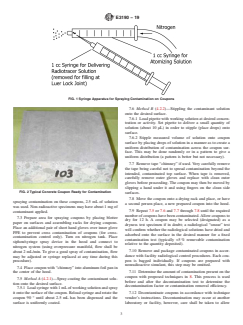
shown in Fig. 1. This apparatus may be prepared well in
4.2.1 Method A: Spray coating the contaminant solution
advance. Exercise caution making this device as the needle on
onto the desired surface.
thedeliverysyringeisquitesharp(thoughnotremovedoncein
4.2.2 Method B: Stippling the contaminant solution onto the
place)andshallbecompletelycontainedwithinthebodyofthe
desired surface.
spraying syringe (and held in place with tape).
4.3 The protocol for determining the decontamination
factor/efficiency is provided when the coupons are utilized to
7. Procedure for Contaminating Materials
test a decontamination method. The detection method (for
7.1 Prepare coupons for contamination:
example, gamma analysis or x-ray fluorescence) provides data
7.1.1 Wash coupons with high-resistivity water (ASTM
for this evaluation. The use of gamma emitting radionuclides
Type I as outlined in D1193) or brush them lightly to remove
and a specific geometry high-purity germanium detector mea-
dust. Some coupons may not require additional preparation
surement process is recommended.
beyond brushing and the application of a label.
5. Significance and Use
NOTE1—Ifusingaconcretecoupon(Fig.2),thetopsurfaceofconcrete
coupons is the only one used in these tests.The top surface has a “floated”
5.1 This practice provides a protocol to compare different
texture and did not contact the plywood mold/form.
decontamination technologies with a standard contamination
7.1.2 Label coupons with unique identifiers.
mechanism and analysis of subsequent decontamination
7.1.3 Coat coupon sides with polyester resin to provide a
factors/efficiencies.
surface that may be more easily decontaminated (if necessary).
5.2 The use of this practice provides for the preparation of
7.1.4 Prior to placing them in the hood where spraying
test coupons with a known amount of fixed radiological
...