

ASTM F2562/F2562M-24
(Specification)Specification for Steel Reinforced Thermoplastic Ribbed Pipe and Fittings for Non-Pressure Drainage and Sewerage
General Information
- Abstract
ABSTRACT
This specification covers requirements and test methods for materials, dimensions, workmanship, impact resistance, pipe stiffness, flattening, buckling, tensile strength of seam, joint systems, perforations, and markings for steel reinforced thermoplastic pipe and fittings. The steel reinforced, spirally formed thermoplastic pipes are intended for use in underground applications where soil provides support for their flexible walls. These pipes will be used for gravity flow and non-pressure applications, such as storm sewers, sanitary sewers, industrial waste applications and drainage pipes. The pipe dimensions, pipe stiffness, flattening, impact resistance, tensile strength of seam, and joint tightness shall be tested to meet the requirements prescribed.
SCOPE
1.1 This specification covers requirements and test methods for materials, dimensions, workmanship, impact resistance, pipe stiffness, flattening, buckling, tensile strength of seam, joint systems, perforations, and markings for steel reinforced thermoplastic pipe and fittings of nominal sizes 8 in. [200 mm] through 120 in. [3000 mm]. The steel reinforced, spirally formed thermoplastic pipes governed by this standard are intended for use in underground applications where soil provides support for their flexible walls. These pipes will be used for gravity flow and non-pressure applications, such as storm sewers, sanitary sewers, industrial waste applications and drainage pipes.
1.2 Units—The values stated in either inch-pound units or SI units are to be regarded separately as standard. Within the text the SI units are shown in brackets. The values stated in each system may not be exact equivalents: therefore, each system shall be used independently of the other. Combining values from the two systems may result in non-conformance with the standard.
1.3 This standard does not purport to address all of the safety concerns, if any, associated with its use. It is the responsibility of the user of this standard to establish appropriate safety, health, and environmental practices and determine the applicability of regulatory limitations prior to use.
1.4 There is no similar or equivalent ISO standard.
1.5 This international standard was developed in accordance with internationally recognized principles on standardization established in the Decision on Principles for the Development of International Standards, Guides and Recommendations issued by the World Trade Organization Technical Barriers to Trade (TBT) Committee.
- Status
- Published
- Publication Date
- 14-Feb-2024
- Technical Committee
- F17 - Plastic Piping Systems
- Drafting Committee
- F17.62 - Sewer
Buy Documents
ASTM F2562/F2562M-24 - Specification for Steel Reinforced Thermoplastic Ribbed Pipe and Fittings for Non-Pressure Drainage and Sewerage
REDLINE ASTM F2562/F2562M-24 - Specification for Steel Reinforced Thermoplastic Ribbed Pipe and Fittings for Non-Pressure Drainage and Sewerage
Overview
ASTM F2562/F2562M-24, developed by ASTM International, specifies the requirements for steel reinforced thermoplastic ribbed pipes and fittings for non-pressure drainage and sewerage systems. This standard covers materials, manufacturing, test methods, dimensions, impact resistance, pipe stiffness, flattening, buckling, seam tensile strength, joint systems, perforations, and markings. Pipes covered by this specification are primarily intended for underground, gravity-flow, and non-pressure applications where soil supports the flexible walls. Common applications include storm sewers, sanitary sewers, industrial waste lines, and general drainage systems.
The standard applies to pipe and fittings in nominal sizes from 8 inches [200 mm] up to 120 inches [3000 mm], providing a robust guideline for manufacturing, installation, and quality assurance within infrastructure projects.
Key Topics
Material Requirements
- Specifies the use of steel (cold-rolled, hot-rolled, coated, or galvanized) and high-density polyethylene (HDPE) that meet strict classification and physical property standards.
- Use of clean rework material from the same manufacturer's production is permitted if performance criteria are maintained.
Design and Construction
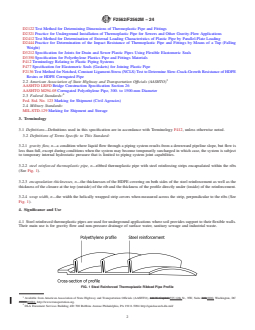
- Steel reinforced, spirally formed thermoplastic pipes with ribbed profiles encapsulate the steel within HDPE to provide strength and flexibility.
- Pipes are tested for properties including wall thickness, inside diameter, encapsulation thickness, and joint integrity.
Performance and Testing
- Stipulates procedures for impact resistance, flattening, buckling, and seam tensile strength tests.
- Joint systems are classified as soil-tight, silt-tight, or watertight and must demonstrate conformance through pressure testing according to application.
Marking and Certification
- Markings must remain legible after installation and must include size, class, manufacturer, and joint type.
- Manufacturers must provide certification upon request that all supplied products conform to ASTM F2562/F2562M-24.
Applications
The steel reinforced thermoplastic ribbed pipes and fittings as specified in ASTM F2562/F2562M-24 are widely used in:
- Storm Sewer Systems: Reliable management of surface water in urban and rural environments.
- Sanitary Sewer Lines: Conveyance of wastewater, requiring watertight joints to prevent contamination.
- Industrial Waste Disposal: Durable construction suitable for non-pressurized industrial waste conveyance, subject to approval based on specific conditions and compatibility.
- General Drainage: Agricultural, roadway, and site drainage systems where flexibility and strength are essential for underground installations.
These pipes are favored for their high stiffness, corrosion resistance, ease of handling, and compatibility with various soil and installation conditions.
Related Standards
The standard references several key documents to ensure comprehensive performance and compatibility, including:
- ASTM A1008/A1008M, A1011/A1011M, and A653/A653M: Specifications for the steel materials used in the reinforcement.
- ASTM D3350: Classification for polyethylene pipe materials.
- ASTM D2412: Test method for external loading characteristics of plastic pipes.
- ASTM D2444: Test method for impact resistance.
- ASTM D2321: Installation practices for thermoplastic pipes in gravity-flow applications.
- ASTM D3212 & F477: Standards for joint performance and gasket specifications.
- AASHTO M294: Related requirements for corrugated polyethylene pipe.
Practical Value
Adhering to ASTM F2562/F2562M-24 ensures the selection and installation of steel reinforced thermoplastic pipes that deliver long-term structural reliability in drainage and sewerage infrastructure, with standardized methods for evaluation, quality control, and traceability. It provides confidence for engineers, contractors, and asset owners, increasing project durability, safety, and regulatory compliance. There is no ISO equivalent to this standard, making it a definitive reference for these product types in international and domestic projects.
Keywords: steel reinforced thermoplastic pipe, drainage pipe standard, ASTM F2562, sewerage pipe, storm sewer pipe, ribbed polyethylene pipe, pipe fitting standards, gravity-flow pipe systems.
Relations
- Effective Date
- 15-Feb-2024
Buy Documents
ASTM F2562/F2562M-24 - Specification for Steel Reinforced Thermoplastic Ribbed Pipe and Fittings for Non-Pressure Drainage and Sewerage
REDLINE ASTM F2562/F2562M-24 - Specification for Steel Reinforced Thermoplastic Ribbed Pipe and Fittings for Non-Pressure Drainage and Sewerage
Get Certified
Connect with accredited certification bodies for this standard

Zavod za gradbeništvo Slovenije (ZAG) - Inšpekcija
ZAG inspection body for construction products, structures, and materials.
Sponsored listings
Frequently Asked Questions
ASTM F2562/F2562M-24 is a technical specification published by ASTM International. Its full title is "Specification for Steel Reinforced Thermoplastic Ribbed Pipe and Fittings for Non-Pressure Drainage and Sewerage". This standard covers: ABSTRACT This specification covers requirements and test methods for materials, dimensions, workmanship, impact resistance, pipe stiffness, flattening, buckling, tensile strength of seam, joint systems, perforations, and markings for steel reinforced thermoplastic pipe and fittings. The steel reinforced, spirally formed thermoplastic pipes are intended for use in underground applications where soil provides support for their flexible walls. These pipes will be used for gravity flow and non-pressure applications, such as storm sewers, sanitary sewers, industrial waste applications and drainage pipes. The pipe dimensions, pipe stiffness, flattening, impact resistance, tensile strength of seam, and joint tightness shall be tested to meet the requirements prescribed. SCOPE 1.1 This specification covers requirements and test methods for materials, dimensions, workmanship, impact resistance, pipe stiffness, flattening, buckling, tensile strength of seam, joint systems, perforations, and markings for steel reinforced thermoplastic pipe and fittings of nominal sizes 8 in. [200 mm] through 120 in. [3000 mm]. The steel reinforced, spirally formed thermoplastic pipes governed by this standard are intended for use in underground applications where soil provides support for their flexible walls. These pipes will be used for gravity flow and non-pressure applications, such as storm sewers, sanitary sewers, industrial waste applications and drainage pipes. 1.2 Units—The values stated in either inch-pound units or SI units are to be regarded separately as standard. Within the text the SI units are shown in brackets. The values stated in each system may not be exact equivalents: therefore, each system shall be used independently of the other. Combining values from the two systems may result in non-conformance with the standard. 1.3 This standard does not purport to address all of the safety concerns, if any, associated with its use. It is the responsibility of the user of this standard to establish appropriate safety, health, and environmental practices and determine the applicability of regulatory limitations prior to use. 1.4 There is no similar or equivalent ISO standard. 1.5 This international standard was developed in accordance with internationally recognized principles on standardization established in the Decision on Principles for the Development of International Standards, Guides and Recommendations issued by the World Trade Organization Technical Barriers to Trade (TBT) Committee.
ABSTRACT This specification covers requirements and test methods for materials, dimensions, workmanship, impact resistance, pipe stiffness, flattening, buckling, tensile strength of seam, joint systems, perforations, and markings for steel reinforced thermoplastic pipe and fittings. The steel reinforced, spirally formed thermoplastic pipes are intended for use in underground applications where soil provides support for their flexible walls. These pipes will be used for gravity flow and non-pressure applications, such as storm sewers, sanitary sewers, industrial waste applications and drainage pipes. The pipe dimensions, pipe stiffness, flattening, impact resistance, tensile strength of seam, and joint tightness shall be tested to meet the requirements prescribed. SCOPE 1.1 This specification covers requirements and test methods for materials, dimensions, workmanship, impact resistance, pipe stiffness, flattening, buckling, tensile strength of seam, joint systems, perforations, and markings for steel reinforced thermoplastic pipe and fittings of nominal sizes 8 in. [200 mm] through 120 in. [3000 mm]. The steel reinforced, spirally formed thermoplastic pipes governed by this standard are intended for use in underground applications where soil provides support for their flexible walls. These pipes will be used for gravity flow and non-pressure applications, such as storm sewers, sanitary sewers, industrial waste applications and drainage pipes. 1.2 Units—The values stated in either inch-pound units or SI units are to be regarded separately as standard. Within the text the SI units are shown in brackets. The values stated in each system may not be exact equivalents: therefore, each system shall be used independently of the other. Combining values from the two systems may result in non-conformance with the standard. 1.3 This standard does not purport to address all of the safety concerns, if any, associated with its use. It is the responsibility of the user of this standard to establish appropriate safety, health, and environmental practices and determine the applicability of regulatory limitations prior to use. 1.4 There is no similar or equivalent ISO standard. 1.5 This international standard was developed in accordance with internationally recognized principles on standardization established in the Decision on Principles for the Development of International Standards, Guides and Recommendations issued by the World Trade Organization Technical Barriers to Trade (TBT) Committee.
ASTM F2562/F2562M-24 is classified under the following ICS (International Classification for Standards) categories: 93.030 - External sewage systems. The ICS classification helps identify the subject area and facilitates finding related standards.
ASTM F2562/F2562M-24 has the following relationships with other standards: It is inter standard links to ASTM F2562/F2562M-15(2019). Understanding these relationships helps ensure you are using the most current and applicable version of the standard.
ASTM F2562/F2562M-24 is available in PDF format for immediate download after purchase. The document can be added to your cart and obtained through the secure checkout process. Digital delivery ensures instant access to the complete standard document.
Standards Content (Sample)
This international standard was developed in accordance with internationally recognized principles on standardization established in the Decision on Principles for the
Development of International Standards, Guides and Recommendations issued by the World Trade Organization Technical Barriers to Trade (TBT) Committee.
Designation: F2562/F2562M − 24
Specification for
Steel Reinforced Thermoplastic Ribbed Pipe and Fittings for
Non-Pressure Drainage and Sewerage
This standard is issued under the fixed designation F2562/F2562M; the number immediately following the designation indicates the year
of original adoption or, in the case of revision, the year of last revision. A number in parentheses indicates the year of last reapproval.
A superscript epsilon (´) indicates an editorial change since the last revision or reapproval.
1. Scope* 2. Referenced Documents
1.1 This specification covers requirements and test methods 2.1 ASTM Standards:
for materials, dimensions, workmanship, impact resistance, A1008/A1008M Specification for Steel, Sheet, Cold-Rolled,
pipe stiffness, flattening, buckling, tensile strength of seam, Carbon, Structural, High-Strength Low-Alloy, High-
joint systems, perforations, and markings for steel reinforced Strength Low-Alloy with Improved Formability, Required
thermoplastic pipe and fittings of nominal sizes 8 in. [200 mm] Hardness, Solution Hardened, and Bake Hardenable
through 120 in. [3000 mm]. The steel reinforced, spirally A1011/A1011M Specification for Steel, Sheet and Strip,
formed thermoplastic pipes governed by this standard are Hot-Rolled, Carbon, Structural, High-Strength Low-
intended for use in underground applications where soil pro- Alloy, High-Strength Low-Alloy with Improved
vides support for their flexible walls. These pipes will be used Formability, and Ultra-High Strength
for gravity flow and non-pressure applications, such as storm D618 Practice for Conditioning Plastics for Testing
sewers, sanitary sewers, industrial waste applications and D638 Test Method for Tensile Properties of Plastics
drainage pipes. A653/A653M Specification for Steel Sheet, Zinc-Coated
(Galvanized) or Zinc-Iron Alloy-Coated (Galvannealed)
1.2 Units—The values stated in either inch-pound units or
by the Hot-Dip Process
SI units are to be regarded separately as standard. Within the
D2122 Test Method for Determining Dimensions of Ther-
text the SI units are shown in brackets. The values stated in
moplastic Pipe and Fittings
each system may not be exact equivalents: therefore, each
D2321 Practice for Underground Installation of Thermoplas-
system shall be used independently of the other. Combining
tic Pipe for Sewers and Other Gravity-Flow Applications
values from the two systems may result in non-conformance
D2412 Test Method for Determination of External Loading
with the standard.
Characteristics of Plastic Pipe by Parallel-Plate Loading
1.3 This standard does not purport to address all of the
D2444 Practice for Determination of the Impact Resistance
safety concerns, if any, associated with its use. It is the
of Thermoplastic Pipe and Fittings by Means of a Tup
responsibility of the user of this standard to establish appro-
(Falling Weight)
priate safety, health, and environmental practices and deter-
D3212 Specification for Joints for Drain and Sewer Plastic
mine the applicability of regulatory limitations prior to use.
Pipes Using Flexible Elastomeric Seals
1.4 There is no similar or equivalent ISO standard.
D3350 Specification for Polyethylene Plastics Pipe and Fit-
1.5 This international standard was developed in accor-
tings Materials
dance with internationally recognized principles on standard-
F412 Terminology Relating to Plastic Piping Systems
ization established in the Decision on Principles for the
F477 Specification for Elastomeric Seals (Gaskets) for Join-
Development of International Standards, Guides and Recom-
ing Plastic Pipe
mendations issued by the World Trade Organization Technical
F2136 Test Method for Notched, Constant Ligament-Stress
Barriers to Trade (TBT) Committee.
(NCLS) Test to Determine Slow-Crack-Growth Resis-
tance of HDPE Resins or HDPE Corrugated Pipe
This specification is under the jurisdiction of ASTM Committee F17 on Plastic
Piping Systems and is the direct responsibility of Subcommittee F17.62 on Sewer. For referenced ASTM standards, visit the ASTM website, www.astm.org, or
Current edition approved Feb. 15, 2024. Published March 2024. Originally contact ASTM Customer Service at service@astm.org. For Annual Book of ASTM
approved in 2007. Last previous edition approved in 2019 as F2562/F2562M- Standards volume information, refer to the standard’s Document Summary page on
15(2019). DOI: 10.1520/F2562_F2562M-24. the ASTM website.
*A Summary of Changes section appears at the end of this standard
Copyright © ASTM International, 100 Barr Harbor Drive, PO Box C700, West Conshohocken, PA 19428-2959. United States
F2562/F2562M − 24
NOTE 1—Industrial waste disposal lines should be installed only upon
2.2 American Association of State Highway and Transpor-
the specific approval of the governing code, or other authority, and after
tation Offıcials (AASHTO)
determining the suitability of the product under the anticipated
AASHTO LRFD Bridge Construction Specification Section
environment, temperature, and other end-use conditions. Users should
consult the manufacturer for the required product information.
AASHTO M294-05 Corrugated Polyethylene Pipe, 300- to
4.2 This specification covers pipe products made in various
1500-mm Diameter
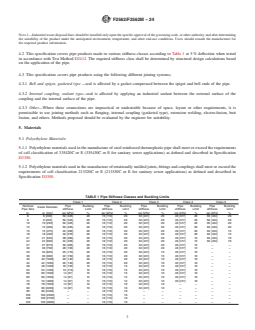
stiffness classes according to Table 1 at 5 % deflection when
2.3 Federal Standards:
tested in accordance with Test Method D2412. The required
Fed. Std. No. 123 Marking for Shipment (Civil Agencies)
stiffness class shall be determined by structural design calcu-
2.4 Military Standards:
lations based on the application of the pipe.
MIL-STD-129 Marking for Shipment and Storage
4.3 This specification covers pipe products using the fol-
3. Terminology lowing different joining systems;
4.3.1 Bell and spigot, gasketed type —seal is affected by a
3.1 Definitions—Definitions used in this specification are in
gasket compressed between the spigot and bell ends of the
accordance with Terminology F412, unless otherwise noted.
pipe.
3.2 Definitions of Terms Specific to This Standard:
4.3.2 Internal coupling, sealant type—seal is affected by
3.2.1 gravity flow, n—a condition where liquid flow through
applying an industrial sealant between the external surface of
a piping system results from a downward pipeline slope, but
the coupling and the internal surface of the pipe.
flow is less than full, except during conditions when the system
4.3.3 Other—Where these connections are impractical or
may become temporarily surcharged in which case, the system
undesirable because of space, layout or other requirements, it is
is subject to temporary internal hydrostatic pressure that is
permissible to use joining methods such as flanging, internal
limited to piping system joint capabilities.
coupling (gasketed type), extrusion welding, electro-fusion,
3.2.2 steel reinforced thermoplastic pipe, n—ribbed thermo- butt fusion, and others. Methods proposed should be evaluated
plastic pipe with steel reinforcing strips encapsulated within by the engineer for suitability.
the ribs (See Fig. 1).
5. Materials
3.2.3 encapsulation thicknesses, n—the thicknesses of the
HDPE covering on both sides of the steel reinforcement as well 5.1 Polyethylene Materials:
as the thickness of the closure at the top (outside) of the rib and 5.1.1 Polyethylene materials used in the manufacture of
the thickness of the profile directly under (inside) of the steel reinforced thermoplastic pipe shall meet or exceed the
reinforcement. requirements of cell classification of 335420C or E (335430C
or E for sanitary sewer applications) as defined and described
3.2.4 wrap width, n—the width the helically wrapped strip
in Specification D3350.
covers when measured across the strip, perpendicular to the
5.1.2 Polyethylene materials used in the manufacture of
ribs (See Fig. 1).
rotationally molded joints, fittings and couplings shall meet or
4. Significance and Use exceed the requirements of cell classification 213320C or E
(213330C or E for sanitary sewer applications) as defined and
4.1 Steel reinforced thermoplastic pipes are used for under-
described in Specification D3350.
ground applications where soil provides support to their
5.1.3 Polyethylene materials used in the manufacture of
flexible walls. Their main use is for gravity flow and non-
injection molded joints, fittings and couplings shall meet or
pressure drainage of surface water, sanitary sewage and indus-
exceed the requirements of cell classification 314420C or E
trial waste.
(314430C or E for sanitary sewer applications) as defined and
described in Specification D3350.
5.1.4 Slow crack growth resistance of the polyethylene
Available from American Association of State Highway and Transportation
Officials (AASHTO), 555 12th St., NW, Suite 1000, Washington, DC 20004, materials shall be determined by testing in accordance with
http://www.transportation.org.
Test Method F2136. The applied stress shall be 600 psi [4100
DLA Document Services Building 4/D 700 Robbins Avenue Philadelphia, PA
kPa]. The test specimens shall exceed 24 h with no failures.
19111-5094 http://quicksearch.dla.mil/
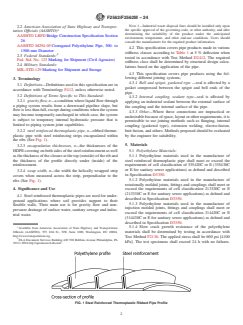
FIG. 1 Steel Reinforced Thermoplastic Ribbed Pipe Profile
F2562/F2562M − 24
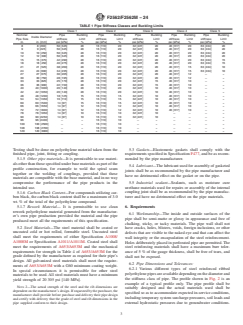
TABLE 1 Pipe Stiffness Classes and Buckling Limits
Class 1 Class 2 Class 3 Class 4 Class 5
Nominal Pipe Buckling Pipe Buckling Pipe Buckling Pipe Buckling Pipe Buckling
Inside Diameter
Pipe Size stiffness Limit stiffness Limit stiffness Limit stiffness Limit stiffness Limit
in. in. [mm] psi [kPa] % psi [kPa] % psi [kPa] % psi [kPa] % psi [kPa] %
8 8 [200] 50 [345] 20 16 [110] 20 32 [221] 20 46 [317] 20 63 [434] 20
9 9 [225] 50 [345] 20 16 [110] 20 32 [221] 20 46 [317] 20 63 [434] 20
10 10 [250] 50 [345] 20 16 [110] 20 32 [221] 20 46 [317] 20 63 [434] 20
12 12 [300] 50 [345] 20 16 [110] 20 32 [221] 20 46 [317] 20 63 [434] 20
15 15 [375] 42 [290] 20 16 [110] 20 32 [221] 20 46 [317] 20 63 [434] 15
18 18 [450] 40 [275] 20 16 [110] 20 32 [221] 20 46 [317] 20 63 [434] 15
21 21 [525] 38 [260] 20 16 [110] 20 32 [221] 20 46 [317] 15 63 [434] 10
24 24 [600] 34 [235] 20 16 [110] 20 32 [221] 20 46 [317] 15 63 [434] 10
27 27 [675] 30 [205] 20 16 [110] 20 32 [221] 20 46 [317] 12 -- --
30 30 [750] 28 [195] 20 16 [110] 20 32 [221] 20 46 [317] 12 -- --
33 33 [825] 25 [170] 20 16 [110] 20 32 [221] 15 46 [317] 10 -- --
36 36 [900] 22 [150] 20 16 [110] 20 32 [221] 15 46 [317] 10 -- --
40 40 [1000] 20 [140] 20 16 [110] 20 32 [221] 10 46 [317] 10 -- --
42 42 [1050] 20 [140] 20 16 [110] 20 32 [221] 10 46 [317] 10 -- --
48 48 [1200] 18 [125] 15 16 [110] 15 32 [221] 10 46 [317] 10 -- --
54 54 [1350] 16 [110] 15 16 [110] 15 32 [221] 10 46 [317] 10 -- --
60 60 [1500] 14 [97] 15 16 [110] 15 32 [221] 10 46 [317] 10 -- --
66 66 [1650] 14 [97] 12 16 [110] 12 32 [221] 10 46 [317] 10 -- --
72 72 [1800] 14 [97] 12 16 [110] 12 32 [221] 10 46 [317] 10 -- --
78 78 [1950] 14 [97] 10 16 [110] 10 32 [221] 10 -- -- -- --
90 90 [2250] 14 [97] 10 16 [110] 10 32 [221] 10 -- -- -- --
96 96 [2400] -- -- 16 [110] 10 -- -- -- -- -- --
100 100 [2500] -- -- 16 [110] 10 -- -- -- -- -- --
108 108 [2700] -- -- 16 [110] 10 -- -- -- -- -- --
120 120 [3000] -- -- 16 [110] 10 -- -- -- -- -- --
Testing shall be done on polyethylene material taken from the 5.3 Gaskets—Elastomeric gaskets shall comply with the
finished pipe, joint, fitting or coupling. requirements specified in Specification F477, and be as recom-
5.1.5 Other pipe materials—It is permissible to use materi- mended by the pipe manufacturer.
als other than those specified under base materials as part of the
5.4 Lubricant—The lubricant used for assembly of gasketed
profile construction, for example to weld the spiral seam
joints shall be as recommended by the pipe manufacturer and
together or the welding of couplings, provided that these
have no detrimental effect on the gasket or on the pipe.
materials are compatible with the base material, and in no way
compromise the performance of the pipe products in the 5.5 Industrial sealant—Sealants, such as moisture cure
urethane materials used for repairs or assembly of the internal
intended use.
5.1.6 Carbon Black Content—For compounds utilizing car- coupling joint shall be as recommended by the pipe manufac-
turer and have no detrimental effect on the pipe materials.
bon black, the carbon black content shall be a maximum of 3.0
wt. % of the total of the polyethylene compound.
5.1.7 Rework Material— It is permissible to use clean 6. Requirements
rework polyethylene material generated from the manufactur-
6.1 Workmanship—The inside and outside surfaces of the
er’s own pipe production provided the material and the pipe
pipe shall be semi-matte or glossy in appearance and free of
produced meet all the requirements of this specification.
chalking, sticky, or tacky materials. The pipe wall shall not
5.2 Steel Materials—The steel material shall be coated or
have cracks, holes, blisters, voids, foreign inclusions, or other
uncoated cold or hot rolled, formable steel. Uncoated steel
defects that are visible to the naked eye and that can affect the
shall meet the requirements of either Specification A1008/
wall integrity or the encapsulation of the steel reinforcement.
A1008M or Specification A1011/A1011M. Coated steel shall
Holes deliberately placed in perforated pipe are permitted. The
meet the requirements of A653/A653M and the mechanical
steel reinforcing materials shall have a maximum burr toler-
requirements for strength in Table 4 of A653/A653M for the
ance of 5 % of the gauge thickness, shall be free of tears, and
grade defined by the manufacturer as required for their pipe’s
shall not be exposed.
design. All galvanized steel materials shall meet the require-
6.2 Pipe Dimensions and Tolerances:
ments of A653/A653M with a G60 minimum coating weight.
6.2.1 Various different types of steel reinforced ribbed
In special circumstances it is permissible for other steel
polyethylene pipes are available depending on the diameter and
materials to be used. All steel materials must have a minimum
the stiffness class of pipe. The profile shown in Fig. 2 is an
yield strength of 20 305 psi [140 MPa].
example of a typical profile only. The pipe profile shall be
NOTE 2—The actual strength of the steel and the rib dimensions are
suitably designed and the actual materials used shall be
dependent on the manufacturer’s design. If requested by the purchaser, the
specified so as to accommodate expected in-service conditions,
manufacturer shall provide before purchase and delivery their pipe design
including temporary system surcharge pressures, soil loads and
and certify with delivery that the grade of steel and rib dimensions in the
pipe supplied conform to their design. external hydrostatic pressures due to groundwater conditions.
F2562/F2562M − 24
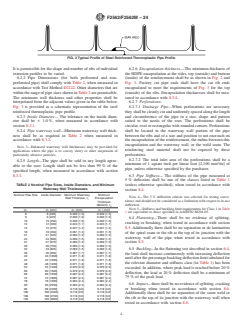
FIG. 2 Typical Profile of Steel Reinforced Thermoplastic Pipe Profile
It is permissible for the shape and number of ribs of individual 6.2.6 Encapsulation thickness,—The minimum thickness of
extrusion profiles to be varied. the HDPE encapsulation at the sides, top (outside) and bottom
6.2.2 Pipe Dimensions (for both perforated and non- (inside) of the reinforcement shall be as shown in Fig. 2 and
perforated pipe) shall comply with Table 2, when measured in Fig. 3. Factory cut pipe ends shall have the cut rib ends
accordance with Test Method D2122. Other diameters that are encapsulated to meet the requirements of Fig. 3 for the top
within the range of pipe sizes shown in Table 2 are permissible. (outside) of the ribs. Encapsulation thicknesses shall be mea-
The minimum wall thickness and other properties shall be sured in accordance with 8.3.4.
interpolated from the adjacent values given in the table below. 6.2.7 Perforations:
Fig. 3 is provided as a schematic representation of the steel 6.2.7.1 Drainage Pipe—When perforations are necessary
reinforced thermoplastic pipe profile. they shall be cleanly cut and uniformly spaced along the length
6.2.3 Inside Diameter— The tolerance on the inside diam- and circumference of the pipe in a size, shape and pattern
eter shall be 6 1.0 %, when measured in accordance with suited to the needs of the user. The perforations shall be
section 8.3.1. circular, oval or rectangular with round
...
This document is not an ASTM standard and is intended only to provide the user of an ASTM standard an indication of what changes have been made to the previous version. Because
it may not be technically possible to adequately depict all changes accurately, ASTM recommends that users consult prior editions as appropriate. In all cases only the current version
of the standard as published by ASTM is to be considered the official document.
Designation: F2562/F2562M − 15 (Reapproved 2019) F2562/F2562M − 24
Specification for
Steel Reinforced Thermoplastic Ribbed Pipe and Fittings for
Non-Pressure Drainage and Sewerage
This standard is issued under the fixed designation F2562/F2562M; the number immediately following the designation indicates the year
of original adoption or, in the case of revision, the year of last revision. A number in parentheses indicates the year of last reapproval.
A superscript epsilon (´) indicates an editorial change since the last revision or reapproval.
1. Scope Scope*
1.1 This specification covers requirements and test methods for materials, dimensions, workmanship, impact resistance, pipe
stiffness, flattening, buckling, tensile strength of seam, joint systems, perforations, and markings for steel reinforced thermoplastic
pipe and fittings of nominal sizes 8 in. [200 mm] through 120 in. [3000 mm]. The steel reinforced, spirally formed thermoplastic
pipes governed by this standard are intended for use in underground applications where soil provides support for their flexible
walls. These pipes will be used for gravity flow and non-pressure applications, such as storm sewers, sanitary sewers, industrial
waste applications and drainage pipes.
1.2 Units—The values stated in either inch-pound units or SI units are to be regarded separately as standard. Within the text the
SI units are shown in brackets. The values stated in each system may not be exact equivalents: therefore, each system shall be used
independently of the other. Combining values from the two systems may result in non-conformance with the standard.
1.3 This standard does not purport to address all of the safety concerns, if any, associated with its use. It is the responsibility
of the user of this standard to establish appropriate safety, health, and environmental practices and determine the applicability of
regulatory limitations prior to use.
1.4 There is no similar or equivalent ISO standard.
1.5 This international standard was developed in accordance with internationally recognized principles on standardization
established in the Decision on Principles for the Development of International Standards, Guides and Recommendations issued
by the World Trade Organization Technical Barriers to Trade (TBT) Committee.
2. Referenced Documents
2.1 ASTM Standards:
A1008/A1008M Specification for Steel, Sheet, Cold-Rolled, Carbon, Structural, High-Strength Low-Alloy, High-Strength
Low-Alloy with Improved Formability, Required Hardness, Solution Hardened, and Bake Hardenable
A1011/A1011M Specification for Steel, Sheet and Strip, Hot-Rolled, Carbon, Structural, High-Strength Low-Alloy, High-
Strength Low-Alloy with Improved Formability, and Ultra-High Strength
D618 Practice for Conditioning Plastics for Testing
D638 Test Method for Tensile Properties of Plastics
A653/A653M Specification for Steel Sheet, Zinc-Coated (Galvanized) or Zinc-Iron Alloy-Coated (Galvannealed) by the
Hot-Dip Process
This specification is under the jurisdiction of ASTM Committee F17 on Plastic Piping Systems and is the direct responsibility of Subcommittee F17.62 on Sewer.
Current edition approved Nov. 15, 2019Feb. 15, 2024. Published November 2019March 2024. Originally approved in 2007. Last previous edition approved in 20152019
as F2562/F2562MF2562/F2562M-15(2019).-15. DOI: 10.1520/F2562_F2562M-15R19.10.1520/F2562_F2562M-24.
For referenced ASTM standards, visit the ASTM website, www.astm.org, or contact ASTM Customer Service at service@astm.org. For Annual Book of ASTM Standards
volume information, refer to the standard’s Document Summary page on the ASTM website.
*A Summary of Changes section appears at the end of this standard
Copyright © ASTM International, 100 Barr Harbor Drive, PO Box C700, West Conshohocken, PA 19428-2959. United States
F2562/F2562M − 24
D2122 Test Method for Determining Dimensions of Thermoplastic Pipe and Fittings
D2321 Practice for Underground Installation of Thermoplastic Pipe for Sewers and Other Gravity-Flow Applications
D2412 Test Method for Determination of External Loading Characteristics of Plastic Pipe by Parallel-Plate Loading
D2444 Practice for Determination of the Impact Resistance of Thermoplastic Pipe and Fittings by Means of a Tup (Falling
Weight)
D3212 Specification for Joints for Drain and Sewer Plastic Pipes Using Flexible Elastomeric Seals
D3350 Specification for Polyethylene Plastics Pipe and Fittings Materials
F412 Terminology Relating to Plastic Piping Systems
F477 Specification for Elastomeric Seals (Gaskets) for Joining Plastic Pipe
F2136 Test Method for Notched, Constant Ligament-Stress (NCLS) Test to Determine Slow-Crack-Growth Resistance of HDPE
Resins or HDPE Corrugated Pipe
2.2 American Association of State Highway and Transportation Offıcials (AASHTO)
AASHTO LRFD Bridge Construction Specification Section 26
AASHTO M294-05 Corrugated Polyethylene Pipe, 300- to 1500-mm Diameter
2.3 Federal Standards:
Fed. Std. No. 123 Marking for Shipment (Civil Agencies)
2.4 Military Standards:
MIL-STD-129 Marking for Shipment and Storage
3. Terminology
3.1 Definitions—Definitions used in this specification are in accordance with Terminology F412, unless otherwise noted.
3.2 Definitions of Terms Specific to This Standard:
3.2.1 gravity flow, n—a condition where liquid flow through a piping system results from a downward pipeline slope, but flow is
less than full, except during conditions when the system may become temporarily surcharged in which case, the system is subject
to temporary internal hydrostatic pressure that is limited to piping system joint capabilities.
3.2.2 steel reinforced thermoplastic pipe, n—ribbed thermoplastic pipe with steel reinforcing strips encapsulated within the ribs
(See Fig. 1).
3.2.3 encapsulation thicknesses, n—the thicknesses of the HDPE covering on both sides of the steel reinforcement as well as the
thickness of the closure at the top (outside) of the rib and the thickness of the profile directly under (inside) of the reinforcement.
3.2.4 wrap width, n—the width the helically wrapped strip covers when measured across the strip, perpendicular to the ribs (See
Fig. 1).
4. Significance and Use
4.1 Steel reinforced thermoplastic pipes are used for underground applications where soil provides support to their flexible walls.
Their main use is for gravity flow and non-pressure drainage of surface water, sanitary sewage and industrial waste.
FIG. 1 Steel Reinforced Thermoplastic Ribbed Pipe Profile
Available from American Association of State Highway and Transportation Officials (AASHTO), 444 N. Capitol 555 12th St., NW, Suite 249,1000, Washington, DC
20001,20004, http://www.transportation.org.
DLA Document Services Building 4/D 700 Robbins Avenue Philadelphia, PA 19111-5094 http://quicksearch.dla.mil/
F2562/F2562M − 24
NOTE 1—Industrial waste disposal lines should be installed only upon the specific approval of the governing code, or other authority, and after determining
the suitability of the product under the anticipated environment, temperature, and other end-use conditions. Users should consult the manufacturer for
the required product information.
4.2 This specification covers pipe products made in various stiffness classes according to Table 1 at 5 % deflection when tested
in accordance with Test Method D2412. The required stiffness class shall be determined by structural design calculations based
on the application of the pipe.
4.3 This specification covers pipe products using the following different joining systems;
4.3.1 Bell and spigot, gasketed type —seal is affected by a gasket compressed between the spigot and bell ends of the pipe.
4.3.2 Internal coupling, sealant type—seal is affected by applying an industrial sealant between the external surface of the
coupling and the internal surface of the pipe.
4.3.3 Other—Where these connections are impractical or undesirable because of space, layout or other requirements, it is
permissible to use joining methods such as flanging, internal coupling (gasketed type), extrusion welding, electro-fusion, butt
fusion, and others. Methods proposed should be evaluated by the engineer for suitability.
5. Materials
5.1 Polyethylene Materials:
5.1.1 Polyethylene materials used in the manufacture of steel reinforced thermoplastic pipe shall meet or exceed the requirements
of cell classification of 335420C or E (335430C or E for sanitary sewer applications) as defined and described in Specification
D3350.
5.1.2 Polyethylene materials used in the manufacture of rotationally molded joints, fittings and couplings shall meet or exceed the
requirements of cell classification 213320C or E (213330C or E for sanitary sewer applications) as defined and described in
Specification D3350.
TABLE 1 Pipe Stiffness Classes and Buckling Limits
Class 1 Class 2 Class 3 Class 4 Class 5
Nominal Pipe Buckling Pipe Buckling Pipe Buckling Pipe Buckling Pipe Buckling
Inside Diameter
Pipe Size stiffness Limit stiffness Limit stiffness Limit stiffness Limit stiffness Limit
in. in. [mm] psi [kPa] % psi [kPa] % psi [kPa] % psi [kPa] % psi [kPa] %
8 8 [200] 50 [345] 20 16 [110] 20 32 [221] 20 46 [317] 20 63 [434] 20
9 9 [225] 50 [345] 20 16 [110] 20 32 [221] 20 46 [317] 20 63 [434] 20
10 10 [250] 50 [345] 20 16 [110] 20 32 [221] 20 46 [317] 20 63 [434] 20
12 12 [300] 50 [345] 20 16 [110] 20 32 [221] 20 46 [317] 20 63 [434] 20
15 15 [375] 42 [290] 20 16 [110] 20 32 [221] 20 46 [317] 20 63 [434] 15
18 18 [450] 40 [275] 20 16 [110] 20 32 [221] 20 46 [317] 20 63 [434] 15
21 21 [525] 38 [260] 20 16 [110] 20 32 [221] 20 46 [317] 15 63 [434] 10
24 24 [600] 34 [235] 20 16 [110] 20 32 [221] 20 46 [317] 15 63 [434] 10
27 27 [675] 30 [205] 20 16 [110] 20 32 [221] 20 46 [317] 12 -- --
30 30 [750] 28 [195] 20 16 [110] 20 32 [221] 20 46 [317] 12 -- --
33 33 [825] 25 [170] 20 16 [110] 20 32 [221] 15 46 [317] 10 -- --
36 36 [900] 22 [150] 20 16 [110] 20 32 [221] 15 46 [317] 10 -- --
40 40 [1000] 20 [140] 20 16 [110] 20 32 [221] 10 46 [317] 10 -- --
42 42 [1050] 20 [140] 20 16 [110] 20 32 [221] 10 46 [317] 10 -- --
48 48 [1200] 18 [125] 15 16 [110] 15 32 [221] 10 46 [317] 10 -- --
54 54 [1350] 16 [110] 15 16 [110] 15 32 [221] 10 46 [317] 10 -- --
60 60 [1500] 14 [97] 15 16 [110] 15 32 [221] 10 46 [317] 10 -- --
66 66 [1650] 14 [97] 12 16 [110] 12 32 [221] 10 46 [317] 10 -- --
72 72 [1800] 14 [97] 12 16 [110] 12 32 [221] 10 46 [317] 10 -- --
78 78 [1950] 14 [97] 10 16 [110] 10 32 [221] 10 -- -- -- --
90 90 [2250] 14 [97] 10 16 [110] 10 32 [221] 10 -- -- -- --
96 96 [2400] -- -- 16 [110] 10 -- -- -- -- -- --
100 100 [2500] -- -- 16 [110] 10 -- -- -- -- -- --
108 108 [2700] -- -- 16 [110] 10 -- -- -- -- -- --
120 120 [3000] -- -- 16 [110] 10 -- -- -- -- -- --
F2562/F2562M − 24
5.1.3 Polyethylene materials used in the manufacture of injection molded joints, fittings and couplings shall meet or exceed the
requirements of cell classification 314420C or E (314430C or E for sanitary sewer applications) as defined and described in
Specification D3350.
5.1.4 Slow crack growth resistance of the polyethylene materials shall be determined by testing in accordance with Test Method
F2136. The applied stress shall be 600 psi [4100 kPa]. The test specimens shall exceed 24 h with no failures. Testing shall be done
on polyethylene material taken from the finished pipe, joint, fitting or coupling.
5.1.5 Other pipe materials—It is permissible to use materials other than those specified under base materials as part of the profile
construction, for example to weld the spiral seam together or the welding of couplings, provided that these materials are compatible
with the base material, and in no way compromise the performance of the pipe products in the intended use.
5.1.6 Carbon Black Content—For compounds utilizing carbon black, the carbon black content shall be a maximum of 3.0 wt. %
of the total of the polyethylene compound.
5.1.7 Rework Material— It is permissible to use clean rework polyethylene material generated from the manufacturer’s own pipe
production provided the material and the pipe produced meet all the requirements of this specification.
5.2 Steel Materials—The steel material shall be coated or uncoated cold or hot rolled, formable steel meeting steel. Uncoated steel
shall meet the requirements of either Specification A1008/A1008M or Specification A1011/A1011M. Coated steel shall meet the
requirements of A653/A653M and the mechanical requirements for strength in Table 4 of A653/A653M for the grade defined by
the manufacturer as required for their pipe’s design. All galvanized steel materials shall meet the requirements of A653/A653M
with a G60 minimum coating weight. In special circumstances it is permissible for galvanized, coated or stainless other steel
materials to be used. All steel materials must have a minimum yield strength of 20 305 psi [140 MPa].
NOTE 2—The actual strength of the steel and the rib dimensions are dependent on the manufacturer’s design. If requested by the purchaser, the
manufacturer shall provide before purchase and delivery their pipe design and certify with delivery that the grade of steel and rib dimensions in the pipe
supplied conform to their design.
5.3 Gaskets—Elastomeric gaskets shall comply with the requirements specified in Specification F477, and be as recommended by
the pipe manufacturer.
5.4 Lubricant—The lubricant used for assembly of gasketed joints shall be as recommended by the pipe manufacturer and have
no detrimental effect on the gasket or on the pipe.
5.5 Industrial sealant—Sealants, such as moisture cure urethane materials used for repairs or assembly of the internal coupling
joint shall be as recommended by the pipe manufacturer and have no detrimental effect on the pipe materials.
6. Requirements
6.1 Workmanship—The inside and outside surfaces of the pipe shall be semi-matte or glossy in appearance and free of chalking,
sticky, or tacky materials. The pipe wall shall not have cracks, holes, blisters, voids, foreign inclusions, or other defects that are
visible to the naked eye and that can affect the wall integrity or the encapsulation of the steel reinforcement. Holes deliberately
placed in perforated pipe are permitted. The steel reinforcing materials shall have a maximum burr tolerance of 5 % of the
guagegauge thickness, shall be free of tears, and shall not be exposed.
6.2 Pipe Dimensions and Tolerances:
6.2.1 Various different types of steel reinforced ribbed polyethylene pipes are available depending on the diameter and the stiffness
class of pipe. The profile shown in Fig. 2 is an example of a typical profile only. The pipe profile shall be suitably designed and
the actual materials used shall be specified so as to accommodate expected in-service conditions, including temporary system
surcharge pressures, soil loads and external hydrostatic pressures due to groundwater conditions. It is permissible for the shape and
number of ribs of individual extrusion profiles to be varied.
6.2.2 Pipe Dimensions (for both perforated and non-perforated pipe) shall comply with Table 2, when measured in accordance
with Test Method D2122. Other diameters that are within the range of pipe sizes shown in Table 2 are permissible. The minimum
F2562/F2562M − 24
FIG. 2 Typical Profile of Steel Reinforced Thermoplastic Pipe Profile
TABLE 2 Nominal Pipe Sizes, Inside Diameters, and Minimum
Waterway Wall Thicknesses
Nominal Pipe Size Inside Diameter Minimum Waterway Minimum
Wall Thickness, t Encapsulation
Thickness
(Bottom), t
in. in. [mm] in. [mm[ in. [ mm]
8 8 [200] 0.039 [1.0] 0.039 [1.0]
9 9 [225] 0.039 [1.0] 0.039 [1.0]
10 10 [250] 0.039 [1.0] 0.039 [1.0]
12 12 [300] 0.043 [1.1] 0.043 [1.1]
15 15 [375] 0.047 [1.2] 0.047 [1.2]
18 18 [450] 0.051 [1.3] 0.051 [1.3]
21 21 [525] 0.059 [1.5] 0.059 [1.5]
24 24 [600] 0.059 [1.5] 0.059 [1.5]
27 27 [675] 0.059 [1.5] 0.059 [1.5]
30 30 [750] 0.059 [1.5] 0.059 [1.5]
33 33 [825] 0.059 [1.5] 0.059 [1.5]
36 36 [900] 0.067 [1.7] 0.067 [1.7]
40 40 [1000] 0.071 [1.8] 0.071 [1.8]
42 42 [1050] 0.071 [1.8] 0.071 [1.8]
48 48 [1200] 0.071 [1.8] 0.071 [1.8]
54 54 [1350] 0.079 [2.0] 0.079 [2.0]
60 60 [1500] 0.079 [2.0] 0.079 [2.0]
66 66 [1650] 0.087 [2.2] 0.087 [2.2]
72 72 [1800] 0.087 [2.2] 0.087 [2.2]
78 78 [19
...