

ASTM A970/A970M-18
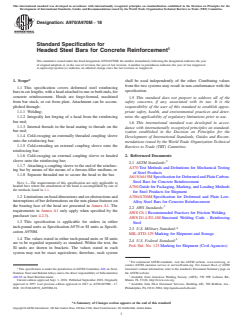
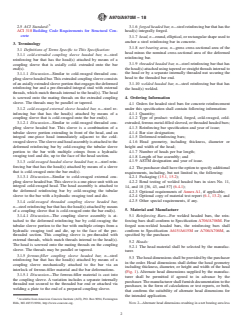
(Specification)Standard Specification for Headed Steel Bars for Concrete Reinforcement
General Information
- Abstract
ABSTRACT
This specification covers deformed and plain steel reinforcing bars in cut lengths with a head attached to one or both ends for reinforcing concrete structures. This standard applies only to headed bars with welded, threaded or forged heads. Material, manufacturing and testing requirements for the reinforcing bars shall be in accordance with other ASTM documents listed herein.
SCOPE
1.1 This specification covers deformed steel reinforcing bars in cut lengths, with a head attached to one or both ends, for concrete reinforcement. Heads are forge-formed, machined from bar stock, or cut from plate. Attachment can be accomplished through:
1.1.1 Welding;
1.1.2 Integrally hot forging of a head from the reinforcing bar end;
1.1.3 Internal threads in the head mating to threads on the bar end;
1.1.4 Cold-swaging an externally threaded coupling sleeve onto the reinforcing bar;
1.1.5 Cold-extruding an external coupling sleeve onto the reinforcing bar;
1.1.6 Cold-swaging an external coupling sleeve or headed sleeve onto the reinforcing bar;
1.1.7 Attaching a coupling sleeve to the end of the reinforcing bar by means of the means of a ferrous-filler medium; or
1.1.8 Separate threaded nut to secure the head to the bar.
Note 1: The requirements of this specification are only applicable to headed bars where the attachment of the head is accomplished by one of the methods listed in 1.1.
1.2 Limitations on head dimensions and on obstructions and interruptions of bar deformations on the non-planar features on the bearing face of the head are presented in Annex A1. The requirements in Annex A1 only apply when specified by the purchaser (see 4.2.3).
1.3 This specification is applicable for orders in either inch-pound units as Specification A970 or SI units as Specification A970M.
1.4 The values stated in either inch-pound units or SI units are to be regarded separately as standard. Within the text, the SI units are shown in brackets. The values stated in each system may not be exact equivalents; therefore, each system shall be used independently of the other. Combining values from the two systems may result in non-conformance with the specification.
1.5 This standard does not purport to address all of the safety concerns, if any, associated with its use. It is the responsibility of the user of this standard to establish appropriate safety, health, and environmental practices and determine the applicability of regulatory limitations prior to use.
1.6 This international standard was developed in accordance with internationally recognized principles on standardization established in the Decision on Principles for the Development of International Standards, Guides and Recommendations issued by the World Trade Organization Technical Barriers to Trade (TBT) Committee.
- Status
- Published
- Publication Date
- 31-Aug-2018
- Technical Committee
- A01 - Steel, Stainless Steel and Related Alloys
- Drafting Committee
- A01.05 - Steel Reinforcement
Buy Documents
ASTM A970/A970M-18 - Standard Specification for Headed Steel Bars for Concrete Reinforcement
REDLINE ASTM A970/A970M-18 - Standard Specification for Headed Steel Bars for Concrete Reinforcement
Overview
ASTM A970/A970M-18 is a comprehensive standard specification developed by ASTM International for headed steel bars for concrete reinforcement. This standard outlines the requirements for deformed and plain steel reinforcing bars in cut lengths with attached heads, designed specifically to enhance the anchorage of steel reinforcement within concrete structures. Headed bars covered under this standard are widely utilized where conventional anchorage methods are impractical or limited by space constraints. The standard specifies acceptable attachment methods for heads, including welding, forging, threading, and mechanical couplers, ensuring consistent performance and safety in concrete construction projects.
Key Topics
- Scope and Usage:
- Covers deformed steel reinforcing bars with a head attached to one or both ends.
- Heads may be formed by forging, machining from bar stock, or cutting from plate.
- Attachment methods include welding, hot forging, threading, and various types of cold-swaged or extruded coupling sleeves.
- Attachment Methods:
- Welding of the head to the reinforcing bar.
- Integrally hot forging a head from the bar end.
- Internal/external threading, with or without nuts.
- Use of cold-swaged or cold-extruded sleeves.
- Ferrous-filler medium for mechanical attachment.
- Material and Manufacturing Requirements:
- Reinforcing bars must conform to relevant specifications (such as ASTM A615/A615M or A706/A706M), depending on attachment method.
- Manufacturers select head material and dimensions as specified by the purchaser.
- Testing and Quality Control:
- Mechanical tests (tensile and bend) prescribed to verify bar and head performance.
- Frequency and type of tests defined for both pre-production and production phases to ensure quality.
- Test reporting and documentation requirements for traceability and verification.
- Dimensional and Geometrical Requirements:
- Limitations on head dimensions and features to ensure adequate net bearing area.
- Special requirements for Class HA dimensions specified in Annex A1, in accordance with building codes like ACI 318.
Applications
Headed steel bars produced under ASTM A970/A970M-18 are critical enhancements for concrete reinforcement in a variety of structural applications. Some typical uses include:
- Anchorage at Beam/Column Ends:
- Allows for efficient transfer of forces within limited concrete cover or at points of congestion.
- Seismic and Structural Integrity:
- Provides improved anchorage and reduces required development length, especially in seismic zones, improving overall structural ductility and performance.
- Constructability in Dense Reinforcement Areas:
- Facilitates reinforcement layouts in heavily congested concrete elements such as bridge decks, footings, shear walls, and complex structural nodes.
- Compliance with Building Codes:
- Used where design codes or project specifications call for mechanical anchorage solutions for rebar ends to meet stringent safety and performance requirements.
The versatility in attachment methods and head geometry enables designers and builders to select the most suitable product for specific project needs, optimizing both safety and economy.
Related Standards
ASTM A970/A970M-18 references and interacts with several other industry standards to establish a comprehensive regulatory framework for headed reinforcing bars. Notable related standards include:
- ASTM A615/A615M - Specification for Deformed and Plain Carbon-Steel Bars for Concrete Reinforcement
- ASTM A706/A706M - Specification for Deformed and Plain Low-Alloy Steel Bars for Concrete Reinforcement
- ASTM A370 - Test Methods and Definitions for Mechanical Testing of Steel Products
- AWS D1.4/D1.4M - Structural Welding Code - Reinforcing Steel
- ACI 318 - Building Code Requirements for Structural Concrete
By adhering to ASTM A970/A970M-18, manufacturers, designers, and contractors ensure that headed steel bars for concrete reinforcement meet high standards for quality, mechanical performance, and compatibility with key building codes and related industry standards. This specification is essential for achieving reliable, code-compliant, and durable concrete structures.
Relations
- Effective Date
- 01-Mar-2024
- Effective Date
- 01-Nov-2019
- Effective Date
- 01-Jul-2019
- Refers
ASTM A370-17a - Standard Test Methods and Definitions for Mechanical Testing of Steel Products - Effective Date
- 15-Nov-2017
- Effective Date
- 01-Jan-2017
- Effective Date
- 01-Nov-2015
- Effective Date
- 01-Apr-2015
- Effective Date
- 01-Nov-2014
- Effective Date
- 15-May-2014
- Effective Date
- 01-Apr-2014
- Effective Date
- 15-Nov-2013
- Effective Date
- 01-Oct-2013
- Refers
ASTM A370-12a - Standard Test Methods and Definitions for Mechanical Testing of Steel Products - Effective Date
- 15-Oct-2012
- Effective Date
- 15-Mar-2012
- Effective Date
- 01-Mar-2012
Buy Documents
ASTM A970/A970M-18 - Standard Specification for Headed Steel Bars for Concrete Reinforcement
REDLINE ASTM A970/A970M-18 - Standard Specification for Headed Steel Bars for Concrete Reinforcement
Get Certified
Connect with accredited certification bodies for this standard

Element Materials Technology
Materials testing and product certification.

Inštitut za kovinske materiale in tehnologije
Institute of Metals and Technology. Materials testing, metallurgical analysis, NDT.
Sponsored listings
Frequently Asked Questions
ASTM A970/A970M-18 is a technical specification published by ASTM International. Its full title is "Standard Specification for Headed Steel Bars for Concrete Reinforcement". This standard covers: ABSTRACT This specification covers deformed and plain steel reinforcing bars in cut lengths with a head attached to one or both ends for reinforcing concrete structures. This standard applies only to headed bars with welded, threaded or forged heads. Material, manufacturing and testing requirements for the reinforcing bars shall be in accordance with other ASTM documents listed herein. SCOPE 1.1 This specification covers deformed steel reinforcing bars in cut lengths, with a head attached to one or both ends, for concrete reinforcement. Heads are forge-formed, machined from bar stock, or cut from plate. Attachment can be accomplished through: 1.1.1 Welding; 1.1.2 Integrally hot forging of a head from the reinforcing bar end; 1.1.3 Internal threads in the head mating to threads on the bar end; 1.1.4 Cold-swaging an externally threaded coupling sleeve onto the reinforcing bar; 1.1.5 Cold-extruding an external coupling sleeve onto the reinforcing bar; 1.1.6 Cold-swaging an external coupling sleeve or headed sleeve onto the reinforcing bar; 1.1.7 Attaching a coupling sleeve to the end of the reinforcing bar by means of the means of a ferrous-filler medium; or 1.1.8 Separate threaded nut to secure the head to the bar. Note 1: The requirements of this specification are only applicable to headed bars where the attachment of the head is accomplished by one of the methods listed in 1.1. 1.2 Limitations on head dimensions and on obstructions and interruptions of bar deformations on the non-planar features on the bearing face of the head are presented in Annex A1. The requirements in Annex A1 only apply when specified by the purchaser (see 4.2.3). 1.3 This specification is applicable for orders in either inch-pound units as Specification A970 or SI units as Specification A970M. 1.4 The values stated in either inch-pound units or SI units are to be regarded separately as standard. Within the text, the SI units are shown in brackets. The values stated in each system may not be exact equivalents; therefore, each system shall be used independently of the other. Combining values from the two systems may result in non-conformance with the specification. 1.5 This standard does not purport to address all of the safety concerns, if any, associated with its use. It is the responsibility of the user of this standard to establish appropriate safety, health, and environmental practices and determine the applicability of regulatory limitations prior to use. 1.6 This international standard was developed in accordance with internationally recognized principles on standardization established in the Decision on Principles for the Development of International Standards, Guides and Recommendations issued by the World Trade Organization Technical Barriers to Trade (TBT) Committee.
ABSTRACT This specification covers deformed and plain steel reinforcing bars in cut lengths with a head attached to one or both ends for reinforcing concrete structures. This standard applies only to headed bars with welded, threaded or forged heads. Material, manufacturing and testing requirements for the reinforcing bars shall be in accordance with other ASTM documents listed herein. SCOPE 1.1 This specification covers deformed steel reinforcing bars in cut lengths, with a head attached to one or both ends, for concrete reinforcement. Heads are forge-formed, machined from bar stock, or cut from plate. Attachment can be accomplished through: 1.1.1 Welding; 1.1.2 Integrally hot forging of a head from the reinforcing bar end; 1.1.3 Internal threads in the head mating to threads on the bar end; 1.1.4 Cold-swaging an externally threaded coupling sleeve onto the reinforcing bar; 1.1.5 Cold-extruding an external coupling sleeve onto the reinforcing bar; 1.1.6 Cold-swaging an external coupling sleeve or headed sleeve onto the reinforcing bar; 1.1.7 Attaching a coupling sleeve to the end of the reinforcing bar by means of the means of a ferrous-filler medium; or 1.1.8 Separate threaded nut to secure the head to the bar. Note 1: The requirements of this specification are only applicable to headed bars where the attachment of the head is accomplished by one of the methods listed in 1.1. 1.2 Limitations on head dimensions and on obstructions and interruptions of bar deformations on the non-planar features on the bearing face of the head are presented in Annex A1. The requirements in Annex A1 only apply when specified by the purchaser (see 4.2.3). 1.3 This specification is applicable for orders in either inch-pound units as Specification A970 or SI units as Specification A970M. 1.4 The values stated in either inch-pound units or SI units are to be regarded separately as standard. Within the text, the SI units are shown in brackets. The values stated in each system may not be exact equivalents; therefore, each system shall be used independently of the other. Combining values from the two systems may result in non-conformance with the specification. 1.5 This standard does not purport to address all of the safety concerns, if any, associated with its use. It is the responsibility of the user of this standard to establish appropriate safety, health, and environmental practices and determine the applicability of regulatory limitations prior to use. 1.6 This international standard was developed in accordance with internationally recognized principles on standardization established in the Decision on Principles for the Development of International Standards, Guides and Recommendations issued by the World Trade Organization Technical Barriers to Trade (TBT) Committee.
ASTM A970/A970M-18 is classified under the following ICS (International Classification for Standards) categories: 77.140.15 - Steels for reinforcement of concrete. The ICS classification helps identify the subject area and facilitates finding related standards.
ASTM A970/A970M-18 has the following relationships with other standards: It is inter standard links to ASTM A370-24, ASTM A700-14(2019), ASTM A370-19, ASTM A370-17a, ASTM A370-17, ASTM A370-15, ASTM A615/A615M-15, ASTM A700-14, ASTM A370-14, ASTM A615/A615M-14, ASTM A370-13, ASTM A615/A615M-13, ASTM A370-12a, ASTM A370-12, ASTM A615/A615M-12. Understanding these relationships helps ensure you are using the most current and applicable version of the standard.
ASTM A970/A970M-18 is available in PDF format for immediate download after purchase. The document can be added to your cart and obtained through the secure checkout process. Digital delivery ensures instant access to the complete standard document.
Standards Content (Sample)
This international standard was developed in accordance with internationally recognized principles on standardization established in the Decision on Principles for the
Development of International Standards, Guides and Recommendations issued by the World Trade Organization Technical Barriers to Trade (TBT) Committee.
Designation:A970/A970M −18
Standard Specification for
Headed Steel Bars for Concrete Reinforcement
This standard is issued under the fixed designationA970/A970M; the number immediately following the designation indicates the year
of original adoption or, in the case of revision, the year of last revision. A number in parentheses indicates the year of last reapproval.
A superscript epsilon (´) indicates an editorial change since the last revision or reapproval.
1. Scope* shall be used independently of the other. Combining values
from the two systems may result in non-conformance with the
1.1 This specification covers deformed steel reinforcing
specification.
barsincutlengths,withaheadattachedtooneorbothends,for
concrete reinforcement. Heads are forge-formed, machined
1.5 This standard does not purport to address all of the
from bar stock, or cut from plate. Attachment can be accom-
safety concerns, if any, associated with its use. It is the
plished through:
responsibility of the user of this standard to establish appro-
1.1.1 Welding;
priate safety, health, and environmental practices and deter-
1.1.2 Integrally hot forging of a head from the reinforcing mine the applicability of regulatory limitations prior to use.
bar end;
1.6 This international standard was developed in accor-
1.1.3 Internal threads in the head mating to threads on the
dance with internationally recognized principles on standard-
bar end;
ization established in the Decision on Principles for the
1.1.4 Cold-swaging an externally threaded coupling sleeve
Development of International Standards, Guides and Recom-
onto the reinforcing bar;
mendations issued by the World Trade Organization Technical
1.1.5 Cold-extruding an external coupling sleeve onto the
Barriers to Trade (TBT) Committee.
reinforcing bar;
1.1.6 Cold-swaging an external coupling sleeve or headed 2. Referenced Documents
sleeve onto the reinforcing bar;
2.1 ASTM Standards:
1.1.7 Attaching a coupling sleeve to the end of the reinforc-
A370 Test Methods and Definitions for Mechanical Testing
ing bar by means of the means of a ferrous-filler medium; or
of Steel Products
1.1.8 Separate threaded nut to secure the head to the bar.
A615/A615M SpecificationforDeformedandPlainCarbon-
Steel Bars for Concrete Reinforcement
NOTE 1—The requirements of this specification are only applicable to
headed bars where the attachment of the head is accomplished by one of
A700 Guide for Packaging, Marking, and Loading Methods
the methods listed in 1.1.
for Steel Products for Shipment
1.2 Limitations on head dimensions and on obstructions and A706/A706M Specification for Deformed and Plain Low-
interruptions of bar deformations on the non-planar features on
Alloy Steel Bars for Concrete Reinforcement
the bearing face of the head are presented in Annex A1. The
2.2 AWS Standards:
requirements in Annex A1 only apply when specified by the
AWS C6.1 Recommended Practices for Friction Welding
purchaser (see 4.2.3).
AWS D1.4⁄D1.4M Structural Welding Code - Reinforcing
1.3 This specification is applicable for orders in either
Steel
inch-pound units as Specification A970 or SI units as Specifi-
2.3 U.S. Military Standard:
cation A970M.
MIL-STD-129 Marking for Shipment and Storage
1.4 The values stated in either inch-pound units or SI units
2.4 U.S. Federal Standard:
are to be regarded separately as standard. Within the text, the
Fed. Std. No. 123 Marking for Shipment (Civil Agencies)
SI units are shown in brackets. The values stated in each
system may not be exact equivalents; therefore, each system
For referenced ASTM standards, visit the ASTM website, www.astm.org, or
contact ASTM customer service at service@astm.org. For Annual Book of ASTM
This specification is under the jurisdiction of ASTM Committee A01 on Steel, Standards volume information, refer to the standard’s Document Summary page on
Stainless Steel and Related Alloys and is the direct responsibility of Subcommittee the ASTM website.
A01.05 on Steel Reinforcement. Available from American Welding Society (AWS), 550 NW LeJeune Rd.,
Current edition approved Sept. 1, 2018. Published September 2018. Originally Miami, FL 33126, http://www.aws.org.
approved in 1997. Last previous edition approved in 2017 as A970/A970M – 17. Available from DLA Document Services, Building 4/D, 700 Robbins Ave.,
DOI: 10.1520/A0970_A0970M-18. Philadelphia, PA 19111-5094, http://quicksearch.dla.mil.
*A Summary of Changes section appears at the end of this standard
Copyright © ASTM International, 100 Barr Harbor Drive, PO Box C700, West Conshohocken, PA 19428-2959. United States
A970/A970M−18
2.5 ACI Standard: 3.1.6 forgedheadedbar,n—steelreinforcingbarthathasthe
ACI 318 Building Code Requirements for Structural Con- head(s) integrally forged.
crete
3.1.7 head, n—round,elliptical,orrectangularshapeusedto
anchor a steel reinforcing bar in concrete.
3. Terminology
3.1.8 net bearing area, n—gross cross-sectional area of the
3.1 Definitions of Terms Specific to This Specification:
head minus the nominal cross-sectional area of the deformed
3.1.1 cold-extruded coupling sleeve headed bar, n—steel
reinforcing bar.
reinforcing bar that has the head(s) attached by means of a
3.1.9 threaded headed bar, n—steel reinforcing bar that has
coupling sleeve that is axially cold- extruded onto the bar
thehead(s)attachedusingtaperedorstraightthreadsinternalto
end(s).
the head or by a separate internally threaded nut securing the
3.1.1.1 Discussion—Similar to cold-swaged threaded cou-
head to the threaded bar end.
pling sleeve headed bar.This extruded coupling sleeve consists
ofanaxiallyextrudedsleeveportionthatengagesthedeformed
3.1.10 welded headed bar, n—steel reinforcing bar that has
reinforcing bar and a pre-threaded integral stud with external
the head(s) welded.
threads, which match threads internal to the head(s). The head
4. Ordering Information
is screwed onto the mating threads on the extruded coupling
sleeve. The threads may be parallel or tapered.
4.1 Orders for headed steel bars for concrete reinforcement
3.1.2 cold-swaged external sleeve headed bar, n—steel re- under this specification shall contain following information:
inforcing bar that has the head(s) attached by means of a 4.1.1 Quantity;
coupling sleeve that is cold-swaged onto the bar end(s).
4.1.2 Type of product: welded, forged, cold-swaged, cold-
3.1.2.1 Discussion—Similar to cold-swaged threaded cou- extruded, ferrous metal-filled sleeved, or threaded headed bars;
pling sleeve headed bar. This sleeve is a combination of a
4.1.3 Reinforcing bar specification and year of issue;
tubular sleeve portion extending in front of the head, and an 4.1.4 Bar size designation;
integral one-piece head immediately adjacent to the cold-
4.1.5 Deformed reinforcing bars;
swaged sleeve.The sleeve and head assembly is attached to the 4.1.6 Head geometry, including thickness, diameter or
deformed reinforcing bar by cold-swaging the tubular sleeve height and width of the head;
portion to the bar with multiple crimps from a hydraulic 4.1.7 Number of heads per bar length;
swaging tool and die, up to the face of the head section. 4.1.8 Length of bar assembly; and
4.1.9 ASTM designation and year of issue.
3.1.3 cold-swaged headed sleeve headed bar, n—steel rein-
forcing bar that has the head(s) attached by means of a sleeve
4.2 Thepurchasershallhavetheoptiontospecifyadditional
that is cold-swaged onto the bar end(s).
requirements, including, but not limited to, the following:
3.1.3.1 Discussion—Similar to cold-swaged external cou-
4.2.1 Packaging (15.1, 15.2);
pling sleeve headed bar. This sleeve is a one-piece unit with an
4.2.2 Bend testing of welded headed bars in sizes No. 11,
integral cold-swaged head. The head assembly is attached to
14, and 18 [36, 43, and 57] (6.4.1);
the deformed reinforcing bar by cold-swaging the tubular
4.2.3 Optional requirements of Annex A1, if applicable;
sleeve to the bar with a hydraulic swaging tool and die.
4.2.4 Optional copy of material test report (6.1, 13.2); and
4.2.5 Other special requirements, if any.
3.1.4 cold-swaged threaded coupling sleeve headed bar,
n—steel reinforcing bar that has the head(s) attached by means
5. Material and Manufacture
of a coupling sleeve that is cold-swaged onto the bar end(s).
3.1.4.1 Discussion—The coupling sleeve assembly is at- 5.1 Reinforcing Bars—For welded headed bars, the rein-
tached to the deformed reinforcing bar by cold-swaging the forcing bars shall conform to Specification A706/A706M. For
tubular sleeve portion to the bar with multiple crimps from a forged non-welded headed bars, the reinforcing bars shall
hydraulic swaging tool and die, up to the face of the pre- conform to Specification A615/A615M or A706/A706M,as
threaded section. This coupling sleeve is pre-threaded with specified by the purchaser.
external threads, which match threads internal to the head(s).
5.2 Heads:
The head is screwed onto the mating threads on the coupling
5.2.1 The head material shall be selected by the manufac-
sleeve. The threads may be parallel or tapered.
turer.
3.1.5 ferrous-filler coupling sleeve headed bar, n—steel
5.3 The head dimensions shall be provided by the purchaser
reinforcing bar that has the head(s) attached by means of a
in the order. Head dimensions shall define the head geometry
coupling sleeve mechanically attached to the bar via an
including thickness, diameter, or height and width of the head
interlock of ferrous-filler material and the bar deformations.
(Fig. 1). Alternate head dimensions supplied by the manufac-
3.1.5.1 Discussion—The ferrous-filler material is cast into
turer shall be permitted if agreed to in advance by the
the coupling sleeve. A variation includes a separate internally
purchaser.Themanufacturershallfurnishdocumentationtothe
threaded nut secured to the threaded bar end or attached via
purchaser, in the form of calculations or test reports, or both,
welding a plate to the end of a prepared coupling sleeve.
that confirms the suitability of alternate head dimensions for
the intended application.
Available fromAmerican Concrete Institute (ACI), P.O. Box 9094, Farmington
Hills, MI 48333-9094, http://www.concrete.org. NOTE 2—Alternate head dimensions resulting in a net bearing area less
A970/A970M−18
FIG. 1Headed Reinforcing Bar
than four times the nominal cross-sectional area of the deformed reinforc-
6.2 Tensile Tests:
ingbararenotsuitableforuseinconstructionprojectsgovernedbycertain
6.2.1 Tensile testing of the headed bar assembly shall be
consensus building codes and design standards (see 5.4 and Note 3).
performed in accordance with the requirements described in
5.4 When specified by the purchaser in the purchase order
Test Methods and Definitions A370. The failure mode shall be
or contract as a class HA headed bar, head dimensions shall
reported as partial or total fracture of the bar, the head, or the
meet the requirements of Annex A1.
head-to-bar connection.
6.2.2 Specimen Preparation—Tensile test specimens shall
NOTE 3—Some methods of attachment, as defined in Section 3 of this
specification, do not meet the requirements on obstructions as prescribed be the full cross-section of the bar with a head attached to one
in Annex A1. The requirements for head dimensions, limitations to
end of the reinforcing bar. The minimum length of the test
reinforcing bar deformation interruptions and the size of obstruction
specimen shall be the greater of 10 in. [250 mm] or ten times
allowances provided in Annex A1 are mandated by certain consensus
the nominal diameter of the bar. The test specimen shall be
building codes and design standards, for example, "Building Code
placed in the testing machine with the head supported to
Requirements for Structural Concrete (ACI 318)." Heads with obstruc-
tions that do not conform to Annex A1 may not be permitted for use by preventmovementandbendingofthehead.Provisionsshallbe
certain building codes and design standards, such as ACI 318.
made for clearance between the support and any weld or
forming material on the reinforcing bar-to-head connection.
5.5 Welding—A welding procedure conforming to
AWS D1.4⁄D1.4M shall be used for all required production The opposite bar end of the bar, without a head attached, shall
be gripped by the testing machine and loaded to failure.
welding of the head to the bar, except for friction welding that
shall conform to AWS C6.1 in conjunction with the manufac-
6.3 Tensile Requirements:
turer’s QA/QC procedures.
6.3.1 Tensile Properties—The tensile properties of the test
5.6 Forging—For integrally forged headed bars, the heads specimen shall conform to one of the following classes:
shall be produced by deforming the bar ends in a hot-forging 6.3.1.1 Class A—Develop the minimum specified tensile
process.
strength of the reinforcing bar.
6.3.1.2 Class B—Develop the minimum specified tensile
5.7 Threading:
strength and the minimum specified elongation of the reinforc-
5.7.1 Threads on bars shall be either tapered or straight.The
ing bar.
head shall either thread onto the bar directly, or it shall be held
on the bar end by a nut and counternut. Thread specifications
NOTE 4—Reference the requirements of Specifications A615/A615M
and standards shall be selected by the manufacturer.
and A706/A706M for minimum reinforcing bar tensile properties. ClassA
has been introduced for applications that require the development of the
5.7.2 The out-of-roundness in the as-rolled reinforcing bar
minimum tensile strength of the reinforcing bar. The Class B criteria
shall be evaluated so that the manufacturer’s minimum thread
requires the head and the head-to-bar connection to meet or exceed the
dimensions are maintained.
minimum specified tensile strength and the minimum specified elongation
5.7.3 It shall be permissible to hot- or cold-roll, or machine
requirements of the reinforcing bar. In the previous criteria, the failure of
cut, threads into the surface of the bar and heads at the option the head or the head-to-bar connection within the attachment region was
cause for rejection.
of the manufacturer.
6.4 Bend Test Requirements:
6. Mechanical Test and Performance Requirements
6.4.1 Only welded headed bars in sizes No. 3 to 10 [10 to
6.1 Headed bars shall be subjected to mechanical tests to
32] shall be subject to bend testing. Bend testing of welded
verify production method and product quality prior to manu-
headed bars in sizes No. 11, 14, and 18 [36, 43, and 57] shall
facture. Mechanical testing also shall be performed at intervals
be subject to agreement between the purchaser and manufac-
during production of the assembly.
turer.
NOTE 5—Serious safety issues may be involved in performing bend
A970/A970M−18
TABLE 1 Bend Test Requirements
Bar Designation No. Mandrel Diameter
A
3, 4, and 5 [10, 13, and 16] 3d
6, 7, and 8 [19, 22, and 25] 4d
9, 10, and 11 [29, 32, and 36] 6d
14 and 18 [43 and 57] 8d
A
d = nominal diameter of bar
tests on welded headed bars in sizes No. 11, 14, and 18 [36, 43, and 57].
FIG. 2Bend Test Specimen Mandrel Configuration
Thus, 6.4 requires such bend testing to be subject to agreement between
the purchaser and manufacturer.
require production sampling at the location where final assembly occurs.
6.4.2 Procedure—The test specimen shall be bent around a
7.1.2.1 In the event different heats of head or bar material,
mandrel of suitable diameter to an angle of at least 90° with no
or both, within the same material specification are used to
observed partial or total fracture of the head, the bar, or the
produce headed bar assemblies during a production run, a
head-to-bar connection.
minimum of two tensile tests in accordance with 6.3 or two
6.4.3 Bend Test Mandrel—Themandrelshallbeplacedsoas
bend tests in accordance with 6.4 shall be conducted to verify
to directly bend the welded region. The required mandrel
the production method, product quality, and head attachment
dimensions for bend testing are prescribed in Table 1. The
method prior to continuing production.
centerline of the bend test mandrel shall be placed at the
7.1.2.2 Test Specimen Length—The test specimen length
intersection of the reinforcing bar and the weld, as shown in
shall be sufficient to accommodate a minimum of 8 in. [200
Fig. 2.
mm] of free bar length between the grips of the tensile testing
6.4.4 Specimen Preparation—Bend test specimens shall be
machine holding the reinforcing bar and the bearing face of the
the full cross-section of the bar with a head attached to one end
head. Lot traceability shall be maintained for the specimen.
of the deformed reinforcing bar. Where the welded head
7.2 Retests:
interferes with placement of the bend test mandrel, sufficient
7.2.1 Pre-Production—Any identified procedural or perfor-
head material and any excess material associated with the
mance deficiencies shall be corrected and pre-production
welding process shall be removed along one edge of the
testing repeated until the tensile and bend test results meet the
deformed reinforcing bar to provide a flat surface on the
performance requirements of this specification.
specimen for the bend mandrel. This preparation shall ensure
7.2.2 Production—For welded headed bars, when partial or
thatthecontactpointofthebendmandrelisdirectlyatthebase
total fracture(s) of the bend or tensile test specimens occur(s)
of the reinforcing bar diameter as shown in Fig. 2.
in the weld, the production lot shall be rejected and a retest
shall be conducted as shown in 7.2.2.1 or 7.2.2.3. During
7. Frequency of Testing
production tests of headed bars, if any tensile test specimen
7.1 Number of Tests:
failstonotmeettherequirementsfortensilepropertiesin6.3.1,
7.1.1 Pre-Production—Prior to production, a testing pro-
the production lot shall be retested as shown in 7.2.2.1. For
gram shall be undertaken that includes two bend tests for
threaded components used to assemble the headed bars, if
welded headed bars and two tensile tests for all headed bars.
thread dimensions are found not to meet the manufacturer’s
The tests shall be repeated for each combination of head and
practices for the threads, the production lot shall be rejected.
bar material specification, grade or type, or head attachment
7.2.2.1 If the result of a tension test fails to meet the
method.
requirements for tensile properties in 6.3.1, then a retest shall
NOTE 6—The bend test is used to ensure that no weak points existed in
be allowed. Two specimens taken at random from the produc-
the weld at the head-to-bar connection. Other head-to-bar connections are
tion lot shall be tested during a retest. Both specimens shall
not subject to this test due to the mechanical nature of those head-to-bar
meet the tension test requirements of Section 6,orthe
connections.
production lot shall be rejected.
7.1.2 Production Sampling and Testing of Headed Bars—It
7.2.2.2 If any test specimen fails because of mechanical
shall be permissible to use either the tensile test prescribed in
reasons, such as failure of the testing equipment or from flaws
6.3, or the bend test prescribed in 6.4 to verify the production
caused by specimen preparation, shipment, or other damage
method and product quality of headed bar. A minimum of two
unrelated to manufacturing or testing, it shall be discarded and
specimensshallbesampledandtestedforeachproductionshift
another specimen from the same production lot substituted.
or period. One test of a headed bar at the start and one test at
7.2.2.3 If a bend test fails for reasons other than mechanical
the end of each 8-h production period or less than 8-h
reasons or flaws in the specimen, as described in 7.2.2.2,a
production period or at random intervals during the production
retest shall be permitted on two random specimens from the
period shall be conducted. Sampling shall be conducted at the
same production lot. If the results of both test specimens meet
location where the head is permanently attached to the rein-
the specified requirements, the lot shall be accepted.
forcing bar in its final form, unless otherwise agreed to by the
8. Finish
purchaser and the manufacturer at the time of purchase.
8.1 Rust, surface irregularities, or mill scale shall not be
NOTE 7—Headed bars as defined in this specification can be produced
from single or multiple components. It is the intent of this specification to cause for rejection, provided the dimensions, cross-sectional
A970/A970M−18
area, and tensile properties of a hand wire brushed specimen 13.2 A test report shall be required of the manufacturer for
are not less than the requirements of this specification. the production of headed bar assemblies as described in
Section 6, including the failure mode.Acopy of the test report
9. Inspection
shall be provided to the purchaser upon request.
9.1 The inspector representing the purchaser shall have free
13.3 A material test report, certificate of inspection, or
...
This document is not an ASTM standard and is intended only to provide the user of an ASTM standard an indication of what changes have been made to the previous version. Because
it may not be technically possible to adequately depict all changes accurately, ASTM recommends that users consult prior editions as appropriate. In all cases only the current version
of the standard as published by ASTM is to be considered the official document.
Designation: A970/A970M − 17 A970/A970M − 18
Standard Specification for
Headed Steel Bars for Concrete Reinforcement
This standard is issued under the fixed designation A970/A970M; the number immediately following the designation indicates the year
of original adoption or, in the case of revision, the year of last revision. A number in parentheses indicates the year of last reapproval.
A superscript epsilon (´) indicates an editorial change since the last revision or reapproval.
1. Scope*
1.1 This specification covers deformed steel reinforcing bars in cut lengths, with a head attached to one or both ends, for
concrete reinforcement. Heads are forge-formed, machined from bar stock, or cut from plate. Attachment can be accomplished
through:
1.1.1 Welding;
1.1.2 Integrally hot forging of a head from the reinforcing bar end;
1.1.3 Internal threads in the head mating to threads on the bar end;
1.1.4 Cold-swaging an externally threaded coupling sleeve onto the reinforcing bar;
1.1.5 Cold-extruding an external coupling sleeve onto the reinforcing bar;
1.1.6 Cold-swaging an external coupling sleeve or headed sleeve onto the reinforcing bar;
1.1.7 Attaching a coupling sleeve to the end of the reinforcing bar by means of the means of a ferrous-filler medium; or
1.1.8 Separate threaded nut to secure the head to the bar.
NOTE 1—The requirements of this specification are only applicable to headed bars where the attachment of the head is accomplished by one of the
methods listed in 1.1.
1.2 Limitations on head dimensions and on obstructions and interruptions of bar deformations on the non-planar features on the
bearing face of the head are presented in Annex A1. The requirements in Annex A1 only apply when specified by the purchaser
(see 4.2.3).
1.3 This specification is applicable for orders in either inch-pound units as Specification A970 or SI units as Specification
A970M.
1.4 The values stated in either inch-pound units or SI units are to be regarded separately as standard. Within the text, the SI units
are shown in brackets. The values stated in each system may not be exact equivalents; therefore, each system shall be used
independently of the other. Combining values from the two systems may result in non-conformance with the specification.
1.5 This standard does not purport to address all of the safety concerns, if any, associated with its use. It is the responsibility
of the user of this standard to establish appropriate safety, health, and environmental practices and determine the applicability of
regulatory limitations prior to use.
1.6 This international standard was developed in accordance with internationally recognized principles on standardization
established in the Decision on Principles for the Development of International Standards, Guides and Recommendations issued
by the World Trade Organization Technical Barriers to Trade (TBT) Committee.
2. Referenced Documents
2.1 ASTM Standards:
A370 Test Methods and Definitions for Mechanical Testing of Steel Products
A615/A615M Specification for Deformed and Plain Carbon-Steel Bars for Concrete Reinforcement
A700 Guide for Packaging, Marking, and Loading Methods for Steel Products for Shipment
A706/A706M Specification for Deformed and Plain Low-Alloy Steel Bars for Concrete Reinforcement
This specification is under the jurisdiction of ASTM Committee A01 on Steel, Stainless Steel and Related Alloys and is the direct responsibility of Subcommittee A01.05
on Steel Reinforcement.
Current edition approved Nov. 15, 2017Sept. 1, 2018. Published November 2017September 2018. Originally approved in 1997. Last previous edition approved in
20162017 as A970/A970M – 16.A970/A970M – 17. DOI: 10.1520/A0970_A0970M-17.10.1520/A0970_A0970M-18.
For referenced ASTM standards, visit the ASTM website, www.astm.org, or contact ASTM customer service at service@astm.org. For Annual Book of ASTM Standards
volume information, refer to the standard’s Document Summary page on the ASTM website.
*A Summary of Changes section appears at the end of this standard
Copyright © ASTM International, 100 Barr Harbor Drive, PO Box C700, West Conshohocken, PA 19428-2959. United States
A970/A970M − 18
2.2 AWS Standards:
AWS C6.1 Recommended Practices for Friction Welding
AWS D1.4 ⁄D1.4M Structural Welding Code - Reinforcing Steel
2.3 U.S. Military Standard:
MIL-STD-129 Marking for Shipment and Storage
2.4 U.S. Federal Standard:
Fed. Std. No. 123 Marking for Shipment (Civil Agencies)
2.5 ACI Standard:
ACI 318 Building Code Requirements for Structural Concrete
3. Terminology
3.1 Definitions of Terms Specific to This Specification:
3.1.1 cold-extruded coupling sleeve headed bar, n—steel reinforcing bar that has the head(s) attached by means of a coupling
sleeve that is axially cold- extruded onto the bar end(s).
Available from American Welding Society (AWS), 550 NW LeJeune Rd., Miami, FL 33126, http://www.aws.org.
Available from DLA Document Services, Building 4/D, 700 Robbins Ave., Philadelphia, PA 19111-5094, http://quicksearch.dla.mil.
Available from American Concrete Institute (ACI), P.O. Box 9094, Farmington Hills, MI 48333-9094, http://www.concrete.org.
3.1.1.1 Discussion—
Similar to cold-swaged threaded coupling sleeve headed bar. This extruded coupling sleeve consists of an axially extruded sleeve
portion that engages the deformed reinforcing bar and a pre-threaded integral stud with external threads, which match threads
internal to the head(s). The head is screwed onto the mating threads on the extruded coupling sleeve. The threads may be parallel
or tapered.
3.1.2 cold-swaged external sleeve headed bar, n—steel reinforcing bar that has the head(s) attached by means of a coupling
sleeve that is cold-swaged onto the bar end(s).
3.1.2.1 Discussion—
Similar to cold-swaged threaded coupling sleeve headed bar. This sleeve is a combination of a tubular sleeve portion extending
in front of the head, and an integral one-piece head immediately adjacent to the cold-swaged sleeve. The sleeve and head assembly
is attached to the deformed reinforcing bar by cold-swaging the tubular sleeve portion to the bar with multiple crimps from a
hydraulic swaging tool and die, up to the face of the head section.
3.1.3 cold-swaged headed sleeve headed bar, n—steel reinforcing bar that has the head(s) attached by means of a sleeve that
is cold-swaged onto the bar end(s).
3.1.3.1 Discussion—
Similar to cold-swaged external coupling sleeve headed bar. This sleeve is a one-piece unit with an integral cold-swaged head. The
head assembly is attached to the deformed reinforcing bar by cold-swaging the tubular sleeve to the bar with a hydraulic swaging
tool and die.
3.1.4 cold-swaged threaded coupling sleeve headed bar, n—steel reinforcing bar that has the head(s) attached by means of a
coupling sleeve that is cold-swaged onto the bar end(s).
3.1.4.1 Discussion—
The coupling sleeve assembly is attached to the deformed reinforcing bar by cold-swaging the tubular sleeve portion to the bar
with multiple crimps from a hydraulic swaging tool and die, up to the face of the pre-threaded section. This coupling sleeve is
pre-threaded with external threads, which match threads internal to the head(s). The head is screwed onto the mating threads on
the coupling sleeve. The threads may be parallel or tapered.
3.1.5 ferrous-filler coupling sleeve headed bar, n—steel reinforcing bar that has the head(s) attached by means of a coupling
sleeve mechanically attached to the bar via an interlock of ferrous-filler material and the bar deformations.
3.1.5.1 Discussion—
A970/A970M − 18
FIG. 1 Headed Reinforcing Bar
The ferrous-filler material is cast into the coupling sleeve. A variation includes a separate internally threaded nut secured to the
threaded bar end or attached via welding a plate to the end of a prepared coupling sleeve.
3.1.6 forged headed bar, n—steel reinforcing bar that has the head(s) integrally forged.
3.1.7 head, n—round, elliptical, or rectangular shape used to anchor a steel reinforcing bar in concrete.
3.1.8 net bearing area, n—gross cross-sectional area of the head minus the nominal cross-sectional area of the deformed
reinforcing bar.
3.1.9 threaded headed bar, n—steel reinforcing bar that has the head(s) attached using tapered or straight threads internal to the
head or by a separate internally threaded nut securing the head to the threaded bar end.
3.1.10 welded headed bar, n—steel reinforcing bar that has the head(s) welded.
4. Ordering Information
4.1 Orders for headed steel bars for concrete reinforcement under this specification shall contain following information:
4.1.1 Quantity;
4.1.2 Type of product: welded, forged, cold-swaged, cold-extruded, ferrous metal-filled sleeved, or threaded headed bars;
4.1.3 Reinforcing bar specification and year of issue;
4.1.4 Bar size designation;
4.1.5 Deformed reinforcing bars;
4.1.6 Head geometry, including thickness, diameter or height and width of the head;
4.1.7 Number of heads per bar length;
4.1.8 Length of bar assembly; and
4.1.9 ASTM designation and year of issue.
4.2 The purchaser shall have the option to specify additional requirements, including, but not limited to, the following:
4.2.1 Packaging (15.1, 15.2);
4.2.2 Bend testing of welded headed bars in sizes No. 11, 14, and 18 [36, 43, and 57] (6.4.1);
4.2.3 Optional requirements of Annex A1, if applicable;
4.2.4 Optional copy of material test report (6.1, 13.2); and
4.2.5 Other special requirements, if any.
5. Material and Manufacture
5.1 Reinforcing Bars—For welded headed bars, the reinforcing bars shall conform to Specification A706/A706M. For forged
non-welded headed bars, the reinforcing bars shall conform to Specification A615/A615M or A706/A706M, as specified by the
purchaser.
5.2 Heads:
5.2.1 The head material shall be selected by the manufacturer.
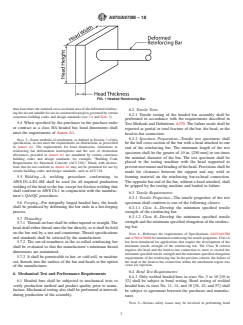
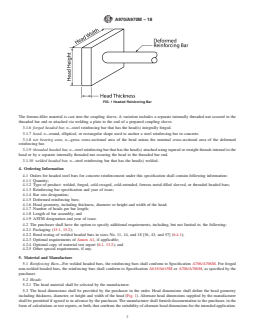
5.3 The head dimensions shall be provided by the purchaser in the order. Head dimensions shall define the head geometry
including thickness, diameter, or height and width of the head (Fig. 1). Alternate head dimensions supplied by the manufacturer
shall be permitted if agreed to in advance by the purchaser. The manufacturer shall furnish documentation to the purchaser, in the
form of calculations or test reports, or both, that confirms the suitability of alternate head dimensions for the intended application.
A970/A970M − 18
NOTE 2—Alternate head dimensions resulting in a net bearing area less than four times the nominal cross-sectional area of the deformed reinforcing
bar are not suitable for use in construction projects governed by certain consensus building codes and design standards (see 5.4 and Note 3).
5.4 When specified by the purchaser in the purchase order or contract as a class HA headed bar, head dimensions shall meet
the requirements of Annex A1.
NOTE 3—Some methods of attachment, as defined in Section 3 of this specification, do not meet the requirements on obstructions as prescribed in
Annex A1. The requirements for head dimensions, limitations to reinforcing bar deformation interruptions and the size of obstruction allowances provided
in Annex A1 are mandated by certain consensus building codes and design standards, for example, "Building Code Requirements for Structural Concrete
(ACI 318)." Heads with obstructions that do not conform to Annex A1 may not be permitted for use by certain building codes and design standards, such
as ACI 318.
5.5 Welding—A welding procedure conforming to AWS D1.4 ⁄D1.4M shall be used for all required production welding of the
head to the bar, except for friction welding that shall conform to AWS C6.1 in conjunction with the manufacturer’s QA/QC
procedures.
5.6 Forging—For integrally forged headed bars, the heads shall be produced by deforming the bar ends in a hot-forging process.
5.7 Threading:
5.7.1 Threads on bars shall be either tapered or straight. The head shall either thread onto the bar directly, or it shall be held
on the bar end by a nut and counternut. Thread specifications and standards shall be selected by the manufacturer.
5.7.2 The out-of-roundness in the as-rolled reinforcing bar shall be evaluated so that the manufacturer’s minimum thread
dimensions are maintained.
5.7.3 It shall be permissible to hot- or cold-roll, or machine cut, threads into the surface of the bar and heads at the option of
the manufacturer.
6. Mechanical Test and Performance Requirements
6.1 Headed bars shall be subjected to mechanical tests to verify production method and product quality prior to manufacture.
Mechanical testing also shall be performed at intervals during production of the assembly.
A970/A970M − 18
TABLE 1 Bend Test Requirements
Bar Designation No. Mandrel Diameter
A
3, 4, and 5 [10, 13, and 16] 3d
6, 7, and 8 [19, 22, and 25] 4d
9, 10, and 11 [29, 32, and 36] 6d
14 and 18 [43 and 57] 8d
A
d = nominal diameter of bar
6.2 Tensile Tests:
6.2.1 Tensile testing of the headed bar assembly shall be performed in accordance with the requirements described in Test
Methods and Definitions A370. The failure mode shall be reported as partial or total fracture of the bar, the head, or the head-to-bar
connection.
6.2.2 Specimen Preparation—Tensile test specimens shall be the full cross-section of the bar with a head attached to one end
of the reinforcing bar. The minimum length of the test specimen shall be the greater of 10 in. [250 mm] or ten times the nominal
diameter of the bar. The test specimen shall be placed in the testing machine with the head supported to prevent movement and
bending of the head. Provisions shall be made for clearance between the support and any weld or forming material on the
reinforcing bar-to-head connection. The opposite bar end of the bar, without a head attached, shall be gripped by the testing
machine and loaded to failure.
6.3 Tensile Requirements:
6.3.1 Tensile Properties—The tensile properties of the test specimen shall conform to one of the following classes:
6.3.1.1 Class A—Develop the minimum specified tensile strength of the reinforcing bar.
6.3.1.2 Class B—Develop the minimum specified tensile strength and the minimum specified elongation of the reinforcing bar.
NOTE 4—Reference the requirements of Specifications A615/A615M and A706/A706M for minimum reinforcing bar tensile properties. Class A has
been introduced for applications that require the development of the minimum tensile strength of the reinforcing bar. The Class B criteria requires the
head and the head-to-bar connection to meet or exceed the minimum specified tensile strength and the minimum specified elongation requirements of
the reinforcing bar. In the previous criteria, the failure of the head or the head-to-bar connection within the attachment region was cause for rejection.
6.4 Bend Test Requirements:
6.4.1 Only welded headed bars in sizes No. 3 to 10 [10 to 32] shall be subject to bend testing. Bend testing of welded headed
bars in sizes No. 11, 14, and 18 [36, 43, and 57] shall be subject to agreement between the purchaser and manufacturer.
NOTE 5—Serious safety issues may be involved in performing bend tests on welded headed bars in sizes No. 11, 14, and 18 [36, 43, and 57]. Thus,
6.4 requires such bend testing to be subject to agreement between the purchaser and manufacturer.
6.4.2 Procedure—The test specimen shall be bent around a mandrel of suitable diameter to an angle of at least 90° with no
observed partial or total fracture of the head, the bar, or the head-to-bar connection.
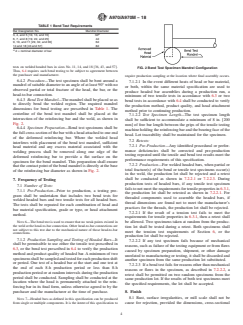
6.4.3 Bend Test Mandrel—The mandrel shall be placed so as to directly bend the welded region. The required mandrel
dimensions for bend testing are prescribed in Table 1. The centerline of the bend test mandrel shall be placed at the intersection
of the reinforcing bar and the weld, as shown in Fig. 2.
6.4.4 Specimen Preparation—Bend test specimens shall be the full cross-section of the bar with a head attached to one end of
the deformed reinforcing bar. Where the welded head interferes with placement of the bend test mandrel, sufficient head material
and any excess material associated with the welding process shall be removed along one edge of the deformed reinforcing bar to
provide a flat surface on the specimen for the bend mandrel. This preparation shall ensure that the contact point of the bend mandrel
is directly at the base of the reinforcing bar diameter as shown in Fig. 2.
7. Frequency of Testing
7.1 Number of Tests:
7.1.1 Pre-Production—Prior to production, a testing program shall be undertaken that includes two bend tests for welded headed
bars and two tensile tests for all headed bars. The tests shall be repeated for each combination of head and bar material
specification, grade or type, or head attachment method.
NOTE 6—The bend test is used to ensure that no weak points existed in the weld at the head-to-bar connection. Other head-to-bar connections are not
subject to this test due to the mechanical nature of those head-to-bar connections.
7.1.2 Production Sampling and Testing of Headed Bars—It shall be permissible to use either the tensile test prescribed in 6.3,
or the bend test prescribed in 6.4 to verify the production method and product quality of headed bar. A minimum of two specimens
shall be sampled and tested for each production shift or period. One test of a headed bar at the start and one test at the end of each
8-h production period or less than 8-h production period or at random intervals during the production period shall be conducted.
Sampling shall be conducted at the location where the head is permanently attached to the reinforcing bar in its final form, unless
otherwise agreed to by the purchaser and the manufacturer at the time of purchase.
NOTE 7—Headed bars as defined in this specification can be produced from single or multiple components. It is the intent of this specification to require
A970/A970M − 18
FIG. 2 Bend Test Specimen Mandrel Configuration
production sampling at the location where final assembly occurs.
7.1.2.1 In the event different heats of head or bar material, or both, within the same material specification are used to produce
headed bar assemblies during a production run, a minimum of two tensile tests in accordance with 6.3 or two bend tests in
accordance with 6.4 shall be conducted to verify the production method, product quality, and head attachment method prior to
continuing production.
7.1.2.2 Test Specimen Length—The test specimen length shall be sufficient to accommodate a minimum of 8 in. [200 mm] of
free bar length between the grips of the tensile testing machine holding the reinforcing bar and the bearing face of the head. Lot
traceability shall be maintained for the specimen.
7.2 Retests:
7.2.1 Pre-Production—Any identified procedural or performance deficiencies shall be corrected and pre-production testing
repeated until the tensile and bend test results meet the performance requirements of this specification.
7.2.2 Production—For welded headed bars, when partial or total fracture(s) of the bend or tensile test specimens occur(s) in the
weld, the production lot shall be rejected and a retest shall be conducted as shown in 7.2.2.1 or 7.2.2.3. During production tests
of headed bars, if any tensile test specimen fails to not meet the requirements for tensile properties in 6.3.1, the production lot shall
be retested as shown in 7.2.2.1. For threaded components used to assemble the headed bars, if thread dimensions are found not
to meet the manufacturer’s practices for the threads, the production lot shall be rejected.
7.2.2.1 If the result of a tension test fails to meet the requirements for tensile properties in 6.3.1, then a retest shall be allowed.
Two specimens taken at random from the production lot shall be tested during a retest. Both specimens shall meet the tension test
requirements of Section 6, or the production lot shall be rejected.
7.2.2.2 If any test specimen fails because of mechanical reasons, such as failure of the testing equipment or from flaws caused
by specimen preparation, shipment, or other damage unrelated to manufacturing or testing, it shall be discarded and another
specimen from the same production lot substituted.
7.2.2.3 If a bend test fails for reasons other than mechanical reasons or flaws in the specimen, as described in 7.2.2.2, a retest
shall be permitted on two random specimens from the same production lot. If the results of both test specimens meet the specified
requirements, the lot shall be accepted.
8. Finish
8.1 Rust, surface irregularities, or mill scale shall not be cause for rejection, provided the dimensions, cross-sectional area, and
tensile properties of a hand wire brushed specimen are not less than the requirements of this specification.
9. Inspection
9.1 The inspector representing the purchaser shall have free entry while work on the contract of the purchaser is being
performed to the parts of the manufacturer’s facilities that concern manufacture of the material ordered. The manufacturer shall
afford the inspector reasonable access to the facilit
...