

ASTM F1084-08(2024)
(Guide)Standard Guide for Sampling Oil/Water Mixtures for Oil Spill Recovery Equipment
General Information
- Abstract
SIGNIFICANCE AND USE
3.1 This guide provides techniques for obtaining representative samples of oil and water mixtures. This information is necessary in the calculation of oil recovery efficiency and oil recovery rates for oil collection devices.
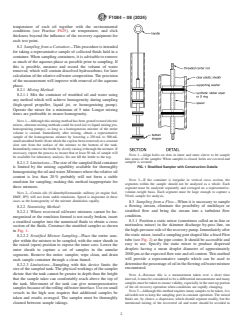
3.2 Sampling Stationary Mixtures—When recovered oil/water mixtures are contained within a holding tank and the relative oil content of the recovered fluid is needed, the sampling technique is somewhat dependent on the container. Two techniques are outlined in this guide. If the container has a flat bottom with straight sides perpendicular to the base (or nearly so), either stationary technique can be implemented, with the stratified sampling method preferred. If the container is irregular in either the horizontal or vertical cross section, the mixing method is preferred.
3.3 Sampling Flowing Mixtures—To sample flowing mixtures containing both oil and water, turbulence is induced, to create a homogenous mixture while sampling. The oil content in the sample taken from the flowing stream can then be used to quantify the performance-rating criterion (see Procedure Section of Test Method D1796).
SCOPE
1.1 This guide is intended for sampling flowing or stationary oil/water mixtures. It is intended for use with oil spill recovery devices either in testing or in documentation of field performance.
1.2 The values stated in SI units are to be regarded as standard. No other units of measurement are included in this standard.
1.3 This standard does not purport to address all of the safety concerns, if any, associated with its use. It is the responsibility of the user of this standard to establish appropriate safety, health, and environmental practices and determine the applicability of regulatory limitations prior to use.
1.4 This international standard was developed in accordance with internationally recognized principles on standardization established in the Decision on Principles for the Development of International Standards, Guides and Recommendations issued by the World Trade Organization Technical Barriers to Trade (TBT) Committee.
- Status
- Published
- Publication Date
- 29-Feb-2024
- Technical Committee
- F20 - Hazardous Substances and Oil Spill Response
- Drafting Committee
- F20.12 - Removal


Overview
ASTM F1084-08(2024) – Standard Guide for Sampling Oil/Water Mixtures for Oil Spill Recovery Equipment provides a systematic approach for obtaining representative samples of oil and water mixtures during oil spill recovery operations. Accurate sampling is essential for calculating oil recovery efficiency and verifying the performance of oil spill recovery devices under both laboratory and field conditions. Developed with international harmonization principles, this standard supports reliable measurement practices critical to environmental management, oil spill response, and efficiency assessments.
Key Topics
Sampling Stationary Mixtures
- Recovered oil/water mixtures in holding tanks require specific techniques based on the tank design.
- For tanks with flat bottoms and straight sides, stratified sampling or mixing methods are provided, with a preference for stratified sampling.
- Containers with irregular shapes are best sampled using the mixing method to ensure homogeneity.
Sampling Flowing Mixtures
- Turbulence is induced in flowing oil/water mixtures to create a homogeneous sample representative of the stream's oil content.
- This sampling helps quantify recovery device performance as per established test methods.
Sample Handling and Analysis
- A minimum of four samples should be taken under each set of sampling conditions to obtain reliable, averaged results.
- Glass containers, rigorously washed and accurately labeled, are recommended for sample collection.
- Samples do not require special preservation but must remain sealed until analysis.
- Key baseline data, including oil type, physical properties, and environmental conditions, must be recorded for each sampling event.
Accuracy and Limitations
- The methods outlined generally achieve results within 4-7% accuracy, depending on whether stationary or flowing mixtures are sampled.
- Physical limitations, tank design, and debris in recovery streams may affect sampling effectiveness and accuracy.
Applications
The ASTM F1084-08(2024) standard guide is widely used in:
Oil Spill Recovery Equipment Testing
- Establishes a foundation for evaluating the performance of skimmers and other oil spill recovery devices under controlled and field situations.
Environmental Monitoring and Compliance
- Supports documentation required for environmental audits, regulatory compliance, and reporting during and after spill response operations.
Research and Development
- Provides laboratories and manufacturers with proven methods for benchmarking new oil spill recovery technologies and improving sampling protocols.
Field Performance Documentation
- Ensures that field teams can accurately document the efficiency and effectiveness of oil/water separation in situ, leading to enhanced data reliability and better decision-making.
Related Standards
The guide references and is complemented by other key ASTM standards, including:
- ASTM D1796: Test Method for Water and Sediment in Fuel Oils by the Centrifuge Method. Establishes laboratory procedures for determining water and sediment content in fuel oils.
- ASTM D4007: Test Method for Water and Sediment in Crude Oil by the Centrifuge Method. Provides methods for accurate analysis of crude oil samples.
- ASTM F625: Practice for Classifying Water Bodies for Spill Control Systems. Offers classification techniques to better understand and control spill response in various water environments.
By following ASTM F1084-08(2024), environmental professionals, oil spill responders, and equipment manufacturers can ensure consistent, repeatable, and internationally recognized sampling procedures, thus enhancing oil spill recovery rates and supporting environmental stewardship.
Keywords: oil spill recovery, oil/water sampling, oil recovery efficiency, oil spill response, ASTM F1084, environmental monitoring, oil spill testing standards.
Relations
- Effective Date
- 01-Mar-2024
Get Certified
Connect with accredited certification bodies for this standard

CIS Institut d.o.o.
Personal Protective Equipment (PPE) certification body. Notified Body NB-2890 for EU Regulation 2016/425 PPE.

Kiwa BDA Testing
Building and construction product certification.
Kmetijski inštitut Slovenije
Agricultural Institute of Slovenia. Soil testing, plant health, agricultural product analysis.
Sponsored listings
Frequently Asked Questions
ASTM F1084-08(2024) is a guide published by ASTM International. Its full title is "Standard Guide for Sampling Oil/Water Mixtures for Oil Spill Recovery Equipment". This standard covers: SIGNIFICANCE AND USE 3.1 This guide provides techniques for obtaining representative samples of oil and water mixtures. This information is necessary in the calculation of oil recovery efficiency and oil recovery rates for oil collection devices. 3.2 Sampling Stationary Mixtures—When recovered oil/water mixtures are contained within a holding tank and the relative oil content of the recovered fluid is needed, the sampling technique is somewhat dependent on the container. Two techniques are outlined in this guide. If the container has a flat bottom with straight sides perpendicular to the base (or nearly so), either stationary technique can be implemented, with the stratified sampling method preferred. If the container is irregular in either the horizontal or vertical cross section, the mixing method is preferred. 3.3 Sampling Flowing Mixtures—To sample flowing mixtures containing both oil and water, turbulence is induced, to create a homogenous mixture while sampling. The oil content in the sample taken from the flowing stream can then be used to quantify the performance-rating criterion (see Procedure Section of Test Method D1796). SCOPE 1.1 This guide is intended for sampling flowing or stationary oil/water mixtures. It is intended for use with oil spill recovery devices either in testing or in documentation of field performance. 1.2 The values stated in SI units are to be regarded as standard. No other units of measurement are included in this standard. 1.3 This standard does not purport to address all of the safety concerns, if any, associated with its use. It is the responsibility of the user of this standard to establish appropriate safety, health, and environmental practices and determine the applicability of regulatory limitations prior to use. 1.4 This international standard was developed in accordance with internationally recognized principles on standardization established in the Decision on Principles for the Development of International Standards, Guides and Recommendations issued by the World Trade Organization Technical Barriers to Trade (TBT) Committee.
SIGNIFICANCE AND USE 3.1 This guide provides techniques for obtaining representative samples of oil and water mixtures. This information is necessary in the calculation of oil recovery efficiency and oil recovery rates for oil collection devices. 3.2 Sampling Stationary Mixtures—When recovered oil/water mixtures are contained within a holding tank and the relative oil content of the recovered fluid is needed, the sampling technique is somewhat dependent on the container. Two techniques are outlined in this guide. If the container has a flat bottom with straight sides perpendicular to the base (or nearly so), either stationary technique can be implemented, with the stratified sampling method preferred. If the container is irregular in either the horizontal or vertical cross section, the mixing method is preferred. 3.3 Sampling Flowing Mixtures—To sample flowing mixtures containing both oil and water, turbulence is induced, to create a homogenous mixture while sampling. The oil content in the sample taken from the flowing stream can then be used to quantify the performance-rating criterion (see Procedure Section of Test Method D1796). SCOPE 1.1 This guide is intended for sampling flowing or stationary oil/water mixtures. It is intended for use with oil spill recovery devices either in testing or in documentation of field performance. 1.2 The values stated in SI units are to be regarded as standard. No other units of measurement are included in this standard. 1.3 This standard does not purport to address all of the safety concerns, if any, associated with its use. It is the responsibility of the user of this standard to establish appropriate safety, health, and environmental practices and determine the applicability of regulatory limitations prior to use. 1.4 This international standard was developed in accordance with internationally recognized principles on standardization established in the Decision on Principles for the Development of International Standards, Guides and Recommendations issued by the World Trade Organization Technical Barriers to Trade (TBT) Committee.
ASTM F1084-08(2024) is classified under the following ICS (International Classification for Standards) categories: 13.060.10 - Water of natural resources. The ICS classification helps identify the subject area and facilitates finding related standards.
ASTM F1084-08(2024) has the following relationships with other standards: It is inter standard links to ASTM F1084-08(2018). Understanding these relationships helps ensure you are using the most current and applicable version of the standard.
ASTM F1084-08(2024) is available in PDF format for immediate download after purchase. The document can be added to your cart and obtained through the secure checkout process. Digital delivery ensures instant access to the complete standard document.
Standards Content (Sample)
This international standard was developed in accordance with internationally recognized principles on standardization established in the Decision on Principles for the
Development of International Standards, Guides and Recommendations issued by the World Trade Organization Technical Barriers to Trade (TBT) Committee.
Designation: F1084 − 08 (Reapproved 2024)
Standard Guide for
Sampling Oil/Water Mixtures for Oil Spill Recovery
Equipment
This standard is issued under the fixed designation F1084; the number immediately following the designation indicates the year of
original adoption or, in the case of revision, the year of last revision. A number in parentheses indicates the year of last reapproval. A
superscript epsilon (´) indicates an editorial change since the last revision or reapproval.
1. Scope necessary in the calculation of oil recovery efficiency and oil
recovery rates for oil collection devices.
1.1 This guide is intended for sampling flowing or station-
ary oil/water mixtures. It is intended for use with oil spill 3.2 Sampling Stationary Mixtures—When recovered oil/
recovery devices either in testing or in documentation of field water mixtures are contained within a holding tank and the
performance. relative oil content of the recovered fluid is needed, the
sampling technique is somewhat dependent on the container.
1.2 The values stated in SI units are to be regarded as
Two techniques are outlined in this guide. If the container has
standard. No other units of measurement are included in this
a flat bottom with straight sides perpendicular to the base (or
standard.
nearly so), either stationary technique can be implemented,
1.3 This standard does not purport to address all of the
with the stratified sampling method preferred. If the container
safety concerns, if any, associated with its use. It is the
is irregular in either the horizontal or vertical cross section, the
responsibility of the user of this standard to establish appro-
mixing method is preferred.
priate safety, health, and environmental practices and deter-
3.3 Sampling Flowing Mixtures—To sample flowing mix-
mine the applicability of regulatory limitations prior to use.
tures containing both oil and water, turbulence is induced, to
1.4 This international standard was developed in accor-
create a homogenous mixture while sampling. The oil content
dance with internationally recognized principles on standard-
in the sample taken from the flowing stream can then be used
ization established in the Decision on Principles for the
to quantify the performance-rating criterion (see Procedure
Development of International Standards, Guides and Recom-
Section of Test Method D1796).
mendations issued by the World Trade Organization Technical
Barriers to Trade (TBT) Committee.
4. Number of Samples
4.1 Take a minimum of four samples under each set of
2. Referenced Documents
conditions to average results and store the samples separately.
2.1 ASTM Standards:
In less ideal sampling conditions, take additional samples.
D1796 Test Method for Water and Sediment in Fuel Oils by
the Centrifuge Method (Laboratory Procedure) 5. Containers
D4007 Test Method for Water and Sediment in Crude Oil by
5.1 A dry, water-washed glass sample container.
the Centrifuge Method (Laboratory Procedure)
6. Labeling
F625 Practice for Classifying Water Bodies for Spill Control
Systems
6.1 Mark the sample container with the source, type of oil,
date and time of sampling, the name of the person taking the
3. Significance and Use
sample, and a sample number. Require water and oil-resistant
3.1 This guide provides techniques for obtaining represen- labeling. If several receiving containers are to be sampled, they
tative samples of oil and water mixtures. This information is must be identified and the samples marked for later coordina-
tion.
7. Preservation and Storage
This guide is under the jurisdiction of ASTM Committee F20 on Hazardous
Substances and Oil Spill Response and is the direct responsibility of Subcommittee
7.1 The samples do not require special treatment to preserve
F20.12 on Removal.
their integrity other than ensuring that they remain sealed until
Current edition approved March 1, 2024. Published March 2024. Originally
approved in 1987. Last previous edition approved in 2018 as F1084 – 08 (2018).
analyzed. Note date and time of analysis for each sample.
DOI: 10.1520/F1084-08R24.
For referenced ASTM standards, visit the ASTM website, www.astm.org, or 8. Procedure
contact ASTM Customer Service at service@astm.org. For Annual Book of ASTM
8.1 Baseline Data—The test fluids may be crude, refined, or
Standards volume information, refer to the standard’s Document Summary page on
the ASTM website. synthetic oils. Record type, specific gravity, viscosity, and
Copyright © ASTM International, 100 Barr Harbor Drive, PO Box C700, West Conshohocken, PA 19428-2959. United States
F1084 − 08 (2024)
temperature of each oil together with the environmental
conditions (see Practice F625), air temperature, and slick
thickness beyond the influence of the recovery equipment for
each test point.
8.2 Sampling from a Container—This procedure is intended
for taking a representative sample of collected fluids held in a
container. When sampling containers, it is advisable to remove
as much of the aqueous phase as possible prior to sampling. If
this is possible, measure and record the volume of water
removed, which will contain dissolved hydrocarbons, for later
calculation of the relative oil/water composition. The precision
of the measurement will improve with removal of the aqueous
phase.
8.2.1 Mixing Method:
8.2.1.1 Mix the container of stratified oil and water using
any method which will achieve homogeneity during sampling
(high-speed propeller, liquid jet, or homogenizing pump).
Operate the mixer for a minimum of 5 min. Longer mixing
times are preferable to ensure homogeneity.
NOTE 1—Although this mixing method has been geared toward electric
mixers, alternate mixing methods could be used (air or liquid mixing jets,
homogenizing pumps), so long as a homogeneous mixture of the entire
volume is created. Immediately after mixing, obtain a representative
sample of the homogeneous mixture by lowering a 250 mL to 500 mL
small-mouthed bottle (from which the cap has been removed) at a constant
slow rate from the surface of the mixture to the bottom of the tank.
Immediately remove the bottle by slowly raising it through the mixture. If
necessary, repeat the process to ensure that at least 50 mL of sample will
NOTE 1—Align holes on slots in inner and outer sleeve to let sample
be available for laboratory analysis. Do not fill the bottle to the top.
into zones of the sampler. When sampler is closed, holes are covered and
8.2.1.2 Limitations—The size of the sampled fluid container sampler is secured.
FIG. 1 Stratified Sampler with Construction Details
is li
...