

ASTM A795/A795M-21
(Specification)Standard Specification for Black and Hot-Dipped Zinc-Coated (Galvanized) Welded and Seamless Steel Pipe for Fire Protection Use
General Information
- Abstract
ABSTRACT
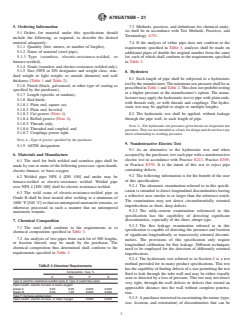
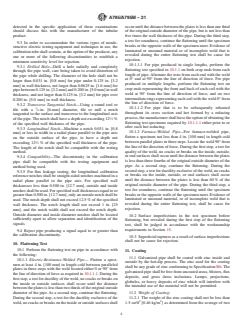
This specification covers black and hot-dipped zinc-coated (galvanized) welded and seamless steel pipe for fire protection use. The pipe may be bent, but it is not intended for bending made at ambient temperature wherein the inside diameter of the bend is less than twelve times the outside diameter of the pipe being bent. The steel shall conform to the required chemical composition. Each length of pipe shall be subjected to a hydrostatic test without leakage through the pipe wall. As an alternative to the hydrostatic test, and when accepted by the purchaser, each pipe shall be tested with a non-destructive electrical method. Finally, flattening test shall be performed on the pipe in accordance with, electric-resistance-welded pipe, and furnace-welded pipe.
SCOPE
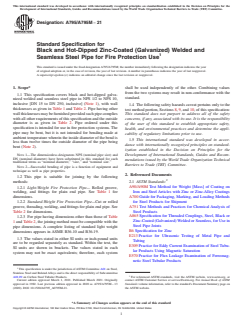
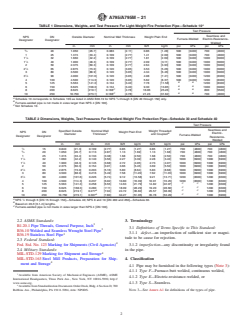
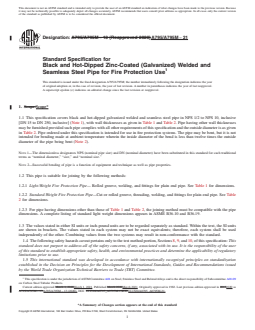
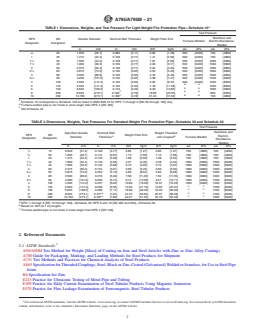
1.1 This specification covers black and hot-dipped galvanized welded and seamless steel pipe in NPS 1/2 to NPS 10, inclusive [DN 15 to DN 250, inclusive] (Note 1), with wall thicknesses as given in Table 1 and Table 2. Pipe having other wall thicknesses may be furnished provided such pipe complies with all other requirements of this specification and the outside diameter is as given in Table 2. Pipe ordered under this specification is intended for use in fire protection systems. The pipe may be bent, but it is not intended for bending made at ambient temperature wherein the inside diameter of the bend is less than twelve times the outside diameter of the pipe being bent (Note 2).
Note 1: The dimensionless designators NPS (nominal pipe size) and DN (nominal diameter) have been substituted in this standard for such traditional terms as “nominal diameter,” “size,” and “nominal size.”
Note 2: Successful bending of pipe is a function of equipment and technique as well as pipe properties.
1.2 This pipe is suitable for joining by the following methods:
1.2.1 Light-Weight Fire Protection Pipe—Rolled groove, welding, and fittings for plain end pipe. See Table 1 for dimensions.
1.2.2 Standard-Weight Fire Protection Pipe—Cut or rolled groove, threading, welding, and fittings for plain end pipe. See Table 2 for dimensions.
1.2.3 For pipe having dimensions other than those of Table 1 and Table 2, the joining method must be compatible with the pipe dimensions. A complete listing of standard light weight dimensions appears in ASME B36.10 and B36.19.
1.3 The values stated in either SI units or inch-pound units are to be regarded separately as standard. Within the text, the SI units are shown in brackets. The values stated in each system may not be exact equivalents; therefore, each system shall be used independently of the other. Combining values from the two systems may result in non-conformance with the standard.
1.4 The following safety hazards caveat pertains only to the test method portion, Sections 8, 9, and 10, of this specification: This standard does not purport to address all of the safety concerns, if any, associated with its use. It is the responsibility of the user of this standard to establish appropriate safety, health, and environmental practices and determine the applicability of regulatory limitations prior to use.
1.5 This international standard was developed in accordance with internationally recognized principles on standardization established in the Decision on Principles for the Development of International Standards, Guides and Recommendations issued by the World Trade Organization Technical Barriers to Trade (TBT) Committee.
- Status
- Published
- Publication Date
- 28-Feb-2021
- Technical Committee
- A01 - Steel, Stainless Steel and Related Alloys
- Drafting Committee
- A01.09 - Carbon Steel Tubular Products
Buy Documents
ASTM A795/A795M-21 - Standard Specification for Black and Hot-Dipped Zinc-Coated (Galvanized) Welded and Seamless Steel Pipe for Fire Protection Use
REDLINE ASTM A795/A795M-21 - Standard Specification for Black and Hot-Dipped Zinc-Coated (Galvanized) Welded and Seamless Steel Pipe for Fire Protection Use
Overview
ASTM A795/A795M-21 is the standard specification for black and hot-dipped zinc-coated (galvanized) welded and seamless steel pipe used specifically for fire protection systems. Developed by ASTM International, this standard ensures that steel piping, ranging from NPS 1/2 to NPS 10 [DN 15 to DN 250], meets rigorous requirements for chemical composition, mechanical testing, and dimensional consistency. The specification covers both black and galvanized finishes and delineates processes and tests to guarantee reliability and safety in fire protection applications.
This international standard supports compliance with building codes by providing a recognized benchmark for the manufacture and acceptance of steel pipes in fire protection systems worldwide.
Key Topics
- Pipe Types and Sizes: Covers welded (electric-resistance and furnace-welded) and seamless steel pipes with specified wall thickness for both light-weight (Schedule 10) and standard-weight (Schedule 30 and 40) applications.
- Intended Use: Designed for fire protection piping systems such as fire sprinkler systems, where reliability and performance are critical.
- Bending Guidelines: Pipe may be bent, but is not intended for tight-radius bending at ambient temperature where the inside diameter of the bend is less than twelve times the outside diameter of the pipe.
- Joining Methods:
- Light-Weight Pipe: Suitable for rolled groove, welding, and fittings.
- Standard-Weight Pipe: Compatible with cut or rolled groove, threading, welding, and fittings.
- Testing Requirements:
- Hydrostatic Test: Each pipe length must pass a hydrostatic test to ensure no leakage.
- Alternative Non-Destructive Electric Tests: Such as ultrasonic, eddy current, or flux leakage tests may be used if agreed upon by the purchaser.
- Flattening Test: Conducted according to the pipe type to assess ductility and weld quality.
- Zinc Coating (Galvanizing): For galvanized pipe, a minimum zinc coating weight is required and verified by standardized test methods. The finish must be continuous and free from defects.
- Dimensional Tolerances: Prescribed limits for outside diameter, wall thickness, and weight to ensure consistent and safe installation.
- Marking and Certification: Each pipe length must be clearly marked with manufacturer information, pipe type, and compliance to ASTM A795/A795M-21, supported by inspection certification if requested.
Applications
The main application of ASTM A795/A795M-21 certified pipe is in the installation of fire protection systems, where strict reliability and performance standards are required. Key uses include:
- Automatic Sprinkler Systems: Ensures water delivery in fire scenarios.
- Standpipe Systems: Provides water transport for manual fire fighting.
- Fire Hydrant Networks: Integral part of fire suppression infrastructure.
- Fire Pump Discharge and Suction Piping: Critical piping for fire pump performance.
Building owners, engineers, contractors, and fire safety professionals rely on pipes meeting ASTM A795/A795M-21 for consistent quality, ease of installation, and compliance with local and international fire safety codes.
Related Standards
Understanding related standards is essential for complete compliance and system integration:
- ASTM A53/A53M: Specification for pipe, steel, black and hot-dipped zinc-coated, welded and seamless.
- ASTM A135/A135M: Standard for electric-resistance-welded steel pipe.
- ASME B36.10, B36.19: Dimensions for welded, seamless wrought, and stainless steel pipe.
- ASTM B6: Requirements for zinc used in hot-dip galvanizing.
- ASTM A865: Specification for threaded steel pipe couplings.
- NFPA 13: Standard for the Installation of Sprinkler Systems, which references ASTM pipe standards.
By specifying ASTM A795/A795M-21, stakeholders ensure that fire protection piping systems are robust, safe, and consistent with global best practices. Compliance with this standard supports insurance requirements, code approvals, and peace of mind that fire suppression systems will perform as needed.
Relations
- Effective Date
- 01-Jun-2020
- Effective Date
- 01-Nov-2019
- Effective Date
- 01-Jun-2015
- Effective Date
- 01-Jun-2015
- Effective Date
- 01-Nov-2014
- Effective Date
- 01-Mar-2014
- Effective Date
- 01-Feb-2013
- Effective Date
- 01-May-2012
- Effective Date
- 15-Feb-2011
- Effective Date
- 01-Oct-2009
- Effective Date
- 01-Jun-2009
- Effective Date
- 01-Jun-2009
- Effective Date
- 01-Nov-2008
- Effective Date
- 01-Oct-2008
- Effective Date
- 01-Jun-2007
Buy Documents
ASTM A795/A795M-21 - Standard Specification for Black and Hot-Dipped Zinc-Coated (Galvanized) Welded and Seamless Steel Pipe for Fire Protection Use
REDLINE ASTM A795/A795M-21 - Standard Specification for Black and Hot-Dipped Zinc-Coated (Galvanized) Welded and Seamless Steel Pipe for Fire Protection Use
Get Certified
Connect with accredited certification bodies for this standard

Institut za varilstvo d.o.o. (Welding Institute)
Slovenia's leading welding institute since 1952. ISO 3834, EN 1090, pressure equipment certification, NDT personnel, welder qualification. Only IIW Au
Sponsored listings
Frequently Asked Questions
ASTM A795/A795M-21 is a technical specification published by ASTM International. Its full title is "Standard Specification for Black and Hot-Dipped Zinc-Coated (Galvanized) Welded and Seamless Steel Pipe for Fire Protection Use". This standard covers: ABSTRACT This specification covers black and hot-dipped zinc-coated (galvanized) welded and seamless steel pipe for fire protection use. The pipe may be bent, but it is not intended for bending made at ambient temperature wherein the inside diameter of the bend is less than twelve times the outside diameter of the pipe being bent. The steel shall conform to the required chemical composition. Each length of pipe shall be subjected to a hydrostatic test without leakage through the pipe wall. As an alternative to the hydrostatic test, and when accepted by the purchaser, each pipe shall be tested with a non-destructive electrical method. Finally, flattening test shall be performed on the pipe in accordance with, electric-resistance-welded pipe, and furnace-welded pipe. SCOPE 1.1 This specification covers black and hot-dipped galvanized welded and seamless steel pipe in NPS 1/2 to NPS 10, inclusive [DN 15 to DN 250, inclusive] (Note 1), with wall thicknesses as given in Table 1 and Table 2. Pipe having other wall thicknesses may be furnished provided such pipe complies with all other requirements of this specification and the outside diameter is as given in Table 2. Pipe ordered under this specification is intended for use in fire protection systems. The pipe may be bent, but it is not intended for bending made at ambient temperature wherein the inside diameter of the bend is less than twelve times the outside diameter of the pipe being bent (Note 2). Note 1: The dimensionless designators NPS (nominal pipe size) and DN (nominal diameter) have been substituted in this standard for such traditional terms as “nominal diameter,” “size,” and “nominal size.” Note 2: Successful bending of pipe is a function of equipment and technique as well as pipe properties. 1.2 This pipe is suitable for joining by the following methods: 1.2.1 Light-Weight Fire Protection Pipe—Rolled groove, welding, and fittings for plain end pipe. See Table 1 for dimensions. 1.2.2 Standard-Weight Fire Protection Pipe—Cut or rolled groove, threading, welding, and fittings for plain end pipe. See Table 2 for dimensions. 1.2.3 For pipe having dimensions other than those of Table 1 and Table 2, the joining method must be compatible with the pipe dimensions. A complete listing of standard light weight dimensions appears in ASME B36.10 and B36.19. 1.3 The values stated in either SI units or inch-pound units are to be regarded separately as standard. Within the text, the SI units are shown in brackets. The values stated in each system may not be exact equivalents; therefore, each system shall be used independently of the other. Combining values from the two systems may result in non-conformance with the standard. 1.4 The following safety hazards caveat pertains only to the test method portion, Sections 8, 9, and 10, of this specification: This standard does not purport to address all of the safety concerns, if any, associated with its use. It is the responsibility of the user of this standard to establish appropriate safety, health, and environmental practices and determine the applicability of regulatory limitations prior to use. 1.5 This international standard was developed in accordance with internationally recognized principles on standardization established in the Decision on Principles for the Development of International Standards, Guides and Recommendations issued by the World Trade Organization Technical Barriers to Trade (TBT) Committee.
ABSTRACT This specification covers black and hot-dipped zinc-coated (galvanized) welded and seamless steel pipe for fire protection use. The pipe may be bent, but it is not intended for bending made at ambient temperature wherein the inside diameter of the bend is less than twelve times the outside diameter of the pipe being bent. The steel shall conform to the required chemical composition. Each length of pipe shall be subjected to a hydrostatic test without leakage through the pipe wall. As an alternative to the hydrostatic test, and when accepted by the purchaser, each pipe shall be tested with a non-destructive electrical method. Finally, flattening test shall be performed on the pipe in accordance with, electric-resistance-welded pipe, and furnace-welded pipe. SCOPE 1.1 This specification covers black and hot-dipped galvanized welded and seamless steel pipe in NPS 1/2 to NPS 10, inclusive [DN 15 to DN 250, inclusive] (Note 1), with wall thicknesses as given in Table 1 and Table 2. Pipe having other wall thicknesses may be furnished provided such pipe complies with all other requirements of this specification and the outside diameter is as given in Table 2. Pipe ordered under this specification is intended for use in fire protection systems. The pipe may be bent, but it is not intended for bending made at ambient temperature wherein the inside diameter of the bend is less than twelve times the outside diameter of the pipe being bent (Note 2). Note 1: The dimensionless designators NPS (nominal pipe size) and DN (nominal diameter) have been substituted in this standard for such traditional terms as “nominal diameter,” “size,” and “nominal size.” Note 2: Successful bending of pipe is a function of equipment and technique as well as pipe properties. 1.2 This pipe is suitable for joining by the following methods: 1.2.1 Light-Weight Fire Protection Pipe—Rolled groove, welding, and fittings for plain end pipe. See Table 1 for dimensions. 1.2.2 Standard-Weight Fire Protection Pipe—Cut or rolled groove, threading, welding, and fittings for plain end pipe. See Table 2 for dimensions. 1.2.3 For pipe having dimensions other than those of Table 1 and Table 2, the joining method must be compatible with the pipe dimensions. A complete listing of standard light weight dimensions appears in ASME B36.10 and B36.19. 1.3 The values stated in either SI units or inch-pound units are to be regarded separately as standard. Within the text, the SI units are shown in brackets. The values stated in each system may not be exact equivalents; therefore, each system shall be used independently of the other. Combining values from the two systems may result in non-conformance with the standard. 1.4 The following safety hazards caveat pertains only to the test method portion, Sections 8, 9, and 10, of this specification: This standard does not purport to address all of the safety concerns, if any, associated with its use. It is the responsibility of the user of this standard to establish appropriate safety, health, and environmental practices and determine the applicability of regulatory limitations prior to use. 1.5 This international standard was developed in accordance with internationally recognized principles on standardization established in the Decision on Principles for the Development of International Standards, Guides and Recommendations issued by the World Trade Organization Technical Barriers to Trade (TBT) Committee.
ASTM A795/A795M-21 is classified under the following ICS (International Classification for Standards) categories: 23.040.10 - Iron and steel pipes. The ICS classification helps identify the subject area and facilitates finding related standards.
ASTM A795/A795M-21 has the following relationships with other standards: It is inter standard links to ASTM E570-20, ASTM A700-14(2019), ASTM E570-15, ASTM E570-15e1, ASTM A700-14, ASTM A751-14, ASTM B6-13, ASTM B6-12, ASTM E309-11, ASTM B6-09, ASTM E213-09, ASTM E570-09, ASTM B6-08, ASTM A751-08, ASTM A751-07a. Understanding these relationships helps ensure you are using the most current and applicable version of the standard.
ASTM A795/A795M-21 is available in PDF format for immediate download after purchase. The document can be added to your cart and obtained through the secure checkout process. Digital delivery ensures instant access to the complete standard document.
Standards Content (Sample)
This international standard was developed in accordance with internationally recognized principles on standardization established in the Decision on Principles for the
Development of International Standards, Guides and Recommendations issued by the World Trade Organization Technical Barriers to Trade (TBT) Committee.
Designation:A795/A795M −21
Standard Specification for
Black and Hot-Dipped Zinc-Coated (Galvanized) Welded and
Seamless Steel Pipe for Fire Protection Use
This standard is issued under the fixed designationA795/A795M; the number immediately following the designation indicates the year
of original adoption or, in the case of revision, the year of last revision. A number in parentheses indicates the year of last reapproval.
A superscript epsilon (´) indicates an editorial change since the last revision or reapproval.
1. Scope* shall be used independently of the other. Combining values
from the two systems may result in non-conformance with the
1.1 This specification covers black and hot-dipped galva-
standard.
nized welded and seamless steel pipe in NPS 1/2 to NPS 10,
inclusive [DN 15 to DN 250, inclusive] (Note 1), with wall
1.4 The following safety hazards caveat pertains only to the
thicknesses as given in Table 1 and Table 2. Pipe having other
test method portion, Sections 8, 9, and 10, of this specification:
wallthicknessesmaybefurnishedprovidedsuchpipecomplies
This standard does not purport to address all of the safety
with all other requirements of this specification and the outside
concerns, if any, associated with its use. It is the responsibility
diameter is as given in Table 2. Pipe ordered under this
of the user of this standard to establish appropriate safety,
specification is intended for use in fire protection systems. The
health, and environmental practices and determine the appli-
pipe may be bent, but it is not intended for bending made at
cability of regulatory limitations prior to use.
ambient temperature wherein the inside diameter of the bend is
1.5 This international standard was developed in accor-
less than twelve times the outside diameter of the pipe being
dance with internationally recognized principles on standard-
bent (Note 2).
ization established in the Decision on Principles for the
NOTE 1—The dimensionless designators NPS (nominal pipe size) and Development of International Standards, Guides and Recom-
DN (nominal diameter) have been substituted in this standard for such
mendations issued by the World Trade Organization Technical
traditional terms as “nominal diameter,” “size,” and “nominal size.”
Barriers to Trade (TBT) Committee.
NOTE 2—Successful bending of pipe is a function of equipment and
technique as well as pipe properties.
2. Referenced Documents
1.2 This pipe is suitable for joining by the following
methods: 2.1 ASTM Standards:
A90/A90M Test Method for Weight [Mass] of Coating on
1.2.1 Light-Weight Fire Protection Pipe— Rolled groove,
Iron and Steel Articles with Zinc or Zinc-Alloy Coatings
welding, and fittings for plain end pipe. See Table 1 for
A700 Guide for Packaging, Marking, and Loading Methods
dimensions.
for Steel Products for Shipment
1.2.2 Standard-Weight Fire Protection Pipe—Cut or rolled
A751 Test Methods and Practices for Chemical Analysis of
groove, threading, welding, and fittings for plain end pipe. See
Steel Products
Table 2 for dimensions.
A865 Specification for Threaded Couplings, Steel, Black or
1.2.3 For pipe having dimensions other than those of Table
Zinc-Coated (Galvanized)Welded or Seamless, for Use in
1 and Table 2, the joining method must be compatible with the
Steel Pipe Joints
pipe dimensions. A complete listing of standard light weight
B6 Specification for Zinc
dimensions appears in ASME B36.10 and B36.19.
E213 Practice for Ultrasonic Testing of Metal Pipe and
1.3 The values stated in either SI units or inch-pound units
Tubing
are to be regarded separately as standard. Within the text, the
E309 Practice for Eddy Current Examination of Steel Tubu-
SI units are shown in brackets. The values stated in each
lar Products Using Magnetic Saturation
system may not be exact equivalents; therefore, each system
E570 Practice for Flux Leakage Examination of Ferromag-
netic Steel Tubular Products
This specification is under the jurisdiction of ASTM Committee A01 on Steel,
Stainless Steel and Related Alloys and is the direct responsibility of Subcommittee
A01.09 on Carbon Steel Tubular Products. For referenced ASTM standards, visit the ASTM website, www.astm.org, or
Current edition approved March 1, 2021. Published March 2021. Originally contact ASTM Customer Service at service@astm.org. For Annual Book of ASTM
approved in 1982. Last previous edition approved in 2020 as A795/A795M – 13 Standards volume information, refer to the standard’s Document Summary page on
(2020). DOI: 10.1520/A0795_A0795M-21. the ASTM website.
*A Summary of Changes section appears at the end of this standard
Copyright © ASTM International, 100 Barr Harbor Drive, PO Box C700, West Conshohocken, PA 19428-2959. United States
A795/A795M−21
A
TABLE 1 Dimensions, Weights, and Test Pressure For Light-Weight Fire Protection Pipe—Schedule 10
Test Pressure
Seamless and
NPS DN Outside Diameter Nominal Wall Thickness Weight Plain End
Furnace-Welded Electric-Resistance-
Designator Designator
Welded
in. mm in. mm lb/ft kg/m psi kPa psi kPa
⁄4 20 1.050 [26.7] 0.083 [2.11] 0.86 [1.28] 500 [3400] 700 [4800]
1 25 1.315 [33.4] 0.109 [2.77] 1.41 [2.09] 500 [3400] 700 [4800]
1 ⁄4 32 1.660 [42.2] 0.109 [2.77] 1.81 [2.69] 500 [3400] 1000 [6900]
1 ⁄2 40 1.900 [48.3] 0.109 [2.77] 2.09 [3.11] 500 [3400] 1000 [6900]
2 50 2.375 [60.3] 0.109 [2.77] 2.64 [3.93] 500 [3400] 1000 [6900]
2 ⁄2 65 2.875 [73.0] 0.120 [3.05] 3.53 [5.26] 500 [3400] 1000 [6900]
3 80 3.500 [88.9] 0.120 [3.05] 4.34 [6.46] 500 [3400] 1000 [6900]
3 ⁄2 90 4.000 [101.6] 0.120 [3.05] 4.98 [7.41] 500 [3400] 1200 [8300]
4 100 4.500 [114.3] 0.120 [3.05] 5.62 [8.37] 500 [3400] 1200 [8300]
BB
5 125 5.563 [141.3] 0.134 [3.40] 7.78 [11.58] 1200 [8300]
BB
6 150 6.625 [168.3] 0.134 [3.40] 9.30 [13.85] 1000 [6900]
C BB
8 200 8.625 [219.1] 0.188 [4.78] 16.96 [25.26] 800 [5500]
C BB
10 250 10.750 [273.1] 0.188 [4.78] 21.23 [31.62] 700 [4800]
A
Schedule 10 corresponds to Schedule 10S as listed in ANSI B36.19 for NPS ⁄4 through 6 [DN 20 through 150] only.
B
Furnace-welded pipe is not made in sizes larger than NPS 4 [DN 100].
C
Not Schedule 10.
TABLE 2 Dimensions, Weights, Test Pressures For Standard-Weight Fire Protection Pipe—Schedule 30 and Schedule 40
Test Pressure
Seamless and
Specified Outside Nominal Wall Weight Threaded
NPS DN Weight Plain End
A B Electric-
Diameter Thickness and Coupled
Furnace-Welded
Designator Designator
Resistance-
Welded
in. mm in. mm lb/ft kg/m lb/ft kg/m psi kPa psi kPa
⁄2 15 0.840 [21.3] 0.109 [2.77] 0.85 [1.27] 0.85 [1.27] 700 [4800] 700 [4800]
⁄4 20 1.050 [26.7] 0.113 [2.87] 1.13 [1.69] 1.13 [1.68] 700 [4800] 700 [4800]
1 25 1.315 [33.4] 0.133 [3.38] 1.68 [2.50] 1.68 [2.50] 700 [4800] 700 [4800]
1 ⁄4 32 1.660 [42.2] 0.140 [3.56] 2.27 [3.39] 2.28 [3.40] 1000 [6900] 1000 [6900]
1 ⁄2 40 1.900 [48.3] 0.145 [3.68] 2.72 [4.05] 2.73 [4.07] 1000 [6900] 1000 [6900]
2 50 2.375 [60.3] 0.154 [3.91] 3.66 [5.45] 3.69 [5.50] 1000 [6900] 1000 [6900]
2 ⁄2 65 2.875 [73.0] 0.203 [5.16] 5.80 [8.64] 5.83 [8.68] 1000 [6900] 1000 [6900]
3 80 3.500 [88.9] 0.216 [5.49] 7.58 [11.29] 7.62 [11.35] 1000 [6900] 1000 [6900]
3 ⁄2 90 4.000 [101.6] 0.226 [5.74] 9.12 [13.58] 9.21 [13.71] 1200 [8300] 1200 [8300]
4 100 4.500 [114.3] 0.237 [6.02] 10.80 [16.09] 10.91 [16.25] 1200 [8300] 1200 [8300]
CC
5 125 5.563 [141.3] 0.258 [6.55] 14.63 [21.79] 14.82 [22.07] 1200 [8300]
CC
6 150 6.625 [168.3] 0.280 [7.11] 18.99 [28.29] 19.20 [28.60] 1200 [8300]
A CC
8 200 8.625 [219.1] 0.277 [7.04] 24.72 [36.82] 25.57 [38.09] 1200 [8300]
A CC
10 250 10.750 [273.1] 0.307 [7.80] 34.27 [51.05] 35.78 [53.29] 1000 [6900]
A
NPS ⁄2 through 6 [DN 15 through 150]—Schedule 40; NPS 8 and 10 [DN 200 and 250]—Schedule 30.
B
Based on 20-ft [6.1-m] lengths.
C
Furnace-welded pipe is not made in sizes larger than NPS 4 [DN 100].
2.2 ASME Standards: 3. Terminology
B1.20.1 Pipe Threads, General Purpose, Inch
3.1 Definitions of Terms Specific to This Standard:
B36.10 Welded and Seamless Wrought Steel Pipe
3.1.1 defect—an imperfection of sufficient size or magni-
B36.19 Stainless Steel Pipe
tude to be cause for rejection.
2.3 Federal Standard:
Fed. Std. No. 123 Marking for Shipments (Civil Agencies) 3.1.2 imperfection—any discontinuity or irregularity found
2.4 Military Standards: in the pipe.
MIL-STD-129 Marking for Shipment and Storage
MIL-STD-163 Steel Mill Products, Preparation for Ship- 4. Classification
ment and Storage
4.1 Pipe may be furnished in the following types (Note 3):
4.1.1 Type F—Furnace-butt welded, continuous welded,
Available from American Society of Mechanical Engineers (ASME), ASME
4.1.2 Type E—Electric-resistance-welded, or
International Headquarters, Three Park Ave., New York, NY 10016-5990, http://
4.1.3 Type S—Seamless.
www.asme.org.
AvailablefromStandardizationDocumentsOrderDesk,Bldg.4SectionD,700
Robbins Ave., Philadelphia, PA 19111-5094, Attn: NPODS. NOTE 3—See Annex A1 for definitions of the types of pipe.
A795/A795M−21
5. Ordering Information 7.3 Methods, practices, and definitions for chemical analy-
sis shall be in accordance with Test Methods, Practices, and
5.1 Orders for material under this specification should
Terminology A751.
include the following, as required, to describe the desired
material adequately:
7.4 If the analysis of either pipe does not conform to the
5.1.1 Quantity (feet, metres, or number of lengths),
requirements specified in Table 3, analyses shall be made on
5.1.2 Name of material (steel pipe),
additional pipes of double the original number from the same
5.1.3 Type (seamless, electric-resistance-welded, or
lot, each of which shall conform to the requirements specified
furnace-welded),
in Table 3.
5.1.4 Grade (seamless and electric-resistance-welded only),
5.1.5 Size (NPS or DN designator and weight class; stan-
8. Hydrotest
dard weight or light weight; or outside diameter) and wall
8.1 Each length of pipe shall be subjected to a hydrostatic
thickness (Table 1 and Table 2),
testbythemanufacturer.Theminimumtestpressureshallbeas
5.1.6 Finish (black, galvanized, or other type of coating as
prescribedinTable1andTable2.Thisdoesnotprohibittesting
specified by the purchaser),
at a higher pressure at the manufacturer’s option. The manu-
5.1.7 Length (specific or random),
facturer may apply the hydrostatic test to pipe with plain ends,
5.1.8 End finish,
with threads only, or with threads and couplings. The hydro-
5.1.8.1 Plain end, square cut,
static test may be applied to single or multiple lengths.
5.1.8.2 Plain end, beveled,
5.1.8.3 Cut groove (Note 4), 8.2 The hydrostatic test shall be applied, without leakage
5.1.8.4 Rolled groove (Note 4), through the pipe wall, to each length of pipe.
5.1.8.5 Threads only,
NOTE 5—The hydrostatic test pressures given herein are inspection test
5.1.8.6 Threaded and coupled, and
pressures. They are not intended as a basis for design and do not have any
5.1.8.7 Couplings power tight.
direct relationship to working pressures.
NOTE 4—Type of groove specified by the purchaser.
9. Nondestructive Electric Test
5.1.9 ASTM designation.
9.1 As an alternative to the hydrostatic test, and when
6. Materials and Manufacture accepted by the purchaser, test each pipe with a nondestructive
electric test in accordance with Practice E213, Practice E309,
6.1 The steel for both welded and seamless pipe shall be
or Practice E570. It is the intent of this test to reject pipe
made by one or more of the following processes: open-hearth,
containing defects.
electric-furnace, or basic-oxygen.
9.2 The following information is for the benefit of the user
6.2 Welded pipe NPS 4 [DN 100] and under may be
of this specification:
furnace-welded or electric-resistance welded. Welded pipe
9.2.1 The ultrasonic examination referred to in this specifi-
over NPS 4 [DN 100] shall be electric-resistance-welded.
cation is intended to detect longitudinal discontinuities having
6.3 The weld seam of electric-resistance-welded pipe in
a reflective area similar to or larger than the reference notch.
Grade B shall be heat treated after welding to a minimum of
The examination may not detect circumferentially oriented
1000 °F [540 °C] so that no untempered martensite remains, or
imperfections or short, deep defects.
otherwise processed in such a manner that no untempered
9.2.2 The eddy-current examination referenced in this
martensite remains.
specification has the capability of detecting significant
discontinuities, especially of the short, abrupt type.
7. Chemical Composition
9.2.3 The flux leakage examination referred to in this
7.1 The steel shall conform to the requirements as to
specification is capable of detecting the presence and location
chemical composition specified in Table 3.
of significant longitudinally or transversely oriented disconti-
7.2 An analysis of two pipes from each lot of 500 lengths,
nuities. The provisions of this specification only require
or fraction thereof, may be made by the purchaser. The
longitudinal calibration for flux leakage. Different techniques
chemical composition thus determined shall conform to the
need to be employed for the detection of differently oriented
requirements specified in Table 3.
imperfections.
9.2.4 The hydrostatic test referred to in Section 8 is a test
method provided for in many product specifications. This test
TABLE 3 Chemical Requirements
has the capability of finding defects of a size permitting the test
Composition, max, %
fluid to leak through the tube wall and may be either visually
CMn P S
seen or detected by a loss of pressure. This test may not detect
Type E (electric-resistance-welded pipe) & Type S (seamless pipe)
very tight, through-the-wall defects or defects that extend an
Open-hearth, electric-furnace or basic-oxygen:
appreciable distance into the wall without complete penetra-
Grade A 0.25 0.95 0.035 0.035
Grade B 0.30 1.20 0.035 0.035
tion.
Type F (furnace-welded pipe)
9.2.5 Apurchaser interested in ascertaining the nature (type,
Open-hearth, electric-furnace, or basic oxygen 0.050 0.045
size, location, and orientation) of discontinuities that can be
A795/A795M−21
detected in the specific application of these examinations occuruntilthedistancebetweentheplatesislessthanonethird
should discuss this with the manufacturer of the tubular of the original outside diameter of the pipe, but is not less than
product. five times the wall thickness of the pipe. During the third step,
a test for soundness, continue the flattening until the specimen
9.3 In order to accommodate the various types of nonde-
breaks or the opposite walls of the specimen meet. Evidence of
structive electric testing equipment and techniques in use, the
laminated or unsound material or of incomplete weld that is
calibrationtubeshall contain, at the option of the producer,any
revealed during the entire flattening test shall be cause for
one or more of the following discontinuities to establish a
rejection.
minimum sensitivity level for rejection.
10.1.1.1 For pipe produced in single lengths, perform the
9.3.1 Drilled Hole—Drill a hole radially and completely
flattening test specified in 10.1.1 on both crop ends from each
through the pipe wall, care being taken to avoid distortion of
length of pipe.Alternate the tests from each end with the weld
the pipe while drilling. The diameter of the hole shall not be
at 0° and at 90° from the line of direction of force. For pipe
larger than 0.031 in. [0.8 mm] for pipe under 0.125 in. [3.2
produced in multiple lengths, perform the flattening test on
mm] in wall thickness, not larger than 0.0625 in. [1.6 mm] for
crop ends representing the front and back of each coil with the
pipebetween0.125in.[3.2mm]and0.200in.[5.0mm]inwall
weld at 90° from the line of direction of force, and on two
thickness, and not larger than 0.125 in. [3.2 mm] for pipe over
intermediate rings representing each coil with the weld 0° from
0.200 in. [5.0 mm] in wall thickness.
the line of direction of force.
9.3.2 Transverse Tangential Notch—Using a round tool or
1 10.1.1.2 For pipe that is to be subsequently reheated
file with a ⁄4-in. [6-mm] diameter, file or mill a notch
throughout its cross section and hot formed by a reducing
tangential to the surface and transv
...
This document is not an ASTM standard and is intended only to provide the user of an ASTM standard an indication of what changes have been made to the previous version. Because
it may not be technically possible to adequately depict all changes accurately, ASTM recommends that users consult prior editions as appropriate. In all cases only the current version
of the standard as published by ASTM is to be considered the official document.
Designation: A795/A795M − 13 (Reapproved 2020) A795/A795M − 21
Standard Specification for
Black and Hot-Dipped Zinc-Coated (Galvanized) Welded and
Seamless Steel Pipe for Fire Protection Use
This standard is issued under the fixed designation A795/A795M; the number immediately following the designation indicates the year
of original adoption or, in the case of revision, the year of last revision. A number in parentheses indicates the year of last reapproval.
A superscript epsilon (´) indicates an editorial change since the last revision or reapproval.
1. Scope Scope*
1.1 This specification covers black and hot-dipped galvanized welded and seamless steel pipe in NPS 1/2 to NPS 10, inclusive
[DN 15 to DN 250, inclusive] (Note 1), with wall thicknesses as given in Table 1 and Table 2. Pipe having other wall thicknesses
may be furnished provided such pipe complies with all other requirements of this specification and the outside diameter is as given
in Table 2. Pipe ordered under this specification is intended for use in fire protection systems. The pipe may be bent, but it is not
intended for bending made at ambient temperature wherein the inside diameter of the bend is less than twelve times the outside
diameter of the pipe being bent (Note 2).
NOTE 1—The dimensionless designators NPS (nominal pipe size) and DN (nominal diameter) have been substituted in this standard for such traditional
terms as “nominal diameter,” “size,” and “nominal size.”
NOTE 2—Successful bending of pipe is a function of equipment and technique as well as pipe properties.
1.2 This pipe is suitable for joining by the following methods:
1.2.1 Light-Weight Fire Protection Pipe— Rolled groove, welding, and fittings for plain end pipe. See Table 1 for dimensions.
1.2.2 Standard-Weight Fire Protection Pipe—Cut or rolled groove, threading, welding, and fittings for plain end pipe. See Table
2 for dimensions.
1.2.3 For pipe having dimensions other than those of Table 1 and Table 2, the joining method must be compatible with the pipe
dimensions. A complete listing of standard light weight dimensions appears in ASME B36.10 and B36.19.
1.3 The values stated in either SI units or inch-pound units are to be regarded separately as standard. Within the text, the SI units
are shown in brackets. The values stated in each system may not be exact equivalents; therefore, each system shall be used
independently of the other. Combining values from the two systems may result in non-conformance with the standard.
1.4 The following safety hazards caveat pertains only to the test method portion, Sections 8, 9, and 10, of this specification: This
standard does not purport to address all of the safety concerns, if any, associated with its use. It is the responsibility of the user
of this standard to establish appropriate safety, health, and environmental practices and determine the applicability of regulatory
limitations prior to use.
1.5 This international standard was developed in accordance with internationally recognized principles on standardization
established in the Decision on Principles for the Development of International Standards, Guides and Recommendations issued
by the World Trade Organization Technical Barriers to Trade (TBT) Committee.
This specification is under the jurisdiction of ASTM Committee A01 on Steel, Stainless Steel and Related Alloys and is the direct responsibility of Subcommittee A01.09
on Carbon Steel Tubular Products.
Current edition approved March 1, 2020March 1, 2021. Published March 2020March 2021. Originally approved in 1982. Last previous edition approved in 20132020 as
A795/A795M – 13.A795/A795M – 13 (2020). DOI: 10.1520/A0795_A0795M-13R20.10.1520/A0795_A0795M-21.
*A Summary of Changes section appears at the end of this standard
Copyright © ASTM International, 100 Barr Harbor Drive, PO Box C700, West Conshohocken, PA 19428-2959. United States
A795/A795M − 21
A
TABLE 1 Dimensions, Weights, and Test Pressure For Light-Weight Fire Protection Pipe—Schedule 10
Test Pressure
Seamless and
NPS DN Outside Diameter Nominal Wall Thickness Weight Plain End
Furnace-Welded Electric-Resistance-
Designator Designator
Welded
in. mm in. mm lb/ft kg/m psi kPa psi kPa
⁄4 20 1.050 [26.7] 0.083 [2.11] 0.86 [1.28] 500 [3400] 700 [4800]
1 25 1.315 [33.4] 0.109 [2.77] 1.41 [2.09] 500 [3400] 700 [4800]
1 ⁄4 32 1.660 [42.2] 0.109 [2.77] 1.81 [2.69] 500 [3400] 1000 [6900]
1 ⁄2 40 1.900 [48.3] 0.109 [2.77] 2.09 [3.11] 500 [3400] 1000 [6900]
2 50 2.375 [60.3] 0.109 [2.77] 2.64 [3.93] 500 [3400] 1000 [6900]
2 ⁄2 65 2.875 [73.0] 0.120 [3.05] 3.53 [5.26] 500 [3400] 1000 [6900]
3 80 3.500 [88.9] 0.120 [3.05] 4.34 [6.46] 500 [3400] 1000 [6900]
3 ⁄2 90 4.000 [101.6] 0.120 [3.05] 4.98 [7.41] 500 [3400] 1200 [8300]
4 100 4.500 [114.3] 0.120 [3.05] 5.62 [8.37] 500 [3400] 1200 [8300]
B B
5 125 5.563 [141.3] 0.134 [3.40] 7.78 [11.58] 1200 [8300]
B B
6 150 6.625 [168.3] 0.134 [3.40] 9.30 [13.85] 1000 [6900]
C B B
8 200 8.625 [219.1] 0.188 [4.78] 16.96 [25.26] 800 [5500]
C B B
10 250 10.750 [273.1] 0.188 [4.78] 21.23 [31.62] 700 [4800]
A
Schedule 10 corresponds to Schedule 10S as listed in ANSI B36.19 for NPS ⁄4 through 6 [DN 20 through 150] only.
B
Furnace-welded pipe is not made in sizes larger than NPS 4 [DN 100].
C
Not Schedule 10.
TABLE 2 Dimensions, Weights, Test Pressures For Standard-Weight Fire Protection Pipe—Schedule 30 and Schedule 40
Test Pressure
Seamless and
Specified Outside Nominal Wall Weight Threaded
NPS DN Weight Plain End
A B Electric-
Diameter Thickness and Coupled
Furnace-Welded
Designator Designator
Resistance-
Welded
in. mm in. mm lb/ft kg/m lb/ft kg/m psi kPa psi kPa
⁄2 15 0.840 [21.3] 0.109 [2.77] 0.85 [1.27] 0.85 [1.27] 700 [4800] 700 [4800]
⁄4 20 1.050 [26.7] 0.113 [2.87] 1.13 [1.69] 1.13 [1.68] 700 [4800] 700 [4800]
1 25 1.315 [33.4] 0.133 [3.38] 1.68 [2.50] 1.68 [2.50] 700 [4800] 700 [4800]
1 ⁄4 32 1.660 [42.2] 0.140 [3.56] 2.27 [3.39] 2.28 [3.40] 1000 [6900] 1000 [6900]
1 ⁄2 40 1.900 [48.3] 0.145 [3.68] 2.72 [4.05] 2.73 [4.07] 1000 [6900] 1000 [6900]
2 50 2.375 [60.3] 0.154 [3.91] 3.66 [5.45] 3.69 [5.50] 1000 [6900] 1000 [6900]
2 ⁄2 65 2.875 [73.0] 0.203 [5.16] 5.80 [8.64] 5.83 [8.68] 1000 [6900] 1000 [6900]
3 80 3.500 [88.9] 0.216 [5.49] 7.58 [11.29] 7.62 [11.35] 1000 [6900] 1000 [6900]
3 ⁄2 90 4.000 [101.6] 0.226 [5.74] 9.12 [13.58] 9.21 [13.71] 1200 [8300] 1200 [8300]
4 100 4.500 [114.3] 0.237 [6.02] 10.80 [16.09] 10.91 [16.25] 1200 [8300] 1200 [8300]
C C
5 125 5.563 [141.3] 0.258 [6.55] 14.63 [21.79] 14.82 [22.07] 1200 [8300]
C C
6 150 6.625 [168.3] 0.280 [7.11] 18.99 [28.29] 19.20 [28.60] 1200 [8300]
A C C
8 200 8.625 [219.1] 0.277 [7.04] 24.72 [36.82] 25.57 [38.09] 1200 [8300]
A C C
10 250 10.750 [273.1] 0.307 [7.80] 34.27 [51.05] 35.78 [53.29] 1000 [6900]
A 1
NPS ⁄2 through 6 [DN 15 through 150]—Schedule 40; NPS 8 and 10 [DN 200 and 250]—Schedule 30.
B
Based on 20-ft [6.1-m] lengths.
C
Furnace-welded pipe is not made in sizes larger than NPS 4 [DN 100].
2. Referenced Documents
2.1 ASTM Standards:
A90/A90M Test Method for Weight [Mass] of Coating on Iron and Steel Articles with Zinc or Zinc-Alloy Coatings
A700 Guide for Packaging, Marking, and Loading Methods for Steel Products for Shipment
A751 Test Methods and Practices for Chemical Analysis of Steel Products
A865 Specification for Threaded Couplings, Steel, Black or Zinc-Coated (Galvanized) Welded or Seamless, for Use in Steel Pipe
Joints
B6 Specification for Zinc
E213 Practice for Ultrasonic Testing of Metal Pipe and Tubing
E309 Practice for Eddy Current Examination of Steel Tubular Products Using Magnetic Saturation
E570 Practice for Flux Leakage Examination of Ferromagnetic Steel Tubular Products
For referenced ASTM standards, visit the ASTM website, www.astm.org, or contact ASTM Customer Service at service@astm.org. For Annual Book of ASTM Standards
volume information, refer to the standard’s Document Summary page on the ASTM website.
A795/A795M − 21
2.2 ASME Standards:
B1.20.1 Pipe Threads, General Purpose, Inch
B36.10 Welded and Seamless Wrought Steel Pipe
B36.19 Stainless Steel Pipe
2.3 Federal Standard:
Fed. Std. No. 123 Marking for Shipments (Civil Agencies)
2.4 Military Standards:
MIL-STD-129 Marking for Shipment and Storage
MIL-STD-163 Steel Mill Products, Preparation for Shipment and Storage
3. Terminology
3.1 Definitions of Terms Specific to This Standard:
3.1.1 defect—an imperfection of sufficient size or magnitude to be cause for rejection.
3.1.2 imperfection—any discontinuity or irregularity found in the pipe.
4. Classification
4.1 Pipe may be furnished in the following types (Note 3):
4.1.1 Type F—Furnace-butt welded, continuous welded,
4.1.2 Type E—Electric-resistance-welded, or
4.1.3 Type S—Seamless.
NOTE 3—See Annex A1 for definitions of the types of pipe.
5. Ordering Information
5.1 Orders for material under this specification should include the following, as required, to describe the desired material
adequately:
5.1.1 Quantity (feet, metres, or number of lengths),
5.1.2 Name of material (steel pipe),
5.1.3 Type (seamless, electric-resistance-welded, or furnace-welded),
5.1.4 Grade (seamless and electric-resistance-welded only),
5.1.5 Size (NPS or DN designator and weight class; standard weight or light weight; or outside diameter) and wall thickness (Table
1 and Table 2),
5.1.6 Finish (black, galvanized, or other type of coating as specified by the purchaser),
5.1.7 Length (specific or random),
5.1.8 End finish,
5.1.8.1 Plain end, square cut,
5.1.8.2 Plain end, beveled,
Available from American Society of Mechanical Engineers (ASME), ASME International Headquarters, Three Park Ave., New York, NY 10016-5990, http://
www.asme.org.
Available from Standardization Documents Order Desk, Bldg. 4 Section D, 700 Robbins Ave., Philadelphia, PA 19111-5094, Attn: NPODS.
A795/A795M − 21
5.1.8.3 Cut groove (Note 4),
5.1.8.4 Rolled groove (Note 4),
5.1.8.5 Threads only,
5.1.8.6 Threaded and coupled, and
5.1.8.7 Couplings power tight.
NOTE 4—Type of groove specified by the purchaser.
5.1.9 ASTM designation.
6. Materials and Manufacture
6.1 The steel for both welded and seamless pipe shall be made by one or more of the following processes: open-hearth,
electric-furnace, or basic-oxygen.
6.2 Welded pipe NPS 4 [DN 100] and under may be furnace-welded or electric-resistance welded. Welded pipe over NPS 4 [DN
100] shall be electric-resistance-welded.
6.3 The weld seam of electric-resistance-welded pipe in Grade B shall be heat treated after welding to a minimum of 1000 °F
[540 °C] so that no untempered martensite remains, or otherwise processed in such a manner that no untempered martensite
remains.
7. Chemical Composition
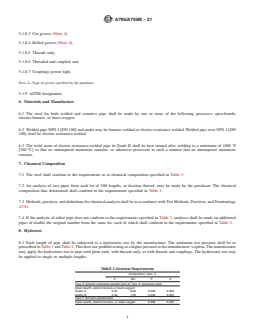
7.1 The steel shall conform to the requirements as to chemical composition specified in Table 3.
7.2 An analysis of two pipes from each lot of 500 lengths, or fraction thereof, may be made by the purchaser. The chemical
composition thus determined shall conform to the requirements specified in Table 3.
7.3 Methods, practices, and definitions for chemical analysis shall be in accordance with Test Methods, Practices, and Terminology
A751.
7.4 If the analysis of either pipe does not conform to the requirements specified in Table 3, analyses shall be made on additional
pipes of double the original number from the same lot, each of which shall conform to the requirements specified in Table 3.
8. Hydrotest
8.1 Each length of pipe shall be subjected to a hydrostatic test by the manufacturer. The minimum test pressure shall be as
prescribed in Table 1 and Table 2. This does not prohibit testing at a higher pressure at the manufacturer’s option. The manufacturer
may apply the hydrostatic test to pipe with plain ends, with threads only, or with threads and couplings. The hydrostatic test may
be applied to single or multiple lengths.
TABLE 3 Chemical Requirements
Composition, max, %
C Mn P S
Type E (electric-resistance-welded pipe) & Type S (seamless pipe)
Open-hearth, electric-furnace or basic-oxygen:
Grade A 0.25 0.95 0.035 0.035
Grade B 0.30 1.20 0.035 0.035
Type F (furnace-welded pipe)
Open-hearth, electric-furnace, or basic oxygen 0.050 0.045
A795/A795M − 21
8.2 The hydrostatic test shall be applied, without leakage through the pipe wall, to each length of pipe.
NOTE 5—The hydrostatic test pressures given herein are inspection test pressures. They are not intended as a basis for design and do not have any direct
relationship to working pressures.
9. Nondestructive Electric Test
9.1 As an alternative to the hydrostatic test, and when accepted by the purchaser, test each pipe with a nondestructive electric test
in accordance with Practice E213, Practice E309, or Practice E570. It is the intent of this test to reject pipe containing defects.
9.2 The following information is for the benefit of the user of this specification:
9.2.1 The ultrasonic examination referred to in this specification is intended to detect longitudinal discontinuities having a
reflective area similar to or larger than the reference notch. The examination may not detect circumferentially oriented
imperfections or short, deep defects.
9.2.2 The eddy-current examination referenced in this specification has the capability of detecting significant discontinuities,
especially of the short, abrupt type.
9.2.3 The flux leakage examination referred to in this specification is capable of detecting the presence and location of significant
longitudinally or transversely oriented discontinuities. The provisions of this specification only require longitudinal calibration for
flux leakage. Different techniques need to be employed for the detection of differently oriented imperfections.
9.2.4 The hydrostatic test referred to in Section 8 is a test method provided for in many product specifications. This test has the
capability of finding defects of a size permitting the test fluid to leak through the tube wall and may be either visually seen or
detected by a loss of pressure. This test may not detect very tight, through-the-wall defects or defects that extend an appreciable
distance into the wall without complete penetration.
9.2.5 A purchaser interested in ascertaining the nature (type, size, location, and orientation) of discontinuities that can be detected
in the specific application of these examinations should discuss this with the manufacturer of the tubular product.
9.3 In order to accommodate the various types of nondestructive electric testing equipment and techniques in use, the calibration
tube shall contain, at the option of the producer, any one or more of the following discontinuities to establish a minimum sensitivity
level for rejection.
9.3.1 Drilled Hole—Drill a hole radially and completely through the pipe wall, care being taken to avoid distortion of the pipe
while drilling. The diameter of the hole shall not be larger than 0.031 in. [0.8 mm] for pipe under 0.125 in. [3.2 mm] in wall
thickness, not larger than 0.0625 in. [1.6 mm] for pipe between 0.125 in. [3.2 mm] and 0.200 in. [5.0 mm] in wall thickness, and
not larger than 0.125 in. [3.2 mm] for pipe over 0.200 in. [5.0 mm] in wall thickness.
9.3.2 Transverse Tangential Notch—Using a round tool or file with a ⁄4-in. [6-mm] diameter, file or mill a notch tangential to the
surface and transverse to the longitudinal axis of the pipe. The notch shall have a depth not exceeding 12 ⁄2 % of the specified wall
thickness of the pipe.
9.3.3 Longitudinal Notch—Machine a notch 0.031 in. [0.8 mm] or less in width in a radial plane parallel to the pipe axis on the
outside surface of the pipe, to have a depth not exceeding 12 ⁄2 % of the specified wall thickness of the pipe. The length of the
notch shall be compatible with the testing method.
9.3.4 Compatibility—The discontinuity in the calibration pipe shall be compatible with the testing equipment and method being
used.
9.3.5 For flux leakage testing, the longitudinal calibration reference notches shall be straight-sided notches machined in a radial
plane parallel to the pipe axis. For specified wall thicknesses less than 0.500 in. [12.7 mm], outside and inside notches shall be
used. For specified wall thicknesses equal to or greater than 0.500 in. [12.7 mm], only an outside notch shall be used. The notch
A795/A795M − 21
depth shall not exceed 1
...