


ASTM E1190-11(2018)
(Test Method)Standard Test Methods for Strength of Power-Actuated Fasteners Installed in Structural Members
Standard Test Methods for Strength of Power-Actuated Fasteners Installed in Structural Members
SIGNIFICANCE AND USE
4.1 These test methods are intended to measure the anchoring capability and shear resistance of power-actuated fasteners to provide information from which applicable design values are to be derived for use in structural applications, such as in members of concrete, concrete masonry, and steel.
SCOPE
1.1 These test methods describe procedures for determining the static axial tensile and shear strengths of power-actuated fasteners installed in structural members made of concrete, concrete masonry, and steel.
1.2 These test methods are intended for use with fasteners that are installed perpendicular to a plane surface of the structural member.
1.3 Tests for combined tension and shear, fatigue, dynamic, and torsional load resistance are not covered.
1.4 The values stated in SI units are to be regarded as standard. The values given in parentheses are mathematical conversions to inch-pound units that are provided for information only and are not considered standard.
1.5 This standard does not purport to address all of the safety concerns, if any, associated with its use. It is the responsibility of the user of this standard to establish appropriate safety, health, and environmental practices and determine the applicability of regulatory limitations prior to use. Specific hazard statements are given in Section 6.
1.6 This international standard was developed in accordance with internationally recognized principles on standardization established in the Decision on Principles for the Development of International Standards, Guides and Recommendations issued by the World Trade Organization Technical Barriers to Trade (TBT) Committee.
General Information
Buy Standard
Standards Content (Sample)
NOTICE: This standard has either been superseded and replaced by a new version or withdrawn.
Contact ASTM International (www.astm.org) for the latest information
Designation: E1190 − 11 (Reapproved 2018)
Standard Test Methods for
Strength of Power-Actuated Fasteners Installed in Structural
Members
This standard is issued under the fixed designation E1190; the number immediately following the designation indicates the year of
original adoption or, in the case of revision, the year of last revision. A number in parentheses indicates the year of last reapproval. A
superscript epsilon (´) indicates an editorial change since the last revision or reapproval.
1. Scope Building Constructions, Elements, Connections, and As-
semblies
1.1 These test methods describe procedures for determining
E631 Terminology of Building Constructions
the static axial tensile and shear strengths of power-actuated
fasteners installed in structural members made of concrete, 2.2 ANSI Standard:
ANSIA10.3 Safety Requirements for Powder-Actuated Fas-
concrete masonry, and steel.
tening Systems
1.2 These test methods are intended for use with fasteners
that are installed perpendicular to a plane surface of the
3. Terminology
structural member.
3.1 Definitions of general terms may be found in Terminol-
1.3 Tests for combined tension and shear, fatigue, dynamic,
ogy E631.
and torsional load resistance are not covered.
3.2 Definitions of Terms Specific to This Standard:
1.4 The values stated in SI units are to be regarded as
3.2.1 displacement—movement of a fastener relative to the
standard. The values given in parentheses are mathematical
structural member. In tensile tests, displacement is measured
conversions to inch-pound units that are provided for informa-
alongtheaxisofthefastener;insheartestsitismeasuredinthe
tion only and are not considered standard.
direction of the applied load perpendicular to the axis of the
1.5 This standard does not purport to address all of the
fastener.
safety concerns, if any, associated with its use. It is the
3.2.2 drive pin—anail-likemetalfastenerdesignedtoattach
responsibility of the user of this standard to establish appro-
one material to another.
priate safety, health, and environmental practices and deter-
3.2.3 edge distance, c—the distance from the longitudinal
mine the applicability of regulatory limitations prior to use.
axis (center) of a fastener to the nearest edge of the structural
Specific hazard statements are given in Section 6.
member in which it is installed.
1.6 This international standard was developed in accor-
dance with internationally recognized principles on standard-
3.2.4 embedment depth, h —the distance from the surface
ef
ization established in the Decision on Principles for the
of the structural member to the installed end of the fastener
Development of International Standards, Guides and Recom-
including its point, if any.
mendations issued by the World Trade Organization Technical
3.2.5 fastener spacing, s—the distance between the longitu-
Barriers to Trade (TBT) Committee.
dinal axes of two fasteners in the same plane. Also, distance
between longitudinal axis of fastener and nearest edge of
2. Referenced Documents
test-system supports (see s in Fig. 1).
2.1 ASTM Standards:
3.2.6 powder-actuated fastening system—a system that uses
E4 Practices for Force Verification of Testing Machines
explosive powder to embed the fastener in structural elements.
E575 Practice for Reporting Data from Structural Tests of
3.2.7 power-actuated fastening system—a system that uses
explosive powder, gas combustion, or compressed air or other
gas to embed the fastener in structural elements.
These test methods are under the jurisdiction of ASTM Committee E06 on
Performance of Buildings and are the direct responsibility of Subcommittee E06.13
3.2.8 shear test—a test in which a force is applied perpen-
on Structural Performance of Connections in Building Construction.
dicularly to the axis of the fastener and parallel to the surface
Current edition approved Sept. 1, 2018. Published September 2018. Originally
of the structural member.
approved in 1987. Last previous edition approved in 2011 as E1190–11. DOI:
10.1520/E1190–11R18.
For referenced ASTM standards, visit the ASTM website, www.astm.org, or
contact ASTM Customer Service at service@astm.org. For Annual Book of ASTM
Standards volume information, refer to the standard’s Document Summary page on Available from American National Standards Institute (ANSI), 25 W. 43rd St.,
the ASTM website. 4th Floor, New York, NY 10036, http://www.ansi.org.
Copyright © ASTM International, 100 Barr Harbor Drive, PO Box C700, West Conshohocken, PA 19428-2959. United States
E1190 − 11 (2018)
FIG. 1 Typical Static Tension Test Arrangement
3.2.9 static load—aloadorseriesofloadsthataresupported surface of the structural member during testing. Load cells
by or are applied to a structure so gradually that forces caused shall be used for laboratory testing. If pressure gages are used
bychangeinmomentumoftheloadandstructuralelementsare for field testing, they shall be calibrated immediately prior to
negligible and all parts of the system at any instant are
use.
essentially in equilibrium.
5.1.1 Tensile Test—A system suitable for applying tensile
3.2.10 structural member—an element of a structural sys- forces is shown in Fig. 1 for a single fastener specimen. The
test system supports shall be of sufficient size to prevent failure
tem such as a beam, column, or truss.
of the surrounding structural member. The loading rod shall be
3.2.11 tensile test—a test in which a fastener is loaded
of a size to develop the ultimate strength of the fastener
axially in tension at a specified rate.
hardware with minimal elongation and shall be attached to the
3.2.12 threaded stud—a round metal-wire fastener, with a
fastener by means of a connector that will minimize the direct
pointed shank at one end and threads along the other end,
transfer of bending forces through the connection. When
designed to be used as a removable fastening or in conjunction
displacements are measured, dial gages or a linear variable
with a threaded coupler.
differential transformer (LVDT) shall be mounted in a manner
so as to ensure accurate displacement measurement.
4. Significance and Use
5.1.2 Shear Test:
4.1 These test methods are intended to measure the anchor-
5.1.2.1 Asystem suitable for applying shear forces is shown
ing capability and shear resistance of power-actuated fasteners
inFig.2.forasinglefastenerspecimen.Thecomponentsofthe
toprovideinformationfromwhichapplicabledesignvaluesare
test fixture shall be of sufficient size and strength to prevent
to be derived for use in structural applications, such as in
yielding during application of the ultimate test load. The test
members of concrete, concrete masonry, and steel.
systemsupportshallbeofsufficientsizetopreventlocalfailure
5. Apparatus
of the structural member in the bearing contact area. When
displacements are measured, dial gages or a linear variable
5.1 Equipment—Any system suitable for applying tensile
differential transformer (LVDT) shall be mounted in a manner
and shear forces shall be used, provided the requirements for
so as to ensure accurate displacement measurement.
rate of loading in 9.4 are met, and the instrumentation is
capable of measuring the forces to an accuracy within 62%of 5.1.2.2 The thickness of the shear fixture in the immediate
the applied force, when calibrated in accordance with Practices vicinity of the test fastener shall be approximately equal to the
E4. The device shall be of sufficient capacity to prevent fastener shank diameter at the point of intersection of the
yielding of its various components and shall ensure that the fastener and the base material unless otherwise specified. The
applied tensile forces remain parallel to the axes of the hole in the shear fixture designed to accommodate the fastener
fastenersandthattheappliedshearforcesremainparalleltothe shall have a diameter that is 0.5 6 0.1 mm (0.020 6 0.004 in.)
E1190 − 11 (2018)
FIG. 2 Typical Static Shear Test Arrangement
greater than that of the fastener shank diameter tested. 5.2.2 Tests of a Group of Fasteners—Only one set of
Alternatively, a shear fixture using a slot to accommodate the
instruments is required for a group of fasteners tested as a
fastener instead of a round hole shall be permitted.The loading
closely spaced cluster. The displacement to be used for the
end of the slot shall have a width that is 0.5 6 0.1 mm
evaluation of the findings is the average deformation indicated
(0.020 6 0.004 in.) greater than that of the fastener shank
by all instruments mounted symmetrically equidistant from the
diameter tested.The non-loading end of the slot is permitted to
center of the cluster.
be larger than the fastener head or thread diameter. The initial
5.2.3 Shear Test (see Fig. 2)—A single dial gage, having a
shape of the hole or the loading end of the slot in the shear
smallest division of not more than 0.025 mm (0.001 in.) or any
fixture shall correspond to that of the fastener shank cross
suitable measurement device, such as an LVDT, or calibrated
section and shall be maintained throughout all tests. For shear
sensor of at least comparable accuracy and sensitivity shall be
fixtures using a slot to accommodate the fastener instead of a
used to measure the displacement of the fastening system
hole, loading is to be applied parallel to the slot. Worn or
relative to the structural member. The instrument shall be
deformedholesorslotsshallberepaired.Whenrequired,insert
positioned to measure displacement in the direction of the
sleeves shall be installed in the shear plate to meet these
applied force. The displacement sensor shall be placed on the
requirements, provided they do not increase deformation of the
structural member to allow the sensing element to be in direct
anchorage under load.
contact with the fastener or be attached directly to the fastener.
5.2 Optional Displacement Measurements—Displacement
For tests on clusters of fasteners, the instrument shall lie in a
or deformation measurements are not required to derive design
plane through the axis of the shear loading rod or plate. An
data for a given fastening system.
extension of the axis of the shear fixture shall pass through the
5.2.1 Tension Test (see Fig. 1)—Dial gages, having a small-
centroid of the cluster of fasteners.
est division of not more than 0.025 mm (0.001 in.), or any
suitable measurement devices or calibrated sensors of at least
6. Hazards
comparableaccuracyandsensitivity,suchasanLVDT,shallbe
used to measure displacement of the fastening system relative
6.1 Takeprecautiontoensurethatpeoplearenotinjuredand
to the structural member. The instruments shall be positioned
that test equipment, instrumentation, and the building, its
to measure the vertical movement of the fastener with respect
components, and its finish are not damaged prior to, during, or
to points on the structural member, at a minimum distance of
after load application, by any unexpected release of potential
40 mm (1.6 in.) from the center of the test fastener. The
strain energy accumulated during testing.
instruments shall be mounted on the fastener specimen or
6.2 All operators of powder-actuated tools used for the
loading rod at a distance not more than 100 mm (4.0 in.) from
installation of test specimens shall be licensed by the manu-
the structural member surface, in order to minimize extraneous
facturer. Operators shall comply with ANSI A10.3 require-
movements (hardware elongation) in the displacement mea-
surements. ments and local safety requirements.
E1190 − 11 (2018)
7. Test Specimens listed in Table 1 for concrete structural members do not apply
to masonry walls. Fasteners shall be installed in masonry walls
7.1 Fastening System—The fastening system shall be rep-
using the manufacturer’s installation instructions or in accor-
resentative of the type and lot to be used in field construction
dance with accepted field methods.
and shall include all accessory hardware normally required.
7.2 Fastener Installation—The fasteners shall be installed
8. Number of Tests
using the manufacturer’s installation instructions and tools or,
8.1 Tensile or Shear Resistance—For determining the aver-
where specific deviation is justified, in accordance with ac-
age tensile or shear resistance, perform at least the minimum
cepted field methods or to meet the requirements of the tests.
number of tests per condition specified in Table 2. Depending
7.3 Fastener Placement—Allfasteners(types,sizes,embed-
on the purpose of the test, the number of tests shall be
ment depths) to be used in a given installation shall either be increased. These tests shall be repeated for each variation in
tested individually or in groups of two or more at the intended
fastener type, size, embedment depth, location, and for each
spacing. Fasteners shall be installed at distances equal to or variation in the type or strength of structural member.
greater than those specified in Table 1 to preclude influences
Alternatively, if the sample size is ten and the coefficient of
from adjacent fasteners or edges during testing. These dis-
variationis15 %orgreater,thefastenercapacityshallbebased
tances are not to be considered minimum distances. Tests shall
on the lowest test value for the original ten tests instead of
be performed to determine minimum spacing and edge dis-
increasing the sample size.
tances.
8.2 All installed fasteners shall be tested regardless of
7.4 Structural Member—The structural member in which
fastener embedment, angle of installation, damage to the
the fastener is to be installed shall be representative of the
structural member, or damage to the fastener. Fasteners that
materials and configuration intended for field use. Concrete or
cannot be tested, because they did not set at all, that is were not
masonry structural members do not have to be reinforced with
installed properly, shall be reported as invalid data points.
steel (Note 1).
Invalid data points shall not be included when determining the
average ultimate test values.
NOTE 1—The location and orientation of reinforcement embedded in
concrete and masonry members may influence fastener capacity. Their
8.3 For developing minimum edge distances and fastener
influence shall be evaluated if reinforcement is used.
spacings, the number of fasteners for each condition shall be at
7.5 The concrete or masonry structural member thickness,
least ten.
T, shall be sufficient to ensure that the installation and testing
9. Procedure
of the fastener will not crack or cause any other failure of the
base material.
9.1 Positioning of Loading System:
9.1.1 Tension Test—Position the loading system over the
7.6 The length, L, and width, W, of co
...
This document is not an ASTM standard and is intended only to provide the user of an ASTM standard an indication of what changes have been made to the previous version. Because
it may not be technically possible to adequately depict all changes accurately, ASTM recommends that users consult prior editions as appropriate. In all cases only the current version
of the standard as published by ASTM is to be considered the official document.
Designation: E1190 − 11 E1190 − 11 (Reapproved 2018)
Standard Test Methods for
Strength of Power-Actuated Fasteners Installed in Structural
Members
This standard is issued under the fixed designation E1190; the number immediately following the designation indicates the year of
original adoption or, in the case of revision, the year of last revision. A number in parentheses indicates the year of last reapproval. A
superscript epsilon (´) indicates an editorial change since the last revision or reapproval.
1. Scope
1.1 These test methods describe procedures for determining the static axial tensile and shear strengths of power-actuated
fasteners installed in structural members made of concrete, concrete masonry, and steel.
1.2 These test methods are intended for use with fasteners that are installed perpendicular to a plane surface of the structural
member.
1.3 Tests for combined tension and shear, fatigue, dynamic, and torsional load resistance are not covered.
1.4 The values stated in SI units are to be regarded as standard. The values given in parentheses are mathematical conversions
to inch-pound units that are provided for information only and are not considered standard.
1.5 This standard does not purport to address all of the safety concerns, if any, associated with its use. It is the responsibility
of the user of this standard to establish appropriate safety safety, health, and healthenvironmental practices and determine the
applicability of regulatory limitations prior to use. Specific hazard statements are given in Section 6.
1.6 This international standard was developed in accordance with internationally recognized principles on standardization
established in the Decision on Principles for the Development of International Standards, Guides and Recommendations issued
by the World Trade Organization Technical Barriers to Trade (TBT) Committee.
2. Referenced Documents
2.1 ASTM Standards:
E4 Practices for Force Verification of Testing Machines
E575 Practice for Reporting Data from Structural Tests of Building Constructions, Elements, Connections, and Assemblies
E631 Terminology of Building Constructions
2.2 ANSI Standards:Standard:
ANSI A10.3ANSI A10.3 Safety Requirements for Powder-Actuated Fastening Systems
3. Terminology
3.1 Definitions of general terms may be found in Terminology E631.
3.2 Definitions of Terms Specific to This Standard:
3.2.1 displacement—movement of a fastener relative to the structural member. In tensile tests, displacement is measured along
the axis of the fastener; in shear tests it is measured in the direction of the applied load perpendicular to the axis of the fastener.
3.2.2 drive pin—a nail-like metal fastener designed to attach one material to another.
3.2.3 edge distance, c—the distance from the longitudinal axis (center) of a fastener to the nearest edge of the structural member
in which it is installed.
3.2.4 embedment depth, h —the distance from the surface of the structural member to the installed end of the fastener including
ef
its point, if any.
These test methods are under the jurisdiction of ASTM Committee E06 on Performance of Buildings and are the direct responsibility of Subcommittee E06.13 on
Structural Performance of Connections in Building Construction.
Current edition approved Sept. 1, 2011Sept. 1, 2018. Published October 2011September 2018. Originally approved in 1987. Last previous edition approved in 20072011
as E1190 – 95 (2007).E1190–11. DOI: 10.1520/E1190-11.10.1520/E1190–11R18.
For referenced ASTM standards, visit the ASTM website, www.astm.org, or contact ASTM Customer Service at service@astm.org. For Annual Book of ASTM Standards
volume information, refer to the standard’sstandard’s Document Summary page on the ASTM website.
Available from American National Standards Institute (ANSI), 25 W. 43rd St., 4th Floor, New York, NY 10036, http://www.ansi.org.
Copyright © ASTM International, 100 Barr Harbor Drive, PO Box C700, West Conshohocken, PA 19428-2959. United States
E1190 − 11 (2018)
3.2.5 fastener spacing, s—the distance between the longitudinal axes of two fasteners in the same plane. Also, distance between
longitudinal axis of fastener and nearest edge of test-system supports (see s in Fig. 1).
3.2.6 powder-actuated fastening system—a system that uses explosive powder to embed the fastener in structural elements.
3.2.7 power-actuated fastening system—a system that uses explosive powder, gas combustion, or compressed air or other gas
to embed the fastener in structural elements.
3.2.8 shear test—a test in which a force is applied perpendicularly to the axis of the fastener and parallel to the surface of the
structural member.
3.2.9 static load—a load or series of loads that are supported by or are applied to a structure so gradually that forces caused
by change in momentum of the load and structural elements are negligible and all parts of the system at any instant are essentially
in equilibrium.
3.2.10 structural member—an element of a structural system such as a beam, column, or truss.
3.2.11 tensile test—a test in which a fastener is loaded axially in tension at a specified rate.
3.2.12 threaded stud—a round metal-wire fastener, with a pointed shank at one end and threads along the other end, designed
to be used as a removable fastening or in conjunction with a threaded coupler.
4. Significance and Use
4.1 These test methods are intended to measure the anchoring capability and shear resistance of power-actuated fasteners to
provide information from which applicable design values are to be derived for use in structural applications, such as in members
of concrete, concrete masonry, and steel.
5. Apparatus
5.1 Equipment—Any system suitable for applying tensile and shear forces shall be used, provided the requirements for rate of
loading in 9.4 are met, and the instrumentation is capable of measuring the forces to an accuracy within 6 2 % 62 % of the applied
force, when calibrated in accordance with Practices E4. The device shall be of sufficient capacity to prevent yielding of its various
components and shall ensure that the applied tensile forces remain parallel to the axes of the fasteners and that the applied shear
forces remain parallel to the surface of the structural member during testing. Load cells shall be used for laboratory testing. If
pressure gages are used for field testing, they shall be calibrated immediately prior to use.
5.1.1 Tensile Test—A system suitable for applying tensile forces is shown in Fig. 1 for a single fastener specimen. The test
system supports shall be of sufficient size to prevent failure of the surrounding structural member. The loading rod shall be of a
size to develop the ultimate strength of the fastener hardware with minimal elongation and shall be attached to the fastener by
FIG. 1 TypicalTypical Static Tension Test Arrangement
E1190 − 11 (2018)
means of a connector that will minimize the direct transfer of bending forces through the connection. When displacements are
measured, dial gages or a linear variable differential transformer (LVDT) shall be mounted in a manner so as to ensure accurate
displacement measurement.
5.1.2 Shear Test:
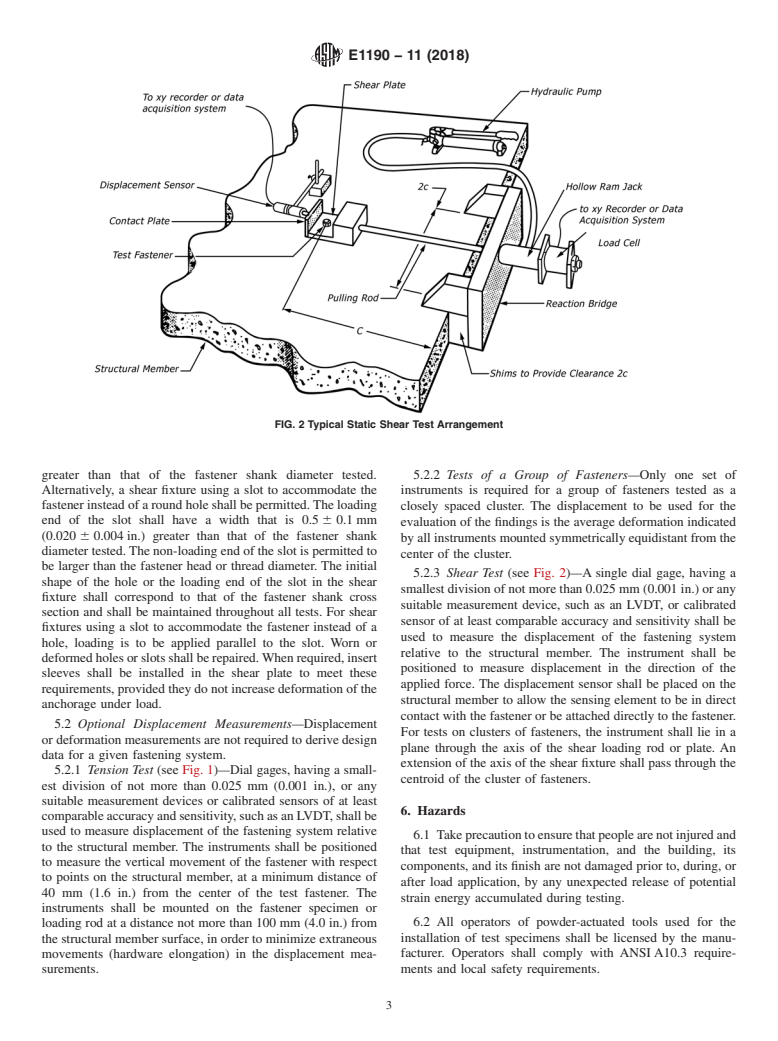
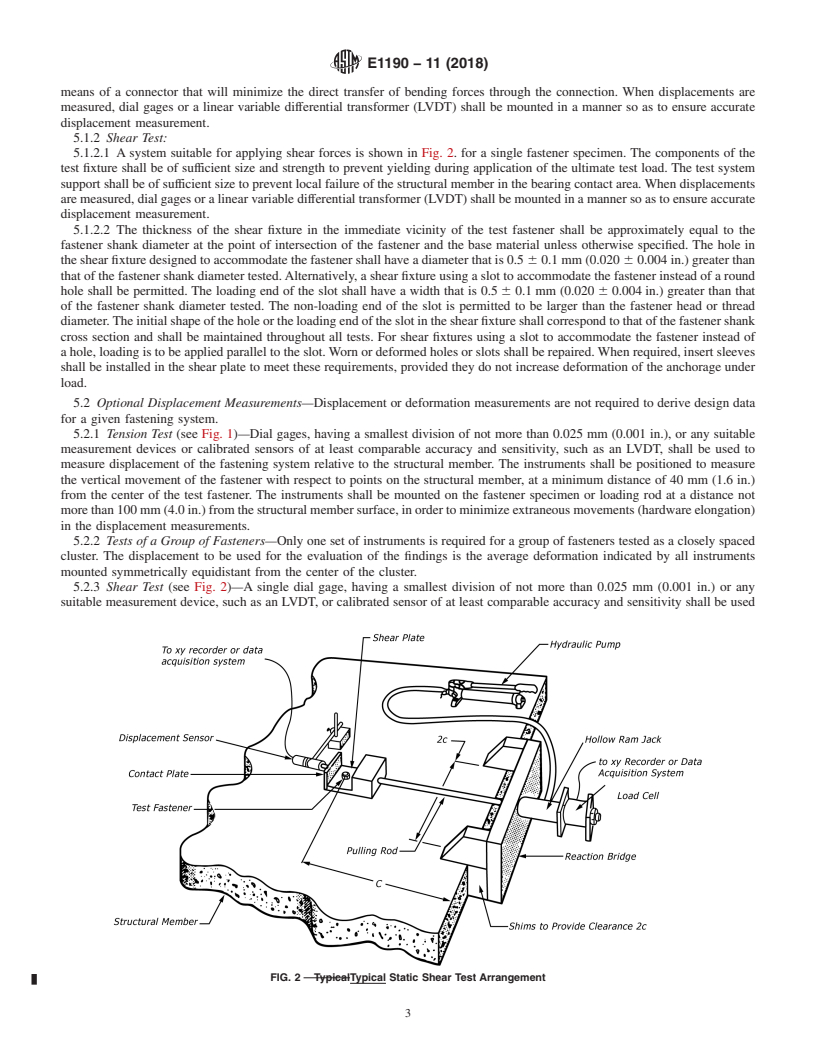
5.1.2.1 A system suitable for applying shear forces is shown in Fig. 2. for a single fastener specimen. The components of the
test fixture shall be of sufficient size and strength to prevent yielding during application of the ultimate test load. The test system
support shall be of sufficient size to prevent local failure of the structural member in the bearing contact area. When displacements
are measured, dial gages or a linear variable differential transformer (LVDT) shall be mounted in a manner so as to ensure accurate
displacement measurement.
5.1.2.2 The thickness of the shear fixture in the immediate vicinity of the test fastener shall be approximately equal to the
fastener shank diameter at the point of intersection of the fastener and the base material unless otherwise specified. The hole in
the shear fixture designed to accommodate the fastener shall have a diameter that is 0.5 6 0.1 mm (0.020 6 0.004 in.) greater than
that of the fastener shank diameter tested. Alternatively, a shear fixture using a slot to accommodate the fastener instead of a round
hole shall be permitted. The loading end of the slot shall have a width that is 0.5 6 0.1 mm (0.020 6 0.004 in.) greater than that
of the fastener shank diameter tested. The non-loading end of the slot is permitted to be larger than the fastener head or thread
diameter. The initial shape of the hole or the loading end of the slot in the shear fixture shall correspond to that of the fastener shank
cross section and shall be maintained throughout all tests. For shear fixtures using a slot to accommodate the fastener instead of
a hole, loading is to be applied parallel to the slot. Worn or deformed holes or slots shall be repaired. When required, insert sleeves
shall be installed in the shear plate to meet these requirements, provided they do not increase deformation of the anchorage under
load.
5.2 Optional Displacement Measurements—Displacement or deformation measurements are not required to derive design data
for a given fastening system.
5.2.1 Tension Test (see Fig. 1)—Dial gages, having a smallest division of not more than 0.025 mm (0.001 in.), or any suitable
measurement devices or calibrated sensors of at least comparable accuracy and sensitivity, such as an LVDT, shall be used to
measure displacement of the fastening system relative to the structural member. The instruments shall be positioned to measure
the vertical movement of the fastener with respect to points on the structural member, at a minimum distance of 40 mm (1.6 in.)
from the center of the test fastener. The instruments shall be mounted on the fastener specimen or loading rod at a distance not
more than 100 mm (4.0 in.) from the structural member surface, in order to minimize extraneous movements (hardware elongation)
in the displacement measurements.
5.2.2 Tests of a Group of Fasteners—Only one set of instruments is required for a group of fasteners tested as a closely spaced
cluster. The displacement to be used for the evaluation of the findings is the average deformation indicated by all instruments
mounted symmetrically equidistant from the center of the cluster.
5.2.3 Shear Test (see Fig. 2)—A single dial gage, having a smallest division of not more than 0.025 mm (0.001 in.) or any
suitable measurement device, such as an LVDT, or calibrated sensor of at least comparable accuracy and sensitivity shall be used
FIG. 2 TypicalTypical Static Shear Test Arrangement
E1190 − 11 (2018)
to measure the displacement of the fastening system relative to the structural member. The instrument shall be positioned to
measure displacement in the direction of the applied force. The displacement sensor shall be placed on the structural member to
allow the sensing element to be in direct contact with the fastener or be attached directly to the fastener. For tests on clusters of
fasteners, the instrument shall lie in a plane through the axis of the shear loading rod or plate. An extension of the axis of the shear
fixture shall pass through the centroid of the cluster of fasteners.
6. Hazards
6.1 Take precaution to ensure that people are not injured and that test equipment, instrumentation, and the building, its
components, and its finish are not damaged prior to, during, or after load application, by any unexpected release of potential strain
energy accumulated during testing.
6.2 All operators of powder-actuated tools used for the installation of test specimens shall be licensed by the manufacturer.
Operators shall comply with ANSI A10.3 requirements and local safety requirements.
7. Test Specimens
7.1 Fastening System—The fastening system shall be representative of the type and lot to be used in field construction and shall
include all accessory hardware normally required.
7.2 Fastener Installation—The fasteners shall be installed using the manufacturer’smanufacturer’s installation instructions and
tools or, where specific deviation is justified, in accordance with accepted field methods or to meet the requirements of the tests.
7.3 Fastener Placement—All fasteners (types, sizes, embedment depths) to be used in a given installation shall either be tested
individually or in groups of two or more at the intended spacing. Fasteners shall be installed at distances equal to or greater than
those specified in Table 1 to preclude influences from adjacent fasteners or edges during testing. These distances are not to be
considered minimum distances. Tests shall be performed to determine minimum spacing and edge distances.
7.4 Structural Member—The structural member in which the fastener is to be installed shall be representative of the materials
and configuration intended for field use. Concrete or masonry structural members do not have to be reinforced with steel (Note
1).
NOTE 1—The location and orientation of reinforcement embedded in concrete and masonry members may influence fastener capacity. Their influence
shall be evaluated if reinforcement is used.
7.5 The concrete or masonry structural member thickness, T, shall be sufficient to ensure that the installation and testing of the
fastener will not crack or cause any other failure of the base material.
7.6 The length, L, and width, W, of concrete structural members shall ensure that no shear breakout or tension failure spall
intersects either the outside edges of the structural member or the bearing contact points of the test frame.
7.7 The edge distance, c, shall be as in Table 1 where the reaction bridge in the shear test set-up shown in Fig. 2 provides a
minimum 150-mm (5.9-in.) clearance along the edge of the concrete structural member and a minimum 50-mm (2.0-in.) clearance
along the edge of a steel structural member (not shown). A shear reaction bridge is not required when concrete edge distances
exceed 150 mm or steel edge distances exceed 50 mm.
7.8 When testing fasteners installed in horizontal mortar joints, the masonry wall shall be treated as a complete structural
member. The minimum edge distances and spacing listed in Table 1 for concrete structural members do not apply to masonry walls.
Fasteners shall be installed in masonry walls using the manufacturer’s installation instructions or in accordance with accepted fi
...
Questions, Comments and Discussion
Ask us and Technical Secretary will try to provide an answer. You can facilitate discussion about the standard in here.