ASTM F803-99
(Specification)Standard Specification for Eye Protectors For Selected Sports
Standard Specification for Eye Protectors For Selected Sports
SCOPE
1.1 This specification covers eye protectors, designed for use by players of racket sports, women's lacrosse, field hockey, basketball, and baseball that minimize or significantly reduce injury to the eye and adnexa due to impact and penetration by racket-sport rackets and balls, women's lacrosse and field hockey sticks and balls, baseballs, and hands, elbows, and fingers. Protective eyewear offers protection only to the eyes and does not protect other parts of the head.
1.2 Protectors are divided into four types depending on their design characteristics.
1.3 This specification applies to eye protectors for use by wearers of corrective lenses and also by those players who do not require prescription eyewear.
Note 1—Warning Polycarbonate spectacle lenses should be used if spectacles are worn under protective eyewear.
1.4 In this standard, the use of the words "shall" or "must" indicates a mandatory requirement. The word "should" indicates a recommendation.
1.5 The values stated in SI units are to be regarded as the standard. The values given in parentheses are for information only. Metric units of measurement in this specification are in accordance with the International System of Units (SI). If a value for measurement as given in this specification is followed by an equivalent value in other units, the first stated is to be regarded as the requirement. A given equivalent value may be approximate.
1.6 The following precautionary caveat pertains only to the test methods portions, Sections 9-11, of this specification:This standard does not purport to address all of the safety concerns, if any, associated with its use. It is the responsibility of the user of this standard to establish appropriate safety and health practices and determine the applicability of regulatory limitations prior to use.
General Information
Relations
Standards Content (Sample)
NOTICE: This standard has either been superseded and replaced by a new version or discontinued.
Contact ASTM International (www.astm.org) for the latest information.
Designation: F 803 – 99
Standard Specification for
Eye Protectors for Selected Sports
This standard is issued under the fixed designation F 803; the number immediately following the designation indicates the year of
original adoption or, in the case of revision, the year of last revision. A number in parentheses indicates the year of last reapproval. A
superscript epsilon (e) indicates an editorial change since the last revision or reapproval.
1. Scope D 570 Test Method for Water Absorption of Plastics
D 1003 Test Method for Haze and Luminous Transmittance
1.1 This specification covers eye protectors, designed for
of Transparent Plastics
use by players of racket sports, women’s lacrosse, field hockey,
2.2 American National Standards:
basketball, and baseball that minimize or significantly reduce
ANSI Z80.1 Requirements for First-Quality Prescription
injury to the eye and adnexa due to impact and penetration by
Ophthalmic Lenses
racket-sport rackets and balls, women’s lacrosse and field
ANSI Z80.3 Requirements for Nonprescription Sunglasses
hockey sticks and balls, baseballs, and hands, elbows, and
and Fashion Eyewear
fingers. Protective eyewear offers protection only to the eyes
ANSI Z87.1 Practice for Occupational and Educational Eye
and does not protect other parts of the head.
and Face Protectors
1.2 Protectors are divided into four types depending on their
2.3 Federal Standard:
design characteristics.
National Institute of Standards and Technology Special
1.3 This specification applies to eye protectors for use by
Technical Publication 374 Method for Determining the
wearers of corrective lenses and also by those players who do
Resolving Power of Photographic Lenses (1973)
not require prescription eyewear.
NOTE 1—Warning: Polycarbonate spectacle lenses should be used if 3. Terminology
spectacles are worn under protective eyewear.
3.1 Definitions of Terms Specific to This Standard:
1.4 In this standard, the use of the words “shall” or “must”
3.1.1 binocular, adj—relating to the field of view which is
indicates a mandatory requirement. The word “should” indi-
shared by both eyes simultaneously; also any simultaneous
cates a recommendation.
activity of the two eyes.
1.5 The values stated in SI units are to be regarded as the
3.1.2 central viewing zone, n—that part of the eye of a
standard. The values given in parentheses are for information
protector, which has its center in line with the wearer’s normal
only. Metric units of measurement in this specification are in
line of sight. The zone is circular in shape, and 40 mm in
accordance with the International System of Units (SI). If a
diameter. The center of the central viewing zone shall be the
value for measurement as given in this specification is followed
point of intersection of the line of sight with the lens as
by an equivalent value in other units, the first stated is to be
mounted on the CSA headform.
regarded as the requirement. A given equivalent value may be
3.1.3 cleanable, n—the ability of a protective device to be
approximate.
made readily free of dirt or grime without being damaged
1.6 The following precautionary caveat pertains only to the
during an appropriate cleaning process, such as the use of soap
test methods portions, Sections 9-11, of this specification: This
and water.
standard does not purport to address all of the safety concerns,
3.1.4 coverage, n—a characteristic of a protective device
if any, associated with its use. It is the responsibility of the user
that obstructs straight line paths that are coincident with the
of this standard to establish appropriate safety and health
wearer’s eyes.
practices and determine the applicability of regulatory limita-
3.1.5 definition (optical), n—the characteristic of a lens that
tions prior to use.
allows separate distinct points in close proximity to be dis-
cerned when looking through the lens.
2. Referenced Documents
3.1.6 eye, n—relating to the eye of a test headform or the
2.1 ASTM Standards:
eye of a person wearing a protector or that part of an eye
B 117 Practice for Operating Salt Spray (Fog) Apparatus
Annual Book of ASTM Standards, Vol 08.01.
1 4
This specification is under the jurisdiction of ASTM Committee F-8 on Sports Available from American National Standards Institute, 11 W. 42nd St., 13th
Equipment, Surfaces, and Facilitiesand is the direct responsibility of Subcommittee Floor, New York, NY 10036.
F08.57on Eye Safety for Sports. Available from National Institute of Standards and Technology, U.S. Depart-
Current edition approved Nov. 10, 1999. Published February 2000. Originally ment of Commerce, Washington, DC 20234.
published as F 803 – 83. Last previous edition F 803 – 97. Available from Canadian Standards Association, Etobicoke (Toronto), 178
Annual Book of ASTM Standards, Vol 03.02. Rexdale Boulevard, Etobicoke (Toronto), ON M9W 1R3.
Copyright © ASTM, 100 Barr Harbor Drive, West Conshohocken, PA 19428-2959, United States.
F 803
protective device through which a wearer’s eye would nor- parts of a protective device through which the wearer normally
mally look. sees.
3.1.7 eye of the headform, n—all structures contained
3.1.12 luminous transmittance, n—luminous transmittance
within the orbital rim of the CSA headform.
is a function of the spectral transmittance of the lens weighted
3.1.8 haze, n—the fraction of the total transmitted light
by the corresponding ordinates of the photopic luminous
from a normally incident beam which is not transmitted in a
efficiency distribution of the CIE (1931) standard colorimetric
focused condition but scattered by inclusions or surface de-
observer and by the spectral intensity of standard Illuminant C.
fects. Excessive haze will reduce contrast and visibility.
(See ANSI Z80.3, 1986, Paragraph 3.9.1.)
3.1.9 headform optical parameters, n—key dimensions for
3.1.13 normal lines of sight, n—straight ahead horizontal
the headforms as provided in Figs. 1-3.
lines that intersect the center of the eyes of the appropriate
3.1.10 impact resistance, n—the ability of a device to afford
headform.
protection from impact as required by this specification.
3.1.11 lens, n—when so equipped, the transparent part or 3.1.14 penetration resistance, n—the ability of a device to
Dimensions, mm
A = 54.0 6 2%
B and C = 27.0 6 2%
D and E = 95.0 6 2%
F and G = 93.0 6 2%
H and I = 66.0 6 2%
J = 80.06 2%
Note 1—If headform is found to be symmetrical or is to be made symmetrical then B = C, D = E, F = G, and H = I.
A = Interpupillary distance.
B = Distance of right eye pupil from sagittal plane.
C = Distance of left eye pupil from sagittal plane.
D = Distance of right eye pupil from top of headform.
E = Distance of left eye pupil from top of headform.
F = Distance of top of right ear/headform junction from top of headform.
G = Distance of top of left ear/headform junction from top of headform.
H = Distance from right side of headform to sagittal plane.
I = Distance from left side of headform to sagittal plane.
J = Distance between front of pupil and top of ear/headform junction.
FIG. 1 CSA 8-Year Old Child
F 803
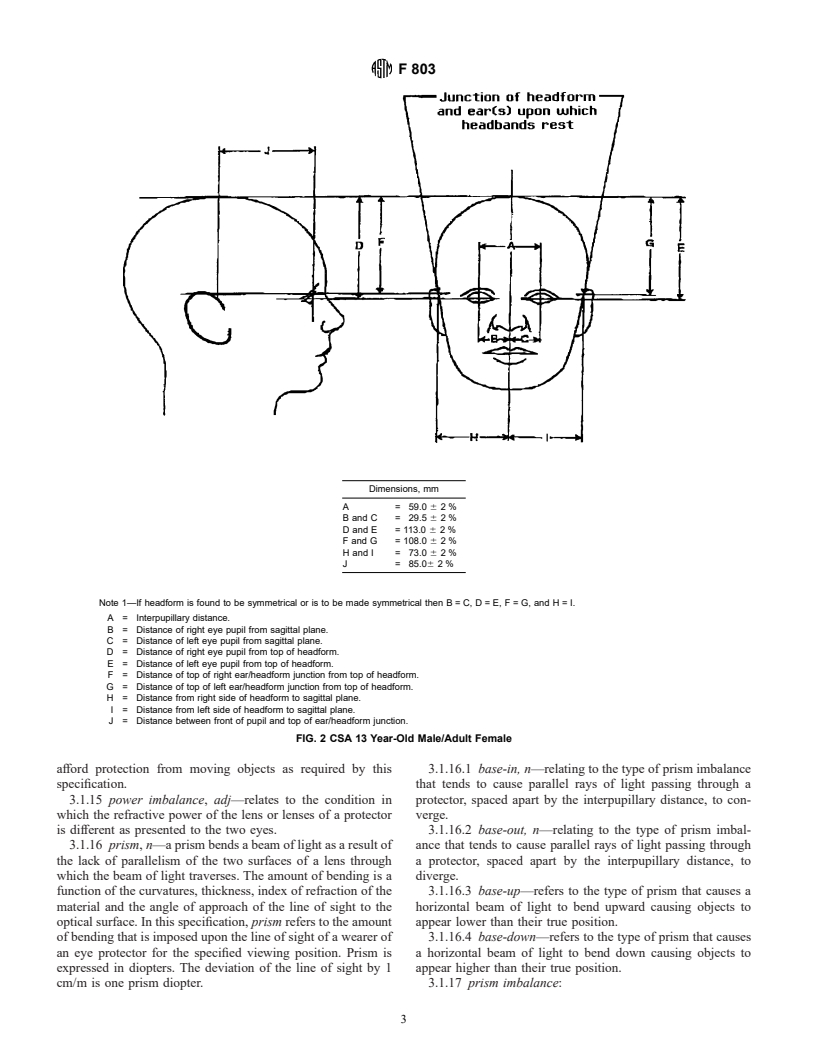
Dimensions, mm
A = 59.0 6 2%
B and C = 29.5 6 2%
D and E = 113.0 6 2%
F and G = 108.0 6 2%
H and I = 73.0 6 2%
J = 85.06 2%
Note 1—If headform is found to be symmetrical or is to be made symmetrical then B = C, D = E, F = G, and H = I.
A = Interpupillary distance.
B = Distance of right eye pupil from sagittal plane.
C = Distance of left eye pupil from sagittal plane.
D = Distance of right eye pupil from top of headform.
E = Distance of left eye pupil from top of headform.
F = Distance of top of right ear/headform junction from top of headform.
G = Distance of top of left ear/headform junction from top of headform.
H = Distance from right side of headform to sagittal plane.
I = Distance from left side of headform to sagittal plane.
J = Distance between front of pupil and top of ear/headform junction.
FIG. 2 CSA 13 Year-Old Male/Adult Female
afford protection from moving objects as required by this 3.1.16.1 base-in, n—relating to the type of prism imbalance
specification. that tends to cause parallel rays of light passing through a
3.1.15 power imbalance, adj—relates to the condition in protector, spaced apart by the interpupillary distance, to con-
which the refractive power of the lens or lenses of a protector verge.
is different as presented to the two eyes. 3.1.16.2 base-out, n—relating to the type of prism imbal-
3.1.16 prism, n—a prism bends a beam of light as a result of ance that tends to cause parallel rays of light passing through
the lack of parallelism of the two surfaces of a lens through a protector, spaced apart by the interpupillary distance, to
which the beam of light traverses. The amount of bending is a diverge.
function of the curvatures, thickness, index of refraction of the 3.1.16.3 base-up—refers to the type of prism that causes a
material and the angle of approach of the line of sight to the horizontal beam of light to bend upward causing objects to
optical surface. In this specification, prism refers to the amount appear lower than their true position.
of bending that is imposed upon the line of sight of a wearer of 3.1.16.4 base-down—refers to the type of prism that causes
an eye protector for the specified viewing position. Prism is a horizontal beam of light to bend down causing objects to
expressed in diopters. The deviation of the line of sight by 1 appear higher than their true position.
cm/m is one prism diopter. 3.1.17 prism imbalance:
F 803
Dimensions, mm
A = 67.0 6 2%
B and C = 33.5 6 2%
D and E = 117.0 6 2%
F and G = 108.0 6 2%
H and I = 75.0 6 2%
J = 92.06 2%
Note 1—If headform is found to be symmetrical or is to be made symmetrical then B = C, D = E, F = G, and H = I.
A = Interpupillary distance.
B = Distance of right eye pupil from sagittal plane.
C = Distance of left eye pupil from sagittal plane.
D = Distance of right eye pupil from top of headform.
E = Distance of left eye pupil from top of headform.
F = Distance of top of right ear/headform junction from top of headform.
G = Distance of top of left ear/headform junction from top of headform.
H = Distance from right side of headform to sagittal plane.
I = Distance from left side of headform to sagittal plane.
J = Distance between front of pupil and top of ear/headform junction.
FIG. 3 CSA Adult Male
3.1.17.1 horizontal imbalance—the difference in prismatic 3.1.20 spherical power, n—the average of the maximum
deviation of incident parallel light beams on the two eyes of a meridional astigmatic power and the minimum meridional
protective device in the horizontal meridian. (See base-in and astigmatic power of a lens.
base-out).
3.1.17.2 vertical imbalance—the difference in prismatic 4. Classification
deviation between parallel light beams incident on the two eyes
4.1 Eye protectors are classified into the following types:
of a protective device in the vertical meridian.
4.1.1 Type I—A protector with the lens or lenses and frame
3.1.18 protective device (or protector), n—a device that
frontpiece molded as one unit. Frame temples or other devices,
provides protection to the wearer’s eye against specific hazards
such as straps, to affix the lens/frontpiece may be separate
encountered in sports.
pieces.
3.1.19 refractive power, n—the focusing effect of a lens
4.1.2 Type II—A protector with a single lens or lenses,
expressed in diopters.
either plano or prescription, mounted in a frame that was
3.1.19.1 astigmatism, n—a condition in a lens that creates
manufactured as a separate unit.
two axially separated line foci of each object point, the lines
4.1.3 Type III—A protector without a lens.
being mutually perpendicular. In other words, the lens has two
different refractive powers in meridians that are 90° apart. 4.1.4 Type IV—A full or partial face shield.
F 803
5. General Requirements in the protector shall not exceed 3 %.
6.1.10 Lenses that exhibit any distortion or doubling of the
5.1 Materials of Construction:
image during the test for refractive power or prism shall be
5.1.1 The manufacturer’s choice of material shall be in
further tested in accordance with 9.2.
accordance with 5.1.2 and 5.1.3.
6.1.11 Optical Quality—Within the central viewing zone,
5.1.2 Materials coming into contact with the wearer’s face
striae warpage, surface ripples, lenticulations, or abrupt optical
shall not be of a type known to cause skin irritation.
changes that are visible under the test conditions of 9.2 and that
5.1.3 Materials coming into contact with the wearer’s face,
would impair the function of the lens shall be cause for
except replaceable padding, shall not undergo significant loss
rejection. Visual impairment is defined by the scanning and
of strength or flexibility, or other physical change as a result of
focimeter test of 9.2.
perspiration, oil, or grease from the wearer’s skin and hair.
6.1.12 Surface and Internal Defects—Pits, scratches,
5.1.4 Cleanability—Protective devices shall be capable of
bubbles, grayness, specks, cracks, and water marks that are
being cleaned to the degree that when conditioned in accor-
visible under the test conditions of 9.7 and that would impair
dance with the method described in 10.1, they shall remain
the function of the lens shall be a cause for rejection. Grayness
functional in all ways.
should be evaluated by the requirements of 6.1.8.
5.2 Finishes and Construction—The protector shall be con-
6.2 Mechanical Requirements:
structed in a manner to prevent the missile or components of
6.2.1 No contact with the eye of the headform shall be
the protector from contact with the eye of the headform when
permitted when tested in accordance with Section 11.
tested in accordance with Section 11.
6.2.2 When tested in accordance with Section 11, displaced
5.3 Straps are not required on eye protectors, provided the
fragments or complete fracture of the frame or lenses consti-
protector passes the standard without straps.
tutes a failure.
6. Performance Requirements 6.2.3 When tested in accordance with Section 11, any
displacement of the lens from the frame constitutes a failure.
6.1 Optical Requirements—Type I, II, and IV Protectors:
6.2.4 A protector that is dislodged from the test headform
6.1.1 Field of View—When tested in accordance with 9.1,
when tested in accordance with Section 11 shall not constitute
protectors shall have fields of view equal or exceeding the
a failure, provided all of the above mechanical requirements
following:
are met.
6.1.1.1 Temporal Field—50°,
6.1.1.2 Nasal Field—45°,
7. Sample Preparation
6.1.1.3 Superior Field—45°, and
7.1 Only new and
...


Questions, Comments and Discussion
Ask us and Technical Secretary will try to provide an answer. You can facilitate discussion about the standard in here.