


ASTM D7338-14(2023)
(Guide)Standard Guide for Assessment Of Fungal Growth in Buildings
Standard Guide for Assessment Of Fungal Growth in Buildings
SIGNIFICANCE AND USE
5.1 This guide presents options for a systematic assessment of fungal growth in buildings.
5.2 This guide allows for site-specific flexibility and professional judgment in the choice of assessment procedures. It may not be necessary to perform in its entirety the basic assessment presented below to resolve a particular problem, for example, where fungal growth is localized and the source and extent of moisture is readily observable.
5.3 Conversely, no matter how comprehensive the survey, all fungal growth may not be identified or located in a fungal assessment.
5.4 Material removal or destructive investigation may be needed to access suspect surfaces.
5.5 Using the procedures described in this guide, the investigator may have obtained the data necessary to suggest specific recommendations, for example, how to remediate the observed fungal growth, or how to prevent further fungal growth, but those recommendations are beyond the scope of this guide.
5.6 Precautions may be needed to protect the assessor and building occupants where access may disturb fungal growth.
5.7 It is the user’s responsibility to protect information that may be considered confidential, or private, or both, in accordance with project contract, corporate protocol, or local, state, and federal regulations, or a combination thereof.
5.8 It may be necessary to enlist other disciplines or trade expertise to assist in some steps of the assessment, but recommendations of when to enlist and whom to enlist are beyond the scope of this guide.
SCOPE
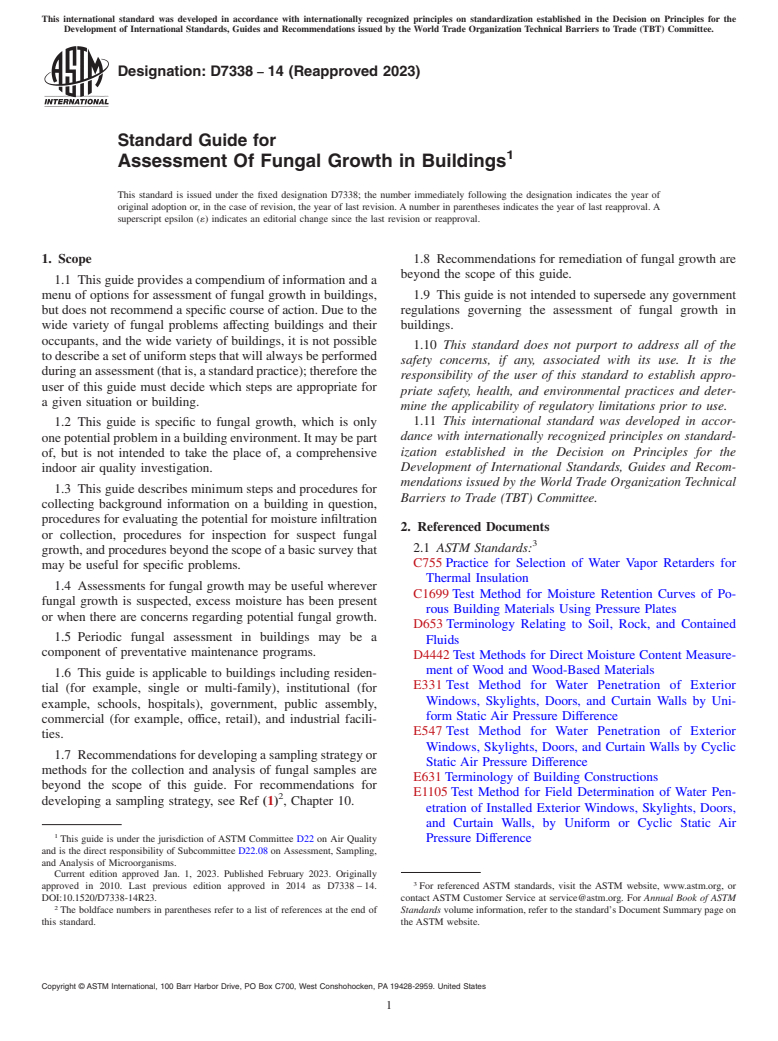
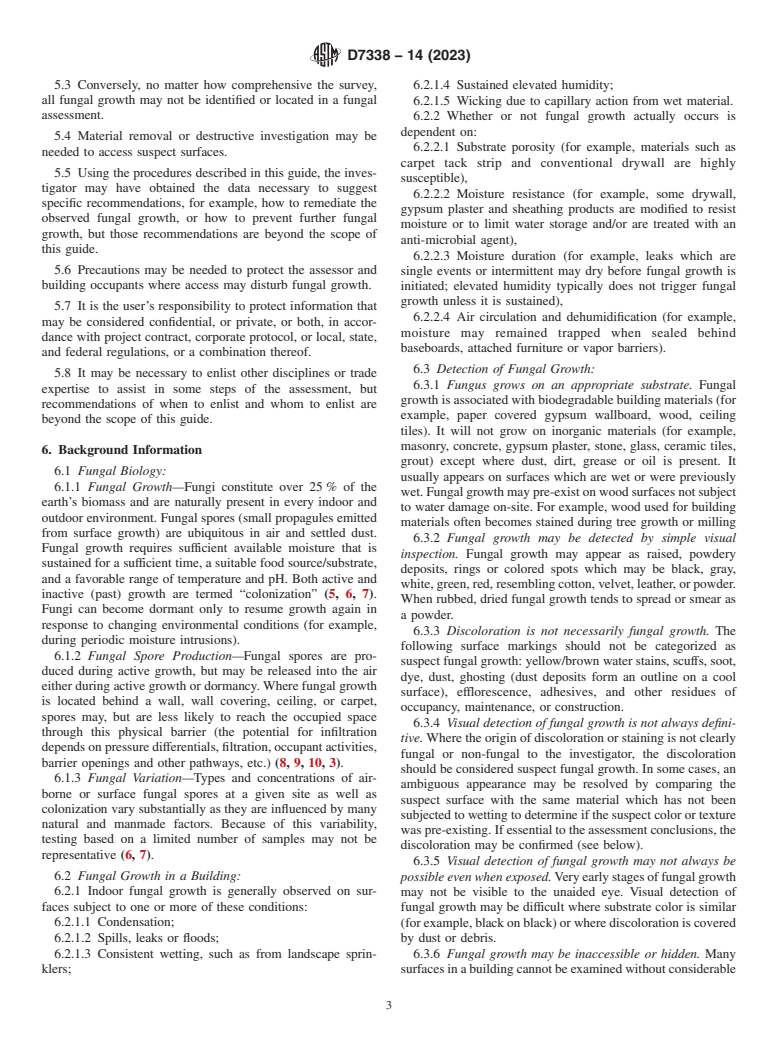
1.1 This guide provides a compendium of information and a menu of options for assessment of fungal growth in buildings, but does not recommend a specific course of action. Due to the wide variety of fungal problems affecting buildings and their occupants, and the wide variety of buildings, it is not possible to describe a set of uniform steps that will always be performed during an assessment (that is, a standard practice); therefore the user of this guide must decide which steps are appropriate for a given situation or building.
1.2 This guide is specific to fungal growth, which is only one potential problem in a building environment. It may be part of, but is not intended to take the place of, a comprehensive indoor air quality investigation.
1.3 This guide describes minimum steps and procedures for collecting background information on a building in question, procedures for evaluating the potential for moisture infiltration or collection, procedures for inspection for suspect fungal growth, and procedures beyond the scope of a basic survey that may be useful for specific problems.
1.4 Assessments for fungal growth may be useful wherever fungal growth is suspected, excess moisture has been present or when there are concerns regarding potential fungal growth.
1.5 Periodic fungal assessment in buildings may be a component of preventative maintenance programs.
1.6 This guide is applicable to buildings including residential (for example, single or multi-family), institutional (for example, schools, hospitals), government, public assembly, commercial (for example, office, retail), and industrial facilities.
1.7 Recommendations for developing a sampling strategy or methods for the collection and analysis of fungal samples are beyond the scope of this guide. For recommendations for developing a sampling strategy, see Ref (1)2, Chapter 10.
1.8 Recommendations for remediation of fungal growth are beyond the scope of this guide.
1.9 This guide is not intended to supersede any government regulations governing the assessment of fungal growth in buildings.
1.10 This standard does not purport to address all of the safety concerns, if any, associated with its use. It is the responsibility of the user of this standard to establish appropriate safety, health, and environmental practices and determine the applicability of regulatory limitations prior to use...
General Information
Relations
Standards Content (Sample)
This international standard was developed in accordance with internationally recognized principles on standardization established in the Decision on Principles for the
Development of International Standards, Guides and Recommendations issued by the World Trade Organization Technical Barriers to Trade (TBT) Committee.
Designation: D7338 − 14 (Reapproved 2023)
Standard Guide for
1
Assessment Of Fungal Growth in Buildings
This standard is issued under the fixed designation D7338; the number immediately following the designation indicates the year of
original adoption or, in the case of revision, the year of last revision. A number in parentheses indicates the year of last reapproval. A
superscript epsilon (´) indicates an editorial change since the last revision or reapproval.
1. Scope 1.8 Recommendations for remediation of fungal growth are
beyond the scope of this guide.
1.1 This guide provides a compendium of information and a
menu of options for assessment of fungal growth in buildings, 1.9 This guide is not intended to supersede any government
but does not recommend a specific course of action. Due to the regulations governing the assessment of fungal growth in
wide variety of fungal problems affecting buildings and their buildings.
occupants, and the wide variety of buildings, it is not possible
1.10 This standard does not purport to address all of the
to describe a set of uniform steps that will always be performed
safety concerns, if any, associated with its use. It is the
during an assessment (that is, a standard practice); therefore the
responsibility of the user of this standard to establish appro-
user of this guide must decide which steps are appropriate for
priate safety, health, and environmental practices and deter-
a given situation or building.
mine the applicability of regulatory limitations prior to use.
1.11 This international standard was developed in accor-
1.2 This guide is specific to fungal growth, which is only
dance with internationally recognized principles on standard-
one potential problem in a building environment. It may be part
ization established in the Decision on Principles for the
of, but is not intended to take the place of, a comprehensive
Development of International Standards, Guides and Recom-
indoor air quality investigation.
mendations issued by the World Trade Organization Technical
1.3 This guide describes minimum steps and procedures for
Barriers to Trade (TBT) Committee.
collecting background information on a building in question,
procedures for evaluating the potential for moisture infiltration
2. Referenced Documents
or collection, procedures for inspection for suspect fungal
3
2.1 ASTM Standards:
growth, and procedures beyond the scope of a basic survey that
C755 Practice for Selection of Water Vapor Retarders for
may be useful for specific problems.
Thermal Insulation
1.4 Assessments for fungal growth may be useful wherever
C1699 Test Method for Moisture Retention Curves of Po-
fungal growth is suspected, excess moisture has been present
rous Building Materials Using Pressure Plates
or when there are concerns regarding potential fungal growth.
D653 Terminology Relating to Soil, Rock, and Contained
1.5 Periodic fungal assessment in buildings may be a
Fluids
component of preventative maintenance programs.
D4442 Test Methods for Direct Moisture Content Measure-
ment of Wood and Wood-Based Materials
1.6 This guide is applicable to buildings including residen-
E331 Test Method for Water Penetration of Exterior
tial (for example, single or multi-family), institutional (for
Windows, Skylights, Doors, and Curtain Walls by Uni-
example, schools, hospitals), government, public assembly,
form Static Air Pressure Difference
commercial (for example, office, retail), and industrial facili-
E547 Test Method for Water Penetration of Exterior
ties.
Windows, Skylights, Doors, and Curtain Walls by Cyclic
1.7 Recommendations for developing a sampling strategy or
Static Air Pressure Difference
methods for the collection and analysis of fungal samples are
E631 Terminology of Building Constructions
beyond the scope of this guide. For recommendations for
E1105 Test Method for Field Determination of Water Pen-
2
developing a sampling strategy, see Ref (1) , Chapter 10.
etration of Installed Exterior Windows, Skylights, Doors,
and Curtain Walls, by Uniform or Cyclic Static Air
1
This guide is under the jurisdiction of ASTM Committee D22 on Air Quality
Pressure Difference
and is the direct responsibility of Subcommittee D22.08 on Assessment, Sampling,
and Analysis of Microorganisms.
Current edition approved Jan. 1, 2023. Published February 2023. Originally
3
approved in 2010. Last previous edition approved in 2014 as D7338 – 14. For referenced ASTM standards, visit the ASTM website, www.astm.org, or
DOI:10.1520/D7338-14R23. contact ASTM Customer Service at service@astm.org. For Annual Book of ASTM
2
The boldface numbers in parentheses refer to a list of references at the end of Standards
...
Questions, Comments and Discussion
Ask us and Technical Secretary will try to provide an answer. You can facilitate discussion about the standard in here.