


ASTM E2045-99(2014)
(Practice)Standard Practice for Detailed Clinical Observations of Test Animals
Standard Practice for Detailed Clinical Observations of Test Animals
SIGNIFICANCE AND USE
3.1 This practice pertains to all forms of toxicological testing (acute, subchronic, or chronic) performed by any route of administration (inhalation, oral, dermal, ocular, or other).
3.2 The U.S. Environmental Protection Agency, Good Laboratory Practices for Nonclinical Laboratory Studies, as listed in 40 CFR, requires that a testing facility maintain specific standard operating procedures (SOPs) including an SOP covering clinical observations in test animals.
3.3 This practice serves as a basis for consistency in clinical observations. Actual procedures and forms to be used in recording observations must be described in individual study protocols.
SCOPE
1.1 This practice describes the terms used in observing and recording cutaneous, gastrointestinal, respiratory, reproductive, neuromuscular, ocular, and general clinical signs of animals undergoing toxicological testing. This practice also assists in properly observing and assessing laboratory animals for signs of disease or adverse effects of compound administration.
1.2 This practice includes codes and descriptions for a wide variety of clinical signs, anatomical locations, and other descriptive qualifiers, and a technique for scoring the extent or severity of clinical signs.
1.3 This practice assumes that the reader is knowledgeable in animal toxicology and related pertinent areas and is trained in making clinical observations.
1.4 This standard does not purport to address all of the safety concerns, if any, associated with its use. It is the responsibility of the user of this standard to establish appropriate safety and health practices and determine the applicability of regulatory limitations prior to use.
General Information
Buy Standard
Standards Content (Sample)
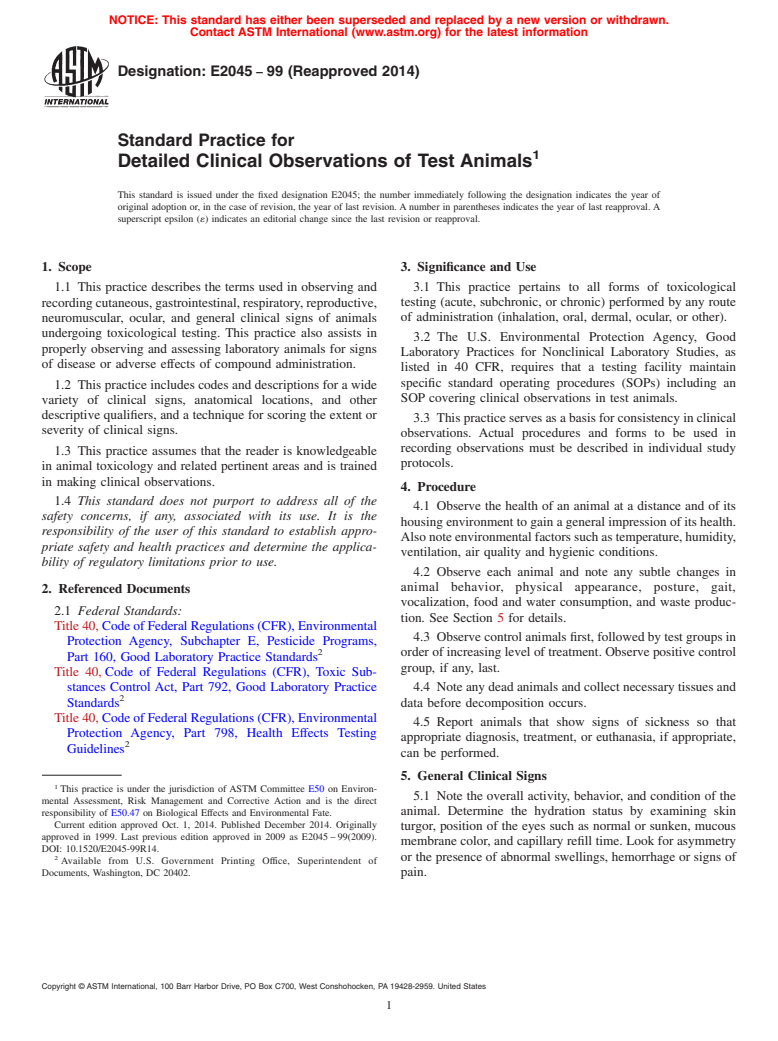
NOTICE: This standard has either been superseded and replaced by a new version or withdrawn.
Contact ASTM International (www.astm.org) for the latest information
Designation: E2045 − 99 (Reapproved 2014)
Standard Practice for
Detailed Clinical Observations of Test Animals
This standard is issued under the fixed designation E2045; the number immediately following the designation indicates the year of
original adoption or, in the case of revision, the year of last revision. A number in parentheses indicates the year of last reapproval. A
superscript epsilon (´) indicates an editorial change since the last revision or reapproval.
1. Scope 3. Significance and Use
1.1 This practice describes the terms used in observing and 3.1 This practice pertains to all forms of toxicological
testing (acute, subchronic, or chronic) performed by any route
recordingcutaneous,gastrointestinal,respiratory,reproductive,
neuromuscular, ocular, and general clinical signs of animals of administration (inhalation, oral, dermal, ocular, or other).
undergoing toxicological testing. This practice also assists in
3.2 The U.S. Environmental Protection Agency, Good
properly observing and assessing laboratory animals for signs
Laboratory Practices for Nonclinical Laboratory Studies, as
of disease or adverse effects of compound administration.
listed in 40 CFR, requires that a testing facility maintain
specific standard operating procedures (SOPs) including an
1.2 This practice includes codes and descriptions for a wide
SOP covering clinical observations in test animals.
variety of clinical signs, anatomical locations, and other
descriptive qualifiers, and a technique for scoring the extent or
3.3 This practice serves as a basis for consistency in clinical
severity of clinical signs.
observations. Actual procedures and forms to be used in
recording observations must be described in individual study
1.3 This practice assumes that the reader is knowledgeable
protocols.
in animal toxicology and related pertinent areas and is trained
in making clinical observations.
4. Procedure
1.4 This standard does not purport to address all of the
4.1 Observe the health of an animal at a distance and of its
safety concerns, if any, associated with its use. It is the
housing environment to gain a general impression of its health.
responsibility of the user of this standard to establish appro-
Alsonoteenvironmentalfactorssuchastemperature,humidity,
priate safety and health practices and determine the applica-
ventilation, air quality and hygienic conditions.
bility of regulatory limitations prior to use.
4.2 Observe each animal and note any subtle changes in
animal behavior, physical appearance, posture, gait,
2. Referenced Documents
vocalization, food and water consumption, and waste produc-
2.1 Federal Standards:
tion. See Section 5 for details.
Title 40, Code of Federal Regulations (CFR), Environmental
4.3 Observe control animals first, followed by test groups in
Protection Agency, Subchapter E, Pesticide Programs,
order of increasing level of treatment. Observe positive control
Part 160, Good Laboratory Practice Standards
group, if any, last.
Title 40, Code of Federal Regulations (CFR), Toxic Sub-
stances Control Act, Part 792, Good Laboratory Practice 4.4 Note any dead animals and collect necessary tissues and
Standards data before decomposition occurs.
Title 40, Code of Federal Regulations (CFR), Environmental
4.5 Report animals that show signs of sickness so that
Protection Agency, Part 798, Health Effects Testing
appropriate diagnosis, treatment, or euthanasia, if appropriate,
Guidelines
can be performed.
5. General Clinical Signs
This practice is under the jurisdiction of ASTM Committee E50 on Environ-
5.1 Note the overall activity, behavior, and condition of the
mental Assessment, Risk Management and Corrective Action and is the direct
animal. Determine the hydration status by examining skin
responsibility of E50.47 on Biological Effects and Environmental Fate.
Current edition approved Oct. 1, 2014. Published December 2014. Originally
turgor, position of the eyes such as normal or sunken, mucous
approved in 1999. Last previous edition approved in 2009 as E2045 – 99(2009).
membrane color, and capillary refill time. Look for asymmetry
DOI: 10.1520/E2045-99R14.
or the presence of abnormal swellings, hemorrhage or signs of
Available from U.S. Government Printing Office, Superintendent of
Documents, Washington, DC 20402. pain.
Copyright © ASTM International, 100 Barr Harbor Drive, PO Box C700, West Conshohocken, PA 19428-2959. United States
E2045 − 99 (2014)
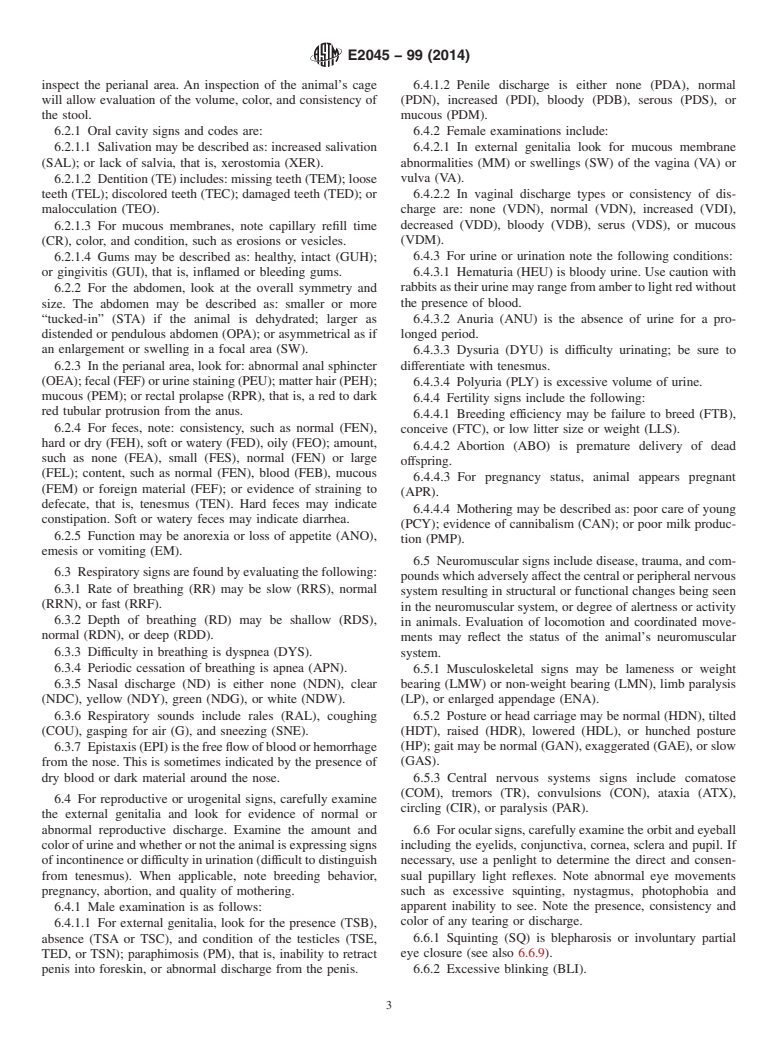
5.2 The following are some general conditions along with 6.1.3 Swelling (SW) is an increase in tissue size or in-
suggested codes for record keeping that do not fall into any creased abnormal shape of the skin or other organs from
specific organ system. Refer to Annex A1 – Annex A3 for a abnormal presence of: air, that is, emphysema (SWA); fluid or
detailed listing of the codes and their descriptions. Other water, that is, edema (SWE); solid tissue or tumor (SWT);
3,4,5
general reference material will also be helpful. blood, that is, hematoma (SWH); pus, that is, abscess (SWB).
5.2.1 Activity may be described as: decreased (ACD);
6.1.4 Skin condition (SK) may be described as: thickened
increased (ACI); hyperexcitable (HX); hyperactive (HYP);
(SKT); thinned (SKH); scaly (SKS); dry (SKD); or red (SKY)
lethargic (LE); irritable (IRR); moribund (MB), that is near
(see 6.1.5).
death; prostate (PRO), that is, exhibiting inability or unwill-
6.1.5 Erythema (ERY) is an increased pink or red color on
ingness to maintain upright posture.
smooth skin.
5.2.2 Body condition may be described as: obese (OBS);
6.1.6 Rash (RAS) is small red, pink or white dots or
thin (THN); decreased rectal temperature (BTD); increased
pustules on the skin; petechiae (PET) are red dots formed from
rectal temperature (BTI); hypothermia that is cold to touch
blood.
(HPO); hyperthermia that is warm to touch (HPR).
6.1.7 Blisters (BLS) are fluid-filled vesicles. The fluid is
5.2.3 Death may be described as: accidental death (AD);
usually clear, but can be pink (blood-tinged) or red/brown
euthanized (ETH); found dead (FD).
(filled with blood). White-filled vesicles are either pustules
5.2.4 Examineskinfordehydration(DHY).Theskinshould
(RAS) (< 5 mm) or abscesses (SW) (> 5 mm).
fall back into place immediately after it is pulled out of
6.1.8 Color change (CC) may be other than pink or red, for
position; if the skin is pulled out of position and tends to stick
example, bluish-black as in brushing, green as in bruising or
together or slowly fall back into place, the animal may be
severe infection, brown as in increased pigmentation, or white
dehydrated. Other signs of dehydration include sunken eyeball
as in blanching.
(SUN), pale or dry mucous membranes (MM), and a capillary
6.1.9 Abrasions (ABR) are denuded skin or mucous mem-
refill time of >3 s (CR4). Distinguish between dehydration and
brane.
various types of shock.
6.1.10 Lacerations(LCN)arecutsintheskinfrommechani-
5.2.5 Generalized edema (EDE) may appear as swelling of
cal injury, that is, bite, scratch, foreign object, and so forth.
the limbs, lower abdomen, head or under the mandible. When
6.1.11 Ulceration (ULC) is an open sore accompanied by
the apparently fluid-filled tissue is pressed, an indentation may
the disintegration of tissue, usually with necrosis, that is, death
persist for a short time.
of tissue.
5.2.6 Evidence of hemorrhage (HE) may appear on the
6.1.12 Scab (SCB) is an eschar formed from sloughed skin.
haircoat (HEH) or underlying skin or nails (HES), in urine
6.1.13 Pruritis (PRU) is itching evidenced by scratching,
(HEU) or feces (HEF), from the mouth (HEM), nose or
with or without a rash or abrasion.
epistaxis (EPI), eyes (HEO), ears (HEE), genitalia (HEG), or
6.1.14 Urticaria (URT) is a transient appearance of smooth,
anus (HEA).
slightly elevated bumps which are redder or paler than the
5.2.7 Jaundice (JAU) is an overall slight yellow to pale
surrounding skin and often accompanied by severe itching.
orange tinge to the skin and mucous membranes.
Uricaria often appears as localized, discrete or confluent areas
5.2.8 Mucous membrane condition (MM) is noted by the
of edema.
color and condition of the mucous membranes of the eye, nose,
6.1.15 Purpura (PUR) is confluent petechiae, that is, pin-
mouth, or external genitalia.
5.2.9 Swelling (SW) is noted by the size, location and point hemorrhages, which form ecchymoses, that is, blotchy
hemorrhages over any part of the body.
probable cause, such as edema (SWE) from: a solid tissue or
tumor (SWT); blood (SWH); air (SWA); or pus (SWB). 6.1.16 Common manifestations of dermal sensitivity reac-
tions are:
6. Specific Clinical Signs
6.1.16.1 Contact dermatitis (COD) is pruritis, erythema and
6.1 Inspect the entire haircoat and underlying skin for
vesiculation that may be followed by pustulation and necrosis
integumentary signs. Some common clinical signs and their
and that has a pattern consistent with the touch of a foreign
suggested codes are as follows:
object or substance.
6.1.1 Alopecia, that is, hair loss (ALO), includes hair
6.1.16.2 Exanthema (EXA) is macular or papular redness in
thinning, patchy/focal hair loss or balding.
discrete areas.
6.1.2 Haircoat condition (HC) may be described as: oily
6.1.16.3 Exfoliation (EXF) is loss of superficial skin layers
(HCO); rough (HCR); wet (HCW); soiled (HCS); dry (D);
with redness, swelling, and presence of free blood.
bloody (HEH); or piloerection (HCP), that is, distinctly raised
6.1.16.4 Bullous eruption (BUL) is the presence of discrete
fur, excluding the vibrissae, giving a bristled or porcupine-like
serous or seropustular areas.
appearance.
6.1.16.5 Erythema multiform (EMF) is the presence of
multiple types of macules, papules and nodules.
Taylor, E.J., ed., Dorland’s Illustrated Medical Dictionary, W.B. Saunders,
Philadelphia, PA, 27th edition, 1988.
6.2 Gastrointestinal signs are observed during external
Stedman’s Medical Dictionary, Williams and Wilkins, Baltimore, MD, 25th
evaluations of the gastrointestinal system conducted from the
edition, 1990 .
oral cavity to the anal area. Visually inspect the teeth and
Thomas, C.L., ed., Tabor’s Cyclopedic Medical Dictionary, F. A. Davis Co.,
Philadelphia, PA, 17th edition, 1993. mucousmembranesoftheoralcavity,palpatetheabdomenand
E2045 − 99 (2014)
inspect the perianal area. An inspection of the animal’s cage 6.4.1.2 Penile discharge is either none (PDA), normal
will allow evaluation of the volume, color, and consistency of (PDN), increased (PDI), bloody (PDB), serous (PDS), or
the stool. mucous (PDM).
6.2.1 Oral cavity signs and codes are: 6.4.2 Female examinations include:
6.2.1.1 Salivation may be described as: increased salivation 6.4.2.1 In external genitalia look for mucous membrane
(SAL); or lack of salvia, that is, xerostomia (XER). abnormalities (MM) or swellings (SW) of the vagina (VA) or
vulva (VA).
6.2.1.2 Dentition (TE) includes: missing teeth (TEM); loose
teeth (TEL); discolored teeth (TEC); damaged teeth (TED); or 6.4.2.2 In vaginal discharge types or consistency of dis-
malocculation (TEO). charge are: none (VDN), normal (VDN), increased (VDI),
decreased (VDD), bloody (VDB), serus (VDS), or mucous
6.2.1.3 For mucous membranes, note capillary refill time
(CR), color, and condition, such as erosions or vesicles. (VDM).
6.4.3 For urine or urination note the following conditions:
6.2.1.4 Gums may be described as: healthy, intact (GUH);
or gingivitis (GUI), that is, inflamed or bleeding gums. 6.4.3.1 Hematuria (HEU) is bloody urine. Use caution with
rabbitsastheirurinemayrangefromambertolightredwithout
6.2.2 For the abdomen, look at the overall symmetry and
the presence of blood.
size. The abdomen may be described as: smaller or more
“tucked-in” (STA) if the animal is dehydrated; larger as 6.4.3.2 Anuria (ANU) is the absence of urine for a pro-
distended or pendulous abdomen (OPA); or asymmetrical as if longed period.
an enlargement or swelling in a focal area (SW).
6.4.3.3 Dysuria (DYU) is difficulty urinating; be sure to
6.2.3 In the perianal area, look for: abnormal anal sphincter differentiate with tenesmus.
(OEA);fecal(FEF)orurinestaining(PEU);matterhair(PEH); 6.4.3.4 Polyuria (PLY) is excessive volume of urine.
mucous (PEM); or rectal prolapse (RPR), that is, a red to dark
6.4.4 Fertility signs include the following:
red tubular protrusion from the anus.
6.4.4.1 Breeding efficiency may be failure to breed (FTB),
6.2.4 For feces, note: consistency, such as normal (FEN),
conceive (FTC), or low litter size or weight (LLS).
hard or dry (FEH), soft or watery (FED), oily (FEO); amount,
6.4.4.2 Abortion (ABO) is premature delivery of dead
such as none (FEA), small (FES), normal (FEN) or large
offspring.
(FEL); content, such as normal (FEN), blood (FEB), mucous
6.4.4.3 For pregnancy status, animal appears pregnant
(FEM) or foreign material (FEF); or evidence of straining to
(APR).
defecate, that is, tenesmus (TEN). Hard feces may indicate
6.4.4.4 Mothering may be described as: poor care of young
constipation. Soft or watery feces may indicate diarrhea.
(PCY); evidence of cannibalism (CAN); or poor milk produc-
6.2.5 Function may be anorexia or loss of appetite (ANO),
tion (PMP).
emesis or vomiting (EM).
6.5 Neuromuscular signs include disease, trauma, and com-
6.3 Respiratory signs are found by evaluating the following:
poundswhichadverselyaffectthecentralorperipheralnervous
6.3.1 Rate of breathing (RR) may be slow (RRS), normal
system resulting in structural or functional changes being seen
(RRN), or fast (RRF).
in the neuromuscular system, or degree of alertness or activity
6.3.2 Depth of breathing (RD) may be shallow (RDS),
in animals. Evaluation of locomotion and coordinated move-
normal (RDN), or deep (RDD).
ments may reflect the status of the animal’s neuromuscular
6.3.3 Difficulty in breathing is dyspnea (DYS). system.
6.3.4 Periodic cessation of breathing is apnea (APN).
6.5.1 Musculoskeletal signs may be lameness or weight
6.3.5 Nasal discharge (ND) is either none (NDN), clear bearing (LMW) or non-weight bearing (LMN), limb paralysis
(NDC), yellow (NDY), green (NDG), or white (NDW). (LP), or enlarged appendage (ENA).
6.3.6 Respiratory sounds include rales (RAL), coughing 6.5.2 Posture or head carriage may be normal (HDN), tilted
(COU), gasping for air (G), and sneezing (SNE). (HDT), raised (HDR), lowered (HDL), or hunched posture
6.3.7 Epistaxis(EPI)isthefreeflowofbloodorhemorrhage (HP); gait may be normal (GAN), exaggerated (GAE), or slow
(GAS).
from the nose. This is sometimes indicated by the presence of
dry blood or dark material around the nose. 6.5.3 Central nervous systems signs include comatose
(COM), tremors (TR), convulsions (CON), ataxia (ATX),
6.4 For reproductive or urogenital signs,
...
This document is not an ASTM standard and is intended only to provide the user of an ASTM standard an indication of what changes have been made to the previous version. Because
it may not be technically possible to adequately depict all changes accurately, ASTM recommends that users consult prior editions as appropriate. In all cases only the current version
of the standard as published by ASTM is to be considered the official document.
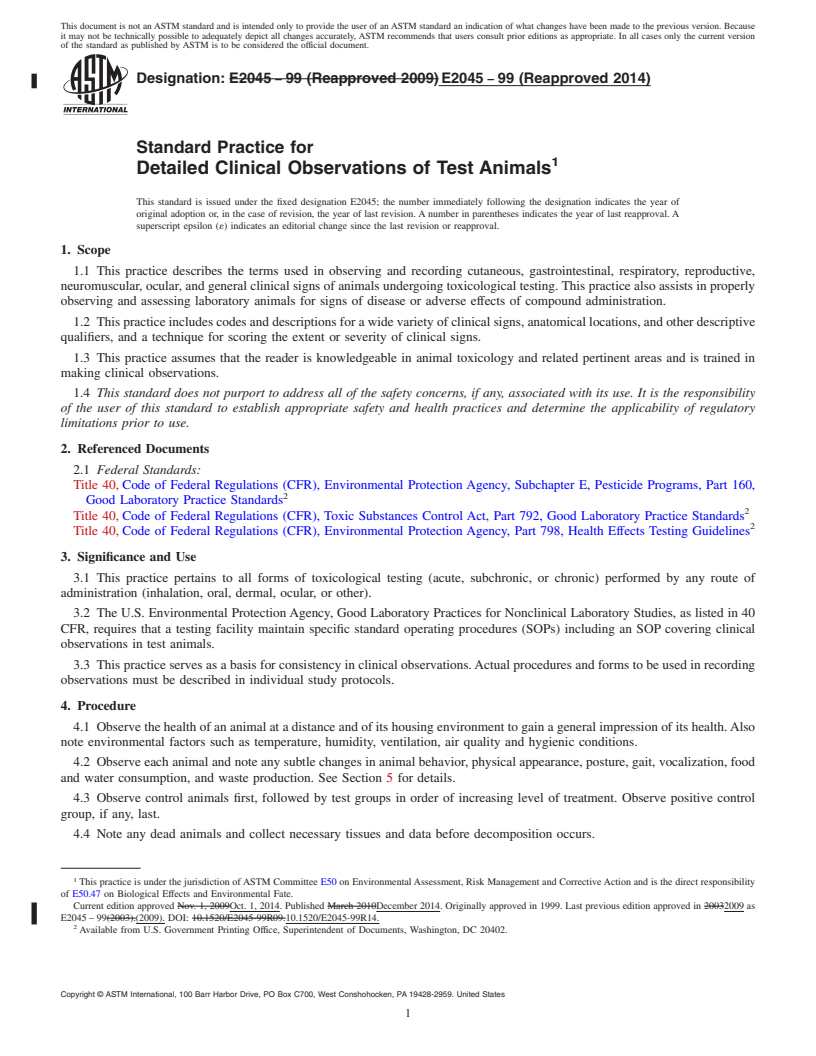
Designation: E2045 − 99 (Reapproved 2009) E2045 − 99 (Reapproved 2014)
Standard Practice for
Detailed Clinical Observations of Test Animals
This standard is issued under the fixed designation E2045; the number immediately following the designation indicates the year of
original adoption or, in the case of revision, the year of last revision. A number in parentheses indicates the year of last reapproval. A
superscript epsilon (´) indicates an editorial change since the last revision or reapproval.
1. Scope
1.1 This practice describes the terms used in observing and recording cutaneous, gastrointestinal, respiratory, reproductive,
neuromuscular, ocular, and general clinical signs of animals undergoing toxicological testing. This practice also assists in properly
observing and assessing laboratory animals for signs of disease or adverse effects of compound administration.
1.2 This practice includes codes and descriptions for a wide variety of clinical signs, anatomical locations, and other descriptive
qualifiers, and a technique for scoring the extent or severity of clinical signs.
1.3 This practice assumes that the reader is knowledgeable in animal toxicology and related pertinent areas and is trained in
making clinical observations.
1.4 This standard does not purport to address all of the safety concerns, if any, associated with its use. It is the responsibility
of the user of this standard to establish appropriate safety and health practices and determine the applicability of regulatory
limitations prior to use.
2. Referenced Documents
2.1 Federal Standards:
Title 40, Code of Federal Regulations (CFR), Environmental Protection Agency, Subchapter E, Pesticide Programs, Part 160,
Good Laboratory Practice Standards
Title 40, Code of Federal Regulations (CFR), Toxic Substances Control Act, Part 792, Good Laboratory Practice Standards
Title 40, Code of Federal Regulations (CFR), Environmental Protection Agency, Part 798, Health Effects Testing Guidelines
3. Significance and Use
3.1 This practice pertains to all forms of toxicological testing (acute, subchronic, or chronic) performed by any route of
administration (inhalation, oral, dermal, ocular, or other).
3.2 The U.S. Environmental Protection Agency, Good Laboratory Practices for Nonclinical Laboratory Studies, as listed in 40
CFR, requires that a testing facility maintain specific standard operating procedures (SOPs) including an SOP covering clinical
observations in test animals.
3.3 This practice serves as a basis for consistency in clinical observations. Actual procedures and forms to be used in recording
observations must be described in individual study protocols.
4. Procedure
4.1 Observe the health of an animal at a distance and of its housing environment to gain a general impression of its health. Also
note environmental factors such as temperature, humidity, ventilation, air quality and hygienic conditions.
4.2 Observe each animal and note any subtle changes in animal behavior, physical appearance, posture, gait, vocalization, food
and water consumption, and waste production. See Section 5 for details.
4.3 Observe control animals first, followed by test groups in order of increasing level of treatment. Observe positive control
group, if any, last.
4.4 Note any dead animals and collect necessary tissues and data before decomposition occurs.
This practice is under the jurisdiction of ASTM Committee E50 on Environmental Assessment, Risk Management and Corrective Action and is the direct responsibility
of E50.47 on Biological Effects and Environmental Fate.
Current edition approved Nov. 1, 2009Oct. 1, 2014. Published March 2010December 2014. Originally approved in 1999. Last previous edition approved in 20032009 as
E2045 – 99(2003).(2009). DOI: 10.1520/E2045-99R09.10.1520/E2045-99R14.
Available from U.S. Government Printing Office, Superintendent of Documents, Washington, DC 20402.
Copyright © ASTM International, 100 Barr Harbor Drive, PO Box C700, West Conshohocken, PA 19428-2959. United States
E2045 − 99 (2014)
4.5 Report animals that show signs of sickness so that appropriate diagnosis, treatment, or euthanasia, if appropriate, can be
performed.
5. General Clinical Signs
5.1 Note the overall activity, behavior, and condition of the animal. Determine the hydration status by examining skin turgor,
position of the eyes such as normal or sunken, mucous membrane color, and capillary refill time. Look for asymmetry or the
presence of abnormal swellings, hemorrhage or signs of pain.
5.2 The following are some general conditions along with suggested codes for record keeping that do not fall into any specific
organ system. Refer to Annex A1 – Annex A3 for a detailed listing of the codes and their descriptions. Other general reference
3,4,5
material will also be helpful.
5.2.1 Activity may be described as: decreased (ACD); increased (ACI); hyperexcitable (HX); hyperactive (HYP); lethargic
(LE); irritable (IRR); moribund (MB), that is near death; prostate (PRO), that is, exhibiting inability or unwillingness to maintain
upright posture.
5.2.2 Body condition may be described as: obese (OBS); thin (THN); decreased rectal temperature (BTD); increased rectal
temperature (BTI); hypothermia that is cold to touch (HPO); hyperthermia that is warm to touch (HPR).
5.2.3 Death may be described as: accidental death (AD); euthanized (ETH); found dead (FD).
5.2.4 Examine skin for dehydration (DHY). The skin should fall back into place immediately after it is pulled out of position;
if the skin is pulled out of position and tends to stick together or slowly fall back into place, the animal may be dehydrated. Other
signs of dehydration include sunken eyeball (SUN), pale or dry mucous membranes (MM), and a capillary refill time of >3 s (CR4).
Distinguish between dehydration and various types of shock.
5.2.5 Generalized edema (EDE) may appear as swelling of the limbs, lower abdomen, head or under the mandible. When the
apparently fluid-filled tissue is pressed, an indentation may persist for a short time.
5.2.6 Evidence of hemorrhage (HE) may appear on the haircoat (HEH) or underlying skin or nails (HES), in urine (HEU) or
feces (HEF), from the mouth (HEM), nose or epistaxis (EPI), eyes (HEO), ears (HEE), genitalia (HEG), or anus (HEA).
5.2.7 Jaundice (JAU) is an overall slight yellow to pale orange tinge to the skin and mucous membranes.
5.2.8 Mucous membrane condition (MM) is noted by the color and condition of the mucous membranes of the eye, nose, mouth,
or external genitalia.
5.2.9 Swelling (SW) is noted by the size, location and probable cause, such as edema (SWE) from: a solid tissue or tumor
(SWT); blood (SWH); air (SWA); or pus (SWB).
6. Specific Clinical Signs
6.1 Inspect the entire haircoat and underlying skin for integumentary signs. Some common clinical signs and their suggested
codes are as follows:
6.1.1 Alopecia, that is, hair loss (ALO), includes hair thinning, patchy/focal hair loss or balding.
6.1.2 Haircoat condition (HC) may be described as: oily (HCO); rough (HCR); wet (HCW); soiled (HCS); dry (D); bloody
(HEH); or piloerection (HCP), that is, distinctly raised fur, excluding the vibrissae, giving a bristled or porcupine-like appearance.
6.1.3 Swelling (SW) is an increase in tissue size or increased abnormal shape of the skin or other organs from abnormal presence
of: air, that is, emphysema (SWA); fluid or water, that is, edema (SWE); solid tissue or tumor (SWT); blood, that is, hematoma
(SWH); pus, that is, abscess (SWB).
6.1.4 Skin condition (SK) may be described as: thickened (SKT); thinned (SKH); scaly (SKS); dry (SKD); or red (SKY) (see
6.1.5).
6.1.5 Erythema (ERY) is an increased pink or red color on smooth skin.
6.1.6 Rash (RAS) is small red, pink or white dots or pustules on the skin; petechiae (PET) are red dots formed from blood.
6.1.7 Blisters (BLS) are fluid-filled vesicles. The fluid is usually clear, but can be pink (blood-tinged) or red/brown (filled with
blood). White-filled vesicles are either pustules (RAS) (< 5 mm) or abscesses (SW) (> 5 mm).
6.1.8 Color change (CC) may be other than pink or red, for example, bluish-black as in brushing, green as in bruising or severe
infection, brown as in increased pigmentation, or white as in blanching.
6.1.9 Abrasions (ABR) are denuded skin or mucous membrane.
6.1.10 Lacerations (LCN) are cuts in the skin from mechanical injury, that is, bite, scratch, foreign object, and so forth.
6.1.11 Ulceration (ULC) is an open sore accompanied by the disintegration of tissue, usually with necrosis, that is, death of
tissue.
6.1.12 Scab (SCB) is an eschar formed from sloughed skin.
6.1.13 Pruritis (PRU) is itching evidenced by scratching, with or without a rash or abrasion.
Taylor, E.J., ed., Dorland’s Illustrated Medical Dictionary, W.B. Saunders, Philadelphia, PA, 27th edition, 1988.
Stedman’s Medical Dictionary, Williams and Wilkins, Baltimore, MD, 25th edition, 1990 .
Thomas, C.L., ed., Tabor’s Cyclopedic Medical Dictionary, F. A. Davis Co., Philadelphia, PA, 17th edition, 1993.
E2045 − 99 (2014)
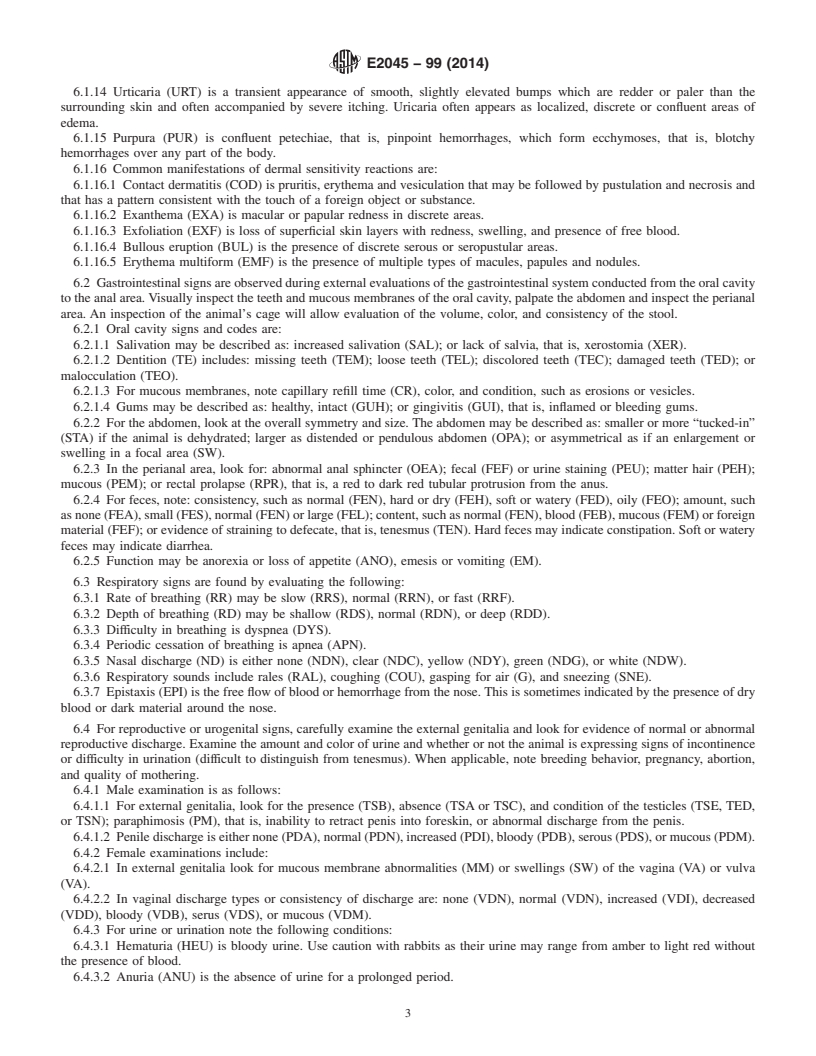
6.1.14 Urticaria (URT) is a transient appearance of smooth, slightly elevated bumps which are redder or paler than the
surrounding skin and often accompanied by severe itching. Uricaria often appears as localized, discrete or confluent areas of
edema.
6.1.15 Purpura (PUR) is confluent petechiae, that is, pinpoint hemorrhages, which form ecchymoses, that is, blotchy
hemorrhages over any part of the body.
6.1.16 Common manifestations of dermal sensitivity reactions are:
6.1.16.1 Contact dermatitis (COD) is pruritis, erythema and vesiculation that may be followed by pustulation and necrosis and
that has a pattern consistent with the touch of a foreign object or substance.
6.1.16.2 Exanthema (EXA) is macular or papular redness in discrete areas.
6.1.16.3 Exfoliation (EXF) is loss of superficial skin layers with redness, swelling, and presence of free blood.
6.1.16.4 Bullous eruption (BUL) is the presence of discrete serous or seropustular areas.
6.1.16.5 Erythema multiform (EMF) is the presence of multiple types of macules, papules and nodules.
6.2 Gastrointestinal signs are observed during external evaluations of the gastrointestinal system conducted from the oral cavity
to the anal area. Visually inspect the teeth and mucous membranes of the oral cavity, palpate the abdomen and inspect the perianal
area. An inspection of the animal’s cage will allow evaluation of the volume, color, and consistency of the stool.
6.2.1 Oral cavity signs and codes are:
6.2.1.1 Salivation may be described as: increased salivation (SAL); or lack of salvia, that is, xerostomia (XER).
6.2.1.2 Dentition (TE) includes: missing teeth (TEM); loose teeth (TEL); discolored teeth (TEC); damaged teeth (TED); or
malocculation (TEO).
6.2.1.3 For mucous membranes, note capillary refill time (CR), color, and condition, such as erosions or vesicles.
6.2.1.4 Gums may be described as: healthy, intact (GUH); or gingivitis (GUI), that is, inflamed or bleeding gums.
6.2.2 For the abdomen, look at the overall symmetry and size. The abdomen may be described as: smaller or more “tucked-in”
(STA) if the animal is dehydrated; larger as distended or pendulous abdomen (OPA); or asymmetrical as if an enlargement or
swelling in a focal area (SW).
6.2.3 In the perianal area, look for: abnormal anal sphincter (OEA); fecal (FEF) or urine staining (PEU); matter hair (PEH);
mucous (PEM); or rectal prolapse (RPR), that is, a red to dark red tubular protrusion from the anus.
6.2.4 For feces, note: consistency, such as normal (FEN), hard or dry (FEH), soft or watery (FED), oily (FEO); amount, such
as none (FEA), small (FES), normal (FEN) or large (FEL); content, such as normal (FEN), blood (FEB), mucous (FEM) or foreign
material (FEF); or evidence of straining to defecate, that is, tenesmus (TEN). Hard feces may indicate constipation. Soft or watery
feces may indicate diarrhea.
6.2.5 Function may be anorexia or loss of appetite (ANO), emesis or vomiting (EM).
6.3 Respiratory signs are found by evaluating the following:
6.3.1 Rate of breathing (RR) may be slow (RRS), normal (RRN), or fast (RRF).
6.3.2 Depth of breathing (RD) may be shallow (RDS), normal (RDN), or deep (RDD).
6.3.3 Difficulty in breathing is dyspnea (DYS).
6.3.4 Periodic cessation of breathing is apnea (APN).
6.3.5 Nasal discharge (ND) is either none (NDN), clear (NDC), yellow (NDY), green (NDG), or white (NDW).
6.3.6 Respiratory sounds include rales (RAL), coughing (COU), gasping for air (G), and sneezing (SNE).
6.3.7 Epistaxis (EPI) is the free flow of blood or hemorrhage from the nose. This is sometimes indicated by the presence of dry
blood or dark material around the nose.
6.4 For reproductive or urogenital signs, carefully examine the external genitalia and look for evidence of normal or abnormal
reproductive discharge. Examine the amount and color of urine and whether or not the animal is expressing signs of incontinence
or difficulty in urination (difficult to distinguish from tenesmus). When applicable, note breeding behavior, pregnancy, abortion,
and quality of mothering.
6.4.1 Male examination is as follows:
6.4.1.1 For external genitalia, look for the presence (TSB), absence (TSA or TSC), and condition of the testicles (TSE, TED,
or TSN); paraphimosis (PM), that is, inability to retract penis into foreskin, or abnormal discharge from the penis.
6.4.1.2 Penile discharge is either none (PDA), normal (PDN), increased (PDI), bloody (PDB), serous (PDS), or mucous (PDM).
6.4.2 Female examinations include:
6.4.2.1 In external genitalia look for mucous membrane abnormalities (MM) or swellings (SW) of the vagina (VA) or vulva
(VA).
6.4.2.2 In vaginal discharge types or consistency of discharge are: none (VDN), normal (VDN), increased (VDI), decreased
(VDD), bloody (VDB), serus (VDS), or mucous (VDM).
6.4.3 For urine or urination note the following conditions:
6.4.3.1 Hematuria (HEU) is bloody urine. Use caution with rabbits as their urine may range from amber to light red without
the presence of blood.
6.4.3.2 Anuria (ANU) is the absence of urine for a prolonged period.
E2045 − 99 (2014)
6.4.3.3 Dysuria (DYU) is difficulty urinating; be sure to differentiate with tenesmus.
6.4.3.4 Polyuria (PLY) is excessive volume of urine.
6.4.4 Fertility signs include the following:
6.4.4.1 Breeding efficiency may be fail
...
Questions, Comments and Discussion
Ask us and Technical Secretary will try to provide an answer. You can facilitate discussion about the standard in here.