


ASTM D1294-05(2013)
(Test Method)Standard Test Method for Tensile Strength and Breaking Tenacity of Wool Fiber Bundles 1-in. (25.4-mm) Gage Length (Withdrawn 2022)
Standard Test Method for Tensile Strength and Breaking Tenacity of Wool Fiber Bundles 1-in. (25.4-mm) Gage Length (Withdrawn 2022)
SIGNIFICANCE AND USE
5.1 Test Method D1294 for the determination of tensile strength may be used for the acceptance testing of commercial shipments of wool, but caution is advised since technicians may fail to get good agreement between results. Comparative tests as directed in 5.1.1 may be advisable.
5.1.1 If there are differences of practical significance between reported test results for two laboratories (or more), comparative test should be performed to determine if there is a statistical bias between them, using competent statistical assistance. As a minimum, use the samples for such a comparative test that are as homogenous as possible, drawn from the same lot of material as the samples that resulted in disparate results during initial testing and randomly assigned in equal numbers to each laboratory. The test results from the laboratories involved should be compared using a statistical test for unpaired data, a probability level chosen prior to the testing series. If bias is found, either its cause must be found and corrected, or future test results for that material must be adjusted in consideration of the known bias.
5.2 This test method is useful in studying the relationship between fiber strength and product quality; results should be considered comparative rather than fundamental since the strength found will be lower than the sum of the strengths of the individual fibers present due to slight differences in tensioning.
5.3 Elongation may be obtained also but the accuracy of elongation measurements is limited and their determination is, therefore, not included as a formal part of this test method.
5.4 The basic differences between the procedures employed in this test method and those of Test Method D2524 are in the gage lengths employed and the methods of clamping. In Test Method D2524, specific clamps are required whereas in Test Method D1294, any conventional clamps may be used. Results for breaking load determined by Test Method D2524 average 30 % higher than ...
SCOPE
1.1 This test method covers the determination of the breaking force (or load) and estimation of the tensile strength and tenacity of wool fiber bundles with a 1-in. (25.4-mm) gage length. A procedure for preparation of the fiber bundle is included.
1.2 The values stated in inch-pound units are to be regarded as standard; the values in SI units are provided for information only. Because the instrument is calibrated in inch-pound units, inch-pound units are shown first, contrary to Committee D13 policy. Note 1—For other methods of measuring breaking tenacity of fiber bundles, refer to Test Methods D1445 and D2524.Note 2—This test method can be used for other fibers that lend themselves to the same kind of preparation but the difference in density must be taken into account when calculating the tensile strength. It is not necessary to know or correct for the density of a fiber when calculating breaking tenacity.
1.3 This standard does not purport to address all of the safety concerns, if any, associated with its use. It is the responsibiltiy of the user of this standard to establish appropriate safety and health practices and determine the applicability of regulatory limitations prior to use.
General Information
Standards Content (Sample)
NOTICE: This standard has either been superseded and replaced by a new version or withdrawn.
Contact ASTM International (www.astm.org) for the latest information
Designation: D1294 − 05 (Reapproved 2013)
Standard Test Method for
Tensile Strength and Breaking Tenacity of Wool Fiber
Bundles 1-in. (25.4-mm) Gage Length
This standard is issued under the fixed designation D1294; the number immediately following the designation indicates the year of
original adoption or, in the case of revision, the year of last revision.Anumber in parentheses indicates the year of last reapproval.A
superscript epsilon (´) indicates an editorial change since the last revision or reapproval.
1. Scope D4845Terminology Relating to Wool
1.1 This test method covers the determination of the break-
3. Terminology
ing force (or load) and estimation of the tensile strength and
tenacity of wool fiber bundles with a 1-in. (25.4-mm) gage
3.1 For all terminology related to Wool and Wool Felt,
length. A procedure for preparation of the fiber bundle is
D13.13, refer to Terminology D4845.
included.
3.1.1 Thefollowingtermsarerelevanttothisstandard:gage
length, recycled wool, tenacity, tensile strength, wool (as
1.2 The values stated in inch-pound units are to be regarded
defined in the Wool Products Labeling Act of 1939).
as standard; the values in SI units are provided for information
only. Because the instrument is calibrated in inch-pound units,
3.2 For all other terminology related to textiles see Termi-
inch-pound units are shown first, contrary to Committee D13
nology D123.
policy.
4. Summary of Test Method
NOTE 1—For other methods of measuring breaking tenacity of fiber
bundles, refer to Test Methods D1445 and D2524.
4.1 Thestrengthdeterminationisbasedontheloadrequired
NOTE 2—This test method can be used for other fibers that lend
to break a bundle of fibers which had been parallelized and
themselves to the same kind of preparation but the difference in density
must be taken into account when calculating the tensile strength. It is not held under uniform tension with masking tape. A 1-in. (25.4-
necessary to know or correct for the density of a fiber when calculating
mm)spacingbetweenthetapes(andclampsatthezerosetting)
breaking tenacity.
makespossiblethecuttingandweighingofthisamountoffiber
1.3 This standard does not purport to address all of the
for use in calculating the strength expressed as breaking
safety concerns, if any, associated with its use. It is the
tenacity in grams-force per tex or tensile strength in pounds-
responsibiltiy of the user of this standard to establish appro-
force per square inch.
priate safety and health practices and determine the applica-
bility of regulatory limitations prior to use.
5. Significance and Use
5.1 Test Method D1294 for the determination of tensile
2. Referenced Documents
strength may be used for the acceptance testing of commercial
2.1 ASTM Standards:
shipments of wool, but caution is advised since technicians
D76Specification for Tensile Testing Machines for Textiles
may fail to get good agreement between results. Comparative
D123Terminology Relating to Textiles
tests as directed in 5.1.1 may be advisable.
D1445TestMethodforBreakingStrengthandElongationof
5.1.1 If there are differences of practical significance be-
Cotton Fibers (Flat Bundle Method)
tween reported test results for two laboratories (or more),
D1776Practice for Conditioning and Testing Textiles
comparative test should be performed to determine if there is a
D2524Test Method for Breaking Tenacity of Wool Fibers,
statistical bias between them, using competent statistical assis-
Flat Bundle Method— ⁄8-in. (3.2-mm) Gage Length
tance.As a minimum, use the samples for such a comparative
D2525Practice for Sampling Wool for Moisture
test that are as homogenous as possible, drawn from the same
lot of material as the samples that resulted in disparate results
ThistestmethodisunderthejurisdictionofASTMCommitteeD13onTextiles
during initial testing and randomly assigned in equal numbers
and is the direct responsibility of Subcommittee D13.13 on Wool and Felt.
to each laboratory. The test results from the laboratories
Current edition approved Jan. 1, 2013. Published January 2013. Originally
involved should be compared using a statistical test for
approved in 1953. Last previous edition approved in 2005 as D1294–05. DOI:
10.1520/D1294-05R13.
unpaired data, a probability level chosen prior to the testing
For referenced ASTM standards, visit the ASTM website, www.astm.org, or
series. If bias is found, either its cause must be found and
contact ASTM Customer Service at service@astm.org. For Annual Book of ASTM
corrected, or future test results for that material must be
Standards volume information, refer to the standard’s Document Summary page on
the ASTM website. adjusted in consideration of the known bias.
Copyright © ASTM International, 100 Barr Harbor Drive, PO Box C700, West Conshohocken, PA 19428-2959. United States
D1294 − 05 (2013)
5.2 This test method is useful in studying the relationship 7.3.1 For loose fiber, grease, and scoured wool, reduce the
between fiber strength and product quality; results should be mass of clean fiber submitted for testing to approximately 15 g
considered comparative rather than fundamental since the byrandomlyselectingpiecesthroughoutthemass.Formintoa
strength found will be lower than the sum of the strengths of loose sliver by hand.
the individual fibers present due to slight differences in
7.3.2 For card sliver and top, cut a length of sliver about 20
tensioning.
in. (500 mm) long from each ball submitted for testing.
7.3.3 For roving, cut a length about 20 in. (500 mm) long
5.3 Elongation may be obtained also but the accuracy of
from each spool submitted for testing and include all ends.
elongation measurements is limited and their determination is,
therefore, not included as a formal part of this test method.
7.4 Test Specimens—Scour or solvent-extract the laboratory
sample until residual contamination is 1% or less of the
5.4 The basic differences between the procedures employed
laboratory mass, as established by further cleaning of a part of
in this test method and those of Test Method D2524 are in the
thelaboratorysample.Fromeachunitinthelaboratorysample,
gage lengths employed and the methods of clamping. In Test
prepare five test specimens as directed in 9.1.
Method D2524, specific clamps are required whereas in Test
MethodD1294,anyconventionalclampsmaybeused.Results
8. Preconditioning and Conditioning
for breaking load determined by Test Method D2524 average
30% higher than those obtained by Test Method D1294.
8.1 Bring the laboratory sample to moisture equilibrium for
testing in the standard atmosphere for testing textiles, as
6. Apparatus and Materials
directed in Practice D1776.
6.1 Comb, fine, sharp.
6.2 Analytical Balance, with a sensitivity of 0.0001 g. 9. Preparation of Specimens
6.3 Tensile Testing Machine, a CRE or CRT Type about
9.1 Prepare each specimen by drawing small groups of
50-lb (22-kg) capacity machine as prescribed in Specification
fibers from at least five locations in a unit of the laboratory
D76, capable of operating the moving clamp at a uniform
sample. Parallelize and combine them in a bundle which may
speedof10.0 60.5in./min(250 612mm/min).IfaCRLtype
be held conveniently between the thumb and forefinger.
machine is used, it should be capable of operating at a rate of
Choose the size of the bundle so that in the final bundle the
loading of 1 kgf/s (10 N/s). In no case shall the working range
1-in. (25.4-mm) length of fiber between the clamps of the
be outside the limits recommended by the manufacturer.
testing machine has a mass of between 15 and 25 mg.
NOTE 3—There may be no overall correlation between the results
9.2 Transfer one end of the bundle to the hand vise and
obtained with the CRE, CRT, or CRL type testing machines.
comb the rest of the bundle to remove the short fibers and to
Consequently, these three machines cannot be used interchangeably.
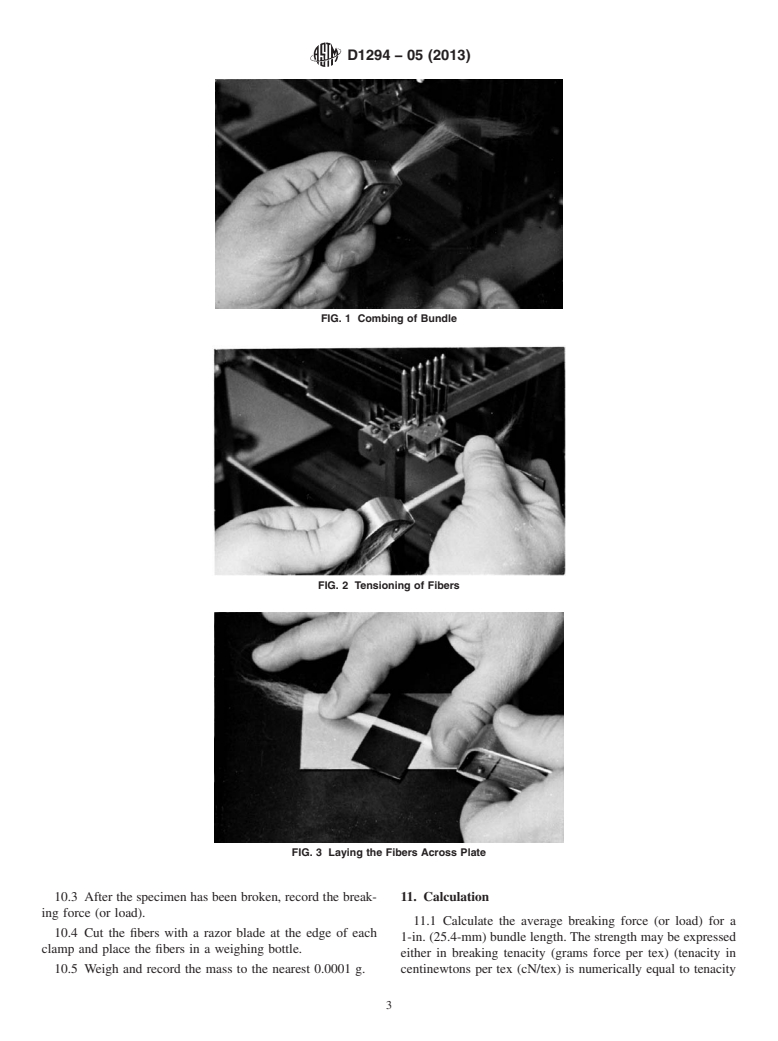
parallelize the remainder (see Fig. 1).
6.4 Metal Plates, 2 by 1-in. (50.8 by 25.4-mm) with one
9.3 Transferthehandvisetotheotherendofthebundleand
rubber-covered surface. The plates should be rigid, flat, and
repeat the combing operation.
approximately 0.1 in. (2.5 mm) thick with one rubber face
approximately0.06in.(1.5mm)thick(Note4).Twoplatesare
NOTE 5—The procedure described in 9.2 and 9.3 may have to be
repeated several times until the fibers are par
...
Questions, Comments and Discussion
Ask us and Technical Secretary will try to provide an answer. You can facilitate discussion about the standard in here.