


ASTM E131-10(2015)
(Terminology)Standard Terminology Relating to Molecular Spectroscopy
Standard Terminology Relating to Molecular Spectroscopy
SCOPE
1.1 The values stated in SI units are to be regarded as standard. No other units of measurement are included in this standard.
General Information
Buy Standard
Standards Content (Sample)
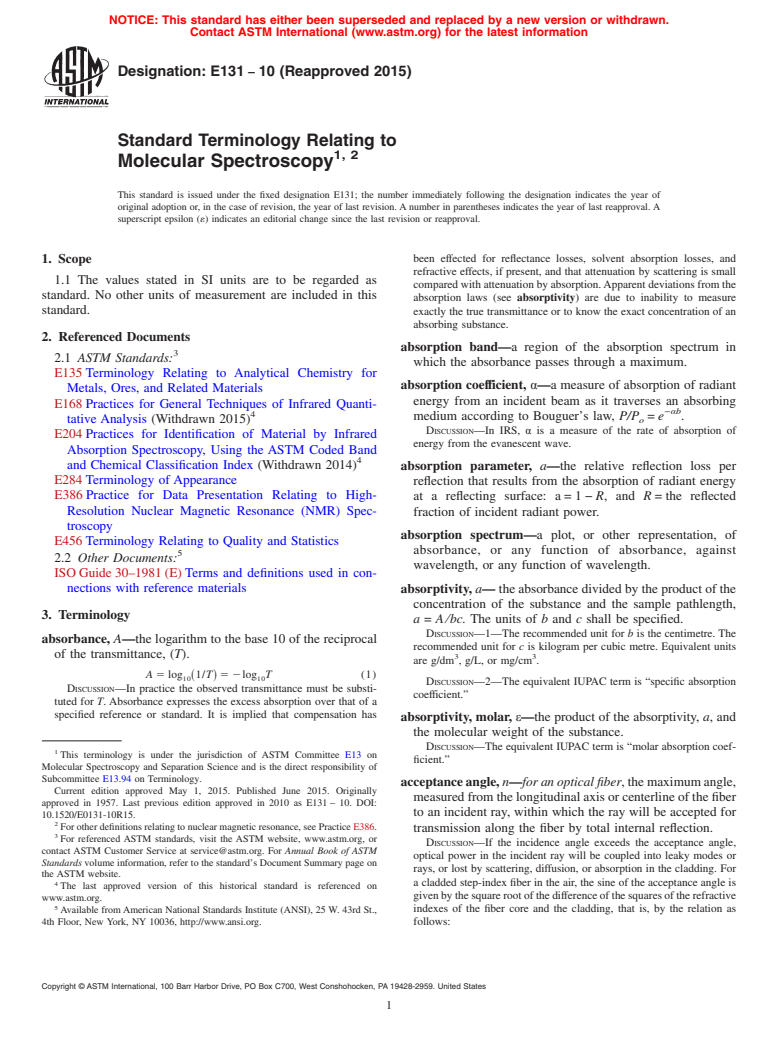
NOTICE: This standard has either been superseded and replaced by a new version or withdrawn.
Contact ASTM International (www.astm.org) for the latest information
Designation: E131 − 10 (Reapproved 2015)
Standard Terminology Relating to
1, 2
Molecular Spectroscopy
This standard is issued under the fixed designation E131; the number immediately following the designation indicates the year of
original adoption or, in the case of revision, the year of last revision.Anumber in parentheses indicates the year of last reapproval.A
superscript epsilon (´) indicates an editorial change since the last revision or reapproval.
been effected for reflectance losses, solvent absorption losses, and
1. Scope
refractive effects, if present, and that attenuation by scattering is small
1.1 The values stated in SI units are to be regarded as
comparedwithattenuationbyabsorption.Apparentdeviationsfromthe
standard. No other units of measurement are included in this
absorption laws (see absorptivity) are due to inability to measure
standard.
exactly the true transmittance or to know the exact concentration of an
absorbing substance.
2. Referenced Documents
absorption band—a region of the absorption spectrum in
2.1 ASTM Standards:
which the absorbance passes through a maximum.
E135Terminology Relating to Analytical Chemistry for
absorption coefficient, α—a measure of absorption of radiant
Metals, Ores, and Related Materials
energy from an incident beam as it traverses an absorbing
E168Practices for General Techniques of Infrared Quanti-
−αb
medium according to Bouguer’s law, P/P = e .
tative Analysis (Withdrawn 2015) o
DISCUSSION—In IRS, α is a measure of the rate of absorption of
E204Practices for Identification of Material by Infrared
energy from the evanescent wave.
Absorption Spectroscopy, Using the ASTM Coded Band
and Chemical Classification Index (Withdrawn 2014) absorption parameter, a—the relative reflection loss per
E284Terminology of Appearance
reflection that results from the absorption of radiant energy
E386Practice for Data Presentation Relating to High- at a reflecting surface: a=1− R, and R=the reflected
Resolution Nuclear Magnetic Resonance (NMR) Spec-
fraction of incident radiant power.
troscopy
absorption spectrum—a plot, or other representation, of
E456Terminology Relating to Quality and Statistics
absorbance, or any function of absorbance, against
2.2 Other Documents:
wavelength, or any function of wavelength.
ISOGuide30–1981(E)Terms and definitions used in con-
nections with reference materials
absorptivity, a—theabsorbancedividedbytheproductofthe
concentration of the substance and the sample pathlength,
3. Terminology
a=A⁄bc. The units of b and c shall be specified.
DISCUSSION—1—The recommended unit for b is the centimetre. The
absorbance, A—the logarithm to the base 10 of the reciprocal
recommended unit for c is kilogram per cubic metre. Equivalent units
of the transmittance, (T). 3 3
are g/dm , g/L, or mg/cm .
A 5 log ~1/T!52log T (1)
10 10
DISCUSSION—2—The equivalent IUPAC term is “specific absorption
DISCUSSION—In practice the observed transmittance must be substi-
coefficient.”
tuted for T.Absorbance expresses the excess absorption over that of a
specified reference or standard. It is implied that compensation has
absorptivity, molar, ε—the product of the absorptivity, a, and
the molecular weight of the substance.
DISCUSSION—The equivalent IUPAC term is “molar absorption coef-
This terminology is under the jurisdiction of ASTM Committee E13 on
ficient.”
Molecular Spectroscopy and Separation Science and is the direct responsibility of
Subcommittee E13.94 on Terminology.
acceptance angle, n—for an optical fiber,themaximumangle,
Current edition approved May 1, 2015. Published June 2015. Originally
measuredfromthelongitudinalaxisorcenterlineofthefiber
approved in 1957. Last previous edition approved in 2010 as E131– 10. DOI:
to an incident ray, within which the ray will be accepted for
10.1520/E0131-10R15.
Forotherdefinitionsrelatingtonuclearmagneticresonance,seePracticeE386.
transmission along the fiber by total internal reflection.
For referenced ASTM standards, visit the ASTM website, www.astm.org, or
DISCUSSION—If the incidence angle exceeds the acceptance angle,
contact ASTM Customer Service at service@astm.org. For Annual Book of ASTM
optical power in the incident ray will be coupled into leaky modes or
Standards volume information, refer to the standard’s Document Summary page on
rays, or lost by scattering, diffusion, or absorption in the cladding. For
the ASTM website.
a cladded step-index fiber in the air, the sine of the acceptance angle is
The last approved version of this historical standard is referenced on
givenbythesquarerootofthedifferenceofthesquaresoftherefractive
www.astm.org.
indexes of the fiber core and the cladding, that is, by the relation as
Available fromAmerican National Standards Institute (ANSI), 25 W. 43rd St.,
4th Floor, New York, NY 10036, http://www.ansi.org. follows:
Copyright © ASTM International, 100 Barr Harbor Drive, PO Box C700, West Conshohocken, PA 19428-2959. United States
E131 − 10 (2015)
DISCUSSION—This term should strictly be used with reference to a
2 2
sin A 5 = n 2 n (2)
1 2
weighting function whose magnitude is greatest at the centerburst and
where A is the acceptance angle and n and n are the refractive in-
1 2
decreases with retardation.
dexes of the core and cladding, respectively. If the refractive index is a
function of distance from the center of the core, as in the case of
attenuated total reflection (ATR)—reflection that occurs
graded index fibers, then the acceptance angle depends on the distance
when an absorbing coupling mechanism acts in the process
from the core center. The acceptance angle is maximum at the center,
of total internal reflection to make the reflectance less than
and zero at the core-cladding boundary. At any radius, r, the sine of the
unity.
acceptance angle of a graded index fiber is defined in compliance with
that of a step-index fiber as follows: DISCUSSION—In this process, if an absorbing sample is placed in
contact with the reflecting surface, the reflectance for total internal
2 2
sin A 5 =n 2 n (3)
r 1 2 reflection will be attenuated to some value between zero and unity (O
where A is the acceptance angle at a point on the entrance face at a
r
distance, r, from the center, n is the refractive index of the core at a
r power can take place.
radius, r, and n is the refractive index of the cladding. In air, sin A
attenuation index, κ—a measure of the absorption of radiant
and sin A are the numerical apertures. Unless otherwise stated, accep-
r
tance angles and numerical apertures for fiber optics are those for the
energy by an absorbing material. κ is related to the absorp-
center of the endface of the fiber, that is, where the refractive index,
tion coefficient by: nκ= αc /4πν, where c =the speed of
o o
and hence the numerical aperture, is the highest.
light in vacuo, ν=the frequency of radiant energy, and
n=the refractive index of the absorbing medium.
accuracy—the closeness of agreement between an observed
value and an accepted reference value (see Terminology
background—apparent absorption caused by anything other
E456).
than the substance for which the analysis is being made.
DISCUSSION—The term accuracy, when applied to a set of observed
values, will be a combination of a random component and a common
baseline—any line drawn on an absorption spectrum to estab-
systematic error or bias component. Since in routine use, random
lish a reference point representing a function of the radiant
components and bias components cannot be completely separated, the
power incident on a sample at a given wavelength.
reported “accuracy” must be interpreted as a combination of these two
components.
basic NMR frequency, ν —the frequency, measured in hertz
(Hz), of the oscillating magnetic field applied to induce
active fiber optic chemical sensor, n—a fiber optic chemical
transitions between nuclear magnetic energy levels.
sensor in which a transduction mechanism other than the
intrinsic spectroscopic properties of the analyte is used to
bathochromic shift, n—change of a spectral band to longer
modulate the optical signal.
wavelength (lower frequency) because of structural modifi-
DISCUSSION—Examples include a pH sensor composed of a chemical
cations or environmental influence; also known as “red
indicator substance whose color changes with pH, and an oxygen
shift.”
sensor coupled to an optical fiber bearing a chemical indicator whose
fluorescence intensity depends on oxygen concentration.
beamsplitter—a semireflecting device used to create, and
often to recombine, spatially separate beams.
aliasing—the appearance of features at wavenumbers other
DISCUSSION—Beamsplitters are often made by depositing a film of a
than their true value caused by using a sampling frequency
high refractive index material onto a flat transmitting substrate with an
less than twice the highest modulation frequency in the
identical compensator plate being held on the other side of the film.
interferogram; also known as “folding.”
beamsplitter efficiency—the product 4RT, where R is the
analytical curve—the graphical representation of a relation
reflectance and T is the transmittance of the beamsplitter.
between some function of radiant power and the concentra-
tion or mass of the substance emitting or absorbing it.
Beer’s law—the absorbance of a homogeneous sample con-
taininganabsorbingsubstanceisdirectlyproportionaltothe
analytical wavelength—any wavelength at which an absor-
concentration of the absorbing substance (see also absorp-
bance measurement is made for the purpose of the determi-
tivity )
nation of a constituent of a sample.
bias—a systematic error that contributes to the difference
angle of incidence, θ—the angle between an incident radiant
between a population mean of the measurements or test
beam and a perpendicular to the interface between two
results and an accepted or reference value (see Terminology
media.
E456).
DISCUSSION—Bias is determined by the following equation:
anti-Stokes line (band)—a Raman line (band) that has a
frequency higher than that of the incident monochromatic
n
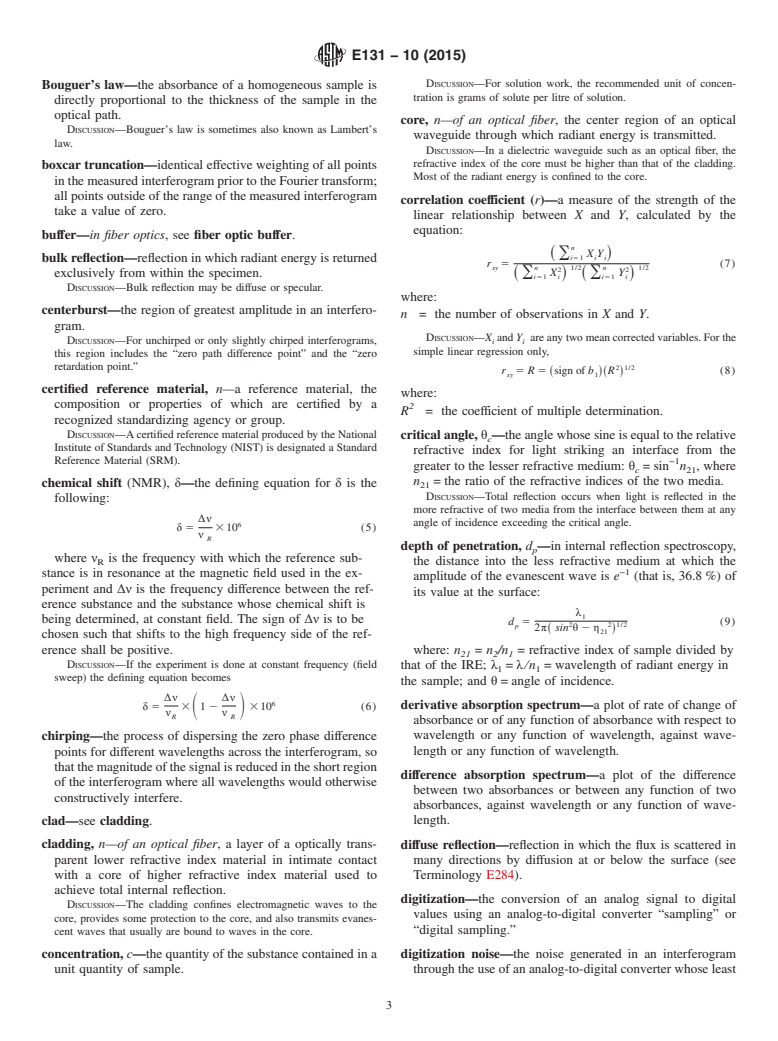
bias 5 e¯ 5 e (4)
beam. (i51 i
n
aperture of an IRE, A'—that portion of the IRE surface that
where:
can be utilized to conduct light into the IRE at the desired
n = the number of observations for which the accuracy is
angle of incidence.
determined,
e = the difference between a measured value of a property
i
apodization—modification of the ILS function by multiplying
and its accepted reference value, and
the interferogram by a weighting function the magnitude of
e¯ = the mean value of all the e.
I
which varies with retardation.
E131 − 10 (2015)
DISCUSSION—For solution work, the recommended unit of concen-
Bouguer’s law—the absorbance of a homogeneous sample is
tration is grams of solute per litre of solution.
directly proportional to the thickness of the sample in the
optical path.
core, n—of an optical fiber, the center region of an optical
DISCUSSION—Bouguer’s law is sometimes also known as Lambert’s
waveguide through which radiant energy is transmitted.
law.
DISCUSSION—In a dielectric waveguide such as an optical fiber, the
refractive index of the core must be higher than that of the cladding.
boxcar truncation—identical effective weighting of all points
Most of the radiant energy is confined to the core.
inthemeasuredinterferogrampriortotheFouriertransform;
allpointsoutsideoftherangeofthemeasuredinterferogram
correlation coefficient (r)—a measure of the strength of the
take a value of zero.
linear relationship between X and Y, calculated by the
equation:
buffer—in fiber optics, see fiber optic buffer.
n
X Y
~ !
(i51 i i
bulk reflection—reflection in which radiant energy is returned
r 5 (7)
n 1/2 n 1/2
xy
2 2
X Y
exclusively from within the specimen. ~ ! ~ !
(i51 i (i51 i
DISCUSSION—Bulk reflection may be diffuse or specular.
where:
centerburst—the region of greatest amplitude in an interfero-
n = the number of observations in X and Y.
gram.
DISCUSSION—X and Y areanytwomeancorrectedvariables.Forthe
DISCUSSION—For unchirped or only slightly chirped interferograms, i i
simple linear regression only,
this region includes the “zero path difference point” and the “zero
retardation point.” 2 1/2
r 5 R 5 ~signof b !~R ! (8)
xy 1
certified reference material, n—a reference material, the
where:
composition or properties of which are certified by a
R = the coefficient of multiple determination.
recognized standardizing agency or group.
DISCUSSION—Acertified reference material produced by the National
critical angle, θ —theanglewhosesineisequaltotherelative
c
Institute of Standards and Technology (NIST) is designated a Standard
refractive index for light striking an interface from the
Reference Material (SRM). −1
greater to the lesser refractive medium: θ =sin n , where
c 21
n =the ratio of the refractive indices of the two media.
chemical shift (NMR), δ—the defining equation for δ is the
DISCUSSION—Total reflection occurs when light is reflected in the
following:
more refractive of two media from the interface between them at any
∆ν
6 angle of incidence exceeding the critical angle.
δ 5 310 (5)
ν
R
depth of penetration, d —in internal reflection spectroscopy,
p
where ν is the frequency with which the reference sub-
R the distance into the less refractive medium at which the
−1
stance is in resonance at the magnetic field used in the ex-
amplitude of the evanescent wave is e (that is, 36.8%) of
periment and ∆ν is the frequency difference between the ref-
its value at the surface:
erence substance and the substance whose chemical shift is
λ
being determined, at constant field. The sign of ∆ν is to be
d 5 (9)
p 2 2 1/2
2π~ sin θ 2 η !
chosen such that shifts to the high frequency side of the ref-
erence shall be positive.
where: n =n /n =refractive index of sample divided by
21 2 1
DISCUSSION—If the experiment is done at constant frequency (field
that of the IRE; λ = λ⁄n =wavelength of radiant energy in
1 1
sweep) the defining equation becomes
the sample; and θ=angle of incidence.
∆ν ∆ν
δ 5 3 1 2 310 (6) derivative absorption spectrum—a plot of rate of change of
S D
ν ν
R R
absorbance or of any function of absorbance with respect to
chirping—the process of dispersing the zero phase difference wavelength or any function of wavelength, against wave-
length or any function of wavelength.
points for different wavelengths across the interferogram, so
thatthemagnitudeofthesignalisreducedintheshortregion
difference absorption spectrum—a plot of the difference
of the interferogram where all wavelengths would otherwise
between two absorbances or between any function of two
constructively interfere.
absorbances, against wavelength or any functio
...
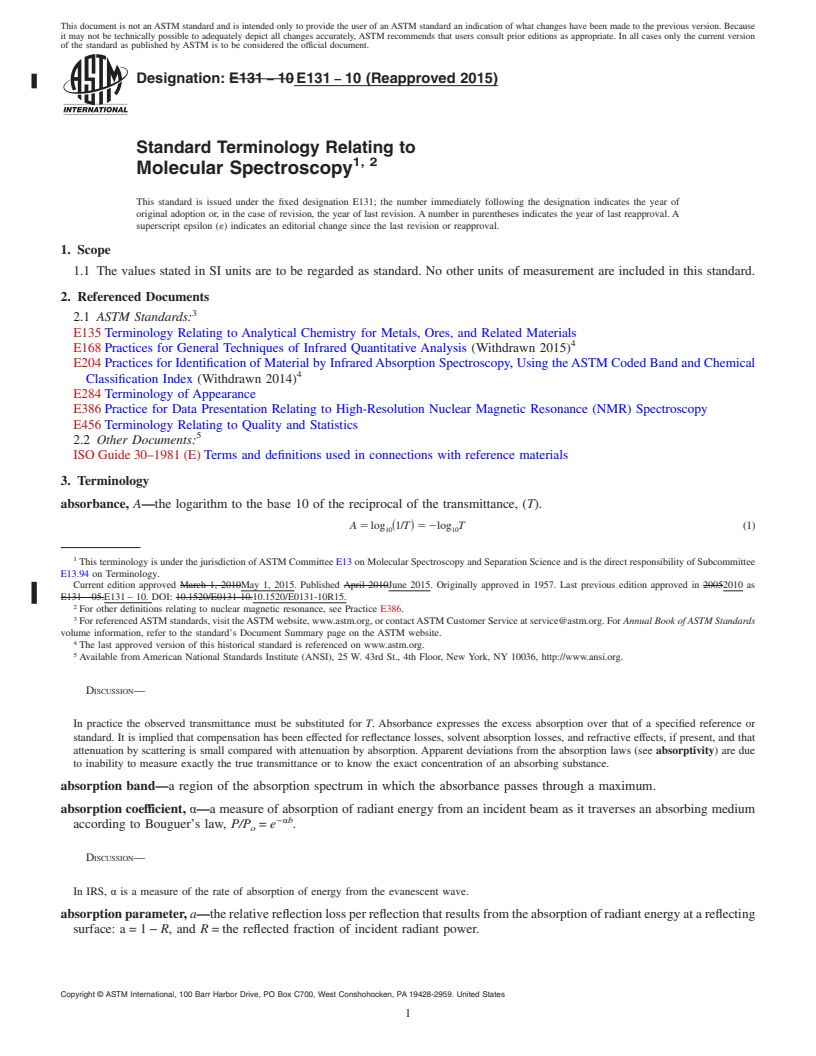
This document is not an ASTM standard and is intended only to provide the user of an ASTM standard an indication of what changes have been made to the previous version. Because
it may not be technically possible to adequately depict all changes accurately, ASTM recommends that users consult prior editions as appropriate. In all cases only the current version
of the standard as published by ASTM is to be considered the official document.
Designation: E131 − 10 E131 − 10 (Reapproved 2015)
Standard Terminology Relating to
1, 2
Molecular Spectroscopy
This standard is issued under the fixed designation E131; the number immediately following the designation indicates the year of
original adoption or, in the case of revision, the year of last revision. A number in parentheses indicates the year of last reapproval. A
superscript epsilon (´) indicates an editorial change since the last revision or reapproval.
1. Scope
1.1 The values stated in SI units are to be regarded as standard. No other units of measurement are included in this standard.
2. Referenced Documents
2.1 ASTM Standards:
E135 Terminology Relating to Analytical Chemistry for Metals, Ores, and Related Materials
E168 Practices for General Techniques of Infrared Quantitative Analysis (Withdrawn 2015)
E204 Practices for Identification of Material by Infrared Absorption Spectroscopy, Using the ASTM Coded Band and Chemical
Classification Index (Withdrawn 2014)
E284 Terminology of Appearance
E386 Practice for Data Presentation Relating to High-Resolution Nuclear Magnetic Resonance (NMR) Spectroscopy
E456 Terminology Relating to Quality and Statistics
2.2 Other Documents:
ISO Guide 30–1981 (E) Terms and definitions used in connections with reference materials
3. Terminology
absorbance, A—the logarithm to the base 10 of the reciprocal of the transmittance, (T).
A 5 log 1/T 52log T (1)
~ !
10 10
This terminology is under the jurisdiction of ASTM Committee E13 on Molecular Spectroscopy and Separation Science and is the direct responsibility of Subcommittee
E13.94 on Terminology.
Current edition approved March 1, 2010May 1, 2015. Published April 2010June 2015. Originally approved in 1957. Last previous edition approved in 20052010 as
E131 – 05.E131 – 10. DOI: 10.1520/E0131-10.10.1520/E0131-10R15.
For other definitions relating to nuclear magnetic resonance, see Practice E386.
For referenced ASTM standards, visit the ASTM website, www.astm.org, or contact ASTM Customer Service at service@astm.org. For Annual Book of ASTM Standards
volume information, refer to the standard’s Document Summary page on the ASTM website.
The last approved version of this historical standard is referenced on www.astm.org.
Available from American National Standards Institute (ANSI), 25 W. 43rd St., 4th Floor, New York, NY 10036, http://www.ansi.org.
DISCUSSION—
In practice the observed transmittance must be substituted for T. Absorbance expresses the excess absorption over that of a specified reference or
standard. It is implied that compensation has been effected for reflectance losses, solvent absorption losses, and refractive effects, if present, and that
attenuation by scattering is small compared with attenuation by absorption. Apparent deviations from the absorption laws (see absorptivity) are due
to inability to measure exactly the true transmittance or to know the exact concentration of an absorbing substance.
absorption band—a region of the absorption spectrum in which the absorbance passes through a maximum.
absorption coefficient, α—a measure of absorption of radiant energy from an incident beam as it traverses an absorbing medium
−αb
according to Bouguer’s law, P/P = e .
o
DISCUSSION—
In IRS, α is a measure of the rate of absorption of energy from the evanescent wave.
absorption parameter, a—the relative reflection loss per reflection that results from the absorption of radiant energy at a reflecting
surface: a = 1 − R, and R = the reflected fraction of incident radiant power.
Copyright © ASTM International, 100 Barr Harbor Drive, PO Box C700, West Conshohocken, PA 19428-2959. United States
E131 − 10 (2015)
absorption spectrum—a plot, or other representation, of absorbance, or any function of absorbance, against wavelength, or any
function of wavelength.
absorptivity, a— the absorbance divided by the product of the concentration of the substance and the sample pathlength, a = A ⁄bc.
The units of b and c shall be specified.
DISCUSSION—
3 3
1—The recommended unit for b is the centimetre. The recommended unit for c is kilogram per cubic metre. Equivalent units are g/dm , g/L, or mg/cm .
DISCUSSION—
2—The equivalent IUPAC term is “specific absorption coefficient.”
absorptivity, molar, ε—the product of the absorptivity, a, and the molecular weight of the substance.
DISCUSSION—
The equivalent IUPAC term is “molar absorption coefficient.”
acceptance angle, n—for an optical fiber, the maximum angle, measured from the longitudinal axis or centerline of the fiber to
an incident ray, within which the ray will be accepted for transmission along the fiber by total internal reflection.
DISCUSSION—
If the incidence angle exceeds the acceptance angle, optical power in the incident ray will be coupled into leaky modes or rays, or lost by scattering,
diffusion, or absorption in the cladding. For a cladded step-index fiber in the air, the sine of the acceptance angle is given by the square root of the
difference of the squares of the refractive indexes of the fiber core and the cladding, that is, by the relation as follows:
2 2
sin A 5= n 2 n (2)
1 2
where A is the acceptance angle and n and n are the refractive indexes of the core and cladding, respectively. If the refractive index is a function
1 2
of distance from the center of the core, as in the case of graded index fibers, then the acceptance angle depends on the distance from the core center.
The acceptance angle is maximum at the center, and zero at the core-cladding boundary. At any radius, r, the sine of the acceptance angle of a
graded index fiber is defined in compliance with that of a step-index fiber as follows:
2 2
sin A 5=n 2 n (3)
r 1 2
where A is the acceptance angle at a point on the entrance face at a distance, r, from the center, n is the refractive index of the core at a radius, r,
r r
and n is the refractive index of the cladding. In air, sin A and sin A are the numerical apertures. Unless otherwise stated, acceptance angles and
2 r
numerical apertures for fiber optics are those for the center of the endface of the fiber, that is, where the refractive index, and hence the numerical
aperture, is the highest.
accuracy—the closeness of agreement between an observed value and an accepted reference value (see Terminology E456).
DISCUSSION—
The term accuracy, when applied to a set of observed values, will be a combination of a random component and a common systematic error or bias
component. Since in routine use, random components and bias components cannot be completely separated, the reported “accuracy” must be
interpreted as a combination of these two components.
active fiber optic chemical sensor, n—a fiber optic chemical sensor in which a transduction mechanism other than the intrinsic
spectroscopic properties of the analyte is used to modulate the optical signal.
DISCUSSION—
Examples include a pH sensor composed of a chemical indicator substance whose color changes with pH, and an oxygen sensor coupled to an optical
fiber bearing a chemical indicator whose fluorescence intensity depends on oxygen concentration.
aliasing—the appearance of features at wavenumbers other than their true value caused by using a sampling frequency less than
twice the highest modulation frequency in the interferogram; also known as “folding.”
analytical curve—the graphical representation of a relation between some function of radiant power and the concentration or mass
of the substance emitting or absorbing it.
analytical wavelength—any wavelength at which an absorbance measurement is made for the purpose of the determination of a
constituent of a sample.
E131 − 10 (2015)
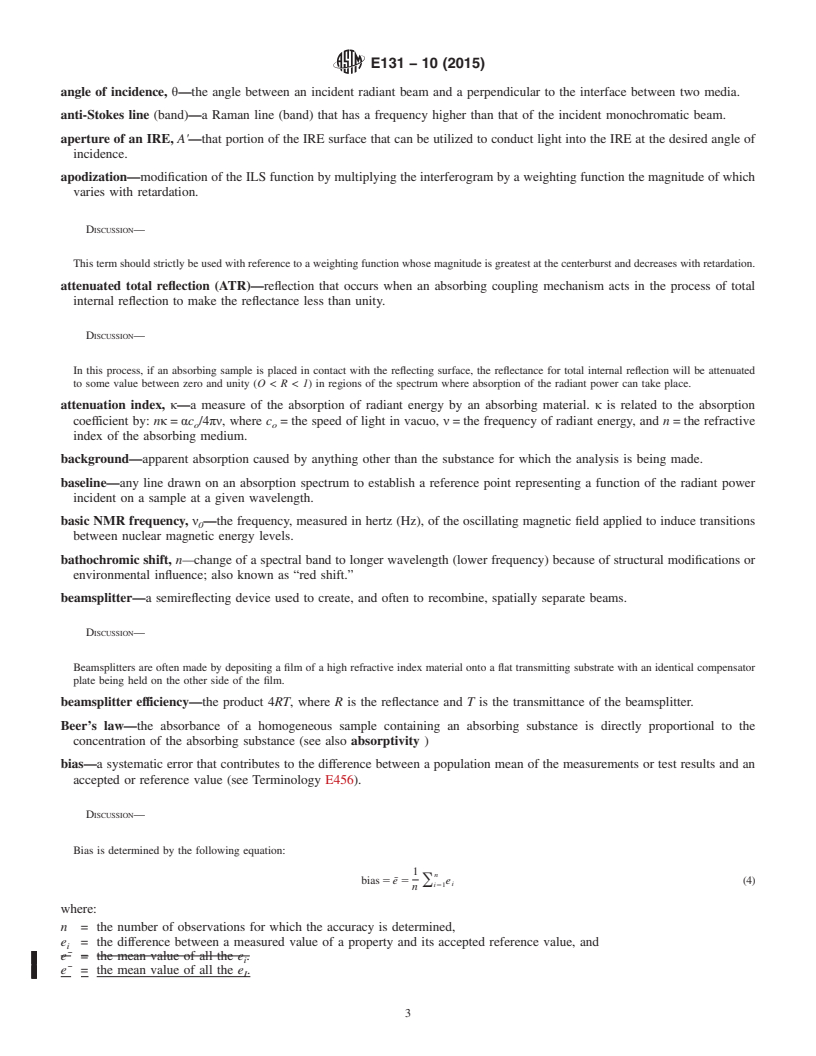
angle of incidence, θ—the angle between an incident radiant beam and a perpendicular to the interface between two media.
anti-Stokes line (band)—a Raman line (band) that has a frequency higher than that of the incident monochromatic beam.
aperture of an IRE, A'—that portion of the IRE surface that can be utilized to conduct light into the IRE at the desired angle of
incidence.
apodization—modification of the ILS function by multiplying the interferogram by a weighting function the magnitude of which
varies with retardation.
DISCUSSION—
This term should strictly be used with reference to a weighting function whose magnitude is greatest at the centerburst and decreases with retardation.
attenuated total reflection (ATR)—reflection that occurs when an absorbing coupling mechanism acts in the process of total
internal reflection to make the reflectance less than unity.
DISCUSSION—
In this process, if an absorbing sample is placed in contact with the reflecting surface, the reflectance for total internal reflection will be attenuated
to some value between zero and unity (O < R < 1) in regions of the spectrum where absorption of the radiant power can take place.
attenuation index, κ—a measure of the absorption of radiant energy by an absorbing material. κ is related to the absorption
coefficient by: nκ = αc /4πν, where c = the speed of light in vacuo, ν = the frequency of radiant energy, and n = the refractive
o o
index of the absorbing medium.
background—apparent absorption caused by anything other than the substance for which the analysis is being made.
baseline—any line drawn on an absorption spectrum to establish a reference point representing a function of the radiant power
incident on a sample at a given wavelength.
basic NMR frequency, ν —the frequency, measured in hertz (Hz), of the oscillating magnetic field applied to induce transitions
between nuclear magnetic energy levels.
bathochromic shift, n—change of a spectral band to longer wavelength (lower frequency) because of structural modifications or
environmental influence; also known as “red shift.”
beamsplitter—a semireflecting device used to create, and often to recombine, spatially separate beams.
DISCUSSION—
Beamsplitters are often made by depositing a film of a high refractive index material onto a flat transmitting substrate with an identical compensator
plate being held on the other side of the film.
beamsplitter efficiency—the product 4RT, where R is the reflectance and T is the transmittance of the beamsplitter.
Beer’s law—the absorbance of a homogeneous sample containing an absorbing substance is directly proportional to the
concentration of the absorbing substance (see also absorptivity )
bias—a systematic error that contributes to the difference between a population mean of the measurements or test results and an
accepted or reference value (see Terminology E456).
DISCUSSION—
Bias is determined by the following equation:
n
bias 5 e¯ 5 e (4)
i
(i51
n
where:
n = the number of observations for which the accuracy is determined,
e = the difference between a measured value of a property and its accepted reference value, and
i
e¯ = the mean value of all the e .
i
e¯ = the mean value of all the e .
I
E131 − 10 (2015)
Bouguer’s law—the absorbance of a homogeneous sample is directly proportional to the thickness of the sample in the optical
path.
DISCUSSION—
Bouguer’s law is sometimes also known as Lambert’s law.
boxcar truncation—identical effective weighting of all points in the measured interferogram prior to the Fourier transform; all
points outside of the range of the measured interferogram take a value of zero.
buffer—in fiber optics, see fiber optic buffer.
bulk reflection—reflection in which radiant energy is returned exclusively from within the specimen.
DISCUSSION—
Bulk reflection may be diffuse or specular.
centerburst—the region of greatest amplitude in an interferogram.
DISCUSSION—
For unchirped or only slightly chirped interferograms, this region includes the “zero path difference point” and the “zero retardation point.”
certified reference material, n—a reference material, the composition or properties of which are certified by a recognized
standardizing agency or group.
DISCUSSION—
A certified reference material produced by the National Institute of Standards and Technology (NIST) is designated a Standard Reference Material
(SRM).
chemical shift (NMR), δ—the defining equation for δ is the following:
Δν
δ5 310 (5)
ν
R
where ν is the frequency with which the reference substance is in resonance at the magnetic field used in the experiment
R
and Δν is the frequency difference between the reference substance and the substance whose chemical shift is being
determined, at constant field. The sign of Δν is to be chosen such that shifts to the high frequency side of the reference shall
be positive.
DISCUSSION—
If the experiment is done at constant frequency (field sweep) the defining equation becomes
Δν Δν
δ5 3 12 310 (6)
S D
ν ν
R R
chirping—the process of dispersing the zero phase difference points for different wavelengths across the interferogram, so that the
magnitude of the signal is reduced in the short region of the interferogram where all wavelengths would otherwise constructively
interfere.
clad—see cladding.
cladding, n—of an optical fiber, a layer of a optically transparent lower refractive index material in intimate contact with a core
of higher refractive index material used to achieve total internal reflection.
DISCUSSION—
The cladding confines electromagnetic waves to the core, provides some protection to the core, and also transmits evanescent waves that usually are
bound to waves in the core.
concentration, c—the quantity of the substance contained in a unit quantity of sample.
E131 − 10 (2015)
DISCUSSION—
For solution work, the recommended unit of concentration is grams of solute per litre of solution.
core, n—of an optical fiber, the center region of an optical waveguide through which radiant energy is transmitted.
DISCUSSION—
In a dielectric waveguide such as an optical fiber, the refractive index of the core must be higher than that of the cladding. Most of the radiant energy
is confined to the core.
correlation coefficient (r)—a measure of the strength of the linear relationship between X and Y, calculated by the equation:
n
X Y
~ !
(i51 i i
r 5 (7)
xy n 1/2 n 1/2
2 2
X Y
~ ! ~ !
(i51 i (i51 i
where:
n = the number of observations in X and Y.
DISCUSSION—
X and Y are any two mean corrected variables. For the simple linear regression only,
i i
2 1/2
r 5 R 5 sign of b R (8)
~ !~ !
xy 1
where:
R = the coefficient of multiple determination.
critical angle, θ —the angle whose sine is equal to the rela
...
Questions, Comments and Discussion
Ask us and Technical Secretary will try to provide an answer. You can facilitate discussion about the standard in here.