

ASTM C295/C295M-19
(Guide)Standard Guide for Petrographic Examination of Aggregates for Concrete
General Information
- Abstract
SIGNIFICANCE AND USE
5.1 Petrographic examinations are made for the following purposes:
5.1.1 To determine the physical and chemical characteristics of the material that may be observed by petrographic methods and that have a bearing on the performance of the material in its intended use.
5.1.2 To describe and classify the constituents of the sample,
5.1.3 To determine the relative amounts of the constituents of the sample that are essential for proper evaluation of the sample when the constituents differ significantly in properties that have a bearing on the performance of the material in its intended use, and
5.1.4 To compare samples of aggregate from new sources with samples of aggregate from one or more sources, for which test data or performance records are available.
5.2 This guide may be used by a petrographer employed directly by those for whom the examination is made. The employer should tell the petrographer, in as much detail as necessary, the purposes and objectives of the examination, the kind of information needed, and the extent of examination desired. Pertinent background information, including results of prior testing, should be made available. The petrographer's advice and judgment should be sought regarding the extent of the examination.
5.3 This guide may form the basis for establishing arrangements between a purchaser of consulting petrographic service and the petrographer. In such a case, the purchaser and the consultant should together determine the kind, extent, and objectives of the examination and analyses to be made, and should record their agreement in writing. The agreement may stipulate specific determinations to be made, observations to be reported, funds to be obligated, or a combination of these or other conditions.
5.4 Petrographic examination of aggregate considered for use in hydraulic-cement concrete is one aspect of the evaluation of aggregate, but petrographic examination is also used for many other purposes. Petrographic exami...
SCOPE
1.1 This guide outlines procedures for the petrographic examination of samples representative of materials proposed for use as aggregates in cementitious mixtures or as raw materials for use in production of such aggregates. This guide is based on Ref (1).2
1.2 This guide outlines the extent to which petrographic techniques should be used, the selection of properties that should be looked for, and the manner in which such techniques may be employed in the examination of samples of aggregates for concrete.
1.3 The rock and mineral names given in Descriptive Nomenclature C294 should be used, insofar as they are appropriate, in reports prepared in accordance with this guide.
1.4 The values stated in either SI units or inch-pound units are to be regarded separately as standard. The values stated in each system may not be exact equivalents; therefore, each system shall be used independently of the other. Combining values from the two systems may result in non-conformance with the standard.
1.5 This standard does not purport to address all of the safety concerns, if any, associated with its use. It is the responsibility of the user of this standard to establish appropriate safety, health, and environmental practices and determine the applicability of regulatory limitations prior to use.
1.6 This international standard was developed in accordance with internationally recognized principles on standardization established in the Decision on Principles for the Development of International Standards, Guides and Recommendations issued by the World Trade Organization Technical Barriers to Trade (TBT) Committee.
- Status
- Published
- Publication Date
- 31-Jul-2019
- Technical Committee
- C09 - Concrete and Concrete Aggregates
- Drafting Committee
- C09.65 - Petrography
Overview
ASTM C295/C295M-19, Standard Guide for Petrographic Examination of Aggregates for Concrete, issued by ASTM International, provides comprehensive procedures for the petrographic examination of aggregates used in concrete. The guide outlines standardized techniques for analyzing the physical and chemical properties of aggregates to ensure their suitability and durability in cementitious mixtures. This guidance is essential for professionals involved in concrete construction, materials evaluation, and quality assurance.
Key Topics
Purpose and Objectives
- Assess physical and chemical characteristics of concrete aggregates through petrographic methods.
- Describe and classify sample constituents.
- Quantify significant constituents to evaluate material performance.
- Compare aggregate samples from new or existing sources to ensure reliability and performance.
Scope of Application
- Applies to both natural and manufactured aggregates for use in concrete or as raw materials.
- Utilizes petrographic techniques ranging from optical microscopy to more advanced analytical methods, such as X-ray diffraction or scanning electron microscopy, when needed.
- Recommends use of standardized nomenclature as detailed in ASTM C294.
Petrographer Qualifications
- Examinations should be performed by experienced petrographers with backgrounds in geology, mineralogy, and concrete materials.
- Ensures accurate analysis and reporting based on industry best practices.
Safety and Compliance
- Both SI and inch-pound units are recognized as standard; users must adhere to one system throughout testing to ensure compliance.
- Requires users to implement appropriate safety, health, and environmental practices during examination.
Applications
ASTM C295/C295M-19 is invaluable across several settings within the concrete and construction industries:
- Aggregate Quality Control: Helps producers and suppliers ensure aggregates meet performance and durability requirements before use in concrete production.
- Source Evaluation: Enables engineers and material scientists to evaluate new sources of aggregates and compare them with known, approved materials.
- Problem Investigation: Assists in diagnosing concrete deterioration or failure by identifying deleterious materials, weathered particles, or reactive mineral constituents.
- Consulting Services: Provides a framework for arrangements between purchasers and consulting petrographers, detailing objectives, methods, and reporting requirements.
Key aspects evaluated include:
- Detection of potentially reactive minerals (e.g., those that can cause alkali-silica reaction).
- Identification of weathered or porous particles vulnerable to freeze-thaw cycles.
- Determination of impurities or contaminants, such as sulphates or organic matter, that can adversely affect concrete performance.
Related Standards
ASTM C295/C295M-19 references and complements several related standards, including:
- ASTM C33/C33M: Specification for Concrete Aggregates
- ASTM C117: Test Method for Materials Finer than 75-μm Sieve in Mineral Aggregates by Washing
- ASTM C136/C136M: Test Method for Sieve Analysis of Fine and Coarse Aggregates
- ASTM C294: Descriptive Nomenclature for Constituents of Concrete Aggregates
- ASTM D75/D75M: Practice for Sampling Aggregates
- ASTM C702/C702M: Practice for Reducing Samples of Aggregate to Testing Size
Using ASTM C295/C295M-19 together with these standards ensures a rigorous approach to aggregate evaluation, improving concrete quality, longevity, and structural integrity.
Keywords: petrographic examination, aggregates for concrete, ASTM C295, concrete quality control, aggregate analysis, concrete durability, material testing standards, aggregate evaluation, construction materials, ASTM standards.
Relations
- Replaces
ASTM C295/C295M-18a - Standard Guide for Petrographic Examination of Aggregates for Concrete - Effective Date
- 01-Aug-2019
- Effective Date
- 01-Apr-2024
- Effective Date
- 15-Nov-2023
- Effective Date
- 01-Nov-2019
- Effective Date
- 01-Jun-2017
- Effective Date
- 01-Feb-2016
- Effective Date
- 15-Dec-2013
- Effective Date
- 01-Oct-2013
- Effective Date
- 01-Feb-2013
- Effective Date
- 01-Jan-2013
- Effective Date
- 01-Aug-2011
- Effective Date
- 01-May-2011
- Effective Date
- 01-Jan-2011
- Effective Date
- 01-May-2009
- Effective Date
- 01-Dec-2008
Get Certified
Connect with accredited certification bodies for this standard

DIBt (Deutsches Institut für Bautechnik)
German Institute for Building Technology.
DIN CERTCO
DIN Group product certification.

Aboma Certification B.V.
Specialized in construction, metal, and transport sectors.
Sponsored listings
Frequently Asked Questions
ASTM C295/C295M-19 is a guide published by ASTM International. Its full title is "Standard Guide for Petrographic Examination of Aggregates for Concrete". This standard covers: SIGNIFICANCE AND USE 5.1 Petrographic examinations are made for the following purposes: 5.1.1 To determine the physical and chemical characteristics of the material that may be observed by petrographic methods and that have a bearing on the performance of the material in its intended use. 5.1.2 To describe and classify the constituents of the sample, 5.1.3 To determine the relative amounts of the constituents of the sample that are essential for proper evaluation of the sample when the constituents differ significantly in properties that have a bearing on the performance of the material in its intended use, and 5.1.4 To compare samples of aggregate from new sources with samples of aggregate from one or more sources, for which test data or performance records are available. 5.2 This guide may be used by a petrographer employed directly by those for whom the examination is made. The employer should tell the petrographer, in as much detail as necessary, the purposes and objectives of the examination, the kind of information needed, and the extent of examination desired. Pertinent background information, including results of prior testing, should be made available. The petrographer's advice and judgment should be sought regarding the extent of the examination. 5.3 This guide may form the basis for establishing arrangements between a purchaser of consulting petrographic service and the petrographer. In such a case, the purchaser and the consultant should together determine the kind, extent, and objectives of the examination and analyses to be made, and should record their agreement in writing. The agreement may stipulate specific determinations to be made, observations to be reported, funds to be obligated, or a combination of these or other conditions. 5.4 Petrographic examination of aggregate considered for use in hydraulic-cement concrete is one aspect of the evaluation of aggregate, but petrographic examination is also used for many other purposes. Petrographic exami... SCOPE 1.1 This guide outlines procedures for the petrographic examination of samples representative of materials proposed for use as aggregates in cementitious mixtures or as raw materials for use in production of such aggregates. This guide is based on Ref (1).2 1.2 This guide outlines the extent to which petrographic techniques should be used, the selection of properties that should be looked for, and the manner in which such techniques may be employed in the examination of samples of aggregates for concrete. 1.3 The rock and mineral names given in Descriptive Nomenclature C294 should be used, insofar as they are appropriate, in reports prepared in accordance with this guide. 1.4 The values stated in either SI units or inch-pound units are to be regarded separately as standard. The values stated in each system may not be exact equivalents; therefore, each system shall be used independently of the other. Combining values from the two systems may result in non-conformance with the standard. 1.5 This standard does not purport to address all of the safety concerns, if any, associated with its use. It is the responsibility of the user of this standard to establish appropriate safety, health, and environmental practices and determine the applicability of regulatory limitations prior to use. 1.6 This international standard was developed in accordance with internationally recognized principles on standardization established in the Decision on Principles for the Development of International Standards, Guides and Recommendations issued by the World Trade Organization Technical Barriers to Trade (TBT) Committee.
SIGNIFICANCE AND USE 5.1 Petrographic examinations are made for the following purposes: 5.1.1 To determine the physical and chemical characteristics of the material that may be observed by petrographic methods and that have a bearing on the performance of the material in its intended use. 5.1.2 To describe and classify the constituents of the sample, 5.1.3 To determine the relative amounts of the constituents of the sample that are essential for proper evaluation of the sample when the constituents differ significantly in properties that have a bearing on the performance of the material in its intended use, and 5.1.4 To compare samples of aggregate from new sources with samples of aggregate from one or more sources, for which test data or performance records are available. 5.2 This guide may be used by a petrographer employed directly by those for whom the examination is made. The employer should tell the petrographer, in as much detail as necessary, the purposes and objectives of the examination, the kind of information needed, and the extent of examination desired. Pertinent background information, including results of prior testing, should be made available. The petrographer's advice and judgment should be sought regarding the extent of the examination. 5.3 This guide may form the basis for establishing arrangements between a purchaser of consulting petrographic service and the petrographer. In such a case, the purchaser and the consultant should together determine the kind, extent, and objectives of the examination and analyses to be made, and should record their agreement in writing. The agreement may stipulate specific determinations to be made, observations to be reported, funds to be obligated, or a combination of these or other conditions. 5.4 Petrographic examination of aggregate considered for use in hydraulic-cement concrete is one aspect of the evaluation of aggregate, but petrographic examination is also used for many other purposes. Petrographic exami... SCOPE 1.1 This guide outlines procedures for the petrographic examination of samples representative of materials proposed for use as aggregates in cementitious mixtures or as raw materials for use in production of such aggregates. This guide is based on Ref (1).2 1.2 This guide outlines the extent to which petrographic techniques should be used, the selection of properties that should be looked for, and the manner in which such techniques may be employed in the examination of samples of aggregates for concrete. 1.3 The rock and mineral names given in Descriptive Nomenclature C294 should be used, insofar as they are appropriate, in reports prepared in accordance with this guide. 1.4 The values stated in either SI units or inch-pound units are to be regarded separately as standard. The values stated in each system may not be exact equivalents; therefore, each system shall be used independently of the other. Combining values from the two systems may result in non-conformance with the standard. 1.5 This standard does not purport to address all of the safety concerns, if any, associated with its use. It is the responsibility of the user of this standard to establish appropriate safety, health, and environmental practices and determine the applicability of regulatory limitations prior to use. 1.6 This international standard was developed in accordance with internationally recognized principles on standardization established in the Decision on Principles for the Development of International Standards, Guides and Recommendations issued by the World Trade Organization Technical Barriers to Trade (TBT) Committee.
ASTM C295/C295M-19 is classified under the following ICS (International Classification for Standards) categories: 91.100.30 - Concrete and concrete products. The ICS classification helps identify the subject area and facilitates finding related standards.
ASTM C295/C295M-19 has the following relationships with other standards: It is inter standard links to ASTM C295/C295M-18a, ASTM E883-11(2024), ASTM C117-23, ASTM D75/D75M-19, ASTM E883-11(2017), ASTM C33/C33M-16e1, ASTM D75/D75M-13, ASTM E11-13, ASTM C117-13, ASTM C33/C33M-13, ASTM C702/C702M-11, ASTM E883-11, ASTM C33/C33M-11, ASTM E11-09e1, ASTM C33/C33M-08. Understanding these relationships helps ensure you are using the most current and applicable version of the standard.
ASTM C295/C295M-19 is available in PDF format for immediate download after purchase. The document can be added to your cart and obtained through the secure checkout process. Digital delivery ensures instant access to the complete standard document.
Standards Content (Sample)
This international standard was developed in accordance with internationally recognized principles on standardization established in the Decision on Principles for the
Development of International Standards, Guides and Recommendations issued by the World Trade Organization Technical Barriers to Trade (TBT) Committee.
Designation: C295/C295M − 19
Standard Guide for
Petrographic Examination of Aggregates for Concrete
This standard is issued under the fixed designation C295/C295M; the number immediately following the designation indicates the year
of original adoption or, in the case of revision, the year of last revision.Anumber in parentheses indicates the year of last reapproval.
A superscript epsilon (´) indicates an editorial change since the last revision or reapproval.
This standard has been approved for use by agencies of the U.S. Department of Defense.
1. Scope* 2. Referenced Documents
2.1 ASTM Standards:
1.1 This guide outlines procedures for the petrographic
C33/C33MSpecification for Concrete Aggregates
examination of samples representative of materials proposed
C117Test Method for Materials Finer than 75-µm (No. 200)
for use as aggregates in cementitious mixtures or as raw
Sieve in Mineral Aggregates by Washing
materials for use in production of such aggregates. This guide
C136/C136MTest Method for Sieve Analysis of Fine and
is based on Ref (1).
Coarse Aggregates
1.2 This guide outlines the extent to which petrographic
C294Descriptive Nomenclature for Constituents of Con-
techniques should be used, the selection of properties that
crete Aggregates
shouldbelookedfor,andthemannerinwhichsuchtechniques
C702/C702MPractice for Reducing Samples of Aggregate
may be employed in the examination of samples of aggregates
to Testing Size
for concrete.
D75/D75MPractice for Sampling Aggregates
E11Specification forWovenWireTest Sieve Cloth andTest
1.3 The rock and mineral names given in Descriptive
Sieves
Nomenclature C294 should be used, insofar as they are
E883Guide for Reflected–Light Photomicrography
appropriate, in reports prepared in accordance with this guide.
1.4 The values stated in either SI units or inch-pound units 3. Qualifications of Petrographers
are to be regarded separately as standard. The values stated in
3.1 All petrographic examinations of aggregate for use in
each system may not be exact equivalents; therefore, each
concrete as described in this guide should be performed by a
system shall be used independently of the other. Combining
petrographer with at least 5 years experience in petrographic
values from the two systems may result in non-conformance
examination of concrete or concrete-making materials. The
with the standard.
petrographershouldhavecompletedcollege-levelcoursework
pertaining to basic geology, mineralogy, petrography, and
1.5 This standard does not purport to address all of the
optical mineralogy or have obtained equivalent knowledge
safety concerns, if any, associated with its use. It is the
through experience and on-the-job training. Completion of
responsibility of the user of this standard to establish appro-
course work in concrete materials is also advantageous. The
priate safety, health, and environmental practices and deter-
petrographer should have experience evaluating the effects of
mine the applicability of regulatory limitations prior to use.
aggregatesonthephysicalandchemicalpropertiesofhardened
1.6 This international standard was developed in accor-
concrete. Identification of individual minerals in aggregate
dance with internationally recognized principles on standard-
particles, classification of rock types, and categorizing the
ization established in the Decision on Principles for the
physical and chemical properties of rocks and minerals should
Development of International Standards, Guides and Recom-
also be included in the petrographer’s experience. The petrog-
mendations issued by the World Trade Organization Technical
raphershouldhaveexpertisetoproperlyusetheequipmentand
Barriers to Trade (TBT) Committee.
apparatus described in Section 6 and provide detailed interpre-
tations of the petrographic examination. If the petrographer
does not meet these qualifications, the individual may perform
This guide is under the jurisdiction ofASTM Committee C09 on Concrete and
such examinations under the technical direction of a full-time
Concrete Aggregatesand is the direct responsibility of Subcommittee C09.65 on
Petrography.
Current edition approved Aug. 1, 2019. Published September 2019. Originally
approved in 1954. Last previous edition approved in 2018 as C295/C295M–18a. For referenced ASTM standards, visit the ASTM website, www.astm.org, or
DOI: 10.1520/C0295_C0295M-19. contact ASTM Customer Service at service@astm.org. For Annual Book of ASTM
Theboldfacenumbersinparenthesesrefertothelistofreferencesattheendof Standards volume information, refer to the standard’s Document Summary page on
this standard. the ASTM website.
*A Summary of Changes section appears at the end of this standard
Copyright © ASTM International, 100 Barr Harbor Drive, PO Box C700, West Conshohocken, PA 19428-2959. United States
C295/C295M − 19
supervising petrographer who meets these qualifications. A 5.1.4 To compare samples of aggregate from new sources
resume of the professional experience and education of the withsamplesofaggregatefromoneormoresources,forwhich
petrographer shall be available. test data or performance records are available.
3.1.1 Licensing, certification, or other accreditation by a
5.2 This guide may be used by a petrographer employed
governmental agency or other organization stating the indi-
directly by those for whom the examination is made. The
vidual is a professional geologist should not, by itself, consti-
employer should tell the petrographer, in as much detail as
tute sufficient qualification for examination of aggregates for
necessary, the purposes and objectives of the examination, the
concrete.
kind of information needed, and the extent of examination
desired.Pertinentbackgroundinformation,includingresultsof
4. Summary of Method
prior testing, should be made available. The petrographer’s
4.1 The specific procedures employed in the petrographic
advice and judgment should be sought regarding the extent of
examinationofanysamplewilldependtoalargeextentonthe
the examination.
purpose of the examination and the nature of the sample. In
5.3 This guide may form the basis for establishing arrange-
most cases the examination will require the use of optical
ments between a purchaser of consulting petrographic service
microscopy. Complete petrographic examinations for particu-
and the petrographer. In such a case, the purchaser and the
larpurposesandtoinvestigateparticularproblemsmayrequire
consultant should together determine the kind, extent, and
examinationofaggregatesorofselectedconstituentsbymeans
objectives of the examination and analyses to be made, and
of additional procedures, such as X-ray diffraction (XRD)
should record their agreement in writing. The agreement may
analysis, differential thermal analysis (DTA), infrared
stipulatespecificdeterminationstobemade,observationstobe
spectroscopy, or other scanning electron microscopy (SEM)
reported, funds to be obligated, or a combination of these or
energy-dispersive x-ray analysis (EDX). In some instances,
other conditions.
such procedures are more rapid and more definitive than are
microscopical methods.
5.4 Petrographic examination of aggregate considered for
4.2 Identificationoftheconstituentsofasampleisusuallya use in hydraulic-cement concrete is one aspect of the evalua-
tionofaggregate,butpetrographicexaminationisalsousedfor
necessary step towards recognition of the properties that may
be expected to influence the behavior of the material in its many other purposes. Petrographic examinations provide iden-
intendeduse,butidentificationisnotanendinitself.Thevalue tification of types and varieties of rocks present in potential
of any petrographic examination will depend to a large extent aggregates. However, as noted above, identification of every
on the representativeness of the samples examined, the com- rockandmineralpresentinanaggregatesourceisnotrequired.
pleteness and accuracy of the information provided to the
5.5 The petrographic examination should establish whether
petrographer concerning the source and proposed use of the
the aggregate contains chemically unstable minerals (such as
material, and the petrographer’s ability to correlate these data
soluble sulfates) or volumetrically unstable materials, such as
with the findings of the examination.
smectites (formerly known as the montmorillonite-saponite
4.3 This guide does not attempt to describe the techniques
group of minerals or swelling clays). Specifications may limit
of petrographic work since it is assumed that the guide will be
thequartzcontentofaggregatesforuseinconcretethatmaybe
usedbypersonswhoarequalifiedbyeducationandexperience
subject to high temperature (purposefully or accidentally)
to employ such techniques for the recognition of the charac-
because of the conversion to beta-quartz at 573 °C [1063 °F],
teristic properties of rocks and minerals and to describe and
with accompanying volume increase.
classifytheconstituentsofanaggregatesample.Insomecases,
5.6 The petrographic examination should establish whether
the petrographer will have had experience adequate to provide
the aggregate contains iron sulfide minerals that may poten-
detailed interpretation of the results. In others, the interpreta-
tially oxidize within the concrete. Pyrite, marcasite, or pyrrho-
tion will be made in part by engineers or others qualified to
tite may cause popouts and rust staining if present near the
relate the observations to the questions to be answered.
surface of the concrete. Pyrrhotite within some rock types, in
thepresenceofmoisture,hasbeenfoundtooxidizeandexpand
5. Significance and Use
causing significant cracking within concrete. Oxidation of iron
5.1 Petrographic examinations are made for the following
sulfide minerals within concrete can lead to sulfuric acid
purposes:
attack, sulfate attack, or both.
5.1.1 Todeterminethephysicalandchemicalcharacteristics
of the material that may be observed by petrographic methods 5.7 Petrographic examination should identify the portion of
and that have a bearing on the performance of the material in each coarse aggregate that is composed of weathered or
its intended use. otherwise altered particles and the extent of that weathering or
5.1.2 To describe and classify the constituents of the alteration, whether it is severe, moderate, or slight, and should
sample, determine the proportion of each rock type in each condition.
5.1.3 To determine the relative amounts of the constituents If the concrete in which the aggregate may be used will be
of the sample that are essential for proper evaluation of the exposed to freezing and thawing in a critically saturated
sample when the constituents differ significantly in properties condition, finely porous and highly weathered or otherwise
that have a bearing on the performance of the material in its altered rocks should be identified because they will be espe-
intended use, and cially susceptible to damage by freezing and thawing and will
C295/C295M − 19
cause the aggregate portion of the concrete to fail in freezing reasonable assurance that the petrographic examination results
and thawing.This will ultimately destroy the concrete because wherever and whenever obtained may confidently be com-
pared.
such aggregates cannot be protected by adequately air-
entrained mortar. Finely porous aggregates near the concrete
6. Apparatus and Supplies
surfacearealsolikelytoformpopouts,whichareblemisheson
6.1 The apparatus and supplies listed as follows comprise a
pavements and walls.
selectionthatwillpermittheuseoftheproceduresdescribedin
5.8 Petrographic examinations may also be used to deter-
this guide.All specific items listed have been used, in connec-
minetheproportionsofcubic,spherical,ellipsoidal,pyramidal,
tionwiththeperformanceofpetrographicexaminations,bythe
tabular, flat, and elongated particles in an aggregate sample or
procedures described herein; it is not, however, intended to
samples. Flat, elongated, and thin chip-like particles in aggre-
imply that other items cannot be substituted to serve similar
gateincreasethemixingwaterrequirementandhencedecrease
functions. Whenever possible the selection of particular appa-
concrete strength. ratus and supplies should be left to the judgment of the
petrographer who is to perform the work so that the items
5.9 Petrographicexaminationshouldidentifyandcallatten-
obtained will be those with the use of which the petrographer
tion to potentially alkali-silica reactive and alkali-carbonate
has the greatest experience and familiarity. The minimum
reactive constituents, determine such constituents
equipment regarded as essential to the making of petrographic
quantitatively, and recommend additional tests to confirm or
examinations of aggregate samples are those items, or equiva-
refute the presence in significant amounts of aggregate con-
lentapparatusorsuppliesthatwillservethesamepurpose,that
stituents capable of alkali reaction in concrete. See Specifica-
are indicated by asterisks in the lists given as follows.
tion C33/C33M. Alkali-silica reactive constituents found in
6.1.1 ApparatusandSuppliesforPreparationofSpecimens:
aggregates include: opal, chalcedony, cristobalite, tridymite,
6.1.1.1 Rock-Cutting Saw*, preferably with 350-mm [14-
highly strained quartz, microcrystalline quartz, cryptocrystal-
in.] diameter or larger diamond blade, and automatic feed.
line quartz, volcanic glass, and synthetic siliceous glass.
6.1.1.2 Horizontal Grinding Wheel, * preferably 400-mm
Aggregate materials containing these constituents include:
[16-in.] diameter.
glassy to cryptocrystalline intermediate to acidic volcanic
6.1.1.3 Polishing Wheel, preferably 200- to 300-mm [8 to
rocks, some argillites, phyllites, graywacke, gneiss, schist,
12-in.] diameter.
gneissic granite, vein quartz, quartzite, sandstone, chert, and 6.1.1.4 Abrasives*, Silicon carbide grit No. 100 [122 µm],
carbonate rocks containing alkali reactive forms of silica. 220 [63 µm], 320 [31 µm], 600 [16 µm], and 800 [12 µm];
alumina M-305 [5 µm].
Criteria are available for identifying the minerals in the list
6.1.1.5 Geologist’s Pick or Hammer.
abovebytheiropticalpropertiesorbyXRD (2),(3).Criteriaare
6.1.1.6 Microscope Slides*, clear, noncorrosive, 25 by
available for identifying rocks by their mineral composition
45mm [1 by 2 in.] in size.
and texture (4). Examination in both reflected and transmitted
6.1.1.7 Mounting Medium for Powder Mounts*—Canada
lightmaybenecessarytoprovidedatafortheseidentifications.
balsam, neutral, in xylene; suitable low-viscosity epoxy resins;
X-ray microanalysis using energy-dispersive x-ray spectrom-
or Lakeside 70.
eters with scanning electron microscopy (SEM/EDX) or
6.1.1.8 Xylene*.
wavelength-dispersive x-ray spectrometers in electron micro-
6.1.1.9 Mounting Medium*, suitable for mounting rock
probes (EMPA/WDX) may provide useful information on the
slices for thin sections.
chemical composition of minerals and rocks. Potentially del-
6.1.1.10 Laboratory Oven*.
eterious alkali-carbonate reactive rocks are usually calcareous
6.1.1.11 Plate-GlassSquares*,about300mm[12in.]onan
dolomites or dolomitic limestones with clayey insoluble resi-
edge for thin-section grinding.
dues. Some dolomites essentially free of clay and some very
6.1.1.12 Sample Splitter with pans.*
fine-grained limestones free of clay and with minor insoluble
6.1.1.13 MicroCoverGlasses*,noncorrosive,square,12to
residue, mostly quartz, are also capable of some alkali-
18 mm, 25 mm, [0.5 to 0.75 in., 1.0 in.], and so forth.
carbonate reactions, however, such reactions are not necessar-
6.1.1.14 Plattner Mortar.
ily deleterious.
6.1.2 Apparatus and Supplies for Examination of Speci-
mens:
5.10 Petrographic examination may be directed specifically
6.1.2.1 Petrographic Microscope*, with mechanical stage;
at the possible presence of contaminants in aggregates, such as
oculars and objective lenses that will allow magnifications of
syntheticglass,cinders,clinker,orcoalash,magnesiumoxide,
up to 600×, and objective-centering devices; full- and quarter-
calcium oxide, or both, gypsum, soil, hydrocarbons, chemicals
wave compensators; quartz wedge; micrometer eyepiece; Ber-
that may affect the setting behavior of concrete or the proper-
trand lens.
ties of the aggregate, animal excrement, plants or rotten
6.1.2.2 Microscope Lamps*
vegetation, and any other contaminant that may prove unde-
6.1.2.3 Stereoscopic Microscope*, with objectives and ocu-
sirable in concrete.
lars to give final magnifications from about 6× to about 150×.
5.11 These objectives, for which this guide was prepared,
willhavebeenattainedifthoseinvolvedwiththeevaluationof 4
The values given in micrometres are the approximate average grain size of
aggregate materials for use in concrete construction have commercial silicon carbide grit in the designated size classification.
C295/C295M − 19
6.1.2.4 Magnet*, preferably Alnico, or an electromagnet. Drillingofsuchcoresshouldbeinadirectionthatisessentially
6.1.2.5 Needleholder and Points*. perpendicular to the dominant structural feature of the rock.
Massive material may be sampled by “NX” (50-mm [2-in.]
6.1.2.6 Dropping Bottle, 60-mL [2 oz.] capacity.
diameter) cores. Thinly bedded or complex material should be
6.1.2.7 Petri Culture Dishes.
represented by cores not less than 100 mm [4 in.] in diameter.
6.1.2.8 Forceps, smooth, straightpointed.
There should be an adequate number of cores to cover the
6.1.2.9 Lens Paper.*
limits of the deposit proposed for the project. The entire
6.1.2.10 Immersion Media*, n =1.410 to n =1.785 in
footage of the recovered core should be included in the sample
steps of no more than 0.005.
and accurate data given as to elevations, depths, and core
6.1.2.11 Counter.
losses.
6.1.2.12 Photomicrographic Camera and accessories.
7.1.2 Operating quarries and operating sand and gravel
6.2 The items under Apparatus and Supplies include those
deposits, in which stock piles of the material produced are
used to make thin sections. Semiautomatic thin section ma-
available,shouldberepresentedbynotlessthan45kg[100lb]
chines are available, and there are several thin-section makers
or 300 pieces, whichever is larger, of each size of material to
who advertise in Geotimes, the American Mineralogist, and
beexamined.Samplesfromstockpilesshouldbecomposedof
other mineralogical or geological journals. Laboratories may
representative portions of larger samples collected with due
find it reasonable to buy a thin-section machine or use a
consideration given to segregation in the piles.
commercial thin-section maker. Remotely located laboratories
7.1.3 Exposed faces of nonproducing quarries, where stock
have more need to be able to make their own thin sections.
piles of processed material are not available, should be
6.3 It is necessary that facilities be available to the petrog- represented by not less than 2 kg [4 lb] from each distinctive
raphertochecktheindexofrefractionoftheimmersionmedia. stratumorbed,withnopiecehavingamasslessthan0.5kg[1
If accurate identification of materials is to be attempted, as for lb], or by a drilled core as described above.
example the differentiation of quartz and chalcedony, or the 7.1.4 Undeveloped sand and gravel deposits should be
differentiation of basic from intermediate volcanic glass, the sampled by means of test pits dug to the anticipated depth of
indices of refraction of the media need to be known with futureeconomicproduction.Samplesshouldconsistofnotless
accuracy.Mediawillnotbestableforverylongperiodsoftime than the quantities of material indicated in Table 1, selected so
and are subject to considerable variation due to temperature as to be representative of the deposits.
change. In laboratories not provided with close temperature
NATURAL GRAVEL AND SAND
control, it is often necessary to recalibrate immersion media
several times during the course of a single day when accurate
8. Procedure
identifications are required. The equipment needed for check-
8.1 Selection of Samples for Examination—Samples of
ing immersion media consists of an Abbé refractometer. The
gravelandnaturalsandforpetrographicexaminationshouldbe
refractometershouldbeequippedwithcompensatingprismsto
drysievedinaccordancewithMethodC136/C136Mtoprovide
read indices for sodium light from white light, or it should be
samples of each sieve size. In the case of sands an additional
used with a sodium arc lamp.
portion should then be tested in accordance with Test Method
6.4 Alaboratorythatundertakesanyconsiderableamountof
C117,withthewashwaterbeingsavedandremovedbydrying
petrographic work should be provided with facilities to make
in order to provide a sample of the material passing the 75-µm
photomicrographic records of such features as cannot ad-
(No. 200) sieve (See Specification E11). The results of the
equately be described in words. For illustrations of typical
sieveanalysisofeachsamplemadeinaccordancewithMethod
apparatus,referencemaybemadetoRef (1)andmanufacturers
ofmicroscopesequippedwithcamerasandphotomacrographic
equipment may be consulted. Much useful guidance regarding
Sieve size is identified by its standard designation in Specification E11. The
photomicrography, especially using reflected light, is found in
alternative designation given in parentheses is for information only and does not
represent a different standard sieve size.
Guide E883.
TABLE 1 Minimum Sizes for Samples from Undeveloped Sand
7. Sampling
and Gravel Deposits
7.1 Samples for petrographic examination should be taken
Quantity
by or under the direct supervision of a geologist familiar with Sieve Size
kg [lb] Pieces
the requirements for random sampling of aggregates for
A B
Larger than 150-mm (6-in.) . .
concrete and in general following the requirements of Practice A B
75 to 150-mm (3 to 6-in.) . . 300
1 A
D75/D75M. Information on the exact location from which the 37.5 to 75-mm (1 ⁄2 to 3-in.) 180 [400] .
A
3 1
19.0 to 37.5-mm ( ⁄4 to 1 ⁄2-in.) 90 [200] .
sample was taken, the geology of the site, and other pertinent
A
4.75 to 19.0-mm (No. 4 to ⁄4-in.) 45 [100] .
data should be submitted with the sample. The amount of A,C
Finer than 4.75-mm (No. 4) 23 [50] .
material actually studied in the petrographic examination will
A
Sieve size is identified by its standard designation in Specification E11. The
bedeterminedbythenatureoftheexaminationtobemadeand
alternative designation given in parentheses is for information only and does not
represent a different standard sieve size.
the nature of the material to be examined, as discussed below.
B
Not less than one piece from each apparent type of rock.
7.1.1 Undevelopedquarriesshouldbesampledbymeansof C
Fine aggregate.
cores drilled through the entire depth expected to be exploited.
C295/C295M − 19
C136/C136M should be provided to the petrographer making diffraction, may be required or might most rapidly serve to
the examination and used in calculating results of the petro- identify fine-grained rock materials.
graphic examination. Each sieve fraction should be examined
9.3 Condition—The separated groups belonging to each
separately, starting with the largest size available. Rocks are
rock type should be examined to determine whether a further
more easily recognized in larger pieces; the breakdown of a
separation by physical condition is necessary. If all of the
heterogeneous type present in the larger sizes may have
particles of a rock type are in a similar condition, that fact
provided particles of several apparently different types in the
should be noted. More frequently, particles in several degrees
smaller sizes. Some important and easily confused types may
of weathering will be found in a group. They should be sorted
be recognizable using the stereoscopic microscope if they are
into categories based on condition and on the expectation of
first recognized and separated in the larger sizes, but may
comparable behavior in concrete. The types of categories
require examination using the petrographic microscope if they
intended are: (1) fresh, dense; (2) moderately weathered; (3)
are first encountered in the smaller sizes.
very weathered; or (1) dense; (2) porous (or porous and
friable). It usually is not practicable to recognize more than
8.2 The number of particles of each sieve fraction to be
three conditions per rock type, and one or two may be
examined will be fixed by the required precision of determi-
sufficient.An important constituent present in larger quantities
nation of the less abundant constituents. Assuming that the
may sometimes require separation into four groups by condi-
fieldsamplingandlaboratorysamplingproceduresareaccurate
tion. The conspicuous example is chert when it is the major
and reliable, the number of particles examined, identified, and
constituent of a gravel sample. It may be present as dense,
counted in each sieve fraction will depend on the required
unfracturedchert;asvuggychert;asporouschert;andasdense
accuracy of the estimate of constituents present in sma
...
This document is not an ASTM standard and is intended only to provide the user of an ASTM standard an indication of what changes have been made to the previous version. Because
it may not be technically possible to adequately depict all changes accurately, ASTM recommends that users consult prior editions as appropriate. In all cases only the current version
of the standard as published by ASTM is to be considered the official document.
Designation: C295/C295M − 18a C295/C295M − 19
Standard Guide for
Petrographic Examination of Aggregates for Concrete
This standard is issued under the fixed designation C295/C295M; the number immediately following the designation indicates the year
of original adoption or, in the case of revision, the year of last revision. A number in parentheses indicates the year of last reapproval.
A superscript epsilon (´) indicates an editorial change since the last revision or reapproval.
This standard has been approved for use by agencies of the U.S. Department of Defense.
1. Scope*
1.1 This guide outlines procedures for the petrographic examination of samples representative of materials proposed for use as
aggregates in cementitious mixtures or as raw materials for use in production of such aggregates. This guide is based on Ref (1).
1.2 This guide outlines the extent to which petrographic techniques should be used, the selection of properties that should be
looked for, and the manner in which such techniques may be employed in the examination of samples of aggregates for concrete.
1.3 The rock and mineral names given in Descriptive Nomenclature C294 should be used, insofar as they are appropriate, in
reports prepared in accordance with this guide.
1.4 The values stated in either SI units or inch-pound units are to be regarded separately as standard. The values stated in each
system may not be exact equivalents; therefore, each system shall be used independently of the other. Combining values from the
two systems may result in non-conformance with the standard.
1.5 This standard does not purport to address all of the safety concerns, if any, associated with its use. It is the responsibility
of the user of this standard to establish appropriate safety, health, and environmental practices and determine the applicability of
regulatory limitations prior to use.
1.6 This international standard was developed in accordance with internationally recognized principles on standardization
established in the Decision on Principles for the Development of International Standards, Guides and Recommendations issued
by the World Trade Organization Technical Barriers to Trade (TBT) Committee.
2. Referenced Documents
2.1 ASTM Standards:
C33C33/C33M Specification for Concrete Aggregates
C117 Test Method for Materials Finer than 75-μm (No. 200) Sieve in Mineral Aggregates by Washing
C136C136/C136M Test Method for Sieve Analysis of Fine and Coarse Aggregates
C294 Descriptive Nomenclature for Constituents of Concrete Aggregates
C702C702/C702M Practice for Reducing Samples of Aggregate to Testing Size
D75D75/D75M Practice for Sampling Aggregates
E11 Specification for Woven Wire Test Sieve Cloth and Test Sieves
E883 Guide for Reflected–Light Photomicrography
3. Qualifications of Petrographers
3.1 All petrographic examinations of aggregate for use in concrete as described in this guide should be performed by a
petrographer with at least 5 years experience in petrographic examination of concrete or concrete-making materials. The
petrographer should have completed college-level course work pertaining to basic geology, mineralogy, petrography, and optical
mineralogy or have obtained equivalent knowledge through experience and on-the-job training. Completion of course work in
concrete materials is also advantageous. The petrographer should have experience evaluating the effects of aggregates on the
physical and chemical properties of hardened concrete. Identification of individual minerals in aggregate particles, classification
This guide is under the jurisdiction of ASTM Committee C09 on Concrete and Concrete Aggregates and is the direct responsibility of Subcommittee C09.65 on
Petrography.
Current edition approved Nov. 1, 2018Aug. 1, 2019. Published November 2018September 2019. Originally approved in 1954. Last previous edition approved in 2018 as
C295/C295M – 18.C295/C295M – 18a. DOI: 10.1520/C0295_C0295M-18A.10.1520/C0295_C0295M-19.
The boldface numbers in parentheses refer to the list of references at the end of this standard.
For referenced ASTM standards, visit the ASTM website, www.astm.org, or contact ASTM Customer Service at service@astm.org. For Annual Book of ASTM Standards
volume information, refer to the standard’s Document Summary page on the ASTM website.
*A Summary of Changes section appears at the end of this standard
Copyright © ASTM International, 100 Barr Harbor Drive, PO Box C700, West Conshohocken, PA 19428-2959. United States
C295/C295M − 19
of rock types, and categorizing the physical and chemical properties of rocks and minerals should also be included in the
petrographer’s experience. The petrographer should have expertise to properly use the equipment and apparatus described in
Section 6 and provide detailed interpretations of the petrographic examination. If the petrographer does not meet these
qualifications, the individual may perform such examinations under the technical direction of a full-time supervising petrographer
who meets these qualifications. A resume of the professional experience and education of the petrographer shall be available.
3.1.1 Licensing, certification, or other accreditation by a governmental agency or other organization stating the individual is a
professional geologist should not, by itself, constitute sufficient qualification for examination of aggregates for concrete.
4. Summary of Method
4.1 The specific procedures employed in the petrographic examination of any sample will depend to a large extent on the
purpose of the examination and the nature of the sample. In most cases the examination will require the use of optical microscopy.
Complete petrographic examinations for particular purposes and to investigate particular problems may require examination of
aggregates or of selected constituents by means of additional procedures, such as X-ray diffraction (XRD) analysis, differential
thermal analysis (DTA), infrared spectroscopy, or other scanning electron microscopy (SEM) energy-dispersive x-ray analysis
(EDX). In some instances, such procedures are more rapid and more definitive than are microscopical methods.
4.2 Identification of the constituents of a sample is usually a necessary step towards recognition of the properties that may be
expected to influence the behavior of the material in its intended use, but identification is not an end in itself. The value of any
petrographic examination will depend to a large extent on the representativeness of the samples examined, the completeness and
accuracy of the information provided to the petrographer concerning the source and proposed use of the material, and the
petrographer’s ability to correlate these data with the findings of the examination.
4.3 This guide does not attempt to describe the techniques of petrographic work since it is assumed that the guide will be used
by persons who are qualified by education and experience to employ such techniques for the recognition of the characteristic
properties of rocks and minerals and to describe and classify the constituents of an aggregate sample. In some cases, the
petrographer will have had experience adequate to provide detailed interpretation of the results. In others, the interpretation will
be made in part by engineers or others qualified to relate the observations to the questions to be answered.
5. Significance and Use
5.1 Petrographic examinations are made for the following purposes:
5.1.1 To determine the physical and chemical characteristics of the material that may be observed by petrographic methods and
that have a bearing on the performance of the material in its intended use.
5.1.2 To describe and classify the constituents of the sample,
5.1.3 To determine the relative amounts of the constituents of the sample that are essential for proper evaluation of the sample
when the constituents differ significantly in properties that have a bearing on the performance of the material in its intended use,
and
5.1.4 To compare samples of aggregate from new sources with samples of aggregate from one or more sources, for which test
data or performance records are available.
5.2 This guide may be used by a petrographer employed directly by those for whom the examination is made. The employer
should tell the petrographer, in as much detail as necessary, the purposes and objectives of the examination, the kind of information
needed, and the extent of examination desired. Pertinent background information, including results of prior testing, should be made
available. The petrographer’s advice and judgment should be sought regarding the extent of the examination.
5.3 This guide may form the basis for establishing arrangements between a purchaser of consulting petrographic service and
the petrographer. In such a case, the purchaser and the consultant should together determine the kind, extent, and objectives of the
examination and analyses to be made, and should record their agreement in writing. The agreement may stipulate specific
determinations to be made, observations to be reported, funds to be obligated, or a combination of these or other conditions.
5.4 Petrographic examination of aggregate considered for use in hydraulic-cement concrete is one aspect of the evaluation of
aggregate, but petrographic examination is also used for many other purposes. Petrographic examinations provide identification
of types and varieties of rocks present in potential aggregates. However, as noted above, identification of every rock and mineral
present in an aggregate source is not required.
5.5 The petrographic examination should establish whether the aggregate contains chemically unstable minerals such as soluble
sulfates, unstable sulfides that may form sulfuric acid or create distress in concrete exposed to high temperatures during service,
or volumetrically unstable materials(such as soluble sulfates) or volumetrically unstable materials, such as smectites (formerly
known as the montmorillonite-saponite group of minerals or swelling clays). Specifications may limit the quartz content of
aggregates for use in concrete that may be subject to high temperature (purposefully or accidentally) because of the conversion
to beta-quartz at 573 °C [1063 °F], with accompanying volume increase.
5.6 The petrographic examination should establish whether the aggregate contains iron sulfide minerals that may potentially
oxidize within the concrete. Pyrite, marcasite, or pyrrhotite may cause popouts and rust staining if present near the surface of the
C295/C295M − 19
concrete. Pyrrhotite within some rock types, in the presence of moisture, has been found to oxidize and expand causing significant
cracking within concrete. Oxidation of iron sulfide minerals within concrete can lead to sulfuric acid attack, sulfate attack, or both.
5.7 Petrographic examination should identify the portion of each coarse aggregate that is composed of weathered or otherwise
altered particles and the extent of that weathering or alteration, whether it is severe, moderate, or slight, and should determine the
proportion of each rock type in each condition. If the concrete in which the aggregate may be used will be exposed to freezing
and thawing in a critically saturated condition, finely porous and highly weathered or otherwise altered rocks should be identified
because they will be especially susceptible to damage by freezing and thawing and will cause the aggregate portion of the concrete
to fail in freezing and thawing. This will ultimately destroy the concrete because such aggregates cannot be protected by adequately
air-entrained mortar. Finely porous aggregates near the concrete surface are also likely to form popouts, which are blemishes on
pavements and walls.
5.8 Petrographic examinations may also be used to determine the proportions of cubic, spherical, ellipsoidal, pyramidal, tabular,
flat, and elongated particles in an aggregate sample or samples. Flat, elongated, and thin chip-like particles in aggregate increase
the mixing water requirement and hence decrease concrete strength.
5.9 Petrographic examination should identify and call attention to potentially alkali-silica reactive and alkali-carbonate reactive
constituents, determine such constituents quantitatively, and recommend additional tests to confirm or refute the presence in
significant amounts of aggregate constituents capable of alkali reaction in concrete. See Specification C33C33/C33M. Alkali-silica
reactive constituents found in aggregates include: opal, chalcedony, cristobalite, tridymite, highly strained quartz, microcrystalline
quartz, cryptocrystalline quartz, volcanic glass, and synthetic siliceous glass. Aggregate materials containing these constituents
include: glassy to cryptocrystalline intermediate to acidic volcanic rocks, some argillites, phyllites, graywacke, gneiss, schist,
gneissic granite, vein quartz, quartzite, sandstone, chert, and carbonate rocks containing alkali reactive forms of silica. Criteria are
available for identifying the minerals in the list above by their optical properties or by XRD (2),(3). Criteria are available for
identifying rocks by their mineral composition and texture (4). Examination in both reflected and transmitted light may be
necessary to provide data for these identifications. X-ray microanalysis using energy-dispersive x-ray spectrometers with scanning
electron microscopy (SEM/EDX) or wavelength-dispersive x-ray spectrometers in electron microprobes (EMPA/WDX) may
provide useful information on the chemical composition of minerals and rocks. Potentially deleterious alkali-carbonate reactive
rocks are usually calcareous dolomites or dolomitic limestones with clayey insoluble residues. Some dolomites essentially free of
clay and some very fine-grained limestones free of clay and with minor insoluble residue, mostly quartz, are also capable of some
alkali-carbonate reactions, however, such reactions are not necessarily deleterious.
5.10 Petrographic examination may be directed specifically at the possible presence of contaminants in aggregates, such as
synthetic glass, cinders, clinker, or coal ash, magnesium oxide, calcium oxide, or both, gypsum, soil, hydrocarbons, chemicals that
may affect the setting behavior of concrete or the properties of the aggregate, animal excrement, plants or rotten vegetation, and
any other contaminant that may prove undesirable in concrete.
5.11 These objectives, for which this guide was prepared, will have been attained if those involved with the evaluation of
aggregate materials for use in concrete construction have reasonable assurance that the petrographic examination results wherever
and whenever obtained may confidently be compared.
6. Apparatus and Supplies
6.1 The apparatus and supplies listed as follows comprise a selection that will permit the use of the procedures described in this
guide. All specific items listed have been used, in connection with the performance of petrographic examinations, by the procedures
described herein; it is not, however, intended to imply that other items cannot be substituted to serve similar functions. Whenever
possible the selection of particular apparatus and supplies should be left to the judgment of the petrographer who is to perform
the work so that the items obtained will be those with the use of which the petrographer has the greatest experience and familiarity.
The minimum equipment regarded as essential to the making of petrographic examinations of aggregate samples are those items,
or equivalent apparatus or supplies that will serve the same purpose, that are indicated by asterisks in the lists given as follows.
6.1.1 Apparatus and Supplies for Preparation of Specimens:
6.1.1.1 Rock-Cutting Saw*, preferably with 350-mm [14-in.] diameter or larger diamond blade, and automatic feed.
6.1.1.2 Horizontal Grinding Wheel, * preferably 400-mm [16-in.] diameter.
6.1.1.3 Polishing Wheel, preferably 200- to 300-mm [8 to 12-in.] diameter.
6.1.1.4 Abrasives*, Silicon carbide grit No. 100 [122 μm], 220 [63 μm], 320 [31 μm], 600 [16 μm], and 800 [12 μm]; alumina
M-305 [5 μm].
6.1.1.5 Geologist’s Pick or Hammer.
6.1.1.6 Microscope Slides*, clear, noncorrosive, 25 by 45 mm [1 by 2 in.] in size.
6.1.1.7 Mounting Medium for Powder Mounts*—Canada balsam, neutral, in xylene; suitable low-viscosity epoxy resins; or
Lakeside 70.
The values given in micrometres are the approximate average grain size of commercial silicon carbide grit in the designated size classification.
C295/C295M − 19
6.1.1.8 Xylene*.
6.1.1.9 Mounting Medium*, suitable for mounting rock slices for thin sections.
6.1.1.10 Laboratory Oven*.
6.1.1.11 Plate-Glass Squares*, about 300 mm [12 in.] on an edge for thin-section grinding.
6.1.1.12 Sample Splitter with pans.*
6.1.1.13 Micro Cover Glasses *, noncorrosive, square, 12 to 18 mm, 25 mm, [0.5 to 0.75 in., 1.0 in.], and so forth.
6.1.1.14 Plattner Mortar.
6.1.2 Apparatus and Supplies for Examination of Specimens:
6.1.2.1 Petrographic Microscope*, with mechanical stage; oculars and objective lenses that will allow magnifications of up to
600×, and objective-centering devices; full- and quarter-wave compensators; quartz wedge; micrometer eyepiece; Bertrand lens.
6.1.2.2 Microscope Lamps*
6.1.2.3 Stereoscopic Microscope*, with objectives and oculars to give final magnifications from about 6× to about 150×.
6.1.2.4 Magnet*, preferably Alnico, or an electromagnet.
6.1.2.5 Needleholder and Points*.
6.1.2.6 Dropping Bottle, 60-mL [2 oz.] capacity.
6.1.2.7 Petri Culture Dishes.
6.1.2.8 Forceps, smooth, straightpointed.
6.1.2.9 Lens Paper.*
6.1.2.10 Immersion Media*, n = 1.410 to n = 1.785 in steps of no more than 0.005.
6.1.2.11 Counter.
6.1.2.12 Photomicrographic Camera and accessories.
6.2 The items under Apparatus and Supplies include those used to make thin sections. Semiautomatic thin section machines are
available, and there are several thin-section makers who advertise in Geotimes, the American Mineralogist, and other mineralogical
or geological journals. Laboratories may find it reasonable to buy a thin-section machine or use a commercial thin-section maker.
Remotely located laboratories have more need to be able to make their own thin sections.
6.3 It is necessary that facilities be available to the petrographer to check the index of refraction of the immersion media. If
accurate identification of materials is to be attempted, as for example the differentiation of quartz and chalcedony, or the
differentiation of basic from intermediate volcanic glass, the indices of refraction of the media need to be known with accuracy.
Media will not be stable for very long periods of time and are subject to considerable variation due to temperature change. In
laboratories not provided with close temperature control, it is often necessary to recalibrate immersion media several times during
the course of a single day when accurate identifications are required. The equipment needed for checking immersion media consists
of an Abbé refractometer. The refractometer should be equipped with compensating prisms to read indices for sodium light from
white light, or it should be used with a sodium arc lamp.
6.4 A laboratory that undertakes any considerable amount of petrographic work should be provided with facilities to make
photomicrographic records of such features as cannot adequately be described in words. For illustrations of typical apparatus,
reference may be made to Ref (1) and manufacturers of microscopes equipped with cameras and photomacrographic equipment
may be consulted. Much useful guidance regarding photomicrography, especially using reflected light, is found in Guide E883.
7. Sampling
7.1 Samples for petrographic examination should be taken by or under the direct supervision of a geologist familiar with the
requirements for random sampling of aggregates for concrete and in general following the requirements of Practice
D75D75/D75M. Information on the exact location from which the sample was taken, the geology of the site, and other pertinent
data should be submitted with the sample. The amount of material actually studied in the petrographic examination will be
determined by the nature of the examination to be made and the nature of the material to be examined, as discussed below.
7.1.1 Undeveloped quarries should be sampled by means of cores drilled through the entire depth expected to be exploited.
Drilling of such cores should be in a direction that is essentially perpendicular to the dominant structural feature of the rock.
Massive material may be sampled by “NX” (50-mm [2-in.] diameter) cores. Thinly bedded or complex material should be
represented by cores not less than 100 mm [4 in.] in diameter. There should be an adequate number of cores to cover the limits
of the deposit proposed for the project. The entire footage of the recovered core should be included in the sample and accurate
data given as to elevations, depths, and core losses.
7.1.2 Operating quarries and operating sand and gravel deposits, in which stock piles of the material produced are available,
should be represented by not less than 45 kg [100 lb] or 300 pieces, whichever is larger, of each size of material to be examined.
Samples from stock piles should be composed of representative portions of larger samples collected with due consideration given
to segregation in the piles.
7.1.3 Exposed faces of nonproducing quarries, where stock piles of processed material are not available, should be represented
by not less than 2 kg [4 lb] from each distinctive stratum or bed, with no piece having a mass less than 0.5 kg [1 lb], or by a drilled
core as described above.
C295/C295M − 19
7.1.4 Undeveloped sand and gravel deposits should be sampled by means of test pits dug to the anticipated depth of future
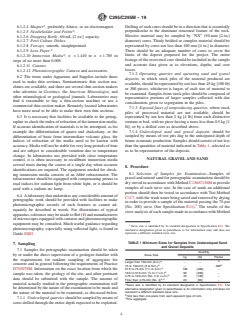
economic production. Samples should consist of not less than the quantities of material indicated in Table 1, selected so as to be
representative of the deposits.
NATURAL GRAVEL AND SAND
8. Procedure
8.1 Selection of Samples for Examination—Samples of gravel and natural sand for petrographic examination should be dry
sieved in accordance with Method C136C136/C136M to provide samples of each sieve size. In the case of sands an additional
portion should then be tested in accordance with Test Method C117, with the wash water being saved and removed by drying in
order to provide a sample of the material passing the 75-μm (No. 200) sieve (See Specification E11). The results of the sieve
analysis of each sample made in accordance with Method C136C136/C136M should be provided to the petrographer making the
examination and used in calculating results of the petrographic examination. Each sieve fraction should be examined separately,
starting with the largest size available. Rocks are more easily recognized in larger pieces; the breakdown of a heterogeneous type
present in the larger sizes may have provided particles of several apparently different types in the smaller sizes. Some important
and easily confused types may be recognizable using the stereoscopic microscope if they are first recognized and separated in the
larger sizes, but may require examination using the petrographic microscope if they are first encountered in the smaller sizes.
8.2 The number of particles of each sieve fraction to be examined will be fixed by the required precision of determination of
the less abundant constituents. Assuming that the field sampling and laboratory sampling procedures are accurate and reliable, the
number of particles examined, identified, and counted in each sieve fraction will depend on the required accuracy of the estimate
of constituents present in small quantities. The numbers given in this method are minimal. They are based on experience and on
statistical considerations (5, 6). It is believed that at least 150 particles of each sieve fraction should be identified and counted in
order to obtain reliable results. Precise determinations of small quantities of an important constituent will require counts of larger
numbers of particles. If the sample of a sieve fraction contains many more particles than need to be identified, the sample shall
be reduced in accordance with one of the procedures in Practice C702C702/C702M, so as to contain a proper number of particles
for examination.
9. Procedure for Examination of Natural Gravel
9.1 Coatings—The particles should be examined to establish whether exterior coatings are present. If coatings are present, it
should be determined whether the coatings consist of materials likely to be deleterious in concrete (opal, gypsum, easily soluble
salts, organic matter). It should also be determined qualitatively how firmly the coatings are bonded to the particles.
9.2 Rock Types—The sieve fraction should be sorted into rock types by visual examination. If all or most of the groups present
are types easily identifiable in hand specimen by examination of a natural or broken surface, and by scratch and acid tests, no
further identification may be needed. Fine-grained rocks that cannot be identified macroscopically or that may consist of or contain
constituents known to be deleterious in concrete should be checked by examination with the stereoscopic microscope. If they
cannot be identified by that means, they should be examined by means of the petrographic microscope. The amount of work done
in identifying fine-grained rocks should be adapted to the information needed about the particular sample. Careful examination of
one size of a sample, or study of information from previous e
...