

ASTM F2206-19
(Specification)Standard Specification for Fabricated Fittings of Butt-Fused Polyethylene (PE)
General Information
- Abstract
ABSTRACT
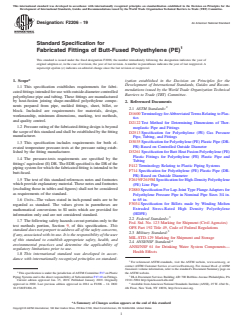
This specification deals with fabricated fittings intended for use with outside-diameter controlled polyethylene pipe and tubing. These fittings are manufactured by heat-fusion joining shape-modified polyethylene components prepared from pipe, molded fittings, sheet, or block. Pressure rating of the fabricated-fitting design is beyond the scope of this standard and shall be established by the fitting manufacturer. This specification includes requirements for both room temperature and elevated temperature pressure-tests to demonstrate a reasonable level of performance of the fabricated-fitting design at the pressure rating established by the fitting manufacturer. Materials shall be tested and shall conform to the requirements for materials, design, workmanship, minimum dimensions, marking, test methods, and quality control.
SCOPE
1.1 This specification establishes requirements for fabricated fittings intended for use with outside-diameter controlled polyethylene pipe and tubing. These fittings are manufactured by heat-fusion joining shape-modified polyethylene components prepared from pipe, molded fittings, sheet, billet, or block. Included are requirements for materials, design, workmanship, minimum dimensions, marking, test methods, and quality control.
1.2 Pressure rating of the fabricated-fitting design is beyond the scope of this standard and shall be established by the fitting manufacturer.
1.3 This specification includes requirements for both elevated temperature pressure-tests at the pressure rating established by the fitting manufacturer.
1.4 The pressure-tests requirements are specified by the fittings’ equivalent (E) DR. The EDR specified is the DR of the piping system for which the fabricated fitting is intended to be butt-fused.
1.5 The text of this standard references notes and footnotes which provide explanatory material. These notes and footnotes (excluding those in tables and figures) shall not be considered as requirements of the standard.
1.6 Units—The values stated in inch-pound units are to be regarded as standard. The values given in parentheses are mathematical conversions to SI units which are provided for information only and are not considered standard.
1.7 The following safety hazards caveat pertains only to the test methods portion, Section 9, of this specification.. This standard does not purport to address all of the safety concerns, if any, associated with its use. It is the responsibility of the user of this standard to establish appropriate safety, health, and environmental practices and determine the applicability of regulatory limitations prior to use.
1.8 This international standard was developed in accordance with internationally recognized principles on standardization established in the Decision on Principles for the Development of International Standards, Guides and Recommendations issued by the World Trade Organization Technical Barriers to Trade (TBT) Committee.
- Status
- Published
- Publication Date
- 14-Jan-2019
- Technical Committee
- F17 - Plastic Piping Systems
- Drafting Committee
- F17.10 - Fittings
Buy Documents
ASTM F2206-19 - Standard Specification for Fabricated Fittings of Butt-Fused Polyethylene (PE)
REDLINE ASTM F2206-19 - Standard Specification for Fabricated Fittings of Butt-Fused Polyethylene (PE)
Overview
ASTM F2206-19 is the internationally recognized standard specification for fabricated fittings of butt-fused polyethylene (PE). Developed by ASTM International, this standard outlines requirements for fittings intended to be used with outside-diameter controlled PE pipe and tubing. The fittings covered by this specification are manufactured by heat-fusion joining of shape-modified polyethylene components derived from pipe, molded fittings, sheet, billet, or block.
ASTM F2206-19 ensures the reliability, performance, and quality control of fabricated butt-fused PE fittings, supporting safe and effective integration into piping systems for water, gas, and industrial applications. Key aspects include material selection, dimensional and physical properties, workmanship, marking, and tests for both room and elevated temperature pressure performance.
Key Topics
- Scope and Coverage: Specifies requirements for fabricated polyethylene fittings joined to pipe by butt fusion, including materials, design, manufacturing, and testing protocols.
- Manufacturing Methods: Describes the use of heat-fusion to join PE components, including those from pipe, molded fittings, sheet, billet, or block.
- Materials: Polyethylene materials must conform to specific ASTM specifications, ensuring stress-rated compounds are used for quality and long-term performance.
- Dimensional Requirements: Established minimum wall thicknesses, tolerances, and eccentricity limits for both IPS and DIPS sizing systems. Machining-precise dimensions are essential for proper fusion.
- Physical Properties: Fabricated fittings using miter cuts require thicker wall stock for enhanced strength.
- Testing: Outlines pressure testing under both standard and elevated temperatures, along with workmanship and homogeneity requirements.
- Product Marking: Detailed guidance on product labeling to support traceability and regulatory compliance.
- Quality Assurance: Manufacturers must demonstrate ongoing conformance through comprehensive testing and inspection routines.
Applications
ASTM F2206-19 is essential for stakeholders in industries where butt-fused polyethylene piping systems are used, including:
- Water Supply and Distribution: Ensures leak-tight and durable water transport for municipal, commercial, and residential systems.
- Natural Gas Distribution: Provides baseline safety and performance requirements for gas utility networks utilizing PE plastic pipe and fittings.
- Industrial and Agricultural Piping: Suitable for transporting a broad range of fluids, chemicals, or process water in manufacturing and agricultural operations.
- Potable Water Systems: Requires conformance with ANSI/NSF 61 for products in contact with drinking water, ensuring health effects are minimized.
- Government/Military Procurement: Includes additional packaging and marking requirements for federal or military contracts.
By following ASTM F2206-19, designers, installers, and regulators can trust that fabricated butt-fused PE fittings meet stringent standards for performance, compatibility, and durability.
Related Standards
Integrating ASTM F2206-19 into your project? Consider these related ASTM and industry standards:
- ASTM D2513: Specification for Polyethylene (PE) Gas Pressure Pipe, Tubing, and Fittings
- ASTM D3035: Specification for PE Plastic Pipe (DR-PR) Based on Controlled Outside Diameter
- ASTM D3261: Specification for Butt Heat Fusion PE Plastic Fittings for PE Plastic Pipe and Tubing
- ASTM F714: Specification for PE Plastic Pipe (DR-PR) Based on Outside Diameter
- ASTM F2880: Specification for Lap-Joint Type Flange Adapters for PE Pressure Pipe
- ASTM F3034: Specification for Billets Made by Winding Molten Extruded Stress-Rated HDPE
- ANSI/NSF 61: Drinking Water System Components - Health Effects
- OPS 49 CFR Part 192: Federal regulations for qualification of joining procedures and personnel
- PPI TR-4: Plastic Pipe Institute’s listing of hydrostatic design basis and related PE material properties
These references provide guidance on PE materials, dimensions, and quality required for reliable plastic piping systems. Using them together with ASTM F2206-19 ensures comprehensive compliance and system integrity.
Relations
- Replaces
ASTM F2206-14 - Standard Specification for Fabricated Fittings of Butt-Fused Polyethylene (PE) - Effective Date
- 15-Jan-2019
- Effective Date
- 01-Feb-2024
- Effective Date
- 01-Feb-2024
- Effective Date
- 01-Apr-2020
- Effective Date
- 01-Sep-2019
- Effective Date
- 01-Jan-2019
- Refers
ASTM D2513-18 - Standard Specification for Polyethylene (PE) Gas Pressure Pipe, Tubing, and Fittings - Effective Date
- 15-Apr-2018
- Refers
ASTM D1600-18 - Standard Terminology for Abbreviated Terms Relating to Plastics (Withdrawn 2024) - Effective Date
- 01-Jan-2018
- Effective Date
- 01-Aug-2017
- Effective Date
- 01-Feb-2017
- Effective Date
- 15-Dec-2016
- Refers
ASTM D2513-16 - Standard Specification for Polyethylene (PE) Gas Pressure Pipe, Tubing, and Fittings - Effective Date
- 01-Dec-2016
- Effective Date
- 15-Nov-2016
- Effective Date
- 01-Aug-2016
- Effective Date
- 15-Dec-2015
Buy Documents
ASTM F2206-19 - Standard Specification for Fabricated Fittings of Butt-Fused Polyethylene (PE)
REDLINE ASTM F2206-19 - Standard Specification for Fabricated Fittings of Butt-Fused Polyethylene (PE)
Get Certified
Connect with accredited certification bodies for this standard

Institut za varilstvo d.o.o. (Welding Institute)
Slovenia's leading welding institute since 1952. ISO 3834, EN 1090, pressure equipment certification, NDT personnel, welder qualification. Only IIW Au
Sponsored listings
Frequently Asked Questions
ASTM F2206-19 is a technical specification published by ASTM International. Its full title is "Standard Specification for Fabricated Fittings of Butt-Fused Polyethylene (PE)". This standard covers: ABSTRACT This specification deals with fabricated fittings intended for use with outside-diameter controlled polyethylene pipe and tubing. These fittings are manufactured by heat-fusion joining shape-modified polyethylene components prepared from pipe, molded fittings, sheet, or block. Pressure rating of the fabricated-fitting design is beyond the scope of this standard and shall be established by the fitting manufacturer. This specification includes requirements for both room temperature and elevated temperature pressure-tests to demonstrate a reasonable level of performance of the fabricated-fitting design at the pressure rating established by the fitting manufacturer. Materials shall be tested and shall conform to the requirements for materials, design, workmanship, minimum dimensions, marking, test methods, and quality control. SCOPE 1.1 This specification establishes requirements for fabricated fittings intended for use with outside-diameter controlled polyethylene pipe and tubing. These fittings are manufactured by heat-fusion joining shape-modified polyethylene components prepared from pipe, molded fittings, sheet, billet, or block. Included are requirements for materials, design, workmanship, minimum dimensions, marking, test methods, and quality control. 1.2 Pressure rating of the fabricated-fitting design is beyond the scope of this standard and shall be established by the fitting manufacturer. 1.3 This specification includes requirements for both elevated temperature pressure-tests at the pressure rating established by the fitting manufacturer. 1.4 The pressure-tests requirements are specified by the fittings’ equivalent (E) DR. The EDR specified is the DR of the piping system for which the fabricated fitting is intended to be butt-fused. 1.5 The text of this standard references notes and footnotes which provide explanatory material. These notes and footnotes (excluding those in tables and figures) shall not be considered as requirements of the standard. 1.6 Units—The values stated in inch-pound units are to be regarded as standard. The values given in parentheses are mathematical conversions to SI units which are provided for information only and are not considered standard. 1.7 The following safety hazards caveat pertains only to the test methods portion, Section 9, of this specification.. This standard does not purport to address all of the safety concerns, if any, associated with its use. It is the responsibility of the user of this standard to establish appropriate safety, health, and environmental practices and determine the applicability of regulatory limitations prior to use. 1.8 This international standard was developed in accordance with internationally recognized principles on standardization established in the Decision on Principles for the Development of International Standards, Guides and Recommendations issued by the World Trade Organization Technical Barriers to Trade (TBT) Committee.
ABSTRACT This specification deals with fabricated fittings intended for use with outside-diameter controlled polyethylene pipe and tubing. These fittings are manufactured by heat-fusion joining shape-modified polyethylene components prepared from pipe, molded fittings, sheet, or block. Pressure rating of the fabricated-fitting design is beyond the scope of this standard and shall be established by the fitting manufacturer. This specification includes requirements for both room temperature and elevated temperature pressure-tests to demonstrate a reasonable level of performance of the fabricated-fitting design at the pressure rating established by the fitting manufacturer. Materials shall be tested and shall conform to the requirements for materials, design, workmanship, minimum dimensions, marking, test methods, and quality control. SCOPE 1.1 This specification establishes requirements for fabricated fittings intended for use with outside-diameter controlled polyethylene pipe and tubing. These fittings are manufactured by heat-fusion joining shape-modified polyethylene components prepared from pipe, molded fittings, sheet, billet, or block. Included are requirements for materials, design, workmanship, minimum dimensions, marking, test methods, and quality control. 1.2 Pressure rating of the fabricated-fitting design is beyond the scope of this standard and shall be established by the fitting manufacturer. 1.3 This specification includes requirements for both elevated temperature pressure-tests at the pressure rating established by the fitting manufacturer. 1.4 The pressure-tests requirements are specified by the fittings’ equivalent (E) DR. The EDR specified is the DR of the piping system for which the fabricated fitting is intended to be butt-fused. 1.5 The text of this standard references notes and footnotes which provide explanatory material. These notes and footnotes (excluding those in tables and figures) shall not be considered as requirements of the standard. 1.6 Units—The values stated in inch-pound units are to be regarded as standard. The values given in parentheses are mathematical conversions to SI units which are provided for information only and are not considered standard. 1.7 The following safety hazards caveat pertains only to the test methods portion, Section 9, of this specification.. This standard does not purport to address all of the safety concerns, if any, associated with its use. It is the responsibility of the user of this standard to establish appropriate safety, health, and environmental practices and determine the applicability of regulatory limitations prior to use. 1.8 This international standard was developed in accordance with internationally recognized principles on standardization established in the Decision on Principles for the Development of International Standards, Guides and Recommendations issued by the World Trade Organization Technical Barriers to Trade (TBT) Committee.
ASTM F2206-19 is classified under the following ICS (International Classification for Standards) categories: 23.040.20 - Plastics pipes; 23.040.45 - Plastics fittings. The ICS classification helps identify the subject area and facilitates finding related standards.
ASTM F2206-19 has the following relationships with other standards: It is inter standard links to ASTM F2206-14, ASTM D3261-24, ASTM F714-24, ASTM F412-20, ASTM F2619/F2619M-19, ASTM F412-19, ASTM D2513-18, ASTM D1600-18, ASTM F412-17a, ASTM F412-17, ASTM D2513-16a, ASTM D2513-16, ASTM F412-16a, ASTM F412-16, ASTM D3261-15. Understanding these relationships helps ensure you are using the most current and applicable version of the standard.
ASTM F2206-19 is available in PDF format for immediate download after purchase. The document can be added to your cart and obtained through the secure checkout process. Digital delivery ensures instant access to the complete standard document.
Standards Content (Sample)
This international standard was developed in accordance with internationally recognized principles on standardization established in the Decision on Principles for the
Development of International Standards, Guides and Recommendations issued by the World Trade Organization Technical Barriers to Trade (TBT) Committee.
Designation: F2206 −19 An American National Standard
Standard Specification for
Fabricated Fittings of Butt-Fused Polyethylene (PE)
This standard is issued under the fixed designation F2206; the number immediately following the designation indicates the year of
original adoption or, in the case of revision, the year of last revision. A number in parentheses indicates the year of last reapproval. A
superscript epsilon (´) indicates an editorial change since the last revision or reapproval.
1. Scope* ization established in the Decision on Principles for the
Development of International Standards, Guides and Recom-
1.1 This specification establishes requirements for fabri-
mendations issued by the World Trade Organization Technical
cated fittings intended for use with outside-diameter controlled
Barriers to Trade (TBT) Committee.
polyethylene pipe and tubing. These fittings are manufactured
by heat-fusion joining shape-modified polyethylene compo-
2. Referenced Documents
nents prepared from pipe, molded fittings, sheet, billet, or
2.1 ASTM Standards:
block. Included are requirements for materials, design,
D1600 Terminology forAbbreviatedTerms Relating to Plas-
workmanship, minimum dimensions, marking, test methods,
tics
and quality control.
D2122 Test Method for Determining Dimensions of Ther-
1.2 Pressure rating of the fabricated-fitting design is beyond
moplastic Pipe and Fittings
the scope of this standard and shall be established by the fitting
D2513 Specification for Polyethylene (PE) Gas Pressure
manufacturer.
Pipe, Tubing, and Fittings
D3035 SpecificationforPolyethylene(PE)PlasticPipe(DR-
1.3 This specification includes requirements for both el-
PR) Based on Controlled Outside Diameter
evated temperature pressure-tests at the pressure rating estab-
D3261 Specification for Butt Heat Fusion Polyethylene (PE)
lished by the fitting manufacturer.
Plastic Fittings for Polyethylene (PE) Plastic Pipe and
1.4 The pressure-tests requirements are specified by the
Tubing
fittings’equivalent (E) DR.The EDR specified is the DR of the
F412 Terminology Relating to Plastic Piping Systems
piping system for which the fabricated fitting is intended to be
F714 Specification for Polyethylene (PE) Plastic Pipe (DR-
butt-fused.
PR) Based on Outside Diameter
1.5 The text of this standard references notes and footnotes
F2619/F2619M SpecificationforHigh-DensityPolyethylene
which provide explanatory material. These notes and footnotes
(PE) Line Pipe
(excluding those in tables and figures) shall not be considered
F2880 Specification For Lap-Joint Type FlangeAdapters for
as requirements of the standard.
Polyethylene Pressure Pipe in Nominal Pipe Sizes 3/4 in.
to 65 in.
1.6 Units—The values stated in inch-pound units are to be
F3034 Specification for Billets made by Winding Molten
regarded as standard. The values given in parentheses are
Extruded Stress-Rated High Density Polyethylene
mathematical conversions to SI units which are provided for
(HDPE)
information only and are not considered standard.
2.2 Federal Standards:
1.7 The following safety hazards caveat pertains only to the
Fed. Std. No. 123 Marking for Shipment (Civil Agencies)
test methods portion, Section 9, of this specification. This
OPS Part 192 Title 49, Code of Federal Regulations
standard does not purport to address all of the safety concerns,
2.3 Military Standard:
if any, associated with its use. It is the responsibility of the user
MIL-STD-129 Marking for Shipment and Storage
of this standard to establish appropriate safety, health, and
2.4 ANSI/NSF Standard:
environmental practices and determine the applicability of
ANSI/NSF 61 for Drinking Water System Components—
regulatory limitations prior to use.
Health Effects
1.8 This international standard was developed in accor-
dance with internationally recognized principles on standard-
For referenced ASTM standards, visit the ASTM website, www.astm.org, or
contact ASTM Customer Service at service@astm.org. For Annual Book of ASTM
Standards volume information, refer to the standard’s Document Summary page on
This specification is under the jurisdiction ofASTM Committee F17 on Plastic the ASTM website.
Piping Systems and is the direct responsibility of Subcommittee F17.10 on Fittings. DLA Document Services Building 4/D 700 Robbins Avenue Philadelphia, PA
Current edition approved Jan. 15, 2019. Published January 2019. Originally 19111-5094 http://quicksearch.dla.mil/
approved in 2002. Last previous edition approved in 2014 as F2206 – 14. DOI: Available fromAmerican National Standards Institute (ANSI), 25 W. 43rd St.,
10.1520/F2206-19. 4th Floor, New York, NY 10036, http://www.ansi.org.
*A Summary of Changes section appears at the end of this standard
Copyright © ASTM International, 100 Barr Harbor Drive, PO Box C700, West Conshohocken, PA 19428-2959. United States
F2206 − 19
2.5 Plastic Pipe Institute: 6.1.2 Molded PE fittings used in the production of fabri-
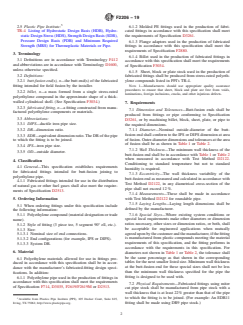
TR-4 Listing of Hydrostatic Design Basis (HDB), Hydro- cated fittings in accordance with this specification shall meet
static Design Stress (HDS), Strength Design Basis (SDB), the requirements of Specification D3261.
Pressure Design Basis (PDB) and Minimum Required
6.1.3 Flange adaptors used in the production of fabricated
Strength (MRS) for Thermoplastic Materials or Pipe.
fittings in accordance with this specification shall meet the
requirements of Specification F2880.
3. Terminology
6.1.4 Billet used in the production of fabricated fittings in
3.1 Definitions are in accordance with Terminology F412
accordance with this specification shall meet the requirements
and abbreviations are in accordance with Terminology D1600,
of Specification F3034.
unless otherwise specified.
6.1.5 Sheet, block or plate stock used in the production of
3.2 Definitions: fabricated fittings shall be produced from stress-rated polyeth-
3.2.1 butt-fusion end(s), n—the butt end(s) of the fabricated ylene compounds listed in PPI’s TR-4.
fitting intended for field fusion by the installer. NOTE 1—Manufacturers should use appropriate quality assurance
procedures to ensure that sheet, block and plate are free from voids,
3.2.2 billet, n—a mass formed from a single stress-rated
laminations, foreign inclusions, cracks, and other injurious defects.
polyethylene compound in the approximate shape of a thick-
walled cylindrical shell. (See Specification F3034.)
7. Requirements
3.2.3 fabricated fitting, n—a fitting constructed from manu-
7.1 Dimension and Tolerances—Butt-fusion ends shall be
factured polyethylene components or materials.
produced from fittings or pipe conforming to Specification
3.3 Abbreviations:
D3261, or by machining billet, block, sheet, plate, or pipe to
3.3.1 DIPS—ductile iron pipe size.
the required dimensions.
3.3.2 DR—dimension ratio.
7.1.1 Diameter—Nominal outside-diameter of the butt-
fusion end shall conform to the IPS or DIPS dimension at area
3.3.3 EDR—equivalent dimension ratio. The DR of the pipe
offusion.Outer-diameterdimensionsandtolerancesatthearea
to which the fitting is to be joined.
of fusion shall be as shown in Table 1 or Table 2.
3.3.4 IPS—iron pipe size.
7.1.2 Wall Thickness—The minimum wall thickness of the
3.3.5 OD—outside diameter.
butt-fusion end shall be in accordance with Table 1 or Table 2
when measured in accordance with Test Method D2122.
4. Classification
Conditioning to standard temperature but not to standard
4.1 General—This specification establishes requirements
humidity is required.
for fabricated fittings intended for butt-fusion joining to
7.1.3 Eccentricity—The wall thickness variability of the
polyethylene pipe.
butt-fusion end as measured and calculated in accordance with
4.1.1 Fabricated fittings intended for use in the distribution
Test Method D2122, in any diametrical cross-section of the
of natural gas or other fuel gases shall also meet the require-
pipe shall not exceed 12 %.
ments of Specification D2513.
7.1.4 Measurements—These shall be made in accordance
with Test Method D2122 for roundable pipe.
5. Ordering Information
7.1.5 Laying Lengths—Laying length dimensions shall be
5.1 When ordering fittings under this specification include
defined by the manufacturer.
the following information:
7.1.6 Special Sizes—Where existing system conditions or
5.1.1 Polyethylene compound (material designation or trade
special local requirements make other diameters or dimension
name).
ratios necessary, other sizes or dimension ratios, or both, shall
5.1.2 Style of fitting (3 piece tee, 5 segment 90° ell, etc.).
be acceptable for engineered applications when mutually
5.1.3 Size:
agreeduponbythecustomerandthemanufacturer,ifthefitting
5.1.3.1 Nominal size of end connections.
is manufactured from plastic compounds meeting the material
5.1.3.2 End configurations (for example, IPS or DIPS).
requirements of this specification, and the fitting performs in
5.1.3.3 System DR.
accordance with the requirements in this specification. For
6. Material
diameters not shown in Table 1 or Table 2, the tolerance shall
be the same percentage as that shown in the corresponding
6.1 Polyethylene materials allowed for use in fittings pro-
tables for the next smaller listed size. Minimum wall thickness
duced in accordance with this specification shall be in accor-
at the butt-fusion end for these special sizes shall not be less
dance with the manufacturer’s fabricated-fitting design speci-
than the minimum wall thickness specified for the pipe the
fications. In addition:
fitting is designed to be used with.
6.1.1 Polyethylene pipe used in the production of fittings in
accordance with this specification shall meet the requirements
7.2 Physical Requirements—Fabricated fittings using miter
of Specification F714, D3035, F2619/F2619M or D2513.
cut pipe stock shall be manufactured from pipe stock with a
wall thickness that is at least 22% greater than that of the pipe
to which the fitting is to be joined. (For example: An EDR11
Available from Plastics Pipe Institute (PPI), 105 Decker Court, Suite 825,
Irving, TX 75062, http://www.plasticpipe.org. fitting shall be made using DR9 pipe stock.)
F2206 − 19
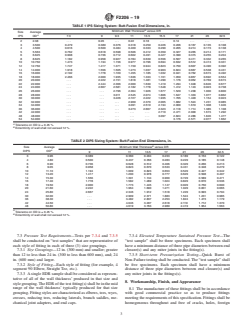
TABLE 1 IPS Sizing System: Butt-Fusion End Dimensions, in.
B
Minimum Wall Thickness versus DR
Size Average
A
IPS OD
7.3 9 9.3 11 13.5 15.5 17 21 26 32.5
2 2.38 . 0.26 . 0.22 0.18 . 0.14 . . .
3 3.500 0.479 0.389 0.376 0.318 0.259 0.226 0.206 0.167 0.135 0.108
4 4.500 0.616 0.500 0.484 0.409 0.333 0.290 0.265 0.214 0.173 0.138
5 5.563 0.762 0.618 0.598 0.506 0.412 0.359 0.327 0.265 0.214 0.171
6 6.625 0.908 0.736 0.712 0.602 0.491 0.427 0.390 0.315 0.255 0.204
8 8.625 1.182 0.958 0.927 0.784 0.639 0.556 0.507 0.411 0.332 0.265
10 10.750 1.473 1.194 1.156 0.977 0.796 0.694 0.632 0.512 0.413 0.331
12 12.750 1.747 1.417 1.371 1.159 0.944 0.823 0.750 0.607 0.490 0.392
14 14.000 1.918 1.556 1.505 1.273 1.037 0.903 0.824 0.667 0.538 0.431
16 16.000 2.192 1.778
...
This document is not an ASTM standard and is intended only to provide the user of an ASTM standard an indication of what changes have been made to the previous version. Because
it may not be technically possible to adequately depict all changes accurately, ASTM recommends that users consult prior editions as appropriate. In all cases only the current version
of the standard as published by ASTM is to be considered the official document.
Designation: F2206 − 14 F2206 − 19 An American National Standard
Standard Specification for
Fabricated Fittings of Butt-Fused Polyethylene (PE)
This standard is issued under the fixed designation F2206; the number immediately following the designation indicates the year of
original adoption or, in the case of revision, the year of last revision. A number in parentheses indicates the year of last reapproval. A
superscript epsilon (´) indicates an editorial change since the last revision or reapproval.
1. Scope*
1.1 This specification establishes requirements for fabricated fittings intended for use with outside-diameter controlled
polyethylene pipe and tubing. These fittings are manufactured by heat-fusion joining shape-modified polyethylene components
prepared from pipe, molded fittings, sheet, billet, or block. Included are requirements for materials, design, workmanship,
minimum dimensions, marking, test methods, and quality control.
1.2 Pressure rating of the fabricated-fitting design is beyond the scope of this standard and shall be established by the fitting
manufacturer. This specification includes requirements for both elevated temperature pressure-tests and short-term pressurization
tests to demonstrate a reasonable level of performance of the fabricated-fitting design at the pressure rating established by the
fitting manufacturer.
1.3 This specification includes requirements for both elevated temperature pressure-tests at the pressure rating established by
the fitting manufacturer.
1.4 The pressure-tests requirements are specified by the fittings’ equivalent (E) DR. The EDR specified is the DR of the piping
system for which the fabricated fitting is intended to be butt-fused.
1.5 The text of this standard references notes and footnotes which provide explanatory material. These notes and footnotes
(excluding those in tables and figures) shall not be considered as requirements of the standard.
1.6 Units—The values stated in inch-pound units are to be regarded as standard. The values given in parentheses are
mathematical conversions to SI units which are provided for information only and are not considered standard.
1.7 The following safety hazards caveat pertains only to the test methods portion, Section 9, of this specification.specification.
This standard does not purport to address all of the safety concerns, if any, associated with its use. It is the responsibility of the
user of this standard to establish appropriate safety safety, health, and healthenvironmental practices and determine the
applicability of regulatory limitations prior to use.
1.8 This international standard was developed in accordance with internationally recognized principles on standardization
established in the Decision on Principles for the Development of International Standards, Guides and Recommendations issued
by the World Trade Organization Technical Barriers to Trade (TBT) Committee.
2. Referenced Documents
2.1 ASTM Standards:
D1600 Terminology for Abbreviated Terms Relating to Plastics
D2122 Test Method for Determining Dimensions of Thermoplastic Pipe and Fittings
D2513 Specification for Polyethylene (PE) Gas Pressure Pipe, Tubing, and Fittings
D3035 Specification for Polyethylene (PE) Plastic Pipe (DR-PR) Based on Controlled Outside Diameter
D3261 Specification for Butt Heat Fusion Polyethylene (PE) Plastic Fittings for Polyethylene (PE) Plastic Pipe and Tubing
F412 Terminology Relating to Plastic Piping Systems
F714 Specification for Polyethylene (PE) Plastic Pipe (DR-PR) Based on Outside Diameter
F2619/F2619M Specification for High-Density Polyethylene (PE) Line Pipe
F2880 Specification For Lap-Joint Type Flange Adapters for Polyethylene Pressure Pipe in Nominal Pipe Sizes 3/4 in. to 65 in.
F3034 Specification for Billets made by Winding Molten Extruded Stress-Rated High Density Polyethylene (HDPE)
This specification is under the jurisdiction of ASTM Committee F17 on Plastic Piping Systems and is the direct responsibility of Subcommittee F17.10 on Fittings.
Current edition approved Dec. 1, 2014Jan. 15, 2019. Published January 2015January 2019. Originally approved in 2002. Last previous edition approved in 20112014 as
F2206F2206 – 11.14. DOI: 10.1520/F2206-14.10.1520/F2206-19.
For referenced ASTM standards, visit the ASTM website, www.astm.org, or contact ASTM Customer Service at service@astm.org. For Annual Book of ASTM Standards
volume information, refer to the standard’s Document Summary page on the ASTM website.
*A Summary of Changes section appears at the end of this standard
Copyright © ASTM International, 100 Barr Harbor Drive, PO Box C700, West Conshohocken, PA 19428-2959. United States
F2206 − 19
2.2 Federal Standards:
Fed. Std. No. 123 Marking for Shipment (Civil Agencies)
OPS Part 192 Title 49, Code of Federal Regulations
2.3 Military Standard:
MIL-STD-129 Marking for Shipment and Storage
2.4 ANSI/NSF Standard:
ANSI/NSF 61 for Drinking Water System Components—Health Effects
2.5 Plastic Pipe Institute:
TR-4 Listing of Hydrostatic Design Basis (HDB), Hydrostatic Design Stress (HDS), Strength Design Basis (SDB), Pressure
Design Basis (PDB) and Minimum Required Strength (MRS) for Thermoplastic Materials or Pipe.
3. Terminology
3.1 Definitions are in accordance with Terminology F412 and abbreviations are in accordance with Terminology D1600, unless
otherwise specified.
3.2 Definitions:
3.2.1 butt-fusion end(s), n—the butt end(s) of the fabricated fitting intended for field fusion by the installer.
3.2.2 billet, n—a mass formed from a single stress-rated polyethylene compound in the approximate shape of a thick-walled
cylindrical shell. (See Specification F3034.)
3.2.3 fabricated fitting, n—a fitting constructed from manufactured polyethylene components or materials.
3.3 Abbreviations:
3.3.1 DIPS—ductile iron pipe size.
3.3.2 DR—dimension ratio.
3.3.3 EDR—equivalent dimension ratio. The DR of the pipe to which the fitting is to be joined.
3.3.4 IPS—iron pipe size.
3.3.5 OD—outside diameter.
4. Classification
4.1 General—This specification establishes requirements for fabricated fittings intended for butt-fusion joining to polyethylene
pipe.
4.1.1 Fabricated fittings intended for use in the distribution of natural gas or other fuel gases shall also meet the requirements
of Specification D2513.
5. Ordering Information
5.1 When ordering fittings under this specification include the following information:
5.1.1 Polyethylene compound (material designation or trade name).
5.1.2 Style of fitting (3 piece tee, 5 segment 90° ell, etc.).
5.1.3 Size:
5.1.3.1 Nominal size of end connections.
5.1.3.2 End configurations (for example, IPS or DIPS).
5.1.3.3 System DR.
6. Material
6.1 Polyethylene materials allowed for use in fittings produced in accordance with this specification shall be in accordance with
the manufacturer’s fabricated-fitting design specifications. In addition:
6.1.1 Polyethylene pipe used in the production of fittings in accordance with this specification shall meet the requirements of
Specification F714, D3035, F2619/F2619M or D2513.
6.1.2 Molded PE fittings used in the production of fabricated fittings in accordance with this specification shall meet the
requirements of Specification D3261.
6.1.3 Flange adaptors used in the production of fabricated fittings in accordance with this specification shall meet the
requirements of Specification F2880.
6.1.4 Billet used in the production of fabricated fittings in accordance with this specification shall meet the requirements of
Specification F3034.
DLA Document Services Building 4/D 700 Robbins Avenue Philadelphia, PA 19111-5094 http://quicksearch.dla.mil/
Available from American National Standards Institute (ANSI), 25 W. 43rd St., 4th Floor, New York, NY 10036, http://www.ansi.org.
Available from Plastics Pipe Institute (PPI), 105 Decker Court, Suite 825, Irving, TX 75062, http://www.plasticpipe.org.
F2206 − 19
6.1.5 Sheet, block or plate stock used in the production of fabricated fittings shall be produced from stress-rated polyethylene
compounds listed in PPI’s TR-4.
NOTE 1—Manufacturers should use appropriate quality assurance procedures to ensure that sheet, block and plate are free from voids, laminations,
foreign inclusions, cracks, and other injurious defects.
7. Requirements
7.1 Dimension and Tolerances—Butt-fusion ends shall be produced from fittings or pipe conforming to Specification D3261,
or by machining billet, block, sheet, plate, or pipe to the required dimensions.
7.1.1 Diameter—Nominal outside-diameter of the butt-fusion end shall conform to the IPS or DIPS dimension at area of fusion.
Outer-diameter dimensions and tolerances at the area of fusion shall be as shown in Table 1 or Table 2.
7.1.2 Wall Thickness—The minimum wall thickness of the butt-fusion end shall be in accordance with Table 1 or Table 2 when
measured in accordance with Test Method D2122. Conditioning to standard temperature but not to standard humidity is required.
7.1.3 Eccentricity—The wall thickness variability of the butt-fusion end as measured and calculated in accordance with Test
Method D2122, in any diametrical cross-section of the pipe shall not exceed 12 %.
7.1.4 Measurements—These shall be made in accordance with Test Method D2122 for roundable pipe.
7.1.5 Laying Lengths—Laying length dimensions shall be defined by the manufacturer.
7.1.6 Special Sizes—Where existing system conditions or special local requirements make other diameters or dimension ratios
necessary, other sizes or dimension ratios, or both, shall be acceptable for engineered applications when mutually agreed upon by
the customer and the manufacturer, if the fitting is manufactured from plastic compounds meeting the material requirements of this
specification, and the fitting performs in accordance with the requirements in this specification. For diameters not shown in Table
1 or Table 2, the tolerance shall be the same percentage as that shown in the corresponding tables for the next smaller listed size.
Minimum wall thickness at the butt-fusion end for these special sizes shall not be less than the minimum wall thickness specified
for the pipe the fitting is designed to be used with.
7.2 Physical Requirements—Fabricated fittings using miter cut pipe stock shall be manufactured from pipe stock with a wall
thickness that is at least 22% greater than that of the pipe to which the fitting is to be joined. (For example: An EDR11 fitting shall
be made using DR9 pipe stock.)
7.3 Pressure Test Requirements—Design validation tests Tests per 7.3.17.3.4 and 7.3.27.3.5 shall be conducted on “test samples”
that are representative of:of
–Each of three (3) size groupings - 12 in. (300 mm) and smaller,
greater than 12 to less than 24 in. (300 to less than 600 mm),
and 24 in. (600 mm) and larger.
–Each style of fitting (for example, 4 segment 90 Elbow, Straight
Tee, etc.).
each style of fitting in each of three (3) size groupings.
TABLE 1 IPS Sizing System: Butt-Fusion End Dimensions, in.
B
Minimum Wall Thickness versus DR
Size Average
A
IPS OD
7.3 9 9.3 11 13.5 15.5 17 21 26 32.5
2 2.38 . . . 0.26 . . . 0.22 0.18 . . . 0.14 . . . . . . . . .
3 3.500 0.479 0.389 0.376 0.318 0.259 0.226 0.206 0.167 0.135 0.108
4 4.500 0.616 0.500 0.484 0.409 0.333 0.290 0.265 0.214 0.173 0.138
5 5.563 0.762 0.618 0.598 0.506 0.412 0.359 0.327 0.265 0.214 0.171
6 6.625 0.908 0.736 0.712 0.602 0.491 0.427 0.390 0.315 0.255 0.204
8 8.625 1.182 0.958 0.927 0.784 0.639 0.556 0.507 0.411 0.332 0.265
10 10.750 1.473 1.194 1.156 0.977 0.796 0.694 0.632 0.512 0.413 0.331
12 12.750 1.747 1.417 1.371 1.159 0.944 0.823 0.750 0.607 0.490 0.392
14 14.000 1.918 1.556 1.505 1.273 1.037 0.903 0.824 0.667 0.538 0.431
16 16.000 2.192 1.778 1.720 1.455 1.185 1.032 0.941 0.762 0.615 0.492
18 18.000 2.466 2.000 1.935 1.636 1.333 1.161 1.059 0.857 0.692 0.554
20 20.000 . . . 2.222 2.151 1.818 1.481 1.290 1.176 0.952 0.769 0.615
22 22.000 . . . 2.444 2.366 2.000 1.630 1.419 1.294 1.048 0.846 0.677
24 24
...