EN 13659:2004+A1:2008
(Main)Shutters - Performance requirements including safety
Shutters - Performance requirements including safety
This European Standard specifies the performance requirements which shutters shall fulfil when fitted to a building. It deals also with the significant hazards for construction, transport, installation, operation and maintenance of the shutters (see list of significant machine hazards in annex C).
It applies to all shutters as well as similar products whatever their use and nature of the materials used, as follows:
- external Venetian blind, roller shutter, wing shutter, Venetian shutter, flat-closing concertina shutter, concertina shutter or sliding panel shutter, with or without a system of projection.
These products can be operated manually with or without compensating spring, or by means of electric motors (power operated products).
This document is not applicable to shutters which are manufactured before the date of application of this document by CEN.
Noise aspects are not treated in the standard because this is not considered a safety issue.
Abschlüsse außen - Leistungs- und Sicherheitsanforderungen
Diese Europäische Norm legt die Leistungsanforderungen fest, die an einem Gebäude befestigte Abschlüsse
außen erfüllen müssen. Die Norm behandelt auch signifikante Gefährdungen für Konstruktion, Transport,
Einbau, Betrieb und Wartung der Abschlüsse (siehe Liste der signifikanten Gefährdungen bei Motorbedienung
im Anhang C).
Die Norm gilt wie folgt für alle Abschlüsse und ähnliche Produkte, unabhängig von ihrem Gebrauch und der
Art der verwendeten Werkstoffe:
⎯ Außenjalousie, Rollladen, Drehladen, Faltladen ungeführt, Faltladen geführt (flach geschlossen),
Faltladen geführt (Akkordeon), oder Schiebeladen, mit oder ohne eine Ausstellvorrichtung.
Diese Produkte können manuell bedient werden, mit oder ohne ausgleichende Federn, oder mittels
Elektromotoren (kraftbetätigte Produkte).
Dieses Dokument gilt nicht für Abschlüsse, die vor dem Veröffentlichungsdatum dieses Dokumentes durch
CEN hergestellt wurden.
!Lärmschutzaspekte werden in der Norm nicht behandelt, da sie die Sicherheit nicht betreffen."
Fermetures pour baies équipées de fenêtres - Exigences de performance y compris la sécurité
La présente Norme européenne spécifie les exigences de performance que doivent remplir les fermetures équipant
les bâtiments. Elle traite également des risques significatifs liés aux machines relatifs aux opérations de fabrication,
transport, installation, utilisation et de maintenance des fermetures (voir la liste des phénomènes dangereux
significatifs en Annexe C).
Elle s'applique à toutes les fermetures dont la liste est donnée ci-après, ainsi qu'aux produits similaires, quelles que
soient leur conception et la nature des matériaux utilisés et définis dans la norme EN 12216 :
— store vénitien extérieur, volet roulant, volet battant, persienne, persienne coulissante, jalousie accordéon ou volet
coulissant, projetables ou non projetables.
EN 13659:2004+A1:2008 (F)
5
Ces produits peuvent être manoeuvrés manuellement avec ou sans ressort de compensation ou au moyen de
moteurs électriques (produits motorisés).
Le présent document n’est pas applicable aux fermetures fabriquées avant la date de mise en application de ce
document par le CEN.
!Les aspects relatifs au bruit ne font pas l’objet de la présente norme car le bruit n’est pas considéré comme un
problème de sécurité."
Polkna - Zahtevane lastnosti, vključno z varnostjo
General Information
- Status
- Withdrawn
- Publication Date
- 30-Sep-2008
- Withdrawal Date
- 13-Apr-2025
- Technical Committee
- CEN/TC 33 - Doors, windows, shutters and building hardware
- Drafting Committee
- CEN/TC 33/WG 3 - Blinds and shutters
- Current Stage
- 9960 - Withdrawal effective - Withdrawal
- Start Date
- 20-May-2015
- Completion Date
- 14-Apr-2025
- Directive
- 89/106/EEC - Construction products
- Directive
- 98/37/EC - Machinery
Relations
- Effective Date
- 18-Jan-2023
- Effective Date
- 22-Dec-2008
- Replaced By
EN 13659:2015 - Shutters and external venetian blinds - Performance requirements including safety - Effective Date
- 08-Jun-2022
- Revised
FprEN 13659 rev - Shutters and external venetian blinds - Performance requirements including safety - Effective Date
- 18-Jan-2023
Frequently Asked Questions
EN 13659:2004+A1:2008 is a standard published by the European Committee for Standardization (CEN). Its full title is "Shutters - Performance requirements including safety". This standard covers: This European Standard specifies the performance requirements which shutters shall fulfil when fitted to a building. It deals also with the significant hazards for construction, transport, installation, operation and maintenance of the shutters (see list of significant machine hazards in annex C). It applies to all shutters as well as similar products whatever their use and nature of the materials used, as follows: - external Venetian blind, roller shutter, wing shutter, Venetian shutter, flat-closing concertina shutter, concertina shutter or sliding panel shutter, with or without a system of projection. These products can be operated manually with or without compensating spring, or by means of electric motors (power operated products). This document is not applicable to shutters which are manufactured before the date of application of this document by CEN. Noise aspects are not treated in the standard because this is not considered a safety issue.
This European Standard specifies the performance requirements which shutters shall fulfil when fitted to a building. It deals also with the significant hazards for construction, transport, installation, operation and maintenance of the shutters (see list of significant machine hazards in annex C). It applies to all shutters as well as similar products whatever their use and nature of the materials used, as follows: - external Venetian blind, roller shutter, wing shutter, Venetian shutter, flat-closing concertina shutter, concertina shutter or sliding panel shutter, with or without a system of projection. These products can be operated manually with or without compensating spring, or by means of electric motors (power operated products). This document is not applicable to shutters which are manufactured before the date of application of this document by CEN. Noise aspects are not treated in the standard because this is not considered a safety issue.
EN 13659:2004+A1:2008 is classified under the following ICS (International Classification for Standards) categories: 91.060.50 - Doors and windows. The ICS classification helps identify the subject area and facilitates finding related standards.
EN 13659:2004+A1:2008 has the following relationships with other standards: It is inter standard links to EN 13659:2004, EN 13659:2004/prA1, EN 13659:2015, FprEN 13659 rev. Understanding these relationships helps ensure you are using the most current and applicable version of the standard.
EN 13659:2004+A1:2008 is associated with the following European legislation: EU Directives/Regulations: 2006/42/EC, 305/2011, 89/106/EEC, 98/37/EC; Standardization Mandates: M/079, M/101, M/396. When a standard is cited in the Official Journal of the European Union, products manufactured in conformity with it benefit from a presumption of conformity with the essential requirements of the corresponding EU directive or regulation.
You can purchase EN 13659:2004+A1:2008 directly from iTeh Standards. The document is available in PDF format and is delivered instantly after payment. Add the standard to your cart and complete the secure checkout process. iTeh Standards is an authorized distributor of CEN standards.
Standards Content (Sample)
2003-01.Slovenski inštitut za standardizacijo. Razmnoževanje celote ali delov tega standarda ni dovoljeno.Abschlüsse außen - Leistungs- und SicherheitsanforderungenFermetures pour baies équipées de fenêtres - Exigences de performance y compris la sécuritéShutters - Performance requirements including safety91.060.50Vrata in oknaDoors and windowsICS:Ta slovenski standard je istoveten z:EN 13659:2004+A1:2008SIST EN 13659:2004+A1:2009en,fr,de01-maj-2009SIST EN 13659:2004+A1:2009SLOVENSKI
STANDARDSIST EN 13659:20041DGRPHãþD
EUROPEAN STANDARD NORME EUROPÉENNE EUROPÄISCHE NORM
EN 13659:2004+A1
October 2008 ICS 91.060.50 Supersedes EN 13659:2004 English Version
Shutters - Performance requirements including safety
Fermetures pour baies équipées de fenêtres - Exigences de performance y compris la sécurité
Abschlüsse außen - Leistungs- und Sicherheitsanforderungen This European Standard was approved by CEN on 2 March 2004 and includes Amendment 1 approved by CEN on 18 August 2008.
CEN members are bound to comply with the CEN/CENELEC Internal Regulations which stipulate the conditions for giving this European Standard the status of a national standard without any alteration. Up-to-date lists and bibliographical references concerning such national standards may be obtained on application to the CEN Management Centre or to any CEN member.
This European Standard exists in three official versions (English, French, German). A version in any other language made by translation under the responsibility of a CEN member into its own language and notified to the CEN Management Centre has the same status as the official versions.
CEN members are the national standards bodies of Austria, Belgium, Bulgaria, Cyprus, Czech Republic, Denmark, Estonia, Finland, France, Germany, Greece, Hungary, Iceland, Ireland, Italy, Latvia, Lithuania, Luxembourg, Malta, Netherlands, Norway, Poland, Portugal, Romania, Slovakia, Slovenia, Spain, Sweden, Switzerland and United Kingdom.
EUROPEAN COMMITTEE FOR STANDARDIZATION
COMITÉ EUROPÉEN DE NORMALISATION EUROPÄISCHES KOMITEE FÜR NORMUNG
Management Centre: rue de Stassart, 36
B-1050 Brussels © 2008 CEN All rights of exploitation in any form and by any means reserved worldwide for CEN national Members. Ref. No. EN 13659:2004+A1:2008: ESIST EN 13659:2004+A1:2009
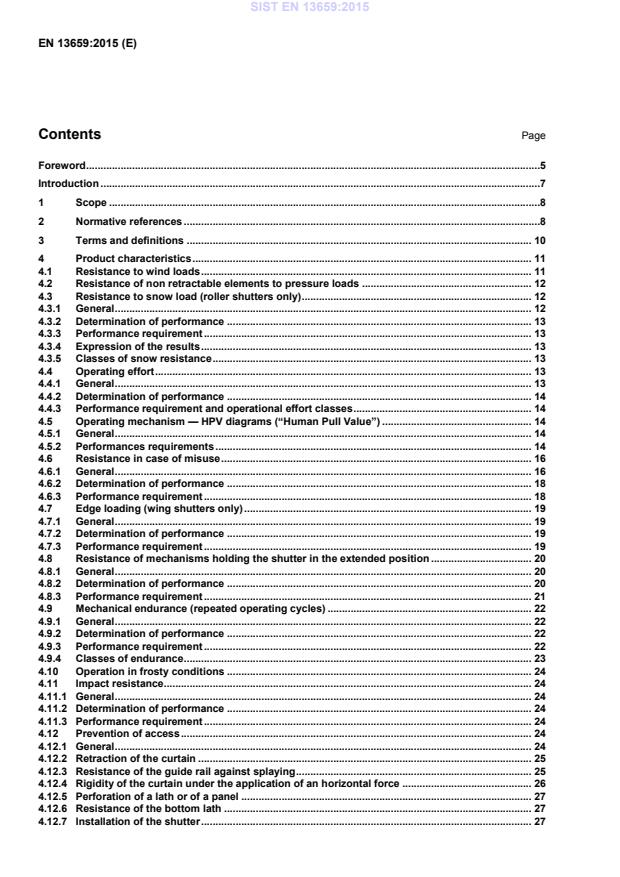
Temperature effects.34 Annex B (informative)
Calculation of wind pressure exerted on a shutter - Allocation of a class of wind resistance.36 Annex C (normative)
List of significant machine hazards.38 Annex ZA (informative)
Clauses of this European Standard addressing the provisions of the EU Construction Products Directive.39 Annex ZB (informative)
!!!!Relationship between this European Standard and the Essential Requirements of EU Directive 98/37/EC"""".43 Annex ZC (informative)
!!!!Relationship between this European Standard and the Essential Requirements of EU Directive 2006/42/EC"""".44 Bibliography.45
EN 12216:2002 and the following apply. 3.1 intrinsic performance overall performances of the shutter regardless of its application as opposed to specific performance 3.2 specific performance performance which may be additional and complementary to the intrinsic performances and refers to a specific product (for example, acoustic, thermic, burglary resistance, etc.) 3.3 curtain that part of the product which is set in motion by the operating mechanism, and ensures its function 3.4 extension/retraction movement of the curtain resulting in an increase/decrease the surface area covered 3.5 opening/closing terms used to describe the increase in light (opening) or reduction of light (closing) in an extended position for products with slats or slats which can be tilted or adjusted NOTE The common parlance uses "open" for retraction and "closed" for extension. 3.6 rough operation sharp action on the operating mechanism or directly on the curtain, resulting in excessive speed at the beginning and a sudden stop at the end NOTE Rough operation is only possible if the moving part has significant inertia (mass and speed). SIST EN 13659:2004+A1:2009
3.7 forced operation excessive force exerted on the operating mechanism or directly on the curtain with the aim of causing movement in spite of resistance to the travel of the curtain 3.8 reversed operation extension or retraction of the curtain occurring in the opposite direction to that intended without use of abnormal force 3.9 winch handle operating mechanism consisting of a reel rotated by an operation handle which allows accumulation of a cord, cable, or chain 3.10 gear with crank handle operating mechanism consisting of a gear attached to an axle, a drive shaft, a universal joint, a rotated rod and a crank handle 3.11 one direction movement of the operating mechanism operating mechanism operated by a single cord, belt, etc., extension / retraction being effected by relying on gravity or the potential energy stored up during retraction / extension, respectively 3.12 endless movement of the operating mechanism operating mechanism operated by a loop, movement in one direction extends the curtain (or tilts the laths), and in the reverse retracts the curtain (or tilts the laths) in the opposite direction 3.13 monocommand same mechanism which achieves both opening/closing and extension/retraction 3.14 vertical loading/racking downward force applied to the panel edge of a wing shutter 3.15 determination of performance means of verification of the performance relating to the corresponding requirement 4 Wind resistance 4.1 General The wind resistance of a shutter is assumed by its ability to withstand to specified loads, simulating the action of wind in positive or negative pressure. Wind resistance is specified through classes defined by threshold values of nominal pressure p and safety pressure γγγγ x p with γγγγ = 1,5 SIST EN 13659:2004+A1:2009
a) Nominal wind pressure p Represents the wind pressure applied to the shutter for which the shutter shall not sustain deformation or deterioration which is detrimental to its correct operation. b) Safety wind pressure 1,5 p Represents the wind pressure applied to the shutter for which no deterioration which may be dangerous for the persons shall be observed: breakage, coming out from the fixing or locking devices. Safety wind pressure 1,5 p corresponds to a net pressure (difference of the pressures on each surface taking due account of their signs) calculated according to annex B with a wind velocity having a mean return period of 20 years (annual probability of excess of 0,05). NOTE Nominal wind pressure corresponds approximately to a wind having a mean return period of 3 years. 4.2 Determination The determination shall be in accordance with the test methods specified in EN 1932. 4.3 Performance requirement 4.3.1 General As a function of the type of shutter, the performance criteria specified in Tables 2, 3 and 4 shall be achieved having applied the test loads FN and FS as specified in Table 1. Table 1 — Test loads Non projecting curtain Projecting curtain FN = ββββ x p x L x H
FS = γγγγ x FN , with γγγγ = 1,5 FN = 2ββββ x p x L x H
FS = γγγγ x FN , with γγγγ = 1,5
where: L, H
is the width and height of shutter as specified in EN 1932 p is the threshold value of wind test pressure in N/m2 corresponding to the class of resistance considered (see 4.4) ββββ
is the coefficient of passage of effect of loads distributed to those of the test loads with: ββββ = 1, in the case of roller shutter, wing shutter, venetian shutter, sliding concertina shutter, concertina shutter, sliding panel shutter (see Table 2) ββββ = 0,2, in the case of external venetian blind (see Table 3) γγγγ
is the conversion coefficient between nominal and safety loads, with γγγγ = 1,5. The classification as given in Table 5 is only obtained after the safety level is achieved. SIST EN 13659:2004+A1:2009
LOAD:
FN = ββββ x p x L x H or FN = 2xββββ x p x L x H PERFORMANCE CRITERIA
with ββββ = 1 Appearance Operation Safety
Nominal direct load FN
Applied on the external side of curtain
Inverse nominal load FN
Applied on the internal side of the curtain
no visible deterioration of the curtain, fixing locking device and guiding
manual operating effort maintained within the class
___
Direct and inverse safety loads
FS = 1,5 x FN
and - FS = 1,5 x - FN
Applied on the external side (direct safety load) then on the internal side of the curtain (inverse safety load)
____
____
no breakage
the curtain shall not come out of its fixings or locking device
EXTERNAL VENETIAN BLIND The loading shall be applied on the external venetian blind in the vertical position by using a rigid rail, according to the sequences described in Table 3. SIST EN 13659:2004+A1:2009
LOAD:
FN = ββββ x p x L x H PERFORMANCE CRITERIA
(ββββ = 0,20) Appearance Operation Safety
1 2
Nominal direct and inverse loads FN and -FN Applied on the external side of curtain (nominal direct load) then on the internal side (nominal inverse load)
residual deflection of laths < 5‰ L
-----
Direct and inverse safety loads FS = 1,5 x FN and -FS = 1,5 x -FN Applied on the external side of curtain
(direct safety load) then on the internal side (inverse safety load)
-----
-----
no breakage
no exit from guide rail
NOTE The coefficient ββββ = 0,20 is a global coefficient of adjustment to test results under assigned air speeds. 4.3.3 Performance of the projection mechanism (projecting products) ROLLER SHUTTER, VENETIAN SHUTTER, FLAT-CLOSING CONCERTINA SHUTTER, CONCERTINA SHUTTER The loading FS being applied at mid-height of the curtain, the projection mechanism shall comply with the conditions given in Table 4. SIST EN 13659:2004+A1:2009
LOAD:
FS = 1,5 x FN REQUIREMENT CRITERIA
(FN = 2 ×××× ββββ ×××× p ×××× L ×××× H, ββββ = 1) Appearance Operation Safety
Curtain extended and projected
Direct safety load FS (towards interior)
___
___
the projection system shall
stay locked
no breakage
Curtain extended and projected Inverse safety load - FS (towards exterior)
___
___
the projection system shall
stay locked
no breakage
Curtain extended but not projected Inverse safety load -FS (towards exterior)
___
___
the projection system shall
stay locked
no breakage
4.4 Classes of wind resistance The classes of wind resistance are given by the threshold test pressures specified in Table 5. Table 5 — Classes of wind resistance Classes 0 1 2 3 4 5 6 Nominal test pressure p (N/m²) < 50 50 70 100 170 270 400 Safety test pressure 1,5 p (N/m²) < 75 75 100 150 250 400 600
NOTE Class 0 corresponds to either performance not required or not declared or a product that does not fulfil the requirements of class 1. SIST EN 13659:2004+A1:2009
2) the shutter resists the snow pressure with the mechanical association with the glazing: maximum snow pressure: p expressed in N/m²; form of resistance: shutter in association with a glazing which withstands pressure p and located at the maximum distance d from the shutter; shutters of the same range with width and height greater than those of the product tested can be used where the distance from the glazing is the same. 5.5 Classes of snow resistance No classes are attributed for snow resistance. For each dimension, the manufacturer shall precise the maximum snow pressure the shutter can sustain, by itself or in mechanical association with a closed window. 6 Operating effort 6.1 General Does not apply for power operated products. The effort Fc necessary to set the curtain in motion in retraction / extension and tilting the laths, in addition to the projection of the curtain is a function of the type of operation. 6.2 Determination The determination shall be in accordance with the test methods specified in EN 13527. 6.3 Performance requirement and operational effort classes Operational effort FC shall not exceed the values in Table 6. SIST EN 13659:2004+A1:2009
Class 2
Crank or winch handle
a,c, lever 30 15 Belt, cord or chain a,b,c, 90 50 Rod operation
vertical plane 90 50 or hand
horizontal or sloping plane 50 30 Spring compensated roller shutters can reach 1,5 Fc for locking in the fully extended position. A shutter belongs to class 2 if both the operations of moving the curtain, tilting the laths and projecting the curtain are class 2. Otherwise the shutter is class 1. a Operation mechanism shall also fulfil the requirement in clause 7. b One direction movement or endless movement of the operating mechanism. c Monocommand.
7 Design of the operating mechanism — HPV diagrams ("Human Pull Value") 7.1 General Geometrical characteristics of operating mechanisms taking into account the comfort of the operation. 7.2 Performances requirements Gear operation
Gear with crank or winch handle shall have: a handle R of length less or equal to 0,20 m (R ≤ 0,20 m); a reduction ratio r of the gear less than 1:10 (average or mean reduction ratio when, for the same gear, several reductions exist). NOTE A reduction ratio of 1:10 means it is necessary to make ten turns of the cranks to achieve one rotation of the roller tube or axle. Belt, cord or chain operation Operation mechanisms shall have minimal dimensions as given in the HPV diagrams (see Figures 1 and 2). SIST EN 13659:2004+A1:2009
dHPV (mm) Apparent cord diameter for HPV for n cords with diameter d
d is the diameter of a single cord
Key 1
Acceptable 2
Not acceptable 3
Operating effort Figure 1 — Diagram HPV for cord or chain operation
Key 1
Acceptable 2
Not acceptable 3
Operating effort Figure 2 — Diagram HPV for belt operation 8 Misuse 8.1 Curtain and slats - General 8.1.1 General requirement Under the action of abnormal but foreseeable use (misuse), the shutter shall not become misshapen or damaged to the extent that: a) the damage impairs its correct operation; b) the damage which leads to a deterioration in appearance as defined in Tables 2 and 3. Misuse operations are related to the displacement of the curtain, the tilting of the laths and, for projected products, to the projection of the curtain. 8.1.2 Displacement of the curtain Rough operation Rough operation occurs during extension and retraction. SIST EN 13659:2004+A1:2009
Forced operation Forced operation occurs in the direction of extension and retraction, the curtain being either stopped or blocked in extended or retracted position, or blocked in an intermediate position. Figure 3 illustrates the six possibilities of forced operations.
a)
b)
c) Key 1 Direction of extension 2 Direction of retraction 3 Obstruction a) Curtain fully extended b) Curtain fully retracted c) Curtain in intermediate position, obstructed during extension and/or retraction Figure 3 — Illustration of the six possibilities of forced operation Reversed operation Reversed operations are only applicable to roller shutters or to products using a rolling mechanism for extension or retraction. For these products, operation in situation a1 or b2 illustrated in Figure 3 is a reversed operation when the movement in the opposite direction is possible with an effort less than the limit of the class of operation. If the movement is not possible, it is a forced operation. Reversed operation occurs on extension with the curtain fully extended and on retraction with the curtain fully retracted. 8.1.3 Tilting of laths Rough operation Rough operation is not possible, the conditions defining its occurrence are not likely to occur (no excessive speed, no inertia of laths). Forced operation Forced operation occurs in both closed positions which are the result of tilting laths in both directions from the open position.
Does not exist. 8.1.4 Projection of the curtain Rough operation Rough operation occurs from the fully projected position, after unlocking of projecting arms at which point, the curtain is left free. Forced operation Forced operation occurs at the end of projection, if effort is continued. Reversed operation Not applicable. 8.2 Determination The determination shall be in accordance with the test methods specified in EN 12194. 8.3 Performance requirement On completion of each of the tests, using rough, forced and reversed operations, with the values given in Table 7: The following flaws in appearance shall not be evident: no permanent distortion of the curtain, fixing or locking devices, residual deflection of laths ≤ 5‰ L, where L is the length of the slat, in the case of external venetian blinds; and, for manual operation, the value of the operating effort shall be maintained within the limit of the initial class (see Table 6). Certain products are not designed to withstand obstruction of the curtain in situations defined in a2, b1, c1 and c2 illustrated in Figure 3. They will not be subjected to the corresponding tests if the technical instructions of the manufacturer have a warning for the user of the risk of damage when the curtain is obstructed in these situations. The manufacturer shall ensure his installation instructions emphasise that the operating procedures shall be provided to the end user. For projecting shutters, if the product cannot be extended or retracted when in the projecting position, the manufacturer shall provide a warning. SIST EN 13659:2004+A1:2009
PB = 2 FC not applicable a rough Movement of curtain PF = 180 CF = 60 x R projection of curtain tilting the laths PF = 100 CF = 30 x R forced b c PI ≤ FC CI ≤ FC x R reversed FC = value of operating effort of the class obtained P = exerted misuse force
C = exerted misuse torque B= rough, F = forced, I = reversed R = maximum length of crank handle described in the technical instructions of the manufacturer with R ≤ 0,20m a Operation by gear is never rough. b If the operating mechanism is equipped with system which limits the force or the torque (see clause 12), values of PF and CF are those given by these systems. c For power operated operations, the effort to be applied is the one produced by the motor.
NOTE There are no performance classes. 9 Edge loading 9.1 General Only wing shutters are concerned. Behaviour of the shutter under the action of vertical effort Pel of 500 N, applied to the edge of the leaf. 9.2 Determination The determination shall be in accordance with the test methods specified in EN 12194. 9.3 Performance requirement After unloading, the remaining displacement of the extremity of the leaf shall be less than 5 mm/m of width of leaf. 10 Resistance of locking mechanism 10.1 General When equipped with a specific locking mechanism (as bolt, sash-bolt, self closing device or espagnolette with latch locked with a key) holding the curtain fastened or locked in closed position the shutter in the fully extended position shall not be able to be opened from the exterior by intruders without tools. SIST EN 13659:2004+A1:2009
Performance not achieved Exert 250 N to allow entryof a hand Performance not achieved Performance achievedCurtain with locking mechanism option yes no Locking mechanism dismountable no yesAccessible opening ≤ 0,40 m x 0,40 m
yesno Not concerned Gap ≤ 12 mm
yesno Exert 250 N to allow entryPerformance fulfilled SIST EN 13659:2004+A1:2009
10.3 Performance requirement The shutter in the fully extended position shall not be able to be opened from the exterior by intruders without tools. The shutter shall not allow an intruder to pass through (0,40 m x 0,40 m opening). 11 Mechanical endurance (repeated operating cycles) 11.1 General Ability of the shutter to withstand a number of operating cycles corresponding to a given usage: the curtain: one cycle corresponds to a complete operation of curtain extension and retraction including the rest times; the laths (external venetian blind, roller and wing shutters with tilting laths): one tilt cycle is defined as a complete movement of the pivoting mechanism, moving the laths from one extreme position to the other and then back again. 11.2 Determination The determination shall be in accordance with the test methods specified in EN 14201. 11.3 Performance requirement 11.3.1 General After carrying out the cycles relating to the appropriate class, the following requirements shall be fulfilled. 11.3.2 Manual operation The operating effort value shall be maintained within the limit of the initial class; Wear of the constituent material of the laths of the curtain: the wall of the lath shall not be perforated as a result of abrasion; Operating mechanisms shall not sustain significant damage. 11.3.3 Power operated products * Variation of the speed under load The ratio 100121×ΤΤ−Τ shall be less or equal to 20 %. where: T1
is the time taken for full retraction of the curtain, measured at the beginning of the endurance test, after five cycles of functioning T2
is the time taken for full retraction of the curtain measured at the end of the endurance test SIST EN 13659:2004+A1:2009
Class 1 Class 2 Tubular ± 15° ± 5° Square ±10° ± 3°
* Characteristics of the mechanical brake Stopping the movement of the curtain shall not lead to an angular displacement more than 20°. the displacement of the curtain, after applying an overload of 15 % of the weight of the curtain, shall not exceed 5 mm, the measurement from an intermediate position carried out after 12 h. NOTE A mechanical brake is a brake applied mechanically by stored energy (spring force) until released with an external sustained electric power supply under the control of the operator or automatically. * Grease and oil traces There shall be no visible traces of grease or oil. * Wear of the constituent material of the laths of the curtain:
The wall of the lath shall not be perforated as a result of abrasion. 11.4 Classes of endurance Table 9 gives the endurance cycles corresponding to the three endurance classes specified. Table 9 — Classes of endurance Number of cycles Class 1 Class 2 Class 3 Extension/retraction 3 000 7 000 10 000 Tilting 6 000 14 000 20 000
NOTE Class 2 can correspond to 10 years with 2 cycles per day. 12
Operation in frosty conditions The technical instructions of the manufacturer shall state whether or not the product can be operated in frosty conditions (in case of formation of ice) and if not, the product shall have a warning: "The operation in frosty conditions may damage the shutter". SIST EN 13659:2004+A1:2009
13.1 General Behaviour of the shutter under the action of hard body impact. 13.2 Determination The determination shall be in accordance with the test methods specified in EN 13330. 13.3 Performance requirement Under the action of the hard body D 0,5, steel ball of 0,5 kg and a drop Z of 0,45 m, the shutter shall not sustain deteriorations: which are detrimental to its correct operation; for manual operation the operating effort shall be maintained within the limit of the initial class; which lead to unacceptable appearance defects (local indentations and cracks); the average diameter of indents shall not be greater than 20 mm. 14 Safety in use 14.1 General The significant machine hazards dealt with are listed in annex C. 14.2 Protection against potentially harmful components 14.2.1 General Contact between the user and the product and its parts shall not cause injury. 14.2.2 Determination The requirements in 14.2.3 shall be fulfilled. 14.2.3 Safety requirement Components likely to come into contact with passers-by and users, shall not present any sharp or projecting edges, likely to cause injury. Sharp and projecting edges of any moving parts of the shutter structure likely to be located at a height lower than 2,50 m above floor or any permanent access level, shall be rounded with a minimum radius of 0,5 mm. 14.3 Power operated shutters – Injurious contact in operation 14.3.1 General Crushing hazards shall be eliminated or reduced. SIST EN 13659:2004+A1:2009
Figure 4 — Gap between the panels at the end of extension b) Shutters with accumulating or retractable laths conform to the accumulation condition as defined in EN 12045 and the average speed of extension of curtain in the last 0,40 m shall be less than 0,2 m/s. c) The shutter has a hold-to-run control and the switch is incorporated in the product or installed in such a way that it allows the control in the direct view of the movement of the curtain. In that last case, it shall be mentioned in the installation instructions. d) The crushing area is found at a distance Z more or equal to 2,50 m from the floor or from any other permanent access level. e) The shutter is equipped with a safety device which: either prevents contact in the crushing area (guards) or limits the transmitted force (static operation force) to a value lower than 150 N and allows removal of the obstacle either by reversing the movement of the curtain or by stopping it. With the last solution, it shall be possible to lift up the curtain with a force less than 25 N. In the case of roller shutter fitted to a roof window, the drive shall stop the movement of the curtain, and within 5 s, start to reverse automatically. During this period, the maximum operating force shall not exceed 250 N for more than 2 s, and the average force calculated over the period of 5 s, shall not exceed 150 N. Guards designed to protect from the mobile elements of transmission shall be fixed in such a way that they can only be dismounted with the use of a tool. Roller shutters with venting position shall not allow the introduction of a finger between slats. This condition is satisfied if a 5 mm diameter rod cannot be introduced. 14.4 Electric hazards The electric drives shall conform to EN 60335-1 and EN 60335-2-97. SIST EN 13659:2004+A1:2009
Requirements material colour aspect resistance corrosion dimensional stability Rigid plastic „ „ „
„ Metal … …
„
Wood … „
„
Only the requirements described by a „ are covered by this standard.
The requirements with a
will be the subject of further developments. Selected criteria are linked to the test methods described in 17.2, 17.3 and 17.4. They specify the minimum quality of characteristics to be fulfilled by the materials. 17.2
...
Die Norm EN 13659:2004+A1:2008 bietet einen umfassenden Rahmen für die Leistungsvoraussetzungen von Rollläden und ähnlichen Produkten, die an Gebäuden angebracht werden. Ihr Anwendungsbereich erstreckt sich auf eine Vielzahl von Produkten, einschließlich externer Jalousien, Rollläden, Flügel- und Scherenschränke sowie Schiebetüren, unabhängig von den verwendeten Materialien. Dies macht die Norm äußerst relevant für Hersteller und Anwender im Bereich der Bauindustrie. Ein herausragendes Merkmal der EN 13659 ist ihre Berücksichtigung wesentlicher Gefahren, die mit der Konstruktion, dem Transport, der Installation, dem Betrieb und der Wartung dieser Produkte verbunden sind. Die eindeutige Auflistung signifikanter Maschinengefahren in Anhang C ist ein wertvolles Werkzeug, um die Sicherheit und Leistungsfähigkeit der Rollläden zu gewährleisten. Zusätzlich legt die Norm Anforderungen fest, die sich auf manuell bedienbare oder elektrisch betriebene Produkte beziehen, was ihre Flexibilität und Anwendbarkeit in verschiedenen Szenarien verstärkt. Dies ermöglicht es, sowohl herkömmliche als auch moderne motorisierte Lösungen zu integrieren, wodurch sie für diverse Benutzergruppen attraktiv ist. Es ist ebenfalls zu beachten, dass diese Norm nicht für Rollläden gilt, die vor dem Inkrafttreten dieser Dokumentation hergestellt wurden, was die Relevanz und Aktualität der Anforderungen sichert und so den aktuellen Sicherheitsstandards in der Branche entspricht. Ein Schwachpunkt, der in der Norm nicht behandelt wird, sind die Lärmaspekte, da diese nicht als Sicherheitsproblem betrachtet werden. Dennoch bleibt die EN 13659 eine grundlegend wichtige Norm, die sicherstellt, dass Rollläden in Übereinstimmung mit modernen Leistungsanforderungen entworfen und gebaut werden. Ihre umfassenden Vorgaben fördern die Sicherheit und Effizienz in der Nutzung von Rollläden und tragen zur Standardisierung in der Bauindustrie bei.
SIST EN 13659:2004+A1:2009 표준은 건물에 설치된 셔터의 성능 요구사항을 명확히 규정하고 있습니다. 이 표준은 외부 베네치안 블라인드, 롤러 셔터, 날개 셔터, 베네치안 셔터, 평면 클로징 콘서티나 셔터 등 다양한 유형의 셔터 및 유사 제품에 적용됩니다. 모든 셔터는 수동으로 조작되거나 전기 모터를 통해 작동될 수 있으며, 이는 사용자의 다양한 요구를 충족할 수 있는 장점을 제공합니다. 이 표준의 주요 강점은 건설, 운송, 설치, 운영 및 유지 관리와 관련된 중요한 위험 요소를 다룬다는 점입니다. 부록 C에서 제시된 기계적 위험 목록은 사용자가 셔터를 안전하게 설치하고 운영할 수 있도록 필수적인 정보를 제공합니다. 이는 셔터 사용 시의 안전성을 극대화하려는 노력의 일환으로, 소비자와 설치업체 모두에게 높은 신뢰성을 보장합니다. 또한, 이 표준은 소음 측면은 다루지 않지만, 이는 안전 문제로 간주되지 않기 때문에 성능 요구사항에 집중하고 있습니다. 이로 인해 성능 기준의 명확한 설정이 가능하며, 셔터의 기본 기능 및 안전성을 보장하는 데 중점을 두고 있습니다. 결국, SIST EN 13659:2004+A1:2009 표준은 다양한 셔터 제품의 안전성과 성능을 확보하고, 산업 전반에 걸쳐 신뢰할 수 있는 기준을 제공하는 데 큰 역할을 합니다. 이 표준의 적용은 셔터 제조업체 및 사용자 모두에게 필수적이며, 안전하고 효율적인 사용을 보장하는 데 기여하고 있습니다.
The EN 13659:2004+A1:2008 standard provides comprehensive performance requirements for shutters, ensuring safety and reliability when integrated into buildings. Its scope is broad, encompassing various types of shutters, including external Venetian blinds, roller shutters, and sliding panel shutters, regardless of the materials used. The document is essential for manufacturers, installers, and operators, as it addresses significant hazards associated with construction, transport, installation, operation, and maintenance of the shutters. One of the strengths of this standard is its inclusive nature, which covers both manual and power-operated products, thereby catering to a wide range of user needs and preferences. This feature enhances the relevance of the standard in the industry, as it promotes safety standards across different operational contexts, ensuring that all types of shutters meet the necessary performance benchmarks. Moreover, the standard emphasizes safety by outlining significant machine hazards, which are crucial for preventing accidents and ensuring user confidence. It serves as a guideline for ensuring that shutters provide reliable protection and functionality, facilitating compliance with relevant safety regulations. It is noteworthy that the standard does not address noise aspects, reinforcing its focused approach on safety rather than acoustic performance. This focus allows stakeholders to prioritize safety in their design and operational practices without being distracted by non-critical factors. Overall, EN 13659:2004+A1:2008 stands out as a pivotal standard in the field of shutter performance requirements, establishing a solid framework for ensuring safety and effectiveness in various applications.
EN 13659:2004+A1:2008規格は、建物に取り付けられるシャッターの性能要件を明確に定義しており、非常に重要な標準です。この規格の範囲は広く、外部のベネチアンブラインド、ロールシャッター、ウイングシャッター、平型コンサーティナシャッター、コンサーティナシャッター、スライディングパネルシャッターなど、様々なタイプのシャッターや類似製品に適用されます。これらは、手動または電動(電動製品)で操作が可能であり、材料の使用や性質に関係なく適用されます。 この標準は、シャッターの施工、輸送、設置、運用、およびメンテナンスにおいて考慮すべき重要な危険要因についても言及しており、特に設置時の安全性を確保するために必要な要件が詳細に記されています。附属書Cには、特に考慮すべき機械的危険のリストが含まれており、これによりシャッターの管理者や設置者は、リスクを軽減し、安全な操作を実現するための基礎を得ることができます。 さらに、規格はノイズに関する側面を扱っていませんが、これは安全上の問題とは見なされていないため、焦点を明確に保っています。これによって、この文書は、安全性に関して具体的で実践的なガイドラインを提供し、ユーザーが安心して製品を使用できる環境を整えています。 EN 13659:2004+A1:2008は、シャッターの性能基準を設定することで製品の安全性と信頼性を高め、市場での競争力を向上させるための重要なリソースです。また、この標準は、最新の技術と市場のニーズに対応するために、定期的に改訂されている点も評価されるべきです。このように、シャッターに関わるすべてのステークホルダーにとって、非常に関連性が高く、有用な指針となっていることは間違いありません。
La norme SIST EN 13659:2004+A1:2009 établit des exigences de performance claires et précises pour les volets installés dans les bâtiments, englobant une large gamme de produits, tels que les stores vénitiens externes, volets roulants, volets à battants et volets concertina. En précisant les exigences de performance, cette norme vise à garantir la sécurité et la fonctionnalité des volets tout au long de leur cycle de vie, incluant la construction, le transport, l'installation, l'opération et la maintenance. Parmi les forces notables de cette norme, on trouve son approche globale qui aborde tous les types de volets, quelle que soit leur utilisation ou le matériau utilisé. Cette inclusivité en fait une référence précieuse pour les fabricants, installateurs et utilisateurs finaux, qui peuvent s'assurer que leurs produits respectent des critères de sécurité et de performance harmonisés au niveau européen. La norme aborde également les dangers significatifs liés à différents aspects de l'utilisation des volets. En fournissant une liste de ces dangers dans l'annexe C, elle permet aux professionnels du secteur de mieux comprendre les risques associés et ainsi de prendre des mesures préventives adaptées. Ce niveau de détail est essentiel pour assurer un environnement de travail et de vie sécurisé. Un autre aspect de la norme est l’indication qu'elle s'applique aux systèmes d'entraînement manuels et électriques, ce qui reflète la diversité des technologies disponibles sur le marché. Cela permet à tous les fabricants de répondre aux exigences sans exclure les solutions innovantes basées sur l'automatisation, augmentant ainsi la pertinence de la norme dans un contexte de modernisation des infrastructures. Il est important de noter que la norme ne traite pas des aspects sonores, car ceux-ci ne sont pas considérés comme une question de sécurité. Cette focalisation sur la sécurité et la performance, tout en excluant les préoccupations sonores, peut être perçue à la fois comme une force-en garantissant une attention ciblée sur les risques critiques-et comme une limitation pour les utilisateurs soucieux du confort acoustique. En résumé, la SIST EN 13659:2004+A1:2009 se positionne comme un standard essentielle dans le domaine des volets, tant pour les professionnels que pour les utilisateurs. Sa portée, ses exigences claires et sa pertinence dans le secteur en font une référence incontournable pour quiconque travaillant avec des volets dans un contexte de construction ou de rénovation.


Questions, Comments and Discussion
Ask us and Technical Secretary will try to provide an answer. You can facilitate discussion about the standard in here.
Loading comments...