


EN ISO 4947:2020
(Main)Steel and cast iron - Determination of vanadium content - Potentiometric titration method (ISO 4947:2020)
Steel and cast iron - Determination of vanadium content - Potentiometric titration method (ISO 4947:2020)
This document specifies a potentiometric titration method for the determination of vanadium in steel and cast iron.
The method is applicable to vanadium contents between 0,04 % (mass fraction) and 2 % (mass fraction).
Stahl und Gusseisen - Bestimmung des Vanadium-Gehaltes - Potentiometrisches Titrierverfahren (ISO 4947:2020)
Dieses Dokument legt ein Verfahren zur Bestimmung des Vanadiumgehalts in Stahl und Gusseisen mittels potentiometrischer Titration fest.
Das Verfahren ist anwendbar für die Bestimmung von Massenanteilen von Vanadium zwischen 0,04 % (Masseanteil) und 2 % (Masseanteil).
Acier et fonte - Détermination des teneurs en vanadium - Méthode par titrage potentiométrique (ISO 4947:2020)
Le présent document spécifie une méthode de détermination du vanadium par titrage potentiométrique dans l'acier et la fonte.
La méthode est applicable aux teneurs en vanadium comprises entre 0,04 % (en masse) et 2 % (en masse).
Jeklo in lito železo - Določevanje vanadija - Potenciometrijska metoda titracije (ISO 4947:2020)
General Information
Relations
Overview
EN ISO 4947:2020 - "Steel and cast iron - Determination of vanadium content - Potentiometric titration method" - is the CEN-adopted version of ISO 4947:2020. This standard specifies a potentiometric titration method for measuring vanadium in steel and cast iron and is applicable to vanadium mass fractions from 0.04% to 2%. It replaces EN 24947:1991 and is intended for laboratory chemical analysis and quality control in ferrous‑metal production and testing.
Key topics and technical requirements
- Scope and applicability: Analytical method for vanadium in steel and cast iron, usable for 0.04–2.0 % V.
- Analytical principle: Dissolution of a test portion in acids (HCl, HNO3, HF as required to keep tungsten in solution), oxidation with potassium peroxydisulfate, controlled redox manipulations (partial oxidation of chromium, reduction/oxidation steps for vanadium) and potentiometric titration of vanadium with an ammonium iron(II) sulfate standard solution while monitoring potential.
- Reagents: Includes potassium peroxydisulfate, hydrochloric/nitric/hydrofluoric acids, sulfuric and orthophosphoric acids, potassium permanganate, sodium nitrite, sulfamic acid, and potassium dichromate for standardization.
- Apparatus: Ordinary laboratory glassware (class A) and a potentiometric titration device capable of measuring potential differences using platinum‑saturated calomel or platinum Ag/AgCl electrodes (optional electrode introduced in the 2020 edition).
- Sampling and test portions: Follow ISO 14284 for sampling. Recommended test portion masses vary by expected vanadium content:
- ~5 g for 0.04–0.25 % V
- ~2 g for 0.25–1.0 % V
- ~1 g for 1.0–2.0 % V
The vanadium mass in the test portion should be about 2–20 mg.
- Standardization and calculation: Requires potentiometric standardization of the ammonium iron(II) sulfate solution against potassium dichromate; formulae for concentration and result calculation are provided.
- Quality and precision: The 2020 revision re-assessed precision data and clarifies procedural options.
Applications and users
- Quality control and chemical analysis laboratories in steelworks, foundries and independent materials testing labs.
- Metallurgists and process engineers monitoring alloy composition, especially for vanadium-bearing steels (tool steels, high‑strength alloys).
- Compliance testing for procurement, certification, and regulatory purposes where accurate vanadium content measurement is required.
Related standards and references
- Normative references used: ISO 385, ISO 648, ISO 1042 (glassware), ISO 3696 (water), ISO 14284 (sampling/preparation).
- CEN/ISO adoption: EN ISO 4947:2020 is identical to ISO 4947:2020.
Keywords: EN ISO 4947:2020, ISO 4947, vanadium determination, potentiometric titration, steel and cast iron analysis, ammonium iron(II) sulfate titration.
Standards Content (Sample)
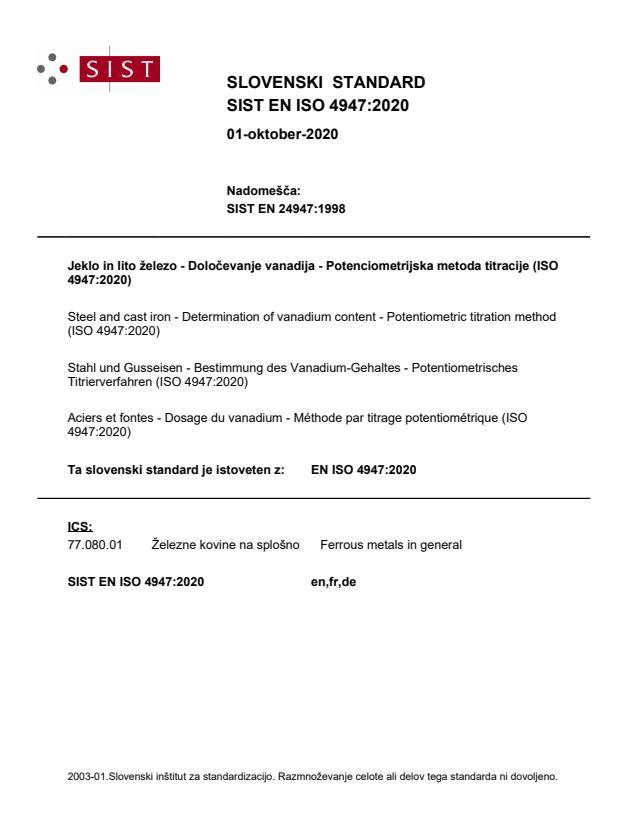
SLOVENSKI STANDARD
01-oktober-2020
Nadomešča:
SIST EN 24947:1998
Jeklo in lito železo - Določevanje vanadija - Potenciometrijska metoda titracije (ISO
4947:2020)
Steel and cast iron - Determination of vanadium content - Potentiometric titration method
(ISO 4947:2020)
Stahl und Gusseisen - Bestimmung des Vanadium-Gehaltes - Potentiometrisches
Titrierverfahren (ISO 4947:2020)
Aciers et fontes - Dosage du vanadium - Méthode par titrage potentiométrique (ISO
4947:2020)
Ta slovenski standard je istoveten z: EN ISO 4947:2020
ICS:
77.080.01 Železne kovine na splošno Ferrous metals in general
2003-01.Slovenski inštitut za standardizacijo. Razmnoževanje celote ali delov tega standarda ni dovoljeno.
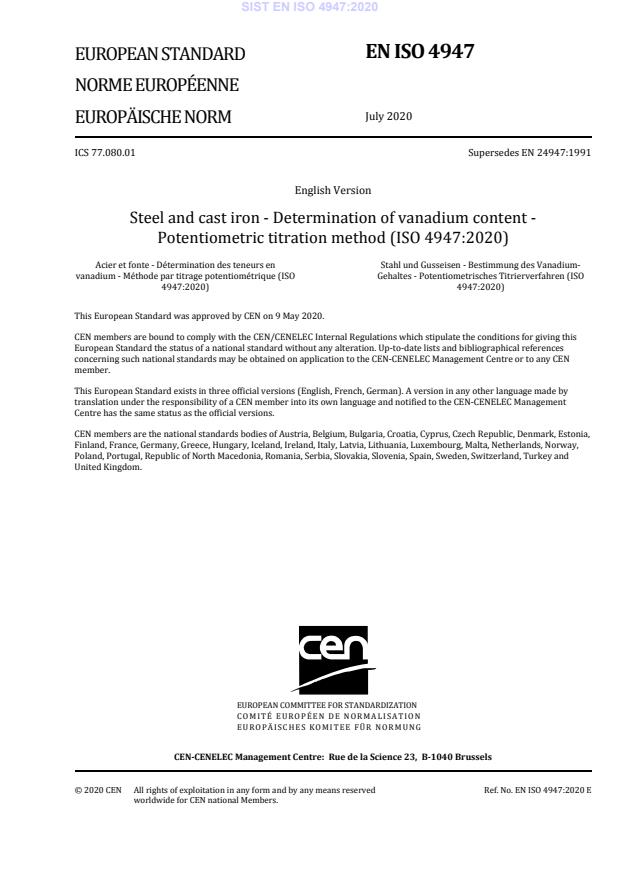
EN ISO 4947
EUROPEAN STANDARD
NORME EUROPÉENNE
July 2020
EUROPÄISCHE NORM
ICS 77.080.01 Supersedes EN 24947:1991
English Version
Steel and cast iron - Determination of vanadium content -
Potentiometric titration method (ISO 4947:2020)
Acier et fonte - Détermination des teneurs en Stahl und Gusseisen - Bestimmung des Vanadium-
vanadium - Méthode par titrage potentiométrique (ISO Gehaltes - Potentiometrisches Titrierverfahren (ISO
4947:2020) 4947:2020)
This European Standard was approved by CEN on 9 May 2020.
CEN members are bound to comply with the CEN/CENELEC Internal Regulations which stipulate the conditions for giving this
European Standard the status of a national standard without any alteration. Up-to-date lists and bibliographical references
concerning such national standards may be obtained on application to the CEN-CENELEC Management Centre or to any CEN
member.
This European Standard exists in three official versions (English, French, German). A version in any other language made by
translation under the responsibility of a CEN member into its own language and notified to the CEN-CENELEC Management
Centre has the same status as the official versions.
CEN members are the national standards bodies of Austria, Belgium, Bulgaria, Croatia, Cyprus, Czech Republic, Denmark, Estonia,
Finland, France, Germany, Greece, Hungary, Iceland, Ireland, Italy, Latvia, Lithuania, Luxembourg, Malta, Netherlands, Norway,
Poland, Portugal, Republic of North Macedonia, Romania, Serbia, Slovakia, Slovenia, Spain, Sweden, Switzerland, Turkey and
United Kingdom.
EUROPEAN COMMITTEE FOR STANDARDIZATION
COMITÉ EUROPÉEN DE NORMALISATION
EUROPÄISCHES KOMITEE FÜR NORMUNG
CEN-CENELEC Management Centre: Rue de la Science 23, B-1040 Brussels
© 2020 CEN All rights of exploitation in any form and by any means reserved Ref. No. EN ISO 4947:2020 E
worldwide for CEN national Members.
Contents Page
European foreword . 3
European foreword
This document (EN ISO 4947:2020) has been prepared by Technical Committee ISO/TC 17 "Steel" in
collaboration with Technical Committee CEN/TC 459/SC 2 “Methods of chemical analysis for iron and
steel ” the secretariat of which is held by SIS.
This European Standard shall be given the status of a national standard, either by publication of an
identical text or by endorsement, at the latest by January 2021, and conflicting national standards shall
be withdrawn at the latest by January 2021.
Attention is drawn to the possibility that some of the elements of this document may be the subject of
patent rights. CEN shall not be held responsible for identifying any or all such patent rights.
This document supersedes EN 24947:1991.
According to the CEN-CENELEC Internal Regulations, the national standards organizations of the
following countries are bound to implement this European Standard: Austria, Belgium, Bulgaria,
Croatia, Cyprus, Czech Republic, Denmark, Estonia, Finland, France, Germany, Greece, Hungary, Iceland,
Ireland, Italy, Latvia, Lithuania, Luxembourg, Malta, Netherlands, Norway, Poland, Portugal, Republic of
North Macedonia, Romania, Serbia, Slovakia, Slovenia, Spain, Sweden, Switzerland, Turkey and the
United Kingdom.
Endorsement notice
The text of ISO 4947:2020 has been approved by CEN as EN ISO 4947:2020 without any modification.
INTERNATIONAL ISO
STANDARD 4947
Second edition
2020-06
Steel and cast iron — Determination of
vanadium content — Potentiometric
titration method
Acier et fonte — Détermination des teneurs en vanadium — Méthode
par titrage potentiométrique
Reference number
ISO 4947:2020(E)
©
ISO 2020
ISO 4947:2020(E)
© ISO 2020
All rights reserved. Unless otherwise specified, or required in the context of its implementation, no part of this publication may
be reproduced or utilized otherwise in any form or by any means, electronic or mechanical, including photocopying, or posting
on the internet or an intranet, without prior written permission. Permission can be requested from either ISO at the address
below or ISO’s member body in the country of the requester.
ISO copyright office
CP 401 • Ch. de Blandonnet 8
CH-1214 Vernier, Geneva
Phone: +41 22 749 01 11
Email: copyright@iso.org
Website: www.iso.org
Published in Switzerland
ii © ISO 2020 – All rights reserved
ISO 4947:2020(E)
Contents Page
Foreword .iv
1 Scope . 1
2 Normative references . 1
3 Terms and definitions . 1
4 Principle . 1
5 Reagents . 2
6 Apparatus . 3
7 Sampling . 3
8 Procedure. 3
8.1 Test portion . 3
8.2 Blank test . 4
8.3 Determination . 4
8.3.1 Preparation of the test solution . 4
8.3.2 Oxidation of chromium and vanadium . 4
8.3.3 Preparation of the solution for titration . 4
8.3.4 Oxidation of vanadium . . . 5
8.4 Titration . 5
9 Expression of results . 6
9.1 Method of calculation . 6
9.2 Precision . 6
10 Test report . 6
Annex A (informative) Additional information on the international interlaboratory test.8
Annex B (informative) Graphical representation of precision data . 9
Bibliography .10
ISO 4947:2020(E)
Foreword
ISO (the International Organization for Standardization) is a worldwide federation of national standards
bodies (ISO member bodies). The work of preparing International Standards is normally carried out
through ISO technical committees. Each member body interested in a subject for which a technical
committee has been established has the right to be represented on that committee. International
organizations, governmental and non-governmental, in liaison with ISO, also take part in the work.
ISO collaborates closely with the International Electrotechnical Commission (IEC) on all matters of
electrotechnical standardization.
The procedures used to develop this document and those intended for its further maintenance are
described in the ISO/IEC Directives, Part 1. In particular, the different approval criteria needed for the
different types of ISO documents should be noted. This document was drafted in accordance with the
editorial rules of the ISO/IEC Directives, Part 2 (see www .iso .org/ directives).
Attention is drawn to the possibility that some of the elements of this document may be the subject of
patent rights. ISO shall not be held responsible for identifying any or all such patent rights. Details of
any patent rights identified during the development of the document will be in the Introduction and/or
on the ISO list of patent declarations received (see www .iso .org/ patents).
Any trade name used in this document is information given for the convenience of users and does not
constitute an endorsement.
For an explanation of the voluntary nature of standards, the meaning of ISO specific terms and
expressions related to conformity assessment, as well as information about ISO's adherence to the
World Trade Organization (WTO) principles in the Technical Barriers to Trade (TBT), see www .iso .org/
iso/ foreword .html.
This document was prepared by Technical Committee ISO/TC 17, Steel, Subcommittee SC 1, Methods of
determination of chemical composition.
This second edition cancels and replaces the first edition (ISO 4947:1986), which has been technically
revised. The main changes compared to the previous edition are as follows:
— introduction of an optional electrode;
— re-assessment of precision data.
Any feedback or questions on this document should be directed to the user’s national standards body. A
complete listing of these bodies can be found at www .iso .org/ members .html.
iv © ISO 2020 – All rights reserved
INTERNATIONAL STANDARD ISO 4947:2020(E)
Steel and cast iron — Determination of vanadium content
— Potentiometric titration method
1 Scope
This document specifies a potentiometric titration method for the determination of vanadium in steel
and cast iron.
The method is applicable to vanadium contents between 0,04 % (mass fraction) and 2 % (mass fraction).
2 Normative references
The following documents are referred to in the text in such a way that some or all of their content
constitutes requirements of this document. For dated references, only the edition cited applies. For
undated references, the latest edition of the referenced document (including any amendments) applies.
ISO 385, Laboratory glassware — Burettes
ISO 648, Laboratory glassware — Single-volume pipettes
ISO 1042, Laboratory glassware — One-mark volumetric flasks
ISO 3696, Water for analytical laboratory use — Specification and test methods
ISO 14284, Steel and iron — Sampling and preparation of samples for the determination of chemical
composition
3 Terms and definitions
No terms and definitions are listed in this document.
ISO and IEC maintain terminological databases for use in standardization at the following addresses:
— ISO Online browsing platform: available at http:// www .iso .org/ obp
— IEC Electropedia: available at http:// www .electropedia .org/
4 Principle
Dissolution of a test portion with appropriate acids. Addition of hydrofluoric acid to keep tungsten in
solution.
Oxidation of chromium and vanadium by potassium peroxydisulfate. Partial oxida
...
Frequently Asked Questions
EN ISO 4947:2020 is a standard published by the European Committee for Standardization (CEN). Its full title is "Steel and cast iron - Determination of vanadium content - Potentiometric titration method (ISO 4947:2020)". This standard covers: This document specifies a potentiometric titration method for the determination of vanadium in steel and cast iron. The method is applicable to vanadium contents between 0,04 % (mass fraction) and 2 % (mass fraction).
This document specifies a potentiometric titration method for the determination of vanadium in steel and cast iron. The method is applicable to vanadium contents between 0,04 % (mass fraction) and 2 % (mass fraction).
EN ISO 4947:2020 is classified under the following ICS (International Classification for Standards) categories: 77.080.01 - Ferrous metals in general. The ICS classification helps identify the subject area and facilitates finding related standards.
EN ISO 4947:2020 has the following relationships with other standards: It is inter standard links to EN 24947:1991. Understanding these relationships helps ensure you are using the most current and applicable version of the standard.
EN ISO 4947:2020 is associated with the following European legislation: Standardization Mandates: M/BC/CEN/89/10. When a standard is cited in the Official Journal of the European Union, products manufactured in conformity with it benefit from a presumption of conformity with the essential requirements of the corresponding EU directive or regulation.
You can purchase EN ISO 4947:2020 directly from iTeh Standards. The document is available in PDF format and is delivered instantly after payment. Add the standard to your cart and complete the secure checkout process. iTeh Standards is an authorized distributor of CEN standards.
記事のタイトル: EN ISO 4947:2020 - 鉄鋼および鋳鉄 - バナジウム含有量の測定 - 電位測定法 (ISO 4947:2020) 記事の内容: この文書では、鉄鋼および鋳鉄中のバナジウムの含有量を測定するための電位測定法が指定されています。 この方法は、0.04%(質量割合)から2%(質量割合)までのバナジウム含有量に適用できます。
기사 제목: EN ISO 4947:2020 - 강철 및 주철 - 바나듐 함량 측정 - 전위 측정 방법 (ISO 4947:2020) 기사 내용: 이 문서는 강철 및 주철에서 바나듐 함량을 측정하기 위한 전위 측정 방법을 명시합니다. 이 방법은 질량 분율로 0.04%에서 2% 사이의 바나듐 함량에 적용됩니다.
The article describes a potentiometric titration method that can be used to determine the amount of vanadium in steel and cast iron. This method is suitable for vanadium contents ranging from 0.04% to 2% mass fraction.
Questions, Comments and Discussion
Ask us and Technical Secretary will try to provide an answer. You can facilitate discussion about the standard in here.
Loading comments...