


EN 196-1:2016
(Main)Methods of testing cement - Part 1: Determination of strength
Methods of testing cement - Part 1: Determination of strength
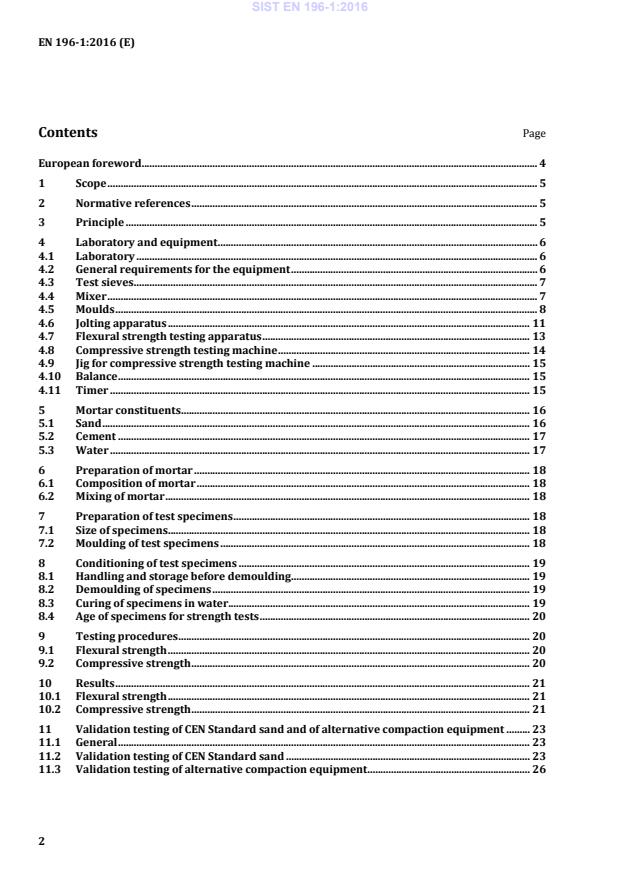
This part of EN 196 describes the method for the determination of the compressive and, optionally, the flexural strength of cement mortar. The method applies to common cements and to other cements and materials, the standards for which call up this method. It may not apply to other cement types that have, for example, a very short initial setting time.
The method is used for assessing whether the compressive strength of cement is in conformity with its specification and for validation testing of a CEN Standard sand, EN 196 1, or alternative compaction equipment.
This part of EN 196 describes the reference equipment and procedure and allows alternative compaction equipment and procedures to be used provided that they have been validated in accordance with the appropriate provisions in this document. In the event of a dispute, only the reference equipment and procedure are used.
Prüfverfahren für Zement - Teil 1: Bestimmung der Festigkeit
Dieser Teil von EN 196 beschreibt das Verfahren zur Bestimmung der Druckfestigkeit und, optional, der Biegezugfestigkeit von Zementmörtel. Das Verfahren gilt für Normalzemente sowie für andere Zemente und Materialien, wenn die für sie geltenden Normen auf dieses Verfahren verweisen. Es ist möglicherweise für andere Zementarten, die z. B. eine sehr kurze Erstarrungszeit haben, nicht anwendbar.
Dieses Verfahren wird angewandt, um zu beurteilen, ob die Druckfestigkeit eines Zements den Anforderungen entspricht, und für Validierungsprüfungen für CEN-Normsand nach EN 196-1 oder für alternative Verdichtungsgeräte.
Dieser Teil von EN 196 beschreibt Referenzgeräte und -verfahren und lässt andere Verdichtungsgeräte und
-verfahren unter der Voraussetzung zu, dass sie nach den entsprechenden Vorgaben dieses Dokuments validiert worden sind. Im Streitfall werden nur Referenzgeräte und -verfahren verwendet.
Méthodes d'essais des ciments - Partie 1: Détermination des résistances
Metode preskušanja cementa - 1. del: Določanje trdnosti
Ta del standarda EN 196 opisuje metodo za določanje tlačne in (izbirno) upogibne trdnosti cementne malte. Metoda se uporablja za običajne vrste cementa in druge vrste cementa in materialov, katerih standardi zahtevajo njeno uporabo. Morda se ne uporablja za druge vrste cementa, ki na primer vključujejo zelo kratek začetni čas vezanja.
Metoda se uporablja za ocenjevanje, ali je tlačna trdnost cementa skladna s svojo specifikacijo, in preskušanje standardnega peska CEN v skladu s standardom FprEN 196-1 ali druge opreme za utrjevanje.
Ta del standarda EN 196 opisuje referenčno opremo in postopek ter dovoljuje uporabo druge opreme za utrjevanje in postopkov pod pogojem, da so preverjeni v skladu z ustreznimi določbami v tem dokumentu. V primeru spora se uporabljajo le referenčna oprema in postopek.
General Information
- Status
- Published
- Publication Date
- 26-Apr-2016
- Withdrawal Date
- 30-Oct-2016
- Technical Committee
- CEN/TC 51 - Cement and building limes
- Drafting Committee
- CEN/TC 51/WG 15 - Revision of methods of testing cement
- Current Stage
- 9092 - Decision on results of review/2YR ENQ - revise - Review Enquiry
- Start Date
- 27-Jun-2022
- Completion Date
- 11-Feb-2026
Relations
- Effective Date
- 02-Oct-2013
- Effective Date
- 28-Jan-2026
- Effective Date
- 28-Jan-2026
- Effective Date
- 28-Jan-2026
- Effective Date
- 28-Jan-2026
- Effective Date
- 28-Jan-2026
- Effective Date
- 28-Jan-2026
- Effective Date
- 28-Jan-2026
- Effective Date
- 28-Jan-2026
- Effective Date
- 28-Jan-2026
- Effective Date
- 28-Jan-2026
- Effective Date
- 28-Jan-2026
- Effective Date
- 28-Jan-2026
- Effective Date
- 28-Jan-2026
- Effective Date
- 28-Jan-2026
Overview - EN 196-1:2016 (Methods of testing cement - Determination of strength)
EN 196-1:2016 is the CEN standard that defines the reference method for determining the compressive and (optionally) flexural strength of cement mortar. It specifies the mortar composition, specimen geometry, laboratory conditions, reference equipment and procedures used to assess whether cement strength conforms to its specification. The method is applicable to common cements and other cements or materials when their product standards call up EN 196-1. It is not suitable for some special cements (for example, those with very short initial setting times).
Key topics and technical requirements
- Specimen geometry and mix: Prismatic specimens 40 × 40 × 160 mm cast from mortar with a binder : sand : water mass ratio of 1 : 3 : 0.5 (water/cement = 0.50) using CEN Standard sand or validated equivalent.
- Reference equipment:
- Mechanical mixer (stainless steel bowl ≈ 5 L, planetary blade; specified gap 3 ± 1 mm; defined low/high speeds).
- Steel moulds with three compartments for 160 mm prisms, hardened internal faces.
- Jolting compaction apparatus (reference method) - alternative compaction and vibration tables permitted only after validation.
- Flexural and compressive strength testing machines calibrated per ISO/EN requirements.
- Test sieves to ISO 3310-1 / ISO 565 series.
- Laboratory conditions and curing:
- Preparation room: (20 ± 2) °C, relative humidity ≥ 50%.
- Moist air storage and water curing: (20.0 ± 1.0) °C, moist room RH ≥ 90%, water storage at (20.0 ± 1.0) °C.
- Specimens stored 24 h in mould, demoulded, then cured under water to test age (typical ages include 2 d and 7 d for precision data).
- Validation and dispute resolution:
- Alternative sands and compaction equipment are acceptable only after validation testing against the reference method. In disputes, only the reference equipment/procedure is used.
- Normative references include EN 196-7, EN 197-1 and relevant ISO standards for sieves and testing-machine verification.
Applications - who uses EN 196-1 and why
- Cement manufacturers for factory quality control and production conformity checks.
- Testing laboratories performing standard compressive and flexural strength measurements for certification and third‑party testing.
- Material engineers and R&D groups validating alternative sands, mixers or compaction methods.
- Regulatory bodies, project specifiers and clients requiring standardized strength verification of cement products.
- Use cases: specification compliance, product development, comparative testing, inter-laboratory validation and certification.
Related standards
- EN 196 (series): Part 2 (chemical analysis), Part 3 (setting times & soundness), Part 6 (fineness), Part 7 (sampling/preparation), Part 10 (Cr(VI) determination), etc.
- EN 197-1: Cement - composition, specifications and conformity criteria for common cements.
- ISO 3310-1 / ISO 565: Test sieve requirements.
Keywords: EN 196-1:2016, methods of testing cement, cement strength test, compressive strength, flexural strength, CEN Standard sand, mortar specimen, jolting apparatus, cement testing standards.

Get Certified
Connect with accredited certification bodies for this standard

ICC Evaluation Service
Building products evaluation and certification.

QAI Laboratories
Building and construction product testing and certification.

Aboma Certification B.V.
Specialized in construction, metal, and transport sectors.
Sponsored listings
Frequently Asked Questions
EN 196-1:2016 is a standard published by the European Committee for Standardization (CEN). Its full title is "Methods of testing cement - Part 1: Determination of strength". This standard covers: This part of EN 196 describes the method for the determination of the compressive and, optionally, the flexural strength of cement mortar. The method applies to common cements and to other cements and materials, the standards for which call up this method. It may not apply to other cement types that have, for example, a very short initial setting time. The method is used for assessing whether the compressive strength of cement is in conformity with its specification and for validation testing of a CEN Standard sand, EN 196 1, or alternative compaction equipment. This part of EN 196 describes the reference equipment and procedure and allows alternative compaction equipment and procedures to be used provided that they have been validated in accordance with the appropriate provisions in this document. In the event of a dispute, only the reference equipment and procedure are used.
This part of EN 196 describes the method for the determination of the compressive and, optionally, the flexural strength of cement mortar. The method applies to common cements and to other cements and materials, the standards for which call up this method. It may not apply to other cement types that have, for example, a very short initial setting time. The method is used for assessing whether the compressive strength of cement is in conformity with its specification and for validation testing of a CEN Standard sand, EN 196 1, or alternative compaction equipment. This part of EN 196 describes the reference equipment and procedure and allows alternative compaction equipment and procedures to be used provided that they have been validated in accordance with the appropriate provisions in this document. In the event of a dispute, only the reference equipment and procedure are used.
EN 196-1:2016 is classified under the following ICS (International Classification for Standards) categories: 91.100.10 - Cement. Gypsum. Lime. Mortar. The ICS classification helps identify the subject area and facilitates finding related standards.
EN 196-1:2016 has the following relationships with other standards: It is inter standard links to EN 196-1:2005, EN 196-7:2007, EN ISO 1101:2017, EN 12503-2:2001, EN 738-4:1998/A1:2002, EN 197-1:2011, EN ISO 21920-1:2022, EN 15316-4-5:2007, EN ISO 7500-1:2018, EN 12618-3:2004, EN 12615:1999, EN 14016-1:2004, EN 13687-3:2002, EN 13395-3:2002, EN 480-13:2009+A1:2011. Understanding these relationships helps ensure you are using the most current and applicable version of the standard.
EN 196-1:2016 is available in PDF format for immediate download after purchase. The document can be added to your cart and obtained through the secure checkout process. Digital delivery ensures instant access to the complete standard document.
Standards Content (Sample)
2003-01.Slovenski inštitut za standardizacijo. Razmnoževanje celote ali delov tega standarda ni dovoljeno.Prüfverfahren für Zement - Teil 1: Bestimmung der FestigkeitMéthodes d'essais des ciments - Partie 1: Détermination des résistancesMethods of testing cement - Part 1: Determination of strength91.100.10Cement. Mavec. Apno. MaltaCement. Gypsum. Lime. MortarICS:Ta slovenski standard je istoveten z:EN 196-1:2016SIST EN 196-1:2016en,fr,de01-junij-2016SIST EN 196-1:2016SLOVENSKI
STANDARDSIST EN 196-1:20051DGRPHãþD
EUROPEAN STANDARD NORME EUROPÉENNE EUROPÄISCHE NORM
EN 196-1
April
t r s x ICS
{ sä s r rä s r Supersedes EN
s { xæ sã t r r wEnglish Version
Methods of testing cement æ Part
sã Determination of strength Méthodes d 5essais des ciments æ Partie
sã Détermination des résistances
Prüfverfahren für Zement æ Teil
sã Bestimmung der Festigkeit This European Standard was approved by CEN on
t r December
t r s wä
egulations which stipulate the conditions for giving this European Standard the status of a national standard without any alterationä Upætoædate lists and bibliographical references concerning such national standards may be obtained on application to the CENæCENELEC Management Centre or to any CEN memberä
translation under the responsibility of a CEN member into its own language and notified to the CENæCENELEC Management Centre has the same status as the official versionsä
CEN members are the national standards bodies of Austriaá Belgiumá Bulgariaá Croatiaá Cyprusá Czech Republicá Denmarká Estoniaá Finlandá Former Yugoslav Republic of Macedoniaá Franceá Germanyá Greeceá Hungaryá Icelandá Irelandá Italyá Latviaá Lithuaniaá Luxembourgá Maltaá Netherlandsá Norwayá Polandá Portugalá Romaniaá Slovakiaá Sloveniaá Spainá Swedená Switzerlandá Turkey and United Kingdomä
EUROPEAN COMMITTEE FOR STANDARDIZATION COMITÉ EUROPÉEN DE NORMALISATION EUROPÄISCHES KOMITEE FÜR NORMUNG
CEN-CENELEC Management Centre:
Avenue Marnix 17,
B-1000 Brussels
t r s x CEN All rights of exploitation in any form and by any means reserved worldwide for CEN national Membersä Refä Noä EN
s { xæ sã t r s x ESIST EN 196-1:2016
Alternative vibration compaction equipment and procedures validated as equivalent to the reference jolting compaction equipment and procedure . 29 A.1 General . 29 A.2 Vibrating table, A . 29 A.3 Vibrating table, B . 32
In Clause 2, the normative references have been updated. —
In 10.2.3 estimates of the precisions for compressive strength testing have been revised with an indication of repeatability and reproducibility at 2 d and 7 d. —
In 6.2 the mixing procedure has been revised with an indication of a maximum timing for the addition in the bowl. —
The standard has been editorially revised. EN 196 consists of the following parts, under the general title Methods of testing cement: — Part 1: Determination of strength; — Part 2: Chemical analysis of cement; — Part 3: Determination of setting times and soundness; — Part 4: Quantitative determination of constituents (CEN/TR 196-4); — Part 5: Pozzolanicity test for pozzolanic cement; — Part 6: Determination of fineness; — Part 7: Methods of taking and preparing samples of cement; — Part 8: Heat of hydration - Solution method; — Part 9: Heat of hydration - Semi-adiabatic method; — Part 10: Determination of the water-soluble chromium (VI) content of cement. According to the CEN-CENELEC Internal Regulations, the national standards organizations of the following countries are bound to implement this European Standard: Austria, Belgium, Bulgaria, Croatia, Cyprus, Czech Republic, Denmark, Estonia, Finland, Former Yugoslav Republic of Macedonia, France, Germany, Greece, Hungary, Iceland, Ireland, Italy, Latvia, Lithuania, Luxembourg, Malta, Netherlands, Norway, Poland, Portugal, Romania, Slovakia, Slovenia, Spain, Sweden, Switzerland, Turkey and the United Kingdom. SIST EN 196-1:2016
Simple tolerance gauges (feeler gauges) are useful where direct measurement is difficult. NOTE 2 The dimensions marked as approximate on Figure 1 are for the guidance of manufacturers. The mixer shall operate at the speeds given in Table 2 when mixing the mortar. Table 2 — Speeds of mixer blade
Rotation Planetary movement min 1 min 1 Low speed 140 ± 5 62 ± 5 High speed 285 ± 10 125 ± 10 SIST EN 196-1:2016
Key 1 bowl 2 blade Figure 1 — Typical bowl and blade 4.5 Moulds The mould shall consist of three horizontal compartments so that three prismatic specimens 40 mm × 40 mm in cross section and 160 mm in length can be prepared simultaneously. A typical design is shown in Figure 2. The mould shall be made of steel with walls approximately 10 mm thick. Each internal side face of the mould shall be case hardened to a Vickers hardness of at least HV 200, as supplied. A minimum Vickers hardness value of HV 400 is recommended. The mould shall be constructed in such a manner as to facilitate the removal of moulded specimens without damage. Each mould shall be provided with a machined steel or cast iron baseplate. The mould, when assembled, shall be positively and rigidly held together and fixed to the baseplate. The assembly shall be such that there is no distortion or visible leakage during operation. The baseplate shall make adequate contact with the table of the compacting apparatus and be rigid enough not to induce secondary vibrations. NOTE 1 Moulds and jolting apparatus from different manufacturers may have unrelated external dimensions and masses, so their compatibility needs to be ensured by the purchaser. SIST EN 196-1:2016
Key 1 striking off direction with sawing motion Figure 2 — Typical mould SIST EN 196-1:2016
a) Large spreader b) Small spreader
c) Straightedge Key D
= height of hopper Figure 3 — Typical spreaders and metal straightedge 4.6 Jolting apparatus The jolting apparatus (a typical design is shown in Figure 4) shall conform to the following requirements. The apparatus shall consist of a rectangular table rigidly connected by two light arms to a pivot at nominally 800 mm from the centre of the table. The table shall incorporate at the centre of its lower face a projecting lug with a rounded face. Beneath the projecting lug shall be a small stop with a plane upper surface. In the rest position, the common normal through the point of contact of the lug and the stop shall be vertical. When the lug rests on the stop, the top face of the table shall be horizontal so that the level of any of the four corners does not deviate from the mean level by more than 1,0 mm. The table SIST EN 196-1:2016
Key 1 lug 2 cam follower 3 cam 4 stop Figure 4 — Typical jolting apparatus 4.7 Flexural strength testing apparatus The provision of this apparatus is optional. If only the compressive strength is to be measured, prisms may be broken using other suitable means which do not subject the prism halves to harmful stresses. The flexural strength can be measured by using a flexural strength testing machine or by using a suitable device in a compression testing machine. In either case the apparatus shall conform to the following requirements: The apparatus for the determination of flexural strength shall be capable of applying loads up to 10 kN with an accuracy of ± 1,0 % of the recorded load in the upper four-fifths of the range being used, at a rate of loading of (50 ± 10) N/s. SIST EN 196-1:2016
a) Front view b) Side view Figure 5 — Arrangement of loading for determination of flexural strength The three vertical planes through the axes of the three rollers shall be parallel and remain parallel, equidistant and normal to the direction of the specimen under test. One of the supporting rollers and the loading roller shall be capable of tilting slightly to allow a uniform distribution of the load over the width of the specimen without subjecting it to any torsional stresses. 4.8 Compressive strength testing machine The testing machine for the determination of compressive strength shall be of suitable capacity for the test: it shall have an accuracy of ± 1,0 % of the recorded load in the upper four-fifths of the range being used when verified in accordance with EN ISO 7500-1. It shall provide a rate of load increase of (2 400 ± 200) N/s. It shall be fitted with an indicating device which shall be so constructed that the value indicated at failure of the specimen remains indicated after the testing machine is unloaded. This can be achieved by the use of a maximum indicator on a pressure gauge or a memory on a digital display. Manually operated testing machines shall be fitted with a pacing device to facilitate the control of the load increase. The vertical axis of the ram shall coincide with the vertical axis of the machine and during loading the direction of movement of the ram shall be along the vertical axis of the machine. Furthermore, the resultant of the forces shall pass through the centre of the specimen. The surface of the lower machine platen shall be normal to the axis of the machine and remain normal during loading. The centre of the upper platen spherical seating shall be at the point of intersection of the vertical machine axis with the plane of the lower surface of the upper machine platen with a tolerance of ± 1 mm. The upper platen shall be free to align as contact is made with the specimen, but during loading the relative attitude of the upper and lower platens shall remain fixed. The testing machine shall be provided with platens made of tungsten carbide, or alternatively through hardened steel with a Vickers hardness of at least HV 600. These platens shall be at least 10 mm thick, (40,0 ± 0,1) mm wide and (40,0 ± 0,1) mm long. The flatness tolerance according to EN ISO 1101, over the entire contact surface with the specimen shall be not greater than 0,01 mm. The surface texture according to EN ISO 1302 shall be not smoother than N3 and not rougher than N6, as supplied. SIST EN 196-1:2016
Key 1 ball bearings 2 sliding assemble 3 return spring 4 spherical seating of machine 5 upper platen of machine 6 spherical seating of the jig 7 upper platen of the jig 8 specimen 9 lower platen of the jig 10 jig 11 lower platen of the machine Figure 6 — Typical jig for compressive strength testing 5 Mortar constituents 5.1 Sand 5.1.1 General CEN Standard sands, which are produced in various countries, shall be used to determine the strength of cement in accordance with this document. “CEN Standard sand, EN 196-1” shall conform to the requirements stated in 5.1.3. Producers of CEN Standard sand shall apply verification testing which shall be inspected under the authority of a certification body. SIST EN 196-1:2016
28 d ± 8 h. 9 Testing procedures 9.1 Flexural strength Use the three-point loading method with one of the types of apparatus described in 4.7. Place the prism in the apparatus (4.7) with one side face on the supporting rollers and with its longitudinal axis normal to the supports. Apply the load vertically by means of the loading roller to the opposite side face of the prism and increase it smoothly at the rate of (50 ± 10) N/s until fracture. Keep the prism halves covered with a damp cloth until tested in compression. Calculate the flexural strength, Rf, in megapascals from: ××ff31,5
lF = Rb (1) where Rf is the flexural strength, in megapascals; b is the side of the square section of the prism, in millimetres; Ff is the load applied to the middle of the prism at fracture, in newtons; l is the distance between the supports, in millimetres. 9.2 Compressive strength Carry out the test on halves of the prism broken either as described in 9.1 or by using suitable means which do not subject the prism halves to harmful stresses. Test each prism half by loading its side faces using the equipment described in 4.8 and 4.9. Centre the prism halves laterally to the platens of the machine within ± 0,5 mm, and longitudinally such that the end face of the prism overhangs the platens or auxiliary plates by about 10 mm. SIST EN 196-1:2016
...
Questions, Comments and Discussion
Ask us and Technical Secretary will try to provide an answer. You can facilitate discussion about the standard in here.
Loading comments...