

prEN 196-19
(Main)Methods of testing cement - Part 19: Determination of the contribution of cement's alkalis
- Abstract
This document describes the method for determining the contribution of cement’s alkali to the alkali-silica reaction process that can occur in concrete or mortar containing aggregates potentially susceptible to alkali attack.
The principle is to consider the alkalis from the insoluble part of the cement (generally associated with fly ash, for example, or pozzolans) and the alkali from the diluted part of the cement (generally associated with clinker, gypsum, granulated blast furnace slag, or limestone) [1].
This test method can be used in the framework of preventing the risk of alkali silica reaction [2].
- Status
- Not Published
- Publication Date
- 24-May-2028
- Technical Committee
- CEN/TC 51 - Cement and building limes
- Drafting Committee
- CEN/TC 51/WG 15 - Revision of methods of testing cement
- Current Stage
- 4020 - Submission to enquiry - Enquiry
- Start Date
- 06-Aug-2026
- Due Date
- 11-Feb-2027
- Completion Date
- 06-Aug-2026

prEN 196-19 is a draft CEN standard in the Methods of testing cement series. It specifies a laboratory method for determining the contribution of a cement’s alkalis to alkali-silica reaction risk in concrete or mortar made with aggregates that may be susceptible to alkali attack.
What does prEN 196-19 specify?
prEN 196-19 specifies the test method, calculation route, and reporting items for assessing the active alkali content of cement. The document is organized into scope, normative references, terms and definitions, general test requirements, reagents and apparatus, sample preparation, the determination of active alkali content, test reporting, and precision.
Clause 1 sets the purpose: to estimate the contribution of cement alkalis to alkali-silica reaction. Clause 6 turns that into a calculation based on total alkali, soluble alkali, and insoluble residue after acid attack, together with the cement’s component balance.
What are the key requirements of prEN 196-19?
Test conditions and result expression
- Clause 4.1 requires one or two tests depending on how the analysis is used. A single test is the minimum in a statistically controlled series, while two tests are required when the analysis is outside such a series or in a dispute. In practice, this decides whether you run duplicate determinations.
- Clause 4.2 defines repeatability and reproducibility in standard laboratory terms. It also requires precision to be expressed as repeatability standard deviation and reproducibility standard deviation, so results can be compared across laboratories.
- Clause 4.3 sets how to report measurements: masses, volumes, factors, and final results each have defined rounding rules. It also requires a repeat test if two results differ by more than twice the repeatability standard deviation, which helps control outliers.
Reagents, apparatus, and sample preparation
- Clause 5 requires analytical-quality reagents and water with low conductivity. That matters because trace contamination would affect alkali measurements.
- Clause 5.2 specifies the key equipment, including a balance readable to 0,0001 g, a naturally ventilated furnace at 1000 °C, class A volumetric glassware, and ashless filter papers. These controls keep the chemistry and the final calculation consistent.
- Clause 5.3 requires a homogeneous cement test sample prepared from the laboratory sample taken according to EN 196-7. The sample is sieved and mixed quickly so the cement is exposed to ambient air only briefly.
Determination and calculation
- Clause 6.1 defines the principle of the method: calculate active alkali content (AAc) from total alkali content (At), soluble alkali content (As), insoluble residue after acid attack (Rins), and the mass content of cement components other than clinker and gypsum (Mcc). For CEM I, the note states that active alkali content corresponds to total alkali content.
- Clause 6.2.1 takes total alkali content from EN 196-2. Clause 6.2.2 extracts the soluble fraction, measures sodium and potassium in the filtrate with EN 196-2, and converts them to sodium oxide equivalent content. Clause 6.2.3 determines the insoluble residue by ignition to constant mass.
- Clause 6.2.4 gives the calculation of AAc and adds two practical shortcuts. If Rins is below 2 %, As and At are treated as equal for the calculation, and if At is lower than As, the first term is set to zero.
- Clause 6.3 defines the test report. It must include the document reference, test dates, cement identity and origin, At, As, Rins, calculated AAc, and any deviations from the method.
- Clause 6.4 states the precision of the method: repeatability is 2 % relative and reproducibility is 5 % relative. That tells users how much variation to expect between repeated tests and between laboratories.
What terms does prEN 196-19 define?
- Sodium oxide equivalent content (Na2Oeq) - the combined alkali measure obtained from sodium oxide plus potassium oxide converted by the stated factor, used to express alkalis on one common basis.
- Total alkali content (At) - the overall alkali content of the cement, determined according to EN 196-2.
- Soluble alkali content (As) - the alkali fraction extracted into solution and then expressed as sodium oxide equivalent content.
- Insoluble residue after the acid attack (Rins) - the residue left after acid treatment and ignition, used in the active alkali calculation.
- Active alkali content (AAc) - the calculated alkali contribution considered relevant to alkali-silica reaction risk.
- Mass content of cement components other than clinker and gypsum (Mcc) - the cement fraction used in the calculation when the cement contains other components.
- Repeatability - precision when the same operator, method, equipment, and laboratory test identical material in a short time.
- Reproducibility - precision when different laboratories, operators, and equipment test identical material by the same method.
Who uses prEN 196-19?
prEN 196-19 is used by cement testing laboratories, cement producers, and quality-control teams that need to measure alkali contribution in cement. It also matters to concrete technologists, specifiers, and buyers who are checking cement suitability where aggregates may be vulnerable to alkali-silica reaction.
Which standards are used with prEN 196-19?
| Standard | What it contributes |
|---|---|
| EN 196-2 | Chemical analysis of cement; used for total alkali content and for measuring sodium and potassium in the soluble fraction. |
| EN 196-7 | Sampling and sample preparation of common cement and its constituents; used to obtain the laboratory sample. |
| CEN/TS 196-4 | Used when producer data are not available to determine Mcc, the mass content of cement components other than clinker and gypsum. |
| ISO 385 | Defines the class A volumetric glassware reference used in the method. |
| ISO 835 | Also supports the class A volumetric glassware requirement. |
What does the prEN 196-19 document contain?
prEN 196-19 contains a step-by-step chemical method, from preparing a homogeneous cement sample to extracting soluble alkalis, filtering the residue, and igniting the residue to constant mass. It also includes the calculation route for active alkali content, the required expressions for reporting, and the precision statements for repeatability and reproducibility. The document is written for laboratory use, so the practical detail is concentrated in the test procedure, apparatus, and report requirements.
Get Certified
Connect with accredited certification bodies for this standard

DIBt (Deutsches Institut für Bautechnik)
German Institute for Building Technology.
DIN CERTCO
DIN Group product certification.

Aboma Certification B.V.
Specialized in construction, metal, and transport sectors.
Sponsored listings
Frequently Asked Questions
prEN 196-19 is a draft published by the European Committee for Standardization (CEN). Its full title is "Methods of testing cement - Part 19: Determination of the contribution of cement's alkalis". This standard covers: This document describes the method for determining the contribution of cement’s alkali to the alkali-silica reaction process that can occur in concrete or mortar containing aggregates potentially susceptible to alkali attack. The principle is to consider the alkalis from the insoluble part of the cement (generally associated with fly ash, for example, or pozzolans) and the alkali from the diluted part of the cement (generally associated with clinker, gypsum, granulated blast furnace slag, or limestone) [1]. This test method can be used in the framework of preventing the risk of alkali silica reaction [2].
This document describes the method for determining the contribution of cement’s alkali to the alkali-silica reaction process that can occur in concrete or mortar containing aggregates potentially susceptible to alkali attack. The principle is to consider the alkalis from the insoluble part of the cement (generally associated with fly ash, for example, or pozzolans) and the alkali from the diluted part of the cement (generally associated with clinker, gypsum, granulated blast furnace slag, or limestone) [1]. This test method can be used in the framework of preventing the risk of alkali silica reaction [2].
prEN 196-19 is classified under the following ICS (International Classification for Standards) categories: 91.100.10 - Cement. Gypsum. Lime. Mortar. The ICS classification helps identify the subject area and facilitates finding related standards.
prEN 196-19 is available in PDF format for immediate download after purchase. The document can be added to your cart and obtained through the secure checkout process. Digital delivery ensures instant access to the complete standard document.
Standards Content (Sample)
SLOVENSKI STANDARD
01-oktober-2026
Metode preskušanja cementa - 19. del: Določanje vpliva alkalij v cementu
Methods of testing cement - Part 19: Determination of the contribution of cement's alkalis
Prüfverfahren für Zement - Teil 19: Bestimmung des Beitrags der Alkalien im Zement
Méthodes d'essais des ciments - Partie 19 : Détermination de la contribution des alcalins
du ciment
Ta slovenski standard je istoveten z: prEN 196-19
ICS:
91.100.10 Cement. Mavec. Apno. Malta Cement. Gypsum. Lime.
Mortar
2003-01.Slovenski inštitut za standardizacijo. Razmnoževanje celote ali delov tega standarda ni dovoljeno.
DRAFT
EUROPEAN STANDARD
NORME EUROPÉENNE
EUROPÄISCHE NORM
August 2026
ICS 91.100.10
English Version
Methods of testing cement - Part 19: Determination of the
contribution of cement's alkalis
Méthodes d'essais des ciments - Partie 19 : Prüfverfahren für Zement - Teil 19: Bestimmung des
Détermination de la contribution des alcalins du Beitrags der Alkalien im Zement
ciment
This draft European Standard is submitted to CEN members for enquiry. It has been drawn up by the Technical Committee
CEN/TC 51.
If this draft becomes a European Standard, CEN members are bound to comply with the CEN/CENELEC Internal Regulations
which stipulate the conditions for giving this European Standard the status of a national standard without any alteration.
This draft European Standard was established by CEN in three official versions (English, French, German). A version in any other
language made by translation under the responsibility of a CEN member into its own language and notified to the CEN-CENELEC
Management Centre has the same status as the official versions.
CEN members are the national standards bodies of Austria, Belgium, Bulgaria, Croatia, Cyprus, Czech Republic, Denmark, Estonia,
Finland, France, Germany, Greece, Hungary, Iceland, Ireland, Italy, Latvia, Lithuania, Luxembourg, Malta, Netherlands, Norway,
Poland, Portugal, Republic of North Macedonia, Romania, Serbia, Slovakia, Slovenia, Spain, Sweden, Switzerland, Türkiye and
United Kingdom.
Recipients of this draft are invited to submit, with their comments, notification of any relevant patent rights of which they are
aware and to provide supporting documentation.
Warning : This document is not a European Standard. It is distributed for review and comments. It is subject to change without
notice and shall not be referred to as a European Standard.
EUROPEAN COMMITTEE FOR STANDARDIZATION
COMITÉ EUROPÉEN DE NORMALISATION
EUROPÄISCHES KOMITEE FÜR NORMUNG
CEN-CENELEC Management Centre: Rue de la Science 23, B-1040 Brussels
© 2026 CEN All rights of exploitation in any form and by any means reserved Ref. No. prEN 196-19:2026 E
worldwide for CEN national Members.
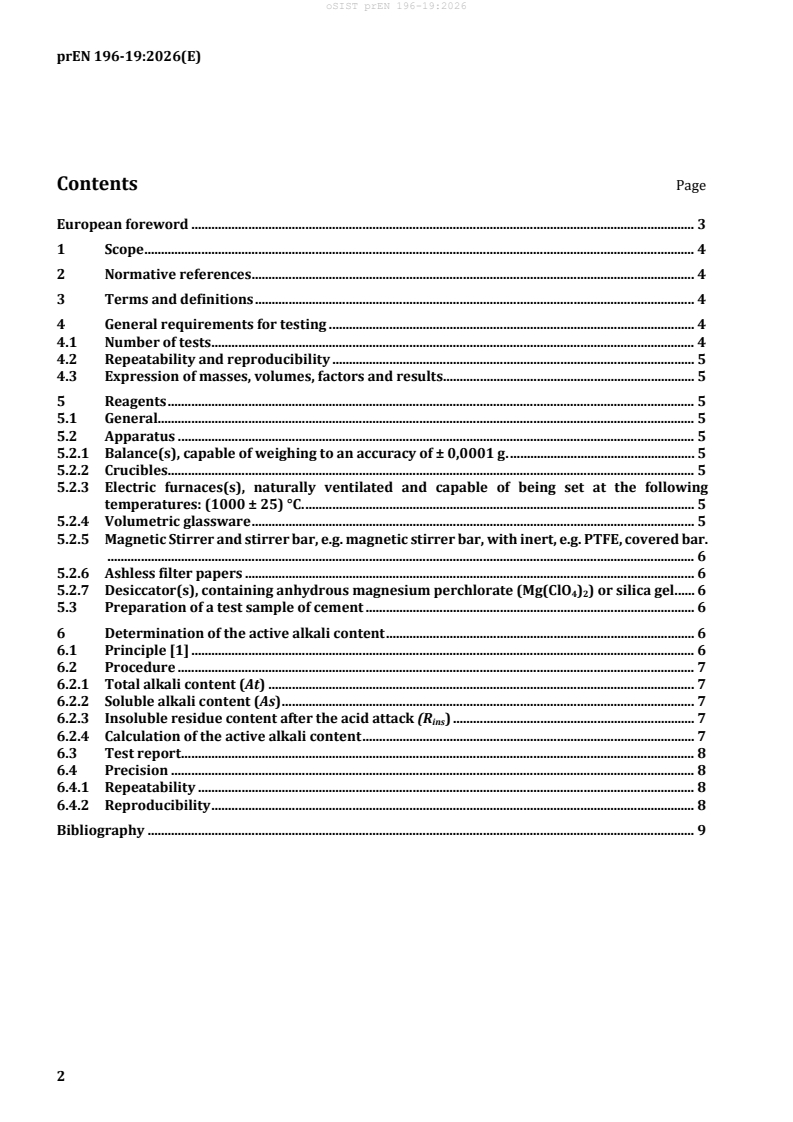
Contents Page
European foreword . 3
1 Scope . 4
2 Normative references . 4
3 Terms and definitions . 4
4 General requirements for testing . 4
4.1 Number of tests . 4
4.2 Repeatability and reproducibility . 5
4.3 Expression of masses, volumes, factors and results. 5
5 Reagents . 5
5.1 General. 5
5.2 Apparatus . 5
5.2.1 Balance(s), capable of weighing to an accuracy of ± 0,0001 g. . 5
5.2.2 Crucibles. 5
5.2.3 Electric furnaces(s), naturally ventilated and capable of being set at the following
temperatures: (1000 ± 25) °C. . 5
5.2.4 Volumetric glassware . 5
5.2.5 Magnetic Stirrer and stirrer bar, e.g. magnetic stirrer bar, with inert, e.g. PTFE, covered bar.
............................................................................................................................................................................... 6
5.2.6 Ashless filter papers . 6
5.2.7 Desiccator(s), containing anhydrous magnesium perchlorate (Mg(ClO ) ) or silica gel. . 6
4 2
5.3 Preparation of a test sample of cement . 6
6 Determination of the active alkali content . 6
6.1 Principle [1] . 6
6.2 Procedure . 7
6.2.1 Total alkali content (At) . 7
6.2.2 Soluble alkali content (As) . 7
6.2.3 Insoluble residue content after the acid attack (R ) . 7
ins
6.2.4 Calculation of the active alkali content . 7
6.3 Test report . 8
6.4 Precision . 8
6.4.1 Repeatability . 8
6.4.2 Reproducibility . 8
Bibliography . 9
European foreword
This document (prEN 196-19:2026) has been prepared by Technical Committee CEN/TC 51 Cement and
building limes”, the secretariat of which is held by NBN.
This document is currently submitted to the CEN Enquiry.
1 Scope
This document describes the method for determining the contribution of cement’s alkali to the alkali-
silica reaction process that can occur in concrete or mortar containing aggregates potentially susceptible
to alkali attack.
The principle is to consider the alkalis from the insoluble part of the cement (generally associated with
fly ash, for example, or pozzolans) and the alkali from the diluted part of the cement (generally associated
with clinker, gypsum, granulated blast furnace slag, or limestone) [1].
This test method can be used in the framework of preventing the risk of alkali silica reaction [2].
2 Normative references
The following documents are referred to in the text in such a way that some or all their content constitutes
requirements of this document. For dated references, only the edition cited applies. For undated
references, the latest edition of the referenced document (including any amendments) applies.
EN 196-2, Methods of testing cement — Part 2: Chemical analysis of cement
EN 196-7, Methods for sampling and sample preparation of common cement and its constituents
3 Terms and definitions
For the purposes of this document, the following terms and definitions apply.
ISO and IEC maintain terminology databases for use in standardization at the following addresses:
— ISO Online browsing platform: available at https://www.iso.org/obp/
— IEC Electropedia: available at https://www.electropedia.org/
3.1
sodium oxide equivalent content (Na O )
2 eq
sum of the sodium oxide mass content (Na O) and the potassium oxide mass c
...