


CEN/TS 14271:2003
(Main)Health informatics - File exchange format for vital signs
Health informatics - File exchange format for vital signs
This standard covers the off-line storage of biosignals, time-stamped measurements, events, enumerations and alerts as expressed in the CEN/TC251 prestandard Vital Signs Information Representation (ENV 13734). This standard defines a file data structure and not a message data structure. This standard does not support data compression. This standard includes a method to encapsulate or refer to one or many medical images, digital video and audio files but the intention is neither to define a new format for medical or other images, video nor audio. Figure 1.1 defines the scope of this prestandard with respect to ENV 13734.
Figure 1.2 defines the scope of this standard with respect to the archival subject in ENV 13734. This standard does not address the specification of the multipatient archive nor the patient archive. The ancillary object in this standard is the multimedia section.
Zdravstvena informatika – Izmenjava formatov podatkov v zvezi z življenjskimi znaki
General Information
- Status
- Withdrawn
- Publication Date
- 25-Nov-2003
- Withdrawal Date
- 26-Jul-2010
- Technical Committee
- CEN/TC 251 - Medical informatics
- Drafting Committee
- CEN/TC 251/WG 2 - Terminology and knowledge representation
- Current Stage
- 9960 - Withdrawal effective - Withdrawal
- Start Date
- 27-Jul-2010
- Completion Date
- 27-Jul-2010

Get Certified
Connect with accredited certification bodies for this standard

BSI Group
BSI (British Standards Institution) is the business standards company that helps organizations make excellence a habit.

NYCE
Mexican standards and certification body.
Sponsored listings
Frequently Asked Questions
CEN/TS 14271:2003 is a technical specification published by the European Committee for Standardization (CEN). Its full title is "Health informatics - File exchange format for vital signs". This standard covers: This standard covers the off-line storage of biosignals, time-stamped measurements, events, enumerations and alerts as expressed in the CEN/TC251 prestandard Vital Signs Information Representation (ENV 13734). This standard defines a file data structure and not a message data structure. This standard does not support data compression. This standard includes a method to encapsulate or refer to one or many medical images, digital video and audio files but the intention is neither to define a new format for medical or other images, video nor audio. Figure 1.1 defines the scope of this prestandard with respect to ENV 13734. Figure 1.2 defines the scope of this standard with respect to the archival subject in ENV 13734. This standard does not address the specification of the multipatient archive nor the patient archive. The ancillary object in this standard is the multimedia section.
This standard covers the off-line storage of biosignals, time-stamped measurements, events, enumerations and alerts as expressed in the CEN/TC251 prestandard Vital Signs Information Representation (ENV 13734). This standard defines a file data structure and not a message data structure. This standard does not support data compression. This standard includes a method to encapsulate or refer to one or many medical images, digital video and audio files but the intention is neither to define a new format for medical or other images, video nor audio. Figure 1.1 defines the scope of this prestandard with respect to ENV 13734. Figure 1.2 defines the scope of this standard with respect to the archival subject in ENV 13734. This standard does not address the specification of the multipatient archive nor the patient archive. The ancillary object in this standard is the multimedia section.
CEN/TS 14271:2003 is classified under the following ICS (International Classification for Standards) categories: 35.240.80 - IT applications in health care technology. The ICS classification helps identify the subject area and facilitates finding related standards.
CEN/TS 14271:2003 is available in PDF format for immediate download after purchase. The document can be added to your cart and obtained through the secure checkout process. Digital delivery ensures instant access to the complete standard document.
Standards Content (Sample)
SLOVENSKI STANDARD
01-april-2005
Zdravstvena informatika – Izmenjava formatov podatkov v zvezi z življenjskimi
znaki
Health informatics - File exchange format for vital signs
Ta slovenski standard je istoveten z: CEN/TS 14271:2003
ICS:
35.240.80 Uporabniške rešitve IT v IT applications in health care
zdravstveni tehniki technology
2003-01.Slovenski inštitut za standardizacijo. Razmnoževanje celote ali delov tega standarda ni dovoljeno.
TECHNICAL SPECIFICATION
CEN/TS 14271
SPÉCIFICATION TECHNIQUE
TECHNISCHE SPEZIFIKATION
November 2003
ICS
English version
Health informatics - File exchange format for vital signs
This Technical Specification (CEN/TS) was approved by CEN on 18 October 2003 for provisional application.
The period of validity of this CEN/TS is limited initially to three years. After two years the members of CEN will be requested to submit their
comments, particularly on the question whether the CEN/TS can be converted into a European Standard.
CEN members are required to announce the existence of this CEN/TS in the same way as for an EN and to make the CEN/TS available. It
is permissible to keep conflicting national standards in force (in parallel to the CEN/TS) until the final decision about the possible
conversion of the CEN/TS into an EN is reached.
CEN members are the national standards bodies of Austria, Belgium, Czech Republic, Denmark, Finland, France, Germany, Greece,
Hungary, Iceland, Ireland, Italy, Luxembourg, Malta, Netherlands, Norway, Portugal, Slovakia, Spain, Sweden, Switzerland and United
Kingdom.
EUROPEAN COMMITTEE FOR STANDARDIZATION
COMITÉ EUROPÉEN DE NORMALISATION
EUROPÄISCHES KOMITEE FÜR NORMUNG
Management Centre: rue de Stassart, 36 B-1050 Brussels
© 2003 CEN All rights of exploitation in any form and by any means reserved Ref. No. CEN/TS 14271:2003 E
worldwide for CEN national Members.
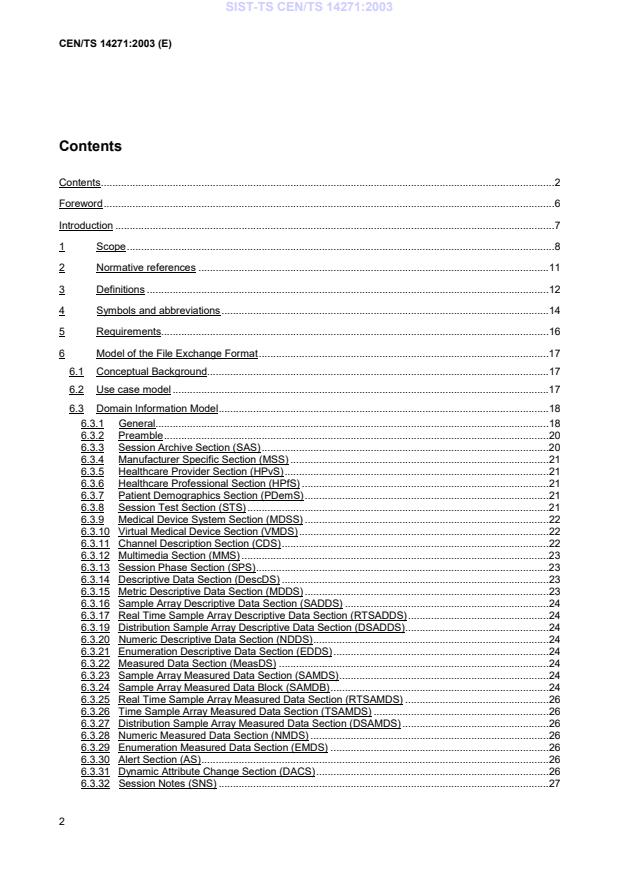
Contents
Contents.2
Foreword.6
Introduction .7
1 Scope.8
2 Normative references .11
3 Definitions .12
4 Symbols and abbreviations.14
5 Requirements.16
6 Model of the File Exchange Format.17
6.1 Conceptual Background.17
6.2 Use case model .17
6.3 Domain Information Model.18
6.3.1 General.18
6.3.2 Preamble.20
6.3.3 Session Archive Section (SAS).20
6.3.4 Manufacturer Specific Section (MSS) .21
6.3.5 Healthcare Provider Section (HPvS).21
6.3.6 Healthcare Professional Section (HPfS) .21
6.3.7 Patient Demographics Section (PDemS).21
6.3.8 Session Test Section (STS).21
6.3.9 Medical Device System Section (MDSS) .22
6.3.10 Virtual Medical Device Section (VMDS).22
6.3.11 Channel Description Section (CDS).22
6.3.12 Multimedia Section (MMS) .23
6.3.13 Session Phase Section (SPS).23
6.3.14 Descriptive Data Section (DescDS) .23
6.3.15 Metric Descriptive Data Section (MDDS) .23
6.3.16 Sample Array Descriptive Data Section (SADDS) .24
6.3.17 Real Time Sample Array Descriptive Data Section (RTSADDS).24
6.3.19 Distribution Sample Array Descriptive Data Section (DSADDS).24
6.3.20 Numeric Descriptive Data Section (NDDS).24
6.3.21 Enumeration Descriptive Data Section (EDDS).24
6.3.22 Measured Data Section (MeasDS) .24
6.3.23 Sample Array Measured Data Section (SAMDS).24
6.3.24 Sample Array Measured Data Block (SAMDB).24
6.3.25 Real Time Sample Array Measured Data Section (RTSAMDS) .26
6.3.26 Time Sample Array Measured Data Section (TSAMDS) .26
6.3.27 Distribution Sample Array Measured Data Section (DSAMDS) .26
6.3.28 Numeric Measured Data Section (NMDS) .26
6.3.29 Enumeration Measured Data Section (EMDS) .26
6.3.30 Alert Section (AS).26
6.3.31 Dynamic Attribute Change Section (DACS).26
6.3.32 Session Notes (SNS) .27
7 Specification of FEF Sections.28
7.1 General .28
7.2 Encoding .29
7.3 Definition of the file format .29
7.3.1 Data types .29
7.3.2 Preamble.32
7.3.3 Session Archive Section.33
7.3.4 ManufacturerSpecificSection (MSS) .36
7.3.5 HealthCareProviderSection (HPvS) .37
7.3.6 HealthCareProfessionalSection (HPfS) .38
7.3.7 PatientDemographicsSection (PDemS).40
7.3.8 SessionTestSection (STS).45
7.3.9 MedicalDeviceSystemSection (MDSS) .47
7.3.10 VirtualMedicalDeviceSection (VMDS).51
7.3.11 ChannelDescriptionSection (CDS).53
7.3.12 MultimediaSection (MMS) .54
7.3.13 SessionPhaseSection (SPS).56
7.3.14 DescriptiveDataSection (DescDS) .57
7.3.15 MetricDescriptiveDataSection (MDDS) .59
7.3.16 SampleArrayDescriptiveDataSection (SADDS) .64
7.3.17 RealTimeSampleArrayDescriptiveDataSection (RTSADDS).68
7.3.18 TimeSampleArrayDescriptiveDataSection (TSADDS).68
7.3.19 DistributionSampleArrayDescriptiveDataSection (DSADDS).69
7.3.20 NumericDescriptiveDataSection (NDDS).70
7.3.21 EnumerationDescriptiveDataSection (EDDS).71
7.3.22 MeasuredDataSection (MeasDS) .72
7.3.23 SampleArrayMeasuredDataSection (SAMDS).73
7.3.24 SampleArrayMeasuredDataBlock (SAMDB).73
7.3.25 RealTimeSampleArrayMeasuredDataSection (RTSAMDS) .74
7.3.26 TimeSampleArrayMeasuredDataSection (TSAMDS) .74
7.3.27 DistributionSampleArrayMeasuredDataSection (DSAMDS) .75
7.3.28 NumericMeasuredDataSection (NMDS) .75
7.3.29 EnumerationMeasuredDataSection (EMDS) .76
7.3.30 AlertSection (AS).78
7.3.31 DynamicAttributeChangeSection (DACS).81
7.3.32 SessionNotesSection (SNS) .82
8 Conformance .84
8.1 Required documents.84
8.2 Document contents.84
Annex A (Normative) Data Dictionary.85
Annex B (Normative) ASN.1 Object definitions .90
B.1 Commonly used types .90
B.1.1 ASN.1 built-in types used .90
B.1.2 Integer subranges .90
B.1.3 Fixed size bit strings.91
B.1.4 Text strings.91
B.1.5 Floating point type .91
B.1.6 Fraction .91
B.1.7 Ranges.91
B.1.8 Handle.92
B.1.9 ENV13734 data dictionary codes.92
B.1.10 Placeholder .92
B.1.11 Manufacturer ID .93
B.1.12 Time types.93
B.1.13 Colour type .93
B.1.14 External Nomenclature Reference.94
B.1.15 Person name.94
B.1.16 Object identifiers .94
B.2 Session Archive Section (SAS).94
B.3 Manufacturer Specific Section (MSS).95
B.4 Healthcare Provider .96
B.4.1 Healthcare Provider Section (HPvS).96
B.4.2 Healthcare Professional Section (HPfS) .96
B.5 Patient Demographics Section (PDemS).97
B.6 Session Test Section (STS).98
B.7 Medical Device System (MDSS).99
B.7.1 Medical Device System Section.99
B.7.2 Virtual Medical Device Section (VMDS).101
B.7.3 Channel Description Section (CDS).102
B.8 Multimedia Section (MMS).103
B.9 Session Phase Section (SPS) .103
B.10 Descriptive Data.104
B.10.1 Descriptive Data Section (DescDS) .104
B.10.2 Metric Descriptive Data Section (MDDS) .104
B.10.3 Sample Array Descriptive Data Section (SADDS) .107
B.10.4 Real Time Sample Array Descriptive Data Section (RTSADDS).110
B.10.5 Time Sample Array Descriptive Data Section (TSADDS).110
B.10.6 Distribution Sample Array Descriptive Data Section (DSADDS).110
B.10.7 Numeric Descriptive Data Section (NDDS).111
B.10.8 Enumeration Descriptive Data Section (EDDS).111
B.11 Measured Data .111
B.11.1 Measured Data Section (MeasDS) .111
B.11.2 SampleArrayMeasuredDataSection (SAMDS).112
B.11.3 SampleArrayMeasuredDataBlock (SAMDB).112
B.11.4 RealTimeSampleArrayMeasuredDataSection (RTSAMDS) .113
B.11.5 TimeSampleArrayMeasuredDataSection (TSAMDS) .113
B.11.6 DistributionSampleArrayMeasuredDataSection (DSAMDS) .114
B.11.7 NumericMeasuredDataSection (NMDS) .114
B.11.8 EnumerationMeasuredDataSection (EMDS) .115
B.11.9 AlertSection (AS).116
B.11.10 DynamicAttributeChangeSection (DACS).117
B.12 Session Notes Section (SNS).118
Annex C (Informative) Scenarios.119
C.1 Introduction .119
C.2 Scenario 1 - Data Logger - Single Device Monitor.119
C.2.1 Overview .119
C.2.2 Examples .120
C.2.3 Notes about the Data to Be Stored .120
C.3 Scenario 2 - Data Logger - Multiple Devices .121
C.3.1 Overview .121
C.3.2 Notes about the Data to Be Stored .121
C.4 Scenario 3 - Patient Data Exchange (Off-line).122
C.4.1 Overview .122
C.4.2 Examples .122
C.4.3 Notes about the Data to Be Stored .123
Annex D (Informative) FEF Example File .124
D.1 Overview .124
D.2 BER Encoding Basics.125
D.2.1 ASN.1 BER Tags .125
D.2.2 ASN.1 BER Lengths.125
D.2.3 ASN.1 BER Primitive Types.125
D.3 Tabular listing of example file .125
D.4 Section Walkthrough.135
D.4.1 Session Archive Section.135
D.4.2 Patient Demographics Section.135
D.4.3 Session Test Section .135
D.4.4 Medical Device System Section.135
D.4.5 Virtual Medical Device Sections.135
D.4.6 Session Phase Sections .136
D.4.7 RealTimeDescriptiveDataSections.136
D.4.8 EnumerationDescriptiveDataSections.136
D.4.9 RealTimeSampleArrayMeasuredDataSections.136
D.4.10 EnumerationMeasuredDataSections .137
D.4.11 Changes in the second Session Phase Section .137
D.5 Additional Examples .137
Foreword
This document (CEN/TS 14271:2003) has been prepared by Technical Committee CEN/TC 251 " Health
informatics", the secretariat of which is held by SIS.
This document has been prepared under a mandate given to CEN by the European Commission and the
European Free Trade Association, and supports essential requirements of EU Directive(s).
This document has been prepared by project team 40.
According to the CEN/CENELEC Internal Regulations, the national standards organizations of the following
countries are bound to announce this Technical Specification : Austria, Belgium, Czech Republic, Denmark,
Finland, France, Germany, Greece, Hungary, Iceland, Ireland, Italy, Luxembourg, Malta, Netherlands,
Norway, Portugal, Slovakia, Spain, Sweden, Switzerland and the United Kingdom.
Introduction
From medical and clinical research new procedures and tests evolve continuously. Increasingly also dynamic
tests are performed where often data from many hours of patient monitoring are acquired to be stored and to
be processed. Also, healthcare is delivered by an increasing number of care providers.
To make cost effective use of the continuously growing medical information per patient, and in general
communication and data integration, is of paramount importance. While today the public infrastructure for
electronic transport of information is well developed, deficits in communication networks still exist within
institutional healthcare providers (e.g. within hospitals) and between them.
There is first the open problem of the electronic health care patient record. Because of the different national
and regional healthcare system requirements proposals for record specifications are still very divergent.
Secondly, medical devices and device systems of different manufacturers differ in hardware and software,
features as interconnectivity and interoperability are only slowly built in. Thirdly, the international uniform
representation of demographic and medical information, and consequently the establishment of standards, is
still incomplete.
This Technical Specification provides the specification for a universal File Exchange Format (FEF) within the
domain of healthcare containing demographic data, administrative data and medical information (”Vital Signs
Information”).
This Technical Specification is based upon the results of long expert discussion and practical experience in
clinical work and international co-operation projects where the requirements for specification of a standard
File Exchange Format for biosignals have emerged. Based upon all this previous work and based upon the
previous prestandard for Vital Signs Information Representation (ENV 13734) this object oriented
standardization proposal is presented. Its details are described in the following chapters.
Within Clause 1 – Scope – it is described which parts of the more generic Vital Signs Information
Representation Standard, in particular, which subjects of the ENV 13734 Domain Information Model are
covered by this document. Clause 2 lists the documents which need to be taken into account in implementing
this Technical Specification. Clause 3 lists the definitions as they apply for the purpose of this document and
Clause 4 lists the abbreviations used in this document. In Clause 5 the requirements are specified resulting
from 3 fundamental data acquisition scenarios. Clause 6 presents the model of the File Exchange Format.
The FEF model is presented using the Unified Modeling Language (UML) methodology. The global domain
information model of the FEF file is given as well as submodels representing all the sections within the File
Exchange Format. Clause 7 contains the detailed definitions and specifications for all sections of the File
Exchange Format. Clause 8 specifies the required documents and the content of the documents for a
conformance claim.
The normative Annex A contains the data dictionary which is an partial copy of the essential parts of the ENV
13734 Medical Data Information Base (MDIB) nomenclature, data dictionary and codes. As the codes for,
e.g. physiological signals are not included here, the user needs to obtain the 13734 nomenclature or its
successor documents (currently identified as IEEE ISO prEN 11073-10101) in order to implement this
Technical Specification. Annex B gives the object definitions in ASN.1 and is normative in order to enable
implementation of the File Exchange Format.
Users of other data formats may be overwhelmed by the large number of attributes and other details in this
document. It should be noted that most attributes are optional. An implementer may use them only when
helpful. In order to get a general overview of the format the reader is advised to take a look at Annex D for a
simple example of the organization of normal biosignal data and events within the FEF.
1 Scope
This Technical Specification covers the off-line storage of biosignals, time-stamped measurements, events,
enumerations and alerts as expressed in the CEN/TC251 prestandard Vital Signs Information Representation
(ENV 13734). This Technical Specification defines a file data structure and not a message data structure.
This Technical Specification does not support data compression. This Technical Specification includes a
method to encapsulate or refer to one or many medical images, digital video and audio files but the intention
is neither to define a new format for medical or other images, video nor audio. Figure 1 defines the scope of
this Technical Specification with respect to ENV 13734.
In a small number of cases exact compatibility to ENV 13734 is not retained because of the chosen
encoding. An example of this is the data type AbsoluteTime of ENV 13734 which is replaced with the ISO
defined GeneralizedTime in this document (Section B.1.12).
Figure 2 defines the scope of this Technical Specification with respect to the archival subject in ENV 13734.
This Technical Specification does not address the specification of the multipatient archive nor the patient
archive. The ancillary object in this Technical Specification is the multimedia section.
Top
Archival
FEF
Patient-
Patient
Archive
Session- Patient
Archive
Demographics
System
Extended Services
Scanner
MDS
Communication
Medical
Communication
Controller
VMD
Alarm
Control
Alert
Service+
Channel
Control
Metric
Figure 1- The area covered of ENV13734 by this Technical Specification is shown with the thick black
line. (This figure is in Coad-Yourdon notation as the original ENV13734 is in this notation, as well.)
Multipatient Archive
Archival
0,m
0,1
Patient Archive
Pat.Demogr.
System-ID 0,1 1
static and dynamic
Comments
patient related data
... 0,m
0,m
FEF
0,1
Session Archive
Physician
S-Archive-ID
... 0,m 0,m
...
0,m 0,m
Ancillary
1 1
1 0,m
Session Test Session Notes
S-Test-ID S-Notes-ID
Start-Time, Stop-Time .
...
10,m
MDS
0,m
0,1
PM Store
Figure 2 - The area covered of ENV 13734 by this Technical Specification with respect to the archival
subject is shown with the thick line. The archival subject area in ENV 13734 is enclosed by the
dashed line. (This figure is in Coad-Yourdon notation as the original ENV13734 is in this notation, as
well.)
2 Normative references
ENV 1614:1994, Medical Informatics - System of concepts for systematic names, classification
and coding for properties, including quantities, in laboratory medicine
ENV 12264:1995, Categorical Structures of Systems of Concepts - Model for Representation of
Semantics (MOSE)
ENV 13734:1999, Health Informatics - Vital Signs Information Representation (VITAL)
IETF- RFC 2046:1996, Multipurpose Internet Mail Extensions (MIME) Part Two: Media Types.
IETF-RFC 2048:1996, Multipurpose Internet Mail Extensions (MIME) Part Four: Registration
Procedures.
ISO 41-0:1992, Quantities and units - Part 0: General principles
ISO 5218:1977, Information interchange - Representation of human sexes
ISO 8601:1988, Data elements and interchange formats - Information interchange -
Representation of dates and times
ISO/IEC 8824-1:1998, Information Technology - Abstract Syntax Notation One (ASN.1):
Specification of Basic Notation (ITU-T Recommendation X.680, 1997)
ISO/IEC 8825-1:1998, Information Technology - ASN.1 Encoding Rules: Specification of Basic
Encoding Rules (BER), Canonical Encoding Rules (CER) and Distinguished
Encoding Rules (DER). (ITU-T Recommendation X.690, 1997)
ISO/IEC 10646-1:2000, Information technology - Universal Multiple-Octet Coded Character Set
(UCS). Part 1: Architecture and Basic Multilingual Plane
3 Definitions
For the purposes of this document, the following definitions apply:
Term Definition
Alarm Signal which indicates abnormal events occurring to the patient or the device
system.
Alert Synonym for the combination of patient-related physiological alarms,
technical alarms and equipment user advisory signals.
Big Endian Type of byte order in computer internal representation. Computer using this
type numbers its bytes with byte 0 being the high-order (i.e., leftmost) byte.
Data Format Arrangement of data in a file or stream.
Data Logger A medical device which is functioning in its capacity as a data storage and
archival system.
Data Structure An aspect of data type expressing the nature of values that are composite, i.e.
not atoms (an atom being a value that cannot be further decomposed). The
non-atomic values have constituent parts (which need not themselves be
atoms), and the data structure expresses how constituents may be combined
to form a compound value or selected from a compound value.
Dictionary Description of the contents of the Medical Data Information Base containing
vital signs information, device information, demographics, and other
elements of the MDIB.
Discrete Parameter Vital signs measurement that it is possible to express as a single numeric or
textual value.
Domain Information Model The model describing common concepts and relationships for a problem
domain.
Graphic Parameter Vital signs measurement that requires a number of regularly sampled data
points in order to be expressed properly.
Host system Term used as an abstraction of a medical system to which measurement
devices are attached.
Intensive Care Unit Unit within a hospital in which critically ill patients are managed using multiple
modes of monitoring and vital system support.
Interchange Format The representation of the data elements and the structure of the file or
stream containing those data elements while in transfer between systems.
The interchange format consists of a data set of construction elements and a
syntax. The representation is technology specific.
Interoperability Idealized scheme whereby medical devices of differing types, models or
manufacturers, are capable of working with each other, whether connected
to each other directly or through a communication system. The
communication system tracks location, connection, disconnection,
replacement and re-siting of all devices.
Little Endian Type of byte order in computer internal representation. Computer using this
type numbers its bytes with byte 0 being the low-order (i.e., rightmost) byte.
Medical Data Information Base The concept of an object oriented database storing (at least) vital signs
information.
Medical Device System Abstraction for system comprising one or more medical devices.
Medical Devices Devices, apparatus, or systems used to prevent, measure, diagnose, or treat
diseases in humans, and which do not normally enter metabolic pathways.
For the purposes of this Technical Specification the scope of medical de-
vices is further limited to those patient connected medical devices which
provide support for electronic communications.
Object A concept, an abstraction or a thing with crisp boundaries and a meaning for
the problem at hand.
Object Attributes Data which, together with methods, define an object.
Object Diagram Diagram showing connections between objects in a system.
Open System Set of protocols allowing computers of different origins to be linked together.
Scenario Formal description of a class of business activities including the semantics of
business agreements, conventions, and information content.
Streaming mode Mode of data acquisition into a file in which other software modules than the
data acquisition module accesses the data during its collection. In streaming
mode it may be necessary to store enumerations, numeric measurements or
alerts between blocks of waveform data.
Syntax The syntax of an Interchange Format (IF) describes the rules for combining
the construction elements of the Interchange Format.
System Demarcated part of the perceivable universe, existing in time and space, that
may be regarded as a set of elements and relationships between these
elements.
Tag Identification information of a piece of data to follow, usually an unique
number which distinguishes sections of data from other sections in the same
level of hierarchy
Timestamp An attribute or field in data which denotes the time of data generation.
Waveform Here, used as graphic data, typically data values varying with respect to time.
Vital signs data which is usually presented to the clinician in a graphical form.
See also “graphic parameter”.
Virtual Medical Device An abstract representation of a medical related subsystem of a Medical
Device System.
Vital Sign Clinical information relating to one or more patients. Measured by or derived
from apparatus connected to the patient, or otherwise gathered from the
patient.
4 Symbols and abbreviations
For the purpose of this document, the following abbreviations apply.
A/D Analogue-to-digital
AID Attribute identification
ASCII American Standard Code for Information Interchange
ASN.1 Abstract Syntax Notation One
CEN European Committee for Standardization
DIM Domain Information Model
DIS Department Information System
ECG Electrocardiogram
EEG Electroencephalogram
FEF File Exchange Format for Vital Signs
HIS Hospital Information System
ICU Intensive Care Unit
ID Identification
IEEE Institute of Electrical and Electronic Engineers
IETF Internet Engineering Task Force
IF Interchange Format
ISO International Standards Organization
LAN Local Area Network
MDIB Medical Data Information Base
MDS Medical Device System
OID Object identification
OR Operating Room
PT Project Team
SA Sample Array
TC Technical Committee
WAN Wide Area Network
WG Working Group
VMD Virtual Medical Device
VS Vital Signs
5 Requirements
The file exchange format is applicable to computer systems used in medical applications independent of the
specific hardware technology. The FEF specification covers all vital signs information described within the
VITAL domain information model. The information represented in the VITAL document is serialised here in
order to produce a file or a set of files which can be stored or exchanged after the completion of vital signs
signal acquisition. In order to make the work with the archived signal data easy the file exchange format
should allow fast access to all pieces of data but nevertheless the format should be efficient for storing the
data on any media. To be manageable and implementable the standard should be short and simple enough
still allowing the required flexibility.
The FEF has to be organised in sessions of vital signs data acquisition. Several session tests of vital signs
data acquisition form a session archive. One or more session archives are available for each patient. Never
should one session archive contain information for more than one patient. This results already in a specific
restricted view on the VITAL domain information model.
Each session archive contains one or many session tests of vital signs data acquisition. Each session test
consists of one or many session phases. One such session phase will represent an archive of continuous
flow of data (which may be empty). If there is an interruption to the continuous flow of data, e.g. one test
ended, a patient was disconnected from the monitoring and moved to a different ward, then the session
phase ends and in case of further recording a new session phase has to be created. Changes in signal
amplitudes, number of signals recorded, should be allowed in one session test but not in one session phase.
To specify changes of signal characteristics and number of signals, one session test of vital signs data
acquisition may contain one or several phases of vital signs data acquisition. One phase always contains one
and not more than one block of descriptive data which specify the vital signs acquired. One phase may
contain many measured data blocks.
One session test contains one or many session phases. A session test combines the phases which belong
together from a medical perspective. A session test may be the recording of a patient during the entire stay
on an intensive care unit. It may be one continuous night recording with just one session phase or a set of
many neurophysiological investigations which together form one test. For practical reasons (search in the file)
only a limited number of session phases will be taken together in one session test and one physical data file.
6 Model of the File Exchange Format
6.1 Conceptual Background
FEF incorporates a major subset of the data elements of the domain information model of ENV 13734, Vital
Signs Information Representation (VITAL). Figure 1 in Clause 1, taken from ENV 13734, shows which parts
of the domain are addressed in the scope FEF. FEF constitutes a natural sequence of VITAL in the direction
of the definition of a vital signs file exchange format.
The model of FEF is presented using the Unified Modelling Language (UML) methodology. Mainly the Use
Cases and Class diagrams of this methodology are used in the modelling of FEF.
6.2 Use case model
Following a high abstraction overview, given on this subclause, some subclauses are p
...
Questions, Comments and Discussion
Ask us and Technical Secretary will try to provide an answer. You can facilitate discussion about the standard in here.
Loading comments...