

EN 3475-701:2026
(Main)Aerospace series - Cables, electrical, aircraft use - Test methods - Part 701: Strippability and adherence of insulation to the conductor
- Abstract
This document specifies methods of measuring the strippability and adherence of the insulation to a conductor of a finished cable.
When a particular method is not specified in the detail product specification, method A is the default test method.
Method B is suitable for wires insulated with materials showing a low adhesion to the conductor due to the poor repeatability of the test method A with this type of wires.
This document is intended to be used together with EN 3475-100.
- Status
- Not Published
- Publication Date
- 06-Oct-2026
- Technical Committee
- ASD-STAN - Aerospace
- Drafting Committee
- ASD-STAN/D 2/S 2 - Cables & Stripping Tools
- Current Stage
- 6055 - CEN Ratification completed (DOR) - Publishing
- Start Date
- 05-Jul-2026
- Completion Date
- 05-Jul-2026

EN 3475-701:2026 is a CEN aerospace series test-method standard for electrical cables used in aircraft. It specifies how to measure the strippability of insulation and the adherence of insulation to the conductor, so manufacturers and test laboratories can check whether cable insulation can be removed cleanly and whether it stays attached as intended during service and processing.
What does EN 3475-701:2026 specify?
EN 3475-701:2026 covers two related test subjects for aircraft electrical cables - stripping behavior and insulation-to-conductor adherence. It is meant to be used together with EN 3475-100, and where no other method is named in the detail product specification, Method A is the default.
The document is organized into:
- Scope
- Normative references
- Terms and definitions
- Preparation of specimens
- Methods
- Requirements
- Bibliography
Clause 4 sets out how specimens are prepared. Clause 5 gives the test methods, and Clause 6 gives the acceptance requirements. The document also distinguishes between testing finished cable and testing individual wire before it is built into a finished cable.
What are the key requirements of EN 3475-701:2026?
EN 3475-701:2026 requires careful specimen selection, defined preparation, and a tensile test setup for adhesion measurements. In practice, that means the user must control where the sample comes from, how it is stripped, and how the force test is run so results are comparable.
Specimen preparation matters
Clause 4.1 requires samples to be taken directly from a reel or coil with minimal deformation. This matters because bent or damaged samples can change stripping behavior and give misleading results.
For insulation stripping properties, Clause 4.2 says the specimen comes from the finished cable. The insulation is stripped at both ends using tools in accordance with EN 2812, and the manufacturer states the tools used in the test report. That gives traceability when results are reviewed or repeated.
For adherence of insulation to the conductor, Clause 4.3 says the specimen comes from individual wire before integration into a finished cable. This keeps the adhesion test focused on the wire construction itself rather than on later assembly effects.
Method A and Method B address different insulation behaviors
Clause 4.3.2 and Clause 5.2.1 describe Method A. The specimen is prepared with circumferential cuts and then pulled in a tensile test until the conductor slides inside the insulating cover. Method A is the default method when the product specification does not choose otherwise.
Clause 4.3.3 and Clause 5.2.2 describe Method B. It uses a different specimen preparation and requires three measurements per sample. The standard points to Method B for wires with low adhesion, where Method A can give poor repeatability. In practice, this gives a better choice for materials that are harder to evaluate consistently.
The test setup is controlled
Clauses 5.2.1 and 5.2.2 require the conductor to pass through a calibrated hole slightly larger than the conductor diameter, then be loaded with increasing tensile force at a defined speed. This matters because both the hole size and pull rate affect the measured force.
Acceptance is based on stated limits
Clause 6.1 says stripping capability of the jacket on screened cables shall not exceed 40 s for a suitably skilled operator. Clause 6.2 then separates the adhesion acceptance criteria for Method A and Method B.
For Method A, the measured adhesion force must meet the value stated in the technical specification. For Method B, each measurement must meet the value in the product standard, and if one does not, two more measurements are taken and the median of five must meet the stated value. That gives a practical rule for resolving borderline results.
What terms does EN 3475-701:2026 define?
The standard uses these terms in its test descriptions:
- Strippability - how readily the insulation can be removed from the conductor without difficulty.
- Adherence - how strongly the insulation remains attached to the conductor under tensile loading.
- Specimen - the cable or wire sample prepared for the test.
- Finished cable - the cable after final construction, used for the stripping property test.
- Individual wire - a wire taken before it is integrated into a finished cable, used for adhesion testing.
- Method A - the default adherence test method used unless another method is specified.
- Method B - the alternative adherence test method for low-adhesion insulation where Method A repeatability is poor.
- Screened cables - cables for which the jacket stripping capability is assessed.
Who uses EN 3475-701:2026?
EN 3475-701:2026 is used by aerospace cable manufacturers, test laboratories, and quality teams that verify cable performance. It is also relevant to buyers and product engineers who write detail product specifications, since the standard lets them choose or default between Method A and Method B. In practice, it supports incoming inspection, type testing, and product qualification for aircraft electrical wiring.
What changed in EN 3475-701:2026 from the previous edition?
EN 3475-701:2026 supersedes EN 3475-701:2017. The stated technical changes are:
- editorial revision
- clarification in Clause 4.2 that the specimen for insulation stripping is taken from the finished cable
- clarification in Clause 4.3.1 that the specimen for adhesion testing is taken from individual wire before integration in a finished cable
Which standards are used with EN 3475-701:2026?
- EN 3475-100 - the general part intended to be used together with this test-method part.
- EN 2812 - provides the stripping tools referenced for the insulation stripping test.
What does the EN 3475-701:2026 document contain?
EN 3475-701:2026 contains specimen-preparation instructions, two test methods for insulation adherence, and a separate stripping-capability method for screened cable jackets. It includes two figures showing the specimen layouts for Method A and Method B, which help users prepare the wire consistently before testing. The document also sets the test speed, force progression, and acceptance logic for the adhesion measurements.
Clause 6 is the practical decision point for users: it tells them whether the stripping time or measured adhesion force meets the required limit. The bibliography points readers to EN 3475-100 for the general framework used across the aerospace cable test-method series.
Relations
- Effective Date
- 06-Dec-2023
Get Certified
Connect with accredited certification bodies for this standard

BUREAU VERITAS Certification Germany
Bureau Veritas certification in Germany.

Element Materials Technology
Materials testing and product certification.

AQMS Ltd.
AQMS provides ISO certification to SMEs across the UK.
Sponsored listings
Frequently Asked Questions
EN 3475-701:2026 is a draft published by the European Committee for Standardization (CEN). Its full title is "Aerospace series - Cables, electrical, aircraft use - Test methods - Part 701: Strippability and adherence of insulation to the conductor". This standard covers: This document specifies methods of measuring the strippability and adherence of the insulation to a conductor of a finished cable. When a particular method is not specified in the detail product specification, method A is the default test method. Method B is suitable for wires insulated with materials showing a low adhesion to the conductor due to the poor repeatability of the test method A with this type of wires. This document is intended to be used together with EN 3475-100.
This document specifies methods of measuring the strippability and adherence of the insulation to a conductor of a finished cable. When a particular method is not specified in the detail product specification, method A is the default test method. Method B is suitable for wires insulated with materials showing a low adhesion to the conductor due to the poor repeatability of the test method A with this type of wires. This document is intended to be used together with EN 3475-100.
EN 3475-701:2026 is classified under the following ICS (International Classification for Standards) categories: 49.060 - Aerospace electric equipment and systems. The ICS classification helps identify the subject area and facilitates finding related standards.
EN 3475-701:2026 has the following relationships with other standards: It is inter standard links to EN 3475-701:2017. Understanding these relationships helps ensure you are using the most current and applicable version of the standard.
EN 3475-701:2026 is available in PDF format for immediate download after purchase. The document can be added to your cart and obtained through the secure checkout process. Digital delivery ensures instant access to the complete standard document.
Standards Content (Sample)
SLOVENSKI STANDARD
oSIST prEN 3475-701:2025
01-julij-2025
Aeronavtika - Električni kabli za uporabo v letalih - Preskusne metode - 701. del:
Odstranljivost in oprijemljivost izolacije vodnika
Aerospace series - Cables, electrical, aircraft use - Test methods - Part 701: Strippability
and adherence of insulation to the conductor
Luft- und Raumfahrt - Elektrische Leitungen für Luftfahrtverwendung - Prüfverfahren -
Teil 701: Abisolierbarkeit und Haftfestigkeit der Isolierung auf dem Leiter
Série aérospatiale - Câbles électriques à usage aéronautique - Méthodes d'essais -
Partie 701 : Dénudabilité et adhérence de l'isolation sur le conducteur
Ta slovenski standard je istoveten z: prEN 3475-701
ICS:
29.060.20 Kabli Cables
49.060 Letalska in vesoljska Aerospace electric
električna oprema in sistemi equipment and systems
oSIST prEN 3475-701:2025 en,fr,de
2003-01.Slovenski inštitut za standardizacijo. Razmnoževanje celote ali delov tega standarda ni dovoljeno.
oSIST prEN 3475-701:2025
oSIST prEN 3475-701:2025
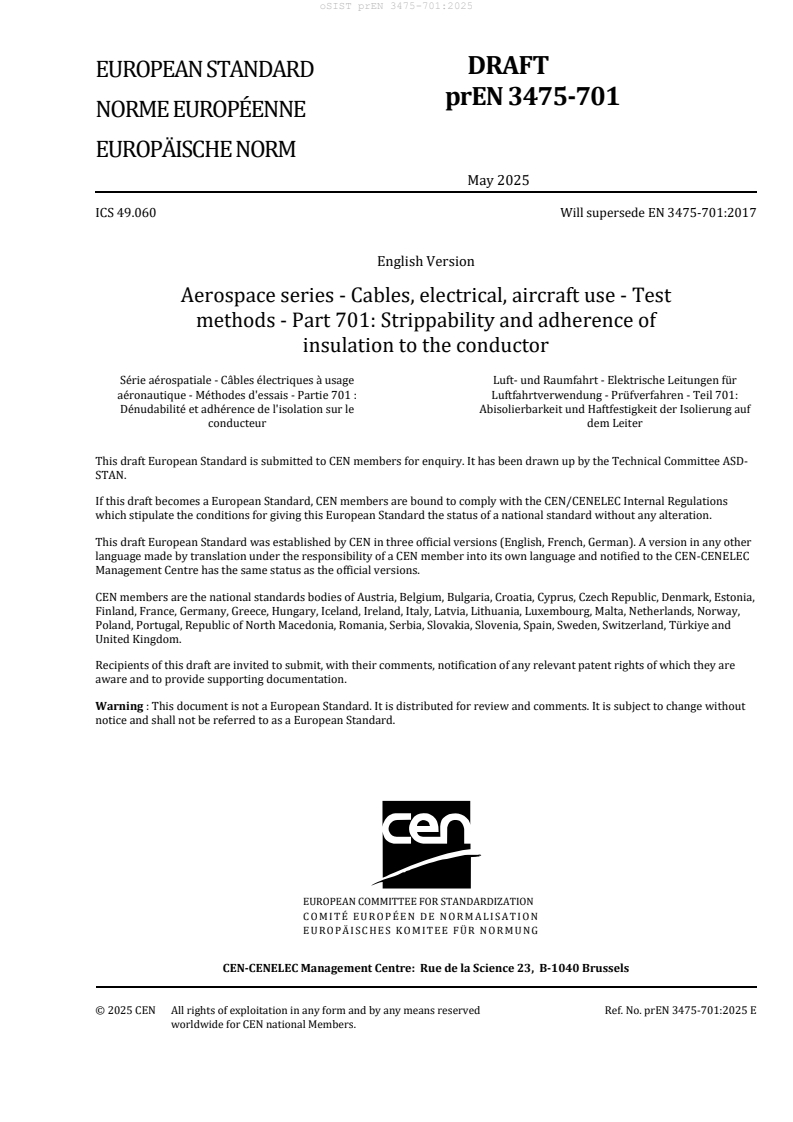
DRAFT
EUROPEAN STANDARD
prEN 3475-701
NORME EUROPÉENNE
EUROPÄISCHE NORM
May 2025
ICS 49.060 Will supersede EN 3475-701:2017
English Version
Aerospace series - Cables, electrical, aircraft use - Test
methods - Part 701: Strippability and adherence of
insulation to the conductor
Série aérospatiale - Câbles électriques à usage Luft- und Raumfahrt - Elektrische Leitungen für
aéronautique - Méthodes d'essais - Partie 701 : Luftfahrtverwendung - Prüfverfahren - Teil 701:
Dénudabilité et adhérence de l'isolation sur le Abisolierbarkeit und Haftfestigkeit der Isolierung auf
conducteur dem Leiter
This draft European Standard is submitted to CEN members for enquiry. It has been drawn up by the Technical Committee ASD-
STAN.
If this draft becomes a European Standard, CEN members are bound to comply with the CEN/CENELEC Internal Regulations
which stipulate the conditions for giving this European Standard the status of a national standard without any alteration.
This draft European Standard was established by CEN in three official versions (English, French, German). A version in any other
language made by translation under the responsibility of a CEN member into its own language and notified to the CEN-CENELEC
Management Centre has the same status as the official versions.
CEN members are the national standards bodies of Austria, Belgium, Bulgaria, Croatia, Cyprus, Czech Republic, Denmark, Estonia,
Finland, France, Germany, Greece, Hungary, Iceland, Ireland, Italy, Latvia, Lithuania, Luxembourg, Malta, Netherlands, Norway,
Poland, Portugal, Republic of North Macedonia, Romania, Serbia, Slovakia, Slovenia, Spain, Sweden, Switzerland, Türkiye and
United Kingdom.
Recipients of this draft are invited to submit, with their comments, notification of any relevant patent rights of which they are
aware and to provide supporting documentation.
Warning : This document is not a European Standard. It is distributed for review and comments. It is subject to change without
notice and shall not be referred to as a European Standard.
EUROPEAN COMMITTEE FOR STANDARDIZATION
COMITÉ EUROPÉEN DE NORMALISATION
EUROPÄISCHES KOMITEE FÜR NORMUNG
CEN-CENELEC Management Centre: Rue de la Science 23, B-1040 Brussels
© 2025 CEN All rights of exploitation in any form and by any means reserved Ref. No. prEN 3475-701:2025 E
worldwide for CEN national Members.
oSIST prEN 3475-701:2025
prEN 3475-701:2025 (E)
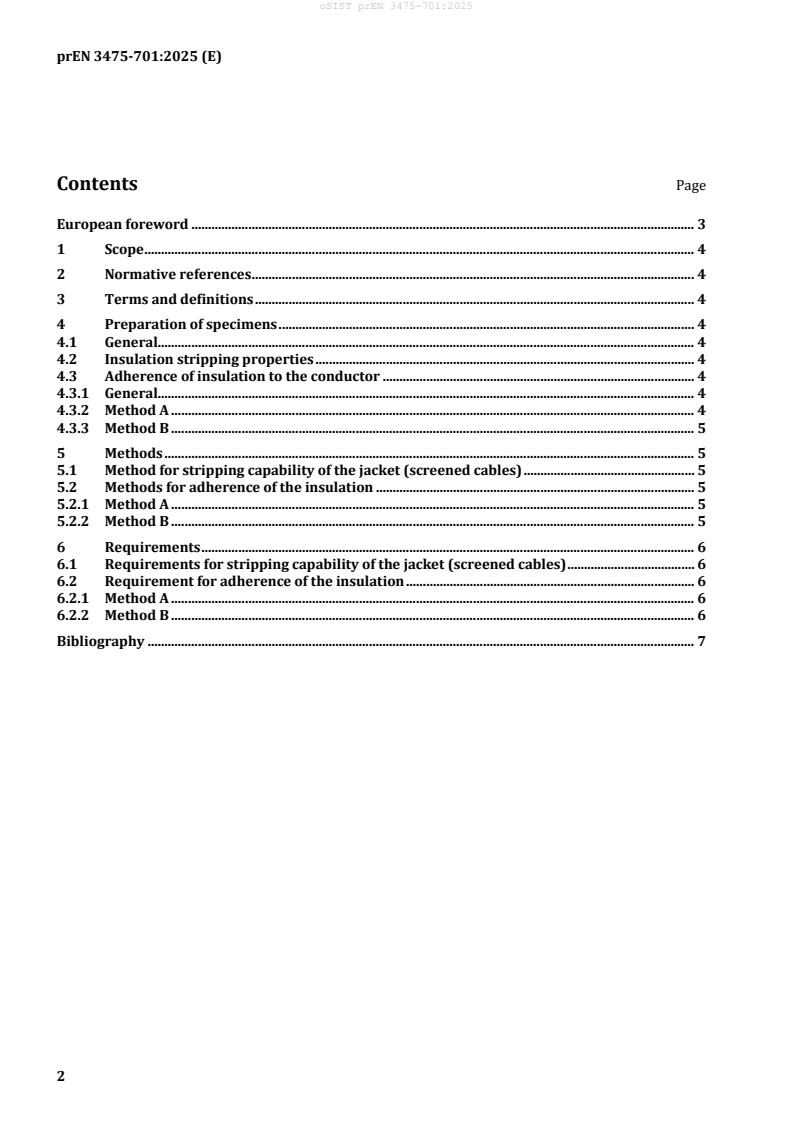
Contents Page
European foreword . 3
1 Scope . 4
2 Normative references . 4
3 Terms and definitions . 4
4 Preparation of specimens . 4
4.1 General. 4
4.2 Insulation stripping properties . 4
4.3 Adherence of insulation to the conductor . 4
4.3.1 General. 4
4.3.2 Method A . 4
4.3.3 Method B . 5
5 Methods . 5
5.1 Method for stripping capability of the jacket (screened cables) . 5
5.2 Methods for adherence of the insulation . 5
5.2.1 Method A . 5
5.2.2 Method B . 5
6 Requirements . 6
6.1 Requirements for stripping capability of the jacket (screened cables) . 6
6.2 Requirement
...