

FprEN 3475-505
(Main)Aerospace series - Cables, electrical, aircraft use - Test methods - Part 505: Tensile test on conductors and strands
- Abstract
This document specifies a method of measuring the tensile properties of stranded conductors, single strands, solid conductors and braids.
When required, it can be used also on insulated wires and cables after removing the insulation.
It is intended to be used together with EN 3475-100.
- Status
- Not Published
- Publication Date
- 10-May-2027
- Technical Committee
- ASD-STAN - Aerospace
- Drafting Committee
- ASD-STAN/D 2/S 2 - Cables & Stripping Tools
- Current Stage
- 4599 - Dispatch of FV draft to CMC - Finalization for Vote
- Start Date
- 28-Sep-2026
- Completion Date
- 28-Sep-2026

FprEN 3475-505 is a draft European Standard from CEN for aerospace electrical cables. It specifies a tensile test method for stranded conductors, single strands, solid conductors and braids, and it is intended to be used with EN 3475-100. In practice, it gives manufacturers, test laboratories and quality teams a common way to measure tensile properties for aircraft-use cable conductors and braids.
What does FprEN 3475-505 specify?
FprEN 3475-505 specifies how to measure tensile properties for conductors and braids used in aircraft cables. It also allows the same method to be applied to insulated wires and cables after the insulation has been removed, when that is required.
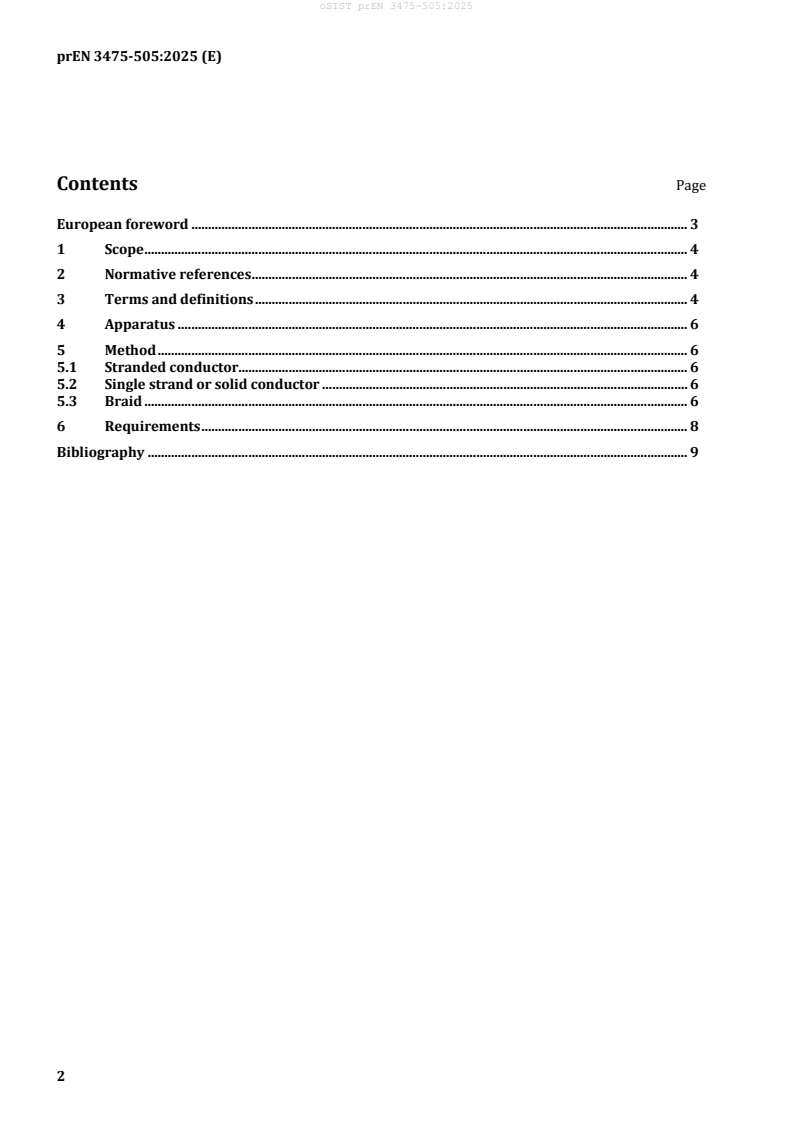
The document is organized into six clauses and a bibliography:
- Clause 1 Scope
- Clause 2 Normative references
- Clause 3 Terms and definitions
- Clause 4 Apparatus
- Clause 5 Method, with 5.1 stranded conductor, 5.2 single strand or solid conductor, and 5.3 braid
- Clause 6 Requirements
- Bibliography
What are the key requirements of FprEN 3475-505?
FprEN 3475-505 is mainly a laboratory test method. The most important points are the test setup, the way each conductor form is sampled, and the rule that the measured values must meet the relevant product standard.
Test equipment and test conditions
Clause 4 requires a tensile tester that measures load and elongation with 1% accuracy. The pulling speed shall be 50 ± 10 mm/min, and the initial length between the jaws shall be 250 ± 5 mm. In practice, this fixes the test conditions so results can be compared between laboratories.
Clause 4 also requires the sample to be free of slack before measurement starts. The jaws or grips must not affect the measurement, and they must be arranged so the fracture occurs between the jaws and at least 25 mm from either jaw. That matters because a break too close to a grip can distort the result.
Stranded conductors
Clause 5.1 covers stranded conductors. For cross-sections of 9 mm² or less, the whole stranded conductor is tested, three samples per size are measured, and the reported values are the average elongation at break and the breaking load. The breaking load is taken at the first strand break, so the test reflects how the conductor behaves as an assembly.
For larger cross-sections, clause 5.1 shifts the measurement to strands taken from the stranding layers or from strand groups, unless the technical specification or product standard says otherwise. The clause also allows a qualification-only check when the product standard requires qualification. This is important for thicker conductors, where the test is based on representative strands rather than the whole cable.
Single strand, solid conductor and braid
Clause 5.2 applies to a single strand or a solid conductor. Three samples per size are tested, and the reported values are the average elongation at break, breaking load and tensile strength. This gives a direct measure of the mechanical performance of a simple conductor form.
Clause 5.3 applies to braid. The whole braid is tested after carefully stripping the cable jacket for at least 500 mm without damaging the shield strands. Three samples are taken, each sample is preloaded before measurement, and the applied tensile force is monitored and recorded. The first strand break defines the breaking load. In practice, this clause protects the braid from damage during preparation and gives a controlled way to assess braid strength.
Acceptance of results
Clause 6 states that elongation at break, load, tensile strength and yield strength, when required, shall conform to the values given in the product standard. This means FprEN 3475-505 provides the test method, while the product standard provides the acceptance limits.
What terms does FprEN 3475-505 define?
- Breaking load - the load at which the material actually breaks.
- Maximum load - the highest load reached during the tensile test.
- Tensile strength - the load divided by the cross-sectional area.
- Elongation at break - the permanent elongation at rupture, expressed as a percentage of the original length.
- Elastic limit - the highest stress a material can take without permanent deformation.
- Yield strength - the stress at which a material begins to show a specified permanent deformation.
Who uses FprEN 3475-505?
FprEN 3475-505 is used by manufacturers of aerospace electrical cables, by test laboratories, and by quality teams that verify conductor and braid performance. It is also relevant to product qualification and routine compliance testing against a product standard. Buyers and certification staff can use the results to check that a cable construction meets the required tensile performance for aircraft use.
What changed in FprEN 3475-505 from the previous edition?
FprEN 3475-505:2025 will supersede EN 3475-505:2023. The foreword says the revision introduces a clearer distinction in clause 5.1 between conductor cross-sections of 9 mm² or less and those above 9 mm², and it rephrases clause 5.2. It also changes the reporting rules in clause 5.1 so the stated values are limited to elongation at break and breaking load.
Which standards are used with FprEN 3475-505?
FprEN 3475-505 is intended to be used with EN 3475-100, which provides the general test-method requirements for the aerospace cable series. The bibliography names EN 3475-100 as the companion part for this method.
What does the FprEN 3475-505 document contain?
FprEN 3475-505 contains one main test method for tensile properties, with separate procedures for stranded conductors, single strands or solid conductors, and braids. Figure 1 explains the load and elongation terms used in the definitions, and Figure 2 shows the recommended test equipment for braid testing. The document is therefore a practical method for laboratory testing and product verification, rather than a product specification.
Relations
- Effective Date
- 23-Jul-2025
Get Certified
Connect with accredited certification bodies for this standard

BUREAU VERITAS Certification Germany
Bureau Veritas certification in Germany.

Element Materials Technology
Materials testing and product certification.

AQMS Ltd.
AQMS provides ISO certification to SMEs across the UK.
Sponsored listings
Frequently Asked Questions
FprEN 3475-505 is a draft published by the European Committee for Standardization (CEN). Its full title is "Aerospace series - Cables, electrical, aircraft use - Test methods - Part 505: Tensile test on conductors and strands". This standard covers: This document specifies a method of measuring the tensile properties of stranded conductors, single strands, solid conductors and braids. When required, it can be used also on insulated wires and cables after removing the insulation. It is intended to be used together with EN 3475-100.
This document specifies a method of measuring the tensile properties of stranded conductors, single strands, solid conductors and braids. When required, it can be used also on insulated wires and cables after removing the insulation. It is intended to be used together with EN 3475-100.
FprEN 3475-505 is classified under the following ICS (International Classification for Standards) categories: 49.060 - Aerospace electric equipment and systems. The ICS classification helps identify the subject area and facilitates finding related standards.
FprEN 3475-505 has the following relationships with other standards: It is inter standard links to EN 3475-505:2023. Understanding these relationships helps ensure you are using the most current and applicable version of the standard.
FprEN 3475-505 is available in PDF format for immediate download after purchase. The document can be added to your cart and obtained through the secure checkout process. Digital delivery ensures instant access to the complete standard document.
Standards Content (Sample)
SLOVENSKI STANDARD
01-december-2025
Aeronavtika - Električni kabli za uporabo v zračnih plovilih - Preskusne metode -
505. del: Natezni preskus vodnikov in žic
Aerospace series - Cables, electrical, aircraft use - Test methods - Part 505: Tensile test
on conductors and strands
Luft- und Raumfahrt - Elektrische Leitungen für Luftfahrtverwendung - Prüfverfahren -
Teil 505: Zugfestigkeit der Einzeldrähte und Leiterseile
Série aérospatiale - Câbles électriques à usage aéronautique - Méthodes d'essais -
Partie 505 : Résistance à la traction des conducteurs et des brins
Ta slovenski standard je istoveten z: prEN 3475-505
ICS:
29.060.20 Kabli Cables
49.060 Letalska in vesoljska Aerospace electric
električna oprema in sistemi equipment and systems
2003-01.Slovenski inštitut za standardizacijo. Razmnoževanje celote ali delov tega standarda ni dovoljeno.
DRAFT
EUROPEAN STANDARD
prEN 3475-505
NORME EUROPÉENNE
EUROPÄISCHE NORM
October 2025
ICS 49.060 Will supersede EN 3475-505:2023
English Version
Aerospace series - Cables, electrical, aircraft use - Test
methods - Part 505: Tensile test on conductors and
strands
Luft- und Raumfahrt - Elektrische Leitungen für
Luftfahrtverwendung - Prüfverfahren - Teil 505:
Zugfestigkeit der Einzeldrähte und Leiterseile
This draft European Standard is submitted to CEN members for enquiry. It has been drawn up by the Technical Committee ASD-
STAN.
If this draft becomes a European Standard, CEN members are bound to comply with the CEN/CENELEC Internal Regulations
which stipulate the conditions for giving this European Standard the status of a national standard without any alteration.
This draft European Standard was established by CEN in three official versions (English, French, German). A version in any other
language made by translation under the responsibility of a CEN member into its own language and notified to the CEN-CENELEC
Management Centre has the same status as the official versions.
CEN members are the national standards bodies of Austria, Belgium, Bulgaria, Croatia, Cyprus, Czech Republic, Denmark, Estonia,
Finland, France, Germany, Greece, Hungary, Iceland, Ireland, Italy, Latvia, Lithuania, Luxembourg, Malta, Netherlands, Norway,
Poland, Portugal, Republic of North Macedonia, Romania, Serbia, Slovakia, Slovenia, Spain, Sweden, Switzerland, Türkiye and
United Kingdom.
Recipients of this draft are invited to submit, with their comments, notification of any relevant patent rights of which they are
aware and to provide supporting documentation.
Warning : This document is not a European Standard. It is distributed for review and comments. It is subject to change without
notice and shall not be referred to as a European Standard.
EUROPEAN COMMITTEE FOR STANDARDIZATION
COMITÉ EUROPÉEN DE NORMALISATION
EUROPÄISCHES KOMITEE FÜR NORMUNG
CEN-CENELEC Management Centre: Rue de la Science 23, B-1040 Brussels
© 2025 CEN All rights of exploitation in any form and by any means reserved Ref. No. prEN 3475-505:2025 E
worldwide for CEN national Members.
prEN 3475-505:2025 (E)
Contents Page
European foreword . 3
1 Scope . 4
2 Normative references . 4
3 Terms and definitions . 4
4 Apparatus . 6
5 Method . 6
5.1 Stranded conductor. 6
5.2 Single strand or solid conductor . 6
5.3 Braid . 6
6 Requirements . 8
Bibliography . 9
prEN 3475-505:2025 (E)
European foreword
This document (prEN 3475-505:2025) has been prepared by ASD-STAN.
After enquiries and votes carried out in accordance with the rules of this Association, this document has
received the approval of the National Associations and the Official Services of the member countries of
ASD-STAN, prior to its presentation to CEN.
This document is currently submitted to the CEN Enquiry.
This document will supersede EN 3475-505:2023
prEN 3475-505:2025 includes the following significant technical changes with respect to
EN 3475-505:2023:
2 2
— clear distinction between rules based on conductor cross-section (≤9 mm vs > 9 mm ) “for stranded
conductor” in 5.1:
— for cross-section ≤ 9 mm : only report the average value of the elongation
...