

EN 18199:2026
(Main)Leather - Essential requirements for leather traceability
- Abstract
This document sets the minimum essential elements of traceability and evidence of verification to be present in a leather traceability system, kept by organizations along the animal-to-leather supply chain. It is applicable to all types of leather.
This document defines the requirements and related evidence for establishing the traceability of leather back to the originating farms or hunting area.
This document can be applied to any organization operating within the leather value chain.
- Status
- Published
- Publication Date
- 25-Aug-2026
- Technical Committee
- CEN/TC 289 - Leather
- Current Stage
- 6060 - Definitive text made available (DAV) - Publishing
- Start Date
- 26-Aug-2026
- Due Date
- 13-May-2026
- Completion Date
- 13-May-2026

EN 18199:2026 is a CEN European Standard for leather traceability. It sets the minimum essential elements of a traceability system and the evidence of verification that organizations along the animal-to-leather supply chain need to keep. It applies to all types of leather and is intended for any organization operating in the leather value chain.
What does EN 18199:2026 specify?
EN 18199:2026 specifies the minimum traceability information and supporting evidence needed to trace leather back to the originating farms or hunting area. It also sets the basic structure of a leather traceability system and the verification records that support due diligence.
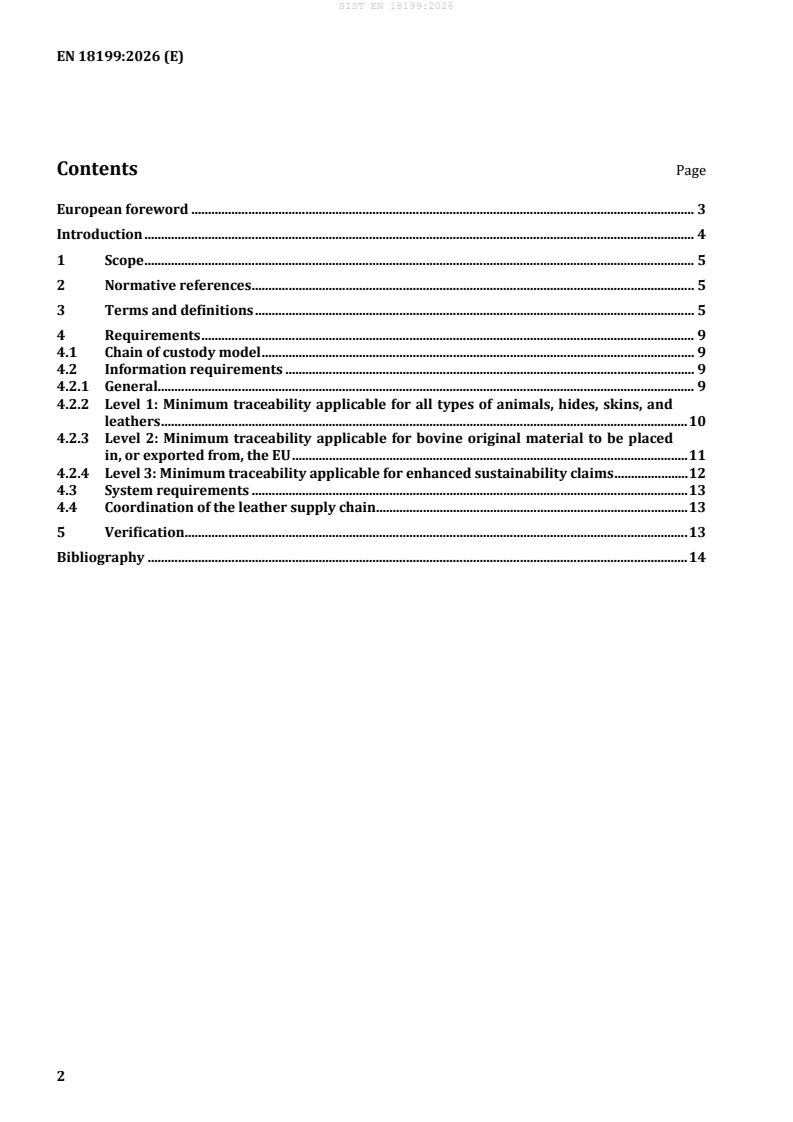
The document is organized into:
- Clause 1: Scope
- Clause 2: Normative references
- Clause 3: Terms and definitions
- Clause 4: Requirements
- Clause 5: Verification
- Bibliography
Clause 4 is the core of the standard. It covers the chain of custody model, three levels of information requirements, system records, and coordination between organizations in the supply chain.
What are the key requirements of EN 18199:2026?
EN 18199:2026 requires a traceability system that uses batch-level segregation and recorded evidence. It does not accept book and claim or mass balance for hides, skins and leather.
Chain of custody model
Clause 4.1 says that material segregation at batch level is the minimum approach. A system based on identity preservation meets or exceeds the standard. In practice, organizations need to keep the physical flow and the records aligned, so batches can be followed without mixing characteristics that would break traceability.
Level 1 traceability
Clause 4.2.2 sets the minimum information for all animals, hides, skins and leathers. The records can use invoices, despatch notes, delivery notes, packing lists, purchase orders, bills of lading, physical or embedded marking, and electronic data systems. At least one piece of data or documentation must be available in the data management system. The key data include transaction date, originating and destination site details, material type, species type, and quantity. In practice, this is the basic evidence set that shows who handled the material, where, and in what form.
Level 2 traceability for bovine material placed in, or exported from, the EU
Clause 4.2.3 adds requirements for bovine original material. It includes the Level 1 information plus items such as geolocation or address data, operator registration or identification number, due diligence statement references, product description, contact details for operators and traders, and verifiable evidence that the product is deforestation-free and legally produced. Any deforested land identified as of the end of 2020 disqualifies the product from due diligence requirements. This matters because bovine material for the EU market needs stronger origin evidence and documented risk control.
Level 3 traceability for sustainability claims
Clause 4.2.4 covers enhanced traceability for sustainability claims. It can require service provider reports, audit reports, and testing certificates, together with evidence linked to the production facility or material. The supporting data may include upstream traceability evidence, chemistry, biodegradability, energy, water, social practice, substance make-up, tannage, thickness, and internal production information. In practice, organizations making claims need proof that can be linked back to the specific material and process.
System records and retention
Clause 4.3 requires the system to define which documents are needed and to describe the organization’s activities, material handling, responsibilities, traceability checks, internal audits, outsourced processes, non-conformities, complaints, and record retention. Records must be kept for at least 5 years. That gives organizations a documented trail for audits and investigations.
Coordination across the supply chain
Clause 4.4 says that when several organizations are involved, their systems must be coordinated and each link must be supported by verifiable information. This means the traceability chain has to connect across farms, processors, traders and manufacturers without gaps.
Verification
Clause 5 says the traceability system shall be available on request as proof of due diligence, and the records should include a clear description of the verification system. In practice, organizations need to be able to show how traceability is checked, not only what they claim.
What terms does EN 18199:2026 define?
- Batch - A quantity of animals or material processed together, which is the unit used for traceability control.
- Book and claim - A chain of custody model where the paper trail is not tied to the physical flow of the material.
- Mass balance - A model where material with specified characteristics is mixed with material without those characteristics under defined rules.
- Segregation - A model that keeps specified characteristics from input to output without allowing incompatible mixing.
- Identity preservation - A process that maintains the unique characteristics of a product throughout the supply chain.
- Traceability - The ability to follow the history, application or location of an object in a supply chain.
- Tannery - The facility where leather production takes place, either fully or in part.
Who uses EN 18199:2026?
EN 18199:2026 is for organizations anywhere in the leather value chain. That includes farms, abattoirs or slaughterhouses, tanneries, traders, finished product manufacturers, and service providers that handle, test or certify material.
It is also relevant to certification bodies, scheme owners, quality managers, compliance teams, and buyers who need traceability evidence for due diligence, sustainability claims, or supply-chain control.
Which standards are used with EN 18199:2026?
- EN 15987, Leather - Terminology - Key definitions for the leather trade - Provides leather-sector terminology used in the document.
- ISO 22095, Chain of custody - General terminology and models - Provides the general chain-of-custody concepts and model language used for the traceability approach.
What does the EN 18199:2026 document contain?
EN 18199:2026 contains a scope statement, referenced terminology, and a requirements framework for leather traceability. Clause 4 gives the practical content: the chain of custody model, the three traceability levels, the data and documents to keep, and the system records needed for checks, complaints and non-conformities.
The document also includes verification guidance in Clause 5 so organizations can show due diligence when asked. Its bibliography points to the EU deforestation regulation and UNECE UN-CEFACT leather value chain reports, which help place the standard in its wider supply-chain context.
Relations
- Effective Date
- 22-Nov-2026
- Effective Date
- 22-Nov-2026
Get Certified
Connect with accredited certification bodies for this standard

Control Union Certifications
Global certification for agriculture and sustainability.

Hohenstein Institut
Textile testing and certification.

Bureau Veritas Bangladesh
Bureau Veritas certification services in Bangladesh.
Sponsored listings
Frequently Asked Questions
EN 18199:2026 is a standard published by the European Committee for Standardization (CEN). Its full title is "Leather - Essential requirements for leather traceability". This standard covers: This document sets the minimum essential elements of traceability and evidence of verification to be present in a leather traceability system, kept by organizations along the animal-to-leather supply chain. It is applicable to all types of leather. This document defines the requirements and related evidence for establishing the traceability of leather back to the originating farms or hunting area. This document can be applied to any organization operating within the leather value chain.
This document sets the minimum essential elements of traceability and evidence of verification to be present in a leather traceability system, kept by organizations along the animal-to-leather supply chain. It is applicable to all types of leather. This document defines the requirements and related evidence for establishing the traceability of leather back to the originating farms or hunting area. This document can be applied to any organization operating within the leather value chain.
EN 18199:2026 is classified under the following ICS (International Classification for Standards) categories: 59.140.30 - Leather and furs. The ICS classification helps identify the subject area and facilitates finding related standards.
EN 18199:2026 has the following relationships with other standards: It is inter standard links to ISO 22095:2020, EN 15987:2022. Understanding these relationships helps ensure you are using the most current and applicable version of the standard.
EN 18199:2026 is available in PDF format for immediate download after purchase. The document can be added to your cart and obtained through the secure checkout process. Digital delivery ensures instant access to the complete standard document.
Standards Content (Sample)
Contents
- Introduction
- 1 Scope
- 2 Normative references
- 3 Terms and definitions
- 3.1 abattoir / slaughterhouse
- 3.2 animal origin
- 3.3 batch
- 3.4 batch system
- 3.5 book and claim
- 3.6 chain of custody
- 3.7 deforested land
- 3.8 direct supplier
- 3.9 indirect supplier
- 3.10 farm
- 3.11 birthing farm
- 3.12 finishing farm (feedlot)
- 3.13 industrialized farm system
- 3.14 rearing farm (raising farm)
- 3.15 finished product manufacturer
- 3.16 geolocation
- 3.17 hide and skin origin
- 3.18 hunting area
- 3.19 identity preservation
- 3.20 mass balance
- 3.21 organization
- 3.22 plot of land
- 3.23 segregation
- 3.24 service provider
- 3.25 subcontractor
- 3.26 supply chain
- 3.27 sustainability claim
- 3.28 tannery
- 3.29 tanning
- 3.30 traceability
- 3.31 trader
- 3.32 value chain
- 4 Requirements
- 4.1 Chain of custody model
- 4.2 Information requirements
- 4.3 System requirements
- 4.4 Coordination of the leather supply chain
- 5 Verification
- Bibliography
Introduction
Public and/or private stakeholders require supply chains to provide information to consumers on how, by whom, and where products are made. Accordingly, traceability of leather back to the place of birth and slaughter of animals whose hide/skin constitute the input material of the tanning process, and transparency in the supply chain have become essential in the leather market. Animal welfare, deforestation, child or forced labour, toxic-free supplies, etc. are some of the ethical considerations that lay behind this growing trend.
Traceability constitutes a particular challenge for the leather industry, as hides and skins obtain their identity separately from the animal at the slaughterhouse, and information on the previous lifecycle is lost in the vast majority of cases. A proliferation of different and diverse approaches on leather traceability risks obliging operators along the animal-to-leather supply chain to implement several systems developed by private certification scheme owners for ascertaining the chain of custody and resulting with audit overlaps and an increase in unproductive costs. The present document provides the requirements agreed by the sector’s certification bodies and scheme owners setting the minimum essential elements for leather traceability and minimum data or information to be kept as evidence.
The document should be used by operators along the leather value chain for implementing their traceability systems, to be verified by a robust assurance process.
SIST EN 18199:2026 EN 18199:2026 (E)
1 Scope
This document sets the minimum essential elements of traceability and evidence of verification to be present in a leather traceability system, kept by organizations along the animal-to-leather supply chain. It is applicable to all types of leather.
This document defines the requirements and related evidence for establishing the traceability of leather back to the originating farms or hunting area.
This document can be applied to any organization operating within the leather value chain.
2 Normative references
The following documents are referred to in the text in such a way that some or all of their content constitutes requirements of this document. For dated references, only the edition cited applies. For undated references, the latest edition of the referenced document (including any amendments) applies. EN 15987, Leather - Terminology - Key definitions for the leather trade ISO 22095, Chain of custody — General terminology and models
3 Terms and definitions
For the purposes of this document, the terms and definitions given in EN 15987, in ISO 22095 and the following apply.
ISO and IEC maintain terminology databases for use in standardization at the following addresses:
- ISO Online browsing platform: available at https://www.iso.org/obp/
- IEC Electropedia: available at https://www.electropedia.org/
3.1 abattoir / slaughterhouse
facility where animals are sent for slaughter at end of life
3.2 animal origin
place where an animal was born
3.3 batch
quantity or consignment of animals farmed, or material processed at the same time
3.4 batch system
method whereby a group (batch) of animals/material is farmed/produced simultaneously (rather than one at a time) Note 1 to entry: It is up to the farmer/manufacturer to decide how big the batch will be, and how often these batches will be processed.
Note 2 to entry: Each batch goes through the separate stages of the farming/manufacturing process together.
SIST EN 18199:2026 EN 18199:2026 (E)
3.5 book and claim
chain of custody model in which the administrative record flow is not necessarily connected to the physical flow of material or product throughout the supply chain Note 1 to entry: This chain of custody model is also referred to as “certificate trading model” or “credit trading”. Note 2 to entry: This is often used where the certified/specified material is not, or only with difficulty, be kept separate from the non-certified/specified material, such as green credits in an electricity supply. [SOURCE: ISO 22095]
3.6 chain of custody
process by which inputs and outputs and associated information are transferred, monitored and controlled as they move through each step in the relevant supply chain [SOURCE: ISO 22095]
3.7 deforested land
plot of forest converted to agricultural use, whether human-induced or not [SOURCE: Regulation (EU) 2023/1115 [1], modified]
3.8 direct supplier
person, party or company that supplies goods/services directly to a person, party or company Note 1 to entry: A company may be an organization, manufacturing facility or farm.
3.9 indirect supplier
person, party or company that supplies goods/services to another supplier as an intermediary Note 1 to entry: A company may be an organization, manufacturing facility or farm.
3.10 farm
all places where the birth, raising and/or finishing or full life cycle of an animal takes place
3.11 birthing farm
facility where animals are born and stay with their mothers until they are weaned
3.12 finishing farm (feedlot)
facility where animals spend the last period of life, prior to slaughter, to ensure optimum weight and health for meat production Note 1 to entry: For cattle it is approx. 4 months before slaughter.
SIST EN 18199:2026 EN 18199:2026 (E)
3.13 industrialized farm system
system that combines the characteristics of a birthing farm, rearing farm (raising farm) and finishing farm (feedlot), and is commonly used for large volume meat production
3.14 rearing farm (raising farm)
facility where young animals are sent to continue to grow to a pre-determined age/weight
3.15 finished product manufacturer
person, party or company that transforms finished leather into final products
3.16 geolocation
geographical location of a plot of land described by means of latitude and longitude coordinates, corresponding to at least one latitude and one longitude point and using at least six decimal digits Note 1 to entry: For plots of land of more than four hectares used for the production of the relevant commodities other than cattle, this shall be provided using polygons with sufficient latitude and longitude points to describe the perimeter of each plot of land.
[SOURCE: Regulation (EU) 2023/1115 [1], modified]
3.17 hide and skin origin
place where the hide or skin is separated from the carcass
3.18 hunting area
geographic area where people are allowed to hunt wild animals, such as a forest or woodland
3.19 identity preservation
process that maintains the unique characteristics of a product throughout its supply chain [SOURCE: ISO 22095]
3.20 mass balance
chain of custody model in which materials or products with a set of specified characteristics are mixed according to defined criteria with materials or products without that set of characteristics Note 1 to entry: The proportion of the input with specified characteristics only match the initial proportions on average and typically vary across different outputs.
[SOURCE: ISO 22095]
...