

EN 12859:2011
(Main)Gypsum blocks - Definitions, requirements and test methods
- Abstract
This European Standard specifies the characteristics and performance of gypsum blocks with smooth faces for which the main intended uses are construction of non-load bearing partitions or independent wall linings and the fire protection of columns, lift shafts, shafts for services, etc. Gypsum blocks are not used to build ceilings.
It covers the following performance characteristics related to the essential requirements:
- reaction to fire;
- resistance to fire;
- direct airborne sound insulation;
- release of dangerous substances;
to be measured according to the corresponding European test methods, as well as:
- thermal resistance
to be calculated from the thermal conductivity values given in 4.3.2.
It describes the reference tests for technical specifications.
This European Standard covers also additional technical characteristics that are of importance for the use and acceptance of the product by the construction industry:
- convenience classes for density;
- convenience classes for pH.
It provides for the evaluation of conformity of the product to this European Standard.
This European Standard does not cover gypsum blocks of thickness less than 50 mm or gypsum storey height units.
- Status
- Published
- Publication Date
- 15-Feb-2011
- Withdrawal Date
- 30-Aug-2011
- Technical Committee
- CEN/TC 241 - Gypsum and gypsum based products
- Drafting Committee
- CEN/TC 241/WG 1 - Powders
- Current Stage
- 9060 - Closure of 2 Year Review Enquiry - Review Enquiry
- Start Date
- 04-Mar-2019
- Completion Date
- 04-Mar-2019
- Directive
- 305/2011 - Regulation (eu) No 305/2011 of the European Parliament and of the Council of 9 march 2011 laying down harmonised conditions for the marketing of construction products and repealing council directive 89/106/eecOJ Ref: C, C 259 OJ Date: 08-Aug-2014
89/106/EEC - Construction productsOJ Ref: C, C 246 OJ Date: 24-Aug-2011

Overview
EN 12859:2011 - Gypsum blocks: Definitions, requirements and test methods - is the CEN European Standard that defines the characteristics, performance criteria and test procedures for smooth-faced gypsum blocks intended primarily for non‑load bearing partitions, independent wall linings and fire protection of columns, lift shafts and service shafts. The standard excludes gypsum blocks thinner than 50 mm and gypsum storey‑height units, and it explicitly states gypsum blocks are not to be used for ceilings.
Key topics and technical requirements
EN 12859:2011 sets out mandatory performance characteristics and the reference test methods to verify them:
- Reaction to fire and resistance to fire (fire behaviour performance measured by European test methods).
- Direct airborne sound insulation (acoustic performance).
- Release of dangerous substances (health and environmental safety).
- Thermal resistance (calculated from thermal conductivity values given in the standard).
Additional product properties and test procedures included:
- Dimensions, tolerances and flatness (sampling and measurement rules).
- Dry density and convenience classes for density.
- pH classes for suitability and acceptance on site.
- Moisture content, bending strength, surface mass, water absorption (including hydrophobic products) and related test methods.
- Sampling rules for factory and independent acceptance testing, plus evaluation of conformity (initial type testing and factory production control).
- An informative annex on surface hardness and an Annex ZA addressing the relationship with EU Construction Products Directive and CE marking requirements.
Applications (practical value)
EN 12859:2011 is applied where reliable, standardized gypsum block performance is needed:
- Construction of non‑load bearing interior partitions and demountable walls.
- Independent wall linings for retrofit or new builds.
- Passive fire protection systems for structural elements, lift shafts and service shafts.
- Product specification and compliance documentation for tenders, building permits and CE marking.
Who should use this standard
- Gypsum block manufacturers (product specification, factory production control, CE marking).
- Test laboratories and inspectors (sampling, test methods, reporting).
- Architects, specifiers and consultants (selecting materials for acoustic, thermal and fire requirements).
- Contractors and installers (acceptance criteria and site verification).
- Regulatory bodies and certifiers (conformity assessment vs. EU directives).
Related standards & compliance
EN 12859:2011 sits within the family of gypsum product standards and links to other European test methods referenced for fire, acoustic and material testing. It supports conformity procedures (initial type testing, factory production control) and CE marking in line with the Construction Products Directive.
Keywords: EN 12859:2011, gypsum blocks, fire resistance, reaction to fire, sound insulation, thermal resistance, CE marking, test methods, construction materials.
Relations
- Effective Date
- 16-Jan-2010
- Effective Date
- 28-Jan-2026
- Effective Date
- 28-Jan-2026
- Effective Date
- 28-Jan-2026
- Effective Date
- 28-Jan-2026
- Effective Date
- 28-Jan-2026
- Effective Date
- 28-Jan-2026
- Effective Date
- 28-Jan-2026
Get Certified
Connect with accredited certification bodies for this standard

DIBt (Deutsches Institut für Bautechnik)
German Institute for Building Technology.
DIN CERTCO
DIN Group product certification.

Aboma Certification B.V.
Specialized in construction, metal, and transport sectors.
Sponsored listings
Frequently Asked Questions
EN 12859:2011 is a standard published by the European Committee for Standardization (CEN). Its full title is "Gypsum blocks - Definitions, requirements and test methods". This standard covers: This European Standard specifies the characteristics and performance of gypsum blocks with smooth faces for which the main intended uses are construction of non-load bearing partitions or independent wall linings and the fire protection of columns, lift shafts, shafts for services, etc. Gypsum blocks are not used to build ceilings. It covers the following performance characteristics related to the essential requirements: - reaction to fire; - resistance to fire; - direct airborne sound insulation; - release of dangerous substances; to be measured according to the corresponding European test methods, as well as: - thermal resistance to be calculated from the thermal conductivity values given in 4.3.2. It describes the reference tests for technical specifications. This European Standard covers also additional technical characteristics that are of importance for the use and acceptance of the product by the construction industry: - convenience classes for density; - convenience classes for pH. It provides for the evaluation of conformity of the product to this European Standard. This European Standard does not cover gypsum blocks of thickness less than 50 mm or gypsum storey height units.
This European Standard specifies the characteristics and performance of gypsum blocks with smooth faces for which the main intended uses are construction of non-load bearing partitions or independent wall linings and the fire protection of columns, lift shafts, shafts for services, etc. Gypsum blocks are not used to build ceilings. It covers the following performance characteristics related to the essential requirements: - reaction to fire; - resistance to fire; - direct airborne sound insulation; - release of dangerous substances; to be measured according to the corresponding European test methods, as well as: - thermal resistance to be calculated from the thermal conductivity values given in 4.3.2. It describes the reference tests for technical specifications. This European Standard covers also additional technical characteristics that are of importance for the use and acceptance of the product by the construction industry: - convenience classes for density; - convenience classes for pH. It provides for the evaluation of conformity of the product to this European Standard. This European Standard does not cover gypsum blocks of thickness less than 50 mm or gypsum storey height units.
EN 12859:2011 is classified under the following ICS (International Classification for Standards) categories: 91.100.10 - Cement. Gypsum. Lime. Mortar. The ICS classification helps identify the subject area and facilitates finding related standards.
EN 12859:2011 has the following relationships with other standards: It is inter standard links to EN 12859:2008, EN ISO 6946:2007, EN 13501-2:2023, EN 13501-1:2018, EN ISO 10456:2007, EN ISO 10140-3:2021, EN ISO 717-1:2020, EN 15254-2:2009. Understanding these relationships helps ensure you are using the most current and applicable version of the standard.
EN 12859:2011 is associated with the following European legislation: EU Directives/Regulations: 305/2011, 89/106/EEC; Standardization Mandates: M/106. When a standard is cited in the Official Journal of the European Union, products manufactured in conformity with it benefit from a presumption of conformity with the essential requirements of the corresponding EU directive or regulation.
EN 12859:2011 is available in PDF format for immediate download after purchase. The document can be added to your cart and obtained through the secure checkout process. Digital delivery ensures instant access to the complete standard document.
Standards Content (Sample)
2003-01.Slovenski inštitut za standardizacijo. Razmnoževanje celote ali delov tega standarda ni dovoljeno.Gips-Wandbauplatten - Begriffe, Anforderungen und PrüfverfahrenCarreaux de plâtre - Définitions, spécifications et méthodes d'essaiGypsum blocks - Definitions, requirements and test methods91.100.10Cement. Mavec. Apno. MaltaCement. Gypsum. Lime. Mortar01.040.91Gradbeni materiali in gradnja (Slovarji)Construction materials and building (Vocabularies)ICS:Ta slovenski standard je istoveten z:EN 12859:2011SIST EN 12859:2011en,fr,de01-junij-2011SIST EN 12859:2011SLOVENSKI
STANDARDSIST EN 12859:20081DGRPHãþD
EUROPEAN STANDARD NORME EUROPÉENNE EUROPÄISCHE NORM
EN 12859
February 2011 ICS 91.100.10 Supersedes EN 12859:2008English Version
Gypsum blocks - Definitions, requirements and test methods
Carreaux de plâtre - Définitions, spécifications et méthodes d'essai
Gips-Wandbauplatten - Begriffe, Anforderungen und Prüfverfahren This European Standard was approved by CEN on 2 January 2011.
CEN members are bound to comply with the CEN/CENELEC Internal Regulations which stipulate the conditions for giving this European Standard the status of a national standard without any alteration. Up-to-date lists and bibliographical references concerning such national standards may be obtained on application to the CEN-CENELEC Management Centre or to any CEN member.
This European Standard exists in three official versions (English, French, German). A version in any other language made by translation under the responsibility of a CEN member into its own language and notified to the CEN-CENELEC Management Centre has the same status as the official versions.
CEN members are the national standards bodies of Austria, Belgium, Bulgaria, Croatia, Cyprus, Czech Republic, Denmark, Estonia, Finland, France, Germany, Greece, Hungary, Iceland, Ireland, Italy, Latvia, Lithuania, Luxembourg, Malta, Netherlands, Norway, Poland, Portugal, Romania, Slovakia, Slovenia, Spain, Sweden, Switzerland and United Kingdom.
EUROPEAN COMMITTEE FOR STANDARDIZATION
COMITÉ EUROPÉEN DE NORMALISATION EUROPÄISCHES KOMITEE FÜR NORMUNG
Management Centre:
Avenue Marnix 17,
B-1000 Brussels © 2011 CEN All rights of exploitation in any form and by any means reserved worldwide for CEN national Members. Ref. No. EN 12859:2011: ESIST EN 12859:2011
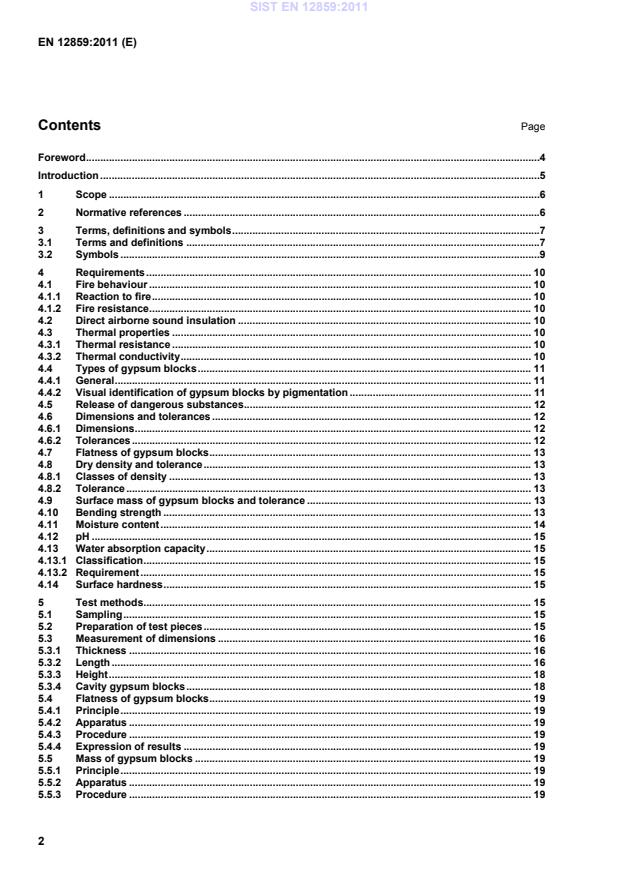
Sampling for independent acceptance testing carried out by a third party . 26A.1General . 26A.2Sampling procedure . 26Annex B (informative)
Surface hardness . 28B.1General . 28B.2Requirements . 28B.3Test method . 28Annex ZA (informative)
Clauses of this European Standard addressing the provisions of the EU Construction Products Directive . 30ZA.1Scope and relevant characteristics . 30ZA.2Procedure for attestation of conformity of gypsum blocks . 31ZA.3CE Marking and labelling . 32Bibliography . 35 SIST EN 12859:2011
Figure 1 — Family of gypsum binders and gypsum products SIST EN 12859:2011
to be calculated from the thermal conductivity values given in 4.3.2. It describes the reference tests for technical specifications. This European Standard covers also additional technical characteristics that are of importance for the use and acceptance of the product by the construction industry: convenience classes for density; convenience classes for pH. It provides for the evaluation of conformity of the product to this European Standard. This European Standard does not cover gypsum blocks of thickness less than 50 mm or gypsum storey height units. 2 Normative references The following referenced documents are indispensable for the application of this document. For dated references, only the edition cited applies. For undated references, the latest edition of the referenced document (including any amendments) applies. EN 13501-1, Fire classification of construction products and building elements — Part 1: Classification using data from reaction to fire tests EN 13501-2, Fire classification of construction products and building elements — Part 2: Classification using data from fire resistance tests, excluding ventilation services EN ISO 717-1, Acoustics — Rating of sound insulation in buildings and of building elements — Part 1: Airborne sound insulation (ISO 717-1:1996)1)
1) This reference is impacted by the stand-alone amendment EN ISO 717-1:1996/A1:2006. SIST EN 12859:2011
NOTE See example on Figure 2. 3.1.5 face plain and smooth surface intended to provide the finish of a partition
NOTE See Figure 2. 3.1.6 edge extreme side of the gypsum block having tongues and grooves
NOTE See Figure 2. 3.1.7 thickness distance between the two faces of a gypsum block
NOTE See Figure 2. SIST EN 12859:2011
NOTE See Figure 2. 3.1.9 height smaller distance between two edges of a gypsum block
NOTE See Figure 2. SIST EN 12859:2011
Key 1 Preformed cavities 2 Face 3 Thickness 4 Height 5 Length Figure 2 — Gypsum block 3.2 Symbols For the purposes of this document, the following symbols apply: ρ gross dry density, in kilograms per cubic metre (kg/m3) λ thermal conductivity, in Watts per metre per Kelvin (W/m·K) SIST EN 12859:2011
Table 1 — Design values of thermal conductivity of gypsum plaster ρρρρ
λλλλ 23-50 kg/m3 W/(m.K) 600 0,18 700 0,22 800 0,26 900 0,30 1 000 0,34 1 100 0,39 1 200 0,43 1 300 0,47 1 400 0,51 1 500 0,56
The values given in Table 1 are taken from EN ISO 10456:2007. Design values concern dry material used inside. When the material is wet, adjust these values using EN ISO 10456. 4.4 Types of gypsum blocks 4.4.1 General Gypsum blocks are manufactured in two types of strength class A and R (see 4.10). Gypsum blocks are manufactured in three types of density Low, Medium and Dense (see 4.8). Gypsum blocks are manufactured in three classes of water absorption H1, H2 and H3 (See 4.13). 4.4.2 Visual identification of gypsum blocks by pigmentation 4.4.2.1 General Visual identification of the different types of gypsum blocks follows the two driteria: density; water absorption. 4.4.2.2 Pigmentation of gypsum blocks following density classes Gypsum blocks are manufactured in three classes of density (see 4.8). SIST EN 12859:2011
4.4.2.3 Pigmentation of gypsum blocks following water absorption Gypsum blocks are manufactured in three classes of water absorption (see 4.13). Table 3 — Classes of water absorption, colour of gypsum blocks and designation Colour Water absorption Designation Natural No requirement H3 a Blue ≤ 5 % H2 Green ≤ 2,5 % H1 a The visual identification by colour of the class for the density applies for the class H3 only (Class of water absorption).
4.5 Release of dangerous substances NOTE For CE marking purposes, see Annex ZA.1, Note. 4.6 Dimensions and tolerances 4.6.1 Dimensions Gypsum block dimensions are determined by the thickness, the length and the height. The thickness shall be at least 50 mm and shall not exceed 150 mm. The length shall not exceed 1 000 mm. The height shall be determined in conjunction with the length so that the surface area of a block is at least 0,10 m2. NOTE Preferred dimensions are for thickness: 50 mm, 60 mm, 70 mm, 80 mm, 100 mm, for length : 666 mm and for height: 500 mm. In cavity gypsum blocks, the wall gypsum plaster shall be at least 15 mm thick throughout the block. The total cavity volume shall not exceed 40 %. 4.6.2 Tolerances The dimensions of individual blocks, when measured in accordance with 5.3, shall have tolerances as follows: thickness: ± 0,5 mm; length: ± 5 mm; SIST EN 12859:2011
≤ 1 500 kg/m3 Medium density (M) 800 ≤ ρ < 1 100 kg/m3 Low density (L) 600 ≤ ρ < 800 kg/m3 4.8.2 Tolerance The average gross dry density within each class shall not deviate by more than 5 % from the average value measured in accordance with 5.6. 4.9 Surface mass of gypsum blocks and tolerance The producer declares the surface mass (mass per square metre) of his gypsum blocks. When the mass of gypsum blocks is determined in accordance with 5.5 and their surface calculated in accordance with 5.3.2 and 5.3.3, the average surface mass of gypsum blocks shall not deviate by more than 5 % from the declared surface mass. 4.10 Bending strength Gypsum blocks of type A shall have a bending strength appropriate to their use, and for this, when tested in accordance with 5.7, they shall withstand the load given in Table 4a). In special cases gypsum blocks may be required having an enhanced strength, gypsum blocks of type R. These gypsum blocks shall withstand the load given in Table 4b). SIST EN 12859:2011
Minimum average breaking load kN Solid blocks (medium and high density) Thickness in mm: 50 60 70 80 100
1,7 1,9 2,3 2,7 4,0 Cavity and low density blocks (all thicknesses) 1,7 a For gypsum blocks shorter than 650 mm and/or with a height different to 500 mm, the values in the second column shall be amended in the ratio of the spans and/or heights (see 5.7.4).
Table 4b) — Breaking loads of gypsum blocks of type R Gypsum blocks equal or longer than 650 mm with a height of 500 mm a
Minimum average breaking load kN
Thickness in mm: 50 60 70 80 100 Solid blocks and cavity blocks (medium or high density)
2,0 2,2 3,0 3,0 5,0 a For gypsum blocks shorter than 650 mm and/or with a height different to 500 mm, the values in the second column shall be amended in the ratio of the spans and/or heights
...