

EN 17331:2023
(Main)Construction products: Assessment of release of dangerous substances - Content of organic substances - Methods for extraction and analysis
General Information
- Abstract
This document specifies analytical methods for the determination of the content of specific organic substances in construction products.
The following parameters are covered: BTEX, biocides, dioxins, furans and dioxin-like PCBs, mineral oil, nonylphenols, PAH, PCB, PCP, PBDE, and short-chain chlorinated paraffins.
NOTE 1 Methods still under development or available at national level only are listed in Annex B (informative) for PFOS, PFOA, HBCD and EOX. The methods can be included in the normative text as soon as full EN standards are available.
NOTE 2 Methods that have not been validated for construction products, because no suitable material was available at the time of the robustness validation, only are listed in Annex B (informative). This applies to organotin compounds, phenols and phthalates.
The methods listed in this document come from different fields and are expected to be suitable for organic substances in organic extracts from all types of constructions products.
The methods in this document are validated for the product types listed in Annex A (informative).
NOTE 3 Construction products include, e.g. mineral-based products (S), bituminous products (B), wood-based products (W), plastic and rubbers (P), sealants and adhesives (A), paints and coatings (C) and metals (M) (see also CEN/TR 16045). This document includes analytical methods for all matrices except metals.
- Status
- Published
- Publication Date
- 21-Nov-2023
- Technical Committee
- CEN/TC 351 - Construction Products - Assessment of release of dangerous substances
- Drafting Committee
- CEN/TC 351/WG 5 - Content and eluate analysis in construction products
- Current Stage
- 6060 - Definitive text made available (DAV) - Publishing
- Start Date
- 22-Nov-2023
- Due Date
- 25-Jan-2023
- Completion Date
- 22-Nov-2023

Overview
EN 17331:2023 (CEN) - "Construction products: Assessment of release of dangerous substances - Content of organic substances - Methods for extraction and analysis" - specifies analytical procedures to determine the content of selected organic substances in construction products. The standard collects validated extraction and analytical methods drawn from related fields (soil, sludge, waste) and applies them to construction-material matrices (except metals). It is part of the CEN/TC 351 modular approach for assessing release of dangerous substances.
Key topics and requirements
- Scope of analytes: BTEX (benzene, toluene, ethylbenzene, xylenes), biocides, dioxins/furans and dioxin-like PCBs, mineral oil, nonylphenols, PAH, PCB, PCP (pentachlorophenol), PBDE, and short‑chain chlorinated paraffins (SCCP).
- Methods under development / national methods: PFOS, PFOA, HBCD and EOX are listed in Annex B (informative) until full EN methods are available. Organotin compounds, phenols and phthalates are also listed in Annex B where validation on construction products was not possible.
- Analytical techniques referenced: gas chromatography (GC), high-resolution GC, mass spectrometry (MS/HR GC‑MS), liquid chromatography–tandem MS (LC‑MS/MS), Soxhlet, pressurized liquid extraction (PLE), and liquid–liquid / solid–liquid extraction methods are among the techniques reflected through the normative references.
- Quality considerations: provisions for sample preparation (see EN 17087), blank determination, interference management, method detection limits (MDL), expression of results, and test performance/validation (Annex A contains validation results).
- Product matrices: validated for the product types listed in Annex A (informative) - e.g., mineral-based (S), bituminous (B), wood-based (W), plastics/rubbers (P), sealants/adhesives (A), paints/coatings (C) - methods exclude metals.
Applications and users
- Who uses it: testing laboratories, manufacturers of construction products, regulatory authorities, environmental and compliance consultants, and standardization bodies.
- Practical uses:
- Determining total content of hazardous organic substances for product safety assessments.
- Supporting risk assessments and compliance with regulatory frameworks concerning release of dangerous substances.
- Selecting validated extraction and analysis modules when designing test protocols for specific construction materials.
- Harmonizing laboratory practice across Europe via referenced EN methods.
Related standards
- EN 17087 - Preparation of test portions from laboratory sample
- EN 16687 - Terminology for assessment of release of dangerous substances
- EN 17844 / EN 17845 - Methods for PAH, BTEX and biocide residue analysis
- EN 17322, EN 16190, EN 14039, EN ISO 22032 and CEN/TR 16045 - referenced analytical and background documents
EN 17331:2023 is a horizontal, modular reference for the analytical step in assessing organic contaminants in construction products and should be used together with the cited normative standards and the product‑specific validation guidance in Annex A.
Relations
- Effective Date
- 18-Jan-2023
- Effective Date
- 17-Sep-2026
- Effective Date
- 27-May-2026
- Effective Date
- 28-Jan-2026
- Effective Date
- 28-Jan-2026
- Effective Date
- 28-Jan-2026
- Effective Date
- 28-Jan-2026
- Effective Date
- 28-Jan-2026
- Effective Date
- 28-Jan-2026
- Effective Date
- 28-Jan-2026
- Refers
EN 16687:2023 - Construction products: Assessment of release of dangerous substances - Terminology - Effective Date
- 28-Jan-2026
- Effective Date
- 28-Jan-2026
- Effective Date
- 28-Jan-2026
Get Certified
Connect with accredited certification bodies for this standard

DIBt (Deutsches Institut für Bautechnik)
German Institute for Building Technology.
DIN CERTCO
DIN Group product certification.

Aboma Certification B.V.
Specialized in construction, metal, and transport sectors.
Sponsored listings
Frequently Asked Questions
EN 17331:2023 is a standard published by the European Committee for Standardization (CEN). Its full title is "Construction products: Assessment of release of dangerous substances - Content of organic substances - Methods for extraction and analysis". This standard covers: This document specifies analytical methods for the determination of the content of specific organic substances in construction products. The following parameters are covered: BTEX, biocides, dioxins, furans and dioxin-like PCBs, mineral oil, nonylphenols, PAH, PCB, PCP, PBDE, and short-chain chlorinated paraffins. NOTE 1 Methods still under development or available at national level only are listed in Annex B (informative) for PFOS, PFOA, HBCD and EOX. The methods can be included in the normative text as soon as full EN standards are available. NOTE 2 Methods that have not been validated for construction products, because no suitable material was available at the time of the robustness validation, only are listed in Annex B (informative). This applies to organotin compounds, phenols and phthalates. The methods listed in this document come from different fields and are expected to be suitable for organic substances in organic extracts from all types of constructions products. The methods in this document are validated for the product types listed in Annex A (informative). NOTE 3 Construction products include, e.g. mineral-based products (S), bituminous products (B), wood-based products (W), plastic and rubbers (P), sealants and adhesives (A), paints and coatings (C) and metals (M) (see also CEN/TR 16045). This document includes analytical methods for all matrices except metals.
This document specifies analytical methods for the determination of the content of specific organic substances in construction products. The following parameters are covered: BTEX, biocides, dioxins, furans and dioxin-like PCBs, mineral oil, nonylphenols, PAH, PCB, PCP, PBDE, and short-chain chlorinated paraffins. NOTE 1 Methods still under development or available at national level only are listed in Annex B (informative) for PFOS, PFOA, HBCD and EOX. The methods can be included in the normative text as soon as full EN standards are available. NOTE 2 Methods that have not been validated for construction products, because no suitable material was available at the time of the robustness validation, only are listed in Annex B (informative). This applies to organotin compounds, phenols and phthalates. The methods listed in this document come from different fields and are expected to be suitable for organic substances in organic extracts from all types of constructions products. The methods in this document are validated for the product types listed in Annex A (informative). NOTE 3 Construction products include, e.g. mineral-based products (S), bituminous products (B), wood-based products (W), plastic and rubbers (P), sealants and adhesives (A), paints and coatings (C) and metals (M) (see also CEN/TR 16045). This document includes analytical methods for all matrices except metals.
EN 17331:2023 is classified under the following ICS (International Classification for Standards) categories: 91.100.01 - Construction materials in general. The ICS classification helps identify the subject area and facilitates finding related standards.
EN 17331:2023 has the following relationships with other standards: It is inter standard links to CEN/TS 17331:2019, EN 14823:2026, EN ISO 22032:2026, EN 16190:2018, EN 17845:2023, EN 17087:2019, EN ISO 22032:2009, CEN/TR 14823:2003, CEN/TS 16182:2012, EN 14039:2004, EN 16687:2023, EN 17844:2023, EN ISO 18475:2025. Understanding these relationships helps ensure you are using the most current and applicable version of the standard.
EN 17331:2023 is associated with the following European legislation: EU Directives/Regulations: 305/2011; Standardization Mandates: M/366. When a standard is cited in the Official Journal of the European Union, products manufactured in conformity with it benefit from a presumption of conformity with the essential requirements of the corresponding EU directive or regulation.
EN 17331:2023 is available in PDF format for immediate download after purchase. The document can be added to your cart and obtained through the secure checkout process. Digital delivery ensures instant access to the complete standard document.
Standards Content (Sample)
SLOVENSKI STANDARD
01-april-2024
Nadomešča:
SIST-TS CEN/TS 17331:2019
Gradbeni proizvodi - Ocenjevanje sproščanja nevarnih snovi - Vsebnost organskih
snovi - Metode za ekstrakcijo in analizo
Construction products - Assessment of release of dangerous substances - Content of
organic substances - Methods for extraction and analysis
Bauprodukte - Bewertung der Freisetzung von gefährlichen Stoffen - Gehalt an
organischen Stoffen - Extraktions- und Analyseverfahren
Produits de construction - Évaluation de l'émission de substances dangereuses - Teneur
en matières organiques - Méthodes d'extraction et d'analyse
Ta slovenski standard je istoveten z: EN 17331:2023
ICS:
13.020.99 Drugi standardi v zvezi z Other standards related to
varstvom okolja environmental protection
91.100.01 Gradbeni materiali na Construction materials in
splošno general
2003-01.Slovenski inštitut za standardizacijo. Razmnoževanje celote ali delov tega standarda ni dovoljeno.
EN 17331
EUROPEAN STANDARD
NORME EUROPÉENNE
November 2023
EUROPÄISCHE NORM
ICS 91.100.01 Supersedes CEN/TS 17331:2019
English Version
Construction products: Assessment of release of
dangerous substances - Content of organic substances -
Methods for extraction and analysis
Produits de construction : Évaluation de l'émission de Bauprodukte: Bewertung der Freisetzung von
substances dangereuses - Teneur en matières gefährlichen Stoffen - Gehalt an organischen Stoffen -
organiques - Méthodes d'extraction et d'analyse Extraktions- und Analyseverfahren
This European Standard was approved by CEN on 14 August 2023.
CEN members are bound to comply with the CEN/CENELEC Internal Regulations which stipulate the conditions for giving this
European Standard the status of a national standard without any alteration. Up-to-date lists and bibliographical references
concerning such national standards may be obtained on application to the CEN-CENELEC Management Centre or to any CEN
member.
This European Standard exists in three official versions (English, French, German). A version in any other language made by
translation under the responsibility of a CEN member into its own language and notified to the CEN-CENELEC Management
Centre has the same status as the official versions.
CEN members are the national standards bodies of Austria, Belgium, Bulgaria, Croatia, Cyprus, Czech Republic, Denmark, Estonia,
Finland, France, Germany, Greece, Hungary, Iceland, Ireland, Italy, Latvia, Lithuania, Luxembourg, Malta, Netherlands, Norway,
Poland, Portugal, Republic of North Macedonia, Romania, Serbia, Slovakia, Slovenia, Spain, Sweden, Switzerland, Türkiye and
United Kingdom.
EUROPEAN COMMITTEE FOR STANDARDIZATION
COMITÉ EUROPÉEN DE NORMALISATION
EUROPÄISCHES KOMITEE FÜR NORMUNG
CEN-CENELEC Management Centre: Rue de la Science 23, B-1040 Brussels
© 2023 CEN All rights of exploitation in any form and by any means reserved Ref. No. EN 17331:2023 E
worldwide for CEN national Members.
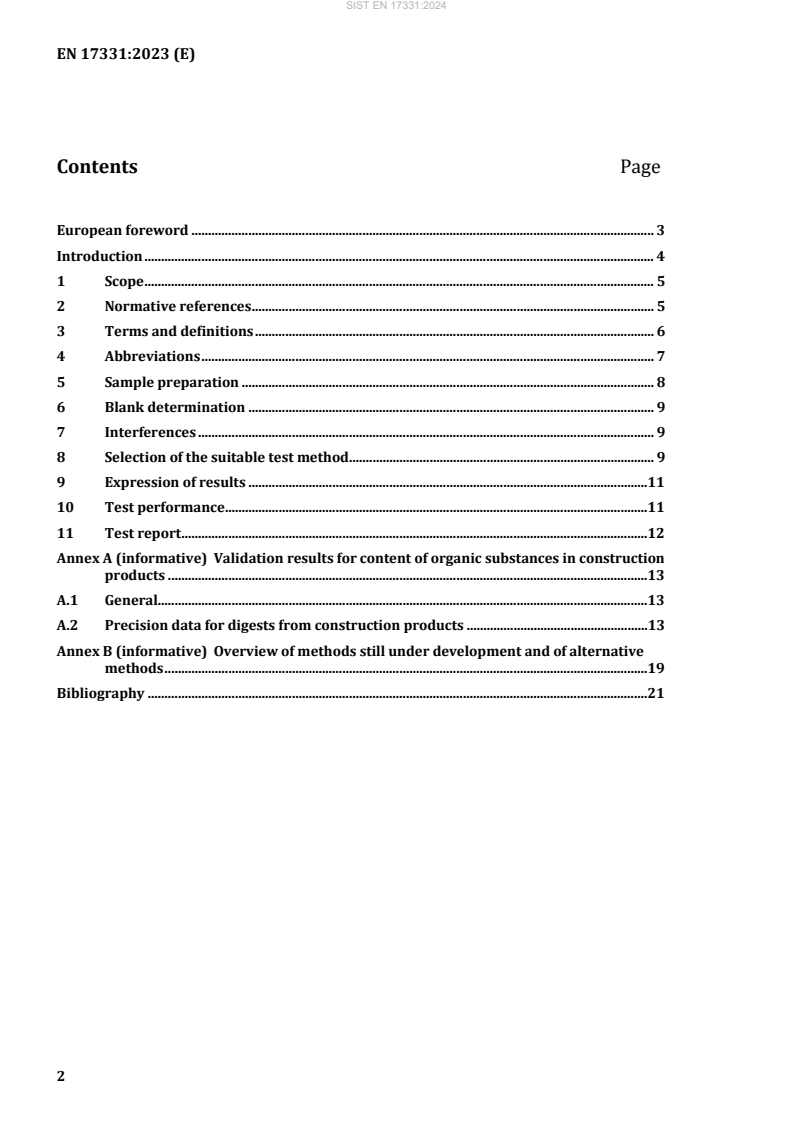
Contents Page
European foreword . 3
Introduction . 4
1 Scope . 5
2 Normative references . 5
3 Terms and definitions . 6
4 Abbreviations . 7
5 Sample preparation . 8
6 Blank determination . 9
7 Interferences . 9
8 Selection of the suitable test method . 9
9 Expression of results .11
10 Test performance .11
11 Test report .12
Annex A (informative) Validation results for content of organic substances in construction
products .13
A.1 General.13
A.2 Precision data for digests from construction products .13
Annex B (informative) Overview of methods still under development and of alternative
methods .19
Bibliography .21
European foreword
This document (EN 17331:2023) has been prepared by Technical Committee CEN/TC 351
“Construction products: Assessment of release of dangerous substances”, the secretariat of which is held
by NEN.
This European Standard shall be given the status of a national standard, either by publication of an
identical text or by endorsement, at the latest by May 2024, and conflicting national standards shall be
withdrawn at the latest by May 2024.
Attention is drawn to the possibility that some of the elements of this document may be the subject of
patent rights. CEN shall not be held responsible for identifying any or all such patent rights.
This document supersedes CEN/TS 17331:2019.
In comparison with the previous edition, the following technical modifications have been made:
— the addition of performance data and data from intercomparison validation;
— alignment of terms and definitions within the working groups of CEN/TC 351, i.e. through the
revised version of EN 16687.
This document has been prepared under a Standardization Request given to CEN by the European
Commission and the European Free Trade Association.
Any feedback and questions on this document should be directed to the users’ national standards body.
A complete listing of these bodies can be found on the CEN website.
According to the CEN-CENELEC Internal Regulations, the national standards organisations of the
following countries are bound to implement this European Standard: Austria, Belgium, Bulgaria, Croatia,
Cyprus, Czech Republic, Denmark, Estonia, Finland, France, Germany, Greece, Hungary, Iceland, Ireland,
Italy, Latvia, Lithuania, Luxembourg, Malta, Netherlands, Norway, Poland, Portugal, Republic of North
Macedonia, Romania, Serbia, Slovakia, Slovenia, Spain, Sweden, Switzerland, Türkiye and the United
Kingdom.
Introduction
This document deals with the determination of the content of organic substances in construction
products.
Following an extended evaluation of available methods for content and eluate analysis in construction
products (CEN/TR 16045) it was concluded that existing methods for determining content of various
organic substances in soil, sludge and waste are applicable to construction products. The present
document therefore contains reference to such other standards for the substances of interest.
In the growing amount of product- and sector-oriented test methods it was recognized that many steps
in test procedures are or could be used in test procedures for many products, materials and sectors. It
was supposed that, by careful determination of these steps and selection of specific questions within
these steps, elements of the test procedure could be described in a way that can be used for all materials
and products or for all materials and products with certain specifications.
In this context a horizontal modular approach was adopted in CEN/TC 351. “Horizontal” means that the
methods can be used for a wide range of materials and products with certain properties. “Modular”
means that a test standard developed in this approach concerns a specific step in assessing a property
and not the whole “chain of measurement” (from sampling to analyses). A beneficial feature of this
approach is that “modules” can be replaced by better ones without jeopardizing the standard “chain”.
The modules that relate to the standards developed in CEN/TC 351 are specified in CEN/TR 16220,
which distinguishes between the modules. This document belongs to the analytical step.
The use of modular horizontal standards implies the drawing of test schemes as well. Before executing
a test on a certain material or product to determine certain characteristics it is recommended to draw
up a protocol in which the adequate modules are selected and together form the basis for the entire test
procedure.
Further guidance on the applicability of specific test methods can be found in CEN/TR 16496.
NOTE In Annex B (informative) several methods are mentioned which are, to the current knowledge of
CEN/TC 351/WG 5 members, national standards or in the process of standardization (at European or national
level).
1 Scope
This document specifies analytical methods for the determination of the content of specific organic
substances in construction products.
The following parameters are covered: BTEX, biocides, dioxins, furans and dioxin-like PCBs, mineral oil,
nonylphenols, PAH, PCB, PCP, PBDE, and short-chain chlorinated paraffins.
NOTE 1 Methods still under development or available at national level only are listed in Annex B (informative)
for PFOS, PFOA, HBCD and EOX. The methods can be included in the normative text as soon as full EN standards
are available.
NOTE 2 Methods that have not been validated for construction products, because no suitable material was
available at the time of the robustness validation, only are listed in Annex B (informative). This applies to organotin
compounds, phenols and phthalates.
The methods listed in this document come from different fields and are expected to be suitable for
organic substances in organic extracts from all types of constructions products.
The methods in this document are validated for the product types listed in Annex A (informative).
NOTE 3 Construction products include, e.g. mineral-based products (S), bituminous products (B), wood-based
products (W), plastic and rubbers (P), sealants and adhesives (A), paints and coatings (C) and metals (M) (see also
CEN/TR 16045). This document includes analytical methods for all matrices except metals.
2 Normative references
The following documents are referred to in the text in such a way that some or all of their content
constitutes requirements of this document. For dated references, only the edition cited applies. For
undated references, the latest edition of the referenced document (including any amendments) applies.
EN 14039, Characterization of waste — Determination of hydrocarbon content in the range of C10 to C40
by gas chromatography
EN 16190:2018, Soil, treated biowaste and sludge — Determination of dioxins and furans and dioxin-like
polychlorinated biphenyls by gas chromatography with high resolution mass selective detection (HR GC-
MS)
EN 16687:2023, Construction products: Assessment of release of dangerous substances — Terminology
EN 17087, Construction products: Assessment of release of dangerous substances — Preparation of test
portions from the laboratory sample for testing of release and analysis of content
EN 17322, Environmental Solid Matrices — Determination of polychlorinated biphenyls (PCB) by gas
chromatography - mass selective detection (GC-MS) or electron-capture detection (GC-ECD)
EN 17844, Construction products: Assessment of release of dangerous substances — Determination of the
content of polycyclic aromatic hydrocarbons (PAH) and of benzene, toluene, ethylbenzene and xylenes
(BTEX) — Gas-chromatographic method with mass spectrometric detection
EN 17845, Construction products: Assessment of release of dangerous substances — Determination of
biocide residues using liquid chromatography with mass spectrometric detection (LC-MS/MS)
EN ISO 22032, Water quality — Determination of selected polybrominated diphenyl ethers in sediment
and sewage sludge — Method using extraction and gas chromatography/mass spectrometry (ISO 22032)
CEN/TS 16182:2012, Sludge treated biowaste and soil — Determination of nonylphenols (NP) and
nonylphenol-mono- and diethoxylates using gas chromatography with mass selective detection (GC-MS)
CEN/TR 14823, Durability of wood and wood-based products — Quantitative determination of
pentachlorophenol in wood - Gas chromatographic method
3 Terms and definitions
For the purposes of this document, the terms and definitions given in EN 16687:2023 and the following
apply.
ISO and IEC maintain terminology databases for use in standardization at the following addresses:
— ISO Online browsing platform: available at https://www.iso.org/obp
— IEC Electropedia: available at https://www.electropedia.org/
3.1
blank value
test result obtained by carrying out the test procedure in the absence of a test portion
[SOURCE: EN 16687:2023, 3.3.1.10; modified – Note 1 to entry removed]
3.2
extract
solution resulting from extraction of a sample with a solvent
[SOURCE: EN 16687:2023, 3.2.2.13]
3.3
extraction
dissolution of substances in a solvent for subsequent chemical analysis
[SOURCE: EN 16687:2023, 3.2.2.14; modified – Note 1 to entry removed]
3.4
laboratory sample
sample or subsample(s) sent to or received by the laboratory
[SOURCE: EN 16687:2023, 3.2.2.1; modified – Notes to entry removed]
3.5
method detection limit
MDL
lowest analyte concentration that can be detected with a specified analytical method including sample
preparation with a defined statistical probability
[SOURCE: EN 16687:2023, 3.3.1.12; modified – Note 1 to entry removed]
3.6
product matrix
main composition of the product dictating the manner of sample preparation and the type of digestion
or extraction for later chemical analysis
[SOURCE: EN 16687:2023, 3.1.1.2; modified – Note 1 to entry removed]
3.7
sample
portion of material selected from a larger quantity of material
[SOURCE: EN 16687:2023, 3.2.1.5; modified – Notes to entry removed]
3.8
Soxhlet extraction
chemical pre-treatment of a solid subsample, where the organic compounds to be determined are
dissolved by the Soxhlet technique
[SOURCE: EN 16687:2023, 3.2.2.16]
3.9
test portion
analytical portion
amount of the test sample taken for testing/analysis purposes, usually of known dimension, mass or
volume
[SOURCE: EN 16687:2023, 3.2.2.3; modified – examples removed]
3.10
test sample
analytical sample
sample, prepared from the laboratory sample, from which test portions are removed for testing or for
analysis
[SOURCE: EN 16687:2023, 3.2.2.2]
4 Abbreviations
For the purposes of this document, the following abbreviations apply.
AAS Atomic absorption spectrometry
AED Atomic emission detector
BTEX Alkylated benzenes: sum of benzene, toluene, ethylbenzene and xylenes
ECD Electron capture detection
ECNI Electron capture negative ionization
EI Electron ionization
EOX Extractable organically bound halogens
FID Flame ionization detector
FPD Flame photometric detector
GC Gas chromatography
HBCD Hexabromocyclododecane
HPLC High performance liquid chromatography
NOTE High pressure liquid chromatography is an (outdated) synonym.
HRGC High-resolution gas chromatography
LLE Liquid-liquid extraction, also known as solvent extraction and partitioning
LOD Limit of detection
MS Mass spectrometry;
Mass selective detection
NCI Negative chemical ionization
NP Nonylphenol(s)
PAH Polycyclic aromatic hydrocarbon(s)
PBDE Polybrominated diphenyl ether(s)
PCB Polychlorinated biphenyl(s)
PCP Pentachlorophenol
PFOA Perfluorooctanoic acid
PFOS Perfluorooctane sulfonate
PLE Pressurized liquid extraction
SCCP Short-chain chlorinated paraffins
SLE Solid-liquid extraction
5 Sample preparation
To obtain test samples for extraction (and analysis) guidance on sample preparation as specified in
EN 17087 shall be applied. The sample shall be analysed for the total content of substances of interest.
Precautions shall be taken before and during transport of the laboratory sample as well as during the
time in which the samples are preserved in the laboratory before being analysed, to avoid alteration of
the sample (see CEN/TR 16220).
Extracts are susceptible to change due to physical or chemical reactions which may take place between
the time of extraction and the analysis.
It is therefore essential to take the necessary precautions to minimize these reactions and in the case of
many parameters to analyse the extract with a minimum of delay. The maximum delay is given in the
respective analytical standards.
6 Blank determination
The blank contribution of the applied procedure for extraction and analysis shall be determined as
specified in the analytical standards and considered in the calculation of the results when appropriate.
7 Interferences
A large number of compounds can interfere with the determination of the parameters concerned. These
potential interferences are listed in the individual standards in question.
Several types of interference effects can contribute to inaccuracies in the determination of the various
parameters, especially at low concentrations. These potential interference effects are listed in the
individual standards and shall be considered separately for each analytical technique.
Chemical interferences are characterized by:
— molecular compound formation;
— ionization effects;
— solute vaporization;
— precipitation;
— effects of decomposition of organic matter.
Addition of buffer and/or preservation methods may reduce these effects.
8 Selection of the suitable test method
Select the appropriate standardized test method listed in Table 1 according to the type of construction
product, the concentration range of the parameter of interest and the expected interferences.
It is pointed out that the standardized test methods listed in Table 1 have primarily been developed for
the analysis of different types of solid samples. They have been validated in an interlaboratory trial for
a limited number of construction products (see Annex A (informative)).
If the methods referred to in Table 1 are found to be inappropriate by reason of, for example, detection
limits, repeatability
...