

prEN 196-17
(Main)Method of testing cement - Part 17: Determination glass content of granulated blast furnace slag as constituent for common cement
- Abstract
This document describes two equivalent test methods for determining the glass content in Granulated blast furnace Slag (GBS) as constituent for common cement as defined on EN 197-1.
Method A - Method of determining the glass content of GBS by X-ray diffraction.
Method B - Method of determining the glass content of GBS by polarized optical microscopy.
The glass content (or glassy/amorphous phase) in GBS is the fraction of the material that lacks a crystalline structure, having solidified rapidly from the melt in the form of amorphous glass.
It is usually expressed as a percentage (wt%) of the total slag.
In the absence of a product standard or a specification in the product standard, the constituent is tested at the fineness of the intended use.
Furthermore, these test methods are used in manufacturing control of cement constituents for assessing their conformity to the limit indicated in EN 197-1.
- Status
- Not Published
- Publication Date
- 24-May-2028
- Technical Committee
- CEN/TC 51 - Cement and building limes
- Drafting Committee
- CEN/TC 51/WG 15 - Revision of methods of testing cement
- Current Stage
- 4020 - Submission to enquiry - Enquiry
- Start Date
- 06-Aug-2026
- Due Date
- 11-Feb-2027
- Completion Date
- 06-Aug-2026

prEN 196-17 is a CEN draft European Standard for testing cement. It specifies two equivalent methods for determining the glass content of granulated blast furnace slag (GBS) used as a constituent for common cement, and it is intended for laboratories and manufacturers that need to assess conformity with EN 197-1.
What does prEN 196-17 specify?
prEN 196-17 specifies how to measure the glass content of GBS as a constituent for common cement. The standard covers both X-ray diffraction and polarized optical microscopy, so users can choose the method that fits their equipment and laboratory practice.
The document is organized into clauses 1 to 7, followed by a bibliography. Clause 1 gives the scope, clause 2 lists normative references, clause 3 gives terms and definitions, clause 4 sets general test requirements, clause 5 explains the principle of the two methods, clause 6 gives the procedures, and clause 7 gives precision data.
It also states that, where no product standard or product-specification requirement applies, the constituent is tested at the fineness of the intended use. In practice, that means the sample preparation should reflect how the slag will actually be used in cement production or control testing.
What are the key requirements of prEN 196-17?
prEN 196-17 requires controlled sampling, drying, and reporting for both methods, because sample condition has a direct effect on the measured glass content. It also sets the minimum level of test replication and gives precision data for both methods.
General test conditions
Clause 4 requires one or more tests for each determination, with the number of measurements defined in the relevant method clause. If the analysis is not part of a statistically controlled series, two tests are required. Results must be recorded individually, and masses are expressed to 0,001 g.
For single results, Method A and Method B are reported to one decimal. If two test results are used, the mean is reported to one percent, and if they differ too much the test is repeated and the two closest results are averaged. This matters because the standard is designed for routine control, not just one-off laboratory work.
Sample preparation and moisture
Clause 6.1 requires a homogeneous test sample prepared from a laboratory sample taken in accordance with EN 196-7. The sample is dried at (105 ± 5) °C before the main test, and a note warns against excessive grinding because it can change the actual glass content.
Clause 6.2 gives the moisture-content method used before testing. The sample is dried to constant mass, and the moisture content is reported to 0,1 %. In practice, this ensures the later glass-content measurement is based on dry material.
Method A - X-ray diffraction
Clause 6.3 describes Method A, which uses X-ray diffraction and Rietveld refinement to quantify crystalline phases and estimate the amorphous fraction. The standard allows direct and indirect refinement strategies, including PONCKS, a linear calibration model, an internal standard method, and an external standard method.
This matters because the glass content is not read directly from the diffraction pattern. The laboratory must process the data correctly and use suitable crystallographic models and standards.
Method B - Polarized optical microscopy
Clause 6.4 describes Method B, which identifies glassy grains by their isotropic optical behaviour under polarized light. At least 1000 grains are counted and assigned to glassy, partly glassy, crystalline, or foreign-component groups, and the glass content is calculated from those counts.
This method is practical when a laboratory works with microscopy rather than diffraction. It gives a direct grain-count approach, so the analyst needs good preparation of the dispersed sample and experience in microscopic identification.
Precision
Clause 7 gives the same precision data for both methods: a repeatability coefficient of variation of 1,0 % and a reproducibility coefficient of variation of 2,0 %. This helps users judge whether results from different runs or laboratories are close enough for control purposes.
What terms does prEN 196-17 define?
- Granulated blast furnace Slag (GBS) - A slag material used as a constituent for common cement.
- Glass content - The fraction of GBS that lacks crystalline structure and is usually expressed as wt %.
- Amorphous phase - The non-crystalline, glassy part of the material.
- Repeatability - Agreement between results obtained with the same method, same material, same laboratory, same operator, and same equipment over a short time.
- Reproducibility - Agreement between results obtained with the same method on the same material in different laboratories with different operators and equipment.
- X-ray diffraction (XRD) - A method that uses X-ray interactions with crystal structures to identify and quantify phases.
- quantitative diffraction analysis (QXRD) - X-ray diffraction analysis used to quantify phases, including the amorphous fraction.
Who uses prEN 196-17?
prEN 196-17 is used by cement manufacturers, cement-conformity laboratories, and quality-control teams working with GBS. It is also relevant to analysts trained in XRD/QXRD and polarized optical microscopy.
In practice, users apply it to manufacturing control of cement constituents and to check conformity with the glass-content limit indicated in EN 197-1. It is therefore a testing document for routine quality assessment, not a product specification.
Which standards are used with prEN 196-17?
prEN 196-17 names EN 197-1 and EN 196-7 as normative references. EN 197-1 provides the product context for common cement and its performance assessment, while EN 196-7 provides the sampling and sample-preparation basis used before testing.
The bibliography also points users to EN 13925-1, EN 13925-2, and EN 13925-3 for X-ray diffraction practice, and to EN 196-2, EN 196-6, EN 196-11, ISO 565, ISO 3310-1, and ISO 9277 for related testing and materials characterization topics.
What does the prEN 196-17 document contain?
prEN 196-17 contains a moisture-content procedure, an X-ray diffraction route with sample preparation, data processing, and reporting steps, and a polarized optical microscopy route with grain preparation, identification rules, counting, and calculation. It also includes figure-based guidance for the XRD pattern and a precision clause for both methods.
For laboratories, the useful parts are the apparatus lists, sample-preparation steps, reporting instructions, and the Rietveld and microscopy workflows. For buyers or quality managers, the key practical value is that the document defines how glass content is measured when checking GBS for use in common cement.
Get Certified
Connect with accredited certification bodies for this standard

DIBt (Deutsches Institut für Bautechnik)
German Institute for Building Technology.
DIN CERTCO
DIN Group product certification.

Aboma Certification B.V.
Specialized in construction, metal, and transport sectors.
Sponsored listings
Frequently Asked Questions
prEN 196-17 is a draft published by the European Committee for Standardization (CEN). Its full title is "Method of testing cement - Part 17: Determination glass content of granulated blast furnace slag as constituent for common cement". This standard covers: This document describes two equivalent test methods for determining the glass content in Granulated blast furnace Slag (GBS) as constituent for common cement as defined on EN 197-1. Method A - Method of determining the glass content of GBS by X-ray diffraction. Method B - Method of determining the glass content of GBS by polarized optical microscopy. The glass content (or glassy/amorphous phase) in GBS is the fraction of the material that lacks a crystalline structure, having solidified rapidly from the melt in the form of amorphous glass. It is usually expressed as a percentage (wt%) of the total slag. In the absence of a product standard or a specification in the product standard, the constituent is tested at the fineness of the intended use. Furthermore, these test methods are used in manufacturing control of cement constituents for assessing their conformity to the limit indicated in EN 197-1.
This document describes two equivalent test methods for determining the glass content in Granulated blast furnace Slag (GBS) as constituent for common cement as defined on EN 197-1. Method A - Method of determining the glass content of GBS by X-ray diffraction. Method B - Method of determining the glass content of GBS by polarized optical microscopy. The glass content (or glassy/amorphous phase) in GBS is the fraction of the material that lacks a crystalline structure, having solidified rapidly from the melt in the form of amorphous glass. It is usually expressed as a percentage (wt%) of the total slag. In the absence of a product standard or a specification in the product standard, the constituent is tested at the fineness of the intended use. Furthermore, these test methods are used in manufacturing control of cement constituents for assessing their conformity to the limit indicated in EN 197-1.
prEN 196-17 is classified under the following ICS (International Classification for Standards) categories: 91.100.10 - Cement. Gypsum. Lime. Mortar. The ICS classification helps identify the subject area and facilitates finding related standards.
prEN 196-17 is available in PDF format for immediate download after purchase. The document can be added to your cart and obtained through the secure checkout process. Digital delivery ensures instant access to the complete standard document.
Standards Content (Sample)
SLOVENSKI STANDARD
01-oktober-2026
Metoda preskušanja cementa - 17. del: Določanje vsebnosti stekla v granulirani
plavžni žlindri kot sestavini za običajni cement
Method of testing cement - Part 17: Determination glass content of granulated blast
furnace slag as constituent for common cement
Prüfverfahren für Zement - Teil 17: Bestimmung des Glasgehalts von Hüttensand als
Bestandteil von Normalzement
Méthode d'essai des ciments - Partie 17: Détermination de la teneur en verre du laitier
granulé de haut-fourneau comme constituant d'un ciment courant
Ta slovenski standard je istoveten z: prEN 196-17
ICS:
91.100.10 Cement. Mavec. Apno. Malta Cement. Gypsum. Lime.
Mortar
2003-01.Slovenski inštitut za standardizacijo. Razmnoževanje celote ali delov tega standarda ni dovoljeno.
DRAFT
EUROPEAN STANDARD
NORME EUROPÉENNE
EUROPÄISCHE NORM
August 2026
ICS 91.100.10
English Version
Method of testing cement - Part 17: Determination glass
content of granulated blast furnace slag as constituent for
common cement
Prüfverfahren für Zement - Teil 17: Bestimmung des
Glasgehalts von Hüttensand als Bestandteil von
Normalzement
This draft European Standard is submitted to CEN members for enquiry. It has been drawn up by the Technical Committee
CEN/TC 51.
If this draft becomes a European Standard, CEN members are bound to comply with the CEN/CENELEC Internal Regulations
which stipulate the conditions for giving this European Standard the status of a national standard without any alteration.
This draft European Standard was established by CEN in three official versions (English, French, German). A version in any other
language made by translation under the responsibility of a CEN member into its own language and notified to the CEN-CENELEC
Management Centre has the same status as the official versions.
CEN members are the national standards bodies of Austria, Belgium, Bulgaria, Croatia, Cyprus, Czech Republic, Denmark, Estonia,
Finland, France, Germany, Greece, Hungary, Iceland, Ireland, Italy, Latvia, Lithuania, Luxembourg, Malta, Netherlands, Norway,
Poland, Portugal, Republic of North Macedonia, Romania, Serbia, Slovakia, Slovenia, Spain, Sweden, Switzerland, Türkiye and
United Kingdom.
Recipients of this draft are invited to submit, with their comments, notification of any relevant patent rights of which they are
aware and to provide supporting documentation.
Warning : This document is not a European Standard. It is distributed for review and comments. It is subject to change without
notice and shall not be referred to as a European Standard.
EUROPEAN COMMITTEE FOR STANDARDIZATION
COMITÉ EUROPÉEN DE NORMALISATION
EUROPÄISCHES KOMITEE FÜR NORMUNG
CEN-CENELEC Management Centre: Rue de la Science 23, B-1040 Brussels
© 2026 CEN All rights of exploitation in any form and by any means reserved Ref. No. prEN 196-17:2026 E
worldwide for CEN national Members.
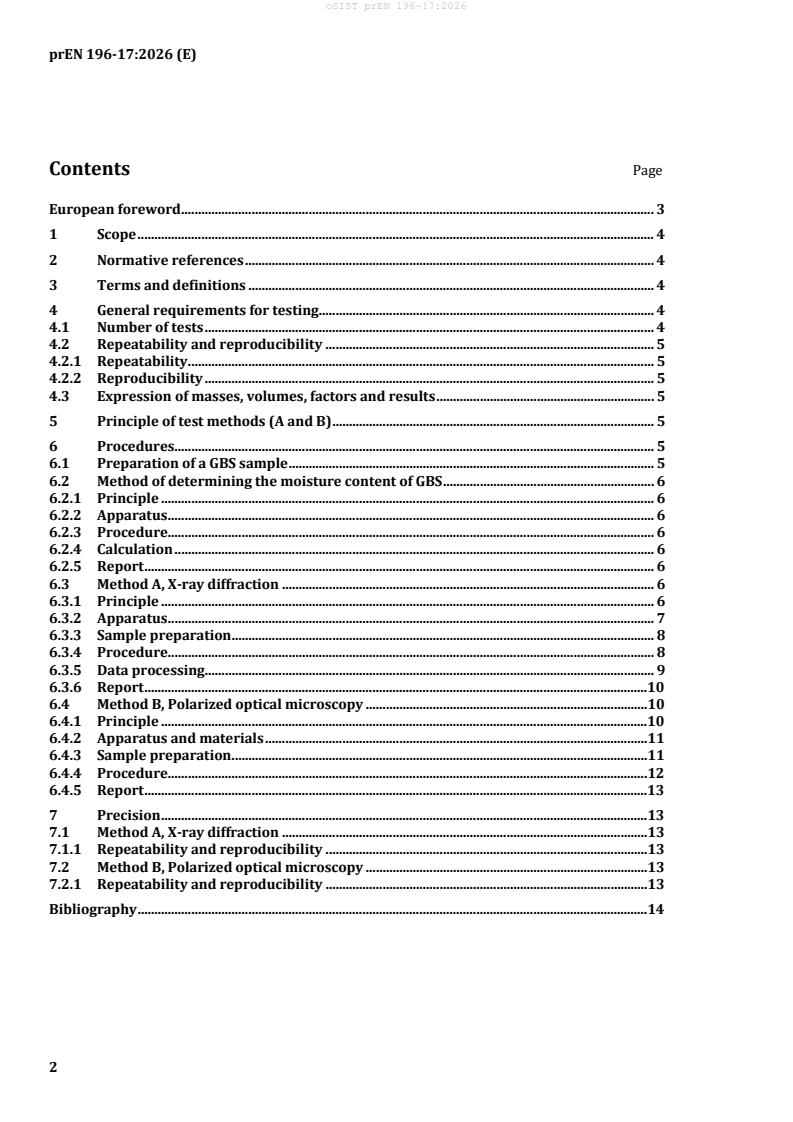
Contents Page
European foreword . 3
1 Scope . 4
2 Normative references . 4
3 Terms and definitions . 4
4 General requirements for testing . 4
4.1 Number of tests . 4
4.2 Repeatability and reproducibility . 5
4.2.1 Repeatability . 5
4.2.2 Reproducibility . 5
4.3 Expression of masses, volumes, factors and results . 5
5 Principle of test methods (A and B) . 5
6 Procedures. 5
6.1 Preparation of a GBS sample . 5
6.2 Method of determining the moisture content of GBS . 6
6.2.1 Principle . 6
6.2.2 Apparatus . 6
6.2.3 Procedure. 6
6.2.4 Calculation . 6
6.2.5 Report . 6
6.3 Method A, X-ray diffraction . 6
6.3.1 Principle . 6
6.3.2 Apparatus . 7
6.3.3 Sample preparation . 8
6.3.4 Procedure. 8
6.3.5 Data processing . 9
6.3.6 Report .10
6.4 Method B, Polarized optical microscopy .10
6.4.1 Principle .10
6.4.2 Apparatus and materials .11
6.4.3 Sample preparation .11
6.4.4 Procedure.12
6.4.5 Report .13
7 Precision .13
7.1 Method A, X-ray diffraction .13
7.1.1 Repeatability and reproducibility .13
7.2 Method B, Polarized optical microscopy .13
7.2.1 Repeatability and reproducibility .13
Bibliography .14
European foreword
This document (prEN 196-17:2026) has been prepared by Technical Committee CEN/TC 51 “Cement and
building limes”, the secretariat of which is held by NBN.
This document is currently submitted to the CEN Enquiry.
1 Scope
This document describes two equivalent test methods for determining the glass content in Granulated
blast furnace Slag (GBS) as constituent for common cement as defined on EN 197-1.
Method A – Method of determining the glass content of GBS by X-ray diffraction.
Method B – Method of determining the glass content of GBS by polarized optical microscopy.
The glass content (or glassy/amorphous phase) in GBS is the fraction of the material that lacks a
crystalline structure, having solidified rapidly from the melt in the form of amorphous glass.
It is usually expressed as a percentage (wt%) of the total slag.
In the absence of a product standard or a specification in the product standard, the constituent is tested
at the fineness of the intended use.
Furthermore, these test methods are used in manufacturing control of cement constituents for assessing
their conformity to the limit indicated in EN 197-1.
2 Normative references
The following documents are referred to in the text in such a way that some or all of their content
constitutes requirements of this document. For dated references, only the edition cited applies. For
undated references, the latest edition of the referenced document (including any amendments) applies.
EN 197-1, Cement — Part 1: Common cement — Performance assessment and declaration
EN 196-7, Methods of testing cement — Part 7: Methods of taking and preparing samples of cement
3 Terms and definitions
For the purposes of this document, the terms and definitions given in EN 197-1 and EN 196-7, and the
following apply.
ISO and IEC maintain terminology databases for use in standardization at the following addresses:
— ISO Online browsing platform: available at https://www.iso.org/obp/
— IEC Electropedia: available at https://www.electropedia.org/
4 General requirements for testing
4.1 Number of tests
For each determination, one or more tests shall be carried out in which the number of measurements to
be taken shall be as specified in the relevant clause of this document (see 6.3 and 6.4).
Where the analysis is one of a series subject to statistical control, the determination of each property by
a single test shall be the minimum required.
Where the analysis is not part of a series subject to statistical control, the number of tests for
determination of each property shall be two.
4.2 Repeatability and reproducibility
4.2.1 Repeatability
Precision under repeatability conditions where independent test results are obtained with the same
method on identical test items (material) in the same laboratory by the same operator using the same
equipment within short intervals of time.
4.2.2 Reproducibility
Precision under reproducibility conditions where test results are obtained with the same method on
identical test items (material) in different laboratories with different operators using different
equipment.
4.3 Expression of masses, volumes, factors and results
Express masses in grams to the nearest 0,001 g.
Express the results, where a single test result has been obtained, to one decimal for method A (6.3) and
for method B (6.4).
Express the results, where two test results have been obtained, as the mean of the results, to one percent.
If the two test results differ by more than twice the standard deviation of repeatability, repeat the test
and take the mean of the two closest test results.
The results of all individual tests shall be recorded.
5 Principle of test methods (A and B)
This document describes two test methods used to the determination of glass content of Granulated
Blast-furnace Slag (GBS).
Method A – Method of determining the glass content of GBS by X-ray diffraction.
Method B – Method of determining the glass content of GBS by polarized optical microscopy.
The results of these test methods can be used to determining the content of glass of GBS.
There is no requirement to preferentially use of Method A and Method B for a given purpose, both
methods are considered equivalent. In many instances the choice is based on the user’s determination of
available equipment.
6 Procedures
6.1 Preparation of a GBS sample
Before the analysis (method A and method B), treat the laboratory sample, taken in accordance with
EN 196-7, as follows to obtain a homogeneous test sample.
If the GBS that has been sampled is a powder, take approximately 100 g of the laboratory sample by
means of a sample divider or by quartering.
If the GBS that has been sampled is not a powder, quartering and size reduction operations are carried
out to obtain representative 100 g in powder with a particle size inferior to 200 µm.
NOTE The size reduction operation can be carried out carefully to avoid any extended fine grinding that can
generate a pollution or a partial amorphisation and then modify the actual glass content.
Before testing the ground GBS, method A (6.3) and method B (6.4), the sample shall be dry at (105 ± 5)
°C for 24 h after the determination of the moisture content of GBS according to 6.2.
Transfer the sample to a clean dry container with an airtight closure and shake vigorously to mix it
thoroughly.
6.2 Method of determining the moisture content of GBS
6.2.1 Principle
The moisture content of the GBS is determined by drying a sample in an oven until constant mass is
achieved.
6.2.2 Apparatus
6.2.2.1 Balance, capable of weighing to an accuracy of ± 0,000 5 g.
6.2.2.2 Shallow glass container, of about 20 g capacity
6.2.2.3 Electric oven, with natural ventilation controlled at (105 ± 5) °C
6.2.2.4 Desiccator, containing a dried desiccant salt like magnesium perchlorate or equivalent
6.2.3 Procedure
Weigh to the nearest 0,001 g, (10 ± 0.050) g of ground GBS into the shallow glass container (6.2.2.2),
which has previously been dried and weighed. Place the container in the electric oven (6.2.2.3) at
(105 ± 5) °C. Heat it for 1 h.
Remove the shallow glass container and allow it to cool in the desiccator (6.2.2.4) to room temperature
and weigh it. Repeat the heating and cooling cycle until constant mass is achieved, i.e. when the difference
between two successive weighings is less than 0,005 g.
6.2.4 Calculation
Calculate the moisture content, C, of the sample as a percentage, to the nearest 0.1 %, from the following
equation:
MM−
( )
C ×100
M
where:
M1 is the mass of initial sample (in g).
M2 is the mass of dried sample (in g).
6.2.5 Report
Report the moisture content as a percentage of the dry mass to the nearest 0,1 %.
6.3 Method A, X-ray diffraction
6.3.1 Principle
X-ray diffraction is a process by which the atoms of a crystalline material interact with radiation in the X-
ray range, generating coherent scattering of the radiation. The diffraction angle depends on the crystal
structure of the material, and the diffraction intensity can be correlated with the amount of material
within the sample.
NOTE Cf. EN 13925-1 and EN 13925-2 for more details.
=
prEN 196-
...