

prEN ISO 17516
(Main)Cosmetics - Microbiology - Microbiological limits (ISO/DIS 17516:2026)
- Abstract
ISO 17516:2014 is applicable for all cosmetics and assists interested parties in the assessment of the microbiological quality of the products. Microbiological testing does not need to be performed on those products considered to be microbiologically low risk.
- Status
- Not Published
- Publication Date
- 03-Jan-2028
- Technical Committee
- CEN/TC 392 - Cosmetics
- Drafting Committee
- CEN/TC 392/WG 2 - Microbiological methods
- Current Stage
- 4060 - Closure of enquiry - Enquiry
- Start Date
- 06-Oct-2026
- Completion Date
- 06-Oct-2026

prEN ISO 17516 is the CEN draft for Cosmetics - Microbiology - Microbiological limits. It specifies acceptable quantitative and qualitative microbiological limits for finished cosmetic products, so manufacturers and laboratories can judge microbiological quality and consumer-safety risk. The standard is aimed at cosmetic manufacturers, test laboratories and other interested parties that assess product microbiology.
What does prEN ISO 17516 specify?
prEN ISO 17516 sets microbiological limits for finished cosmetic products and gives a way to judge whether a product meets them. It applies to cosmetics as a whole and treats them as non-sterile products, but still expects them to stay within defined microbiological limits.
The document is organized into five main clauses, with a normative Annex A and a bibliography.
| Annex | What it covers |
|---|---|
| Annex A (normative) | Flowchart for interpretation of test results |
What are the key requirements of prEN ISO 17516?
prEN ISO 17516 says that cosmetic products are not required to be sterile, but they must not contain microorganisms at levels that could affect product quality or consumer safety. In practice, the standard is used to decide whether a finished product is microbiologically acceptable.
Product risk and routine testing
Clause 1 and the introduction link microbiological testing to risk. Products considered microbiologically low risk may not need routine testing if the manufacturer can still show that they meet the standard. That matters because routine testing is not treated as automatic for every product - the manufacturer has to justify the control approach.
Limit setting for finished products
Clause 5 establishes microbiological limits for finished cosmetics. The standard distinguishes between ordinary products and products specifically intended for children under three years of age, the eye area or mucous membranes. In practice, that means a manufacturer must set specifications with the product’s intended use in mind, not just one global limit for all cosmetics.
Target organisms that must be absent
Clause 4 and Table 1 require the finished product to be free from specified microorganisms, including Escherichia coli, Pseudomonas paraeruginosa - also known as Pseudomonas aeruginosa - Staphylococcus aureus and Candida albicans. For the reader, this means the control plan is not only about total count; it also has to check for organisms that indicate hygienic failure or may pose a safety concern.
Total counts and interpretation
Clause 5 also sets limits for total aerobic mesophilic microorganisms. The document uses colony count results in CFU per gram or millilitre, and it warns that results close to the limit must be interpreted with the natural variability of plate counts in mind. Annex A supports that decision process with a flowchart, so out-of-limit results are assessed consistently rather than by a single isolated reading.
Control of non-specified microorganisms
Clause 5 allows non-specified microorganisms only when they do not have the ability to grow in the product. The standard ties that judgement to risk assessment, including preservation efficacy studies, or to evidence that the product cannot support microbial growth. In practice, this means the manufacturer has to understand how the formulation behaves over shelf life.
Testing methods to use
The introduction points to ISO methods for sample handling, enumeration and organism detection when testing is needed. That matters because prEN ISO 17516 sets the acceptance limits, while the companion methods provide the laboratory procedures for measuring them.
What terms does prEN ISO 17516 define?
- product - the portion of an identified cosmetic product that is received in the laboratory for testing.
- aerobic mesophilic microorganisms - mesophilic bacteria, yeast and mould that grow aerobically under the conditions specified in the related ISO methods.
- specified microorganism - an organism that is undesirable in a cosmetic product because it may cause skin or eye infection or indicate hygienic failure.
- Escherichia coli - a gram-negative, motile rod with smooth colonies.
- Pseudomonas paraeruginosa - the standard’s term for Pseudomonas aeruginosa, a motile gram-negative rod with brown or greenish smooth colonies.
- Staphylococcus aureus - a gram-positive coccus that commonly appears in grape-like clusters.
- Candida albicans - a yeast that forms white to beige, creamy, convex colonies on a selective medium.
Who uses prEN ISO 17516?
prEN ISO 17516 is used by cosmetic manufacturers, quality managers, microbiology laboratories, contract test labs and suppliers involved in raw materials, processing and packaging. They use it to set microbiological specifications, evaluate finished products, investigate failures and support release decisions. It is also relevant when a buyer wants a clear microbiological quality requirement for cosmetic products.
What changed in prEN ISO 17516 from the previous edition?
prEN ISO 17516 replaces ISO 17516:2014. The stated changes are the addition of Clause 2, the renumbering of the following clauses, and an updated bibliography.
Which standards are used with prEN ISO 17516?
prEN ISO 17516 points to related standards that support risk assessment and testing:
- ISO 29621 - helps identify microbiologically low-risk products.
- ISO 22716 - gives Good Manufacturing Practices for cosmetics.
- ISO 21148 - provides general instructions for microbiological examination.
- ISO 21149 - covers enumeration and detection of aerobic mesophilic bacteria.
- ISO 16212 - covers enumeration of yeast and mould.
- ISO 18415 - covers detection of specified and non-specified microorganisms.
- ISO 18416 - covers detection of Candida albicans.
- ISO 21150 - covers detection of Escherichia coli.
- ISO 22717 - covers detection of Pseudomonas aeruginosa.
- ISO 22718 - covers detection of Staphylococcus aureus.
- ISO 11930 - supports evaluation of antimicrobial protection.
- USP Chapter 61 and EP Chapter 2.6.12 - support interpretation of plate-count variability.
What does the prEN ISO 17516 document contain?
prEN ISO 17516 contains a scope, terms and definitions, a principle clause and the microbiological limits clause. Table 1 sets the acceptance criteria for total counts and for specified organisms, while Annex A gives a flowchart for interpreting test results. The bibliography points to the laboratory methods and risk-assessment documents used to carry out the checks in practice.
Relations
- Effective Date
- 12-Feb-2026
- Effective Date
- 17-Dec-2025
Frequently Asked Questions
prEN ISO 17516 is a draft published by the European Committee for Standardization (CEN). Its full title is "Cosmetics - Microbiology - Microbiological limits (ISO/DIS 17516:2026)". This standard covers: ISO 17516:2014 is applicable for all cosmetics and assists interested parties in the assessment of the microbiological quality of the products. Microbiological testing does not need to be performed on those products considered to be microbiologically low risk.
ISO 17516:2014 is applicable for all cosmetics and assists interested parties in the assessment of the microbiological quality of the products. Microbiological testing does not need to be performed on those products considered to be microbiologically low risk.
prEN ISO 17516 is classified under the following ICS (International Classification for Standards) categories: 07.100.40 - Cosmetics microbiology. The ICS classification helps identify the subject area and facilitates finding related standards.
prEN ISO 17516 has the following relationships with other standards: It is inter standard links to ISO 17516, EN ISO 17516:2014. Understanding these relationships helps ensure you are using the most current and applicable version of the standard.
prEN ISO 17516 is available in PDF format for immediate download after purchase. The document can be added to your cart and obtained through the secure checkout process. Digital delivery ensures instant access to the complete standard document.
Standards Content (Sample)
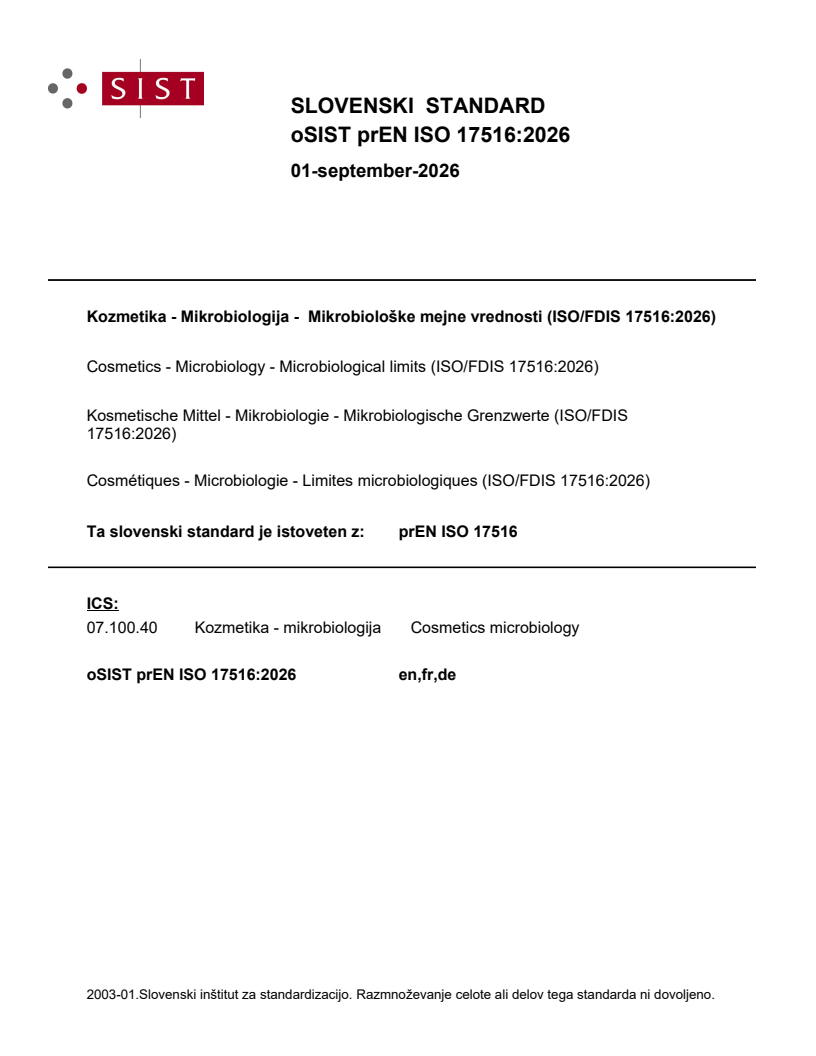
SLOVENSKI STANDARD
01-september-2026
Kozmetika - Mikrobiologija - Mikrobiološke mejne vrednosti (ISO/FDIS 17516:2026)
Cosmetics - Microbiology - Microbiological limits (ISO/FDIS 17516:2026)
Kosmetische Mittel - Mikrobiologie - Mikrobiologische Grenzwerte (ISO/FDIS
17516:2026)
Cosmétiques - Microbiologie - Limites microbiologiques (ISO/FDIS 17516:2026)
Ta slovenski standard je istoveten z: prEN ISO 17516
ICS:
07.100.40 Kozmetika - mikrobiologija Cosmetics microbiology
2003-01.Slovenski inštitut za standardizacijo. Razmnoževanje celote ali delov tega standarda ni dovoljeno.
FINAL DRAFT
International
Standard
ISO/FDIS 17516
ISO/TC 217
Cosmetics — Microbiology —
Secretariat: INSO
Microbiological limits
Voting begins on:
Cosmétiques — Microbiologie — Limites microbiologiques 2026-07-14
Voting terminates on:
2026-10-06
RECIPIENTS OF THIS DRAFT ARE INVITED TO SUBMIT,
WITH THEIR COMMENTS, NOTIFICATION OF ANY
RELEVANT PATENT RIGHTS OF WHICH THEY ARE AWARE
AND TO PROVIDE SUPPOR TING DOCUMENTATION.
IN ADDITION TO THEIR EVALUATION AS
BEING ACCEPTABLE FOR INDUSTRIAL, TECHNO
ISO/CEN PARALLEL PROCESSING LOGICAL, COMMERCIAL AND USER PURPOSES, DRAFT
INTERNATIONAL STANDARDS MAY ON OCCASION HAVE
TO BE CONSIDERED IN THE LIGHT OF THEIR POTENTIAL
TO BECOME STAN DARDS TO WHICH REFERENCE MAY BE
MADE IN NATIONAL REGULATIONS.
Reference number
ISO/FDIS 17516:2026(en) © ISO 2026
FINAL DRAFT
ISO/FDIS 17516:2026(en)
International
Standard
ISO/FDIS 17516
ISO/TC 217
Cosmetics — Microbiology —
Secretariat: INSO
Microbiological limits
Voting begins on:
Cosmétiques — Microbiologie — Limites microbiologiques
Voting terminates on:
RECIPIENTS OF THIS DRAFT ARE INVITED TO SUBMIT,
WITH THEIR COMMENTS, NOTIFICATION OF ANY
RELEVANT PATENT RIGHTS OF WHICH THEY ARE AWARE
AND TO PROVIDE SUPPOR TING DOCUMENTATION.
© ISO 2026
IN ADDITION TO THEIR EVALUATION AS
All rights reserved. Unless otherwise specified, or required in the context of its implementation, no part of this publication may
BEING ACCEPTABLE FOR INDUSTRIAL, TECHNO
ISO/CEN PARALLEL PROCESSING
LOGICAL, COMMERCIAL AND USER PURPOSES, DRAFT
be reproduced or utilized otherwise in any form or by any means, electronic or mechanical, including photocopying, or posting on
INTERNATIONAL STANDARDS MAY ON OCCASION HAVE
the internet or an intranet, without prior written permission. Permission can be requested from either ISO at the address below
TO BE CONSIDERED IN THE LIGHT OF THEIR POTENTIAL
or ISO’s member body in the country of the requester.
TO BECOME STAN DARDS TO WHICH REFERENCE MAY BE
MADE IN NATIONAL REGULATIONS.
ISO copyright office
CP 401 • Ch. de Blandonnet 8
CH-1214 Vernier, Geneva
Phone: +41 22 749 01 11
Email: copyright@iso.org
Website: www.iso.org
Published in Switzerland Reference number
ISO/FDIS 17516:2026(en) © ISO 2026
ii
ISO/FDIS 17516:2026(en)
Contents Page
Foreword .iv
Introduction .v
1 Scope . 1
2 Normative references . 1
3 Terms and definitions . 1
4 Principle . 2
5 Microbiological limits for cosmetics . 2
Annex A (normative) Flowchart for interpretation of test results . 4
Bibliography . 5
iii
ISO/FDIS 17516:2026(en)
Foreword
ISO (the International Organization for Standardization) is a worldwide federation of national standards
bodies (ISO member bodies). The work of preparing International Standards is normally carried out through
ISO technical committees. Each member body interested in a subject for which a technical committee
has been established has the right to be represented on that committee. International organizations,
governmental and non-governmental, in liaison with ISO, also take part in the work. ISO collaborates closely
with the International Electrotechnical Commission (IEC) on all matters of electrotechnical standardization.
The procedures used to develop this document and those intended for its further maintenance are described
in the ISO/IEC Directives, Part 1. In particular, the different approval criteria needed for the different types
of ISO documents should be noted. This document was drafted in accordance with the editorial rules of the
ISO/IEC Directives, Part 2 (see www.iso.org/directives).
ISO draws attention to the possibility that the implementation of this document may involve the use of (a)
patent(s). ISO takes no position concerning the evidence, validity or applicability of any claimed patent
rights in respect thereof. As of the date of publication of this document, ISO had not received notice of (a)
patent(s) which may be required to implement this document. However, implementers are cautioned that
this may not represent the latest information, which may be obtained from the patent database available at
www.iso.org/patents. ISO shall not be held responsible for identifying any or all such patent rights.
Any trade name used in this document is information given for the convenience of users and does not
constitute an endorsement.
For an explanation of the voluntary nature of standards, the meaning of ISO specific terms and expressions
related to conformity assessment, as well as information about ISO's adherence to the World Trade
Organization (WTO) principles in the Technical Barriers to Trade (TBT), see www.iso.org/iso/foreword.html.
This document was prepared by Technical Committee ISO/TC 217, Cosmetics.
This second edition cancels and replaces the first edition (ISO 17516:2014), of which it constitutes a minor
revision.
The changes are as follows:
— Clause 2 has been added and subsequent clauses have been renumbered;
— the bibliography has been updated.
Any feedback or questions on this document should be directed to the user’s national standards body. A
complete listing of these bodies can be found at www.iso.org/members.html.
iv
ISO/FDIS 17516:2026(en)
Introduction
Every cosmetic manufacturer has a responsibility relative to the microbiological safety and quality of its
products to ensure that they have been produced under hygienic conditions. Cosmetic products are not
expected to be sterile. However, they shall not contain excessive amounts of microorganisms nor specified
microorganisms that have the potential to affect the product quality or consumer safety. Moreover, some
[1]
cosmetic products which ar
...