

EN 14344:2022
(Main)Child care articles - Child seats for cycles - Safety requirements and test methods
- Abstract
This document specifies requirements for child seats intended to be mounted on cycles and electrical power assisted cycles with a cut off speed of up to 25 km/h (i.e. according to EN 15194), their attachment system and accessories intended to be attached to the seat in order to transport children with a weight from 9 kg up to 22 kg and who are capable of sitting unaided.
NOTE 1 Some European countries have special legislation for child seats for cycles. Compliance with this document might not meet this legislation.
NOTE 2 Where a child seat or any part of the child seat has several functions or can be converted into another function, other relevant standards might be applicable.
NOTE 3 Additional rationales are presented in Annex E for inclusion of some of the requirements given in this document.
- Status
- Published
- Publication Date
- 07-Jun-2022
- Technical Committee
- CEN/TC 252 - Child use and care articles
- Current Stage
- 6060 - Definitive text made available (DAV) - Publishing
- Start Date
- 08-Jun-2022
- Completion Date
- 08-Jun-2022
- Directive
- 2001/95/EC - General product safetyOJ Ref: 2024/2406, OJ L, OJ L, 2024/2406 OJ Date: 13-Sep-2024
Buy Documents
EN 14344:2024 - BARVE



Overview
EN 14344:2022 - Child care articles: Child seats for cycles - Safety requirements and test methods (CEN) specifies safety, performance and test requirements for child seats designed to be mounted on cycles and electrically power‑assisted cycles (cut‑off speed up to 25 km/h). The standard covers child seats, attachment systems and accessories intended for transporting children weighing 9 kg to 22 kg who can sit unaided. It defines required tests, protective functions and product information to reduce mechanical, chemical, thermal and choking hazards.
Key topics and requirements
- Scope & applicability: Seats for bicycles and e‑bikes (EN 15194 context), attachments and accessories; note that national legislation may impose additional rules.
- General requirements & test conditions: Test order, tolerances, and the “most onerous condition” principle for realistic evaluation.
- Test equipment & methods: Specifications for probes, measuring devices, foot blocks, vibration apparatus, roll‑over dummies and strength/durability rigs.
- Hazard areas addressed:
- Mechanical hazards (protected volume, edges, protrusions, moving parts, shearing/compression)
- Entrapment (finger/foot), small parts and choking/ingestion tests
- Stability and inadvertent release of reclining or attachment systems
- Structural integrity: strength and durability tests for rear, luggage‑carrier and non‑luggage carrier seats
- Thermal and chemical hazards, plus suffocation risk of packaging
- Protective function: Requirements for seating area, footrests/foot guards, lateral protection, head support and restraint systems.
- Product information & marking: Required purchase information, mounting/use instructions, warnings and mandatory markings for safe use.
- Annexes: Normative measuring devices and foot block designs; informative rationales and language translations for warnings.
Practical applications - who uses this standard
- Manufacturers and designers of child bicycle seats and accessories - for compliant product design and validation testing.
- Test laboratories - to perform standardized mechanical, chemical and durability tests.
- Retailers and buyers - to verify safety claims and conformity before placing products on the European market.
- Regulators and certification bodies - to assess compliance and support enforcement or CE marking processes.
- Standards consultants and product safety engineers - for risk assessment, documentation and instructions compliance.
Related standards & notes
- EN 15194 (electrically power‑assisted cycles) relevance for e‑bike compatibility.
- References to toy safety standards (EN 71 series) and other normative documents are used for specific hazards.
- Important: Compliance with EN 14344:2022 does not automatically satisfy any country‑specific child seat laws; always check local regulations.
Keywords: EN 14344:2022, child seats for cycles, bike child seat standard, safety requirements, test methods, e‑bike child seat, attachment system, child seat testing.
Relations
- Effective Date
- 15-Jun-2022
- Effective Date
- 28-Jan-2026
- Effective Date
- 28-Jan-2026
- Effective Date
- 28-Jan-2026
- Effective Date
- 28-Jan-2026
- Effective Date
- 28-Jan-2026
- Effective Date
- 28-Jan-2026
Buy Documents
EN 14344:2024 - BARVE
Frequently Asked Questions
EN 14344:2022 is a standard + national annex and/or foreword published by the European Committee for Standardization (CEN). Its full title is "Child care articles - Child seats for cycles - Safety requirements and test methods". This standard covers: This document specifies requirements for child seats intended to be mounted on cycles and electrical power assisted cycles with a cut off speed of up to 25 km/h (i.e. according to EN 15194), their attachment system and accessories intended to be attached to the seat in order to transport children with a weight from 9 kg up to 22 kg and who are capable of sitting unaided. NOTE 1 Some European countries have special legislation for child seats for cycles. Compliance with this document might not meet this legislation. NOTE 2 Where a child seat or any part of the child seat has several functions or can be converted into another function, other relevant standards might be applicable. NOTE 3 Additional rationales are presented in Annex E for inclusion of some of the requirements given in this document.
This document specifies requirements for child seats intended to be mounted on cycles and electrical power assisted cycles with a cut off speed of up to 25 km/h (i.e. according to EN 15194), their attachment system and accessories intended to be attached to the seat in order to transport children with a weight from 9 kg up to 22 kg and who are capable of sitting unaided. NOTE 1 Some European countries have special legislation for child seats for cycles. Compliance with this document might not meet this legislation. NOTE 2 Where a child seat or any part of the child seat has several functions or can be converted into another function, other relevant standards might be applicable. NOTE 3 Additional rationales are presented in Annex E for inclusion of some of the requirements given in this document.
EN 14344:2022 is classified under the following ICS (International Classification for Standards) categories: 97.190 - Equipment for children. The ICS classification helps identify the subject area and facilitates finding related standards.
EN 14344:2022 has the following relationships with other standards: It is inter standard links to EN 14344:2004, EN 71-1:2014+A1:2018, EN ISO 11243:2016, EN 71-3:2019+A1:2021, EN 71-2:2020, EN 17860-6:2025, EN 14872:2006. Understanding these relationships helps ensure you are using the most current and applicable version of the standard.
EN 14344:2022 is associated with the following European legislation: EU Directives/Regulations: 2001/95/EC; Standardization Mandates: M/264. When a standard is cited in the Official Journal of the European Union, products manufactured in conformity with it benefit from a presumption of conformity with the essential requirements of the corresponding EU directive or regulation.
EN 14344:2022 is available in PDF format for immediate download after purchase. The document can be added to your cart and obtained through the secure checkout process. Digital delivery ensures instant access to the complete standard document.
Standards Content (Sample)
SL O V EN S K I SIST EN 14344
S T ANDAR D
julij 2024
Izdelki za otroke – Otroški sedeži za kolesa – Varnostne zahteve in preskusne
metode
Child care articles – Child seats for cycles – Safety requirements and test
methods
Articles de puériculture – Sièges enfants pour bicyclettes – Exigences de sécurité
et méthodes d’essai
Artikel für Säuglinge und Kleinkinder – Kindersitze für Fahrräder –
Sicherheitstechnische Anforderungen und Prüfverfahren
Referenčna oznaka
ICS 97.190 SIST EN 14344:2024 ((sl)en)
Nadaljevanje na straneh od II do III in od 1 do 80
© 2024-07 Standard je založil in izdal Slovenski inštitut za standardizacijo. Razmnoževanje celote ali delov tega standarda ni dovoljeno.
SIST EN 14344 : 2024
NACIONALNI UVOD
Standard SIST EN 14344 ((sl)en), Izdelki za otroke – Otroški sedeži za kolesa – Varnostne zahteve in
preskusne metode, 2024, ima status slovenskega standarda in je po metodi ponatisa izvirnika z
nacionalnim dodatkom privzet evropski standard EN 14344 (en), Child care articles – Child seats for
cycles – Safety requirements and test methods, 2022.
Ta slovenski standard nadomešča slovenski standard SIST EN 14344:2005.
NACIONALNI PREDGOVOR
Evropski standard EN 14344:2022 je pripravil tehnični odbor Evropskega komiteja za standardizacijo
CEN/TC 252 »Izdelki za otroke«, katerega sekretariat vodi AFNOR.
Ta dokument je bil pripravljen na podlagi mandata M/264, ki sta ga Evropska komisija in Evropsko
združenje za prosto trgovino dodelila CEN.
Odločitev za izdajo tega standarda je 9. maja 2024 sprejel tehnični odbor SIST/TC OTR Izdelki za
otroke.
II
SIST EN 14344 : 2024
NACIONALNI DODATEK
Dodatek C
(informativni)
Prevodi opozoril v različne evropske jezike
V preglednici C.1, ki navaja prevode opozoril, navedenih v točkah 9.1.2.2, 9.1.2.3, 9.2.2.3, 9.3.2, se
popravi slovenski prevod, in sicer:
Preglednica C.1 – Prevodi opozoril
Slovenian
9.1.2.2 OPOZORILO! Zaradi varnostnih razlogov je sedež lahko nameščen samo na prtljažnike, ki so
v skladu z EN ISO 11243:2016, označeni z nosilnostjo 27 kg.
9.1.2.3 OPOZORILO! Sedež, nameščen spredaj, ovira krmiljenje kolesa.
9.2.2.3 a) OPOZORILO! Na nosilec otroškega sedeža ne nameščajte dodatne prtljage.
Opozorilo mora vključevati priporočilo, da se prtljaga vedno namesti na nasprotnem koncu
kolesa, kot je nameščen otroški sedež; npr. če je sedež zadaj, se uporablja sprednji prtljažnik
9.2.2.3 b) OPOZORILO! Ne spreminjajte sedeža.
9.2.2.3 c) OPOZORILO! Ko je otrok v sedežu, se odzivnost kolesa lahko spremeni.
Še posebej to velja za ravnotežje, krmiljenje in zaviranje.
9.2.2.3 d) OPOZORILO! Nikoli ne puščajte otroka v sedežu na parkiranem kolesu brez nadzora.
9.2.2.3 e) OPOZORILO! Če se pojavijo kakršnekoli razpoke ali če površina sedeža začne razpadati, to
pomeni, da je življenjska doba sedeža potekla in ga je treba zamenjati. V primeru dvoma se
je treba obrniti na strokovnjaka.
9.2.2.3 f) OPOZORILO! Pred uporabo vedno preverite temperaturo površine sedeža.
9.2.2.3 g) OPOZORILO! Ko je sedež v naklonu, zagotovite, da je otrokova glava podprta.
9.2.2.3 h) OPOZORILO! Sedež ni primeren za športne aktivnosti.
Za sedež nameščen spredaj:
9.2.2.3 i) OPOZORILO! Krmiljenje je zaradi sedeža lahko ovirano.
9.3.2 OPOZORILO! Dodatna varnostna oprema mora biti vedno pritrjena.
ZVEZA Z NACIONALNIMI STANDARDI
S privzemom tega evropskega standarda veljajo za omejeni namen referenčnih standardov vsi
standardi, navedeni v izvirniku, razen standardov, ki so že sprejeti v nacionalno standardizacijo:
SIST EN 71-1:2015+A1:2018 Varnost igrač – 1. del: Mehanske in fizikalne lastnosti (z dopolnili do
vključno A3)
SIST EN 71-2:2021 Varnost igrač – 2. del: Vnetljivost
SIST EN 71-3:2019+A1:2021 Varnost igrač – 3. del: Migracija določenih elementov (vključno z
dopolnilom A1)
SIST EN ISO 11243:2016 Kolesa – Prtljažniki za kolesa – Zahteve in preskusne metode (ISO
11243:2016)
III
SIST EN 14344 : 2024
OSNOVA ZA IZDAJO
– privzem standarda EN 14344:2022
PREDHODNE IZDAJE
– SIST EN 14344:2005
OPOMBE
– Povsod, kjer se v besedilu standarda uporablja izraz “evropski standard”, v
– Ta nacionalni dokument je istoveten EN 14344:2022 in je objavljen z dovoljenjem
Upravni center
CEN-CENELEC
Rue de la Science 23
B-1040 Bruselj
– This national document is identical with EN 14344:2022 and is published with the permission of
CEN-CENELEC
Management Centre
Rue de la Science 23
B-1040 Brussels
IV
EN 14344
EUROPEAN STANDARD
NORME EUROPÉENNE
June 2022
EUROPÄISCHE NORM
ICS 97.190 Supersedes EN 14344:2004
English Version
Child care articles - Child seats for cycles - Safety
requirements and test methods
Articles de puériculture - Sièges enfants pour Artikel für Säuglinge und Kleinkinder - Kindersitze für
bicyclettes - Exigences de sécurité et méthodes d'essai Fahrräder - Sicherheitstechnische Anforderungen und
Prüfverfahren
This European Standard was approved by CEN on 27 March 2022.
CEN members are bound to comply with the CEN/CENELEC Internal Regulations which stipulate the conditions for giving this
European Standard the status of a national standard without any alteration. Up-to-date lists and bibliographical references
concerning such national standards may be obtained on application to the CEN-CENELEC Management Centre or to any CEN
member.
This European Standard exists in three official versions (English, French, German). A version in any other language made by
translation under the responsibility of a CEN member into its own language and notified to the CEN-CENELEC Management
Centre has the same status as the official versions.
CEN members are the national standards bodies of Austria, Belgium, Bulgaria, Croatia, Cyprus, Czech Republic, Denmark, Estonia,
Finland, France, Germany, Greece, Hungary, Iceland, Ireland, Italy, Latvia, Lithuania, Luxembourg, Malta, Netherlands, Norway,
Poland, Portugal, Republic of North Macedonia, Romania, Serbia, Slovakia, Slovenia, Spain, Sweden, Switzerland, Turkey and
United Kingdom.
EUROPEAN COMMITTEE FOR STANDARDIZATION
COMITÉ EUROPÉEN DE NORMALISATION
EUROPÄISCHES KOMITEE FÜR NORMUNG
CEN-CENELEC Management Centre: Rue de la Science 23, B-1040 Brussels
© 2022 CEN All rights of exploitation in any form and by any means reserved Ref. No. EN 14344:2022 E
worldwide for CEN national Members.
Contents Page
European foreword . 4
1 Scope . 5
2 Normative references . 5
3 Terms and definitions . 5
4 General requirements and test conditions . 8
4.1 General requirement and seat classification . 8
4.2 Additional requirements for front seats . 9
4.3 Additional requirements for rear seats attached to rear luggage carriers. 9
4.4 Principle of the most onerous condition . 9
4.5 Tolerances and test conditions . 9
4.6 Order of tests . 10
5 Test equipment . 10
5.1 Test probes . 10
5.1.1 Finger probes . 10
5.1.2 Conical probes . 11
5.2 Angle and protected volume measurement device . 12
5.3 Test bench . 12
5.4 Foot blocks . 12
5.5 Small part cylinders . 13
5.6 Feeler gauge . 13
5.7 Clamps . 14
5.8 Test equipment for strength and durability . 14
5.8.1 Lateral dynamic test apparatus . 14
5.8.2 Limiting device . 14
5.9 Test bags . 15
5.10 Test dummy for roll-over test . 16
6 Chemical hazards . 16
7 Thermal hazards . 16
8 Mechanical hazards . 17
8.1 Determination of the protected volume . 17
8.2 Hazards from gaps and openings – finger and foot entrapment . 18
8.2.1 Requirements . 18
8.2.2 Test method . 19
8.3 Hazards due to edges and protrusion . 20
8.3.1 Requirements . 20
8.3.2 Test method . 20
8.4 Hazards due to moving parts, i.e. shearing and compression . 20
8.4.1 Requirements . 20
8.4.2 Specific hazard due to elasticity of the seat within the protected volume . 20
8.5 Hazards due inadvertent release of the reclining function . 20
8.5.1 General . 20
8.5.2 Unintentional release of locking mechanism(s) . 21
8.5.3 Hazards due inadvertent release of the attachment system of the seat on bicycle . 21
8.5.4 Hazards due removable foot guards . 21
8.6 Suffocation hazard due to plastic packaging . 22
8.7 Entanglement hazards . 22
8.7.1 Requirements . 22
8.7.2 Test method . 23
8.8 Choking / ingestion hazards – Small parts . 23
8.8.1 Requirements . 23
8.8.2 Test method . 24
8.9 Hazards from inadequate structural integrity . 24
8.9.1 Requirements for strength and durability . 24
8.9.2 Mounting method for strength and durability for luggage and non-luggage carrier
seats . 25
8.9.3 Test methodology for strength and durability. 25
8.10 Hazards from inadequate protective function . 29
8.10.1 General . 29
8.10.2 Requirements for seating area and footrests . 29
8.10.3 Protection for feet . 30
8.10.4 Seat width requirement and test method for all seats . 31
8.10.5 Minimum range of footrest adjustment (height) . 31
8.10.6 Foot retention with straps . 33
8.10.7 Lateral seat protection . 34
8.10.8 Seat and backrest angle . 35
8.10.9 Restraint system . 37
9 Product information . 40
9.1 Purchase information . 40
9.1.1 General requirements for purchase information . 40
9.1.2 Specific purchase information . 40
9.2 Instructions for use . 41
9.2.1 General . 41
9.2.2 Specific instructions for mounting and use . 41
9.3 Marking . 43
9.3.1 General requirements for marking . 43
9.3.2 Marking requirements for rear seats attached to luggage carriers . 45
9.3.3 Marking, test method . 45
Annex A (normative) Measuring device . 46
Annex B (normative) Foot blocks A and B . 64
B.1 General . 64
Annex C (informative) Translation of Warnings in different European languages . 67
Annex D (informative) A–deviation . 72
Annex E (informative) Rationales . 73
E.1 General . 73
E.2 Chemical hazards . 73
E.3 Thermal hazards . 73
E.4 Mechanical hazards . 73
Annex ZA (informative) Relationship between this European Standard and the safety
requirements of Directive 2001/95/EC aimed to be covered . 77
Bibliography . 80
European foreword
This document (EN 14344:2022) has been prepared by Technical Committee CEN/TC 252 “Child care
articles”, the secretariat of which is held by AFNOR.
This European Standard shall be given the status of a national standard, either by publication of an
identical text or by endorsement, at the latest by December 2022, and conflicting national standards shall
be withdrawn at the latest by December 2022.
Attention is drawn to the possibility that some of the elements of this document may be the subject of
patent rights. CEN shall not be held responsible for identifying any or all such patent rights.
This document supersedes EN 14344:2004.
In comparison with the previous edition, the following significant changes have been made:
— complete review of the standard in a hazard-based format;
— alignment with the common practices applied in other technical groups of CEN/TC 252 (hazards
from gaps and openings – finger entrapment, entanglement hazards…);
— definition of a new protected volume;
— inclusion of specific requirements for specific seats with a reclining function;
— improvement of the measuring device;
— introduction of a new test method for the protection for feet;
— introduction of a new test method for footrest adjustment;
— introduction of a new test method for the measurement of the angle of the backrest.
This document has been prepared under a Standardization Request given to CEN by the European
Commission and the European Free Trade Association, and supports essential requirements of EU
Directive(s).
For relationship with EU Directive(s), see informative Annex ZA, which is an integral part of this
document.
Any feedback and questions on this document should be directed to the users’ national standards body.
A complete listing of these bodies can be found on the CEN website.
According to the CEN-CENELEC Internal Regulations, the national standards organisations of the
following countries are bound to implement this European Standard: Austria, Belgium, Bulgaria, Croatia,
Cyprus, Czech Republic, Denmark, Estonia, Finland, France, Germany, Greece, Hungary, Iceland, Ireland,
Italy, Latvia, Lithuania, Luxembourg, Malta, Netherlands, Norway, Poland, Portugal, Republic of North
Macedonia, Romania, Serbia, Slovakia, Slovenia, Spain, Sweden, Switzerland, Turkey and the United
Kingdom.
1 Scope
This document specifies requirements for child seats intended to be mounted on cycles and electrical
power assisted cycles with a cut off speed of up to 25 km/h (i.e. according to EN 15194), their attachment
system and accessories intended to be attached to the seat in order to transport children with a weight
from 9 kg up to 22 kg and who are capable of sitting unaided.
NOTE 1 Some European countries have special legislation for child seats for cycles. Compliance with this
document might not meet this legislation.
NOTE 2 Where a child seat or any part of the child seat has several functions or can be converted into another
function, other relevant standards might be applicable.
NOTE 3 Additional rationales are presented in Annex E for inclusion of some of the requirements given in this
document.
2 Normative references
The following documents are referred to in the text in such a way that some or all of their content
constitutes requirements of this document. For dated references, only the edition cited applies. For
undated references, the latest edition of the referenced document (including any amendments) applies.
EN 71-1:2014+A1:2018, Safety of toys — Part 1: Mechanical and physical properties
EN 71-2:2020, Safety of toys — Part 2: Flammability
EN 71-3:2019+A1:2021, Safety of toys — Part 3: Migration of certain elements
EN ISO 11243:2016, Cycles — Luggage carriers for bicycles — Requirements and test methods
(ISO 11243:2016)
3 Terms and definitions
For the purposes of this document, the following terms and definitions apply.
ISO and IEC maintain terminological databases for use in standardization at the following addresses:
— ISO Online browsing platform: available at https://www.iso.org/obp
— IEC Electropedia: available at https://www.electropedia.org/
3.1
seat
child seat intended to be mounted on a cycle
3.2
front seat
child seat intended to be mounted on a cycle in front of the rider (between handlebar of the cycle and
rider)
3.3
rear seat
child seat intended to be mounted on a cycle behind the rider
3.4
reclining seat
front or rear seat that can transport a child either in an upright or in a reclined sitting position
3.5
guard
device that reduces or prevents physical access to a hazard zone by closing off access to an area
containing one or more hazards
3.6
removable foot guard
guard that is always provided with the seat, or pre-assembled with, and can be removed
3.7
reference plane
plane defined by the top surface of the base plate of the measuring device
Note 1 to entry: See Figure A.2 (key 17).
3.8
attachment system
structure to attach the child seat to the cycle
3.9
footrest
structure to support the child's foot
3.10
protected volume
volume accessible by the child, when sitting and restrained in the seat, where specific safety requirements
are necessary
3.11
handlebar and handlebar stem assembly
3.11.1
handlebar
part held by rider
Note 1 to entry: See Figure 1.
3.11.2
extension
part of the handlebar stem that positions the handlebar in front of the steering axis
Note 1 to entry: See Figure 1.
3.11.3
quill
part of some designs of the handlebar stem, that is co-axial with the steering axis and that fits partly into
the fork steering tube
Note 1 to entry: See Figure 1.
Key
1 handlebar
2 extension
3 quill
Figure 1 — Handlebar and handlebar stem assembly
3.12
restraint system
device designed to restrain the child in a sitting and safe position
3.13
crotch restraint
device designed to pass between the child's legs to prevent the child from sliding forward
3.14
cycle
vehicle that has at least two wheels and is propelled solely or mainly by the muscular energy of the person
on that vehicle, in particular by means of pedals
[SOURCE: EN ISO 4210-1:2014, 2.4]
3.15
accessories
additional element attached directly to the child seat or to the attachment system
Note 1 to entry: The following are not considered as accessories: footrest, restraint system, integral and
additional guard, attachment system.
3.16
headrest
postural support device intended to support the head
3.17
plastic sheeting
thin section plastic sheeting which is used as part of the seat or as part of the packaging
Note 1 to entry: Decals are covered by this definition.
[SOURCE: Modified from EN 71-1:2014+A1:2018, 3.52]
3.18
operating device
part of the locking mechanism(s) designed to be activated by the rider through one or several action(s)
3.19
locking mechanism
assembly of components consisting of one or more locking device(s) and one or more operating device(s)
3.20
locking device
mechanical component that maintains part(s) of the bicycle seat erected in the position of use (e.g.
latch(es), hooks, over centre lock.) which could be deactivated or activated by action(s) on the operating
device
[SOURCE: EN 1888-1:2018, 3.20]
3.21
lateral protection
part of the bicycle seat designed to provide sufficient armrest in order to secure the child sideways
4 General requirements and test conditions
4.1 General requirement and seat classification
Seats are classified according to the weight and height of the child carried and their mounting position
on the cycle (see Table 1).
Table 1 — Classification of seats
Height/Weight range
Type of seat
9 kg to 15 kg 9 kg to 22 kg
Rear seat A15 A22
Front seat between handlebar of C15 Not permitted
the cycle and rider
Maximum standing height of the 930 mm 1 100 mm
child
Front seat in front of handlebar of Not permitted Not permitted
the cycle
EXAMPLE Designation of a seat to be mounted behind the rider (A), maximum load 15 kg (15): Child seat A15.
4.2 Additional requirements for front seats
Front seats shall not be attached to the handlebar of the cycle or the extension of the handlebar as defined
in 3.11.
NOTE Additional regulations could apply on the location of the attachment of the seat on the bicycle (e.g.
German and Austrian road traffic regulations).
Front seats class C15 can be attached between handlebar of the cycle and rider. It is not permitted to
attach any front seat in front of handlebar of the cycle.
4.3 Additional requirements for rear seats attached to rear luggage carriers
Rear seats that are fixed to the rear luggage carrier shall have an additional retention system, not
removable from the seat, which shall be attached to another part of the cycle and limits rearward
movement of the seat. The rearward displacement shall not be greater than 50 mm and angular
displacement shall not be greater than 15° in rearward direction. Where additional retention system is
provided with the seat it shall withstand a tensile force of twice the maximum allowable weight of the
child plus the weight of the seat. Additionally, it shall have a system for securing the free end of the strap
(in order to avoid it to be caught in the wheel).
4.4 Principle of the most onerous condition
Installation and adjustment of the seat during the test shall be conducted according to the instructions
for use.
It is allowed to use any cycle that is suitable according to the instructions for use.
Unless otherwise stated each test shall be conducted with the child seat in the most onerous condition
for that test in terms of:
— the addition (or not) of any other accessories supplied or recommended by the manufacturer for use
with the child seat and with accessories loaded according to the manufacturer's instructions;
— the adjustment of the child seat, and any other adjustable features (e.g. reclined backrest) or
accessories, or any other optional arrangement of the child seat allowed in the manufacturer's
instructions or otherwise approved by the manufacturer;
— any removable padding shall be installed during the measurements.
NOTE The heaviest loads do not always produce the most onerous conditions.
4.5 Tolerances and test conditions
Unless otherwise stated the following accuracies shall be used:
All forces shall have an accuracy of ±5 %.
All masses shall have an accuracy of ±1 %.
All dimensions shall have an accuracy of ±1,0 mm.
All time measurements shall have an accuracy of ±1 s.
All angles shall have an accuracy of ±1°.
All frequencies, amplitudes shall have an accuracy of ±5 %.
The seat shall be conditioned at a temperature of (23 ± 5) °C for at least 2 h prior to test. All tests shall be
carried out at a temperature of (23 ± 5) °C unless otherwise specified.
4.6 Order of tests
Tests from 8 shall be carried out on the same sample in the order that they appear. A separate sample
may be used for all other tests.
5 Test equipment
5.1 Test probes
5.1.1 Finger probes
5.1.1.1 Finger probe with hemispherical end
Probes made from plastics or other hard, smooth material of diameter 7 mm, with a full
−01,
hemispherical end (see Figure 2).
Dimensions in millimetres
Key
1 R 3,5
2 line scribed around circumference showing depth of penetration
Ø (7 )
−01,
Figure 2 — 7 mm probe
5.1.1.2 Shape assessment probe
Probes made from plastics or other hard, smooth material with the dimensions shown in Figure 3 below.
Dimensions in millimetres
Key
A front view
B top view
C side view
D 3D view
Figure 3 — Shape assessment probe
5.1.1.3 Conical probe for mesh
Probe for assessing mesh; probe made from plastics or other hard, smooth material as shown in
Figure 4 — Conical probe for mesh below which shall be capable of being mounted on a force measuring
device, so that the conical end can be presented to the opening being assessed.
Dimensions in millimetres
Figure 4 — Conical probe for mesh
The tolerance on the radius is ±0,2 mm.
5.1.2 Conical probes
Probes made from plastics or other hard smooth material of diameters (12 + 0,1 / 0), (25 0 / –0,1), mm
and (45 + 0,1 / 0) mm with one conical end (with an angle of 30°), that can be mounted on a force
measuring device (see Figure 5 below).
Dimensions in millimetres
Key
d diameter (12; 25 or 45)
Note : To avoid any risk, the tip of the conical part might be rounded.
Figure 5 — Conical probes
5.2 Angle and protected volume measurement device
A measuring device defined in Annex A shall be used to define the protected volume for the child (see
8.1), check seat dimensions (see 8.10.2) and check the minimum angle between the seat and the
horizontal plane and the minimum angle between the seat and the backrest (see 8.10.8).
5.3 Test bench
The device is intended to support the rear seat, with an angle of 73° between the horizontal and the tube
which receives the seat attachment device.
The tube represents the seat tube or the frame of the bicycle.
5.4 Foot blocks
The two foot blocks (see Annex B, Figure B.1) in aluminium shall be used for assessment of:
— the size of the footrest,
— the range adjustment,
— the efficiency of the straps, and
— the footrest strength.
(For further details, see Annex B, Figures B.2 and B.3).
5.5 Small part cylinders
Small part cylinder, for the assessment of small components, shall have dimensions in accordance with
Figure 6.
Dimensions in millimetres
Figure 6 — Small parts cylinder
5.6 Feeler gauge
Gauge with a thickness of (0,40 ± 0,02) mm and an insertion edge radius of (3,0 ± 0,5) mm (see Figure 7).
Dimensions in millimetres
Figure 7 — Feeler gauge
5.7 Clamps
Clamps are required to grip the components being tested in both: the torque test, 8.8.2.2 (examples can
be seen in CEN/TR 13387-3:2018, Figure 27) and the tension test, 8.8.2.3 (examples can be seen in
CEN/TR 13387-3:2018, Figures 28 and 29). However, where a clamp is used it shall not damage the
component being tested. Additionally, the clamp shall not affect the result of the test.
5.8 Test equipment for strength and durability
5.8.1 Lateral dynamic test apparatus
The apparatus (see Figure 8) is capable of providing the motion described in 8.9.3.5.
Key
1 reference plane
2a vertical distance between point D of the measurement device (Annex A) and the lateral swing axis (see
Table 3)
2b vertical distance between carrier platform and the lateral swing axis (see Table 3)
3 height of the measuring points above the reference plane
4 measuring points
D measuring point for seat height
Figure 8 — Lateral dynamic test apparatus
5.8.2 Limiting device
Examples of limiting devices are a micro-switch or infrared sensor to detect excess movement of the seat
during the transverse rigidity test.
5.9 Test bags
These bags shall be constructed from a material that is strong enough to prevent slump to the contents,
so that they still comply with the specified dimensions at the end of the tests, but are sufficiently flexible
to conform to the parts of the seat which support them. They shall be completely filled to the specified
mass with any suitable inert, granular, homogenous material (not necessarily sand). The body bag (B)
shall be a cylinder of diameter d , length l and mass m , and the two foot bags (F) shall each be L-shaped,
1 1 1
90° bent cylinders of diameter d , length l , height h and mass m (see Figure 9). Values for these
2 2 2 2
dimensions and masses are given in Table 2.
Key
B body bag
d diameter of the cylinder of the body bag
l length of the cylinder of the body bag
m mass of the cylinder of the body bag
F foot bag
d diameter of the cylinder of the foot bag
l length of the foot bag
h height of the foot bag
m mass of the foot bag
Figure 9 — Arrangement of test bags in seat
Table 2 — Test bag dimensions and masses
Body bag (B) Foot bag (F)
d l m d l h m
Class of seat
1 1 1 2 2 2 2
mm mm kg mm mm mm kg
A15, C15 175 ± 40 225 ± 50 12,0 ± 0,1 70 ± 20 140 ± 20 175 ± 40 2,0 ± 0,1
A22 200 ± 40 260 ± 50 18,0 ± 0,1 80 ± 20 160 ± 30 200 ± 40 3,0 ± 0,1
5.10 Test dummy for roll-over test
Test dummy made of a rigid material with a smooth finish and a total mass of (9,0 ± 0,1) kg, see Figure 10.
Dimensions in millimetres
Tolerances:
— dimensions ± 2 mm;
— angles ± 2°;
— where shown, corner radii shall be (10 ± 1) mm.
Figure 10 — Test dummy
6 Chemical hazards
A separate sample may be used for these tests.
Determine that all parts where the child can be in contact when seated shall comply with
EN 71-3:2019+A1:2021.
NOTE 1 European chemical regulations exist.
NOTE 2 See also CEN/TR 13387-2.
7 Thermal hazards
Fabrics shall not produce a surface flash when applying a flame as described in EN 71-2:2020, 4.4 and
5.4.
A separate sample may be used for these tests.
NOTE UK and France have special provisions concerning their fire regulation as stated in Annex D.
8 Mechanical hazards
8.1 Determination of the protected volume
Install the seat on the test bench as defined in 5.3.
When the paddings can be removed (for example for cleaning), the test shall be done with the padding.
Place the measuring device (Annex A) into the seat then push the measuring device against the backrest
as shown in Figure 20 until it is in contact with the backrest (H). During the positioning the four pins (G)
shall always stay in contact with the seat.
— Mount on the measuring device the appropriate artificial shoulders and arms according to the
classification of the seat (see Table 4, rows g and h) and the Figure A.1.
— The assessment shall be done with the seat mounted in the most onerous positions taking into
account the instruction for use.
— Determine which part of the cycle seat can be reach by artificial arms of the measuring device.
A vertical band of 200 mm at the external rear surface of the backrest, from the top of the backrest to the
projection of the reference plane, is considered not to be accessible for the child (see Figure 11).
Dimensions in millimetres
Key
1 reference plane
Figure 11 — Accessibility to the backrest
8.2 Hazards from gaps and openings – finger and foot entrapment
8.2.1 Requirements
There shall be no open-ended tubes or completely bounded openings within the protected volume of the
seat between 7 mm and 12 mm when tested in accordance with 8.2.2, unless the depth is less than 10 mm
or unless the shape assessment probe enters when tested in accordance with 8.2.2.a).
This requirement is not applicable to the restraint system and the buckles of the restraint system.
The size of the holes in mesh within the protected volume shall be less than 7 mm when tested in
accordance with 8.2.2.b).
There shall be no accessible holes or openings between rigid parts of the footrest having a width greater
than 25 mm and smaller than 45 mm, when tested in accordance with 8.2.2.c).
8.2.2 Test method
a) Check whether the 7 mm finger probe (5.1.1.1) with an applied force of up to 30 N, enters 10 mm or
more into any accessible opening in any possible orientation. If the 7 mm probe enters 10 mm or
more then the shape assessment probe, (5.1.1.2) shall also enter 10 mm or more with an applied
force of up to 5 N.
b) Check whether the conical probe (5.1.1.3), penetrates holes in the mesh to the 7 mm diameter section
with an applied force of up to 30 N.
c) Check whether the 25 mm conical probe (5.1.2), enters into any opening in the footrest with an
applied force of up to 30 N. If the 25 mm conical probe enters then the 45 mm conical probe (5.1.2.)
shall also enter with an applied force of up to 5 N.
The Figure 12 shows examples of pass and fail criteria for the shape assessment probe.
Key
shape assessment probe
F fail
P pass
Figure 12 — Examples of pass and fail for the shape assessment probe
8.3 Hazards due to edges and protrusion
8.3.1 Requirements
All exposed edges, surfaces and protrusions within the protected volume of the seat should be rounded
or chamfered and shall be free from harmful burrs and harmful sharp edges.
Exposed edges which are outside the protected volume and that could come into contact with the carer’s
hands, legs, etc., during normal riding or normal handling and normal maintenance shall not be sharp in
terms of being harmful to the carer.
When tested in accordance with 8.3.2 any protective covering shall either not be removable or if
removable, all exposed edges, surfaces and protrusions shall be rounded or chamfered and free from
burrs and sharp edges.
8.3.2 Test method
Apply a tensile force of up to 90 N to the protective covering in the direction opposite to the assembly of
the seat to be tested. Apply the force gradually over a period of 5 s and maintain for 10 s.
8.4 Hazards due to moving parts, i.e. shearing and compression
8.4.1 Requirements
Within the protected volume there shall be no potentially hazardous shear and compression points
between rigid parts intended to move to each other that can close to less than 12 mm unless the clearance
is always less than 3 mm. Excluded from this requirement are parts that move while the seat is being
erected for use or being folded or during controlled adjustments of parts that are locked when in position
for use.
The test shall be carried out one time loaded with the corresponding test bag according to 5.9 and a
second time with no load.
The test shall be carried out before and after the strength test in 8.9.3.
8.4.2 Specific hazard due to elasticity of the seat within the protected volume
The space between the shell of the child seat and the attachment system shall be less than 3 mm or more
than 12 mm.
Step 1: The assessment shall be carried out:
— firstly, with no load in the child seat;
— and secondly with the corresponding loaded test bags (according to 5.9) placed into the child seat.
Step 2: The assessment shall be carried out before and after the strength test in 8.9.3.
8.5 Hazards due inadvertent release of the reclining function
8.5.1 General
The following requirement are applicable when the operating device of the locking mechanism is inside
the protected volume.
Product in which the backrest/seat can be adjusted into reclined position shall have the operating
device(s) of the locking mechanism(s), complying with 8.5.2, to maintain the bicycle seat in its position.
Seat attachment systems shall
...
SLOVENSKI STANDARD
oSIST prEN 14344:2020
01-marec-2020
Izdelki za otroke - Otroški sedeži za kolesa - Varnostne zahteve in preskusne
metode
Child care articles - Child seats for cycles - Safety requirements and test methods
Artikel für Säuglinge und Kleinkinder - Kindersitze für Fahrräder - Sicherheitstechnische
Anforderungen und Prüfverfahren
Article de puériculture - Sièges enfants pour bicyclettes - Exigences de sécurité et
méthodes d'essai
Ta slovenski standard je istoveten z: prEN 14344
ICS:
43.150 Kolesa Cycles
97.190 Otroška oprema Equipment for children
oSIST prEN 14344:2020 en,fr,de
2003-01.Slovenski inštitut za standardizacijo. Razmnoževanje celote ali delov tega standarda ni dovoljeno.
oSIST prEN 14344:2020
oSIST prEN 14344:2020
DRAFT
EUROPEAN STANDARD
prEN 14344
NORME EUROPÉENNE
EUROPÄISCHE NORM
March 2020
ICS 97.190 Will supersede EN 14344:2004
English Version
Child care articles - Child seats for cycles - Safety
requirements and test methods
Article de puériculture - Sièges enfants pour bicyclettes Artikel für Säuglinge und Kleinkinder - Kindersitze für
- Exigences de sécurité et méthodes d'essai Fahrräder - Sicherheitstechnische Anforderungen und
Prüfverfahren
This draft European Standard is submitted to CEN members for second enquiry. It has been drawn up by the Technical
Committee CEN/TC 252.
If this draft becomes a European Standard, CEN members are bound to comply with the CEN/CENELEC Internal Regulations
which stipulate the conditions for giving this European Standard the status of a national standard without any alteration.
This draft European Standard was established by CEN in three official versions (English, French, German). A version in any other
language made by translation under the responsibility of a CEN member into its own language and notified to the CEN-CENELEC
Management Centre has the same status as the official versions.
CEN members are the national standards bodies of Austria, Belgium, Bulgaria, Croatia, Cyprus, Czech Republic, Denmark, Estonia,
Finland, France, Germany, Greece, Hungary, Iceland, Ireland, Italy, Latvia, Lithuania, Luxembourg, Malta, Netherlands, Norway,
Poland, Portugal, Republic of North Macedonia, Romania, Serbia, Slovakia, Slovenia, Spain, Sweden, Switzerland, Turkey and
United Kingdom.
Recipients of this draft are invited to submit, with their comments, notification of any relevant patent rights of which they are
aware and to provide supporting documentation.
Warning : This document is not a European Standard. It is distributed for review and comments. It is subject to change without
notice and shall not be referred to as a European Standard.
EUROPEAN COMMITTEE FOR STANDARDIZATION
COMITÉ EUROPÉEN DE NORMALISATION
EUROPÄISCHES KOMITEE FÜR NORMUNG
CEN-CENELEC Management Centre: Rue de la Science 23, B-1040 Brussels
© 2020 CEN All rights of exploitation in any form and by any means reserved Ref. No. prEN 14344:2020 E
worldwide for CEN national Members.
oSIST prEN 14344:2020
prEN 14344:2020 (E)
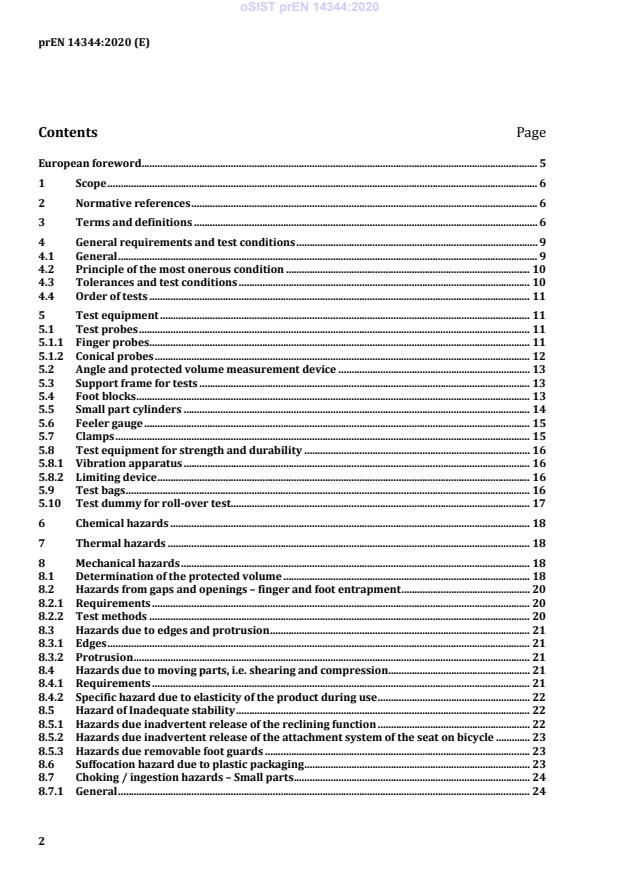
Contents Page
European foreword . 5
1 Scope . 6
2 Normative references . 6
3 Terms and definitions . 6
4 General requirements and test conditions . 9
4.1 General . 9
4.2 Principle of the most onerous condition . 10
4.3 Tolerances and test conditions . 10
4.4 Order of tests . 11
5 Test equipment . 11
5.1 Test probes . 11
5.1.1 Finger probes . 11
5.1.2 Conical probes . 12
5.2 Angle and protected volume measurement device . 13
5.3 Support frame for tests . 13
5.4 Foot blocks . 13
5.5 Small part cylinders . 14
5.6 Feeler gauge . 15
5.7 Clamps . 15
5.8 Test equipment for strength and durability . 16
5.8.1 Vibration apparatus . 16
5.8.2 Limiting device . 16
5.9 Test bags . 16
5.10 Test dummy for roll-over test . 17
6 Chemical hazards . 18
7 Thermal hazards . 18
8 Mechanical hazards . 18
8.1 Determination of the protected volume . 18
8.2 Hazards from gaps and openings – finger and foot entrapment . 20
8.2.1 Requirements . 20
8.2.2 Test methods . 20
8.3 Hazards due to edges and protrusion . 21
8.3.1 Edges . 21
8.3.2 Protrusion . 21
8.4 Hazards due to moving parts, i.e. shearing and compression . 21
8.4.1 Requirements . 21
8.4.2 Specific hazard due to elasticity of the product during use . 22
8.5 Hazard of Inadequate stability . 22
8.5.1 Hazards due inadvertent release of the reclining function . 22
8.5.2 Hazards due inadvertent release of the attachment system of the seat on bicycle . 23
8.5.3 Hazards due removable foot guards . 23
8.6 Suffocation hazard due to plastic packaging . 23
8.7 Choking / ingestion hazards – Small parts . 24
8.7.1 General . 24
oSIST prEN 14344:2020
prEN 14344:2020 (E)
8.7.2 Requirements . 24
8.7.3 Test methodology . 24
8.8 Hazards from inadequate structural integrity . 25
8.8.1 Requirements for strength and durability . 25
8.8.2 Mounting method for strength and durability for luggage and non-luggage carrier
rear seats . 25
8.8.3 Test methodology for strength and durability. 25
8.9 Inadequate protective function . 30
8.9.1 General . 30
8.9.2 Requirements for seating area and footrests . 30
8.9.3 Protection for feet . 31
8.9.4 Lateral seat protection . 35
8.9.5 Seat and backrest angle . 36
8.9.6 Restraint system . 40
9 Product information . 43
9.1 Purchase information . 43
9.1.1 General requirements for purchase information . 43
9.1.2 Specific purchase information . 43
9.2 Instructions for use . 43
9.2.1 General . 43
9.2.2 Specific instructions for mounting and use . 44
9.3 Marking . 46
9.3.1 General requirements for marking . 46
9.3.2 Marking requirements for rear seats attached to luggage carriers . 46
9.3.3 Marking, test method . 46
Annex A (normative) Measuring device . 47
Annex B (normative) Foot Blocks A and B . 64
B.1 General . 64
Annex C (informative) Translation of Warnings in different European languages . 67
Annex D (informative) A–deviation . 70
Annex E (informative) Rationales . 71
E.1 General . 71
E.2 Chemical hazards . 71
E.3 Thermal hazards . 71
E.4 Mechanical hazards . 71
E.4.1 General . 71
E.4.2 Choking and ingestion hazards . 71
E.4.3 Entanglement hazards . 71
E.4.4 Protective function . 72
E.4.4.1 General . 72
E.4.4.2 Protected volume . 72
E.4.4.3 Head support . 72
E.4.4.4 Head protection . 72
E.4.4.5 Foot guarding . 72
oSIST prEN 14344:2020
prEN 14344:2020 (E)
E.4.5 Durability . 72
E.4.6 Suffocation hazards . 72
E.4.7 Hazards from hot and cold surfaces . 72
E.4.8 Product information . 73
Bibliography . 74
oSIST prEN 14344:2020
prEN 14344:2020 (E)
European foreword
This document (prEN 14344:2020) has been prepared by Technical Committee CEN/TC 252 “Child use
and care articles”, the secretariat of which is held by AFNOR.
This document is currently submitted to the second CEN Enquiry.
This document will supersede EN 14344:2004.
This document has been prepared under a mandate given to CEN by the European Commission and the
European Free Trade Association, and supports essential requirements of EU Directive(s).
oSIST prEN 14344:2020
prEN 14344:2020 (E)
1 Scope
This document specifies requirements for child seats intended to be mounted on cycles and electrical
power assisted cycles with a cut off speed of up to 25 km/h (i.e. according to EN 15194), their attachment
system and accessories intended to be attached to the seat in order to transport children with a weight
from 9 kg up to 22 kg and who are capable of sitting unaided.
NOTE 1 Some European countries have special legislation for child seats for cycles. Compliance with this
document might not meet this legislation.
NOTE 2 Where a child seat or any part of the child seat has several functions or can be converted into another
function, other relevant standards might be applicable.
2 Normative references
The following documents are referred to in the text in such a way that some or all of their content
constitutes requirements of this document. For dated references, only the edition cited applies. For
undated references, the latest edition of the referenced document (including any amendments) applies.
EN 71-1:2014+A1:2018, Safety of toys - Part 1: Mechanical and physical properties
EN 71-2:2011+A1:2014, Safety of toys - Part 2: Flammability
EN 71-3, Safety of toys - Part 3: Migration of certain elements
EN 1888-1:2018, Child care articles - Wheeled child conveyances - Part 1: Pushchairs and prams
CEN/TR 13387-3:2015, Child use and care articles - General safety guidelines - Part 3: Mechanical hazards
EN ISO 11243:2016, Cycles - Luggage carriers for bicycles - Requirements and test methods (ISO
11243:2016)
3 Terms and definitions
For the purposes of this document, the following terms and definitions apply.
ISO and IEC maintain terminological databases for use in standardization at the following addresses:
— IEC Electropedia. available at http://www.electropedia.org/
— ISO Online browsing platform: available at http://www.iso.org/obp
3.1
seat
child seat intended to be mounted on a cycle
3.2
front seat
child seat intended to be mounted on a cycle in front of the rider (between handlebar of the cycle and
rider)
3.3
rear seat
child seat intended to be mounted on a cycle behind the rider
oSIST prEN 14344:2020
prEN 14344:2020 (E)
3.4
reclining seat
front or rear seat that can transport a child either in an upright or in a reclined sitting position
3.5
guard
device that reduces or prevents physical access to a hazard zone by closing off access to an area
containing one or more hazards
3.6
integral guard
guard that is part of the seat (for example a foot guards) and cannot be removed or require use of tools
to remove it
3.7
removable foot guard
guard that is always provided with the seat, or pre-assembled with, and can be removed
3.8
reference plane
plane defined by the top surface of the measuring device
3.9
attachment system
structure to attach the child seat to the cycle
3.10
footrest
structure to support the child's foot
3.11
protected volume
volume accessible by the child, when sitting in the seat, where specific safety requirements are necessary
3.12
handlebar and handlebar stem assembly
3.12.1
handlebar
part held by rider
Note 1 to entry: See Figure 1.
3.12.2
extension
part of the handlebar stem that positions the handlebar in front of the steering axis
Note 1 to entry: See Figure 1.
oSIST prEN 14344:2020
prEN 14344:2020 (E)
3.12.3
quill
part of some designs of the handlebar stem, that is co-axial with the steering axis and that fits partly into
the fork steering tube
Note 1 to entry: See Figure 1.
Key
1 handlebar
2 extension
3 quill
Figure 1 — Handlebar and handlebar stem assembly
3.13
restraint system
device designed to restrain the child in a sitting and safe position
3.14
crotch restraint
device designed to pass between the child's legs to prevent the child from sliding forward
3.15
cycle
vehicle that has at least two wheels and is propelled solely or mainly by the muscular energy of the person
on that vehicle, in particular by means of pedals
[SOURCE: EN 15194:2017, 3.1]
oSIST prEN 14344:2020
prEN 14344:2020 (E)
3.16
accessories
additional elements that are attached directly to the child seat
Note 1 to entry: Are not considered as accessories: footrest, restraint system, integral and additional guard,
attachment system.
3.17
headrest
postural support device intended to support the head
3.18
plastic sheeting
thin section plastic sheeting which is used as part of the seat or as part of the packaging
Note 1 to entry: Decals are covered by this definition.
[SOURCE: Modified from EN 71-1:2014+A1:2018, 3.52]
3.19
operating device
part of the locking mechanism(s) designed to be activated by the carer through one or several positive
action(s)
3.20
locking mechanism
assembly of components consisting of one or more locking device(s) and one or more operating device(s)
3.21
lateral protection
part of the bicycle seat designed to keep the child inside the seat and to provide sufficient armrest
3.22
luggage carrier platform
flat part of the luggage carrier (3.2) upon which loads can be placed or fixed, or the flat top rail from which
panniers can be hung, or the bottom part of a container
Note 1 to entry: The bottom part of a container, for example a basket.
[SOURCE: EN ISO 11243:2016, 3.3]
3.23
exposed protrusion
protrusion which, through its location and rigidity, could present a hazard to the rider/child either
through heavy contact with it in normal use or should the rider/child fall onto it in an accident
[SOURCE: EN ISO 4210-1:2014, 2.17]
4 General requirements and test conditions
4.1 General
Seats are classified according to the weight and height of the child carried and their mounting position
on the cycle (see Table 1).
oSIST prEN 14344:2020
prEN 14344:2020 (E)
Front seat shall not be attached to the handlebar of the cycle or the extension of the handlebar as defined
in 3.11.
NOTE Additional regulations could apply on the location of the attachment of the seat on the bicycle (e.g.
German and Austrian road traffic regulations).
Table 1 — Classification of seats
Height/Weight/capacity range
Type of seat
9 kg to 15 kg 9 kg to 22 kg
Rear seat A15 A22
Front seat between handlebar of C15 Not permitted
the cycle and rider
Maximum standing height of the 930 mm 1 100 mm
a
child
Front seat in front of handlebar of Not permitted Not permitted
the cycle
a
SOURCE: World Health Organization (WHO) child growth standards.
EXAMPLE Designation of a seat to be mounted behind the rider (A), maximum load 15 kg (15): Child seat A15.
4.2 Principle of the most onerous condition
All tests shall be conducted according instructions for use.
It is allowed to use any cycle that is suitable according to this information.
Unless otherwise stated each test shall be conducted with the child seat in the most onerous condition
for that test in terms of:
— the addition (or not) of any other accessories supplied or recommended by the manufacturer for use
with the child seat and with accessories loaded according to the manufacturer's instructions;
— the adjustment of the child seat, and any other adjustable features (e.g. reclined backrest) or
accessories, or any other optional arrangement of the child seat allowed in the manufacturer's
instructions or otherwise approved by the manufacturer;
— any removable padding shall be installed during the measurements.
NOTE The heaviest loads do not always produce the most onerous conditions.
4.3 Tolerances and test conditions
Unless otherwise stated the following tolerances shall be used:
All forces shall have an accuracy of ± 5 %.
All masses shall have an accuracy of ± 1 %.
All dimensions shall have an accuracy of ± 1,0 mm.
All time measurements shall have an accuracy of ± 1s.
oSIST prEN 14344:2020
prEN 14344:2020 (E)
All angles shall have an accuracy of ± 1°.
All frequencies, amplitudes shall have an accuracy of ± 5 %.
The seat shall be conditioned at a temperature of (23 ± 10) °C for at least 2 h prior to test. All tests shall
be carried out at a temperature of (23 ± 10) °C unless otherwise specified.
4.4 Order of tests
The tests shall be carried out on the same sample in the order that they appears in 8.8 of this document.
A separate sample could be used for all other tests.
5 Test equipment
5.1 Test probes
5.1.1 Finger probes
5.1.1.1 Finger probe with hemispherical end
Probes made from plastics or other hard, smooth material of diameter 7 mm, with a full
−01,
hemispherical end (see Figure 2).
Dimensions in millimetres
Key
1 R 3,5
2 line scribed around circumference showing depth of penetration
Ø (7 )
−01,
Figure 2 — 7 mm probe (see CEN/TR 13387-3:2015)
5.1.1.2 Shape assessment probe
Probes made from plastics or other hard, smooth material with the dimensions shown in Figure 3 below.
oSIST prEN 14344:2020
prEN 14344:2020 (E)
Dimensions in millimetres
Key
A front view
B top view
C side view
D 3D view
Figure 3 — Shape assessment probe (see CEN/TR 13387-3:2015)
5.1.1.3 Conical probe for mesh
Probe for assessing mesh made from plastics or other hard, smooth material as shown in Figure 4 —
Conical probe for mesh below which shall be capable of being mounted on a force measuring device, so
that the conical end can be presented to the opening being assessed.
Dimensions in millimetres
Figure 4 — Conical probe for mesh (see CEN/TR 13387-3:2015)
The tolerance on the radius is ± 0,2 mm.
5.1.2 Conical probes
Probes made from plastics or other hard smooth material of diameters (12 + 0,1 / 0), (25 0 / –0,1), mm
and (45 + 0,1 / 0) mm with one conical end (with an angle of 30°), that can be mounted on a force
measuring device (see Figure 5 below).
oSIST prEN 14344:2020
prEN 14344:2020 (E)
Dimensions in millimetres
Key
d diameter (12, 25 or 45)
Note : To avoid any risk, the tip of the conical part might be rounded
Figure 5 — Conical probes (see CEN/TR 13387-3:2015)
5.2 Angle and protected volume measurement device
A measuring device defined in Annex A shall be used to check the minimum angle between the seat and
the horizontal plane and the minimum angle between the seat and the backrest (see 8.9.5) and to define
the protected volume for the child (see 8.1).
5.3 Support frame for tests
The device in Figure 6 is intended to support the bicycle seat when specified in the tests.
Figure 6 — Test bench for frame mounted seat
5.4 Foot blocks
The two foot blocks (see Annex B, Figure B.1) in aluminum shall be used for assessment of the size of the
footrest, range adjustment and the efficiency of the straps (For others details, see Annex B, Figures B.2
and B.3). Foot blocks shall be able to be mounted on a cylinder (see Figure 7).
oSIST prEN 14344:2020
prEN 14344:2020 (E)
Dimensions in millimetres
Point A is the centre of the diameter 10.
Figure 7 — Cylinder
5.5 Small part cylinders
Small part cylinder for the assessment of small components, having dimensions in accordance to Figure 8.
oSIST prEN 14344:2020
prEN 14344:2020 (E)
Dimensions in millimetres
Figure 8 — Small parts cylinder (see CEN/TR 13387-3:2015)
5.6 Feeler gauge
Gauge with a thickness of (0,4 ± 0,02) mm and an insertion edge radius of (3 ± 0,5) mm (see Figure 9).
Dimensions in millimetres
Figure 9 — Feeler gauge (see CEN/TR 13387-3:2015)
5.7 Clamps
Clamps are required to grip the components being tested in both: the torque test, 8.7.3.2 (examples can
be seen in CEN/TR 13387-3:2015, in Figure 27) and the tension test, 8.7.3.3 (examples can be seen in
CEN/TR 13387-3:2015, in Figure 28 and Figure 29). However where a clamp is used it shall not damage
the component being tested. Additionally the clamp shall not affect the result of the test.
oSIST prEN 14344:2020
prEN 14344:2020 (E)
5.8 Test equipment for strength and durability
5.8.1 Vibration apparatus
The fixture on an apparatus, which is capable of providing the motion described in 8.8.3.5.
Key
1 Reference plane
2a Vertical distance between point D of the measurement device
(Annex A) and the lateral swing axis (see Table 3)
2b Vertical distance between carrier platform and the lateral swing
axis (see Table 3)
3 height of the measuring points above the reference plane
4 measuring points
D Measuring point for seat high
Figure 10 — Vibration apparatus
5.8.2 Limiting device
Examples of limiting devices are a micro-switch or infrared sensor to detect excess movement of the seat
during the transverse rigidity test.
5.9 Test bags
These bags shall be constructed from a material that is strong enough to prevent slump to the contents,
so that they still comply with the specified dimensions at the end of the tests, but are sufficiently flexible
to conform to the parts of the seat, which support them. They shall be completely filled to the specified
mass with any suitable inert, granular, homogenous material (not necessary sand). The body bag (B) shall
be a cylinder of diameter d1, length l1 and mass m1, and the two foot bags (F) shall each be L-shaped, 90°
bent cylinders of diameter d2, length l2, height h2 and mass m2 (see Figure 11). Values for theses
dimensions and masses are given in Table 2.
oSIST prEN 14344:2020
prEN 14344:2020 (E)
Key
B body bag
d diameter of the cylinder of the body bag
l length of the cylinder of the body bag
m mass of the cylinder of the body bag
F two foot bags
d diameter of the cylinder of the foot bag
l length of the body bag
h height of the body bag
m mass of the body bag
Figure 11 — Arrangement of test bags in seat
Table 2 — Test bag dimensions and masses
Body bag (B) Foot bag (F)
d l m d l h m
Class of seat
1 1 1 2 2 2 2
mm mm kg mm mm mm kg
A15, C15 175 ± 40 225 ± 50 12 ± 0,1 70 ± 20 140 ± 20 175 ± 40 2 ± 0,1
A22 200 ± 40 260 ± 50 18 ± 0,1 80 ± 20 160 ± 30 200 ± 40 3 ± 0,1
5.10 Test dummy for roll-over test
Test dummy made of a rigid material with a smooth finish and a total mass of (9 ± 0,1) kg, see Figure 12.
oSIST prEN 14344:2020
prEN 14344:2020 (E)
Dimensions in millimetres
Tolerances:
— dimensions ± 2 mm;
— angles ± 2°;
— where shown, corner radii shall be (10 ± 1) mm.
Figure 12 — Test dummy (see EN 1888-1:2018)
6 Chemical hazards
A separate sample may be used for these tests.
All the parts or components located within the protected volume shall comply with EN 71-3.
7 Thermal hazards
Fabrics shall not produce a surface flash when applying a flame as described in EN 71-2:2011+A1:2014,
5.4.
A separate sample may be used for these tests.
NOTE UK and France have special provisions concerning their fire regulation as stated in Annex C and Annex D.
8 Mechanical hazards
8.1 Determination of the protected volume
For the rear seat, install the product on the test bench as defined in 5.3.
oSIST prEN 14344:2020
prEN 14344:2020 (E)
When the paddings can be removed (for example. for cleaning), the test shall be done with and without
the padding.
Place the measuring device (Annex A) into the product then push the measuring device against the
backrest as shown in Figure 20 until it is in contact with the backrest (H). During the positioning the four
pins (G) shall stay in contact with the seat.
— Mount on the measuring device the appropriate artificial shoulders and arms according to the
classification of the product and the Figure A.1.
— The assessment shall be done with the seat mounted in every possible positions as recommended by
the manufacturer in the instruction for use.
— Determine which part of the cycle seat can be reach by artificial arms of the measuring device.
A vertical band of 200 mm at the external rear surface of the backrest, from the top of the backrest to the
projection of the reference plane, is considered not to be accessible for the child (see Figure 13). This is
not applicable to front seats.
Dimensions in millimetres
Key
1 Reference plane
Figure 13 — Accessibility to the backrest
oSIST prEN 14344:2020
prEN 14344:2020 (E)
For the front seat, install the product on a bicycle or on an adapted test frame and repeat the procedure
as described above.
8.2 Hazards from gaps and openings – finger and foot entrapment
8.2.1 Requirements
There shall be no open ended tubes and completely bounded openings within the protected volume of
the seat between 7 mm and 12 mm when tested in accordance with 8.2.2, unless the depth is less
than 10 mm or unless the shape assessment probe enters when tested in accordance with 8.2.2.
This requirement is not applicable to the restraint system and the buckles of the restraint system.
The size of the holes in mesh within the protected volume shall be less than 7 mm when tested in
accordance with 8.2.2.
There shall be no accessible holes or openings between rigid parts of the footrest having a width greater
than 25 mm and smaller than 45 mm, when tested in accordance with 8.2.2.
8.2.2 Test methods
Check whether the 7 mm finger probe (5.1.1.1) with an applied force of up to 30 N, enters 10 mm or more
into any accessible opening in any possible orientation. If the 7 mm probe enters 10 mm or more then
the shape assessment probe, (5.1.1.2) shall also enter 10 mm or more with an applied force of up to 5 N.
Check whether the conical probe (5.1.1.3), penetrates holes in the mesh to the 7 mm diameter section
with an applied force of up to 30 N.
Check whether the 25 mm conical probe (5.1.2), enters into any opening in the footrest with an applied
force of up to 30 N. If the 25 mm conical probe enters then the 45 mm conical probe (5.1.2.) shall also
enter with an applied force of up to 5 N.
The Figure 14 show the pass and fail criteria for the shape assessment probe.
oSIST prEN 14344:2020
prEN 14344:2020 (E)
Key
shape assessment probe
F Fail
P Pass
Figure 14 — Shape assessment probe (see CEN/TR 13387-3:2015)
8.3 Hazards due to edges and protrusion
8.3.1 Edges
8.3.1.1 Requirements
All exposed edges and surfaces should be rounded or chamfered and free from burrs and sharp edges.
When tested in accordance with 8.3.1.2 any protective covering shall either not be removable or if
removable, all exposed edges shall be rounded or chamfered and free from burrs and sharp edges.
8.3.1.2 Test method
Apply a tensile force of up to 90 N to the protective covering of the product to be tested. Apply the force
gradually over a period of 5 s and maintain for 10 s.
8.3.2 Protrusion
Exposed protrusion shall be shaped to avoid injuries and punctures.
8.4 Hazards due to moving parts, i.e. shearing and compression
8.4.1 Requirements
Within the protected volume there shall be no potentially hazardous shear and compression points
between rigid parts intended to moveto each other that can close to less than 12 mm unless the clearance
oSIST prEN 14344:2020
prEN 14344:2020 (E)
is always less than 3 mm. Excluded from this requirements, are parts that move while the seat is being
erected for use or being folded or during controlled adjustments of parts that are locked when in position
for use.
The test shall be carried out one time loaded with the corresponding test bag according to 5.9 and a
second time with no load.
The test shall be carried out before, during and after the strength test as in 8.8.3.
NOTE For the assessment during the test according to 8.8.3, the laboratory adapt the equipment to perform
the measure.
8.4.2 Specific hazard due to elasticity of the product during use
The space between the shell of the cycle seat and the connection support, shall be less than 3 mm or more
than 12 mm.
Step 1: The assessment shall be carried out:
— firstly, with no load in the cycle seat;
— and secondly with the corresponding loaded test bag (according to 5.9) placed into the cycle seat.
Step 2: The assessment shall be carried out before, during and after the strength test as in 8.8.3.
NOTE For the assessment during the test according to 8.8.3, the laboratory adapt the equipment to perform
the measure.
8.5 Hazard of Inadequate stability
8.5.1 Hazards due inadvertent release of the reclining function
8.5.1.1 General
The following requirement are applicable when the operating device of the locking mechanism is inside
the protected volume.
Product in which the backrest/seat can be adjusted into reclined position shall have the operating
device(s) of the locking mechanism(s), complying with 8.5.1.2, to maintain the bicycle seat in its position.
Seat attachment systems shall not be considered as locking mechanism for backrest adjustment of the
sitting area.
8.5.1.2 Unintentional release of locking mechanism(s)
To avoid the hazards due to unintentional release of locking mechanisms, one of the following conditions
shall be fulfilled:
a) at least one of the operating device of the locking mechanism requires an operating force greater
than 50 N, or a torque of 0,34 N·m, or
b) at least one of the operating device of the locking mechanism released by the use of a tool, or
c) release of locking mechanism requires at least two consecutive actions, the first of which shall be
maintained while the second is carried out, ord) release of locking mechanism requires at least
two independent and simultaneous actions.
Products that in every position of use have to be removed from the bicycle to adjust the seat or the
backrest are excluded from the requirements of this clause.
oSIST prEN 14344:2020
prEN 14344:2020 (E)
If adjustable backrest having a continuous controlled reclining movement (e.g screwing movement by
knob) this are not concerned by inadequate released.
8.5.2 Hazards due inadvertent release of the attachment system of the seat on bicycle
To avoid the hazards due to unintentional release of attachment system, one of the following conditions
shall be fulfilled:
a) at least one of the operating device of the attachment system requires an operating force greater than
50 N, or a torque of 0,34 N·m, or
b) at least one of the operating device of the attachment system released by the use of a tool, or
c) seat attachment system requires at least two consecutive actions, the first of which shall be
maintained while the second is carried out, or
d) seat attachment system requires at least two independent and simultaneous actions.
8.5.3 Hazards due removable foot guards
8.5.3.1 General
The following requirement are applicable when the operating device of the removable foot guards is
inside the protected volume.
8.5.3.2 Unintentional detachment of foot guards
To avoid the hazards due to unintentional detachment of foot guards, one of the following conditions shall
be fulfilled:
a) locking mechanism of removable foot guards requires an operating force greater than 50 N, or a
torque of 0,34 N·m, or
b) removable foot guards released by the use of a tool, or
c) foot guard detachment requires at least two consecutive actions, the first of which shall be
maintained while the second is carried out, or
d) foot guard detachment requires at least two independent and simultaneous actions.
8.6 Suffocation hazard due to plastic packaging
Plastic bags and plastic sheeting used for packaging shall conform to one of the following requirements:
a) bags made of flexible plastics with an opening perimeter greater than 360 mm used for external or
internal packaging or plastic sheeting used for packaging, shall have an average sheet thickness
of 0,038 mm or more when measured in accordance with EN 71-1:2014+A1:2018 and shall not have
a drawstring or cord as a means of closing; or
b) bags made of perforated sheets or perforated plastic sheeting with an average thickness of less
than 0,038 mm when measured in accordance with EN 71-1:2014+A1:2018 and of an area greater
than 100 mm × 100 mm shall be perforated with defined holes so that a minimum of 1 % of the area
has been removed over any area of 30 mm × 30 mm; or
c) any plastic covering used as packaging that does not fulfil the previous requirements shall be
conspicuously marked in the official language (s) of the country where the product is sold with a
oSIST prEN 14344:2020
prEN 14344:2020 (E)
statement to indicate that any plastic cover should be removed, destroyed or kept away from
children to avoid suffocation hazard.
8.7 Choking / ingestion hazards – Small parts
8.7.1 General
The test applies only to components within the protected volume.
Any component or part of a component that is removed according with 8.7.3.1 shall be assessed.
8.7.2 Requirements
When tested in accordance with 8.7.3.1 (ability to grip), 8.7.3.2 (torque test) and 8.7.3.3 (tensile test), any
component or part of a component that is removed, whether intended to be removed without the use of
a tool or not, shall not fit entirely within the small parts cylinder, see 5.5.
8.7.3 Test methodology
8.7.3.1 Assessment of child’s ability to grip components
If the component to be tested cannot be gripped between thumb and forefinger, establish whether it is
grippable by inserting the feeler gauge (see 5.6) between the component and the underlying layer or
...