

EN 14617-4:2012
(Main)Agglomerated stone - Test methods - Part 4: Determination of the abrasion resistance
- Abstract
This European Standard specifies a method for determining the abrasion resistance of agglomerated stone products.
- Status
- Published
- Publication Date
- 10-Apr-2012
- Withdrawal Date
- 30-Oct-2012
- Technical Committee
- CEN/TC 246 - Natural stones
- Drafting Committee
- CEN/TC 246/WG 4 - Agglomerated stones (JWG 229/246)
- Current Stage
- 9093 - Decision to confirm - Review Enquiry
- Start Date
- 05-Jun-2023
- Completion Date
- 07-Oct-2026

Overview
EN 14617-4:2012 is a European Standard established by the European Committee for Standardization (CEN) that specifies a standardized test method to determine the abrasion resistance of agglomerated stone products. Agglomerated stone, made by bonding natural stone chips with resins or other binders, is widely used in construction, architecture, and design. This standard provides a reliable, repeatable procedure for assessing how well these stone products withstand surface wear caused by abrasion.
The abrasion resistance test outlined in EN 14617-4:2012 ensures quality control and helps manufacturers and clients evaluate the durability of agglomerated stone surfaces, thereby guiding product selection for various applications requiring robust material performance.
Key Topics
- Test Principle: The method involves scraping the upper face of a stone specimen with an abrasive material (corundum F80 grit size) under controlled conditions to measure surface wear.
- Abrasive Material: White fused aluminum oxide (corundum) with specific grain size is used; it must be replaced after no more than three uses to ensure consistency.
- Test Apparatus: The test requires a specialized wearing machine with a rotating abrasion wheel, abrasive feed hopper, clamping trolley with counterweight, and measuring devices to determine groove dimensions caused by abrasion.
- Calibration Requirements: Regular calibration of the apparatus is mandatory, either after 400 grooves or every two months, including verification of consistent abrasive flow and reference testing against standard samples (e.g., glass float).
- Specimen Preparation: Test specimens must be clean, dry, flat within ±1 mm, and cut to a minimum size of 100 mm × 70 mm. Specimens are sampled randomly from homogeneous batches to ensure representativeness.
- Procedure: The process includes positioning the specimen on the clamping trolley, applying abrasive flow, rotating the wheel at a fixed speed, and stopping after 150 rotations to measure the abrasion groove.
- Measurement and Results: Groove length is measured with magnification and digital calipers to the nearest 0.5 mm. The reported value is an average with standard deviation calculated from multiple specimens.
- Test Reporting: The format includes detailed identification, lab and client info, test conditions, specimen details, equipment used, groove dimensions, deviations, and remarks, ensuring traceability and transparency.
Applications
- Quality Control: Manufacturers of agglomerated stone products use this test to validate the abrasion resistance of their materials before market release.
- Material Comparison: Architects, designers, and specifiers use the test outcomes to compare product durability, helping in selecting appropriate materials for high-traffic floors, countertops, and exterior cladding.
- Durability Assessment: Construction engineers rely on abrasion resistance data to predict the lifespan and maintenance needs of agglomerated stone in various environments.
- Compliance and Certification: Compliance with EN 14617-4:2012 supports conformance to European standards, facilitating market acceptance and legal adherence.
- Research and Development: Product developers employ this test during R&D phases to innovate better performing agglomerated stone formulations and surface finishes.
Related Standards
EN 14617-4:2012 is part of a comprehensive series of standards covering test methods for agglomerated stone. Related test parts include:
- EN 14617-1: Determination of apparent density and water absorption
- EN 14617-2: Determination of flexural strength (bending)
- EN 14617-5: Determination of freeze and thaw resistance
- EN 14617-6: Determination of thermal shock resistance
- EN 14617-8: Determination of resistance to fixing (dowel hole)
- EN 14617-9: Determination of impact resistance
- EN 14617-10: Determination of chemical resistance
- EN 14617-11: Determination of linear thermal expansion coefficient
- EN 14617-12: Determination of dimensional stability
- EN 14617-13: Determination of electrical resistivity
- EN 14617-15: Determination of compressive strength
- EN 14617-16: Determination of dimensions, geometric characteristics, and surface quality of modular tiles
These standards collectively enable a rigorous evaluation of the physical and mechanical properties of agglomerated stone products, fostering harmonized testing procedures and product reliability across Europe.
Keywords: EN 14617-4:2012, abrasion resistance test, agglomerated stone, natural stone test methods, corundum abrasive, stone durability, European Standard, CEN, surface wear testing, quality control agglomerated stone, stone product testing
Relations
- Effective Date
- 18-Apr-2012
- Effective Date
- 25-Aug-2026
- Effective Date
- 28-Jan-2026
- Refers
EN 13373:2020 - Natural stone test methods - Determination of geometric characteristics on units - Effective Date
- 28-Jan-2026
- Effective Date
- 28-Jan-2026
- Referred By
EN 15564:2008 - Precast concrete products - Resin bound concrete - Requirements and test methods - Effective Date
- 28-Jan-2026
- Referred By
EN 15285:2008 - Agglomerated stone - Modular tiles for flooring and stairs (internal and external) - Effective Date
- 28-Jan-2026
Get Certified
Connect with accredited certification bodies for this standard

DIBt (Deutsches Institut für Bautechnik)
German Institute for Building Technology.
DIN CERTCO
DIN Group product certification.

Aboma Certification B.V.
Specialized in construction, metal, and transport sectors.
Sponsored listings
Frequently Asked Questions
EN 14617-4:2012 is a standard published by the European Committee for Standardization (CEN). Its full title is "Agglomerated stone - Test methods - Part 4: Determination of the abrasion resistance". This standard covers: This European Standard specifies a method for determining the abrasion resistance of agglomerated stone products.
This European Standard specifies a method for determining the abrasion resistance of agglomerated stone products.
EN 14617-4:2012 is classified under the following ICS (International Classification for Standards) categories: 91.100.15 - Mineral materials and products. The ICS classification helps identify the subject area and facilitates finding related standards.
EN 14617-4:2012 has the following relationships with other standards: It is inter standard links to EN 14617-4:2005, ISO 8486-1:1996, EN 2086:2004, EN 13373:2020, EN 16954:2018, EN 15564:2008, EN 15285:2008. Understanding these relationships helps ensure you are using the most current and applicable version of the standard.
EN 14617-4:2012 is available in PDF format for immediate download after purchase. The document can be added to your cart and obtained through the secure checkout process. Digital delivery ensures instant access to the complete standard document.
Standards Content (Sample)
2003-01.Slovenski inštitut za standardizacijo. Razmnoževanje celote ali delov tega standarda ni dovoljeno.Aglomeriran kamen - Preskusne metode - 4. del: Ugotavljanje obrabne obstojnostiKünstlich hergestellter Stein - Prüfverfahren - Teil 4: Bestimmung der AbriebbeständigkeitPierre agglomérée - Méthodes d'essai - Partie 4: Détermination de la résistance à l'usureAgglomerated stone - Test methods - Part 4: Determination of the abrasion resistance91.100.15Mineralni materiali in izdelkiMineral materials and productsICS:Ta slovenski standard je istoveten z:EN 14617-4:2012SIST EN 14617-4:2012en,fr,de01-julij-2012SIST EN 14617-4:2012SLOVENSKI
STANDARDSIST EN 14617-4:20051DGRPHãþD
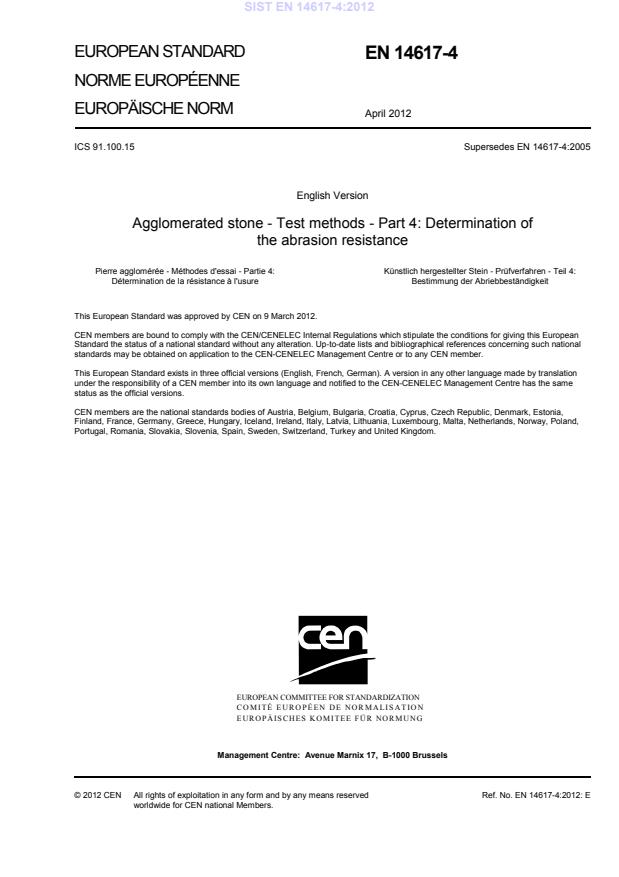
EUROPEAN STANDARD NORME EUROPÉENNE EUROPÄISCHE NORM
EN 14617-4
April 2012 ICS 91.100.15 Supersedes EN 14617-4:2005English Version
Agglomerated stone - Test methods - Part 4: Determination of the abrasion resistance
Pierre agglomérée - Méthodes d'essai - Partie 4: Détermination de la résistance à l'usure
Künstlich hergestellter Stein - Prüfverfahren - Teil 4: Bestimmung der Abriebbeständigkeit This European Standard was approved by CEN on 9 March 2012.
CEN members are bound to comply with the CEN/CENELEC Internal Regulations which stipulate the conditions for giving this European Standard the status of a national standard without any alteration. Up-to-date lists and bibliographical references concerning such national standards may be obtained on application to the CEN-CENELEC Management Centre or to any CEN member.
This European Standard exists in three official versions (English, French, German). A version in any other language made by translation under the responsibility of a CEN member into its own language and notified to the CEN-CENELEC Management Centre has the same status as the official versions.
CEN members are the national standards bodies of Austria, Belgium, Bulgaria, Croatia, Cyprus, Czech Republic, Denmark, Estonia, Finland, France, Germany, Greece, Hungary, Iceland, Ireland, Italy, Latvia, Lithuania, Luxembourg, Malta, Netherlands, Norway, Poland, Portugal, Romania, Slovakia, Slovenia, Spain, Sweden, Switzerland, Turkey and United Kingdom.
EUROPEAN COMMITTEE FOR STANDARDIZATION
COMITÉ EUROPÉEN DE NORMALISATION EUROPÄISCHES KOMITEE FÜR NORMUNG
Management Centre:
Avenue Marnix 17,
B-1000 Brussels © 2012 CEN All rights of exploitation in any form and by any means reserved worldwide for CEN national Members. Ref. No. EN 14617-4:2012: ESIST EN 14617-4:2012
EN 14617-5, Agglomerated stone — Test methods — Part 5: Determination of freeze and thaw resistance EN 14617-6, Agglomerated stone — Test methods — Part 6: Determination of thermal shock resistance EN 14617-8, Agglomerated stone — Test methods — Part 8: Determination of resistance to fixing (dowel hole) EN 14617-9, Agglomerated stone — Test methods — Part 9: Determination of impact resistance EN 14617-10, Agglomerated stone — Test methods — Part 10: Determination of chemical resistance EN 14617-11, Agglomerated stone — Test methods — Part 11: Determination of linear thermal expansion coefficient EN 14617-12, Agglomerated stone — Test methods — Part 12: Determination of dimensional stability EN 14617-13, Agglomerated stone — Test methods — Part 13: Determination of electrical resistivity EN 14617-15, Agglomerated stone — Test methods — Part 15: Determination of compressive strength EN 14617-16, Agglomerated stone — Test methods — Part 16: Determination of dimensions, geometric characteristics and surface quality of modular tiles According to the CEN/CENELEC Internal Regulations, the national standards organizations of the following countries are bound to implement this European Standard: Austria, Belgium, Bulgaria, Croatia, Cyprus, Czech Republic, Denmark, Estonia, Finland, France, Germany, Greece, Hungary, Iceland, Ireland, Italy, Latvia, Lithuania, Luxembourg, Malta, Netherlands, Norway, Poland, Portugal, Romania, Slovakia, Slovenia, Spain, Sweden, Switzerland, Turkey and the United Kingdom SIST EN 14617-4:2012
...