

EN 23923-2:1993
(Main)Metallic powders - Determination of apparent density - Part 2: Scott volumeter method (ISO 3923-2:1981)
- Abstract
IS applicable to powders that will not flow freely through a 5 mm orifice. The oscillating funnel method (part 3) gives better precision, but it cannot be used in cases where the powder may change its properties due to the vibration action applied to the powder during testing. Gives principle, symbols and designations, apparatus, sampling, procedure, expression of results and test report.
- Status
- Published
- Publication Date
- 06-Apr-1993
- Withdrawal Date
- 30-Oct-1993
- Technical Committee
- CEN/SS M11 - Powder metallurgy
- Drafting Committee
- CEN/SS M11 - Powder metallurgy
- Current Stage
- 9093 - Decision to confirm - Review Enquiry
- Start Date
- 13-Oct-1999
- Completion Date
- 13-Oct-1999

Overview
EN 23923-2:1993 specifies the Scott volumeter method for the determination of the apparent density of metallic powders. This standard is applicable to metallic powders that do not flow freely through a 5 mm orifice, providing a reliable procedure for measuring apparent density without the flow issues encountered in other methods. While the oscillating funnel method (Part 3) offers better precision, the Scott volumeter method is preferred when vibration might alter powder properties during testing.
Developed under the guidance of ISO Technical Committee ISO/TC 119 (Powder Metallurgy), this standard ensures consistent and reproducible results critical for industries working with metallic powders.
Key Topics
Scope and Applicability
- Designed for metallic powders unable to flow freely through small orifices.
- Suitable where vibration-sensitive powders must be tested without property alteration.
Test Principle
- Apparent density is calculated by measuring the mass of a powder sample filling a known volume in a cup.
- The powder is introduced through a Scott volumeter’s series of inclined plates, cascading gently to fill the cup with minimum disturbance.
Apparatus and Design
- Scott volumeter consisting of a funnel (with sieve), a baffle box with glass baffles to reduce powder velocity, and a stand.
- Cylindrical cup with a precise volume of 25 cm³ for consistent volumetric measurement.
- A balance accurate to 0.05 g for precise mass determination.
Sampling
- Requires a minimum sample volume of 100 cm³ to allow triplicate testing.
- Powders are tested preferably in the as-received condition; drying instructions are specified if necessary.
Test Procedure
- Powder is carefully poured into the funnel and passes through the sieve and baffles.
- Light brushing may be required to aid powder flow if not freely flowing.
- The cup is filled, leveled, tapped gently, and weighed.
- The test is performed three times to ensure accuracy.
Result Expression
- Apparent density is determined by the formula:
Apparent density = mass of powder (g) ÷ volume of cup (cm³) - Results are averaged and reported to the nearest 0.01 g/cm³.
- When variability exceeds 1% between tests, highest and lowest results must also be reported.
- Apparent density is determined by the formula:
Reporting Requirements
- Identification details of the powder sample.
- Reference to the EN 23923-2:1993 standard.
- Details of drying process if applied.
- Results with any deviations or incidents during testing.
Applications
This standard is essential for industries and laboratories involved in powder metallurgy, particularly:
- Manufacturing of metallic components by powder metallurgy, where accurate powder density impacts compaction and sintering processes.
- Quality control and assurance in production lines dealing with metallic powders of varying flow characteristics.
- Research and development in materials engineering to characterize novel metallic powders.
- Powder suppliers and distributors ensuring consistent product quality and specification compliance.
- Additive manufacturing processes, where powder characteristics affect layer deposition and final part quality.
By following EN 23923-2:1993, organizations optimize process control, improve product reliability, and ensure conformity with international standards.
Related Standards
- EN 23923-1:1993 (ISO 3923-1:1981) – Funnels method for apparent density determination of metallic powders that flow freely.
- EN 23923-3:1993 (ISO 3923-3:1982) – Oscillating funnel method providing better precision for apparent density but unsuitable for sensitive powders.
- ISO 3923 series – General guidelines and methods for determining the apparent density of metallic powders.
- ISO/TC 119 Technical Committee – Focuses on powder metallurgy standards and related test methods.
Using these complementary standards supports comprehensive evaluation of metallic powder characteristics across varying flow and testing conditions.
Keywords: Metallic powders, apparent density, Scott volumeter method, powder metallurgy, powder testing standards, EN 23923-2, ISO 3923-2, powder characterization, powder flow, volumetric analysis
Relations
- Effective Date
- 28-Jan-2026
- Effective Date
- 28-Jan-2026
Get Certified
Connect with accredited certification bodies for this standard

Element Materials Technology
Materials testing and product certification.

Inštitut za kovinske materiale in tehnologije
Institute of Metals and Technology. Materials testing, metallurgical analysis, NDT.
Sponsored listings
Frequently Asked Questions
EN 23923-2:1993 is a standard published by the European Committee for Standardization (CEN). Its full title is "Metallic powders - Determination of apparent density - Part 2: Scott volumeter method (ISO 3923-2:1981)". This standard covers: IS applicable to powders that will not flow freely through a 5 mm orifice. The oscillating funnel method (part 3) gives better precision, but it cannot be used in cases where the powder may change its properties due to the vibration action applied to the powder during testing. Gives principle, symbols and designations, apparatus, sampling, procedure, expression of results and test report.
IS applicable to powders that will not flow freely through a 5 mm orifice. The oscillating funnel method (part 3) gives better precision, but it cannot be used in cases where the powder may change its properties due to the vibration action applied to the powder during testing. Gives principle, symbols and designations, apparatus, sampling, procedure, expression of results and test report.
EN 23923-2:1993 is classified under the following ICS (International Classification for Standards) categories: 77.160 - Powder metallurgy. The ICS classification helps identify the subject area and facilitates finding related standards.
EN 23923-2:1993 has the following relationships with other standards: It is inter standard links to EN 1274:2004, EN 13086:2000. Understanding these relationships helps ensure you are using the most current and applicable version of the standard.
EN 23923-2:1993 is available in PDF format for immediate download after purchase. The document can be added to your cart and obtained through the secure checkout process. Digital delivery ensures instant access to the complete standard document.
Standards Content (Sample)
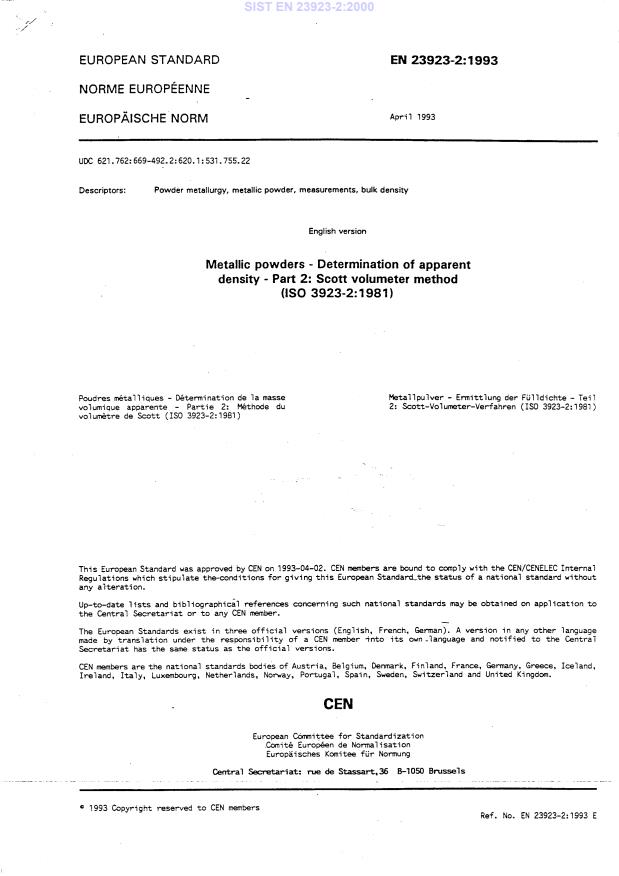
2003-01.Slovenski inštitut za standardizacijo. Razmnoževanje celote ali delov tega standarda ni dovoljeno.Metallic powders - Determination of apparent density - Part 2: Scott volumeter method (ISO 3923-2:1981)Metallpulver - Ermittlung der Fülldichte - Teil 2: Scott-Volumeter-Verfahren (ISO 3923-2:1981)Poudres métalliques - Détermination de la masse volumique apparente - Partie 2: Méthode du volumetre de Scott (ISO 3923-2:1981)Metallic powders - Determination of apparent density - Part 2: Scott volumeter method (ISO 3923-2:1981)77.160Metalurgija prahovPowder metallurgyICS:Ta slovenski standard je istoveten z:EN 23923-2:1993SIST EN 23923-2:2000en01-december-2000SIST EN 23923-2:2000SLOVENSKI
STANDARD
International Standard INTERNATIONAL ORGANIZATION FOR STANDARDIZATIONWlE)YHAPO~HAR OPI-AHM3AUklR fl0 CTAH~APTM3AlJ’lM~ORGANISATlON INTERNATIONALE DE RORMALISATION Metallic powders - Determination of apparent density - Part 2 : Scott volumeter method Poudres m&a/liques - Dbtermination de Ia masse volumique apparente - Partie 2 : Mthode du volumktre de Scott First edition - 1981-09-01 W - UDC 621.762 : 669-492.2 : 531.755 Ref. No. l§O 3923/2-1981 (EI Descriptors : pulverulent products, metallic powder, tests, determination, density (massholume), funnels, sampling, volumetric analysis. 0 cn Price based on 4 pages SIST EN 23923-2:2000
Foreword ISO (the International Organization for Standardization) is a worldwide federation of national Standards institutes (ISO member bedies). The work of developing Inter- national Standards is carried out through ISO technical committees. Every member body interested in a subject for which a technical committee has been set up has the right to be represented on that committee. International organizations, governmental and non-governmental, in liaison with ISO, also take part in the work. Draft International Standards adopted by the technical committees are circulated to the member bodies for approval before their acceptance as International Standards by the ISO Council. International Standard ISO 3923/2 was developed by Technical Committee ISO/TC 119, Powder metahugy, and was circulated to the member bodies in December 1979. lt has been approved by the member bodies of the following countries : Austria Germany, F. R. Bulgaria India Canada Italy China Japan Czechoslovakia Korea, Rep. of Egypt, Arab Rep. of Norway France Portugal Romania South Africa, Rep. of Spain Sweden United Kingdom USA USSR No member body expressed disapproval of the document. International Organkation for Standardkation, 1981 Printed in Switzerland SIST EN 23923-2:2000
INTERNATIONAL STANDARD ISO 3923/2-1981 (E) Metallic powders - Determination of apparent density - Part 2 : Scott volumeter method 1 Scope and field of application This part of ISO 3923 specifies the Scott volumeter method for the determination of the apparent density of metallic powders. It is applicable to powders that will not flow freely through a 5 mm orifice (see ISO 3923/1). Part 3 of this International Standard specifies the oscillating funnel method for the determination of apparent density of such powders, and this is preferred since it gives better preci- sion, but it cannot be used in cases where the powder may Change its properties due to the Vibration action applied to the powder during testing. 2 References I S 0 392311, Metallic po wders - Determination of apparent density - Part I : Funnel method. ISO 392313, Metallic powders - Determination of apparent density - Part 3 : Oscia thg funnel method. 3 Principle Measurement of the mass of a certain quantity of powder which in a loose condition exactly fills a cup of known volume. The loose condition is obtained, when filling the CUP, by cascading the powder over a series of inclined plates in a Scott volumeter (see figures 1 and 2). The ratio between the mass and the volume represents the ap- parent density. 4 Symbols and designations Ebol 1 Designation @a Qas m V Apparent density of metallic powders (general term) Apparent density obtained by the Scott volumeter method Mass of the powder Volume of the
...