

EN 16157-7:2018
(Main)Intelligent transport systems - DATEX II data exchange specifications for traffic management and information - Part 7: Common data elements
- Abstract
This document specifies and defines component facets required to support the exchange and shared use of data and information in the field of traffic and travel.
The component facets include the framework and context for data content, data structure and relationships, communications specification.
This document is applicable to:
- traffic and travel information which is of relevance to road networks (non-urban and urban),
- public transport information that is of direct relevance to the use of a road network (e.g. road link via train or ferry service),
- traffic and travel information in the case of Cooperative intelligent transport systems (C-ITS).
This document establishes specifications for data exchange between any two instances of the following actors:
- Traffic Information Centres (TICs),
- Traffic Control Centres (TCCs),
- Service Providers (SPs),
Use of this document can be applicable for use by other actors.
This document covers, at least, the following types of informational content:
- road traffic event information - planned and unplanned occurrences both on the road network and in the surrounding environment,
- information about operator initiated actions - including both advisory and mandatory measures,
- road traffic measurement data, status data, and travel time data,
- travel information relevant to road users, including weather and environmental information,
- road traffic management information and information and advice relating to use of the road network.
This part of EN 16157 specifies common informational structures, relationships, roles, attributes and associated data types required for publishing information within the DATEX II framework. This is specified as a DATEX II sub-model which is part of the DATEX II platform independent model, but this part only covers common elements that are used by more than one publication. It excludes those elements that relate to location information which are specified in FprEN 16157 2.
- Status
- Published
- Publication Date
- 18-Dec-2018
- Withdrawal Date
- 29-Jun-2019
- Technical Committee
- CEN/TC 278 - Road transport and traffic telematics
- Drafting Committee
- CEN/TC 278/WG 8 - Road traffic data (RTD)
- Current Stage
- 9092 - Decision on results of review/2YR ENQ - revise - Review Enquiry
- Start Date
- 04-Jun-2024
- Completion Date
- 07-Oct-2026


Overview
EN 16157-7:2018 - part of the EN 16157 DATEX II family - specifies the common data elements required to exchange traffic and travel information across Intelligent Transport Systems (ITS). It defines the framework, data structures, relationships, communications context and a data dictionary for publishing information within the DATEX II platform independent model. This part focuses on elements that are shared across multiple DATEX II publications (excluding detailed location models, which are covered in EN 16157‑2).
Key technical topics and requirements
- DATEX II sub‑model: Specifies a platform‑independent sub‑model of common classes used for data exchange between systems.
- Common informational structures: Standardized classes, attributes, roles and relationships for consistent message content.
- Predefined datatypes and enumerations: A catalog of core datatypes (dates, times, numeric measures, multilingual strings, URLs, etc.) and enumerations (vehicle types, precipitation types, validity status, fault severity, etc.).
- Top‑level packages and classes: Organized model packages (e.g., Vehicle, VehicleCharacteristics, WeatherRelated, Validity, Fault, DataValue) that group related elements and semantics.
- Data dictionary: Normative definitions for classes, attributes and datatypes to ensure consistent interpretation.
- Conformance: Requirements to support interoperability between actors by complying with the specified model semantics and data types.
- Scope of content: Road traffic events (planned/unplanned), operator‑initiated actions (advisories/mandatory measures), traffic measurements and travel time data, environment/weather information, and traffic management/advisory information.
Practical applications and who uses it
EN 16157-7:2018 is intended for organizations and systems that need standard, interoperable traffic and travel data exchange:
- Traffic Information Centres (TICs) and Traffic Control Centres (TCCs) exchanging event, measurement and management data.
- Service Providers (SPs) delivering route guidance, traveler information, or value‑added services.
- C‑ITS deployments requiring harmonized message content for cooperative services.
- Road authorities, ITS integrators and software vendors who implement data publishers/subscribers or message brokers using DATEX II. Practical uses include cross‑border traffic feeds, traveler information portals, dynamic traffic control integrations, weather‑aware routing, and data aggregation for analytics.
Related standards
- EN 16157 series (DATEX II) - this document is Part 7 (Common data elements).
- EN 16157‑2 (FprEN 16157‑2) - specifies the location information model referenced by Part 7.
SIST EN 16157‑7:2019 is essential for achieving consistent, machine‑readable traffic information exchange under the DATEX II framework and for enabling interoperable ITS and C‑ITS services across vendors and regions.
Relations
- Effective Date
- 08-Jun-2022
- Effective Date
- 25-Aug-2026
- Effective Date
- 25-Aug-2026
- Effective Date
- 25-Aug-2026
- Effective Date
- 28-Jan-2026
- Effective Date
- 28-Jan-2026
- Effective Date
- 28-Jan-2026
- Effective Date
- 28-Jan-2026
- Effective Date
- 28-Jan-2026
- Effective Date
- 22-Jul-2026
- Effective Date
- 28-Jan-2026
- Effective Date
- 28-Jan-2026
- Effective Date
- 28-Jan-2026
- Effective Date
- 28-Jan-2026
- Effective Date
- 28-Jan-2026
Get Certified
Connect with accredited certification bodies for this standard

BSI Group
BSI (British Standards Institution) is the business standards company that helps organizations make excellence a habit.

NYCE
Mexican standards and certification body.
Sponsored listings
Frequently Asked Questions
EN 16157-7:2018 is a standard published by the European Committee for Standardization (CEN). Its full title is "Intelligent transport systems - DATEX II data exchange specifications for traffic management and information - Part 7: Common data elements". This standard covers: This document specifies and defines component facets required to support the exchange and shared use of data and information in the field of traffic and travel. The component facets include the framework and context for data content, data structure and relationships, communications specification. This document is applicable to: - traffic and travel information which is of relevance to road networks (non-urban and urban), - public transport information that is of direct relevance to the use of a road network (e.g. road link via train or ferry service), - traffic and travel information in the case of Cooperative intelligent transport systems (C-ITS). This document establishes specifications for data exchange between any two instances of the following actors: - Traffic Information Centres (TICs), - Traffic Control Centres (TCCs), - Service Providers (SPs), Use of this document can be applicable for use by other actors. This document covers, at least, the following types of informational content: - road traffic event information - planned and unplanned occurrences both on the road network and in the surrounding environment, - information about operator initiated actions - including both advisory and mandatory measures, - road traffic measurement data, status data, and travel time data, - travel information relevant to road users, including weather and environmental information, - road traffic management information and information and advice relating to use of the road network. This part of EN 16157 specifies common informational structures, relationships, roles, attributes and associated data types required for publishing information within the DATEX II framework. This is specified as a DATEX II sub-model which is part of the DATEX II platform independent model, but this part only covers common elements that are used by more than one publication. It excludes those elements that relate to location information which are specified in FprEN 16157 2.
This document specifies and defines component facets required to support the exchange and shared use of data and information in the field of traffic and travel. The component facets include the framework and context for data content, data structure and relationships, communications specification. This document is applicable to: - traffic and travel information which is of relevance to road networks (non-urban and urban), - public transport information that is of direct relevance to the use of a road network (e.g. road link via train or ferry service), - traffic and travel information in the case of Cooperative intelligent transport systems (C-ITS). This document establishes specifications for data exchange between any two instances of the following actors: - Traffic Information Centres (TICs), - Traffic Control Centres (TCCs), - Service Providers (SPs), Use of this document can be applicable for use by other actors. This document covers, at least, the following types of informational content: - road traffic event information - planned and unplanned occurrences both on the road network and in the surrounding environment, - information about operator initiated actions - including both advisory and mandatory measures, - road traffic measurement data, status data, and travel time data, - travel information relevant to road users, including weather and environmental information, - road traffic management information and information and advice relating to use of the road network. This part of EN 16157 specifies common informational structures, relationships, roles, attributes and associated data types required for publishing information within the DATEX II framework. This is specified as a DATEX II sub-model which is part of the DATEX II platform independent model, but this part only covers common elements that are used by more than one publication. It excludes those elements that relate to location information which are specified in FprEN 16157 2.
EN 16157-7:2018 is classified under the following ICS (International Classification for Standards) categories: 35.240.60 - IT applications in transport. The ICS classification helps identify the subject area and facilitates finding related standards.
EN 16157-7:2018 has the following relationships with other standards: It is inter standard links to CEN/TS 16157-1:2011, ISO 8601:2004, ISO/IEC 10646:2017, ISO 639-1:2002, EN 1090-5:2017, CEN/TR 10317:2020, EN ISO 21530:2004, EN ISO 3166-1:2020, EN 16157-1:2018, CEN/TS 16157-8:2026, CEN/TS 16157-11:2025, CEN/TS 16157-8:2020, CEN/TS 16157-6:2015, EN 16157-2:2019, EN 16157-3:2018. Understanding these relationships helps ensure you are using the most current and applicable version of the standard.
EN 16157-7:2018 is associated with the following European legislation: EU Directives/Regulations: 2010/40/EU. When a standard is cited in the Official Journal of the European Union, products manufactured in conformity with it benefit from a presumption of conformity with the essential requirements of the corresponding EU directive or regulation.
EN 16157-7:2018 is available in PDF format for immediate download after purchase. The document can be added to your cart and obtained through the secure checkout process. Digital delivery ensures instant access to the complete standard document.
Standards Content (Sample)
2003-01.Slovenski inštitut za standardizacijo. Razmnoževanje celote ali delov tega standarda ni dovoljeno.Inteligentni transportni sistemi - Specifikacije za izmenjavo podatkov DATEX II pri upravljanju prometa in informiranju - 7. del: Skupni podatkovni elementiIntelligente Verkehrssysteme - DATEX II Datenaustauschspezifikation für Verkehrsmanagement und Verkehrsinformation - Teil 7: Gemeinsame DatenelementeSystèmes de transport intelligents - Spécifications DATEX II d'échange de données pour la gestion du trafic et l'information routière - Partie 7: Éléments de données communsIntelligent transport systems - DATEX II data exchange specifications for traffic management and information - Part 7: Common data elements35.240.60Uporabniške rešitve IT v prometuIT applications in transportICS:Ta slovenski standard je istoveten z:EN 16157-7:2018SIST EN 16157-7:2019en,fr,de01-februar-2019SIST EN 16157-7:2019SLOVENSKI
STANDARDSIST-TS CEN/TS 16157-1:20111DGRPHãþD
EUROPEAN STANDARD NORME EUROPÉENNE EUROPÄISCHE NORM
EN 16157-7
December
t r s z English Version
Intelligent transport systems æ DATEX II data exchange specifications for traffic management and information æ Part
yã Common data elements Systèmes de transport intelligents æ Spécifications DATEX II d 5échange de données pour la gestion du trafic et l 5information routière æ Partie
yã Éléments de données communs
Intelligente Verkehrssysteme æ DATEX II Datenaustauschspezifikation für Verkehrsmanagement und Verkehrsinformation æ Teil
yã Gemeinsame Datenelemente This European Standard was approved by CEN on
u September
t r s zä
egulations which stipulate the conditions for giving this European Standard the status of a national standard without any alterationä Upætoædate lists and bibliographical references concerning such national standards may be obtained on application to the CENæCENELEC Management Centre or to any CEN memberä
translation under the responsibility of a CEN member into its own language and notified to the CENæCENELEC Management Centre has the same status as the official versionsä
CEN members are the national standards bodies of Austriaá Belgiumá Bulgariaá Croatiaá Cyprusá Czech Republicá Denmarká Estoniaá Finlandá Former Yugoslav Republic of Macedoniaá Franceá Germanyá Greeceá Hungaryá Icelandá Irelandá Italyá Latviaá Lithuaniaá Luxembourgá Maltaá Netherlandsá Norwayá Polandá Portugalá Romaniaá Serbiaá Slovakiaá Sloveniaá Spainá Swedená Switzerlandá Turkey and United Kingdomä
EUROPEAN COMMITTEE FOR STANDARDIZATION COMITÉ EUROPÉEN DE NORMALISATION EUROPÄISCHES KOMITEE FÜR NORMUNG
CEN-CENELEC Management Centre:
Rue de la Science 23,
B-1040 Brussels
t r s z CEN All rights of exploitation in any form and by any means reserved worldwide for CEN national Membersä Refä Noä EN
s x s w yæ yã t r s z ESIST EN 16157-7:2019
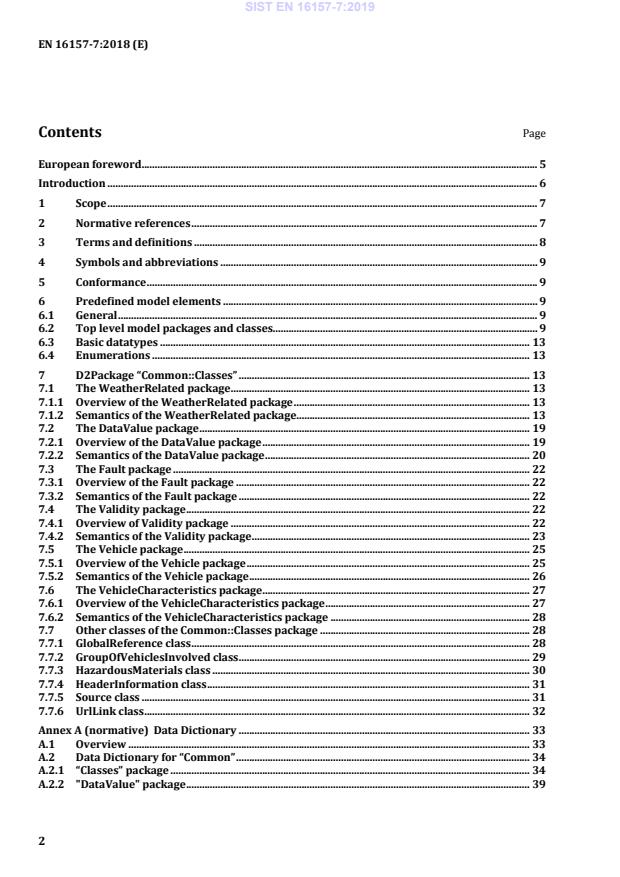
Data Dictionary . 33 A.1 Overview . 33 A.2 Data Dictionary for “Common” . 34 A.2.1 “Classes” package . 34 A.2.2 "DataValue" package . 39 SIST EN 16157-7:2019
Referenced XML Schema for “Common” . 94 B.1 Overview . 94 B.2 DATEX_3_D2Payload.xsd . 94 B.3 DATEX_3_Common.xsd . 94 Bibliography . 160
traffic and travel information which is of relevance to road networks (non-urban and urban),
public transport information that is of direct relevance to the use of a road network (e.g. road link via train or ferry service),
traffic and travel information in the case of Cooperative intelligent transport systems (C-ITS). This document establishes specifications for data exchange between any two instances of the following actors:
Traffic Information Centres (TICs),
Traffic Control Centres (TCCs),
Service Providers (SPs), Use of this document can be applicable for use by other actors. This document covers, at least, the following types of informational content:
road traffic event information – planned and unplanned occurrences both on the road network and in the surrounding environment,
information about operator initiated actions – including both advisory and mandatory measures,
road traffic measurement data, status data, and travel time data,
travel information relevant to road users, including weather and environmental information,
road traffic management information and information and advice relating to use of the road network. This part of EN 16157 specifies common informational structures, relationships, roles, attributes and associated data types required for publishing information within the DATEX II framework. This is specified as a DATEX II sub-model which is part of the DATEX II platform independent model, but this part only covers common elements that are used by more than one publication. It excludes those elements that relate to location information which are specified in FprEN 16157-2. 2 Normative references The following documents are referred to in the text in such a way that some or all of their content constitutes requirements of this document. For dated references, only the edition cited applies. For undated references, the latest edition of the referenced document (including any amendments) applies. EN 16157-1:2018, Intelligent transport systems — DATEX II data exchange specifications for traffic management and information — Part 1: Context and framework SIST EN 16157-7:2019
IEC Electropedia: available at http://www.electropedia.org/
ISO Online browsing platform: available at http://www.iso.org/obp
3.1 Data value value of something that can be measured or calculated 3.2 Extension data model content that is not part of the DATEX II Level A model and that is added in the container package “Extension” (e.g. for project specific purposes) 3.3 Fault information about a malfunction relating to a specific piece of equipment or process 3.4 Generic publication DATEX II publication without predefined content used to make extensions at the publication level 3.5 Payload publication traffic related information or associated management information created at a specific point in time that can be exchanged via a DATEX II interface Note 1 to entry The “PayloadPublication” class is the top level root class for DATEX II Level A. 3.6 Validity time period specification for which the exchanged DATEX II information is valid 3.7 Weather data collection of information related to measured or derived (usually transport related) weather conditions at a specified location SIST EN 16157-7:2019
comply with all stipulated minimum and maximum multiplicity requirements for UML elements and relationships;
comply with all definitions, types and ordering;
employ optional elements as specified;
comply with all expressed constraints. It should be noted that conformance of a publication service with all the structural requirements stated above does not necessarily ensure that the informational content of that service will be semantically comprehensible. It is in principle possible to create models in accordance to EN 16157-1:2018, Clauses 6 and 7 (general and platform independent model related clauses) – even including the mapping to XML Schema Definition described in EN 16157-1:2018, A.3 – that do not comply with Clause 6 'Predefined model elements' of this document. Nevertheless, note that such a model cannot claim full compliance with this European Standard and thus shall not work with tools requiring full compliance. 6 Predefined model elements 6.1 General Besides regulations for the use of UML constructors and a UML profile providing additional meta information via tagged values and stereotypes, the DATEX II modelling methodology furthermore stipulates a certain top-level model structure for all compliant UML models. These clauses are mainly motivated by the need to create a well-defined structure for DATEX II tools aiming at supporting users. The types of attributes and the enumerations specific to this part are defined in the normative Annex A. The XML subschema corresponding to this part of EN 16157 is provided in the normative Annex B. 6.2 Top level model packages and classes The following rules apply for top level model packages and classes: SIST EN 16157-7:2019
“Common” of stereotype “D2Namespace”;
“Extension” of stereotype “D2Namespace”;
“LocationReferencing” of stereotype “D2Namespace”;
“PayloadPublication” of stereotype “D2Package”. c) The “PayloadPublication” package may contain several sub-packages of stereotype “D2Namespace”. EN 16157-3 specifies the sub-package “Situation” and its content. The standardization of further sub-packages may follow in the future. d) The usage of the “Extension” package for creating customized DATEX extensions is specified in EN 16157-1. e) The “Common” package shall have three sub-packages with the following names:
“Classes” of stereotype “D2Package” – see Clause 7;
“DataTypes” of stereotype “D2Package” – see 6.3;
“Enumerations” of stereotype “D2Package” – see 6.4; The further content of these packages is specified in the further chapters of this document. f) The “Common::Classes” package shall contain one abstract UML Class named “PayloadPublication” of stereotype “D2ModelRoot”. It may contain further packages and classes. g) The tagged value “rootElement” of the DATEX II class “PayloadPublication” shall be set to “payload”. h) The tagged value “modelBaseVersion” of the DATEX II class “PayloadPublication” shall be set to “3” which is current DATEX II model version identifier. The tagged value “version” of the DATEX II class “PayloadPublication” shall be set to “3.n” where “n” is the minor version number. NOTE The model base version “3” denotes the third iteration of the second generation of DATEX specifications, denoted “DATEX II”. The Arabic version number “3” is not to be mixed up with the Roman “II” used to give this generation a name that distinguishes it from the EDIFACT-based “DATEX” standard developed in the 1990ies, finally resulting in the meanwhile withdrawn ENV 13106:2000 and ENV 13777:2000. i) The tagged values “extensionName” and “extensionVersion” of the DATEX II class “Payload Publication” shall contain the name of the extension(s) contained in the model and a corresponding version identifier in the case that the “Extension” package is non-empty. These values shall be provided by the creator of the model (see also Figure 1). The tagged values “profileName” and “profileVersion” of the DATEX II class “Payload Publication” shall contain the name of the profile (sub-model) and a corresponding version identifier in the case a profile is derived from the model. These values shall be provided by the creator of the model - see also Figure 1. SIST EN 16157-7:2019
Figure 1 — Tagged Values of top level class “PayloadPublication” j) The class “PayloadPublication” shall have the following structure: SIST EN 16157-7:2019
Figure 2 —Top level class “PayloadPublication” The class “PayloadPublication” shall have a “D2Relation” composition to the “InternationalIdentifier” class. The “GenericPublication” class (see Figure 2) is a specific realizable case of a “PayloadPublication” and used to make level B extensions at the publication level. Its attribute “genericPublicationName” is used to specify a name for any level B extended publication. The “InternationalIdentifier” class (see Figure 2) shall provide an identifier/name whose range is specific to the particular country. NOTE The possible upper-case two-letter codes related to the “country” attribute of class “InternationalIdentifier” are specified in EN ISO 3166-1 and can be obtained from the Online Browsing Platform of ISO1. k) The “DataTypes” package shall have two sub-packages named “Generic” and “Specific” of stereotype “D2Package”.
1 https://www.iso.org/obp/ui/#search/code/.
“Base64Binary”, “Boolean”, “Date”, “DateTime”, “Decimal”, “Double”, “Float”, “Integer”, “Language”, “LongString”, “MultilanguageString”, “NonNegativeInteger”, “Reference”, “String”, “Time”, “Url”, “VersionedReference”. According definitions and XML Schema Definition mappings for these datatypes are described in A.3. The “DataTypes::Specific” package (as defined in 6.2 k)) shall contain the following classes of stereotype “D2Datatype”:
“AngleInDegrees”, “AxlesPerHour”, “ConcentrationKilogramsPerCubicMetre”, “Concentration-MicrogramsPerCubicMetre”, “CountryCode”, “CubicMetres”, “Hectopascal”, “IntensityKilogramsPer-SquareMetre”, “IntensityMillimetresPerHour”, “KilometresPerHour”, “MetresAsFloat”, “MetresAs-NonNegativeInteger”, “Percentage”, “Seconds”, “TemperatureCelsius”, “Tonnes”, “VehiclesPerHour”, “Year”. According definitions and XML Schema Definition mappings for these datatypes are described in A.3. The datatype “MultilingualString” shall represent text that can be defined in more than one language. For this reason, it shall be a defined as an unbounded sequence of pairs of “value” and “lang”, with “value” representing a string of max. length 1 024 characters and “lang” representing a language. The corresponding XML Schema definition mapping can be found in B.3 (see in “Common.xsd” the complex types “MultilingualString”, “MultilingualStringValue” and “MultilingualStringValueType”). If text within a “MultilingualString” is specified in more than one language, the usage of the “lang” attribute shall be mandatory. 6.4 Enumerations The “Enumerations” package shall contain the ”D2Enumeration” stereotyped elements with according definitions and XML Schema Definition mappings as described in A.4. 7 D2Package “Common::Classes” 7.1 The WeatherRelated package 7.1.1 Overview of the WeatherRelated package The package “WeatherRelated” shall comprise a collection of classes used to specify road weather related measurements. 7.1.2 Semantics of the WeatherRelated package 7.1.2.1 WeatherRelated package semantics – General The aspects of weather or pollution measurements modelled in this package relate to humidity, temperature, visibility, wind, pollution, precipitation and road surface conditions. 7.1.2.2 Humidity class The “Humidity” class shall allow relative humidity measurements to be specified (see Figure 3). SIST EN 16157-7:2019
Figure 3 — The Humidity class model 7.1.2.3 Temperature class The “Temperature” class shall allow a number of different atmospheric temperature measurements to be specified (see Figure 4). Individual measurements of air temperature, dew point temperature, maximum temperature and minimum temperature may be specified. Note that each instance of a measurement may be accompanied by information about the measurement via the TemperatureValue class which inherits a number of metadata attributes from the DataValue class. SIST EN 16157-7:2019
Figure 4 — The Temperature class model 7.1.2.4 Visibility class The “Visibility” class shall allow minimum visibility distance measurements to be specified (see Figure 5). Minimum visibility distance measurements shall be given in integer metres. Note that each instance of a measurement may be accompanied by information about the measurement via the IntegerMetreDistanceValue class which inherits a number of metadata attributes from the DataValue class.
Figure 5 — The Visibility class model 7.1.2.5 Wind class The “Wind” class shall allow a number of different measurements relating to wind to be specified (see Figure 6). SIST EN 16157-7:2019
Figure 6 — The Wind class model 7.1.2.6 Pollution class The “Pollution” class shall allow pollution concentration measurements to be specified (see Figure 7). Pollution concentration measurements shall be given in micrograms per cubic metre. Note that each instance of a measurement may be accompanied by information about the measurement via the MicrogramsConcentrationValue class which inherits a number of metadata attributes from the DataValue class.
Figure 7 — The Pollution class model SIST EN 16157-7:2019
Figure 8 — The Pressure class model 7.1.2.8 PrecipitationDetail class The “PrecipitationDetail” class shall allow measurements relating to precipitation to be specified (see Figure 9). Information on the precipitation type and its intensity may be provided by using the enumerations “PrecipitationTypeEnum” and “PrecipitationIntensityEnum” (see data dictionary). Individual measurements of intensity and depth of precipitation may be specified. Note that each instance of a measurement may be accompanied by information about the measurement via the PrecipitationIntensityValue and FloatingPointMetreDistanceValue classes which inherit a number of metadata attributes from the DataValue class. SIST EN 16157-7:2019
Figure 9 — The PrecipitationDetail class model 7.1.2.9 RoadSurfaceConditionMeasurements and TemperatureAboveOrBelowRoadSurface class The “RoadSurfaceConditionMeasurements” class shall allow road surface condition measurements which are related specifically to the weather to be specified (see Figure 10). Individual measurements of road surface temperature, road surface protection temperature, de-icing application rate, de-icing concentration, depth of snow, ice layer thickness and percentage, water film thickness and friction may be specified. By using the “TemperatureAboveOrBelowRoadSurface” class, it is possible to specify temperatures for individual measurement heights above or below the road surface. Note that each instance of a measurement may be accompanied by information about the measurement via the TemperatureValue, ApplicationRateValue, KilogramsConcentrationValue, FloatingPointMetre-DistanceValue, FrictionValue and PercentageValue classes which inherit a number of metadata attributes from the DataValue class. SIST EN 16157-7:2019
Figure 10 — The RoadSurfaceConditionMeasurements class model 7.2 The DataValue package 7.2.1 Overview of the DataValue package This package describes data values of something that can be measured or calculated (see Figure 11). SIST EN 16157-7:2019
Figure 11 — The DataValue package class model 7.2.2 Semantics of the DataValue package 7.2.2.1 DataValue package semantics – general This package contains types for data values (see following subclauses) and adds additional quality and error information to these types. 7.2.2.2 DataValue class The “DataValue” class is an abstract class i.e. shall be specialized by other classes such as those given in this package. It provides the following quality and error information for each specialized data value:
Information on data error and reason for it;
Accuracy and computation method; SIST EN 16157-7:2019
Number of input values used and number of incomplete inputs;
Smoothing factor and standard deviation;
Information on supplier calculated data quality (in percent). 7.2.2.3 ApplicationRateValue class A measured or calculated value of the application rate of a substance. 7.2.2.4 DirectionBearingValue class A measured or calculated value of direction as a bearing. 7.2.2.5 DirectionCompassValue class A measured or calculated value of direction as a point of the compass. 7.2.2.6 FloatingPointMetreDistanceValue class A measured or calculated value of distance in metres in a floating-point format. 7.2.2.7 FrictionValue class A measured or calculated value of road surface friction. 7.2.2.8 IntegerMetreDistanceValue class A measured or calculated value of distance in whole metres. 7.2.2.9 KilogramsConcentrationValue class A measured or calculated value of concentration of a substance in kilograms per unit volume. 7.2.2.10 MicrogramsConcentrationValue class A measured or calculated value of concentration of a substance in micrograms per unit volume. 7.2.2.11 PercentageValue class A measured or calculated value expressed as a percentage. 7.2.2.12 PrecipitationIntensityValue class A measured or calculated value of the accumulation rate of precipitation. 7.2.2.13 PressureValue class A measured or calculated value of atmospheric pressure. 7.2.2.14 SpeedValue class A measured or calcul
...