

EN 12261:2024
(Main)Gas meters - Turbine gas meters
- Abstract
This document specifies the measuring conditions, requirements and tests for the construction, performance and safety of class 1,0 axial and radial turbine gas meters with mechanical indicating devices, hereinafter referred to as a meter(s), having in-line pipe connections for gas flow measurement.
This document applies to turbine gas meters used to measure the volume of fuel gases of the 1st and 2nd gas families, the composition of which is specified in EN 437:2021, at maximum working pressures up to 420 bar, actual flow rates up to 25 000 m3/h over a gas temperature range of at least 40 K and for a climatic environmental temperature range of at least 50 K.
This document applies to meters that are installed in locations with vibration and shocks of low significance and in:
- closed locations (indoor or outdoor with protection as specified by the manufacturer) with condensing or with non-condensing humidity;
or, if specified by the manufacturer,
- open locations (outdoor without any covering) with condensing humidity or with non-condensing humidity;
and in locations with electromagnetic disturbances.
Unless otherwise specified in this document:
- all pressures used are gauge;
- all influence quantities, except the one under test, are kept relatively constant at their reference value.
Clauses 1 to 7 and Annex B are for design and type testing only, with the exception of 6.2.4.3, 6.2.5.3, 6.7.1.2.2 and 6.7.2.2.2. Annex C can be used to provide guidance on periodic tests during use. Clause 8 and Annexes D and E are for each meter prior to dispatch. Annex A is intended to be used for both type and individual testing. Annex F is intended to be used for individual testing. Annex G is intended to be used for design.
- Status
- Published
- Publication Date
- 05-Mar-2024
- Technical Committee
- CEN/TC 237 - Gas meters
- Drafting Committee
- CEN/TC 237/WG 3 - Turbine meters
- Current Stage
- 6060 - Definitive text made available (DAV) - Publishing
- Start Date
- 06-Mar-2024
- Due Date
- 23-Aug-2022
- Completion Date
- 06-Mar-2024
- Directive
- 2014/32/EU - Directive 2014/32/EU of the European Parliament and of the Council of 26 February 2014 on the harmonisation of the laws of the Member States relating to the making available on the market of measuring instrumentsOJ Ref: 2025/375, OJ, OJ L, OJ L, 2025/375 OJ Date: 27-Feb-2025
2014/68/EU - Directive 2014/68/EU of the European Parliament and of the Council of 15 May 2014 on the harmonisation of the laws of the Member States relating to the making available on the market of pressure equipmentOJ Ref: 2025/165, OJ, OJ L, OJ L, 2025/165 OJ Date: 31-Jan-2025

Overview
EN 12261:2024 - Gas meters: Turbine gas meters defines measuring conditions, design, performance, safety and testing requirements for class 1,0 axial and radial turbine gas meters with mechanical indicating devices and in-line pipe connections. The standard covers meters for measuring volumes of fuel gases of the 1st and 2nd gas families (per EN 437:2021), for maximum working pressures up to 420 bar, actual flow rates up to 25 000 m3/h, and gas and ambient temperature ranges required by the standard (minimum 40 K gas range, 50 K climatic range). It applies to meters installed in indoor or outdoor locations (with manufacturer-specified protection), locations with low-significance vibration/shock, and where electromagnetic disturbances may occur.
Key technical topics and requirements
- Meter classification and sizes: axial and radial turbine meters, defined rangeability and connection diameters.
- Metrological performance: type testing and individual meter accuracy requirements for class 1,0 meters.
- Design, materials & manufacturing: structural robustness, materials for pressurized parts, lubrication and manufacturing controls.
- Environmental resistance: temperature ranges, humidity (condensing/non‑condensing), vibration and electromagnetic disturbance considerations.
- Testing framework:
- Clauses 1–7 and Annex B: primarily for design and type testing (with specific exceptions noted in clause text).
- Annex A: test facility specifications (usable for type and individual testing).
- Annex C: recommendations for in-service periodic tests (informative).
- Annexes D, E, F: factory and individual meter testing, metrological checks and compliance evaluation.
- Annex G: guidance on materials for pressurized parts (informative).
- Marking, documentation and conformity: data plate, instruction manual, test certificates and links to EU directives (Annex ZA/ZB).
Practical applications
- Custody transfer, billing and flow measurement for natural gas and other fuel gases in gas supply systems.
- Industrial and commercial metering installations operating under high pressure (up to 420 bar) and high flow demands.
- Selection and type-approval of turbine meters for pipeline, distribution and industrial energy systems.
Who should use this standard
- Meter manufacturers and design engineers specifying axial and radial turbine meters.
- Test laboratories and conformity assessment bodies performing type and individual testing.
- Gas network operators, utilities, EPC contractors and purchasers specifying metering equipment.
- Regulators and metrology authorities evaluating compliance with MID/PED and national implementation.
Related standards and compliance
- EN 437:2021 (test gases and appliance categories) - referenced for gas family compositions.
- Flange standards (EN 1092 series) - for connection compatibility.
- Annexes ZA/ZB map relations to EU Measuring Instruments Directive (MID) and Pressure Equipment Directive (PED).
Keywords: EN 12261:2024, turbine gas meters, gas meters, axial turbine meter, radial turbine meter, class 1.0, metrological testing, EN 437, PED, MID.
Relations
- Effective Date
- 19-Jan-2023
- Effective Date
- 15-Apr-2026
- Effective Date
- 09-Feb-2026
- Effective Date
- 09-Feb-2026
- Refers
EN 60079-11:2012 - Explosive atmospheres - Part 11: Equipment protection by intrinsic safety "i" - Effective Date
- 09-Feb-2026
- Effective Date
- 09-Feb-2026
- Effective Date
- 09-Feb-2026
- Effective Date
- 09-Feb-2026
- Effective Date
- 09-Feb-2026
- Effective Date
- 09-Feb-2026
- Effective Date
- 09-Feb-2026
- Effective Date
- 28-Jan-2026
- Effective Date
- 28-Jan-2026
- Effective Date
- 28-Jan-2026
- Effective Date
- 28-Jan-2026
Get Certified
Connect with accredited certification bodies for this standard

DIBt (Deutsches Institut für Bautechnik)
German Institute for Building Technology.
DIN CERTCO
DIN Group product certification.

Aboma Certification B.V.
Specialized in construction, metal, and transport sectors.
Sponsored listings
Frequently Asked Questions
EN 12261:2024 is a standard published by the European Committee for Standardization (CEN). Its full title is "Gas meters - Turbine gas meters". This standard covers: This document specifies the measuring conditions, requirements and tests for the construction, performance and safety of class 1,0 axial and radial turbine gas meters with mechanical indicating devices, hereinafter referred to as a meter(s), having in-line pipe connections for gas flow measurement. This document applies to turbine gas meters used to measure the volume of fuel gases of the 1st and 2nd gas families, the composition of which is specified in EN 437:2021, at maximum working pressures up to 420 bar, actual flow rates up to 25 000 m3/h over a gas temperature range of at least 40 K and for a climatic environmental temperature range of at least 50 K. This document applies to meters that are installed in locations with vibration and shocks of low significance and in: - closed locations (indoor or outdoor with protection as specified by the manufacturer) with condensing or with non-condensing humidity; or, if specified by the manufacturer, - open locations (outdoor without any covering) with condensing humidity or with non-condensing humidity; and in locations with electromagnetic disturbances. Unless otherwise specified in this document: - all pressures used are gauge; - all influence quantities, except the one under test, are kept relatively constant at their reference value. Clauses 1 to 7 and Annex B are for design and type testing only, with the exception of 6.2.4.3, 6.2.5.3, 6.7.1.2.2 and 6.7.2.2.2. Annex C can be used to provide guidance on periodic tests during use. Clause 8 and Annexes D and E are for each meter prior to dispatch. Annex A is intended to be used for both type and individual testing. Annex F is intended to be used for individual testing. Annex G is intended to be used for design.
This document specifies the measuring conditions, requirements and tests for the construction, performance and safety of class 1,0 axial and radial turbine gas meters with mechanical indicating devices, hereinafter referred to as a meter(s), having in-line pipe connections for gas flow measurement. This document applies to turbine gas meters used to measure the volume of fuel gases of the 1st and 2nd gas families, the composition of which is specified in EN 437:2021, at maximum working pressures up to 420 bar, actual flow rates up to 25 000 m3/h over a gas temperature range of at least 40 K and for a climatic environmental temperature range of at least 50 K. This document applies to meters that are installed in locations with vibration and shocks of low significance and in: - closed locations (indoor or outdoor with protection as specified by the manufacturer) with condensing or with non-condensing humidity; or, if specified by the manufacturer, - open locations (outdoor without any covering) with condensing humidity or with non-condensing humidity; and in locations with electromagnetic disturbances. Unless otherwise specified in this document: - all pressures used are gauge; - all influence quantities, except the one under test, are kept relatively constant at their reference value. Clauses 1 to 7 and Annex B are for design and type testing only, with the exception of 6.2.4.3, 6.2.5.3, 6.7.1.2.2 and 6.7.2.2.2. Annex C can be used to provide guidance on periodic tests during use. Clause 8 and Annexes D and E are for each meter prior to dispatch. Annex A is intended to be used for both type and individual testing. Annex F is intended to be used for individual testing. Annex G is intended to be used for design.
EN 12261:2024 is classified under the following ICS (International Classification for Standards) categories: 91.140.40 - Gas supply systems. The ICS classification helps identify the subject area and facilitates finding related standards.
EN 12261:2024 has the following relationships with other standards: It is inter standard links to EN 12261:2018, ISO 7005-2:1988, EN 62246-1:2015, EN 60529:1991/A1:2000, EN 60079-11:2012, EN 60529:1991, ISO 7005-1:2011, EN IEC 60079-0:2018, ISO/IEC Guide 98-3:2008, EN 60947-5-6:2000, EN 60529:1991/A2:2013, EN ISO 15611:2003, EN ISO 14732:2013, EN ISO 15614-1:2017, EN ISO 15614-6:2006. Understanding these relationships helps ensure you are using the most current and applicable version of the standard.
EN 12261:2024 is associated with the following European legislation: EU Directives/Regulations: 2014/32/EU, 2014/68/EU; Standardization Mandates: M/071, M/541, M/601. When a standard is cited in the Official Journal of the European Union, products manufactured in conformity with it benefit from a presumption of conformity with the essential requirements of the corresponding EU directive or regulation.
EN 12261:2024 is available in PDF format for immediate download after purchase. The document can be added to your cart and obtained through the secure checkout process. Digital delivery ensures instant access to the complete standard document.
Standards Content (Sample)
SLOVENSKI STANDARD
01-julij-2024
Nadomešča:
SIST EN 12261:2018
Plinomeri - Turbinski plinomeri
Gas meters - Turbine gas meters
Gaszähler - Turbinenradgaszähler
Compteurs de gaz - Compteurs de gaz à turbine
Ta slovenski standard je istoveten z: EN 12261:2024
ICS:
91.140.40 Sistemi za oskrbo s plinom Gas supply systems
2003-01.Slovenski inštitut za standardizacijo. Razmnoževanje celote ali delov tega standarda ni dovoljeno.
EN 12261
EUROPEAN STANDARD
NORME EUROPÉENNE
March 2024
EUROPÄISCHE NORM
ICS 91.140.40 Supersedes EN 12261:2018
English Version
Gas meters - Turbine gas meters
Compteurs de gaz - Compteurs de gaz à turbine Gaszähler - Turbinenradgaszähler
This European Standard was approved by CEN on 1 January 2024.
CEN members are bound to comply with the CEN/CENELEC Internal Regulations which stipulate the conditions for giving this
European Standard the status of a national standard without any alteration. Up-to-date lists and bibliographical references
concerning such national standards may be obtained on application to the CEN-CENELEC Management Centre or to any CEN
member.
This European Standard exists in three official versions (English, French, German). A version in any other language made by
translation under the responsibility of a CEN member into its own language and notified to the CEN-CENELEC Management
Centre has the same status as the official versions.
CEN members are the national standards bodies of Austria, Belgium, Bulgaria, Croatia, Cyprus, Czech Republic, Denmark, Estonia,
Finland, France, Germany, Greece, Hungary, Iceland, Ireland, Italy, Latvia, Lithuania, Luxembourg, Malta, Netherlands, Norway,
Poland, Portugal, Republic of North Macedonia, Romania, Serbia, Slovakia, Slovenia, Spain, Sweden, Switzerland, Türkiye and
United Kingdom.
EUROPEAN COMMITTEE FOR STANDARDIZATION
COMITÉ EUROPÉEN DE NORMALISATION
EUROPÄISCHES KOMITEE FÜR NORMUNG
CEN-CENELEC Management Centre: Rue de la Science 23, B-1040 Brussels
© 2024 CEN All rights of exploitation in any form and by any means reserved Ref. No. EN 12261:2024 E
worldwide for CEN national Members.
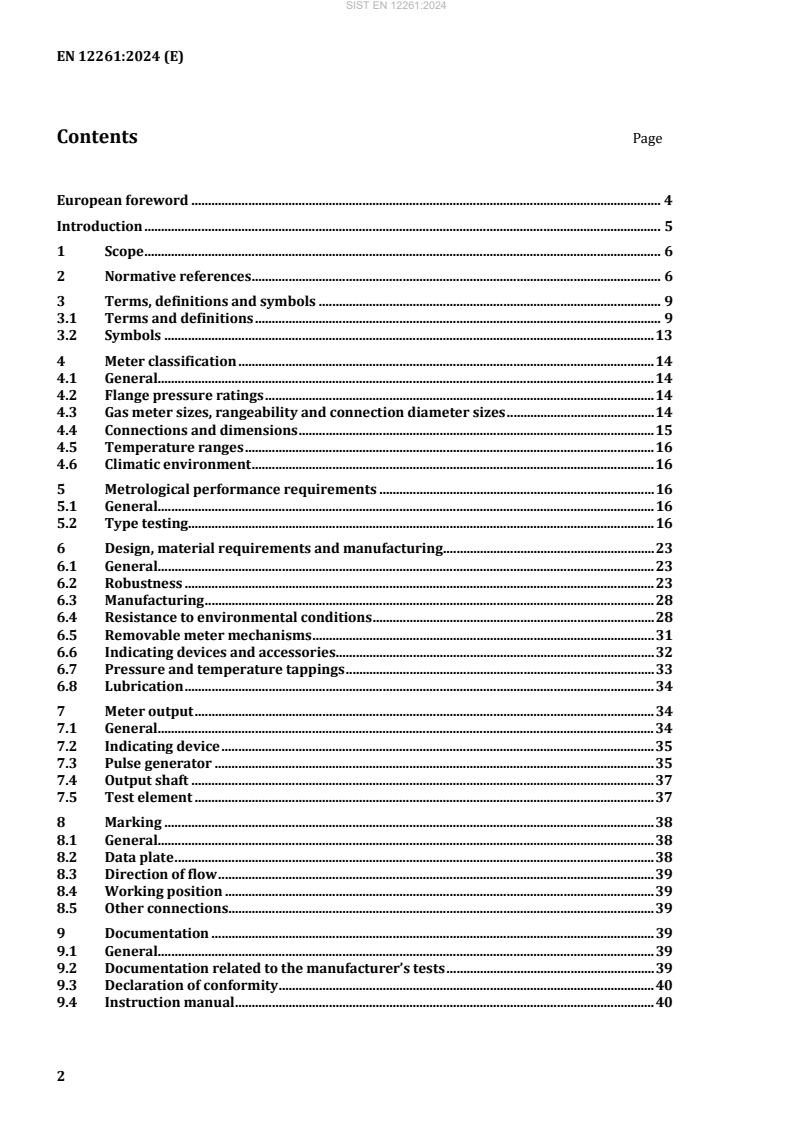
Contents Page
European foreword . 4
Introduction . 5
1 Scope . 6
2 Normative references . 6
3 Terms, definitions and symbols . 9
3.1 Terms and definitions . 9
3.2 Symbols . 13
4 Meter classification . 14
4.1 General. 14
4.2 Flange pressure ratings . 14
4.3 Gas meter sizes, rangeability and connection diameter sizes . 14
4.4 Connections and dimensions . 15
4.5 Temperature ranges . 16
4.6 Climatic environment . 16
5 Metrological performance requirements . 16
5.1 General. 16
5.2 Type testing . 16
6 Design, material requirements and manufacturing . 23
6.1 General. 23
6.2 Robustness . 23
6.3 Manufacturing . 28
6.4 Resistance to environmental conditions . 28
6.5 Removable meter mechanisms . 31
6.6 Indicating devices and accessories. 32
6.7 Pressure and temperature tappings . 33
6.8 Lubrication . 34
7 Meter output . 34
7.1 General. 34
7.2 Indicating device . 35
7.3 Pulse generator . 35
7.4 Output shaft . 37
7.5 Test element . 37
8 Marking . 38
8.1 General. 38
8.2 Data plate . 38
8.3 Direction of flow . 39
8.4 Working position . 39
8.5 Other connections . 39
9 Documentation . 39
9.1 General. 39
9.2 Documentation related to the manufacturer’s tests . 39
9.3 Declaration of conformity . 40
9.4 Instruction manual . 40
Annex A (normative) Test facility specifications . 41
A.1 Test medium . 41
A.2 Leakage. 41
A.3 Installation conditions . 41
A.4 Reference standards . 41
Annex B (normative) Perturbation testing . 42
B.1 General . 42
B.2 Terms and definitions . 42
B.3 Requirements . 42
B.4 Tests . 43
B.5 Similarity . 46
B.6 Flow conditioner . 46
Annex C (informative) Recommendations for use . 48
C.1 Pressure loss . 48
C.2 Spin test . 48
C.3 Locations of temperature measuring devices . 49
Annex D (normative) Individual factory testing . 50
D.1 General . 50
D.2 Meter report . 50
Annex E (normative) Metrological requirements and tests for each meter prior to dispatch
(Individual meter testing) . 51
E.1 Information required from the purchaser (user) . 51
E.2 Determination of number of tests . 51
E.3 Error of indication . 52
E.4 Linearity . 53
E.5 WME . 53
E.6 Data plate specification . 54
E.7 Test certificate . 54
Annex F (normative) Compliance evaluation for gas meters . 55
F.1 General . 55
F.2 Quality Management System . 55
Annex G (informative) Materials for pressurized parts . 56
Annex ZA (informative) Relationship between this European Standard and the essential
requirements of Directive 2014/32/EU Measuring Instruments Directive aimed to
be covered . 64
Annex ZB (informative) Relationship between this European Standard and the essential
requirements of Directive 2014/68/EU aimed to be covered . 69
Bibliography . 71
European foreword
This document (EN 12261:2024) has been prepared by Technical Committee CEN/TC 237 “Gas meters”,
the secretariat of which is held by BSI.
This European Standard shall be given the status of a national standard, either by publication of an
identical text or by endorsement, at the latest by September 2024, and conflicting national standards shall
be withdrawn at the latest by September 2024.
Attention is drawn to the possibility that some of the elements of this document may be the subject of
patent rights. CEN shall not be held responsible for identifying any or all such patent rights.
This document supersedes EN 12261:2018.
— Harmonization with PED;
— Clause 6 reworked completely;
— Annex G added;
— Annex ZB added.
This document has been prepared under a standardization request addressed to CEN by the European
Commission. The Standing Committee of the EFTA States subsequently approves these requests for its
Member States.
For the relationship with EU Legislation, see informative Annex ZA and ZB, which is an integral part of
this document.
Any feedback and questions on this document should be directed to the users’ national standards body.
A complete listing of these bodies can be found on the CEN website.
According to the CEN-CENELEC Internal Regulations, the national standards organisations of the
following countries are bound to implement this European Standard: Austria, Belgium, Bulgaria, Croatia,
Cyprus, Czech Republic, Denmark, Estonia, Finland, France, Germany, Greece, Hungary, Iceland, Ireland,
Italy, Latvia, Lithuania, Luxembourg, Malta, Netherlands, Norway, Poland, Portugal, Republic of North
Macedonia, Romania, Serbia, Slovakia, Slovenia, Spain, Sweden, Switzerland, Türkiye and the United
Kingdom
Introduction
In the preparation of this document, the content of ISO 9951:1993, the content of OIML Publication,
“International Recommendation 6” and “International Recommendation 32” and the content of member
bodies' national standards on turbine meters have been taken into account.
The metrological aspects of this document might be subject to amendments to bring it into line with the
Measuring Instruments Directive (MID).
Electronic Indexes are not specifically covered by this document, however, work to produce a standard
covering these devices is in progress under CEN/TC 237.
1 Scope
This document specifies the measuring conditions, requirements and tests for the construction,
performance and safety of class 1,0 axial and radial turbine gas meters with mechanical indicating
devices, hereinafter referred to as a meter(s), having in-line pipe connections for gas flow measurement.
This document applies to turbine gas meters used to measure the volume of fuel gases of the 1st and 2nd
gas families, the composition of which is specified in EN 437:2021, at maximum operating pressures up
to 420 bar, actual flow rates up to 25 000 m /h over a gas temperature of a minimum −40 °C up to 70 °C,
with a range of at least 40 K and for a climatic environmental temperature range of at least 50 K.
This document applies to meters that are installed in locations with vibration and shocks of low
significance and in:
— closed locations (indoor or outdoor with protection as specified by the manufacturer) with
condensing or with non-condensing humidity;
or, if specified by the manufacturer,
— open locations (outdoor without any covering) with condensing humidity or with non-condensing
humidity;
and in locations with electromagnetic disturbances.
Unless otherwise specified in this document:
— all pressures used are gauge;
— all influence quantities, except the one under test, are kept relatively constant at their reference
value.
2 Normative references
The following documents are referred to in the text in such a way that some or all of their content
constitutes requirements of this document. For dated references, only the edition cited applies. For
undated references, the latest edition of the referenced document (including any amendments) applies.
EN 437:2021, Test gases - Test pressures - Appliance categories
EN 1092-1:2018, Flanges and their joints - Circular flanges for pipes, valves, fittings and accessories, PN
designated - Part 1: Steel flanges
EN 1092-2:2023, Flanges and their joints - Circular flanges for pipes, valves, fittings and accessories, PN
designated - Part 2: Cast iron flanges
EN 1092-3:2003, Flanges and their joints — Circular flanges for pipes, valves, fittings and accessories, PN
designated — Part 3: Copper alloy flanges
EN 1092-4:2002, Flanges and their joints - Circular flanges for pipes, valves, fittings and accessories, PN
designated - Part 4: Aluminium alloy flanges
EN 1759-1:2004, Flanges and their joint - Circular flanges for pipes, valves, fittings and accessories, Class
designated - Part 1: Steel flanges, NPS 1/2 to 24
As impacted by corrigendum EN 1092-3:2003/AC:2007.
EN 1759-3:2003, Flanges and their joints — Circular flanges for pipes, valves, fittings and accessories, Class
designated — Part 3: Copper alloy flanges
EN 1759-4:2003, Flanges and their joint - Circular flanges for pipes, valves, fittings and accessories, class
designated - Part 4: Aluminium alloy flanges
EN 10204:2004, Metallic products - Types of inspection documents
EN 15612:2020, Railway applications - Braking - Brake pipe accelerator
EN ISO 17663:2023, Welding — Quality requirements for heat treatment in connection with welding and
allied processes (ISO 17663:2023)
EN 22768-1:1993, General tolerances - Part 1: Tolerances for linear and angular dimensions without
individual tolerance indications (ISO 2768-1:1989)
EN IEC 60079-0:2018, Explosive atmospheres — Part 0: Equipment — General requirements
(IEC 60079-0:2018)
EN 60079-11:2012, Explosive atmospheres - Part 11: Equipment protection by intrinsic safety "i"
EN 60529:1991, Degrees of protection provided by enclosures (IP Code) (IEC 60529:1989)
EN 60947-5-6:2000, Low-voltage switchgear and controlgear - Part 5-6: Control circuit devices and
switching elements - DC interface for proximity sensors and switching amplifiers (NAMUR)
EN 62246-1:2015, Reed switches - Part 1: Generic specification
EN ISO 5167-1:2022, Measurement of fluid flow by means of pressure differential devices inserted in
circular cross-section conduits running full - Part 1: General principles and requirements (ISO 5167-1:2022)
EN ISO 9606-1:2017, Qualification testing of welders - Fusion welding - Part 1: Steels (ISO 9606-1:2012
including Cor 1:2012 and Cor 2:2013)
EN ISO 9606-2:2004, Qualification test of welders - Fusion welding - Part 2: Aluminium and aluminium
alloys (ISO 9606-2:2004)
EN ISO 9606-3:1999, Approval testing of welders - Fusion welding - Part 3: Copper and copper alloys (ISO
9606-3:1999)
EN ISO 9606-4:1999, Approval testing of welders - Fusion welding - Part 4: Nickel and nickel alloys (ISO
9606-4:1999)
EN ISO 9606-5:2000, Approval testing of welders - Fusion welding - Part 5: Titanium and titanium alloys,
zirconium and zirconium alloys (ISO 9606-5:2000)
EN ISO 9712:2022, Non-destructive testing - Qualification and certification of NDT personnel (ISO
9712:2021)
As impacted by corrigendum EN 1759-3:2003/AC:2004.
As impacted by corrigendum EN 60079-0:2018/AC:2020-02.
As impacted by EN 60529:1991/corrigendum May 1993, EN 60529:1991/AC:2016-12,
EN 60529:1991/A1:2000, EN 60529:1991/A2:2013 and EN 60529:1991/A2:2013/AC:2019-02.
EN ISO 14732:2013, Welding personnel - Qualification testing of welding operators and weld setters for
mechanized and automatic welding of metallic materials (ISO 14732:2013)
EN ISO 15611:2003, Specification and qualification of welding procedures for metallic materials -
Qualification based on previous welding experience (ISO 15611:2003)
EN ISO 15613:2004, Specification and qualification of welding procedures for metallic materials -
Qualification based on pre-production welding test (ISO 15613:2004)
EN ISO 15614-1:2017, Specification and qualification of welding procedures for metallic materials —
Welding procedure test — Part 1: Arc and gas welding of steels and arc welding of nickel and nickel alloys
(ISO 15614-1:2017, Corrected version 2017-10-01)
EN ISO 15614-2:2005, Specification and qualification of welding procedures for metallic materials —
Welding procedure test — Part 2: Arc welding of aluminium and its alloys (ISO 15614-2:2005)
EN ISO 15614-4:2005, Specification and qualification of welding procedures for metallic materials —
Welding procedure test — Part 4: Finishing welding of aluminium castings (ISO 15614-4:2005)
EN ISO 15614-5:2004, Specification and qualification of welding procedures for metallic materials -
Welding procedure test - Part 5: Arc welding of titanium, zirconium and their alloys (ISO 15614-5:2004)
EN ISO 15614-6:2006, Specification and qualification of welding procedures for metallic materials -
Welding procedure test - Part 6: Arc and gas welding of copper and its alloys (ISO 15614-6:2006)
EN ISO 15614-7:2019, Specification and qualification of welding procedures for metallic materials -
Welding procedure test - Part 7: Overlay welding (ISO 15614-7:2016)
EN ISO 15614-8:2016, Specification and qualification of welding procedures for metallic materials -
Welding procedure test - Part 8: Welding of tubes to tube-plate joints (ISO 15614-8:2016)
EN ISO 15614-11:2002, Specification and qualification of welding procedures for metallic materials -
Welding procedure test - Part 11: Electron and laser beam welding (ISO 15614-11:2002)
ISO 7005-1:2011, Pipe flanges — Part 1: Steel flanges for industrial and general service piping systems
ISO 7005-2:1988, Metallic flanges — Part 2: Cast iron flanges
ISO/IEC Guide 98-3:2008, Uncertainty of measurement — Part 3: Guide to the expression of uncertainty in
measurement (GUM:1995)
As impacted by amendment EN ISO 15614-1:2017/A1:2019.
As impacted by corrigendum EN ISO 15614-2:2005/AC:2009.
As impacted by corrigendum EN ISO 15614-242005/AC:2007.
3 Terms, definitions and symbols
3.1 Terms and definitions
For the purposes of this document, the following terms and definitions apply.
ISO and IEC maintain terminology databases for use in standardization at the following addresses:
— ISO Online browsing platform: available at https://www.iso.org/obp
— IEC Electropedia: available at https://www.electropedia.org
3.1.1
turbine gas meter
measuring device in which the dynamic forces of the flowing gas cause a turbine wheel to rotate with a
speed as a function of the volume flow rate
Note 1 to entry: The number of revolutions of the turbine wheel is the basis for the indication of the volume
passed through the meter.
Note 2 to entry: It is designed to measure, memorize and display the volume of a fuel gas that has passed through
it.
3.1.2
measured quantity
volume in cubic meters, at metering conditions
3.1.3
volume flow rate
volume at metering conditions divided by time
3.1.4
rangeability
ratio between Q and Q , i.e. the minimum and maximum flow rate respectively for which the meter
min max
performs within the maximum permissible errors
3.1.5
average velocity
volume flow rate divided by the cross-sectional area of the meter connections
3.1.6
casing
pressure containing structure of the meter
3.1.7 Pressures and temperatures
3.1.7.1
maximum allowable pressure (strength)
PS
maximum allowable pressure PS′ means the maximum pressure for which the equipment is designed, as
specified by the manufacturer, and defined at a location specified by him, being either the connection of
protective and/or limiting devices, or the top of equipment or, if not appropriate, any point specified
3.1.7.2
metering pressure
p
m
absolute gas pressure to which the indicated volume of gas is related
3.1.7.3
operating pressure
gas pressure within the piping containing the meter
3.1.7.4
operating pressure range
permissible pressure range over which the meter is calibrated and operates within the metrological
requirements, which has to be compatible with the design and construction calculations
3.1.7.5
maximum/minimum allowable temperature (strength)
TS
maximum/minimum allowable temperature TS′ means the maximum/minimum temperatures for which
the equipment is designed, as specified by the manufacturer
3.1.7.6
operating temperature range
range of metering temperatures over which the meter operates within the metrological requirements,
which has to be compatible with the design and construction calculations
3.1.8 Designation
3.1.8.1
DN-designation
numerical designation of size for components of a pipework system, which is used for reference purposes
Note 1 to entry: It comprises the letters DN followed by a dimensionless whole number which is indirectly
related to the physical size, in millimetres, of the bore or outside diameter of the end connections.
3.1.8.2
PN-designation
alphanumeric term used for reference purposes related to a combination of mechanical and dimensional
characteristics of a component of a pipework system with regard to pressure
Note 1 to entry: It comprises the letters PN followed by a dimensionless whole number.
3.1.9
metering conditions
conditions of the gas prevailing at the point of the measurement
EXAMPLE Temperature and pressure of the measured gas in the meter.
3.1.10
Reynolds number
Re
number referring to the flow conditions:
4Q
mass 3
Re= 10
πµD
where
Re
is the Reynolds number, dimensionless value;
D is the pipe internal diameter, mm;
μ is the dynamic viscosity, kg/m·s;
is the mass flow rate, kg/s;
Q
mass
where the value of D is given by the internal pipe diameter
Note 1 to entry: The parameters (variables) in the above equation and their units are defined in Table 1.
3.1.11
error of indication
indication of a turbine meter minus the reference value of the measurand
Note 1 to entry: Errors (E) are expressed as relative values (as a percentage) by the ratio of the difference
between the indicated volume ( V ) and a reference volume ( V ) of the gas which has passed through the gas meter
i c
to this latter value:
VV−
ic
E ⋅ 100 %
V
c
or between the indicated flow rate ( Q ) and the reference flow rate ( Q )
i c
QQ−
ic
E ⋅ 100 %
Q
c
3.1.12
pressure loss
non-recoverable pressure drop caused by the presence of the turbine meter in the conduit
3.1.13
pulse value
number of pulses per cubic metre indicated
=
=
3.1.14 Gas families
3.1.14.1
1st family
gas having a Wobbe index between:
–3 –3
23,8 MJ ⋅ m and 31,4 MJ ⋅ m
according to EN 437:2021 related on gross calorific value
3.1.14.2
2nd family
gas having a Wobbe index between:
−3 −3
41,3 MJ ⋅ m and 57,9 MJ ⋅ m
according to EN 437:2021 related on gross calorific value
3.1.15
class 1,0 meter
meter which has an error of indication between −2 % and +2 % for flow rates Q where Q ≤ Q < Q , and
min t
between −1 % and +1 % for flow rates Q where Q ≤ Q ≤ Q and when the errors between Q and Q all
t max t max
have the same sign, they all shall not exceed 0,5 %
3.1.16
Q
min
lowest flowrate at which the gas meter provides indications that satisfy the requirements regarding
maximum permissible error (MPE)
3.1.17
Q
max
highest flowrate at which the gas meter provides indications that satisfy the requirements regarding MPE
3.1.18
Q
t
transitional flowrate, the flowrate occurring between the maximum and minimum flowrates at which the
flowrate range is divided into two zones, the ‘upper zone’ and the ‘lower zone’
Note 1 to entry: Each zone has a characteristic MPE.
3.1.19
Q
r
overload flowrate, the highest flowrate at which the meter operates for a short period of time without
deteriorating
3.2 Symbols
The symbols and subscripts used hereafter in this document are specified in Table 1.
Table 1 — Symbols
Symbols Represented quantity Unit
–4
c Pressure loss coefficient depending on meter type mm
d Relative density of the gas (ρ /ρ ) —
gas air
D Inside diameter meter outlet/inlet mm
D Inside diameter pipe mm
E Error %
F Force (bending moment) N
F′ Force (torsional moment) N
I Current A
L Length of the lever arm (bending moment) mm
L′ Length of the lever arm (torsional moment) mm
M Torque N⋅m
p Pressure bar
PS Maximum allowable pressure (strength) bar
∆p
Pressure loss mbar
Q Volume flow rate m /h
Q Mass flow rate kg/s
mass
q
specified volume flow m /h
s
Re Reynolds number —
t Temperature °C
TS Maximum/minimum allowable temperature (strength) K
T Absolute temperature K
U Battery voltage V
B
V Volume m
v Average velocity m/s
μ Dynamic viscosity Pa·s
–3
ρ Density of the gas kg ⋅ m
Subscripts:
i Summation index
m Metering conditions of the gas
max Maximum value
min Minimum value
s Specified conditions
t Transitional
4 Meter classification
4.1 General
The maximum allowable operating pressure for flanges in accordance with the relevant parts of
ISO 7005-1:2011 and ISO 7005-2:1988 shall not be less than maximum allowable pressure PS. Flanges
shall be in accordance with following appropriate standards: EN 1092-1:2018; EN 1092-2:2023;
EN 1092-3:2003; EN 1092-4:2002; EN 1759-1:2004; EN 1759-3:2003; EN 1759-4:2003.
4.2 Flange pressure ratings
Flanges shall be designed according to PN Designation or ANSI class rating (see Table 2).
Table 2 — Flange pressure ratings
PN Designation ANSI class rating
10 125
16 —
20 150
25 —
40 —
50 300
64 —
100 —
110 600
150 900
250 —
260 1 500
420 2 500
NOTE This table is based on EN 1333:2006 resp. ISO 7005-1:2011.
The use of the following pressure ratings is recommended:
10 – 16 – 20 – 25 – 40 – 50 – 100 – 150 – 250 – 420.
4.3 Gas meter sizes, rangeability and connection diameter sizes
Gas meters shall be classified as class 1,0 with the maximum and minimum flow rates and nominal
diameters as shown in Table 3.
The maximum and minimum flow rates shall be specified for the gas density for which the meter will
operate within the specifications of meter performance defined in Clause 5.
NOTE The maximum flow rate in cubic meters per hour (m /h) is a number in R 5 of the sets of preferred
numbers listed in ISO 3:1973 (the value of 63 has been rounded to 65).
Table 3 — Authorized values of maximum flow rates, corresponding minimum flow rates and
nominal diameters
Rangeability Nominal diameters DN
1 : 20 1 : 30 1 : 50
Q (m /h)
min
Q A B C
max
(m /h)
40 2 1,3 0,8 25 50
65 3 2 1,3 50
100 5 3 2 50 80
160 8 5 3 50 80 100
250 13 8 5 80 100
400 20 13 8 80 100 150
650 32 20 13 100 150
1 000 50 32 20 150 200
1 600 80 50 32 150 200 250
2 500 130 80 50 200 250 300
4 000 200 130 80 250 300 400
6 500 320 200 130 300 400
10 000 500 320 200 400 500
16 000 800 500 320 500 600
25 000 1 300 800 500 600 750
A high speed version
B normal speed version (preferred)
C low speed version
4.4 Connections and dimensions
The inlet and outlet of the meter shall have the same nominal diameter and connection type.
The preferred overall length in millimetres of the meter between inlet and outlet connections is 3 DN.
Tolerances are given in EN 22768-1:1993, “Designation c”.
The preferred length in millimetres of 3 DN for the meter shall not be exceeded. For shorter meters the
manufacturer shall be able to provide a “make up spool piece” to bring their body lengths up to the
preferred length, where requested.
The maximum overall distance in millimetres measured from the extremity of the protruding parts to the
meter axis shall not exceed 150 plus 1,5 DN.
For flange connections refer to Table 2.
4.5 Temperature ranges
The gas and the ambient temperature ranges for which the meter is designed to perform within the
standard performance specification shall be stated.
4.6 Climatic environment
The climatic environment ranges for which the meter is designed to perform within the standard
performance specification shall be stated.
5 Metrological performance requirements
5.1 General
Each type of meter shall be subjected to the series of tests specified in 5.2 to establish the metrological
performance of the type of meter. If one type of meter comprises a range of sizes of the same basic design
and a range of metering conditions, the type test may be performed on a limited number of sample meters
(1 to 6 samples irrespective of size) being representative for that range of meter sizes and metering
conditions.
Each meter conforming to an approved type shall be tested individually according to Annex E. The results
of the tests obtained in 5.2 and Annex E shall be available on request together with a statement of the
conditions under which the test took place.
The meter shall be fitted with all components which may affect the metrological performance.
General requirements for the test facility to be used for the type test are given in Annex A.
Where the text refers to a gas for flow tests this means air or a gas from the 1st or 2nd gas family or any
other gas provided it is yielding similar metrological results at a Reynolds number within ±5 % of the
Reynolds number at the foreseen metering conditions.
The total uncertainty of the equipment used to measure the error of indication shall be calculated
according to ISO/IEC Guide 98-3:2008.
5.2 Type testing
5.2.1 Error of indication
5.2.1.1 Requirements
The error of indication of the meter shall be in absolute values less than the maximum permissible errors
specified in Table 4, taking account of Table 5.
Table 4 — Maximum permissible errors
Flow rate Q Maximum permissible errors
Q ≤ Q < Q ±2 %
min t
Q ≤ Q ≤ Q ±1 %
t max
Table 5 — Transitional flow rate Q
t
Rangeability Q
t
1 : 20 0,20 ⋅ Q
max
1 : 30 0,15 ⋅ Q
max
≥ 1 : 50 0,10 ⋅ Q
max
In order to ensure that the gas meter does not exploit the MPEs or systematically favour any party, each
meter shall be adjusted so that the weighted mean error (WME) is as close to zero as the adjustment and
the maximum permissible errors will allow.
The WME shall have a value between −0,4 % and +0,4 %.
The WME is calculated as follows:
Σ Q / Q ⋅ E
( )
iimax
WME=
Σ Q / Q
( )
i max
where
Q /Q is a weighting factor;
i max
E is the error of indication at the flow rate Q given as a percentage.
i i
When Q = Q a weighting factor of 0,4 instead of 1 shall be used.
i max
If tests at more than one pressure are carried out, the difference between the results of the tests between
0,25 ⋅ Q and Q shall not exceed 0,5 % for meters with DN > 100 or 1,0 % for meters with DN ≤ 100.
max max
If a meter has been certified for one operating pressure range it is deemed to be certified for any smaller
operating pressure range.
If a meter is certified for one rangeability it is deemed to be certified for any lower rangeability.
5.2.1.2 Test
Before type testing, a meter shall undergo a run-in-period of 50 h at a flow rate of at least 0,5 ⋅ Q .
max
The test consists of determining the error of indication of the complete meter at the flow rates given in
Table 6.
For a meter type specified for measurement in a pressure range below or equal to 4 the error of indication
test shall be carried out with a gas at atmospheric conditions (±100 mbar).
For a meter type specified for measurement in a pressure range extended above 4 bar the error of
indication test shall be carried out with a gas in the range of the specified metering conditions. The tests
shall be carried out at least at the lowest and the highest operating pressure specified by the
manufacturer. However, for specified maximum pressures above 50 bar a test at 50 bar is deemed
acceptable.
Table 6 — Test flow rates in % of Q
max
Rangeability
1 : 20 1 : 30 1 : 50
5 5 5
10 10 10
20 15
40 40 40
70 70 70
100 100 100
NOTE The above test points include Qmin, Qt and Qmax for each meter. If the test point is equal to Qt, the tighter
limit of the error of indication has to be applied.
5.2.2 Metrological stability
5.2.2.1 Requirements
In the flow rate range from 0,25 ⋅ Q to Q the variation of the error of indication of the meter at each
max max
flow rate shall stay within a span of 0,2 %.
5.2.2.2 Test
The error of indication of the meter shall be determined at various flow rates in the following order:
0,25 ⋅ Q , 0,70 ⋅ Q , 0,40 ⋅ Q , Q , where the change from 0,4 ⋅ Q to Q is done via 1,10 ⋅ Q , in
max max max max max max max
order to approach Q from a higher flow rate. At each flow rate the error shall be determined three
max
times without changing the flow rate. The cycle shall be repeated three times. The test shall be carried
out with a gas at atmospheric conditions (±100 mbar) or at the lowest pressure designated on the meter.
The nine resulting errors of indication at each flow rate shall be within a span of 0,2 %.
5.2.3 Linearity
5.2.3.1 Requirements
For the test flow rates from 0,25 Q to Q at each test pressure the differences between the highest
max max
and the lowest error of indication shall not exceed the values specified in Table 7.
Table 7 — Allowable differences between the highest and lowest error of indication at each test
pressure
Pressure
Size
≤ 4 bar > 4 bar
≤ DN 100 1,0 % 0,5 %
> DN 100 1,0 % 0,3 %
5.2.3.2 Test
In order to determine if the linearity requirement is fulfilled the value of the errors found at each flow
rate according to 5.2.1.2 shall be taken.
5.2.4 Endurance
5.2.4.1 Requirements
Meters shall retain the accuracy of their metrological characteristics, within defined limits, over their
expected life. To prove this the meters shall undergo an endurance test.
The difference in error of indication between the start and end of the test shall be less than one third of
the maximum permissible error given in Table 4.
After the test, the error of indication shall not exceed the maximum permissible error given in Table 4.
5.2.4.2 Test
One to six sample meters of each type irrespective of size shall be used for the endurance test.
Meters shall be tested with their indicating devices fitted.
The duration of the test shall be such that each meter measures a volume corresponding to 1 000 h of
operation of the meter at the maximum flow rate; the test shall be completed within 2 months.
For a meter type intended for operation in a pressure range below or equal to 4 bar the test shall be
carried out with a gas at a pressure of 4 bar or its maximum operating pressure whichever is the lower.
For a meter type intended for operation in a pressure range extended above 4 bar, the test shall be carried
out with a gas at a minimum pressure of 8 bar or at its maximum operating operating pressure whichever
is lower.
At the start of the test all meters shall conform to 5.2.1.1 and 5.2.2.1.
At the end of the test the error of indication of the meters shall be determined again under the same
conditions and at the same test facility as at the start of the test.
5.2.5 Meter position
5.2.5.1 Requirements
Unless it is specified on the meter that it is to be used only for certain mounting positions in the line, for
each type of meter it shall be established whether the position of the meter influences the measuring
behaviour of the meter. The following positions shall be considered: horizontal, vertical flow-up, vertical
flow-down.
5.2.5.2 Test
The test consists of 2 parts.
a) The meter shall be tested in each position to be considered according to the procedure in 5.2.1. The
test shall take place at the lowest operating pressure of the meter. The difference in test results shall
be less than one third of the maximum permissible error limits for the flow rates above and below
Q .
t
b) A sample meter shall be subjected to the endurance test specified in 5.2.4 in each position.
Different sample meters may be used for each test position.
5.2.6 Temporary overload
5.2.6.1 Requirements
The meter shall be designed to be capable of occasionally running 20 % above the maximum flow rate
within the range of pressure and temperature for which it is rated without influence on the error of
indication of the meter.
5.2.6.2 Test
The meter shall run at a flow rate of 1,2 ⋅ Q for a time period of 1 h. The test shall be carried out at the
max
same pressures as the error of indication test in
...