

EN 1192:1999
(Main)Doors - Classification of strength requirements
General Information
- Abstract
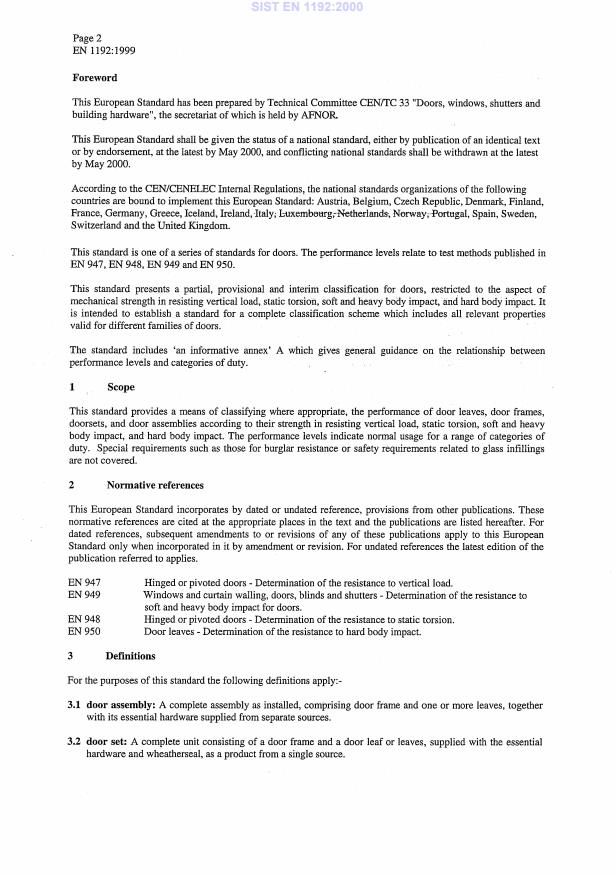
This Standard provides a means of classifying where appropriate, the performance of door leaves, door frames, doorsets, and door assemblies according to their strength in resisting vertical load, static torsion, soft and heavy body impact,and hard body impact. The performance level indicate normal usage for a range of categories of duty. Special requirements such as those for burglar resistance or safety requirements related to glass infillings are not covered.
- Status
- Published
- Publication Date
- 16-Nov-1999
- Withdrawal Date
- 30-May-2000
- Technical Committee
- CEN/TC 33 - Doors, windows, shutters and building hardware
- Drafting Committee
- CEN/TC 33/WG 2 - Windows
- Current Stage
- 9093 - Decision to confirm - Review Enquiry
- Start Date
- 10-Jan-2023
- Completion Date
- 23-Sep-2026

Overview
EN 1192:1999 - Doors - Classification of strength requirements is a European standard developed by CEN. The standard establishes a systematic method for classifying the strength performance of various door components, including door leaves, door frames, doorsets, and door assemblies. By defining strength performance levels, EN 1192:1999 enables manufacturers, builders, designers, and specifiers to select doors suited to distinct categories of use and occupancy. The standard focuses on the door’s ability to withstand several mechanical stresses encountered during normal operation, ensuring safety, durability, and suitability for different applications.
Key Topics
Strength Classification: EN 1192:1999 addresses the classification of doors based on their resistance to:
- Vertical load
- Static torsion
- Soft and heavy body impact
- Hard body impact
Performance Levels: The standard specifies multiple levels of strength performance. Each level corresponds to normal usage scenarios and varying categories of duty, from light to heavy use.
Scope Limitations: EN 1192:1999 does not cover special requirements such as:
- Burglar resistance
- Safety related to glass infillings in doors
Components Covered: The standard is applicable to:
- Door leaves
- Door frames
- Doorsets
- Door assemblies
Applications
Applying EN 1192:1999 ensures reliable classification of door products according to their mechanical strength. This is essential in a variety of building and construction environments, including:
- Residential Buildings: Ensuring internal and external doors meet daily usage demands
- Commercial Premises: Selecting doors for offices, schools, hotels, and public buildings relative to usage frequency and expected loads
- Industrial Facilities: Specifying doors that withstand heavy use and impact in warehouses and factories
- Healthcare and Educational Institutions: Guaranteeing safe and durable access solutions for high-traffic areas
By following EN 1192:1999, stakeholders can:
- Match doors to their appropriate usage category
- Improve building safety and longevity
- Comply with EU norms and national regulations regarding door installations
Related Standards
For a comprehensive approach to door performance and building safety, EN 1192:1999 is often referenced alongside related standards, such as:
- EN 14351-1 - Windows and doors - Product standard, performance characteristics
- EN 1627 - Burglar resistance requirements for doors, windows, and shutters
- EN 1634-1 - Fire resistance testing for doors and shutters
- EN 179 - Emergency exit devices operated by a lever handle or push pad
These standards, together with EN 1192:1999, provide essential guidance for door selection, installation, and maintenance, supporting both safety and compliance across European construction projects.
EN 1192:1999 is a critical door strength classification standard, supporting optimal door selection, improved safety, and regulatory compliance for building professionals across residential, commercial, and industrial environments.
Relations
- Effective Date
- 28-Jan-2026
- Effective Date
- 28-Jan-2026
- Effective Date
- 28-Jan-2026
- Effective Date
- 28-Jan-2026
- Effective Date
- 28-Jan-2026
- Effective Date
- 28-Jan-2026
Get Certified
Connect with accredited certification bodies for this standard

DIBt (Deutsches Institut für Bautechnik)
German Institute for Building Technology.
DIN CERTCO
DIN Group product certification.

Aboma Certification B.V.
Specialized in construction, metal, and transport sectors.
Sponsored listings
Frequently Asked Questions
EN 1192:1999 is a standard published by the European Committee for Standardization (CEN). Its full title is "Doors - Classification of strength requirements". This standard covers: This Standard provides a means of classifying where appropriate, the performance of door leaves, door frames, doorsets, and door assemblies according to their strength in resisting vertical load, static torsion, soft and heavy body impact,and hard body impact. The performance level indicate normal usage for a range of categories of duty. Special requirements such as those for burglar resistance or safety requirements related to glass infillings are not covered.
This Standard provides a means of classifying where appropriate, the performance of door leaves, door frames, doorsets, and door assemblies according to their strength in resisting vertical load, static torsion, soft and heavy body impact,and hard body impact. The performance level indicate normal usage for a range of categories of duty. Special requirements such as those for burglar resistance or safety requirements related to glass infillings are not covered.
EN 1192:1999 is classified under the following ICS (International Classification for Standards) categories: 91.060.50 - Doors and windows. The ICS classification helps identify the subject area and facilitates finding related standards.
EN 1192:1999 has the following relationships with other standards: It is inter standard links to EN 948:1999, EN 950:1999, EN 949:1998, EN 14351-2:2018, EN 14351-1:2006+A2:2016, EN 14351-1:2006+A1:2010. Understanding these relationships helps ensure you are using the most current and applicable version of the standard.
EN 1192:1999 is associated with the following European legislation: EU Directives/Regulations: 305/2011, 89/106/EEC. When a standard is cited in the Official Journal of the European Union, products manufactured in conformity with it benefit from a presumption of conformity with the essential requirements of the corresponding EU directive or regulation.
EN 1192:1999 is available in PDF format for immediate download after purchase. The document can be added to your cart and obtained through the secure checkout process. Digital delivery ensures instant access to the complete standard document.
Standards Content (Sample)
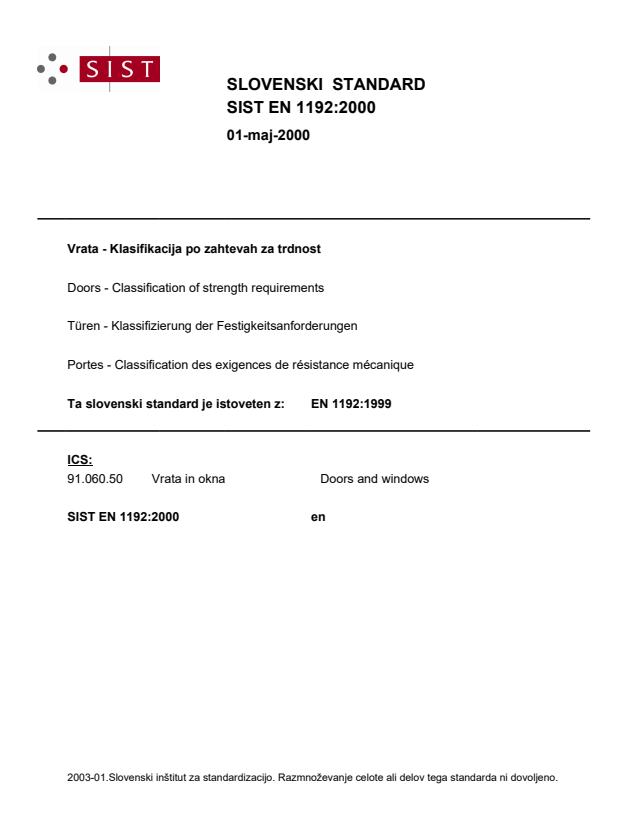
2003-01.Slovenski inštitut za standardizacijo. Razmnoževanje celote ali delov tega standarda ni dovoljeno.Vrata - Klasifikacija po zahtevah za trdnostTüren - Klassifizierung der FestigkeitsanforderungenPortes - Classification des exigences de résistance mécaniqueDoors - Classification of streng
...