

FprEN 50708-1-1:2026
(Main)Power transformers - Additional European requirements - Part 1-1: Common part - General requirements
- Abstract
This document is part of the EN 50708 series which applies to transformers in compliance with EN 60076 1.
- Status
- Not Published
- Publication Date
- 25-Feb-2027
- Technical Committee
- CLC/TC 14 - Power transformers
- Current Stage
- 4599 - Dispatch of FV draft to CMC - Finalization for Vote
- Start Date
- 13-Aug-2026
- Due Date
- 01-Jun-2022
- Completion Date
- 13-Aug-2026

FprEN 50708-1-1:2026 is a draft European Standard from CLC for power transformers. It gives additional European requirements for the common part of the EN 50708 series, building on EN 60076-1 and setting rules for energy performance, material efficiency, technical documentation, rating plates, tolerances, tests and loss evaluation. It is written for manufacturers, purchasers, test laboratories and compliance teams that need to specify, verify or document transformer performance.
What does FprEN 50708-1-1:2026 specify?
FprEN 50708-1-1:2026 specifies the general requirements that apply across the EN 50708 series for transformers in compliance with EN 60076-1. It is the common part that later EN 50708 subparts build on, so the document is the reference point for shared rules on performance, documentation and verification.
The document is organized into clauses 1 to 11 and five annexes.
| Annex | What it covers |
|---|---|
| Annex A | Peak efficiency calculation |
| Annex B | Capitalization of losses |
| Annex C | A-deviations |
| Annex D | Additional considerations related to energy performances |
| Annex ZZ | Relationship with the ecodesign requirements of Commission Regulation (EU) No 548/2014 and amendment No 2019/1783 |
FprEN 50708-1-1:2026 also identifies a defined set of special-purpose transformers that are outside the energy-performance requirements, including instrument transformers, rectifier-load transformers, furnace transformers, offshore and vessel transformers, emergency transformers, railway feeding transformers, earthing or grounding transformers, traction transformers, starting transformers, testing and welding transformers, explosion-proof and underground mining transformers, deep-water transformers, MV/MV interface transformers up to 5 MVA used for network voltage conversion, nuclear-safety transformers, and very small three-phase medium power transformers.
What are the key requirements of FprEN 50708-1-1:2026?
FprEN 50708-1-1:2026 focuses on how to rate, document, test and declare power transformers so their losses, efficiency and material-related information can be checked in practice.
Ratings and energy performance
Clause 5.1 says loss evaluation is based on the continuous rated power. Temporary overload capability for emergency use or refurbishment cannot be treated as rated power. Clause 5.2 sets the rated frequency as the network frequency, with 50 Hz as the default.
Clause 5.3.1 sets two energy-performance routes: maximum no-load and load losses for three-phase MPT, and PEI with its load factor for LPT. In practice, this means the document does not use one single efficiency rule for all transformers - it distinguishes between medium-power and large-power cases.
Clause 5.3.3 defines a reference temperature basis for energy-performance calculations. That matters because transformer losses depend on temperature, so the declared values and comparisons have to use the same thermal basis.
Material efficiency and sustainability
Clause 5.4 introduces material efficiency as a separate technical topic alongside energy performance. It covers durability and reliability, remanufacturing, repair, reuse, upgrade, recyclability and recoverability, reused major components, recycled content and critical raw materials.
In practice, this means the transformer is not assessed only by electrical losses. The manufacturer also has to think about how the design can be maintained, taken apart, reprocessed and documented over its life cycle.
Technical documentation
Clause 5.6 requires a technical file for each transformer. It includes the manufacturer identity, model identifier, rated and loss information, PEI data for large power transformers, dual-voltage data where relevant, major-component weights, the reason for any energy-performance exemption, and the rating-plate data.
This matters because the document links compliance to evidence. If declared values come from another model or from a type test, the technical documentation has to show how they were derived and include the supporting type-test report where relevant.
Clause 5.6.2 also requires a Disassembly Manual, and clause 5.6.5 requires data sheets and working points for key accessories and major components such as coolers, fans, bushings and tap changers. That gives users the information needed for maintenance, substitution and end-of-life handling.
Rating plate and tolerances
Clause 6 adds rating-plate information beyond EN 60076-1 and EN IEC 60076-11:2018. It includes loss-related values, cooling-power information, material masses, PEI data where applicable, and a visible statement for pole-mounted transformers. For dual-voltage transformers, the plate information has to refer to the highest rated voltage values.
Clause 7 distinguishes factory acceptance testing from market surveillance. For acceptance tests, measured no-load and load losses must meet the declared maximums without tolerance. For market surveillance, measured loss values and cooling-system power can be slightly above the declared values, within the clause limits. This distinction matters because factory verification and market checks are not treated the same way.
Tests and cooling consumption
Clause 8 allows cooling-system electrical power to be taken from type-test evidence or from the cooling-equipment manufacturer’s type test. If it is not already known, the clause requires a type test under specified electrical and installation conditions.
This is important because forced cooling affects energy performance. The document makes clear that fan and pump consumption is part of the performance picture, not an afterthought.
Loss capitalization and reprocessing
Clause 10 points users to loss capitalization as the economic method for comparing transformer designs. Clause 11 says medium and large power transformers have to be reassessed for conformity after overhaul if the core or complete windings are replaced. Reuse, however, is treated differently and does not trigger reassessment.
What terms does FprEN 50708-1-1:2026 define?
- MPT (medium power transformer) - The medium-power transformer category used by the standard for its general requirements and energy-performance rules.
- LPT (large power transformer) - The larger transformer category for which PEI-based requirements are used.
- PEI (Peak Efficiency Index) - The highest efficiency ratio achieved at the optimum load factor.
- EI (Efficiency Index) - The efficiency ratio at a given load factor, based on transmitted apparent power and losses.
- Declared value - A value stated in the technical documentation and, where applicable, used for calculation and verification.
- Load factor - The ratio of actual current to rated current.
- Remanufacturing - An industrial process that produces a product from used products or parts with a change affecting safety, performance, purpose or type.
- CRMs (critical raw materials) - Materials that the technical documentation has to declare when regulated or otherwise applicable.
Who uses FprEN 50708-1-1:2026?
FprEN 50708-1-1:2026 is used by transformer manufacturers and design engineers who need to set ratings, efficiency values, material declarations and rating-plate data. It is also used by test laboratories and factory acceptance teams that measure losses, cooling power and related declared values.
Purchasers, utilities and procurement teams use it when comparing bids with loss-capitalization methods and checking whether a transformer fits a required service and documentation profile. Compliance teams, conformity assessment bodies and market-surveillance authorities use it to verify declared values, tolerances and ecodesign-related evidence.
Maintenance, refurbishment and reprocessing teams use it for the disassembly manual, accessory data and the conformity questions raised by overhaul or reuse.
What changed in FprEN 50708-1-1:2026 from the previous edition?
The foreword states that this edition supersedes EN 50708-1-1:2020 and its amendments and corrigenda. It also states these significant technical changes compared with EN 50708-1-1:2020:
- the EN 50708-1-1:2020/AC:2020 corrigendum has been included
- comments received from national committees that were not allowed in the corrigendum have been taken into account
- a new topic, material efficiency, has been added alongside energy performance within transformer sustainability
Which standards are used with FprEN 50708-1-1:2026?
- EN 60076-1:2011 - the base power-transformer standard for service conditions, definitions and general transformer requirements
- EN IEC 62474 - the material declaration standard used for critical raw materials and related declarations
- EN 50708-2-1:2020 - the medium-power transformer part that provides the detailed requirements referenced by this common part
- EN 50708-3-1:2020 - the large-power transformer part referenced for PEI-related requirements and benchmark values
- EN 60076-22 series - the fittings standard series used for accessories and fittings data
- EN IEC 60076-11:2018 - the standard cited for measurement methods linked to tests and rating-plate data
What does the FprEN 50708-1-1:2026 document contain?
FprEN 50708-1-1:2026 contains the full framework for declaring and checking transformer energy performance, including the calculation method for PEI in Annex A and the economic loss-capitalization method in Annex B. It also contains the national A-deviations in Annex C and the extra technical context in Annex D.
Annex ZZ maps the standard to the ecodesign requirements of Commission Regulation (EU) No 548/2014 and its amendment. The body of the document includes the technical file, rating-plate, tolerance and test provisions that support design review, procurement, acceptance testing and market surveillance.
Relations
- Effective Date
- 03-Feb-2026
- Effective Date
- 15-Dec-2020
- Effective Date
- 15-Dec-2020
Get Certified
Connect with accredited certification bodies for this standard

IMQ S.p.A. (Certification)
Italian electrical product certification.

SLG Prüf- und Zertifizierungs GmbH
German testing and certification body.

UL Solutions
Global safety science company with testing, inspection and certification.
Sponsored listings
Frequently Asked Questions
FprEN 50708-1-1:2026 is a draft published by CLC. Its full title is "Power transformers - Additional European requirements - Part 1-1: Common part - General requirements". This standard covers: This document is part of the EN 50708 series which applies to transformers in compliance with EN 60076 1.
This document is part of the EN 50708 series which applies to transformers in compliance with EN 60076 1.
FprEN 50708-1-1:2026 is classified under the following ICS (International Classification for Standards) categories: 29.180 - Transformers. Reactors. The ICS classification helps identify the subject area and facilitates finding related standards.
FprEN 50708-1-1:2026 has the following relationships with other standards: It is inter standard links to EN IEC/IEEE 60076-57-1202:2025/A11:2025, EN 50708-1-1:2020, EN 50708-1-1:2020/AC:2020-12. Understanding these relationships helps ensure you are using the most current and applicable version of the standard.
FprEN 50708-1-1:2026 is associated with the following European legislation: EU Directives/Regulations: 548/2014; Standardization Mandates: M/495, M/495 AMD 2. When a standard is cited in the Official Journal of the European Union, products manufactured in conformity with it benefit from a presumption of conformity with the essential requirements of the corresponding EU directive or regulation.
FprEN 50708-1-1:2026 is available in PDF format for immediate download after purchase. The document can be added to your cart and obtained through the secure checkout process. Digital delivery ensures instant access to the complete standard document.
Standards Content (Sample)
SLOVENSKI STANDARD
01-oktober-2023
Močnostni transformatorji - Dodatne evropske zahteve - 1-1. del: Skupni del -
Splošne zahteve
Power transformers - Additional European requirements - Part 1-1: Common part -
General requirements
Leistungstransformatoren - Zusätzliche europäische Anforderungen - Teil -1-1:
Allgemeiner Teil - Allgemeine Anforderungen
Transformateurs de puissance - Exigences européennes supplémentaires : Partie 1 -
Partie commune
Ta slovenski standard je istoveten z: prEN 50708-1-1:2023
ICS:
29.180 Transformatorji. Dušilke Transformers. Reactors
2003-01.Slovenski inštitut za standardizacijo. Razmnoževanje celote ali delov tega standarda ni dovoljeno.
EUROPEAN STANDARD DRAFT
prEN 50708-1-1
NORME EUROPÉENNE
EUROPÄISCHE NORM
August 2023
ICS 29.180 Will supersede EN 50708-1-1:2020; EN 50708-1-
1:2020/AC:2020-12
English Version
Power transformers - Additional European requirements -
Part 1-1: Common part - General requirements
Transformateurs de puissance - Exigences européennes Leistungstransformatoren - Zusätzliche europäische
supplémentaires : Partie 1 - Partie commune Anforderungen - Teil -1-1: Allgemeiner Teil - Allgemeine
Anforderungen
This draft European Standard is submitted to CENELEC members for enquiry.
Deadline for CENELEC: 2023-11-03.
It has been drawn up by CLC/TC 14.
If this draft becomes a European Standard, CENELEC members are bound to comply with the CEN/CENELEC Internal Regulations which
stipulate the conditions for giving this European Standard the status of a national standard without any alteration.
This draft European Standard was established by CENELEC in three official versions (English, French, German).
A version in any other language made by translation under the responsibility of a CENELEC member into its own language and notified to
the CEN-CENELEC Management Centre has the same status as the official versions.
CENELEC members are the national electrotechnical committees of Austria, Belgium, Bulgaria, Croatia, Cyprus, the Czech Republic,
Denmark, Estonia, Finland, France, Germany, Greece, Hungary, Iceland, Ireland, Italy, Latvia, Lithuania, Luxembourg, Malta, the
Netherlands, Norway, Poland, Portugal, Republic of North Macedonia, Romania, Serbia, Slovakia, Slovenia, Spain, Sweden, Switzerland,
Türkiye and the United Kingdom.
Recipients of this draft are invited to submit, with their comments, notification of any relevant patent rights of which they are aware and to
provide supporting documentation.
Warning : This document is not a European Standard. It is distributed for review and comments. It is subject to change without notice and
shall not be referred to as a European Standard.
European Committee for Electrotechnical Standardization
Comité Européen de Normalisation Electrotechnique
Europäisches Komitee für Elektrotechnische Normung
CEN-CENELEC Management Centre: Rue de la Science 23, B-1040 Brussels
© 2023 CENELEC All rights of exploitation in any form and by any means reserved worldwide for CENELEC Members.
Project: 73196 Ref. No. prEN 50708-1-1:2023 E
prEN 50708-1-1:2023 (E)
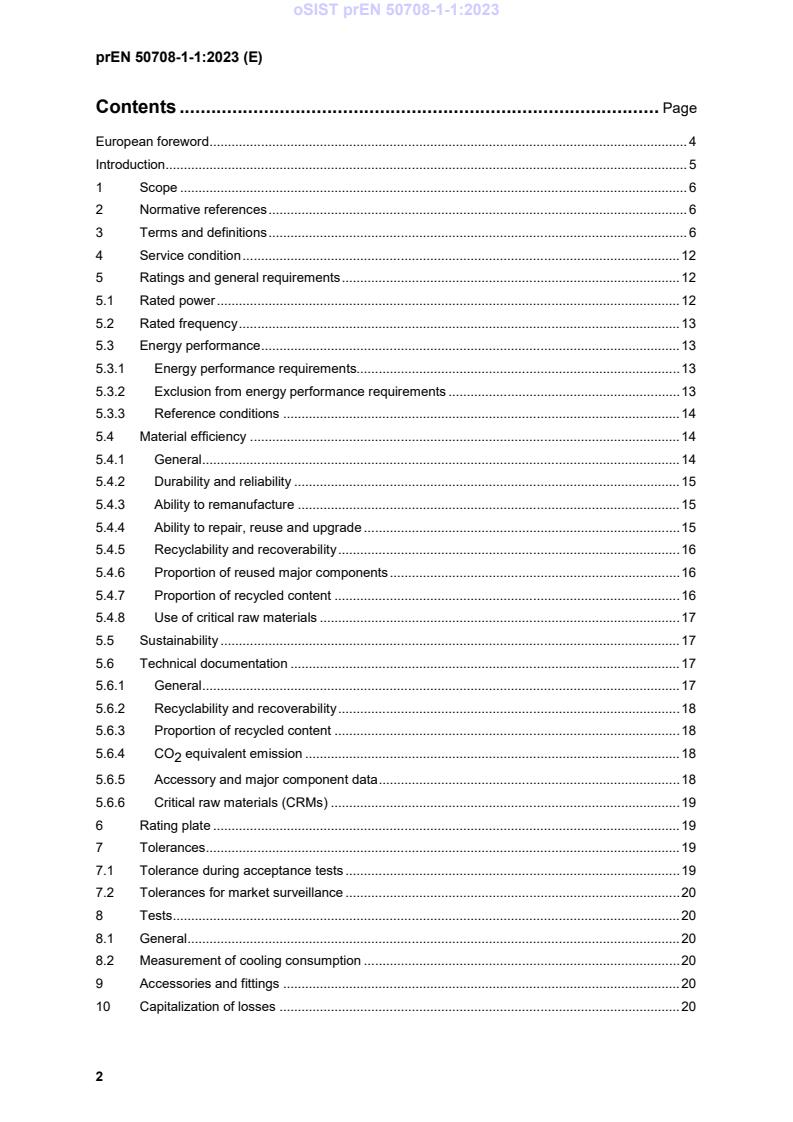
Contents . Page
European foreword . 4
Introduction. 5
1 Scope . 6
2 Normative references . 6
3 Terms and definitions . 6
4 Service condition . 12
5 Ratings and general requirements . 12
5.1 Rated power . 12
5.2 Rated frequency . 13
5.3 Energy performance . 13
5.3.1 Energy performance requirements. 13
5.3.2 Exclusion from energy performance requirements . 13
5.3.3 Reference conditions . 14
5.4 Material efficiency . 14
5.4.1 General . 14
5.4.2 Durability and reliability . 15
5.4.3 Ability to remanufacture . 15
5.4.4 Ability to repair, reuse and upgrade . 15
5.4.5 Recyclability and recoverability . 16
5.4.6 Proportion of reused major components . 16
5.4.7 Proportion of recycled content . 16
5.4.8 Use of critical raw materials . 17
5.5 Sustainability . 17
5.6 Technical documentation . 17
5.6.1 General . 17
5.6.2 Recyclability and recoverability . 18
5.6.3 Proportion of recycled content . 18
5.6.4 CO equivalent emission . 18
5.6.5 Accessory and major component data . 18
5.6.6 Critical raw materials (CRMs) . 19
6 Rating plate . 19
7 Tolerances . 19
7.1 Tolerance during acceptance tests . 19
7.2 Tolerances for market surveillance . 20
8 Tests . 20
8.1 General . 20
8.2 Measurement of cooling consumption . 20
9 Accessories and fittings . 20
10 Capitalization of losses . 20
prEN 50708-1-1:2023 (E)
11 Transformer reprocessing . 21
Annex A (normative) Peak efficiency calculation . 22
Annex B (informative) Capitalization of losses. 25
Annex C (informative) A-deviations . 31
Annex D (informative) Additional considerations related to energy performances . 32
Annex ZZ (informative) Relationship between this European Standard and the ecodesign requirements
of Commission Regulation (EU) No 548/2014 of 21 May 2014 and its amendment No 2019/1783 of 1
October 2019 on implementing Directive 2009/125/EC of the European Parliament and of the Council
with regard to small, medium and large power transformers aimed to be covered . 34
prEN 50708-1-1:2023 (E)
European foreword
This document (prEN 50708-1-1:2023) has been prepared by CLC/TC 14, “Power transformers”.
The following dates are proposed:
• latest date by which the existence of this (doa) dor + 6 months
document has to be announced at national level
• latest date by which this document has to be (dop) dor + 12 months
implemented at national level by publication of
an identical national standard or by
endorsement
• latest date by which the national standards (dow) dor + 36 months
conflicting with this document have to be (to be confirmed or
withdrawn modified when voting)
This document will supersede EN 50708-1-1:2020 and all of its amendments and corrigenda (if any).
EN 50708-1-1:2023 includes the following significant technical changes with respect to
EN 50708-1-1:2020:
— The EN 50708-1-1:2020/AC:2020 Corrigendum has been included in the standard.
— The comments received from NCs not allowed in the corrigendum have been taken into account.
— The new topic ‘Material efficiency’ has been added side to energy performance in the prospective
of power transformer ‘Sustainability’.
This document has been prepared under a Standardization Request given to CENELEC by the
European Commission and the European Free Trade Association, and supports essential requirements
of EU Directive(s) / Regulation(s).
For relationship with EU Directive(s) / Regulation(s), see informative Annex ZZ, which is an integral part
of this document.
prEN 50708-1-1:2023 (E)
Introduction
The EN 50708 series, “Power transformers – Additional European requirements”, has been prepared
by CENELEC TC 14 to address specific European requirements of power transformers related EU
Regulations and local practices.
Technical requirements set by the EN 50708 series supplement, modify or replace certain requirements
of the other EN standards derived from equivalent IEC international standards.
This series contains general requirements on energy performance, accessories, fittings, tests,
mechanical requirements etc. structured as follows:
— Part 1 series - Common requirements;
— Part 2 series - Medium power transformers;
— Part 3 series - Large power transformers.
The EN 50708-X parts with X greater than 1 contain particular requirements for a different category of
transformers or transformer applications which are based on the requirements of the general parts of
EN 50708-1-1.
The EN 50708-X parts should be considered in conjunction with the requirements of the general part.
The particular requirements of these subparts of EN 50708 supplement, modify or replace certain
requirements of the general parts of EN 50708-1-1 and/or EN 50708-1-X being valid at the time of
publication of this part. The absence of references to the exclusion of a part or a clause of a general
part means that the corresponding clauses of the general part are applicable (undated reference).
Requirements of other -X parts with X greater than 1 being eventually relevant for cases covered by
this part also apply. This part therefore possibly supplements, modifies or replaces certain of these
requirements valid at the time of publication of this document.
The main clause numbering of each subpart follows the pattern and corresponding references of
EN 50708-1-1. The numbers following the particular number of this part are those of the corresponding
parts, or clauses of the other parts of the EN 50708 series, valid at the time of publication of this part,
as indicated in the normative references of this document (dated reference).
In the case where new or amended general parts with modified numbering were published after the
subpart was issued, the clause numbers referring to a general part in subparts might no longer align
with the latest edition of the general part. Dated references should be observed.
It is acknowledged that environmental requirements including energy in the use phase are a significant
aspect that can be addressed through product design. As the material content increases to improve
energy performance, it is advisable to make a proper life cycle assessment including recycling of the
extra raw material and the overall energy used to produce and transport transformers. Some guidelines
are given in EN 60076-1.
prEN 50708-1-1:2023 (E)
1 Scope
This document is part of the EN 50708 series which applies to transformers in compliance with
EN 60076-1.
2 Normative references
The following documents are referred to in the text in such a way that some or all of their content
constitutes requirements of this document. For dated references, only the edition cited applies. For
undated references, the latest edition of the referenced document (including any amendments) applies.
EN 60076-1:2011, Power transformers - Part 1: General
EN IEC 62474, Material declaration for products of and for the electrotechnical industry
EN 50708-2-1:2020, Power transformers - Additional European requirements: Part 2-1 Medium power
transformer - General requirements
EN 60076-1:2011, Power transformers - Part 1: General
EN 60076-22 series, Power transformers - Part 22: Power transformer and reactor fittings
3 Terms and definitions
For the purposes of this document, the terms and definitions given in EN 60076-1:2011 and the
following apply.
ISO and IEC maintain terminology databases for use in standardization at the following addresses:
— ISO Online browsing platform: available at https://www.iso.org/obp/
— IEC Electropedia: available at https://www.electropedia.org/
3.1
medium power transformer
MPT
power transformer with all windings having a rated power lower than or equal to 3 150 kVA, and highest
voltage for equipment greater than 1,1 kV and lower than or equal to 36 kV
Note 1 to entry: The definitions of power transformer and winding are given in EN 60076-1.
Note 2 to entry: The national practice of the Czech Republic could require the use of the highest voltages for
equipment in AC three-phase systems of 38,5 kV instead of 36 kV and 25 kV instead of 24 kV. These units have a
rated power lower than or equal to 3 150 kVA:
— with U = 38,5 kV are considered as U = 36 kV (ref. to EN 50708-2-1:2020);
m m
— with U = 25 kV are considered as U = 24 kV (ref. to EN 50708-2-1:2020).
m m
3.2
large power transformer
LPT
power transformer with at least one winding having either a rated power greater than 3 150 kVA or
highest voltage for equipment greater than 36 kV
Note 1 to entry: The definitions of power transformer and winding is given in EN 60076-1.
prEN 50708-1-1:2023 (E)
Note 2 to entry: The national practice of Czech Republic requires the use of the highest voltages for equipment in
AC three-phase systems of 38,5 kV instead of 36 kV and 25 kV instead of 24 kV. These units have a rated power
greater than 3 150 kVA:
— with U = 38,5 kV are considered as U = 36 kV (ref. to EN 50708-3-1:2020)
m m
— with U = 25 kV are considered as U = 24 kV (ref. to EN 50708-3-1:2020).
m m
3.3
medium power pole-mounted transformer
medium power transformer with a rated power of up to 400 kVA suitable for outdoor service and
specifically designed to be mounted on the support structures of overhead power lines
Note 1 to entry: The definitions of power transformer and winding are given in EN 60076-1.
Note 2 to entry: For definitions of pole see IEV [466–07–01].
3.4
load factor
k
ratio of actual current over the rated current of transformer
Note 1 to entry: Normally the ratio is 0 ≤ k ≤ 1.
3.5
transmitted apparent power
kSr
product of the load factor and rated power
3.6
Efficiency Index
EI
ratio of the transmitted apparent power of a transformer minus electrical losses to the transmitted
apparent power of the transformer
3.7
Peak Efficiency Index
PEI
maximum value of the ratio of the transmitted apparent power of a transformer minus the electrical
losses to the transmitted apparent power of the transformer
Note 1 to entry: PEI is the maximum value of EI that can be achieved at the optimum value of load factor.
3.8
load factor of Peak Efficiency Index
k
PEI
load factor at which Peak Efficiency Index occurs
Note 1 to entry: Alternative cooling modes can require an iterative calculation of the k . In any case, the k is
PEI PEI
defined at the point where the highest PEI occurs.
3.9
declared value
value given in the technical documentation and where applicable, the value used to calculate this value
Note 1 to entry: The values given are pursuant to point 2 of Directive 2009/125/EC, Annex IV.
prEN 50708-1-1:2023 (E)
3.9.1
declared value of loss
loss measured by the manufacturer and written in the test report part of technical documentation and
on the rating plate
Note 1 to entry: This definition applies both to no-load loss and to load loss.
Note 2 to entry: Declared values and guaranteed values according to EN 60076-1 are two different concepts.
Guaranteed values are related to contract, whereas declared values are related to compliance verifications with
Commision Regulation (EU) No 548/2014.
Note 3 to entry: This definition complies with item g) of point 2 of Directive 2009/125/EC, Annex IV.
3.9.2
declared value of no-load loss
P
no-load loss measured by the manufacturer and written in the test report part of technical documentation
and on the rating plate
Note 1 to entry: For definition of no-load loss, see EN 60076-1.
3.9.3
declared value of load loss
P
k
load loss measured by the manufacturer and written in the test report part of technical documentation
and on the rating plate
Note 1 to entry: For definition of load loss, see EN 60076-1.
3.9.4
declared value of electrical power required by the cooling system for no-load operation
P
c0
electrical power required by fan and liquid pump motors for no-load operation as derived from the
transformer type test certificates
Note 1 to entry: The electrical power required by the cooling system for no-load operation is not measured all the
time because this is a type test according to EN 60076-1.
3.9.5
declared value of additional electrical power required by the cooling system for the load factor
of k
P (k)
ck
additional electrical power required (in addition to P ) by the cooling system for continuous operation
c0
at k times the rated load ensuring the compliance with the temperature rise derived from the transformer
type test measurements of the power taken by the fan and liquid pump motors
Note 1 to entry: The electrical power required by the cooling system for k times the rated load operation is not
measured all the time, because this is a type test according to EN 60076-1. It can be extrapolated from the
temperature rise test.
3.9.6
declared value of PEI
PEI calculated from the declared values of no-load loss, load loss and power required by the cooling
system for load operation at k according to the above definitions
PEI
prEN 50708-1-1:2023 (E)
3.10
dual voltage transformer
transformer with one or more windings with two voltages available in order to be able to operate and
supply rated power at either of two different voltage values
3.11
acceptance test
contractual test to prove to the customer that the item meets certain conditions of its specification
Note 1 to entry: The test may be witnessed by the purchaser or/and a third party.
Note 2 to entry: The common IEC acceptance tests do not require witnesses. Routine tests are performed on every
transformer; for this reason, the factory acceptance test shall be agreed between purchaser and supplier at the
order stage.
[SOURCE: IEV ref 151-16-23]
3.12
witnessed testing
active observance of the physical testing of the product under investigation by another party, to draw
conclusions on the validity of the test and the test results and which may include conclusions on the
compliance of testing and calculations methods used with applicable standards and legislation
3.13
instrument transformer
transformer intended to transmit an information signal to measuring instruments, meters and protective
or control devices or similar apparatus even if it supplies energy for the operation of connected
equipment
Note 1 to entry: The difference between the definition in Commission Regulation (EU) No. 548/2014 and the
CENELEC one is in the use of the word ‘supply’ rather than ‘transmit an information signal’.
[SOURCE: EN 61869-1:2009, 3.1.1, modified]
3.14
transformer specifically designed and intended to provide a DC power supply to electronic or
rectifier loads
transformer specifically designed and intended to supply power electronic or rectifier loads specified
according to EN 61378-1:2011
Note 1 to entry: This definition covers transformers designed for use with rectifiers to provide a DC supply in certain
applications.
Note 2 to entry: This definition does not include:
— transformers which are intended to provide AC from DC sources such as transformers for wind turbine and
photo voltaic applications;
— transformers designed for DC transmission and distribution applications.
Therefore, they are part of the scope of this document and are expected to comply with Commission
Regulation (EU) No. 548/2014.
3.15
transformer specifically designed for offshore applications and floating offshore applications
transformer to be installed on fixed or floating offshore platforms, offshore wind turbines or on board
ships and all kinds of vessels
prEN 50708-1-1:2023 (E)
3.16
transformer specially designed for emergency installations
transformer designed to only provide cover for a specific time limited situation when the normal power
supply is interrupted either due to an unplanned occurrence such as failure or a station refurbishment,
but not to permanently upgrade an existing substation
Note 1 to entry: Such transformer could have some specific features that make it suitable for emergency or
temporary use as opposed to normal use. Example of some specific features:
— multiple windings making it suitable for use at several locations;
— special low weight or dimensions for easy transport, or special capability to be disassembled into smaller units
for transport;
— increased overload capability achieved by the use of special material;
— permanent mounting on a transporter arrangement.
3.17
transformer and auto-transformer specifically designed for railway feeding systems
traction transformer
Note 1 to entry: The definition of traction transformer given by EN 50329 is a transformer (with separate or auto-
connected windings) connected to an a.c. or d.c. contact line, directly or through a converter, used in fixed
installations of railway applications.
3.18
earthing or grounding transformer
three-phase transformer or reactor connected in a power system to provide a neutral connection for
earthing either directly or via an impedance
[SOURCE: EN 60076-6:2008, 3.1.10, modified]
3.19
traction transformer
transformer installed on board of rolling stock inserted in the traction and auxiliary circuits of rolling stock
and in the scope of EN 60310:2016
3.20
starting transformer specifically designed for starting three-phase induction motors so as to
eliminate supply voltage dips
transformer that is de-energized during normal operation, and used for the purpose of starting a rotating
machine
3.21
Medium Voltage (MV) to Medium Voltage (MV) interface transformer up to 5 MVA
transformer used in network voltage conversion program and placed at the junction between two voltage
levels of two MV networks and which needs to be able to cope with emergency overloads
Note 1 to entry: Such units might or might not be part of a packaged compact substation including also MV
Reclosers and protection equipment.
3.22
durability
ability to funtion as required, under defined condition of use, maintenance and
repair, until a limiting state is reached
Note 1 to entry: The degree to which maintenance and repair are within the scope of durability will vary by product
or product-group.
prEN 50708-1-1:2023 (E)
Note 2 to entry: The user of this document shall define the criteria for the transition from limiting state to end-of-life
(EoL).
Note 3 to entry: Durability can be expressed in units appropriate to the part or product concerned, e.g. calendar
time, operating cycles, distance run, etc. The units should always be clearly stated.
3.23
reliability
probability that a product functions as required under given conditions, including maintenance, for a
given duration without limiting event
Note 1 to entry: The intended funtion(s) and given conditions are described in the information for use provided with
the product.
Note 2 to entry: Duration can be expressed in units appropriate to the part or product concerned, e.g. calendar
time, operating cycles, distance run, etc. The units should always be clearly stated.
3.24
limiting event
occurrence which results in a primary or secondary function no longer being delivered
EXAMPLES failures, wear-out failure or deviation of any analougue signal
3.25
limiting state
condition after one or more limiting event(s)
Note 1 to entry: A limiting state can be changed to a functional state by maintenance or repair of ErP.
Note 2 to entry: A limiting state can change to EoL-status if maintenance or repair is no longher viable due to socio-
economic or technical reasons.
3.26
remanufacturing
industrial process which produces a product from used products or used parts where at least one
change is made which influences the safety, original performance, purpose or type of product
Note 1 to entry: The product created by the remanufacturing process may be considered a new product when
placing on the market. Refer to the EU Blue Guide for additional information.
Note 2 to entry: Refurbishing is a similar concept to remanufacturing except that it does not involve changes
influencing safety, original performance, purpose or type of the product.
3.27
reuse
process by which a product or its parts, having reached the end of their first use, are used for the same
purpose for which they were conceived
Note 1 to entry: Reuse after a second or subsequential usage is also considered as reuse, but normal, regular or
sporadic use is not considered a reuse.
3.28
repair
process returning a faulty product to a condition where it can fulfil its intended use
3.29
upgrade
process of enhancing the functionality, performance, capacity or aesthetics of a product
Note 1 to entry: An update to a product can involve changes to its software, firmware and/or hardware.
prEN 50708-1-1:2023 (E)
Note 2 to entry: Refer to the “Blue Guide” for conditions under with a product is considered as a new product when
placing it on the market after upgrading it.
3.30
recovery
operation of any kind, the principal result of which is waste serving a useful purpose by replacing other
materials which would otherwise have been used to fulfil a particular function, or waste being prepared
to fulfil that function, in the plant or in the wider economy
Note 1 to entry: Annex II of the Waste Framework Directive (2008/98/EC) sets out a non-exhaustive list of recovery
operations.
3.31
material recovery
recovery operation of any kind, other than energy recovery and reprocessing into materials that are to
be use as fuels or other means to generate energy
Note 1 to entry: Material recovery includes, inter alia, preparing for reuse, recycling and backfilling.
3.32
energy recovery
production of useful energy through direct and controlled combustion or other processing of waste
3.33
recycling
recovery operation of any kind, by which waste materials are reprocessed into products, materials or
substances whether for the original or other purposes excluding energy recovery
Note 1 to entry: Recycling includes the reprocessing of organic material but does not include energy recovery and
the reprocessing into materials that are to be used as fuels or for backfilling operations.
3.34
waste
substance or object of any kind, which the holder discards or intends or is required to discard
3.35
component
hardware constituent of a product that cannot be taken apart without destruction or impairment of its
intended use
Note 1 to entry: A component which is used again with or without alteration is considered a reused component.
4 Service condition
See EN 60076-1.
5 Ratings and general requirements
5.1 Rated power
The reference rated power for any losses evaluation is the continuous rated power as stated in
EN 60076-1.
If additional cooling systems such as fans or pumps are to provide additional power for a situation
limited in time when the normal power supply is interrupted due to either an unplanned occurrence
(such as a power failure) or a station refurbishment, but not to permanently upgrade an existing
substation, then such overloading rating cannot be claimed to be the rated power.
prEN 50708-1-1:2023 (E)
5.2 Rated frequency
The rated frequency is the normal undisturbed frequency of the network where the transformer is
installed, unless otherwise specified the rated frequency is 50 Hz.
NOTE All requirements given in this standard series (EN 50708) are for a rated frequency of 50 Hz, except
another frequency is specified in the text or tables of the stated standard series.
5.3 Energy performance
5.3.1 Energy performance requirements
The energy performance of a transformer in accordance with this document is defined as follows:
a) Maximum no-load and load losses at rated power for three-phase MPT;
b) The Peak Efficiency Index and the load at which it occurs for LPT.
Peak efficiency calculation shall be done in accordance with Annex A.
In case of forced cooling system, the consumption of the cooling system shall be considered together
with the losses according to the relative part of this series of standards.
NOTE 1 Minimum energy requirements are based on the rated tapping, but real energy losses in service are
affected also by other variables like, for example, voltage regulation and loading factors. See Annex D and
EN 50708-3-1:2020.
NOTE 2 The economic optimum may be better than the legal minimum requirement. In Annex B there is a
method to evaluate the economic impact of transformer energy performances
5.3.2 Exclusion from energy performance requirements
The following transformers are excluded from energy performance requirements for transformers
specifically designed and used for the following applications:
a) instrument transformers, specifically designed to transmit an information signal to measuring
instruments, meters and protective or control devices or similar apparatus;
b) transformers specifically designed and intended to provide a DC power supply to electronic or
rectifier loads. This exemption does not include transformers that are intended to provide an AC
supply from DC sources such as transformers for wind turbine and photovoltaic applications or
transformers designed for DC transmission and distribution applications;
c) transformers specifically designed to be directly connected to a furnace;
d) transformers specifically designed to be installed on fixed or floating offshore platforms, offshore
wind turbines or on board ships and all kinds of vessels;
e) transformers specifically designed to provide for a situation limited in time when the normal power
supply is interrupted due to either an unplanned occurrence (such as a power failure) or a station
refurbishment, but not to permanently upgrade an existing substation;
f) transformers (with separate or auto-connected windings) connected to an AC or DC contact line,
directly or through a converter, used in fixed installations for railway applications;
g) earthing or grounding transformers specifically designed to be connected in a power system to
provide a neutral connection for earthing either directly or via an impedance;
h) traction transformers specifically designed to be mounted on rolling stock, connected to an AC or
DC contact line, directly or through a converter, for specific use in fixed installations for railway
applications;
prEN 50708-1-1:2023 (E)
NOTE Traction transformers (with separate or auto-connected windings) connected to an AC or DC
contact line, directly or through a converter, specifically designed for fixed installations or on rolling stock for
railway applications;
a) starting transformers specifically designed for starting three-phase induction motors so as to
eliminate supply voltage dips and that remain de-energised during normal operation;
b) testing transformers, specifically designed to be used in a circuit to produce a specific voltage or
current for the purpose of testing electrical equipment;
c) welding transformers, specifically designed for use in arc–welding equipment or resistance-welding
equipment;
d) transformers specifically designed for explosion-proof applications in accordance with
Directive 94/9/EC of the European Parliament and of the Council and underground mining
applications;
e) transformers specifically designed for deep water (submerged) applications;
f) Medium Voltage (MV) to Medium Voltage (MV) interface transformers up to 5 MVA used as
interface transformers used in a network voltage conversion programme and placed at the junction
between two voltage levels of two medium voltage networks and that need to be able to cope with
emergency overloads;
g) medium and large power transformers specifically designed to contribute to the safety of nuclear
installations, as defined in Article 3 of Council Directive 2009/71/Euratom;
h) three-phase medium power transformers with a power rating below 5 kVA.
5.3.3 Reference conditions
For the energy performance calculation, the following reference temperature shall be considered:
a) For transformers with rated average winding temperature rise less than or equal to 65 K for OF or
ON, or 70 K for OD, the reference temperature is 75 °C;
b) For transformers with other rated average winding temperature rise, the reference temperature is
equal to the rated average winding temperature rise + 20 K, or rated winding temperature rise +
yearly external cooling medium average temperature, whichever is higher.
5.4 Material efficiency
5.4.1 General
In accordance with this document, the material efficiency of a power transformer and its parts used for
its purpose is defined by way of the following aspects:
— durability and reliability;
— ability to remanufacture;
— ability to repair, reuse and upgrade;
— recyclability and recoverability;
— proportion of reused major components;
— proportion of recycled content;
prEN 50708-1-1:2023 (E)
— use of critical raw materials.
The result of the assessment of each one of these aspects represent the correspondent rating.
NOTE 1 Material efficiency of a power transformer expresses the degree in which raw materials are consumed,
incorporated, reused, recycled or wasted in manufacturing, maintaining and disposing it.
NOTE 2 If not addressed by an existing standard issued by TC14 or another TC, the material efficiency of single
part/sub-part (for example bushings or tap-changers) included into a power transformer follows the present
document.
5.4.2 Durability and reliability
Even if usually power transformers are largely recycled, they cannot be completely recycled and
benefits associated with material recovery cannot fully compensate the energy and material demand of
the whole production chain and increased durability can contribute to a reduction in the quantity of raw
materials used and energy required for the production/disposal.
A trade-off between lifetime (reducing impacts related to manufacturing and disposal of the product)
and other environmental impacts needs to be considered.
NOTE A standardized parameter (rating) to represent power transformer durability is under study.
5.4.3 Ability to remanufacture
The ability of a power transformer to be remanufactured shall be assessed on the feasibility of
performing the following general process steps:
— inspection;
— disassembly;
— cleaning;
— reprocessing;
— assembly;
— testing;
— storage.
NOTE 1 A standardized parameter (rating) to represent power transformer ability to remanufacture is under
study.
NOTE 2 The ability to remanufacture a power transformer is subject to the availability of data about
performances, material and dimension of the original design including accessories.
NOTE 3 Remanufacturing might or might not require design adaptation.
5.4.4 Ability to repair, reuse and upgrade
Ability to repair a power transformer in principle is linked to the same characteristics listed at the
previous clause and:
— its most probable defective parts/sub-parts;
— the proportion of parts/sub-parts not to be wasted to bring them back to their intended use after a
fault;
— the deep of skills and tools required to intervene.
prEN 50708-1-1:2023 (E)
Power transformers shall be provided with the data sheets and the characteristics of all the accessories
(see EN 60076-22 series) and major components (see relevant standards) in order to allow their
substitution if needed.
NOTE 1 When no standards are available for a given accessory or major component the content of the data
sheets and the characteristics to be provided are subject to agreement between the manufacturer and the user.
Ability to reuse of a power transformer is strongly linked to durability, reliability and maintenance.
Ability to upgrade of a power transformer is linked to availability of information about transformer,
accessories and major components characteristics.
The knowledge of life performance history is a key element in the decision process about the opportunity
to repair, reuse and upgrade a power transformer then ability to repair, reuse and upgrade are linked
to availability of control equipment and data provided by.
NOTE 2 Standardized parameters (ratings) to represent power transformer ability to repair and upgrade are
under study.
5.4.5 Recyclability and recoverability
Power transformers shall be provided with the Disassembly Manual and Maintenance Manual
containing the instructions in order to manage the end of life disposal of the transformer itself and its
parts which are subject of disposal during the lifetime.
NOTE Standardized parameters (ratings) to represent power transformer recyclability and recoverability are
under study.
5.4.6 Proportion of reused major components
For power transformers the reuse of major components is more common during lifetime than at end of
life because of more stringent performances usually required by regulations and market.
NOTE Proportion of reused major components is under study.
5.4.7 Proportion of recycled content
With reference to this clause, the following materials are defined as main raw materials:
— magnetic materials;
— conductor materials (Copper and Aluminium);
— insulating materials (liquid, cellulosic, resin, etc.);
— constructional steel and main metallic parts.
Moreover, the manufacturing process shall comply with the following requirements:
— Main raw material purchasing contracts shall include origin declaration. The origin of main raw
materials used in the equipment manufacturing should be traceable to have the recycled content
in the primary raw material using in them;
— Main purchased raw material percentage of recycled raw material shall be declared by raw material
supplier (some material cannot contain any recycled raw material);
— Residual of main raw material from manufacturing process shall be sent to recycling or valorisation
process.
Functional and performance requirements of equipment with recycled/recyclable material shall be equal
or better than the ones with equivalent new materials.
NOTE A standardized parameter (rating) to represent power transformer sustainability is under study.
prEN 50708-1-1:2023 (E)
5.4.8 Use of critical raw materials
For regulated CRMs incorporated into the power transformer (if any), a material declaration shall be
provided into the technical documentation.
NOTE The list of regulated substances and declarable substances is in EN IEC 62474 and in the applicable
legislation.
5.5 Sustainability
In accordance with this document, the sustainability of a power transformer is given by:
— Energy performance
— Material efficiency
NOTE A standardized quantitative parameter (rating) to represent power transformer sustainability is under
study.
5.6 Technical documentation
5.6.1 General
Each power transformers shall have a technical file (technical documentation). This technical
documentation can be a printed document as well as an electronic document.
NOTE This clause has been included in this document to be aligned with EU regulation. Other data and
information could be required in accordance with agreements between the manufactured and purchaser.
The following minimum information shall be included in the technical documentation of power
transformers:
a) manufacturer's name and address;
b) model identifier, the alphanumeric code to distinguish one model from other models of the same
manufacturer;
c) information on rated power, load loss, reference temperature and no-load loss and the electrical
power of any cooling system required at no load;
d) for large power tr
...