


prEN IEC 61850-7-40:2026
(Main)Communication networks and systems for power utility automation - Part 7-40: Basic communication structure - Compatible logical node classes and data object classes - Common
Kommunikationsnetze und -systeme für die Automatisierung in der elektrischen Energieversorgung – Teil 7-40: Kompatible logische Knotenklassen und Datenobjektklassen – Allgemein
Réseaux et systèmes de communication pour l'automatisation des systèmes électriques - Partie 7-40: Structure de communication de base - Classes de noeuds logiques et classes d'objets de données compatibles - Partie fondamentale
Komunikacijska omrežja in sistemi za avtomatizacijo porabe električne energije - 7-40. del: Osnovna komunikacijska struktura - Združljivi logični vozliščni in podatkovni razredi - Skupno
General Information
- Status
- Not Published
- Publication Date
- 06-Sep-2027
- Technical Committee
- CLC/TC 57 - Power systems management and associated information exchange
- Current Stage
- 4060 - Enquiry results established and sent to TC, SR, BTTF - Enquiry
- Start Date
- 08-May-2026
- Completion Date
- 08-May-2026

Overview
prEN IEC 61850-7-40:2026 is a pre-standard developed by the CLC as part of the globally recognized IEC 61850 series, which defines communication networks and systems for power utility automation. This specific part, titled "Basic communication structure - Compatible logical node classes and data object classes - Common," standardizes the definition and compatibility of logical node (LN) classes and data object classes. The goal is to foster interoperability and uniformity in automation, monitoring, protection, and control systems throughout the electric power utility domain.
The document is crucial for power utilities, equipment manufacturers, and system integrators seeking seamless information exchange and automation through robust, standardized data structures within electric utility control, telecontrol, and telemetering applications.
Key Topics
Logical Node Classes:
The standard defines a wide array of logical node classes, forming the backbone of standardized data modeling for electrical power system automation. Groupings include control, measurement, supervision, functional blocks, interfacing, and sensors.Data Object Classes:
Each logical node class is associated with essential data objects. These objects encapsulate process data, status, control commands, and measurement values relevant for automation and operation.Groupings and Structure:
Logical nodes and data objects are grouped by functionality-control, functional blocks, generic references, metering, measurement, and sensors. This organization streamlines the use of the standard in varied automation and monitoring contexts.Abstract and Derived Logical Nodes:
The standard outlines both abstract logical node classes (like automatic control, command equipment interface, supervision) and concrete, application-specific derived nodes, supporting extensibility for evolving automation needs.Compatibility and Consistency:
Mechanisms for aligning logical node and data object definitions with new revisions are provided. This ensures backward and forward compatibility as the IEC 61850 family of standards evolves.Data Object Semantics:
Clear semantics, enumerated types, and consistent naming conventions are mandated for data objects to standardize their usage and interpretation across systems.
Applications
prEN IEC 61850-7-40:2026 provides practical value in the following areas:
Substation Automation:
Ensures interoperability for intelligent electronic devices (IEDs), enabling automated monitoring, protection, and control across substations.Utility Control Systems:
Facilitates data exchange and integration in energy management, SCADA, and distributed automation systems, enhancing operational efficiency and reliability.Remote Monitoring and Telecontrol:
Supports telecontrol and telemetering applications through standardized data representation, key for remote supervision and diagnostics of utility assets.Integration of Diverse Equipment:
Simplifies integration of equipment from different vendors by using well-defined logical node and data object classes, reducing engineering costs and ensuring flexible system upgrades.Asset Management and Condition Monitoring:
Unified data object classes for supervision and measurement enable advanced asset management and predictive maintenance strategies.
Related Standards
prEN IEC 61850-7-40:2026 is part of the IEC 61850 series, which encompasses a range of standards on communication networks and systems for power utility automation. Closely related standards include:
- IEC 61850-7-4: Core part; defines main logical node classes and data object classes.
- IEC 61850-7-43: Focuses on primary equipment.
- IEC 61850-7-44: Covers instrument transformers.
- IEC 61850-7-400/401/440: Address substation automation, protection, and power quality/metering aspects.
- IEC 61850-5: Communication requirements for functions and device models.
- IEC 61850-8-1: Specifies mapping to communication protocols.
Organizations implementing IEC 61850 series standards, especially in new or upgraded power utility automation systems, will find adherence to prEN IEC 61850-7-40:2026 ensures compatibility, future-proofing, and effective integration across complex energy infrastructures.
Keywords: IEC 61850-7-40, logical nodes, data object classes, power utility automation, communication standard, interoperability, SCADA, substation automation, utility control systems
Get Certified
Connect with accredited certification bodies for this standard

ANCE
Mexican certification and testing association.

Intertek Slovenia
Intertek testing, inspection, and certification services in Slovenia.

LNE (Laboratoire National de Métrologie et d'Essais)
French national laboratory for metrology and testing.
Sponsored listings
Frequently Asked Questions
prEN IEC 61850-7-40:2026 is a draft published by CLC. Its full title is "Communication networks and systems for power utility automation - Part 7-40: Basic communication structure - Compatible logical node classes and data object classes - Common". This standard covers: Communication networks and systems for power utility automation - Part 7-40: Basic communication structure - Compatible logical node classes and data object classes - Common
Communication networks and systems for power utility automation - Part 7-40: Basic communication structure - Compatible logical node classes and data object classes - Common
prEN IEC 61850-7-40:2026 is classified under the following ICS (International Classification for Standards) categories: 33.200 - Telecontrol. Telemetering. The ICS classification helps identify the subject area and facilitates finding related standards.
prEN IEC 61850-7-40:2026 is available in PDF format for immediate download after purchase. The document can be added to your cart and obtained through the secure checkout process. Digital delivery ensures instant access to the complete standard document.
Standards Content (Sample)
SLOVENSKI STANDARD
01-april-2026
Komunikacijska omrežja in sistemi za avtomatizacijo porabe električne energije - 7
-40. del: Osnovna komunikacijska struktura - Združljivi logični vozliščni in
podatkovni razredi - Skupno
Communication networks and systems for power utility automation - Part 7-40: Basic
communication structure - Compatible logical node classes and data object classes -
Common
Réseaux et systèmes de communication pour l'automatisation des systèmes électriques
- Partie 7-40: Structure de communication de base - Classes de noeuds logiques et
classes d'objets de données compatibles - Partie fondamentale
Ta slovenski standard je istoveten z: prEN IEC 61850-7-40:2026
ICS:
29.240.30 Krmilna oprema za Control equipment for electric
elektroenergetske sisteme power systems
33.200 Daljinsko krmiljenje, daljinske Telecontrol. Telemetering
meritve (telemetrija)
2003-01.Slovenski inštitut za standardizacijo. Razmnoževanje celote ali delov tega standarda ni dovoljeno.
57/2871/CDV
COMMITTEE DRAFT FOR VOTE (CDV)
PROJECT NUMBER:
IEC 61850-7-40 ED1
DATE OF CIRCULATION: CLOSING DATE FOR VOTING:
2026-02-13 2026-05-08
SUPERSEDES DOCUMENTS:
57/2824/RR
IEC TC 57 : POWER SYSTEMS MANAGEMENT AND ASSOCIATED INFORMATION EXCHANGE
SECRETARIAT: SECRETARY:
Germany Mr Heiko Englert
OF INTEREST TO THE FOLLOWING COMMITTEES: HORIZONTAL FUNCTION(S):
ASPECTS CONCERNED:
Digital content,Electricity transmission and distribution
SUBMITTED FOR CENELEC PARALLEL VOTING NOT SUBMITTED FOR CENELEC PARALLEL VOTING
Attention IEC-CENELEC parallel voting
The attention of IEC National Committees, members of
CENELEC, is drawn to the fact that this Committee Draft for Vote
(CDV) is submitted for parallel voting.
The CENELEC members are invited to vote through the
CENELEC online voting system.
This document is still under study and subject to change. It should not be used for reference purposes.
Recipients of this document are invited to submit, with their comments, notification of any relevant patent rights of which t hey are aware
and to provide supporting documentation.
Recipients of this document are invited to submit, with their comments, notification of any relevant “In Some Countries” clau ses to be
included should this proposal proceed. Recipients are reminded that the CDV stage is the final stage for submitting ISC c lauses. (SEE
AC/22/2007 OR NEW GUIDANCE DOC).
TITLE:
Communication networks and systems for power utility automation – Part 7-40: Basic communication structure –
Compatible logical node classes and data object classes – Common
PROPOSED STABILITY DATE: 2027
NOTE FROM TC/SC OFFICERS:
electronic file, to make a copy and to print out the content for the sole purpose of preparing National Committee positions.
You may not copy or "mirror" the file or printed version of the document, or any part of it, for any other purpose without
permission in writing from IEC.
IEC CDV 61850-7-40 © IEC 2026
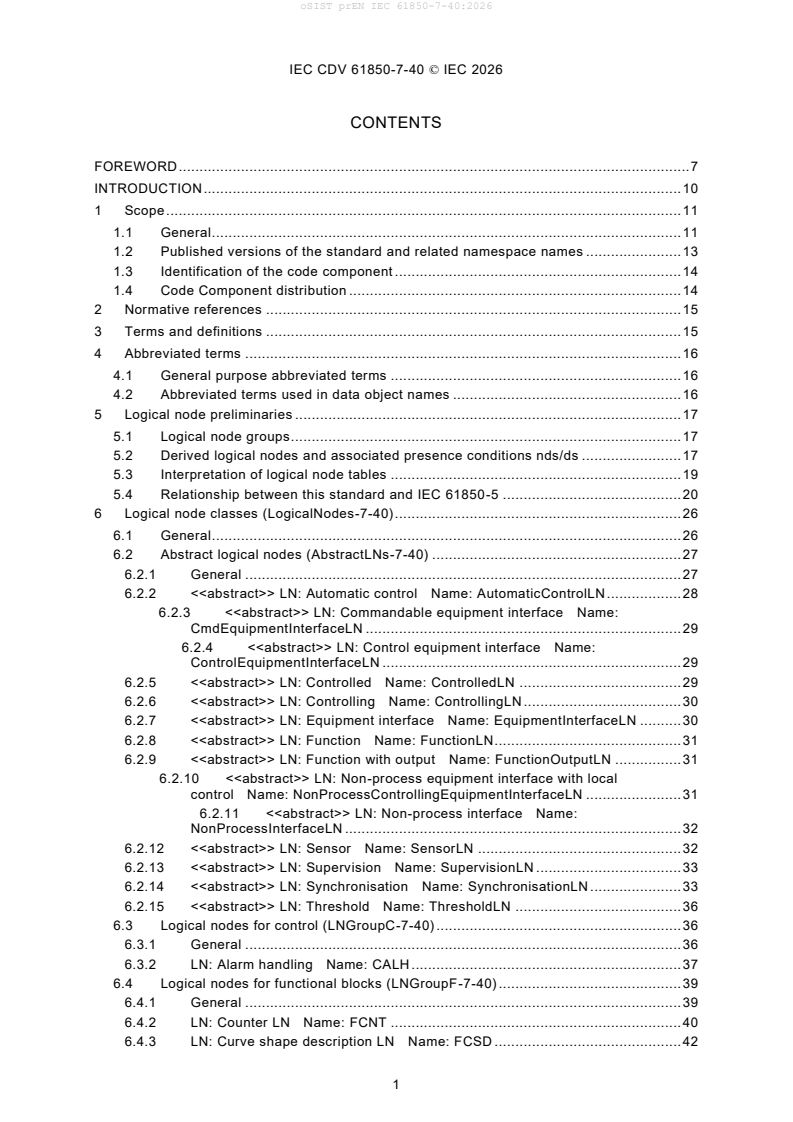
CONTENTS
FOREWORD . 7
INTRODUCTION . 10
1 Scope . 11
1.1 General . 11
1.2 Published versions of the standard and related namespace names . 13
1.3 Identification of the code component . 14
1.4 Code Component distribution . 14
2 Normative references . 15
3 Terms and definitions . 15
4 Abbreviated terms . 16
4.1 General purpose abbreviated terms . 16
4.2 Abbreviated terms used in data object names . 16
5 Logical node preliminaries . 17
5.1 Logical node groups . 17
5.2 Derived logical nodes and associated presence conditions nds/ds . 17
5.3 Interpretation of logical node tables . 19
5.4 Relationship between this standard and IEC 61850-5 . 20
6 Logical node classes (LogicalNodes-7-40) . 26
6.1 General . 26
6.2 Abstract logical nodes (AbstractLNs-7-40) . 27
6.2.1 General . 27
6.2.2 <> LN: Automatic control Name: AutomaticControlLN . 28
6.2.3 <> LN: Commandable equipment interface Name:
CmdEquipmentInterfaceLN . 29
6.2.4 <> LN: Control equipment interface Name:
ControlEquipmentInterfaceLN . 29
6.2.5 <> LN: Controlled Name: ControlledLN . 29
6.2.6 <> LN: Controlling Name: ControllingLN . 30
6.2.7 <> LN: Equipment interface Name: EquipmentInterfaceLN . 30
6.2.8 <> LN: Function Name: FunctionLN . 31
6.2.9 <> LN: Function with output Name: FunctionOutputLN . 31
6.2.10 <> LN: Non-process equipment interface with local
control Name: NonProcessControllingEquipmentInterfaceLN . 31
6.2.11 <> LN: Non-process interface Name:
NonProcessInterfaceLN . 32
6.2.12 <> LN: Sensor Name: SensorLN . 32
6.2.13 <> LN: Supervision Name: SupervisionLN . 33
6.2.14 <> LN: Synchronisation Name: SynchronisationLN . 33
6.2.15 <> LN: Threshold Name: ThresholdLN . 36
6.3 Logical nodes for control (LNGroupC-7-40) . 36
6.3.1 General . 36
6.3.2 LN: Alarm handling Name: CALH . 37
6.4 Logical nodes for functional blocks (LNGroupF-7-40) . 39
6.4.1 General . 39
6.4.2 LN: Counter LN Name: FCNT . 40
6.4.3 LN: Curve shape description LN Name: FCSD . 42
IEC CDV 61850-7-40 © IEC 2026
6.4.4 LN: Generic filter LN Name: FFIL . 44
6.4.5 LN: Control function output limitation LN Name: FLIM . 46
6.4.6 LN: PID regulator LN Name: FPID . 47
6.4.7 LN: Ramp function LN Name: FRMP . 50
6.4.8 LN: Schedule controller Name: FSCC . 51
6.4.9 LN: Schedule Name: FSCH . 53
6.4.10 LN: Setpoint control function LN Name: FSPT . 55
6.4.11 LN: Action at over threshold LN Name: FXOT . 58
6.4.12 LN: Action at under threshold LN Name: FXUT . 60
6.5 Logical nodes for generic references (LNGroupG-7-40) . 61
6.5.1 General . 61
6.5.2 LN: Generic automatic process control Name: GAPC . 63
6.5.3 LN: Generic process I/O Name: GGIO . 65
6.5.4 LN: Generic log Name: GLOG . 67
6.5.5 LN: Generic security application Name: GSAL . 69
6.6 Logical nodes for interfacing and archiving (LNGroupI-7-40) . 71
6.6.1 General . 71
6.6.2 LN: Archiving Name: IARC . 72
6.6.3 LN: Human machine interface Name: IHMI . 74
6.6.4 LN: Safety alarm function Name: ISAF . 76
6.6.5 LN: Telecontrol interface Name: ITCI . 78
6.6.6 LN: Telemonitoring interface Name: ITMI . 80
6.6.7 LN: Teleprotection communication interfaces Name: ITPC . 81
6.7 Logical nodes for metering and measurement (LNGroupM-7-40) . 84
6.7.1 General . 84
6.7.2 LN: Environmental information Name: MENV . 85
6.7.3 LN: Flow measurements Name: MFLW . 87
6.7.4 LN: Heat measured values Name: MHET . 89
6.7.5 LN: Hydrological information Name: MHYD . 91
6.7.6 LN: DC measurement Name: MMDC . 93
6.7.7 LN: Meteorological information Name: MMET . 95
6.7.8 LN: Non-phase-related AC measurement Name: MMXN . 97
6.7.9 LN: Measurement Name: MMXU . 98
6.7.10 LN: Sequence and imbalance Name: MSQI . 102
6.8 Logical nodes for supervision and monitoring (LNGroupS-7-40) . 104
6.8.1 General . 104
6.8.2 LN: Pressure supervision Name: SPRS . 104
6.8.3 LN: Temperature supervision Name: STMP . 106
6.8.4 LN: Vibration supervision Name: SVBR . 108
6.9 Logical nodes for instrument transformers and sensors (LNGroupT-7-40) . 110
6.9.1 General . 110
6.9.2 LN: Angle sensor Name: TANG . 112
6.9.3 LN: Axial displacement sensor Name: TAXD . 114
6.9.4 LN: Distance sensor Name: TDST . 115
6.9.5 LN: Liquid flow sensor Name: TFLW . 117
6.9.6 LN: Frequency sensor Name: TFRQ . 119
6.9.7 LN: Generic sensor Name: TGSN . 121
6.9.8 LN: Humidity sensor Name: THUM . 123
6.9.9 LN: Media level sensor Name: TLVL . 125
IEC CDV 61850-7-40 © IEC 2026
6.9.10 LN: Magnetic field sensor Name: TMGF . 127
6.9.11 LN: Movement sensor Name: TMVM . 129
6.9.12 LN: Position indicator Name: TPOS . 131
6.9.13 LN: Pressure sensor Name: TPRS . 133
6.9.14 LN: Rotation transmitter Name: TRTN . 135
6.9.15 LN: Sound pressure sensor Name: TSND . 136
6.9.16 LN: Temperature sensor Name: TTMP . 138
6.9.17 LN: Mechanical tension / stress sensor Name: TTNS . 140
6.9.18 LN: Vibration sensor Name: TVBR . 142
6.9.19 LN: Water acidity sensor Name: TWPH. 144
7 Data object name semantics and enumerations . 146
7.1 Data semantics . 146
7.2 Enumerated data attribute types . 158
7.2.1 General . 158
7.2.2 Adjustment (AdjustmentKind enumeration) . 158
7.2.3 Filter function (FilterFunctionKind enumeration) . 159
7.2.4 Live-dead mode (LiveDeadModeKind enumeration) . 159
7.2.5 Material (MaterialKind enumeration) . 159
7.2.6 State of material (MaterialStateKind enumeration) . 160
7.2.7 Power factor sign (PFSignKind enumeration) . 160
7.2.8 PID algorithm (PIDAlgorithmKind enumeration). 162
7.2.9 Recording mode (RecordingModeKind enumeration) . 163
7.2.10 Rotational direction (RotationalDirectionKind enumeration). 163
7.2.11 Calculation method for apparent power (STotalCalcMethodKind
enumeration) . 163
7.2.12 Schedule enabling errors (ScheduleEnablingErrorKind enumeration) . 164
7.2.13 Schedule states (ScheduleStateKind enumeration) . 164
7.2.14 Setpoint end (SetpointEndKind enumeration) . 164
7.2.15 Teleprotection application mode (TpcAppModeKind enumeration) . 165
Annex A (informative) Deprecated logical node classes . 166
Annex B (informative) Algorithms used in logical nodes for automatic control . 167
B.1 General . 167
B.2 Logical node FCSD (curve shape description) . 167
B.3 Logical node FCSV (curve shape group) . 167
B.4 Logical node FPID (PID regulator function) . 168
B.5 Logical node FFIL (filter function). 169
B.6 Logical node FRMP (setpoint ramping function) . 170
B.7 Logical node FSPT (setpoint control function) . 170
Annex C (informative) Conditions for element presence . 172
Annex D (normative) Compatibility of the different revisions of the standard . 174
D.1 General . 174
D.2 List of the modifications to consider for backward / forward compatibility . 174
D.3 List of modifications requiring specific treatment . 177
Annex E (normative) Models principles and requirements for scheduling . 178
E.1 Schedules introduction . 178
E.2 Principles for modelling schedules . 178
E.2.1 Schedule controllers and their schedules . 178
E.2.2 Scheduling and direct control / setting . 179
IEC CDV 61850-7-40 © IEC 2026
E.2.3 Schedule behaviour . 179
E.2.4 Schedule structure . 181
E.2.5 Managing schedules . 182
E.2.6 Configuration of schedules . 187
E.2.7 CDCs of supported scheduled entities . 187
E.3 Impact of Mode (Mod) on the schedule status and on the controllable entity . 188
Bibliography . 189
Figure 1 – Overview of this standard and relation of 7-4, 7-4n and 7-4nn series . 12
Figure 2 – Overview of the annexes in 7-4, 7-4n and 7-4nn series . 13
Figure 3 – Class diagram LogicalNodes-7-40::LogicalNodesGroups. 27
Figure 4 – Class diagram AbstractLNs-7-40::AbstractLNs-7-40 . 28
Figure 5 – Adaptation angle . 34
Figure 6 – Class diagram LNGroupC-7-40::LNGroupC-7-40 . 37
Figure 7 – Class diagram LNGroupF-7-40::LNGroupF-7-40 . 40
Figure 8 – State machine of FSCH . 53
Figure 9 – Class diagram LNGroupG-7-40::LNGroupG-7-40 . 62
Figure 10 – Class diagram LNGroupI-7-40::LNGroupI-7-40 . 72
Figure 11 – Class diagram LNGroupM-7-40::LNGroupM1-7-40 . 84
Figure 12 – Class diagram LNGroupM-7-40::LNGroupM2-7-40 . 85
Figure 13 – Class diagram LNGroupS-7-40::LNGroupS-7-40 . 104
Figure 14 – Class diagram LNGroupT-7-40::LNGroupT-7-40 . 112
Figure 15 – IEC power factor sign convention . 161
Figure 16 – EEI power factor sign convention . 162
Figure B.1 – Example of curve based on an indexed gate position providing water flow . 167
Figure B.2 – Example of curve based on an indexed guide vane position (x axis) vs.
net head (y axis) giving an interpolated runner blade position (Z axis) . 168
Figure B.3 – Example of a proportional-integral-derivate controller . 169
Figure B.4 – Example of a power stabilisation system . 170
Figure B.5 – Example of a ramp generator . 170
Figure B.6 – Example of an interface with a setpoint algorithm . 171
Figure E.1 – Scheduling principle. 179
Figure E.2 – State diagram for schedule . 183
Figure E.3 – Flow chart for transition out of running state . 184
Figure E.4 – Handling priorities of schedules to determine the Active one . 186
Figure E.5 – Relation between schedule controller, schedules and entity controlled . 187
Table 1 – Tracking information of IEC 61850-7-40:2025A namespace building-up . 9
Table 2 - Published version . 13
Table 3 – Attributes of IEC 61850-7-40:2025A namespace . 14
Table 4 – List of logical node groups . 17
Table 5 – Interpretation of logical node tables . 19
Table 6 – Logical nodes mappings . 20
Table 7 – Data objects of AutomaticControlLN . 28
IEC CDV 61850-7-40 © IEC 2026
Table 8 – Data objects of CmdEquipmentInterfaceLN . 29
Table 9 – Data objects of ControlEquipmentInterfaceLN . 29
Table 10 – Data objects of ControlledLN . 30
Table 11 – Data objects of ControllingLN . 30
Table 12 – Data objects of EquipmentInterfaceLN . 30
Table 13 – Data objects of FunctionLN . 31
Table 14 – Data objects of FunctionOutputLN . 31
Table 15 – Data objects of NonProcessControllingEquipmentInterfaceLN . 32
Table 16 – Data objects of NonProcessInterfaceLN . 32
Table 17 – Data objects of SensorLN . 33
Table 18 – Data objects of SupervisionLN. 33
Table 19 – Data objects of SynchronisationLN . 34
Table 20 – Data objects of ThresholdLN . 36
Table 21 – Data objects of CALH . 37
Table 22 – Data objects of FCNT . 41
Table 23 – Data objects of FCSD . 42
Table 24 – Data objects of FFIL . 44
Table 25 – Data objects of FLIM . 46
Table 26 – Data objects of FPID . 48
Table 27 – Data objects of FRMP . 50
Table 28 – Data objects of FSCC . 52
Table 29 – Data objects of FSCH . 53
Table 30 – Data objects of FSPT . 55
Table 31 – Data objects of FXOT . 58
Table 32 – Data objects of FXUT . 60
Table 33 – Data objects of GAPC . 63
Table 34 – Data objects of GGIO . 65
Table 35 – Data objects of GLOG . 67
Table 36 – Data objects of GSAL . 69
Table 37 – Data objects of IARC . 73
Table 38 – Data objects of IHMI . 74
Table 39 – Data objects of ISAF . 76
Table 40 – Data objects of ITCI . 78
Table 41 – Data objects of ITMI . 80
Table 42 – Data objects of ITPC . 81
Table 43 – Data objects of MENV . 86
Table 44 – Data objects of MFLW . 87
Table 45 – Data objects of MHET . 89
Table 46 – Data objects of MHYD . 91
Table 47 – Data objects of MMDC . 93
Table 48 – Data objects of MMET . 95
Table 49 – Data objects of MMXN . 97
Table 50 – Data objects of MMXU . 99
IEC CDV 61850-7-40 © IEC 2026
Table 51 – Data objects of MSQI . 102
Table 52 – Data objects of SPRS . 105
Table 53 – Data objects of STMP . 106
Table 54 – Data objects of SVBR . 108
Table 55 – Data objects of TANG . 112
Table 56 – Data objects of TAXD . 114
Table 57 – Data objects of TDST . 116
Table 58 – Data objects of TFLW . 117
Table 59 – Data objects of TFRQ . 119
Table 60 – Data objects of TGSN . 121
Table 61 – Data objects of THUM . 123
Table 62 – Data objects of TLVL . 125
Table 63 – Data objects of TMGF . 127
Table 64 – Data objects of TMVM . 129
Table 65 – Data objects of TPOS . 131
Table 66 – Data objects of TPRS . 133
Table 67 – Data objects of TRTN . 135
Table 68 – Data objects of TSND . 137
Table 69 – Data objects of TTMP . 138
Table 70 – Data objects of TTNS . 140
Table 71 – Data objects of TVBR . 142
Table 72 – Data objects of TWPH . 144
Table 73 – Name and description of data objects defined in classes of LogicalNodes -7-
40 package . 146
Table 74 – Literals of AdjustmentKind . 159
Table 75 – Literals of FilterFunctionKind . 159
Table 76 – Literals of LiveDeadModeKind . 159
Table 77 – Literals of MaterialKind . 160
Table 78 – Literals of MaterialStateKind. 160
Table 79 – Literals of PFSignKind . 162
Table 80 – Literals of PIDAlgorithmKind . 163
Table 81 – Literals of RecordingModeKind . 163
Table 82 – Literals of RotationalDirectionKind . 163
Table 83 – Literals of STotalCalcMethodKind . 163
Table 84 – Literals of ScheduleEnablingErrorKind . 164
Table 85 – Literals of ScheduleStateKind . 164
Table 86 – Literals of SetpointEndKind . 164
Table 87 – Literals of TpcAppModeKind . 165
Table 88 – Conditions for presence of elements within a context . 172
Table E.1 – Expected behaviour of a schedule . 181
Table E.2 – Structure of a schedule . 182
Table E.3 – Impact of Mode (Mod) on the schedule status and on the controllable
entity . 188
IEC CDV 61850-7-40 © IEC 2026
INTERNATIONAL ELECTROTECHNICAL COMMISSION
_____________
COMMUNICATION NETWORKS AND
SYSTEMS FOR POWER UTILITY AUTOMATION –
Part 7-40: Basic communication structure –
Compatible logical node classes and data object classes –
Common
FOREWORD
1) The International Electrotechnical Commission (IEC) is a worldwide organization for standardization comprising
all national electrotechnical committees (IEC National Committees). The object of IEC is to promote international
co-operation on all questions concerning standardization in the electrical and electronic fields. To this end and
in addition to other activities, IEC publishes International Standards, Technical Specifications, Technical Reports,
Publicly Available Specifications (PAS) and Guides (hereafter referred to as “IEC Publication(s)”). Their prepa-
ration is entrusted to technical committees; any IEC National Committee interested in the subject dealt with may
participate in this preparatory work. International, governmental and non-governmental organizations liaising with
the IEC also participate in this preparation. IEC collaborates closely with the International Organization for Stand-
ardization (ISO) in accordance with conditions determined by agreement between the two organizations.
2) The formal decisions or agreements of IEC on technical matters express, as nearly as possible, an international
consensus of opinion on the relevant subjects since each technical committee has representation from all inter-
ested IEC National Committees.
3) IEC Publications have the form of recommendations for international use and are accepted by IEC National
Committees in that sense. While all reasonable efforts are made to ensure that the technical content of IEC
Publications is accurate, IEC cannot be held responsible for the way in which they are used or for any misinter-
pretation by any end user.
4) In order to promote international uniformity, IEC National Committees undertake to apply IEC Publications trans-
parently to the maximum extent possible in their national and regional publications. Any divergence between any
IEC Publication and the corresponding national or regional publication shall be clearly indicated in the latter.
5) IEC itself does not provide any attestation of conformity. Independent certification bodies provide conformity
assessment services and, in some areas, access to IEC marks of conformity. IEC is not responsible for any
services carried out by independent certification bodies.
6) All users should ensure that they have the latest edition of this publication.
7) No liability shall attach to IEC or its directors, employees, servants or agents including individual experts and
members of its technical committees and IEC National Committees for any personal injury, property damage or
other damage of any nature whatsoever, whether direct or indirect, or for costs (including legal fees) and ex-
penses arising out of the publication, use of, or reliance upon, this IEC Publication or any other IEC Publications.
8) Attention is drawn to the Normative references cited in this publication. Use of the referenced publications is
indispensable for the correct application of this publication.
9) Attention is drawn to the possibility that some of the elements of this IEC Publication may be the subject of patent
rights. IEC shall not be held responsible for identifying any or all such patent rights.
International Standard IEC 61850-7-40 has been prepared by IEC technical committee 57:
Power systems management and associated information exchange.
IEC CDV 61850-7-40 © IEC 2026
The IEC 61850-7-4 Edition 2.1 is re-organized into the following parts of “Basic communication
structure – Compatible logical node classes and data object classes”, each hereinafter referred
to by the specialized title indicated below:
• IEC 61850-7-4:2025 Edition 3 – Core part
• IEC 61850-7-40:2025 Edition 1 – Common part (– this document)
• IEC 61850-7-43:2025 Edition 1 – Primary equipment
• IEC 61850-7-44:2025 Edition 1 – Instrument transformers
• IEC 61850-7-400:2025 Edition 1 – Substation automation
• IEC 61850-7-401:2025 Edition 1 – Protection
• IEC 61850-7-440:2025 Edition 1 – Power quality and metering
Further in this document these are referenced as 7-4, 7-4n and 7-4nn.
This structure of IEC 61850-7-4 Edition 2.1 has been changed into several parts (7-4, 7-4n and
7-4nn) which allows to update individual parts without requiring a new edition to the core part.
This enables the standard to meet time to market requirements more quickly.
As a consequence, the annexes of former IEC 61850-7-4 Edition 2.1 are now distributed ac-
cording to their purpose. This document includes the following Annexes:
• Annex A (former Annex C) - Deprecated logical nodes classes in regard to this document.
All deprecated logical node classes from IEC 61850-7-4 Edition 2.1 are found in 7-4 – Core
part.
• Annex B (former Annex E) - Algorithms used in logical nodes for automatic control
• Annex C (former Annex I) - Conditions for element presence
• Annex D (former Annex J) - Compatibility of the different revisions of the standard
• Annex E (former Annex K) - Models principles and requirements for scheduling
IEC 61850-7-4 Edition 2.1 will not be subject to any further improvements with this series being
published.
The new series cancels and replaces IEC 61850-7-4 Edition 2.1 which was last published in
2020 as a consolidated version.
Clauses 4 through 7 and their subclauses (except for 5.1, 5.2, and 5.3) are automatically gen-
erated from the UML model.
The text of this standard is based on the following documents:
FDIS Report on voting
This publication has been drafted in accordance with the ISO/IEC Directives, Part 2. This IEC
standard includes Code Components i.e. components that are intended to be directly processed
by a computer.
The purchase of this IEC standard carries a copyright license for the purchaser to sell software
containing Code Components from this standard to end users either directly or via distributors,
subject to IEC software licensing conditions, which can be found at: http://www.iec.ch/CCv1.
IEC CDV 61850-7-40 © IEC 2026
Table 1 shows all tracking information of IEC 61850-7-40:2025A namespace building-up
Table 1 – Tracking information of IEC 61850-7-40:2025A namespace building-up
Attribute Content
Namespace IEC specific information
Version of the UML model used for gener- WG10built18
ating the document (informative)
Date of the UML model used for generating 2025-12-12
the document (informative)
Autogeneration software name and ver- j61850DocBuilder 02.05b based on jCleanCim beta9.4 (derived
sion(informative) from jCleanCim 02-02)
A list of all parts of the IEC 61850 series under the general title Communication networks and
systems for power utility automation, can be found on the IEC website.
The committee has decided that the contents of the base publication and its amendment will
remain unchanged until the stability date indicated on the IEC web site under "http://web-
store.iec.ch" in the data related to the specific publication. At this date, the publication will be
reconfirmed,
withdrawn,
replaced by a revised edition, or
amended.
A bilingual version of this publication may be issued at a later date.
IMPORTANT – The 'colour inside' logo on the cover page of this publication indicates that it
contains colours which are considered to be useful for the correct understanding of its con-
tents. Users should therefore print this document using a colour printer.
IEC CDV 61850-7-40 © IEC 2026
1 INTRODUCTION
2 This part of IEC 61850 is part of a set of standards, the IEC 61850 series. IEC 61850 defines
3 communication networks and systems for power utility automation, and more specifically the
4 communication architecture for subsystems such as substation automation systems. The sum
5 of all subsystems can result also in the description of the communication architecture for the
6 overall power system management. The defined architecture provided in specific parts of
7 IEC 61850-7-n gives both a power utility specific data model and a substation domain specific
8 data model with abstract definitions of data objects classes and services independently from
9 the specific protocol stacks, implementations, and operating systems. The mapping of these
10 abstract classes and services to communication stacks is outside the scope of IEC 61850-7-n
11 and can be found in IEC 61850-8-n and in IEC 61850-9-n.
12 IEC 61850-7-1 gives an overview of the basic communication architecture to be used for all
13 applications in the power system domain. IEC 61850-7-3 defines common attribute types and
14 common data classes related to all applications in the power system domain. The attributes of
15 the common data classes can be accessed using services defined in IEC 61850-7-2. These
16 common data classes are used in this part to define the compatible data object classes.
17 To reach interoperability, all data objects in the data model need a strong definition with regard
18 to syntax and semantics. The semantics of the data objects is mainly provided by names as-
19 signed to common logical nodes defined in this part and the data objects they contain, as de-
20 fined in this basic part, and dedicated logical nodes defined in domain specific parts such as
21 for hydro power control systems. Interoperability is easiest if as many as possible of the data
22 objects are defined as mandatory. Because of different approaches and technical features,
23 some data objects, especially settings, were declared as optional in IEC 61850-7-4:2010 and
24 its following editions. There are also data objects which were declared as conditional, i.e. they
25 will become mandatory under some well-defined conditions. After some ex
...