

EN 62252:2004
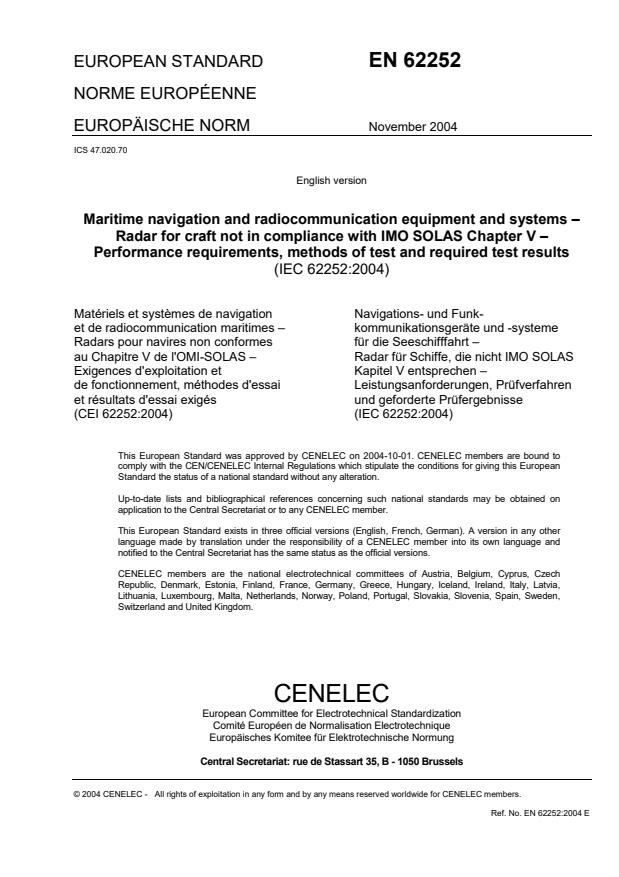
(Main)Maritime navigation and radiocommunication equipment and systems - Radar for craft not in compliance with IMO SOLAS Chapter V - Performance requirements, methods of test and required test results
General Information
- Abstract
Specifies the minimum performance requirements for testing and required test results for conformance of radar not fully compliant with the IMO Performance Standard for radar/radar plotting (MSC.64(67)). Covers radar classes A, B and C. Is based on EN 60872, EN 60936 and takes into account EN 60945.
- Status
- Published
- Publication Date
- 25-Nov-2004
- Withdrawal Date
- 30-Sep-2007
- Technical Committee
- CLC/SR 80 - Maritime navigation and radiocommunication equipment and systems
- Drafting Committee
- IEC/TC 80 - IEC_TC_80
- Parallel Committee
- IEC/TC 80 - IEC_TC_80
- Current Stage
- 9093 - Decision to confirm - Review Enquiry
- Start Date
- 02-Aug-2023
- Completion Date
- 25-Aug-2026

Overview
EN 62252:2004 (IEC 62252:2004 adopted by CLC) specifies minimum performance requirements, methods of test and required test results for maritime radar equipment intended for craft that are not in compliance with IMO SOLAS Chapter V. The standard covers radar classes A, B and C and is based on existing maritime radar standards (EN 60872, EN 60936) while taking into account EN 60945. EN 62252 guides manufacturers, test laboratories and procurement bodies on how to verify radar performance for non‑SOLAS vessels such as small commercial craft, fishing boats and recreational craft.
Key topics and technical requirements
EN 62252 addresses a broad set of technical and operational aspects of marine radar systems, including:
- Radar indication and display requirements - visibility, presentation and ergonomic layout of radar returns and navigational overlays.
- Range performance and range measurement features including VRM (Variable Range Marker) and range rings.
- Bearing and heading tools - heading line, Electronic Bearing Line (EBL), bearing scale and discrimination.
- Antenna characteristics - radiation pattern, scan performance and effects of roll/pitch.
- Frequency band and RF requirements - allocated bands, spurious/unwanted emissions and spectrum conformance (Annex D).
- Signal processing and clutter control - tuning indication, anti‑clutter functions and performance in cluttered environments.
- Operational modes and controls - mode definitions, manual speed/drift input and standard control names (Annex B).
- Interfacing and navigational information - integration with sensors, digital interfaces and guidance on radar maps (Annex C).
- Quality assurance, installation and safety - documentation, failure warnings/alarms and installation testing (Annex E).
- Automatic tracking device (ATD) testing specifics for Class A radars (Annex F).
- Normative test methods and required results for all above topics are specified to ensure reproducible conformity testing.
Applications and users
EN 62252 is intended for:
- Radar manufacturers designing equipment for non‑SOLAS craft to demonstrate conformance.
- Test laboratories and certification bodies performing performance verification and type approval.
- Shipyards and installers specifying radar requirements for small commercial, fishing and recreational vessels.
- Procurement officers and fleet managers who need objective acceptance criteria for maritime radar.
- Regulatory authorities and standardization committees referencing complementary standards.
Related standards
- EN 60872 (radar plotting aids / automatic tracking)
- EN 60936 (shipborne radar performance)
- EN 60945 (general maritime equipment requirements)
- IEC 61162, IEC 61108 series (interfaces and GNSS)
- ITU and IHO recommendations referenced for emissions and display guidance
EN 62252 provides a practical framework for verifying maritime radar performance on non‑SOLAS craft, enabling safer navigation through standardized test methods and measurable acceptance criteria.
Relations
- Effective Date
- 10-Feb-2026
- Refers
IEC 60533:1999 - Electrical and electronic installations in ships - Electromagnetic compatibility - Effective Date
- 10-Feb-2026
- Effective Date
- 10-Feb-2026
- Effective Date
- 09-Feb-2026
- Effective Date
- 09-Feb-2026
- Effective Date
- 03-Feb-2026
- Effective Date
- 03-Feb-2026
- Effective Date
- 03-Feb-2026
- Effective Date
- 03-Feb-2026
- Effective Date
- 03-Feb-2026
- Effective Date
- 03-Feb-2026
- Effective Date
- 03-Feb-2026
- Effective Date
- 03-Feb-2026
- Effective Date
- 03-Feb-2026
- Effective Date
- 03-Feb-2026
Get Certified
Connect with accredited certification bodies for this standard

DNV
DNV is an independent assurance and risk management provider.

Lloyd's Register
Lloyd's Register is a global professional services organisation specialising in engineering and technology.

FSC International
Forest Stewardship Council certification.
Sponsored listings
Frequently Asked Questions
EN 62252:2004 is a standard published by CLC. Its full title is "Maritime navigation and radiocommunication equipment and systems - Radar for craft not in compliance with IMO SOLAS Chapter V - Performance requirements, methods of test and required test results". This standard covers: Specifies the minimum performance requirements for testing and required test results for conformance of radar not fully compliant with the IMO Performance Standard for radar/radar plotting (MSC.64(67)). Covers radar classes A, B and C. Is based on EN 60872, EN 60936 and takes into account EN 60945.
Specifies the minimum performance requirements for testing and required test results for conformance of radar not fully compliant with the IMO Performance Standard for radar/radar plotting (MSC.64(67)). Covers radar classes A, B and C. Is based on EN 60872, EN 60936 and takes into account EN 60945.
EN 62252:2004 is classified under the following ICS (International Classification for Standards) categories: 47.020.70 - Navigation and control equipment. The ICS classification helps identify the subject area and facilitates finding related standards.
EN 62252:2004 has the following relationships with other standards: It is inter standard links to IEC 60092-101:1994, IEC 60533:1999, EN ISO 694:2001, EN 49-2:2005, EN 516:1995, EN 60068-2-52:1996, EN 60872-3:2001, EN 61108-2:1998, EN 60529:1991, EN 60936-2:1999, EN 60872-2:1999, EN 60936-3:2002, EN 60936-1:2000, EN 61000-4-8:1993, EN 60071-2:1997. Understanding these relationships helps ensure you are using the most current and applicable version of the standard.
EN 62252:2004 is available in PDF format for immediate download after purchase. The document can be added to your cart and obtained through the secure checkout process. Digital delivery ensures instant access to the complete standard document.
Standards Content (Sample)
SLOVENSKI SIST EN 62252:2005
STANDARD
december 2005
Pomorska navigacijska in radiokomunikacijska oprema in sistemi – Radarji za
plovila, ki niso skladni s 5. poglavjem konvencije IMO SOLAS – Zahteve za
lastnosti, preskusne metode in zahtevani rezultati preskušanja (IEC
62252:2004)
Maritime navigation and radiocommunication equipment and systems – Radar for
craft not in compliance with IMO SOLAS Chapter V – Performance requirements,
methods of test and required test results (IEC 62252:2004)
ICS 47.020.70 Referenčna številka
© Standard je založil in izdal Slovenski inštitut za standardizacijo. Razmnoževanje ali kopiranje celote ali delov tega dokumenta ni dovoljeno
EUROPEAN STANDARD EN 62252
NORME EUROPÉENNE
EUROPÄISCHE NORM November 2004
ICS 47.020.70
English version
Maritime navigation and radiocommunication equipment and systems –
Radar for craft not in compliance with IMO SOLAS Chapter V –
Performance requirements, methods of test and required test results
(IEC 62252:2004)
Matériels et systèmes de navigation Navigations- und Funk-
et de radiocommunication maritimes – kommunikationsgeräte und -systeme
Radars pour navires non conformes für die Seeschifffahrt –
au Chapitre V de l'OMI-SOLAS – Radar für Schiffe, die nicht IMO SOLAS
Exigences d'exploitation et Kapitel V entsprechen –
de fonctionnement, méthodes d'essai Leistungsanforderungen, Prüfverfahren
et résultats d'essai exigés und geforderte Prüfergebnisse
(CEI 62252:2004) (IEC 62252:2004)
This European Standard was approved by CENELEC on 2004-10-01. CENELEC members are bound to
comply with the CEN/CENELEC Internal Regulations which stipulate the conditions for giving this European
Standard the status of a national standard without any alteration.
Up-to-date lists and bibliographical references concerning such national standards may be obtained on
application to the Central Secretariat or to any CENELEC member.
This European Standard exists in three official versions (English, French, German). A version in any other
language made by translation under the responsibility of a CENELEC member into its own language and
notified to the Central Secretariat has the same status as the official versions.
CENELEC members are the national electrotechnical committees of Austria, Belgium, Cyprus, Czech
Republic, Denmark, Estonia, Finland, France, Germany, Greece, Hungary, Iceland, Ireland, Italy, Latvia,
Lithuania, Luxembourg, Malta, Netherlands, Norway, Poland, Portugal, Slovakia, Slovenia, Spain, Sweden,
Switzerland and United Kingdom.
CENELEC
European Committee for Electrotechnical Standardization
Comité Européen de Normalisation Electrotechnique
Europäisches Komitee für Elektrotechnische Normung
Central Secretariat: rue de Stassart 35, B - 1050 Brussels
© 2004 CENELEC - All rights of exploitation in any form and by any means reserved worldwide for CENELEC members.
Ref. No. EN 62252:2004 E
Foreword
The text of document 80/393/FDIS, future edition 1 of IEC 62252, prepared by IEC TC 80, Maritime
navigation and radiocommunication equipment and systems, was submitted to the IEC-CENELEC
parallel vote and was approved by CENELEC as EN 62252 on 2004-10-01.
The following dates were fixed:
– latest date by which the EN has to be implemented
at national level by publication of an identical
national standard or by endorsement (dop) 2005-07-01
– latest date by which the national standards conflicting
with the EN have to be withdrawn (dow) 2007-10-01
Annex ZA has been added by CENELEC.
__________
Endorsement notice
The text of the International Standard IEC 62252:2004 was approved by CENELEC as a European
Standard without any modification.
__________
- 3 - EN 62252:2004
Annex ZA
(normative)
Normative references to international publications
with their corresponding European publications
The following referenced documents are indispensable for the application of this document. For dated
references, only the edition cited applies. For undated references, the latest edition of the referenced
document (including any amendments) applies.
NOTE Where an international publication has been modified by common modifications, indicated by (mod), the relevant
EN/HD applies.
Publication Year Title EN/HD Year
IEC 60068-2-52 1996 Environmental testing EN 60068-2-52 1996
Corr. July 1996 Part 2: Tests - Test Kb: Salt mist, cyclic
(sodium chloride solution)
IEC 60071-2 1996 Insulation co-ordination EN 60071-2 1997
Part 2: Application guide
1)
IEC 60092-101 - Electrical installations in ships - -
Part 101: Definitions and general
requirements
database
IEC 60417 Graphical symbols for use on equipment - -
IEC 60529 1989 Degrees of protection provided by EN 60529 1991
enclosures (IP Code) + corr. May 1993
IEC 60533 1999 Electrical and electronic installations in - -
ships - Electromagnetic compatibility
IEC 60872-2 1999 Maritime navigation and EN 60872-2 1999
radiocommunication equipment and
systems - Radar plotting aids
Part 2: Automatic tracking aids (ATA) -
Methods of testing and required test
results
IEC 60872-3 2000 Part 3: Electronic plotting aid (EPA) - EN 60872-3 2001
Performance requirements - Methods of
testing and required test results
IEC 60936-1 1999 Maritime navigation and EN 60936-1 2000
radiocommunication equipment and
systems - Radar
Part 1: Shipborne radar - Performance
requirements - Methods of testing and
required test results
IEC 60936-2 1998 Part 2: Shipborne radar for high-speed EN 60936-2 1999
craft (HSC) - Methods of testing and
required test results
1)
Undated reference.
Publication Year Title EN/HD Year
IEC 60936-3 2002 Part 3: Radar with chart facilities - EN 60936-3 2002
Performance requirements - Methods of
testing and required test results
1) 2)
IEC 60945 - Maritime navigation and EN 60945 2002
radiocommunication equipment and
systems - General requirements -
Methods of testing and required test
results
IEC 61000-4-8 1993 Electromagnetic compatibility (EMC) EN 61000-4-8 1993
Part 4-8: Testing and measurement
techniques - Power frequency magnetic
field immunity test
IEC 61108 Series Maritime navigation and EN 61108 Series
radiocommunication equipment and
systems - Global navigation satellite
systems (GNSS)
IEC 61162 Series Maritime navigation and EN 61162 Series
radiocommunication equipment and
systems - Digital interfaces
IEC 61672 Series Electroacoustics-Sound level meters - -
1)
IEC/PAS - Maritime navigation and - -
60936-5 radiocommunication equipment and
systems - Radar
Part 5: Guidelines for the use and display
of AIS information on radar
ISO 694 2000 Ships and marine technology - EN ISO 694 2001
Positioning of magnetic compasses in
ships
ISO 3791 1976 Office machines and data processing - -
equipment - Keyboard layouts for numeric
applications
ITU Radio 2001 Radio Regulations - -
Regulations
1)
ITU-R - Techniques for measurement of - -
Recommendation
unwanted emissions of radar systems
M.1177-3
1)
ITU-R - Technical characteristics of maritime - -
Recommendation
radionavigation radars
M.1313
1)
ITU-R - Spectra and bandwidth of emissions - -
Recommendation
SM.328-9
2)
Valid edition at date of issue.
- 5 - EN 62252:2004
Publication Year Title EN/HD Year
1)
ITU-R - Unwanted emissions in the spurious - -
Recommendation
domain
SM.329-10
1)
ITU-R - Variation of the boundary between the - -
Recommendation
out-of-band and spurious domains
SM.1539
required for the application of
Recommendations ITU-R SM.1541 and
ITU-R SM.329
1)
ITU-R - Unwanted emissions in the out-of-band - -
Recommendation domain falling into adjacent allocated
SM.1540
bands
1)
ITU-R - Unwanted emissions in the out-of-band - -
Recommendation domain
SM.1541
1)
ITU-T - Arrangement of digits, letters and - -
Recommendation
symbols on telephones and other devices
E.161
that can be used for gaining access to a
telephone network
1)
IHO S-52 - Specifications for chart content and - -
display aspects of ECDIS
INTERNATIONAL IEC
STANDARD 62252
First edition
2004-07
Maritime navigation and radiocommunication
equipment and systems –
Radar for craft not in compliance
with IMO SOLAS Chapter V –
Performance requirements, methods
of test and required test results
© IEC 2004 ⎯ Copyright - all rights reserved
No part of this publication may be reproduced or utilized in any form or by any means, electronic or
mechanical, including photocopying and microfilm, without permission in writing from the publisher.
International Electrotechnical Commission, 3, rue de Varembé, PO Box 131, CH-1211 Geneva 20, Switzerland
Telephone: +41 22 919 02 11 Telefax: +41 22 919 03 00 E-mail: inmail@iec.ch Web: www.iec.ch
PRICE CODE
Commission Electrotechnique Internationale XG
International Electrotechnical Commission
ɆɟɠɞɭɧɚɪɨɞɧɚɹɗɥɟɤɬɪɨɬɟɯɧɢɱɟɫɤɚɹɄɨɦɢɫɫɢɹ
For price, see current catalogue
– 2 – 62252 © IEC:2004(E)
CONTENTS
FOREWORD.5
INTRODUCTION.7
1 Scope.8
2 Normative references.8
3 Definitions and abbreviations.9
3.1 Definitions.9
3.2 Abbreviations.12
4 Performance requirements.13
4.1 Radar indication.13
4.2 Safety of options .13
4.3 Technical information.13
4.4 Quality assurance.13
4.5 Radio-frequency spectrum requirements.13
4.6 Range.13
4.7 Display.14
4.8 Frequency band.16
4.9 Range markers.16
4.10 Range measurement using range rings and VRM .17
4.11 Heading line.17
4.12 Electronic bearing line (EBL) .17
4.13 Bearing scale.18
4.14 Discrimination.19
4.15 Antenna radiation pattern.19
4.16 Roll or pitch performance .19
4.17 Antenna scan.19
4.18 Modes.20
4.19 Tuning indication.21
4.20 Anti-clutter devices.21
4.21 Range performance in clutter .21
4.22 Operation.22
4.23 Controls.22
4.24 Manual speed set and drift input.22
4.25 Interference from external magnetic fields .22
4.26 Radar installation.22
4.27 Failure warnings (alarms) and status indication .23
4.28 Interfacing.23
4.29 Navigational information.24
4.30 Ergonomics.24
4.31 Display of information.26
4.32 Safety precautions.26
4.33 Spurious/unwanted frequency emissions (Annex D) .26
5 Methods of test and required test result.26
5.1 Radar indication.27
5.2 Safety of options .28
5.3 Technical information.28
62252 © IEC:2004(E) – 3 –
5.4 Quality assurance.28
5.5 Radio-frequency spectrum requirements.28
5.6 Range.28
5.7 Display.29
5.8 Frequency band.31
5.9 Range markers.32
5.10 Range measurement using range rings and VRM .33
5.11 Heading line.33
5.12 Electronic bearing line (EBL) .34
5.13 Bearing scale.36
5.14 Discrimination.37
5.15 Antenna radiation pattern.38
5.16 Roll and pitch performance.39
5.17 Antenna scan.39
5.18 Modes.40
5.19 Tuning indication.42
5.20 Anti-clutter devices.43
5.21 Range performance in clutter .43
5.22 Operation.44
5.23 Controls.44
5.24 Manual speed set and drift .45
5.25 Interference from external magnetic fields .45
5.26 Radar installation.45
5.27 Failure warnings (alarms) and status indications .45
5.28 Interfacing.46
5.29 Navigational information.48
5.30 Ergonomics.49
5.31 Display of information.49
5.32 Safety precautions.50
5.33 Spurious/unwanted frequency emissions.50
Annex A (normative) Method for relating the radar cross-section (echoing area) of one
radar target with another.51
Annex B (normative) Standard names, abbreviations and symbols for control functions
on marine navigational radar equipment (as referenced by IEC 60945).56
Annex C (normative) Guidelines for the display of navigational information on radar
by means of radar maps .68
Annex D (normative) Unwanted emissions of radar systems – Methods of
measurement and required results .70
Annex E (normative) General requirements – Method of test and required results.75
Annex F (normative) Automatic tracking device (ATD) – Methods of testing and
required test results – Class A only.102
Annex G (normative) Electronic plotting device (EPD) Class A only .117
Annex H (normative) Electronic plotting video symbols (EPVS).126
Annex I (informative) Performance checks during environmental testing .142
– 4 – 62252 © IEC:2004(E)
Figure A.1 – Enhancement by reflection (dB) over free space .54
Figure A.2 – Enhancement by reflection (dB) over free space .55
Figure D.1 – B falls within the allocated band.73
–40
Figure D.2 – B falls outside the allocated band.74
–40
Figure G.1 – Diagram of three plots .125
Table 1 – Effective side-lobes .19
Table 2 – Recommended input data sentences – IEC 61162-1/IEC 61162-2 .23
Table 3 – Output data sentences – IEC 61162-1/IEC 61162-2 where available .24
Table 4 – 3 dB points for main beam.38
Table 5 – Effective side-lobes .39
Table C.1 – Features and colours to be used for radar maps .69
Table D.1 – Measurement frequency ranges .71
Table E.1 – Extreme power supplies variation.84
Table E.2 – Schedule of performance tests and checks .89
Table E.3 – Durability and resistance to environmental conditions .90
Table E.4 – Test severity – half-sine pulse.94
Table E.5 – Emission limits.100
Table F.1 – Accuracy values .107
Table F.2 – Accuracy values .107
Table F.3 – ATD Scenarios .114
Table G.1 – Test scenarios .120
Table G.2 – Scenario 1 data .122
Table G.3 – Scenario 2 data .122
Table G.4 – Scenario 3 data .123
Table G.5 – Scenario 4 data .123
Table G.6 – Scenario 5 data .124
Table G.7 – Scenario 6 data .124
62252 © IEC:2004(E) – 5 –
INTERNATIONAL ELECTROTECHNICAL COMMISSION
____________
MARITIME NAVIGATION AND RADIOCOMMUNICATION
EQUIPMENT AND SYSTEMS –
RADAR FOR CRAFT NOT IN COMPLIANCE WITH
IMO SOLAS CHAPTER V –
PERFORMANCE REQUIREMENTS, METHODS
OF TEST AND REQUIRED TEST RESULTS
FOREWORD
1) The International Electrotechnical Commission (IEC) is a worldwide organization for standardization comprising
all national electrotechnical committees (IEC National Committees). The object of IEC is to promote
international co-operation on all questions concerning standardization in the electrical and electronic fields. To
this end and in addition to other activities, IEC publishes International Standards, Technical Specifications,
Technical Reports, Publicly Available Specifications (PAS) and Guides (hereafter referred to as “IEC
Publication(s)”). Their preparation is entrusted to technical committees; any IEC National Committee interested
in the subject dealt with may participate in this preparatory work. International, governmental and non-
governmental organizations liaising with the IEC also participate in this preparation. IEC collaborates closely
with the International Organization for Standardization (ISO) in accordance with conditions determined by
agreement between the two organizations.
2) The formal decisions or agreements of IEC on technical matters express, as nearly as possible, an international
consensus of opinion on the relevant subjects since each technical committee has representation from all
interested IEC National Committees.
3) IEC Publications have the form of recommendations for international use and are accepted by IEC National
Committees in that sense. While all reasonable efforts are made to ensure that the technical content of IEC
Publications is accurate, IEC cannot be held responsible for the way in which they are used or for any
misinterpretation by any end user.
4) In order to promote international uniformity, IEC National Committees undertake to apply IEC Publications
transparently to the maximum extent possible in their national and regional publications. Any divergence
between any IEC Publication and the corresponding national or regional publication shall be clearly indicated in
the latter.
5) IEC provides no marking procedure to indicate its approval and cannot be rendered responsible for any
equipment declared to be in conformity with an IEC Publication.
6) All users should ensure that they have the latest edition of this publication.
7) No liability shall attach to IEC or its directors, employees, servants or agents including individual experts and
members of its technical committees and IEC National Committees for any personal injury, property damage or
other damage of any nature whatsoever, whether direct or indirect, or for costs (including legal fees) and
expenses arising out of the publication, use of, or reliance upon, this IEC Publication or any other IEC
Publications.
8) Attention is drawn to the Normative references cited in this publication. Use of the referenced publications is
indispensable for the correct application of this publication.
9) Attention is drawn to the possibility that some of the elements of this IEC Publication may be the subject of
patent rights. IEC shall not be held responsible for identifying any or all such patent rights.
International Standard IEC 62252 has been prepared by IEC technical committee 80: Maritime
navigation and radiocommunication equipment and systems.
This standard is based on the standards for radar and radar plotting used on SOLAS vessels,
IEC 60872 series, IEC 60936 series and IEC 60945.
The text of this standard is based on the following documents:
FDIS Report on voting
80/393/FDIS 80/397/RVD
Full information on the voting for the approval of this standard can be found in the report on
voting indicated in the above table.
– 6 – 62252 © IEC:2004(E)
This publication has been drafted in accordance with the ISO/IEC Directives, Part 2.
The committee has decided that the contents of this publication will remain unchanged until
the maintenance result date indicated on the IEC web site under "http://webstore.iec.ch" in
the data related to the specific publication. At this date, the publication will be
• reconfirmed;
• withdrawn;
• replaced by a revised edition, or
• amended.
A bilingual version of this publication may be issued at a later date.
62252 © IEC:2004(E) – 7 –
INTRODUCTION
This IEC radar standard is produced specifically for radar not fully compliant with the IMO
Performance Standard for radar/radar plotting and applies to the following:
• radar (class A) intended for commercial craft under 150 gross tonnage, where no SOLAS
radar carriage requirement currently exists, where the antenna beamwidth is not more
than 4,0° and the display minimum effective diameter is limited to not less than 150 mm.
• radar (class B) intended for recreational craft or other maritime use and where the
antenna beamwidth is not more than 5,5° and the display minimum effective diameter is
limited to not less than 85 mm.
• radar (class C) intended for small recreational craft where the antenna beamwidth is not
more than 7,5° and the display minimum effective diameter is limited to not less than
75 mm.
The requirements for commercial craft radar are covered in the main body of this
specification. The requirements, where different, for radar (class B and C) are shown in
parenthesis where applicable.
NOTE 1 The IMO performance standard for radar/radar plotting is in Resolution MSC.64(67) which is
implemented in the IEC 60872 series and the IEC 60936 series of standards.
NOTE 2 For the purposes of this IEC standard, the words 'craft’ and ‘ship’ are interchangeable and have the
same meaning.
– 8 – 62252 © IEC:2004(E)
MARITIME NAVIGATION AND RADIOCOMMUNICATION
EQUIPMENT AND SYSTEMS –
RADAR FOR CRAFT NOT IN COMPLIANCE WITH
IMO SOLAS CHAPTER V –
PERFORMANCE REQUIREMENTS, METHODS
OF TEST AND REQUIRED TEST RESULTS
1 Scope
This International Standard specifies the minimum performance requirements for testing and
required test results for conformance of radar not fully compliant with the IMO Performance
Standard for radar/radar plotting (RP) (MSC.64(67)). In addition, it takes into account
IEC 60945. When a requirement of this standard is different from that of IEC 60945 the
requirement in this standard shall take precedence.
2 Normative references
The following referenced documents are indispensable for the application of this document.
For dated references, only the edition cited applies. For undated references, the latest edition
of the referenced document (including any amendments) applies.
IEC 60068-2-52:1996, Environmental testing – Part 2: Test Kb: Salt mist, cyclic (sodium
chloride solution)
Corrigendum 1 (1996)
IEC 60071-2:1996, Insulation co-ordination – Part 2: Application guide
IEC 60092-101, Electrical installations in ships – Part 101: Definitions and general
requirements
IEC 60417:1998, Graphical symbols for use on equipment – Part 1: Overview and application
IEC 60529:1989, Degrees of protection provided by enclosures (IP Code)
IEC 60533:1999, Electrical and electronic installations in ships – Electromagnetic
compatibility
IEC 60872-2:1999, Maritime navigation and radiocommunication equipment and systems –
Radar plotting – Part 2: Automatic tracking aids (ATA) – Methods of testing and required test
results
IEC 60872-3:1999, Maritime navigation and radiocommunication equipment and systems –
Radar plotting – Part 3: Electronic plotting aid (EPA)
IEC 60936-1:1999, Maritime navigation and radiocommunication equipment and systems –
Radar – Part 1: Shipborne radar – Methods of testing and required test results
IEC 60936-2:2000, Maritime navigation and radiocommunication equipment and systems –
Radar – Part 2: Shipborne radar for high-speed craft (HSC) – Methods of testing and required
test results
62252 © IEC:2004(E) – 9 –
IEC 60936-3:2000, Maritime navigation and radiocommunication equipment and systems –
Radar – Part 3: Shipborne radar with chart facilities – Methods of testing and required test
results
IEC 60945, Maritime navigation and radiocommunication equipment and systems – General
requirements – Methods of testing and required test results
IEC 61000-4-8:1993, Electromagnetic compatibility (EMC) – Part 4: Testing and measurement
techniques – Section 8: Power frequency magnetic field immunity test – Basic EMC
publication
IEC 61108 (all parts), Maritime navigation and radiocommunication equipment and systems
GNSS/DGNSS
IEC 61162 (all parts), Maritime navigation and radiocommunication equipment and systems –
Digital interfaces
IEC 61672, Electroacoustics - Sound level meters
IEC/PAS 60936-5, Guidelines for the use and display of AIS information on Radar
ISO 694:2000, Ships and marine technology – Positioning of magnetic compasses in ships
ISO 3791:1976, Office machines and data processing equipment – Keyboard layouts for
numeric applications
ITU Radio Regulations 2001
ITU-R Recommendation M.1177-3, Techniques for measurement of unwanted emissions of
radar systems
ITU-R Recommendation M.1313, Technical characteristics of maritime radionavigation radars
ITU-R Recommendation SM.328, Spectra and bandwidth of emissions
ITU-R Recommendation SM.329, Unwanted emissions in the spurious domain
ITU-R Recommendation SM.1539, Variation of the boundary between the out-of-band and
spurious domains required for the application of Recommendations ITU-R SM.1541 and ITU–
R SM.329
ITU-R Recommendation SM.1540, Unwanted emissions in the out-of-band domain falling into
adjacent allocated bands
ITU-R Recommendation SM.1541, Unwanted emissions in the out-of-band domain
ITU-T Recommendation E.161, Arrangement of digits, letters and symbols on telephones and
other devices that can be used for gaining access to a telephone network
IHO S.52, Specifications for chart content and display aspects of ECDIS
3 Terms, definitions and abbreviations
3.1 Definitions
For the purposes of this document, the following definitions apply.
3.1.1
accuracy
measure of the error between the point desired and the point achieved, or between the
position indicated by measurement and the true position
– 10 – 62252 © IEC:2004(E)
3.1.2
by inspection
visual check of the EUT or its documentation
3.1.3
hazards
objects, potentially leading to grounding or collision
3.1.4
maintenance
repair or replacement of defective parts or corresponding corrections to software. Minor
changes and improvements to existing functionality are considered to be maintenance but not
the addition of new functionality
3.1.5
manufacturer
organization responsible for the production of the radar
3.1.6
mode – functional
applicable to functions where the system can be used to display alternative modes such as
chart mode, speed log mode, i.e. multi-function mode or composite mode (when the system
can simultaneously display a combination of two or more modes)
3.1.7
mode – radar stabilized
true motion – heading and speed input required
course up – heading input required
north up – heading input required
3.1.8
mode – radar unstabilized
relative motion head up – no heading input required
3.1.9
mode – standard operating
display modes selectable by the operator (for example, relative motion head-up, true motion
north up, etc.)
3.1.10
navigational aid
shipborne item, for example, instrument, device or chart, intended to assist in the navigation
of a ship
NOTE Aids to navigation (AtoN) are different from navigational aid.
3.1.11
operational check
check by a suitably qualified person to confirm that the equipment complies with the
operational requirements in this standard
3.1.12
performance check
short functional test carried out during or after a technical test to confirm that the equipment
operates
62252 © IEC:2004(E) – 11 –
3.1.13
performance check (EMC)
short functional test carried out during or after an EMC test to confirm that the equipment
complies with the required immunity performance criteria
3.1.14
performance check (operational)
short functional test carried out by reconfiguration of the EUT and checking by non-
quantitative visual means that the system is still operative for the purposes of Annex E.
Operation of the gain, tune, clutter, EBL, VRM and plotting facilities to confirm normal
operation during or after environmental and EMC tests
3.1.15
performance test (operational)
for radar EUT, shall be identical to the performance check for the purposes of Annex E, with
the addition of the display test specified in 4.7
3.1.16
performance test
measurement or a group of measurements carried out during or after a technical test to
confirm that the EUT complies with selected parameters as defined in the equipment standard
3.1.17
pre-conditioning
treatment of a specimen with the object of removing or partly counteracting the effects of its
previous history
NOTE 1 Where pre-conditioning is called for, it is the first process in the test procedure
NOTE 2 Pre-conditioning may be effected by subjecting the specimen to climatic, electrical, or any other
conditions required by the relevant specification in order that the properties of the specimen may be stabilized
before measurements and test
3.1.18
product family EMC standard
definition of specific EMC requirements and test procedures dedicated to particular product
families. It applies the IEC basic standards, is co-ordinated with IEC generic standards, and
has precedence over IEC generic standards
3.1.19
radar echo
signal detected by a radar receiver that is processed and capable of being clearly displayed at
the correct range and bearing on a radar display
3.1.20
radar effective area
area where radar echoes, radar plotting (RP) and other reported targets (for example AIS)
may be displayed and which falls inside of the radar bearing scale
3.1.21
radar information area
area where radar menus and associated information may be shown and which falls outside of
the radar bearing scale
3.1.22
radar plotting (RP)
radar plotting as implemented in ATD or EPD (see Annex F and Annex G respectively)
– 12 – 62252 © IEC:2004(E)
3.1.23
radar target
object that reflects transmitted radar signals
3.1.24
sensor
navigational aid, with or without its own display and/or control as appropriate, providing
information to the radar
3.1.25
standard operating mode
in the operational condition defined in 4.18.7 and in the optional true motion mode described
in 4.18.8, manual or simulated forward speed of 10 knots shall be applied, unless otherwise
specified in the test clause
3.1.26
synthetic information
information, in addition to radar echoes, consisting of graphical objects with or without
alphanumerical information within the effective radar display. This information may consist of
target identifiers, vectors and other symbols
3.1.27
technical test
tests, for which a repeatable method of measurement is defined in this standard
3.1.28
warning
visual indication which may be accompanied by a short audible signal, giving information
about a condition of which the operator needs to be aware
3.2 Abbreviations
a.c. Alternating current
AIS Automatic Identification System
ATA Automatic Tracking Aid
ATD Automatic Tracking Device
d.c. Direct current
EBL Electronic Bearing Line
ECDIS Electronic Chart Display and Information System
EMC Electromagnetic compatibility
e.m.f. Electromotive force
EPA Electronic Plotting Aid
EPD Electronic Plotting Device
EPFS Electronic Position Fixing System
EUT Equipment Under Test
GPS Global Positioning System
HMI Human Machine Interface
IEC International Electrotechnical Commission
IMO International Maritime Organization
ISO International Organisation for Standardization
ITU International Telecommunication Union
PC Performance Check
62252 © IEC:2004(E) – 13 –
PT Performance Test
RCS Radar Cross-Section
r.m.s. Root Mean Square
RF Radio-frequency
RP Radar Plotting incorporating ATD and EPD
SDME Speed and Distance Measuring Equipment
SMCPs Standard Marine Communication Phrases
SOLAS Safety Of Life At Sea
THD Transmitting Heading Device
VRM Variable Range Marker
VCP Vertical Coupling Plane
VDU Visual Display Unit
NOTE See also Annex B for abbreviations in relation to controls.
4 Performance requirements
4.1 Radar indication
The radar equipment shall provide an indication, in relation to own ship, of the position of
other surface craft/obstructions, buoys, shorelines and navigational marks, in a manner which
will assist in navigation and in avoiding collision.
4.2 Safety of options
The equipment, including facilities that are provided in addition to those required herein, shall
not degrade the radar performance as specified in 4.1. The manufacturer shall provide
information for all options available.
4.3 Technical information
Adequate information shall be provided and shall include a manual to enable the equipment to
be properly installed, set up, routinely maintained and operated. The manufacturer shall
declare that the manual contains adequate information to meet this requirement.
4.4 Quality assurance
The manufacturer shall have a quality control system in place for production, final-product
inspection and testing that is audited by a competent authority to ensure continuous
compliance with the certified product. Alternatively, the manufacturer may use final product
verification procedures where a competent authority verifies compliance with the equipment
certification before the product is installed.
4.5 Radio-frequency spectrum requirements
The operational radio-frequency of the equipment shall be within the appropriate bands
allocated for radionavigation defined in the ITU Radio Regulations at all times. (see also
Annex D).
4.6 Range
With the radar antenna mounted at a height of 7,5 m above sea level, the operational
requirement under normal propagation conditions is that the equipment shall, in the absence
of clutter, paint the radar target echoes as detailed in 4.6.1 and 4.6.2 for at least 8 out of 10
radar scans.
– 14 – 62252 © IEC:2004(E)
4.6.1 Coastlines
• At 9 nautical miles class A (5 nautical miles class B and C) when the ground rises to 60 m.
• At 5 nautical miles class A (3 nautical miles class B and C) when the ground rises to 6 m.
4.6.2 Surface objects
• At 5 nautical miles class A (3 nautical miles classes B and C) a radar reflector, having an
effective echoing area of 400 m , mounted at a height of 7,5 m.
• At 2 nautical miles class A (1 nautical mile classes B and C) a radar reflector, having an
effective echoing area of 10 m , mounted at a height of 3,5 m.
• At 1 nautical mile class A (classes B and C not applicable) a radar reflector, having an
effective echoing area of 5 m , mounted at a height of 3,5 m.
NOTE The 7,5 m and the 3,5 m height referred to in 4.6 are test criteria only and not an installation requirement.
This can be achieved using triangular corner reflectors of 201 mm, 225 mm and 570 mm for the “a” dimension,
2 2 2
calculated for X-band are equivalent to echoing areas of 5 m , 10 m and 400 m respectively.
4.6.3 Minimum range
A 10 m test target, set at a height 3,5 m shall be clearly displayed from a minimum horizontal
range of 50 m for class A, (60 m for class B) and (75 m for class C) from the antenna position.
Without changing the setting of controls other than the range selector, the test target shall
remain visible from the minimum horizontal range, up to a range of 1 nautical mile.
NOTE The minimum range is the shortest distance at which a stationary target echo ahead is still presented
separately from the point representing the antenna position.
4.7 Display
4.7.1 Display size
The equipment shall provide, without external magnification, a display with a minimum
effective diameter within the bearing scale of not less than 150 mm class A (85 mm class B)
(75 mm class C).
Other technologies that achieve the same functional requirements are permitted.
4.7.2 Standard ranges
The equipment shall provide the following set of range scales of display; 0,75, 1,5, 3, 6 and
12 nautical miles. Intermediate range scales are not permitted for class A but may be
provided for class B and class C.
An additional range of 0,25 nautical miles for class B and C shall be provided.
4.7.3 Additional range
...