

EN 61162-3:2008/A1:2010
(Amendment)Maritime navigation and radiocommunication equipment and systems - Digital interfaces - Part 3: Serial data instrument network
General Information
- Abstract
This part of IEC 61162 is based upon the NMEA 2000 standard. The NMEA 2000 standard contains the requirements for the minimum implementation of a serial-data communications network to interconnect marine electronic equipment onboard vessels. Equipment designed to this standard will have the ability to share data, including commands and status, with other compatible equipment over a single signalling channel. Data messages are transmitted as a series of data frames, each with robust error check confirmed frame delivery and guaranteed latency times. As the actual data content of a data frame is at best 50 % of the transmitted bits, this standard is primarily intended to support relatively brief data messages, which may be periodic, transmitted as needed, or on-demand by use of query commands. Typical data includes discrete parameters such as position latitude and longitude, GPS status values, steering commands to autopilots, finite parameter lists such as waypoints, and moderately sized blocks of data such as electronic chart database updates. This standard is not necessarily intended to support high-bandwidth applications such as radar, electronic chart or other video data, or other intensive database or file transfer applications. This standard defines all of the pertinent layers of the International Standards Organisation Open Systems Interconnect (ISO/OSI) model, from the application layer to the physical layer, necessary to implement the required IEC 61162-3 network functionality. This standard defines data formats, network protocol, and the minimum physical layer necessary for devices to interface. SOLAS applications shall employ redundant designs (for instance dual networks, redundant network interface circuits) to reduce the impact of single point failures. The NMEA 2000 standard provides the fundamental tools and methods to support redundant equipment, buses and messaging. Specific shipboard installation designs are beyond the scope of this standard, however some guidance is given in Annex A.
- Status
- Published
- Publication Date
- 08-Jul-2010
- Withdrawal Date
- 30-Jun-2013
- Technical Committee
- CLC/SR 80 - Maritime navigation and radiocommunication equipment and systems
- Drafting Committee
- IEC/TC 80 - IEC_TC_80
- Parallel Committee
- IEC/TC 80 - IEC_TC_80
- Current Stage
- 6060 - Document made available - Publishing
- Start Date
- 09-Jul-2010
- Completion Date
- 09-Jul-2010



Overview
EN 61162-3:2008/A1:2010 is the CENELEC-endorsed amendment to the maritime standard IEC 61162-3:2008 for digital interfaces - Part 3: Serial data instrument network. Approved by CENELEC on 2010-07-01, this amendment updates normative references and adds support for new NMEA 2000 database entries that enable enhanced AIS Class B messaging. The amendment helps manufacturers and integrators maintain compliance and interoperability across marine electronic devices.
Key Topics
- Normative reference update: The amendment replaces the previous reference to NMEA 2000 Appendix B (Version 1.210) with NMEA 2000 Appendix B, Version 1.300 (May 2009). This ensures the standard aligns with the latest serial-data networking database of marine electronic devices.
- AIS PGN additions: The update incorporates five AIS-related Parameter Group Numbers (PGNs) introduced in NMEA 2000 v1.300, covering AIS Class B group assignment and static/position reports for AIS Class B devices. These additions improve how Class B AIS data is represented on serial instrument networks.
- Approval and implementation timeline: The amendment was approved by CENELEC and set implementation and withdrawal dates for national standards (identical publication by 2011-04-01; conflicting national standards withdrawn by 2013-07-01).
Applications
This amendment has practical value for a range of maritime stakeholders:
- Manufacturers of navigation and radiocommunication equipment can use the updated normative reference to ensure device firmware and message databases support the latest AIS Class B PGNs and NMEA 2000 device definitions.
- System integrators and shipbuilders benefit from improved interoperability when integrating radars, AIS transponders, ECDIS, displays, and bridge instrumentation on serial data instrument networks.
- Naval architects and ship operators relying on certified equipment gain assurance that devices compliant with EN 61162-3:2008/A1:2010 adhere to the harmonized European amendment adopted from IEC TC 80.
Practical benefits include clearer AIS Class B data exchange, reduced integration friction between vendors, and alignment with the NMEA 2000 device database.
Related Standards
- IEC 61162-3:2008 - Base international standard for the serial data instrument network that this amendment modifies.
- NMEA 2000, Appendix B, Version 1.300 (May 2009) - Updated serial-data networking device database referenced normatively by this amendment; includes the AIS PGNs added by A1.
- Note: The amendment was prepared by IEC TC 80 and adopted by CENELEC; organizations should consult national standards bodies for the endorsed national versions and implementation guidance.
For product development, compliance testing, and system design, referencing EN 61162-3:2008/A1:2010 ensures up-to-date handling of AIS Class B messaging and alignment with the NMEA 2000 device database for serial instrument networks.
Relations
- Effective Date
- 03-Feb-2026
- Effective Date
- 03-Feb-2026
- Effective Date
- 03-Feb-2026
- Effective Date
- 03-Feb-2026
- Effective Date
- 03-Feb-2026
- Effective Date
- 03-Feb-2026
- Effective Date
- 03-Feb-2026
- Effective Date
- 03-Feb-2026
- Effective Date
- 29-Jan-2023
Get Certified
Connect with accredited certification bodies for this standard

DNV
DNV is an independent assurance and risk management provider.

Lloyd's Register
Lloyd's Register is a global professional services organisation specialising in engineering and technology.

FSC International
Forest Stewardship Council certification.
Sponsored listings
Frequently Asked Questions
EN 61162-3:2008/A1:2010 is a amendment published by CLC. Its full title is "Maritime navigation and radiocommunication equipment and systems - Digital interfaces - Part 3: Serial data instrument network". This standard covers: This part of IEC 61162 is based upon the NMEA 2000 standard. The NMEA 2000 standard contains the requirements for the minimum implementation of a serial-data communications network to interconnect marine electronic equipment onboard vessels. Equipment designed to this standard will have the ability to share data, including commands and status, with other compatible equipment over a single signalling channel. Data messages are transmitted as a series of data frames, each with robust error check confirmed frame delivery and guaranteed latency times. As the actual data content of a data frame is at best 50 % of the transmitted bits, this standard is primarily intended to support relatively brief data messages, which may be periodic, transmitted as needed, or on-demand by use of query commands. Typical data includes discrete parameters such as position latitude and longitude, GPS status values, steering commands to autopilots, finite parameter lists such as waypoints, and moderately sized blocks of data such as electronic chart database updates. This standard is not necessarily intended to support high-bandwidth applications such as radar, electronic chart or other video data, or other intensive database or file transfer applications. This standard defines all of the pertinent layers of the International Standards Organisation Open Systems Interconnect (ISO/OSI) model, from the application layer to the physical layer, necessary to implement the required IEC 61162-3 network functionality. This standard defines data formats, network protocol, and the minimum physical layer necessary for devices to interface. SOLAS applications shall employ redundant designs (for instance dual networks, redundant network interface circuits) to reduce the impact of single point failures. The NMEA 2000 standard provides the fundamental tools and methods to support redundant equipment, buses and messaging. Specific shipboard installation designs are beyond the scope of this standard, however some guidance is given in Annex A.
This part of IEC 61162 is based upon the NMEA 2000 standard. The NMEA 2000 standard contains the requirements for the minimum implementation of a serial-data communications network to interconnect marine electronic equipment onboard vessels. Equipment designed to this standard will have the ability to share data, including commands and status, with other compatible equipment over a single signalling channel. Data messages are transmitted as a series of data frames, each with robust error check confirmed frame delivery and guaranteed latency times. As the actual data content of a data frame is at best 50 % of the transmitted bits, this standard is primarily intended to support relatively brief data messages, which may be periodic, transmitted as needed, or on-demand by use of query commands. Typical data includes discrete parameters such as position latitude and longitude, GPS status values, steering commands to autopilots, finite parameter lists such as waypoints, and moderately sized blocks of data such as electronic chart database updates. This standard is not necessarily intended to support high-bandwidth applications such as radar, electronic chart or other video data, or other intensive database or file transfer applications. This standard defines all of the pertinent layers of the International Standards Organisation Open Systems Interconnect (ISO/OSI) model, from the application layer to the physical layer, necessary to implement the required IEC 61162-3 network functionality. This standard defines data formats, network protocol, and the minimum physical layer necessary for devices to interface. SOLAS applications shall employ redundant designs (for instance dual networks, redundant network interface circuits) to reduce the impact of single point failures. The NMEA 2000 standard provides the fundamental tools and methods to support redundant equipment, buses and messaging. Specific shipboard installation designs are beyond the scope of this standard, however some guidance is given in Annex A.
EN 61162-3:2008/A1:2010 is classified under the following ICS (International Classification for Standards) categories: 47.020.70 - Navigation and control equipment. The ICS classification helps identify the subject area and facilitates finding related standards.
EN 61162-3:2008/A1:2010 has the following relationships with other standards: It is inter standard links to EN 61924-2:2013, EN 62616:2010, EN 62388:2013, EN 62287-1:2011, EN 61996-1:2013, EN 62065:2014, EN 61108-3:2010, EN 62287-2:2013, EN 61162-3:2008. Understanding these relationships helps ensure you are using the most current and applicable version of the standard.
EN 61162-3:2008/A1:2010 is available in PDF format for immediate download after purchase. The document can be added to your cart and obtained through the secure checkout process. Digital delivery ensures instant access to the complete standard document.
Standards Content (Sample)
SLOVENSKI STANDARD
01-november-2010
Pomorska navigacijska in radiokomunikacijska oprema in sistemi - Digitalni
vmesniki - 3. del: Instrumentno omrežje s serijskimi podatki - Dopolnilo A1 (IEC
61162-3:2008/A1:2010)
Maritime navigation and radiocommunication equipment and systems - Digital interfaces
- Part 3: Serial data instrument network (IEC 61162-3:2008/A1:2010)
Navigations- und Funkkommunikationsgeräte und -systeme für die Seeschifffahrt -
Digitale Schnittstellen - Teil 3: Serielles Dateninstrumentenetz (IEC 61162-
3:2008/A1:2010)
Matériels et systèmes de navigation et de radiocommunication maritimes - Interfaces
numériques - Partie 3: Réseau par liaison de données série d'instruments (CEI 61162-
3:2008/A1:2010)
Ta slovenski standard je istoveten z: EN 61162-3:2008/A1:2010
ICS:
33.060.01 Radijske komunikacije na Radiocommunications in
splošno general
47.020.70 Navigacijska in krmilna Navigation and control
oprema equipment
2003-01.Slovenski inštitut za standardizacijo. Razmnoževanje celote ali delov tega standarda ni dovoljeno.
EUROPEAN STANDARD
EN 61162-3/A1
NORME EUROPÉENNE
July 2010
EUROPÄISCHE NORM
ICS 47.020.70
English version
Maritime navigation and radiocommunication equipment and systems -
Digital interfaces -
Part 3: Serial data instrument network
(IEC 61162-3:2008/A1:2010)
Matériels et systèmes de navigation Navigations-
et de radiocommunication maritimes - und Funkkommunikationsgeräte
Interfaces numériques - und -systeme für die Seeschifffahrt -
Partie 3: Réseau par liaison de données Digitale Schnittstellen -
série d'instruments Teil 3: Serielles Dateninstrumentenetz
(CEI 61162-3:2008/A1:2010) (IEC 61162-3:2008/A1:2010)
This amendment A1 modifies the European Standard EN 61162-3:2008; it was approved by CENELEC on 2010-
07-01. CENELEC members are bound to comply with the CEN/CENELEC Internal Regulations which stipulate
the conditions for giving this amendment the status of a national standard without any alteration.
Up-to-date lists and bibliographical references concerning such national standards may be obtained on
application to the Central Secretariat or to any CENELEC member.
This amendment exists in three official versions (English, French, German). A version in any other language
made by translation under the responsibility of a CENELEC member into its own language and notified to the
Central Secretariat has the same status as the official versions.
CENELEC members are the national electrotechnical committees of Austria, Belgium, Bulgaria, Croatia, Cyprus,
the Czech Republic, Denmark, Estonia, Finland, France, Germany, Greece, Hungary, Iceland, Ireland, Italy,
Latvia, Lithuania, Luxembourg, Malta, the Netherlands, Norway, Poland, Portugal, Romania, Slovakia, Slovenia,
Spain, Sweden, Switzerland and the United Kingdom.
CENELEC
European Committee for Electrotechnical Standardization
Comité Européen de Normalisation Electrotechnique
Europäisches Komitee für Elektrotechnische Normung
Management Centre: Avenue Marnix 17, B - 1000 Brussels
© 2010 CENELEC - All rights of exploitation in any form and by any means reserved worldwide for CENELEC members.
Ref. No. EN 61162-3:2008/A1:2010 E
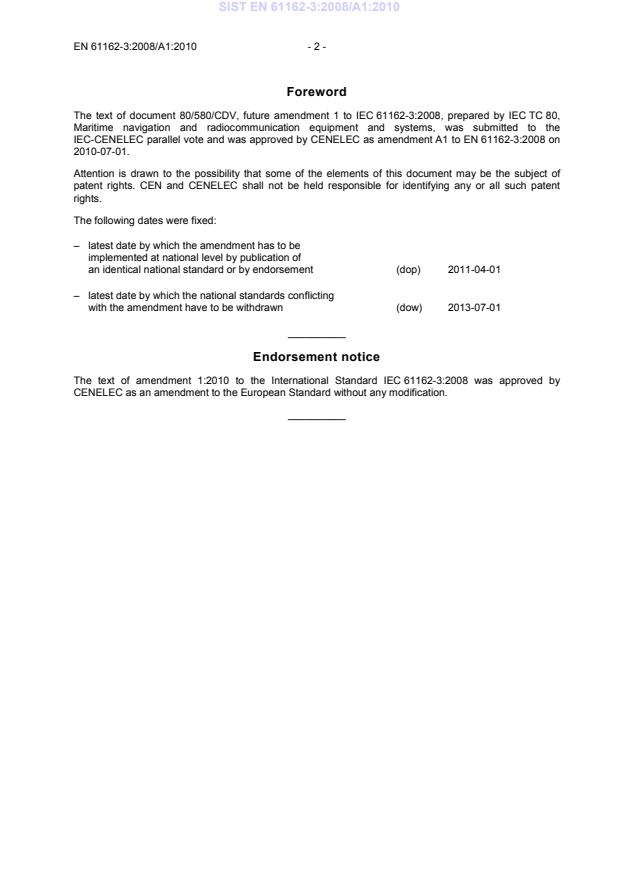
Foreword
The text of document 80/580/CDV, future amendment 1 to IEC 61162-3:2008, prepared by IEC TC 80,
Maritime navigation and radiocommunication equipment and systems, was submitted to the
IEC-CENELEC parallel vote and was approved by CENELEC as amendment A1 to EN
...