


prEN IEC 61850-7-440:2026
(Main)Communication networks and systems for power utility automation - Part 7-440: Basic communication structure - Compatible logical node classes and data object classes - Power quality metering
Kommunikationsnetze und -systeme für die Automatisierung in der elektrischen Energieversorgung – Teil 7-440: Kompatible logische Knotenklassen und Datenobjektklassen – Messung der Netzqualität
Réseaux et systèmes de communication pour l'automatisation des systèmes électriques - Partie 7-440: Structure de communication de base - Classes de noeuds logiques et classes d'objets de données compatibles - Mesure de la qualité de l’énergie
Komunikacijska omrežja in sistemi za avtomatizacijo porabe električne energije - 7-440. del: Osnovna komunikacijska struktura - Združljivi logični vozliščni in podatkovni razredi - Merjenje kakovosti električne energije
General Information
- Status
- Not Published
- Publication Date
- 06-Sep-2027
- Technical Committee
- CLC/TC 57 - Power systems management and associated information exchange
- Current Stage
- 4060 - Enquiry results established and sent to TC, SR, BTTF - Enquiry
- Start Date
- 08-May-2026
- Completion Date
- 08-May-2026

Overview
prEN IEC 61850-7-440:2026, published by CLC, is part of the IEC 61850 series dedicated to the communication networks and systems for power utility automation. Specifically, Part 7-440 defines the basic communication structure relevant for power quality metering, detailing the compatible logical node classes and data object classes. This standard plays a key role in enabling interoperability and structured information exchange between intelligent electronic devices (IEDs) within electric power systems, particularly supporting applications in substations and distribution automation.
With a strong emphasis on standardization, IEC 61850-7-440 supports the effective modeling of metering and monitoring functions for power quality, ensuring consistent data exchange and seamless system integration across various domains such as substations, metering infrastructures, and distributed energy resources.
Key Topics
- Logical Node Classes: Standardizes the names and structures of logical nodes related to power quality metering, defining their roles and the relationships between them.
- Data Object Classes: Provides comprehensive definitions of data object classes used within logical nodes, clarifying their semantics and ensuring uniform interpretation across systems.
- Naming Conventions: Specifies normative rules for instance and extension naming to prevent incompatible, private variations that could hinder interoperability.
- Derived Logical Nodes and Presence Conditions: Outlines principles for statistical or derived calculation nodes, crucial for advanced metering analytics and reporting.
- Code Components: Supplies digital code components for machine processing, supporting direct software implementation and automated interoperability.
- Interoperability and Device Modeling: Stresses the importance of strong definition-both syntax and semantics-of data objects for robust interoperability, leveraging the broader IEC 61850 communication architecture.
- Application Scenarios: Addresses use cases ranging from substation automation to distributed generation and metering.
Applications
IEC 61850-7-440 is broadly applicable in scenarios where reliable, standardized information exchange for power quality and metering is critical:
- Substation Automation: Enabling uniform communication and control for metering equipment within substations, supporting both protection and operational monitoring.
- Distribution Automation: Facilitates seamless integration of power quality data from distribution feeders for systemwide monitoring and optimization.
- Metering Systems: Used in advanced metering infrastructure (AMI) to standardize communication protocols and data exchange, supporting smart grid deployments.
- Substation-to-Control Center Communication: Standardizes exchanges between substations and central control centers, ensuring data consistency for supervisory control and data acquisition (SCADA) systems.
- Distributed Energy Resources (DER): Supports interoperability for metering and monitoring in renewable energy installations, like wind and hydropower plants.
- Quality of Supply Monitoring: Provides a reliable framework for tracking and reporting harmonics, flicker, frequency variations, and voltage disturbances critical for regulatory compliance and performance assessment.
Adopting IEC 61850-7-440 enables utilities, manufacturers, and system integrators to future-proof their automation solutions with a proven, widely recognized standard for power quality metering communication.
Related Standards
- IEC 61850-7-1: Basic communication structure - Principles and models
- IEC 61850-7-2: Abstract communication service interface (ACSI)
- IEC 61850-7-3: Common data classes
- IEC 61850-7-4: Core logical node classes and data object classes
- IEC 61850-7-40: Common logical node classes
- IEC 61000-4-7: Testing and measurement of harmonics and interharmonics
- IEC 61000-4-15: Flickermeter specifications
- IEEE 519: Harmonic control in electrical power systems
- IEEE 1459: Measurement of electric power quantities
By aligning with IEC 61850-7-440 and its related standards, stakeholders ensure their systems are interoperable, standardized, and ready for evolving automation and metering requirements within the power sector.
Get Certified
Connect with accredited certification bodies for this standard

ANCE
Mexican certification and testing association.

Intertek Slovenia
Intertek testing, inspection, and certification services in Slovenia.

LNE (Laboratoire National de Métrologie et d'Essais)
French national laboratory for metrology and testing.
Sponsored listings
Frequently Asked Questions
prEN IEC 61850-7-440:2026 is a draft published by CLC. Its full title is "Communication networks and systems for power utility automation - Part 7-440: Basic communication structure - Compatible logical node classes and data object classes - Power quality metering". This standard covers: Communication networks and systems for power utility automation - Part 7-440: Basic communication structure - Compatible logical node classes and data object classes - Power quality metering
Communication networks and systems for power utility automation - Part 7-440: Basic communication structure - Compatible logical node classes and data object classes - Power quality metering
prEN IEC 61850-7-440:2026 is classified under the following ICS (International Classification for Standards) categories: 33.200 - Telecontrol. Telemetering. The ICS classification helps identify the subject area and facilitates finding related standards.
prEN IEC 61850-7-440:2026 is available in PDF format for immediate download after purchase. The document can be added to your cart and obtained through the secure checkout process. Digital delivery ensures instant access to the complete standard document.
Standards Content (Sample)
SLOVENSKI STANDARD
01-april-2026
Komunikacijska omrežja in sistemi za avtomatizacijo porabe električne energije - 7
-440. del: Osnovna komunikacijska struktura - Združljivi logični vozliščni in
podatkovni razredi - Merjenje kakovosti električne energije
Communication networks and systems for power utility automation - Part 7-440: Basic
communication structure - Compatible logical node classes and data object classes -
Power quality metering
Réseaux et systèmes de communication pour l'automatisation des systèmes électriques
- Partie 7-440: Structure de communication de base - Classes de noeuds logiques et
classes d'objets de données compatibles - Mesure de la qualité de l’énergie
Ta slovenski standard je istoveten z: prEN IEC 61850-7-440:2026
ICS:
29.240.30 Krmilna oprema za Control equipment for electric
elektroenergetske sisteme power systems
33.200 Daljinsko krmiljenje, daljinske Telecontrol. Telemetering
meritve (telemetrija)
2003-01.Slovenski inštitut za standardizacijo. Razmnoževanje celote ali delov tega standarda ni dovoljeno.
57/2876/CDV
COMMITTEE DRAFT FOR VOTE (CDV)
PROJECT NUMBER:
IEC 61850-7-440 ED1
DATE OF CIRCULATION: CLOSING DATE FOR VOTING:
2026-02-13 2026-05-08
SUPERSEDES DOCUMENTS:
57/2824/RR
IEC TC 57 : POWER SYSTEMS MANAGEMENT AND ASSOCIATED INFORMATION EXCHANGE
SECRETARIAT: SECRETARY:
Germany Mr Heiko Englert
OF INTEREST TO THE FOLLOWING COMMITTEES: HORIZONTAL FUNCTION(S):
ASPECTS CONCERNED:
Digital content,Electricity transmission and distribution
SUBMITTED FOR CENELEC PARALLEL VOTING NOT SUBMITTED FOR CENELEC PARALLEL VOTING
Attention IEC-CENELEC parallel voting
The attention of IEC National Committees, members of CENELEC,
is drawn to the fact that this Committee Draft for Vote (CDV) is
submitted for parallel voting.
The CENELEC members are invited to vote through the CENELEC
online voting system.
This document is still under study and subject to change. It should not be used for reference purposes.
Recipients of this document are invited to submit, with their comments, notification of any relevant patent rights of which t hey are aware
and to provide supporting documentation.
Recipients of this document are invited to submit, with their comments, notification of any relevant “In Some Countries” clau ses to be
included should this proposal proceed. Recipients are reminded that the CDV stage is the final stage for submitting ISC c lauses. (SEE
AC/22/2007 OR NEW GUIDANCE DOC).
TITLE:
Communication networks and systems for power utility automation – Part 7-440: Basic communication structure –
Compatible logical node classes and data object classes – Power quality metering
PROPOSED STABILITY DATE: 2027
NOTE FROM TC/SC OFFICERS:
electronic file, to make a copy and to print out the content for the sole purpose of preparing National Committee positions.
You may not copy or "mirror" the file or printed version of the document, o r any part of it, for any other purpose without
permission in writing from IEC.
IEC CDV 61850-7-440 © IEC 2026
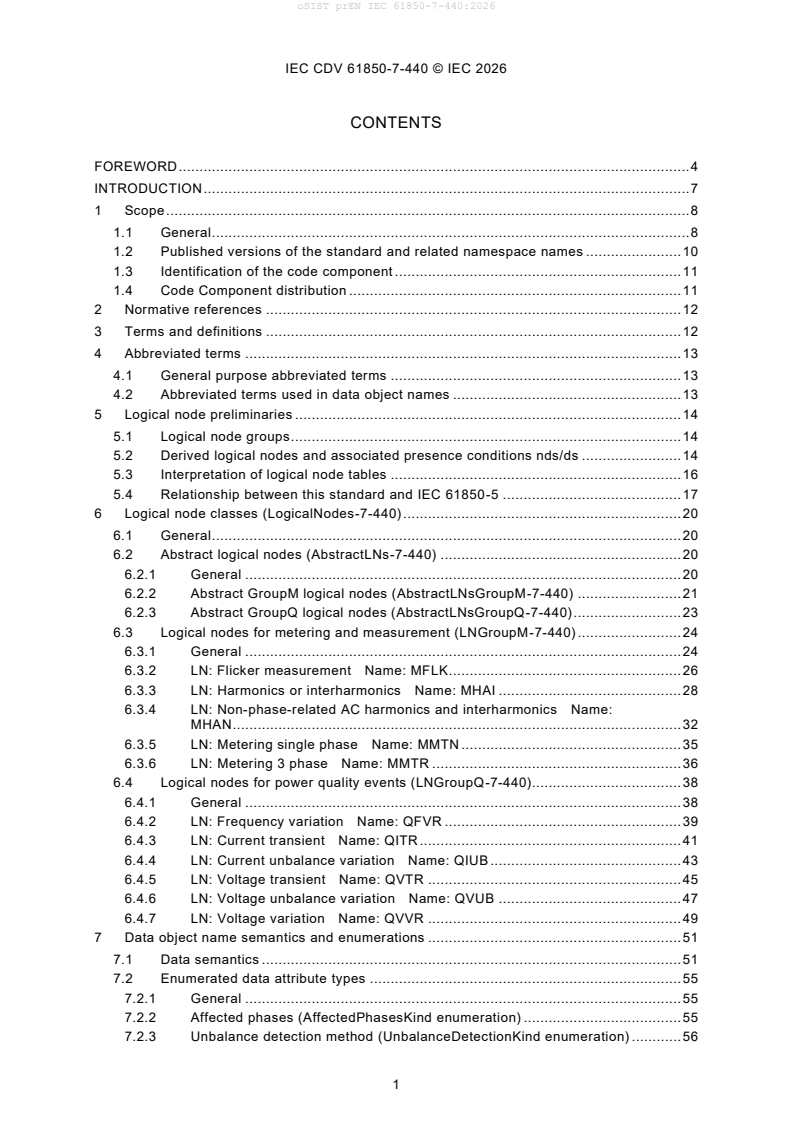
CONTENTS
FOREWORD . 4
INTRODUCTION . 7
1 Scope . 8
1.1 General . 8
1.2 Published versions of the standard and related namespace names . 10
1.3 Identification of the code component . 11
1.4 Code Component distribution . 11
2 Normative references . 12
3 Terms and definitions . 12
4 Abbreviated terms . 13
4.1 General purpose abbreviated terms . 13
4.2 Abbreviated terms used in data object names . 13
5 Logical node preliminaries . 14
5.1 Logical node groups . 14
5.2 Derived logical nodes and associated presence conditions nds/ds . 14
5.3 Interpretation of logical node tables . 16
5.4 Relationship between this standard and IEC 61850-5 . 17
6 Logical node classes (LogicalNodes-7-440) . 20
6.1 General . 20
6.2 Abstract logical nodes (AbstractLNs-7-440) . 20
6.2.1 General . 20
6.2.2 Abstract GroupM logical nodes (AbstractLNsGroupM-7-440) . 21
6.2.3 Abstract GroupQ logical nodes (AbstractLNsGroupQ-7-440) . 23
6.3 Logical nodes for metering and measurement (LNGroupM-7-440) . 24
6.3.1 General . 24
6.3.2 LN: Flicker measurement Name: MFLK . 26
6.3.3 LN: Harmonics or interharmonics Name: MHAI . 28
6.3.4 LN: Non-phase-related AC harmonics and interharmonics Name:
MHAN . 32
6.3.5 LN: Metering single phase Name: MMTN . 35
6.3.6 LN: Metering 3 phase Name: MMTR . 36
6.4 Logical nodes for power quality events (LNGroupQ-7-440). 38
6.4.1 General . 38
6.4.2 LN: Frequency variation Name: QFVR . 39
6.4.3 LN: Current transient Name: QITR . 41
6.4.4 LN: Current unbalance variation Name: QIUB . 43
6.4.5 LN: Voltage transient Name: QVTR . 45
6.4.6 LN: Voltage unbalance variation Name: QVUB . 47
6.4.7 LN: Voltage variation Name: QVVR . 49
7 Data object name semantics and enumerations . 51
7.1 Data semantics . 51
7.2 Enumerated data attribute types . 55
7.2.1 General . 55
7.2.2 Affected phases (AffectedPhasesKind enumeration) . 55
7.2.3 Unbalance detection method (UnbalanceDetectionKind enumeration) . 56
IEC CDV 61850-7-440 © IEC 2026
7.2.4 Voltage interrupt detection (VoltInterruptDetectionKind enumeration) . 56
Annex A (informative) Deprecated logical node classes . 57
Annex B (informative) Conditions for element presence . 58
Annex C (normative) Compatibility of the different revisions of the standard . 60
C.1 General . 60
C.2 List of the modifications to consider for backward / forward compatibility . 60
C.3 List of modifications requiring specific treatment . 63
Bibliography . 64
Figure 1 – Overview of this standard and relation of 7-4, 7-4n and 7-4nn series . 9
Figure 2 – Overview of the annexes in 7-4, 7-4n and 7-4nn series . 10
Figure 3 – Class diagram LogicalNodes-7-440::LogicalNodesGroups . 20
Figure 4 – Class diagram AbstractLNs-7-440::AbstractLNs-7-440 . 21
Figure 5 – Class diagram AbstractLNsGroupM-7-440::AbstractLNsGroupM . 21
Figure 6 – Class diagram AbstractLNsGroupQ-7-440::AbstractLNsGroupQ . 23
Figure 7 – Class diagram LNGroupM-7-440::LNGroupM1-7-440 . 25
Figure 8 – Class diagram LNGroupM-7-440::LNGroupM2-7-440 . 26
Figure 9 – Class diagram LNGroupQ-7-440::LNGroupQ-7-440 . 39
Table 1 – Tracking information of IEC 61850-7-440:2025A namespace building-up . 6
Table 2 - Published version . 10
Table 3 – Attributes of IEC 61850-7-440:2025A namespace . 11
Table 4 – List of logical node groups . 14
Table 5 – Interpretation of logical node tables . 16
Table 6 – Logical nodes mappings . 17
Table 7 – Data objects of EnergyLN . 22
Table 8 – Data objects of HarmonicsLN . 22
Table 9 – Data objects of PowerQualityLN . 24
Table 10 – Data objects of UnbalanceDetectionLN . 24
Table 11 – Data objects of MFLK . 26
Table 12 – Data objects of MHAI. 29
Table 13 – Data objects of MHAN . 32
Table 14 – Data objects of MMTN . 35
Table 15 – Data objects of MMTR . 37
Table 16 – Data objects of QFVR . 39
Table 17 – Data objects of QITR . 41
Table 18 – Data objects of QIUB . 43
Table 19 – Data objects of QVTR . 45
Table 20 – Data objects of QVUB . 47
Table 21 – Data objects of QVVR . 49
Table 22 – Name and description of data objects defined in classes of LogicalNodes -7-
440 package . 51
Table 23 – Literals of AffectedPhasesKind . 55
IEC CDV 61850-7-440 © IEC 2026
Table 24 – Literals of UnbalanceDetectionKind . 56
Table 25 – Literals of VoltInterruptDetectionKind . 56
Table 26 – Conditions for presence of elements within a context . 58
IEC CDV 61850-7-440 © IEC 2026
INTERNATIONAL ELECTROTECHNICAL COMMISSION
_____________
COMMUNICATION NETWORKS AND
SYSTEMS FOR POWER UTILITY AUTOMATION –
Part 7-440: Basic communication structure –
Compatible logical node classes and data object classes –
Power quality and metering
FOREWORD
1) The International Electrotechnical Commission (IEC) is a worldwide organization for standardization comprising
all national electrotechnical committees (IEC National Committees). The object of IEC is to promote international
co-operation on all questions concerning standardization in the electrical and electronic fields. To this end and
in addition to other activities, IEC publishes International Standards, Technical Specifications, Technical Reports,
Publicly Available Specifications (PAS) and Guides (hereafter referred to as “IEC Publication(s)”). Their prepa-
ration is entrusted to technical committees; any IEC National Committee interested in the subject dealt with may
participate in this preparatory work. International, governmental and non-governmental organizations liaising with
the IEC also participate in this preparation. IEC collaborates closely with the International Organization for Stand-
ardization (ISO) in accordance with conditions determined by agreement between the two organizations.
2) The formal decisions or agreements of IEC on technical matters express, as nearly as possible, an international
consensus of opinion on the relevant subjects since each technical committee has representation from all inter-
ested IEC National Committees.
3) IEC Publications have the form of recommendations for international use and are accepted by IEC National
Committees in that sense. While all reasonable efforts are made to ensure that the technical content of IEC
Publications is accurate, IEC cannot be held responsible for the way in which they are used or for any misinter-
pretation by any end user.
4) In order to promote international uniformity, IEC National Committees undertake to apply IEC Publications trans-
parently to the maximum extent possible in their national and regional publications. Any divergence between any
IEC Publication and the corresponding national or regional publication shall be clearly indicated in the latter.
5) IEC itself does not provide any attestation of conformity. Independent certification bodies provide conformity
assessment services and, in some areas, access to IEC marks of conformity. IEC is not responsible for any
services carried out by independent certification bodies.
6) All users should ensure that they have the latest edition of this publication.
7) No liability shall attach to IEC or its directors, employees, servants or agents including individual experts and
members of its technical committees and IEC National Committees for any personal injury, property damage or
other damage of any nature whatsoever, whether direct or indirect, or for costs (including legal fees) and ex-
penses arising out of the publication, use of, or reliance upon, this IEC Publication or any other IEC Publications.
8) Attention is drawn to the Normative references cited in this publication. Use of the referenced publications is
indispensable for the correct application of this publication.
9) Attention is drawn to the possibility that some of the elements of this IEC Publication may be the subject of patent
rights. IEC shall not be held responsible for identifying any or all such patent rights.
International Standard IEC 61850-7-440 has been prepared by IEC technical committee 57:
Power systems management and associated information exchange.
IEC CDV 61850-7-440 © IEC 2026
The IEC 61850-7-4 Edition 2.1 is re-organized into the following parts of “Basic communication
structure – Compatible logical node classes and data object classes”, each hereinafter referred
to by the specialized title indicated below:
• IEC 61850-7-4:2025 Edition 3 – Core part
• IEC 61850-7-40:2025 Edition 1 – Common part
• IEC 61850-7-43:2025 Edition 1 – Primary equipment
• IEC 61850-7-44:2025 Edition 1 – Instrument transformers
• IEC 61850-7-400:2025 Edition 1 – Substation automation
• IEC 61850-7-401:2025 Edition 1 – Protection
• IEC 61850-7-440:2025 Edition 1 – Power quality and metering (– this document)
Further in this document these are referenced as 7-4, 7-4n and 7-4nn.
This structure of IEC 61850-7-4 Edition 2.1 has been changed into several parts (7-4, 7-4n and
7-4nn) which allows to update individual parts without requiring a new edition to the core part.
This enables the standard to meet time to market requirements more quickly.
As a consequence, the annexes of former IEC 61850-7-4 Edition 2.1 are now distributed ac-
cording to their purpose. This document includes the following Annexes:
• Annex A - Deprecated logical nodes classes in regard to this document. All deprecated
logical node classes from IEC 61850-7-4 Edition 2.1 are found in 7-4 – Core part.
• Annex B - Conditions for element presence
• Annex C - Compatibility of the different revisions of the standard
IEC 61850-7-4 Edition 2.1 will not be subject to any further improvements with this series being
published.
The new series cancels and replaces IEC 61850-7-4 Edition 2.1 which was last published in
2020 as a consolidated version.
Clauses 4 through 7 and their subclauses (except for 5.1, 5.2, and 5.3) are automatically gen-
erated from the UML model.
The text of this standard is based on the following documents:
FDIS Report on voting
This publication has been drafted in accordance with the ISO/IEC Directives, Part 2. This IEC
standard includes Code Components i.e. components that are intended to be directly processed
by a computer.
The purchase of this IEC standard carries a copyright license for the purchaser to sell software
containing Code Components from this standard to end users either directly or via distributors,
subject to IEC software licensing conditions, which can be found at: http://www.iec.ch/CCv1.
IEC CDV 61850-7-440 © IEC 2026
Table 1 shows all tracking information of IEC 61850-7-440:2025A namespace building-up
Table 1 – Tracking information of IEC 61850-7-440:2025A namespace building-up
Attribute Content
Namespace IEC specific information
Version of the UML model used for gener- WG10built18
ating the document (informative)
Date of the UML model used for generating 2025-12-12
the document (informative)
Autogeneration software name and ver- j61850DocBuilder 02.05b based on jCleanCim beta9.4 (derived
sion(informative) from jCleanCim 02-02)
A list of all parts of the IEC 61850 series under the general title Communication networks and
systems for power utility automation, can be found on the IEC website.
The committee has decided that the contents of the base publication and its amendment will
remain unchanged until the stability date indicated on the IEC web site under "http://web-
store.iec.ch" in the data related to the specific publication. At this date, the publication will be
reconfirmed,
withdrawn,
replaced by a revised edition, or
amended.
A bilingual version of this publication may be issued at a later date.
IMPORTANT – The 'colour inside' logo on the cover page of this publication indicates that it
contains colours which are considered to be useful for the correct understanding of its con-
tents. Users should therefore print this document using a colour printer.
IEC CDV 61850-7-440 © IEC 2026
1 INTRODUCTION
2 This part of IEC 61850 is part of a set of standards, the IEC 61850 series. IEC 61850 defines
3 communication networks and systems for power utility automation, and more specifically the
4 communication architecture for subsystems such as substation automation systems. The sum
5 of all subsystems can result also in the description of the communication architecture for the
6 overall power system management. The defined architecture provided in specific parts of
7 IEC 61850-7-n gives both a power utility specific data model and a substation domain specific
8 data model with abstract definitions of data objects classes and services independently from
9 the specific protocol stacks, implementations, and operating systems. The mapping of these
10 abstract classes and services to communication stacks is outside the scope of IEC 61850-7-n
11 and can be found in IEC 61850-8-n and in IEC 61850-9-n.
12 IEC 61850-7-1 gives an overview of the basic communication architecture to be used for all
13 applications in the power system domain. IEC 61850-7-3 defines common attribute types and
14 common data classes related to all applications in the power system domain. The attributes of
15 the common data classes can be accessed using services defined in IEC 61850-7-2. These
16 common data classes are used in this part to define the compatible data object classes.
17 To reach interoperability, all data objects in the data model need a strong definition with regard
18 to syntax and semantics. The semantics of the data objects is mainly provided by names as-
19 signed to common logical nodes defined in this part and the data objects they contain, as de-
20 fined in this basic part, and dedicated logical nodes defined in domain specific parts such as
21 for hydro power control systems. Interoperability is easiest if as many as possible of the data
22 objects are defined as mandatory. Because of different approaches and technical features,
23 some data objects, especially settings, were declared as optional in IEC 61850-7-4:2010 and
24 its following editions. There are also data objects which were declared as conditional, i.e. they
25 will become mandatory under some well-defined conditions. After some experience has been
26 gained with this standard, this decision can be reviewed in the next edition of this part of
27 IEC 61850-7.
28 It is noted that data objects with full semantics are only one of the elements required to achieve
29 interoperability. The standardized access to the data objects is defined in compatible, power
30 utility and domain specific services (see IEC 61850-7-2). Since data objects and services are
31 hosted by devices (IED), a proper device model is also needed. To describe both the device
32 capabilities and the interaction of the devices in the related system, a configuration language
33 is also needed, as defined in IEC 61850-6 by the substation configuration description language
34 (SCL).
35 The compatible logical node name and data object name definitions found in this part and the
36 associated semantics are fixed. The syntax of the type definitions of all data objects classes is
37 governed by abstract definitions provided in IEC 61850-7-2 and IEC 61850-7-3. Not all features
38 of logical nodes are listed in this part; for example, data sets and logs are covered in
39 IEC 61850-7-2.
IEC CDV 61850-7-440 © IEC 2026
42 COMMUNICATION NETWORKS AND
43 SYSTEMS FOR POWER UTILITY AUTOMATION –
45 Part 7-440: Basic communication structure –
46 Compatible logical node classes and data object classes –
47 Power quality and metering part
48 1 Scope
49 1.1 General
50 This part of IEC 61850 specifies the information model of devices and functions generally re-
51 lated to common use regarding applications in systems for power utility automation. In particu-
52 lar, it specifies the compatible logical node names and data object names for communication
53 between intelligent electronic devices (IED). This includes the relationship between logical
54 nodes and data objects.
55 The logical node names and data object names defined in this document are part of the class
56 model introduced in IEC 61850-7-1 and defined in IEC 61850-7-2. These names are used to
57 build the hierarchical object references applied for communicating with IEDs in systems for
58 power utility automation and, especially, with IEDs in substations and on distribution feeders.
59 The naming conventions of IEC 61850-7-2 are applied in this part.
60 To avoid private, incompatible extensions, this part specifies normative naming rules for multi-
61 ple instances and private, compatible extensions of logical node (LN) classes and data object
62 names. Any definition is based on IEC 61850 or on referenced well identified public documents.
63 This section does not include tutorial material. It provides content that assumes prior knowledge
64 of IEC 61850-5 and IEC 61850-7-1, together with IEC 61850-7-3 and IEC 61850-7-2.
65 This standard and its direct counterparts (7-4, 7-4n and 7-4nn) are applicable to describe device
66 models and functions for:
67 • substation and feeder equipment,
68 • substation-to-substation information exchange,
69 • substation-to-control centre information exchange,
70 • power plant-to-control centre information exchange,
71 • information exchange for distributed generation,
72 • information exchange for distributed energy resources,
73 • information exchange for metering,
74 • information exchanged for hydro power plants, or
75 • information exchange for wind generation plants.
76 Figure 1 provides a general overview of this standard, the groups of logical nodes and the new
77 structure after the split. For convenience, the logical nodes are defined below in alphabetical
78 order within its part.
79 Figure 2 gives an overview of the annexes used in the series of 7-4, 7-4n and 7-4nn.
IEC CDV 61850-7-440 © IEC 2026
82 Figure 1 – Overview of this standard and relation of 7-4, 7-4n and 7-4nn series
IEC CDV 61850-7-440 © IEC 2026
84 Figure 2 – Overview of the annexes in 7-4, 7-4n and 7-4nn series
86 1.2 Published versions of the standard and related namespace names
87 Table 2 provides a reference between all published editions, amendments or corrigenda of this
88 document and the full name of the namespace.
89 Table 2 - Published version
Edition Publication date Webstore Namespace
Edition 1.0 20nn-nn IEC 61850-7-440:20nn IEC 61850-7-440:2025A3
IEC CDV 61850-7-440 © IEC 2026
91 1.3 Identification of the code component
93 Table 3 shows all attributes of IEC 61850-7-440:2025A namespace.
94 Table 3 – Attributes of IEC 61850-7-440:2025A namespace
Attribute Content
Namespace nameplate
Namespace Identifier IEC 61850-7-440
Version 2025
Revision A
Release 3
Full Namespace Name IEC 61850-7-440:2025A
Full Code Component Name IEC_61850-7-440.NSD.2025A.Full
Light Code Component Name IEC_61850-7-440.NSD.2025A.Light
Namespace Type domain
Namespace dependencies
includes IEC 61850-7-40:2025A version :2025 revision :A
96 1.4 Code Component distribution
97 Each Code Component is a ZIP package containing the electronic representation of the Code
98 Component itself, with a file describing the content of the package (IECManifest.xml).
99 The life cycle of a code component is not restricted to the life cycle of the related publication.
100 The publication life cycle goes through two stages, Version (corresponding to an edition) and
101 Revision (corresponding to an amendment). A third publication stage (Release) allows publica-
102 tion of Code Component in case of urgent fixes of InterOp Tissues, thus without need to publish
103 an amendment.
104 Consequently, new releases of the Code Component might be released, which supersedes the
105 previous release, and will be distributed through the IEC TC57 web site at:
106 https://www.iec.ch/tc57/supportdocuments
107 The code component associated to this document is a nsd file. It is available as a full version
108 and a light version. The light version is freely accessible on the IEC website for download at
109 https://www.iec.ch/tc57/supportdocuments, but the usage remains under the licensing condi-
110 tions.
111 The latest version/release of the code component will be found by selecting the file for the code
112 component with the highest value for VersionStateInfo, e.g. IEC_61850-6-
113 100.XSD.{VersionStateInfo}.full.zip
114 In case of any differences between the downloadable code component and the IEC pdf pub-
115 lished content, the downloadable code component is the valid one; it might be subject to up-
116 dates. See included history files.
IEC CDV 61850-7-440 © IEC 2026
119 2 Normative references
120 The following documents are referred to in the text in such a way that some or all of their content
121 constitutes requirements of this document. For dated references, only the edition cited applies.
122 For undated references, the latest edition of the referenced document (including any amend-
123 ments) applies.
124 IEC 61000-4-7:2002, Electromagnetic compatibility (EMC) - Part 4-7: Testing and measurement
125 techniques - General guide on harmonics and interharmonics measurements and instrumenta-
126 tion, for power supply systems and equipment connected thereto
127 IEC 61000-4-15, Electromagnetic compatibility (EMC) - Part 4-15: Testing and measurement
128 techniques - Flickermeter - Functional and design specifications
129 IEC TS 61850-2, Communication networks and systems for power utility automation - Part 2:
130 Glossary
131 IEC 61850-5, Communication networks and systems for power utility automation - Part 5: Com-
132 munication requirements for functions and device models
133 IEC 61850-7-1:2020, Communication networks and systems for power utility automation - Part
134 7-1: Basic communication structure - Principles and models
135 IEC 61850-7-2:2020, Communication networks and systems for power utility automation - Part
136 7-2: Basic information and communication structure - Abstract communication service interface
137 (ACSI)
138 IEC 61850-7-3:2020, Communication networks and systems for power utility automation - Part
139 7-3: Basic communication structure - Common data classes
140 IEC 61850-7-4:2025, Basic communication structure - Compatible logical node classes and data
141 object classes – Core part
142 IEC 61850-7-40:2025, Basic communication structure - Compatible logical node classes and
143 data object classes – Common part
144 IEEE 519:2022, IEEE Recommended Practises and Requirements for Harmonic Control in Elec-
145 trical Power Systems
146 IEEE C37.2:2022, Electrical Power System Device Function Numbers and Contact Designation
147 IEEE 1459:2025, IEEE Trial-Use Standard Definitions for the Measurement of Electric Power
148 Quantities Under Sinusoidal, Nonsinusoidal, Balanced, or Unbalanced Conditions
149 3 Terms and definitions
150 For the purposes of this document, the terms and definitions given in IEC 61850-2:2019,
151 IEC 61850-7-2:2020 and IEC 61850-7-4:2020, as well as the following, apply.
152 ISO and IEC maintain terminological databases for use in standardization at the following ad-
153 dresses:
154 • IEC Electropedia: available at http://www.electropedia.org/
155 • ISO Online browsing platform: available at http://www.iso.org/obp
156 3.1 <> logical node class
157 abstract logical node class which is never instantiated, used to group common data objects into
158 a semantically meaningful entity and reuse them in a logical node class through inheritance
159 3.2 <> logical node class
160 abstract logical node class with one special rule for changing the presence condition of some
161 of its data objects when they are inherited in the derived statistics (“ds”) context: in a logical
IEC CDV 61850-7-440 © IEC 2026
162 node that does not inherit from statistics logical node (i.e., Group L), the inherited “ds” presence
163 condition is not applicable (‘na’)
164 3.3 deprecated element
165 element still maintained in this edition of the standard, for backwards compatibility purpose, but
166 which is intended to be phased out in the future
167 Note 1 to entry: A deprecated element by definition indicates what should be used instead.
168 3.4 presence condition
169 condition which specifies the occurance rules of data objects of logical node classes in
170 LNinstances of implementations
171 Note 2 to entry: Annex I shows an overview about possibles presence conditions.
172 3.5 scheduled entity
173 data object of one of the following common data classes APC, ASG, INS, ING SPC, SPG, ENC
174 or ENG where the control output or the value of the setting may be determined by the scheduling
175 system
176 3.6 scheduling system
177 collection containing a schedule controller and the schedules to which the schedule controller
178 refers
179 Note 3 to entry: The scheduling system is associated to a scheduled entity (by reference in the schedule controller)
180 and determines the behaviour of the scheduled entity.
181 4 Abbreviated terms
182 4.1 General purpose abbreviated terms
ds derived statistics
LD logical device
LN logical node
PresCond presence condition
nds not derived statistics
RMS root mean square
183 4.2 Abbreviated terms used in data object names
184 Abbreviated terms are used to build concatenated data object names. For example, ChNum is
185 constructed by using two terms "Ch" which stands for "Channel" and "Num" which stands for
186 "Number". Thus the concatenated name represents a "channel number". The abbreviation terms
187 used in the model specified by this document are visible in the following :
188 • the full code component distributed with this document
189 • the yearly updated and circulated INF - IEC 61850 Roadmap and Schedule
190 • the file accessible on the UCA IUG for download at :
IEC CDV 61850-7-440 © IEC 2026
194 5 Logical node preliminaries
195 5.1 Logical node groups
196 Logical nodes are grouped according to the logical node groups listed in Table 4. The names
197 of logical nodes shall begin with the character representing the group to which the logical node
198 belongs. For modelling per phase (for example switches or instrument transformers), one in-
199 stance per phase shall be created; for modelling protection per zone or level, one instance per
200 zone or level shall be created also.
201 Table 4 – List of logical node groups
Group indicator Logical node groups
A Automatic control
B Reserved
C Supervisory control
D Distributed energy resources
E Thermal power plant ("Enthalpy")
F Functional blocks
G Generic function references
H Hydro power
I Interfacing and archiving
J Reserved
K Mechanical and non-electrical primary equipment
L System logical nodes
M Metering and measurement
N Reserved
O Reserved
P Protection functions
Q Power quality events detection related
R Protection related functions
S Supervision and monitoring
T Instrument transformer and sensors
U Reserved
V Reserved
W Wind power
X Switchgear
Y Power transformer and related functions
Z Further (power system) equipment
203 5.2 Derived logical nodes and associated presence conditions nds/ds
204 IEC 61850-7-1 introduces the concept of derived logical nodes for statistical calculation pur-
205 pose, as explained in IEC 61850-7-4 Edition 3 Annex D. These principles have however some
206 direct impacts on whether to accept the presence of data objects in selected logical nodes.
207 IEC 61850-7-3 already includes a stereotype to "tag" the CDCs on which "derived" statistical
208 calculation may apply, by using the <> prefix in front of the sections dealing with
209 these CDC which may support this derivation capability (a needed condition), i.e. may be pre-
210 sent in the context of derived LNs instances for statistical purpose.
IEC CDV 61850-7-440 © IEC 2026
211 This part of IEC 61850 goes further by indicating explicitly for each data object, which presence
212 condition applies in the context of derived LN, for statistical purposes.
213 Two contexts are then introduced in the tables presenting the LN contents:
214 • nds is the common context of Non Derived Statistical case
215 • ds is the specific context where the LN instance is derived from another one (Derived Sta-
216 tistical) of same class, to expose the result of one calculation method (expressed in the
217 ClcMth object and all other objects associated to specify the parameters of the method) on
218 some selected objects derived from the original one.
219 Then for each data object the column of the LN table, which title is "PresCond nds/ds", two
220 fields are present:
221 • a first field expressing the presence condition of the corresponding data object in case of
222 nds context – chosen among the presence conditions expressed in Clause 5 of IEC 61850-
223 7-3:2020.
224 • a second field expressing the presence condition of the same object in case of ds context –
225 chosen among the presence conditions expressed in Clause 5 of IEC 61850-7-3:2020.
226 For example, consider the LN class STMP. A first instance of STMP (thereafter STMP1) is
227 expecting to expose:
228 • the Temperature measurement
229 • the Trip information, based on a selected threshold
230 with no specific statistical calculation method indicated. This LN is not derived from any other
231 source of information.
232 The table specifying LN class STMP indicates that CDCs and presence conditions (PresCond
233 nds/ds) are respectively
234 • "MV" with "O/O" for Tmp
235 • "SPS" with "O/F" for Trip
236 • "ENG" with "O/M" for ClcMth
237 • "ORG" with "F/M" for ClcSrc
238 Then in compliance with the standard, this instance of STMP may contain (among other) Tmp,
239 and Trip, and ClcMth may be absent. ClcSrc shall not be present (F – forbidden).
240 Let us now consider the need for getting the average on a sliding time interval of one hour, of
241 the temperature measurement provided by STMP1. Then a new instance of STMP must be
242 created, derived from STMP1 which must contain:
243 • ClcSrc shall be present to indicate a reference to STMP1, the source of information – said
244 mandatory (M) in case of statistical derived LN
245 • Tmp – said optional (O) in case of derived statistical LN
246 • ClcMth shall be present and indicate "AVERAGE" – said mandatory (M) in case of derived
247 statistical LN
248 • ClcMod, ClcIntvTyp, ClcIntvPer may be present to indicate that calculation is performed on
249 a sliding window of time of one hour – said optional (O) in case of derived statistical LN
250 Trip cannot be present because it is forbidden (F) in case of derived statistical LN.
IEC CDV 61850-7-440 © IEC 2026
252 5.3 Interpretation of logical node tables
253 The interpretation of the headings for the logical node tables is presented in Table 5.
254 Table 5 – Interpretation of logical node tables
Column heading Description
Data object name Name of the data object
Common data class that defines the structure of the data object. See IEC 61850-7-3.
Common data class
For common data classes regarding the service tracking logical node (LTRK).
Explanation Explanation of the data object and how it is used.
Transient data objects – the status of data objects with this designation is momentary
and must be logged or reported to provide evidence of their momentary state. Some
T may be only valid on a modelling level. The TRANSIENT property of DATA
OBJECTS only applies to BOOLEAN process data attributes (FC=ST) of that DATA
OBJECTS. A transient DATA OBJECT is identical to normal DATA OBJECT, except
that for the process state change from TRUE to FALSE no event may be generated
T
for reporting and for logging.
For transient data objects, the falling edge is not reported if the transient attribute is
set to true in the SCL-ICD file . It is recommended to report both states (TRUE to
FALSE, and FALSE to TRUE), i.e. not to set the transient attribute in the SCL -ICD file
for those DOs, and that the clients filter the transitions that are not "desired". For
GOOSE or SMV services this attribute does not apply.
This column defines whether a data object is mandatory (M), optional (O) or has some
other presence condition for a non-derived-statistics (nds) and derived-statistics (ds)
instance of a logical node. When a data object is marked mandatory (M), it shall be
contained in the instance of the logical node. When a data object is marked optional
(O), it may be contained in the instance of the logical node; the decision if the data
object is contained or not is outside the scope of this standard. Other more complex
presence conditions all have their semantic defined in IEC 61850-7-2 and for the con-
venience of the reader they are also reprinted (as informative) in Annex B. In case of
a condition that is not machine processable, the text of the condition is given outside
the LN table.
PresCond nds / ds
NOTE1 Procurement specifications may require specific data objects marked op-
tional to be provided for a particular project. The amount of optional information to be
provided needs to be negotiated.
NOTE 2 The attributes for data objects that are instantiated may also be mandatory
or optional based on the CDC (attribute type) definition in IEC 61850-7-3.
NOTE 3 If inherited data objects from abstract LN listed in the LN table and the
presence condition has assigned to a special condition (e.g. DO Mir from domain LN
has the condition MOcond(1)), the definition of this special presence condition can be
found within the section of the abstract LN.
256 The LN class names are individually given in the logical node tables. The LN instance name
257 shall be composed of the class name, the LN-Prefix and LN-Instance-ID according to
258 IEC 61850-7-2:2020, Clause 22.
259 All data object names defined in this document are listed alphabetically in Clause 7. Despite
...