


EN IEC 62933-5-1:2024
(Main)Electrical energy storage (EES) systems - Part 5-1: Safety considerations for grid-integrated EES systems - General specification
Electrical energy storage (EES) systems - Part 5-1: Safety considerations for grid-integrated EES systems - General specification
IEC 62933-5-1:2024 specifies safety considerations (e.g. hazards identification, risk assessment, risk mitigation) applicable to EES systems integrated with the electrical grid. This document provides criteria to enable the safe application and use of electrical energy storage systems of any type or size intended for grid-integrated applications. This document can be applied to all EESS technologies, but for requirements specific to electrochemical EES systems, reference is also made to IEC 62933-5-2. This first edition cancels and replaces the first edition of IEC TS 62933-5-1 published in 2017. This edition constitutes a technical revision. This edition includes the following significant technical changes with respect to IEC TS 62933‑5‑1:2017: a) Revising “should” statements to “shall” statements for all requirements and move some “should” statements clauses to Annex B for informative purposes. b) Update standard references (normative). c) Update definitions and add or remove definitions where necessary. d) Revise criteria in Clause 6 and Clause 7 to be actionable and add standard references where necessary. e) Revise Clause 8 for more thorough test method and criteria, add tests where necessary. f) Add markings and instruction criteria. g) Revise Annex A to add technology safety information on gravitational and thermal EESS. h) Add Annex B and Annex C for safety considerations for EESS and test method for mechanical EESS. i) Add informative list of standards and update bibliography.
Elektrische Energiespeichersysteme (EES-Systeme) - Teil 5-1: Sicherheitserwägungen für netzintegrierte EES-Systeme - Allgemeine Spezifikation
Systèmes de stockage de l'énergie électrique (EES) - Partie 5-1: Considérations de sécurité pour les systèmes EES intégrés au réseau - Spécifications générales
L’IEC 62933-5-1:2024 spécifie les considérations de sécurité (par exemple, l'identification des phénomènes dangereux, l'appréciation du risque, l'atténuation des risques) applicables aux systèmes EES intégrés au réseau électrique. Le présent document fournit des critères qui permettent l'application et l'utilisation sûres des systèmes de stockage de l'énergie électrique de tout type ou de toute taille destinés à des applications intégrées au réseau. Il peut s'appliquer à toutes les technologies EESS. Toutefois, pour les exigences spécifiques aux systèmes EES électrochimiques, se référer également à l’IEC 62933-5-2. Cette première édition annule et remplace la première édition de l’IEC TS 62933-5-1. Cette édition inclut les modifications techniques majeures suivantes par rapport à l'IEC TS 62933‑5‑1:2017: a) révision des énoncés "il convient" en "doit" pour toutes les exigences et déplacement de certains articles à énoncés "il convient" vers l‘Annexe B à des fins informatives; b) mise à jour des références (normatives); c) mise à jour des définitions et ajout ou suppression des définitions si nécessaire; d) révision des critères de l’Article 6 et de l’Article 7 pour qu’ils soient exploitables et ajout de références normatives si nécessaire; e) révision de l’Article 8 pour approfondir et compléter la méthode d’essai et les critères, ajout d’essais si nécessaire; f) ajout de marquages et de critères d’instructions; g) révision de l’Annexe A en ajoutant des informations sur la sécurité des technologies concernant l’EESS gravitationnel et thermique; h) ajout de l’Annexe B et de l’Annexe C pour des considérations de sécurité pour les EESS et la méthode d’essai pour les EESS mécaniques; i) ajout d’une liste informative de normes et mise à jour de la bibliographie.
Električne naprave za shranjevanje energije (EES) - 5-1. del: Varnostni vidiki za sisteme EES, vključene v omrežje - Splošna specifikacija (IEC 62933-5-1:2024)
Standard IEC 62933-5-1:2024 določa varnostne vidike (npr. prepoznavanje nevarnosti, ocenjevanje in ublažitev tveganj) za električne naprave za shranjevanje energije (EES), vključene v omrežje. Ta dokument določa merila za omogočanje varne uporabe električnih naprav za shranjevanje energije katere koli vrste ali velikosti, ki so namenjene za vključitev v omrežje. Standard je mogoče uporabiti za vse tehnologije električnih naprav za shranjevanje energije, vendar se v zvezi z zahtevami, ki so specifične za elektrokemične naprave za shranjevanje energije, sklicuje tudi na standard IEC 62933-5-2. Ta prva izdaja razveljavlja in nadomešča prvo izdajo standarda IEC TS 62933-5-1, objavljeno leta 2017. Ta izdaja je tehnično popravljena izdaja.
Ta izdaja v primerjavi s standardom IEC TS 62933-5-1:2017 vključuje naslednje pomembne tehnične spremembe:
a) izjave »bi bilo treba« so bile spremenjene v izjave »je treba« in nekatere izjave »je treba« so bile premaknjene v dodatek B v informativne namene;
b) sklici na standarde (zveze s standardi) so bili posodobljeni;
c) definicije so bile posodobljene in po potrebi dodane oziroma odstranjene;
d) merila v točkah 6 in 7 so bila prenovljena tako, da so izvršljiva, in po potrebi so bili dodani sklici na standarde;
e) točka 8 je bila prenovljena tako, da vključuje natančnejšo preskusno metodo in merila, ter po potrebi je bilo dodanih več preskusov;
f) dodana so bila merila za označevanje in navodila;
g) dodatek A je bil prenovljen tako, da vsebuje informacije o varnosti tehnologije v zvezi z gravitacijskimi in toplotnimi električnimi napravami za shranjevanje energije;
h) dodana sta bila dodatka B in C, ki vsebujeta varnostne vidike električnih naprav za shranjevanje energije in preskusno metodo za mehanske električne naprave za shranjevanje energije;
i) dodan je bil informativni seznam standardov in literatura je bila posodobljena.
General Information
Overview
EN IEC 62933-5-1:2024 - Electrical energy storage (EES) systems, Part 5-1 - is the European adoption of IEC 62933-5-1:2024. It provides a general specification of safety considerations for grid‑integrated EES systems, defining hazard identification, risk assessment and required risk‑mitigation measures for EES installations of any size or technology. This first edition replaces the 2017 TS and contains technical revisions to make requirements actionable, add test methods, update normative references, and include marking and instruction criteria.
Key topics and requirements
- Hazard identification and classification
- Electrical, mechanical, thermal, fire, chemical, explosion and electromagnetic hazards.
- Risk assessment and risk reduction
- Structured approach to evaluate system architecture, storage conditions, grid type, vulnerable elements, unattended operation and unintentional islanding.
- Technical requirements
- Actionable ("shall") requirements for design, protection, control and safety functions.
- Updated test methods and pass/fail criteria for safety verification.
- Testing and verification
- Revised Clause 8 with more thorough test methods; new tests added where necessary.
- Annexes include test methods for mechanical EES (informative) and other technology‑specific guidance.
- Marking, instructions and documentation
- Mandatory marking and user/operator instruction criteria to support safe operation and maintenance.
- Technology coverage
- Applicable to all EESS technologies (electrochemical, mechanical, thermal, gravitational). For electrochemical‑specific requirements see IEC 62933‑5‑2.
- Standards integration
- Incorporates updated normative references to many IEC/ISO standards (listed in Annex ZA) to ensure compatibility with EMC, fire testing, insulation coordination, functional safety and installation practices.
Applications and who uses it
EN IEC 62933-5-1:2024 is intended for stakeholders involved in the lifecycle of grid‑integrated energy storage:
- System designers and integrators - to design safe EES architectures and protection schemes.
- Manufacturers and component suppliers - for product safety requirements, markings and test evidence.
- Test laboratories and certification bodies - to apply the standard test methods and criteria.
- Project developers, installers and operators - to perform risk assessments, commissioning and maintenance planning.
- Regulators, utilities and asset owners - to assess compliance, siting and safe grid interconnection.
Practical uses include safety case development, commissioning protocols, maintenance procedures, vendor selection, and conformity assessment for grid‑connected storage projects.
Related standards
Relevant companion standards referenced by EN IEC 62933-5-1:2024 include:
- IEC 62933-1 (vocabulary)
- IEC 62933-5-2 (electrochemical EES systems)
- EMC, fire, insulation and functional safety standards (see Annex ZA for IEC/EN references such as IEC 60664‑1, IEC 61000 series, ISO 12100).
Keywords: EN IEC 62933-5-1:2024, electrical energy storage, EES systems, grid‑integrated, safety considerations, risk assessment, test methods, electrochemical EES.
Frequently Asked Questions
EN IEC 62933-5-1:2024 is a standard published by CLC. Its full title is "Electrical energy storage (EES) systems - Part 5-1: Safety considerations for grid-integrated EES systems - General specification". This standard covers: IEC 62933-5-1:2024 specifies safety considerations (e.g. hazards identification, risk assessment, risk mitigation) applicable to EES systems integrated with the electrical grid. This document provides criteria to enable the safe application and use of electrical energy storage systems of any type or size intended for grid-integrated applications. This document can be applied to all EESS technologies, but for requirements specific to electrochemical EES systems, reference is also made to IEC 62933-5-2. This first edition cancels and replaces the first edition of IEC TS 62933-5-1 published in 2017. This edition constitutes a technical revision. This edition includes the following significant technical changes with respect to IEC TS 62933‑5‑1:2017: a) Revising “should” statements to “shall” statements for all requirements and move some “should” statements clauses to Annex B for informative purposes. b) Update standard references (normative). c) Update definitions and add or remove definitions where necessary. d) Revise criteria in Clause 6 and Clause 7 to be actionable and add standard references where necessary. e) Revise Clause 8 for more thorough test method and criteria, add tests where necessary. f) Add markings and instruction criteria. g) Revise Annex A to add technology safety information on gravitational and thermal EESS. h) Add Annex B and Annex C for safety considerations for EESS and test method for mechanical EESS. i) Add informative list of standards and update bibliography.
IEC 62933-5-1:2024 specifies safety considerations (e.g. hazards identification, risk assessment, risk mitigation) applicable to EES systems integrated with the electrical grid. This document provides criteria to enable the safe application and use of electrical energy storage systems of any type or size intended for grid-integrated applications. This document can be applied to all EESS technologies, but for requirements specific to electrochemical EES systems, reference is also made to IEC 62933-5-2. This first edition cancels and replaces the first edition of IEC TS 62933-5-1 published in 2017. This edition constitutes a technical revision. This edition includes the following significant technical changes with respect to IEC TS 62933‑5‑1:2017: a) Revising “should” statements to “shall” statements for all requirements and move some “should” statements clauses to Annex B for informative purposes. b) Update standard references (normative). c) Update definitions and add or remove definitions where necessary. d) Revise criteria in Clause 6 and Clause 7 to be actionable and add standard references where necessary. e) Revise Clause 8 for more thorough test method and criteria, add tests where necessary. f) Add markings and instruction criteria. g) Revise Annex A to add technology safety information on gravitational and thermal EESS. h) Add Annex B and Annex C for safety considerations for EESS and test method for mechanical EESS. i) Add informative list of standards and update bibliography.
EN IEC 62933-5-1:2024 is classified under the following ICS (International Classification for Standards) categories: 13.020.30 - Environmental impact assessment. The ICS classification helps identify the subject area and facilitates finding related standards.
You can purchase EN IEC 62933-5-1:2024 directly from iTeh Standards. The document is available in PDF format and is delivered instantly after payment. Add the standard to your cart and complete the secure checkout process. iTeh Standards is an authorized distributor of CLC standards.
Standards Content (Sample)
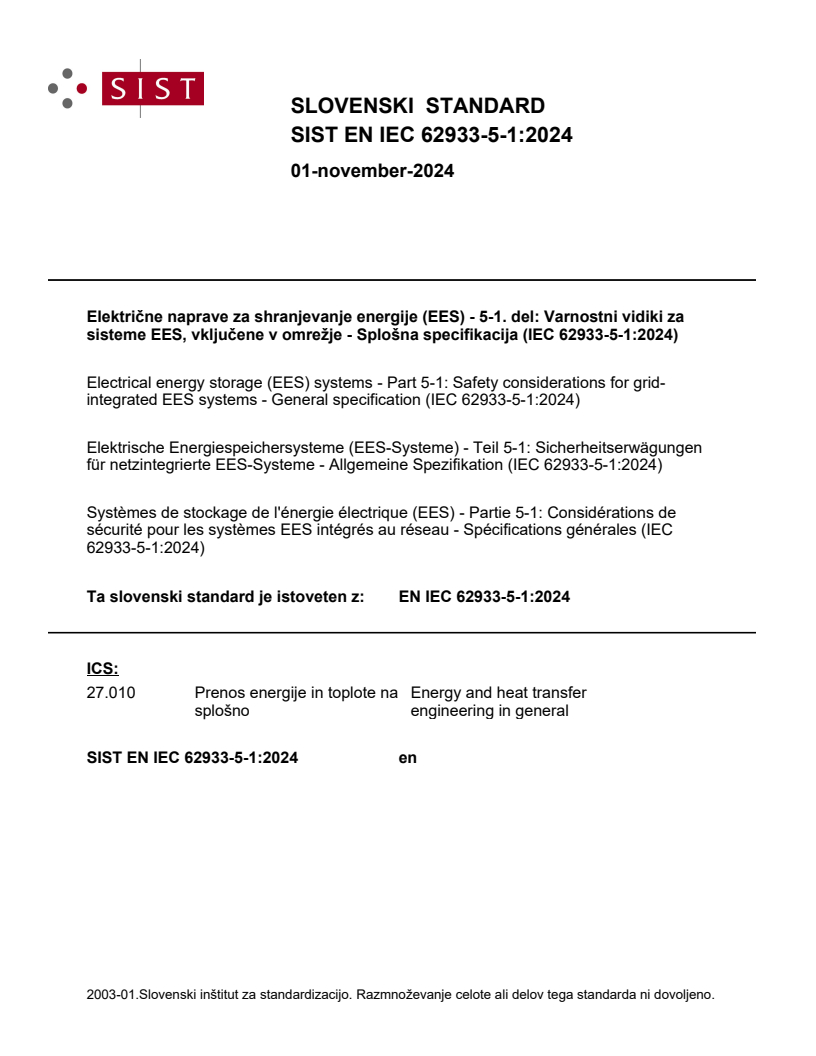
SLOVENSKI STANDARD
01-november-2024
Električne naprave za shranjevanje energije (EES) - 5-1. del: Varnostni vidiki za
sisteme EES, vključene v omrežje - Splošna specifikacija (IEC 62933-5-1:2024)
Electrical energy storage (EES) systems - Part 5-1: Safety considerations for grid-
integrated EES systems - General specification (IEC 62933-5-1:2024)
Elektrische Energiespeichersysteme (EES-Systeme) - Teil 5-1: Sicherheitserwägungen
für netzintegrierte EES-Systeme - Allgemeine Spezifikation (IEC 62933-5-1:2024)
Systèmes de stockage de l'énergie électrique (EES) - Partie 5-1: Considérations de
sécurité pour les systèmes EES intégrés au réseau - Spécifications générales (IEC
62933-5-1:2024)
Ta slovenski standard je istoveten z: EN IEC 62933-5-1:2024
ICS:
27.010 Prenos energije in toplote na Energy and heat transfer
splošno engineering in general
2003-01.Slovenski inštitut za standardizacijo. Razmnoževanje celote ali delov tega standarda ni dovoljeno.
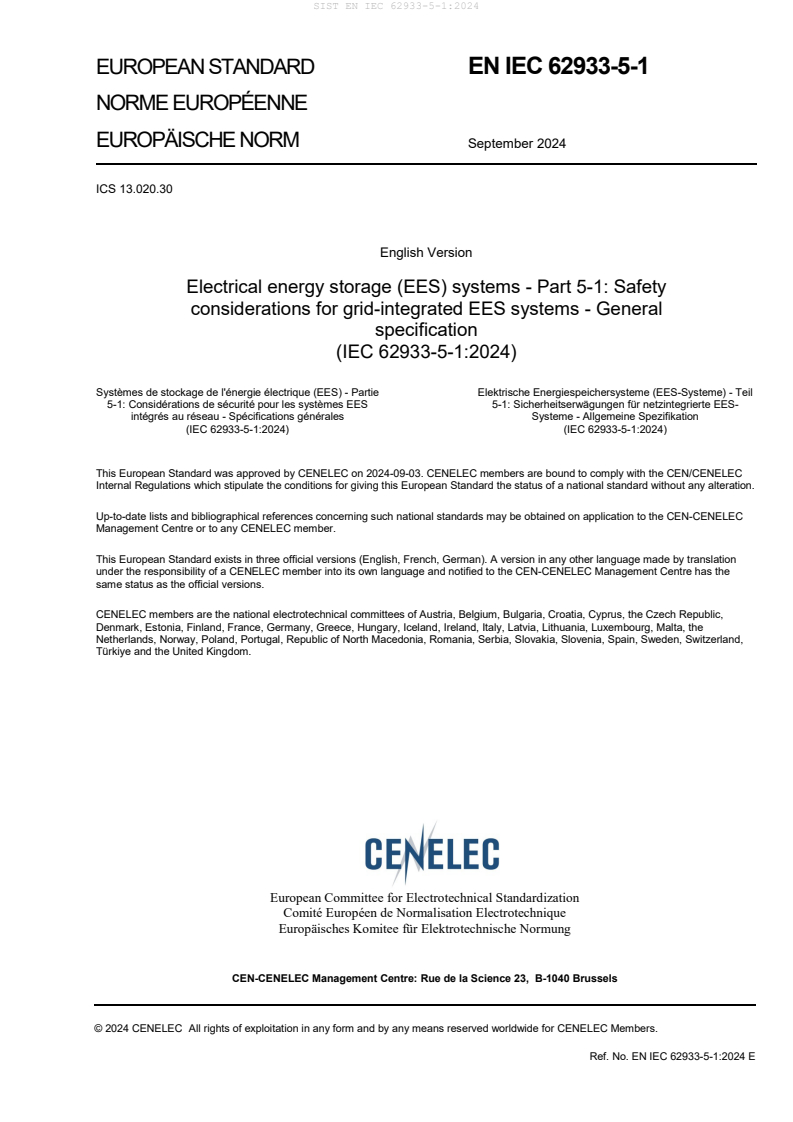
EUROPEAN STANDARD EN IEC 62933-5-1
NORME EUROPÉENNE
EUROPÄISCHE NORM September 2024
ICS 13.020.30
English Version
Electrical energy storage (EES) systems - Part 5-1: Safety
considerations for grid-integrated EES systems - General
specification
(IEC 62933-5-1:2024)
Systèmes de stockage de l'énergie électrique (EES) - Partie Elektrische Energiespeichersysteme (EES-Systeme) - Teil
5-1: Considérations de sécurité pour les systèmes EES 5-1: Sicherheitserwägungen für netzintegrierte EES-
intégrés au réseau - Spécifications générales Systeme - Allgemeine Spezifikation
(IEC 62933-5-1:2024) (IEC 62933-5-1:2024)
This European Standard was approved by CENELEC on 2024-09-03. CENELEC members are bound to comply with the CEN/CENELEC
Internal Regulations which stipulate the conditions for giving this European Standard the status of a national standard without any alteration.
Up-to-date lists and bibliographical references concerning such national standards may be obtained on application to the CEN-CENELEC
Management Centre or to any CENELEC member.
This European Standard exists in three official versions (English, French, German). A version in any other language made by translation
under the responsibility of a CENELEC member into its own language and notified to the CEN-CENELEC Management Centre has the
same status as the official versions.
CENELEC members are the national electrotechnical committees of Austria, Belgium, Bulgaria, Croatia, Cyprus, the Czech Republic,
Denmark, Estonia, Finland, France, Germany, Greece, Hungary, Iceland, Ireland, Italy, Latvia, Lithuania, Luxembourg, Malta, the
Netherlands, Norway, Poland, Portugal, Republic of North Macedonia, Romania, Serbia, Slovakia, Slovenia, Spain, Sweden, Switzerland,
Türkiye and the United Kingdom.
European Committee for Electrotechnical Standardization
Comité Européen de Normalisation Electrotechnique
Europäisches Komitee für Elektrotechnische Normung
CEN-CENELEC Management Centre: Rue de la Science 23, B-1040 Brussels
© 2024 CENELEC All rights of exploitation in any form and by any means reserved worldwide for CENELEC Members.
Ref. No. EN IEC 62933-5-1:2024 E
European foreword
The text of document 120/368/FDIS, future edition 1 of IEC 62933-5-1, prepared by TC 120 "Electrical
Energy Storage (EES) systems" was submitted to the IEC-CENELEC parallel vote and approved by
CENELEC as EN IEC 62933-5-1:2024.
The following dates are fixed:
• latest date by which the document has to be implemented at national (dop) 2025-06-03
level by publication of an identical national standard or by endorsement
• latest date by which the national standards conflicting with the (dow) 2027-09-03
document have to be withdrawn
Attention is drawn to the possibility that some of the elements of this document may be the subject of
patent rights. CENELEC shall not be held responsible for identifying any or all such patent rights.
Any feedback and questions on this document should be directed to the users’ national committee. A
complete listing of these bodies can be found on the CENELEC website.
Endorsement notice
The text of the International Standard IEC 62933-5-1:2024 was approved by CENELEC as a
European Standard without any modification.
In the official version, for Bibliography, the following notes have to be added for the standard indicated:
IEC 60079-0 NOTE Approved as EN IEC 60079-0
IEC 60079-10-1 NOTE Approved as EN IEC 60079-10-1
IEC 60079-10-2 NOTE Approved as EN 60079-10-2
IEC 60085 NOTE Approved as EN 60085
IEC 60127-1 NOTE Approved as EN 60127-1
IEC 60309 series NOTE Approved as EN IEC 60309 series
IEC 60317 series NOTE Approved as EN IEC 60317 series
IEC 60335-2-40 NOTE Approved as EN IEC 60335-2-40
IEC 60691 NOTE Approved as EN IEC 60691
IEC 60730-1 NOTE Approved as EN 60730-1
IEC 60730-2-8 NOTE Approved as EN IEC 60730-2-8
IEC 60738-1 NOTE Approved as EN IEC 60738-1
IEC 60812:2018 NOTE Approved as EN IEC 60812:2018 (not modified)
IEC 60896-11 NOTE Approved as EN 60896-11
IEC 60896-21 NOTE Approved as EN 60896-21
IEC 60896-22 NOTE Approved as EN 60896-22
IEC 60947-1 NOTE Approved as EN IEC 60947-1
IEC 60947-7 series NOTE Approved as EN IEC 60947-7 series
IEC 60999-1 NOTE Approved as EN 60999-1
IEC 60999-2 NOTE Approved as EN 60999-2
IEC 61000 series NOTE Approved as EN IEC 61000 series
IEC 61025:2006 NOTE Approved as EN 61025:2007 (not modified)
IEC 61058-1 NOTE Approved as EN IEC 61058-1
IEC 61140 NOTE Approved as EN 61140
IEC 61204-7 NOTE Approved as EN IEC 61204-7
IEC 61508-1 NOTE Approved as EN 61508-1
IEC 61508-4:2010 NOTE Approved as EN 61508-4:2010 (not modified)
IEC 61558-1 NOTE Approved as EN IEC 61558-1
IEC 61558-2-16 NOTE Approved as EN 61558-2-16
IEC 61643-11 NOTE Approved as EN 61643-11
IEC 61643-331 NOTE Approved as EN IEC 61643-331
IEC 61810-1 NOTE Approved as EN 61810-1
IEC 61882:2016 NOTE Approved as EN 61882:2016 (not modified)
IEC 61984 NOTE Approved as EN 61984
IEC 62271 series NOTE Approved as EN IEC 62271 series
IEC 62282-3-100 NOTE Approved as EN IEC 62282-3-100
IEC 62351 series NOTE Approved as EN IEC 62351 series
IEC 62368-1:2018 NOTE Approved as EN IEC 62368-1:2020 (not modified) +A11:2020
IEC 62485-1:2015 NOTE Approved as EN IEC 62485-1:2018 (not modified)
IEC 62619 NOTE Approved as EN IEC 62619
IEC 62932-2-2 NOTE Approved as EN IEC 62932-2-2
IEC 62984-2 NOTE Approved as EN IEC 62984-2
IEC 62990-2 NOTE Approved as EN IEC 62990-2
IEC 63056 NOTE Approved as EN IEC 63056
IEC 63115-2 NOTE Approved as EN IEC 63115-2
ISO 12944 series NOTE Approved as EN ISO 12944 series
ISO 13732-1:2006 NOTE Approved as EN ISO 13732-1:2008 (not modified)
ISO 13850:2015 NOTE Approved as EN ISO 13850:2015 (not modified)
ISO 13857:2019 NOTE Approved as EN ISO 13857:2019 (not modified)
ISO 19353:2019 NOTE Approved as EN ISO 19353:2019 (not modified)
Annex ZA
(normative)
Normative references to international publications
with their corresponding European publications
The following documents are referred to in the text in such a way that some or all of their content
constitutes requirements of this document. For dated references, only the edition cited applies. For
undated references, the latest edition of the referenced document (including any amendments)
applies.
NOTE 1 Where an International Publication has been modified by common modifications, indicated by (mod),
the relevant EN/HD applies.
NOTE 2 Up-to-date information on the latest versions of the European Standards listed in this annex is available
here: www.cencenelec.eu.
Publication Year Title EN/HD Year
IEC 60068-2-52 - Environmental testing - Part 2-52: Tests - EN IEC 60068-2-52 -
Test Kb: Salt mist, cyclic (sodium chloride
solution)
IEC 60079-2 2014 Explosive atmospheres - Part 2: EN 60079-2 2014
Equipment protection by pressurized
enclosure "p"
IEC 60204-1 - Safety of machinery - Electrical equipment EN 60204-1 -
of machines - Part 1: General requirements
IEC 60204-11 - Safety of machinery - Electrical equipment EN IEC 60204-11 -
of machines - Part 11: Requirements for
equipment for voltages above 1 000 V AC
or 1 500 V DC and not exceeding 36 kV
IEC 60364 series Low-voltage electrical installations HD 60364 series
IEC 60364-4-41 2005 Low-voltage electrical installations - Part 4- HD 60364-4-41 2017
41: Protection for safety - Protection
against electric shock
+ A1 2017 - -
- - + A11 2017
- - + A12 2019
IEC 60364-4-43 - Low-voltage electrical installations - Part 4- HD 60364-4-43 -
43: Protection for safety - Protection
against overcurrent
IEC 60364-4-44 - Low-voltage electrical installations - Part 4- HD 60364-4-442 -
44: Protection for safety - Protection
against voltage disturbances and
electromagnetic disturbances
IEC 60364-6 2016 Low voltage electrical installations - Part 6: HD 60364-6 2016
Verification
- - + A11 2017
- - + A12 2017
Publication Year Title EN/HD Year
- - + AC 2017-11
IEC 60529 - Degrees of protection provided by EN 60529 -
enclosures (IP Code)
IEC 60664-1 2020 Insulation coordination for equipment EN IEC 60664-1 2020
within low-voltage supply systems - Part 1:
Principles, requirements and tests
IEC 60695-11-10 - Fire hazard testing - Part 11-10: Test EN 60695-11-10 -
flames - 50 W horizontal and vertical flame
test methods
IEC 60730-1 2022 Automatic electrical controls - Part 1: EN IEC 60730-1 2024
General requirements
IEC 60730-2-9 - Automatic electrical controls - Part 2-9: EN IEC 60730-2-9 -
Particular requirements for temperature
sensing control
IEC 60947-5-1 - Low-voltage switchgear and controlgear - EN 60947-5-1 -
Part 5-1: Control circuit devices and
switching elements - Electromechanical
control circuit devices
IEC 61000-1-2 - Electromagnetic compatibility (EMC) - Part EN 61000-1-2 -
1-2: General - Methodology for the
achievement of functional safety of
electrical and electronic systems including
equipment with regard to electromagnetic
phenomena
IEC 61000-6-1 - Electromagnetic compatibility (EMC) - Part EN IEC 61000-6-1 -
6-1: Generic standards - Immunity
standard for residential, commercial and
light-industrial environments
IEC 61000-6-2 - Electromagnetic compatibility (EMC) - Part EN IEC 61000-6-2 -
6-2: Generic standards - Immunity
standard for industrial environments
IEC 61000-6-3 - Electromagnetic compatibility (EMC) - Part EN IEC 61000-6-3 -
6-3: Generic standards - Emission
standard for equipment in residential
environments
IEC 61000-6-4 - Electromagnetic compatibility (EMC) - Part EN IEC 61000-6-4 -
6-4: Generic standards - Emission
standard for industrial environments
IEC 61000-6-5 - Electromagnetic compatibility (EMC) - Part EN 61000-6-5 -
6-5: Generic standards - Immunity for
equipment used in power station and
substation environment
IEC 61000-6-7 - Electromagnetic compatibility (EMC) - Part EN 61000-6-7 -
6-7: Generic standards - Immunity
requirements for equipment intended to
perform functions in a safety-related
system (functional safety) in industrial
locations
IEC/TR 61340-1 - Electrostatics - Part 1: Electrostatic - -
phenomena - Principles and
measurements
Publication Year Title EN/HD Year
IEC 61439-1 - Low-voltage switchgear and controlgear EN IEC 61439-1 -
assemblies - Part 1: General rules
IEC 61508 series Functional safety of EN 61508 series
electrical/electronic/programmable
electronic safety-related systems
IEC 61511 series Functional safety - Safety instrumented EN 61511 series
systems for the process industry sector
IEC 61936-1 - Power installations exceeding 1 kV AC and EN IEC 61936-1 -
1,5 kV DC - Part 1: AC
IEC/TS 61936-2 - Power installations exceeding 1 kV a.c. - -
and 1,5 kV d.c. - Part 2: d.c.
IEC 62061 - Safety of machinery - Functional safety of EN IEC 62061 -
safety-related control systems
IEC 62109-1 - Safety of power converters for use in EN 62109-1 -
photovoltaic power systems - Part 1:
General requirements
IEC 62109-2 - Safety of power converters for use in EN 62109-2 -
photovoltaic power systems - Part 2:
Particular requirements for inverters
IEC 62116 2014 Utility-interconnected photovoltaic inverters EN 62116 2014
- Test procedure of islanding prevention
measures
IEC 62305-2 - Protection against lightning - Part 2: Risk EN 62305-2 -
management
IEC 62443-3-3 - Industrial communication networks - EN IEC 62443-3-3 -
Network and system security - Part 3-3:
System security requirements and security
levels
IEC 62477-1 2022 Safety requirements for power electronic EN IEC 62477-1 2023
converter systems and equipment - Part 1:
General
IEC 62477-2 - Safety requirements for power electronic EN IEC 62477-2 -
converter systems and equipment - Part 2:
Power electronic converters from 1 000 V
AC or 1 500 V DC up to 36 kV AC or 54 kV
DC
IEC 62689-2 - Current and voltage sensors or detectors, EN 62689-2 -
to be used for fault passage indication
purposes - Part 2: System aspects
IEC 62909-1 - Bi-directional grid connected power EN IEC 62909-1 -
converters - Part 1: General requirements
IEC 62909-2 - Bi-directional grid-connected power EN IEC 62909-2 -
converters - Part 2: Interface of GCPC and
distributed energy resources
IEC 62933-1 - Electrical energy storage (EES) systems - EN IEC 62933-1 -
Part 1: Vocabulary
IEC 62933-5-2 - Electrical energy storage (EES) systems - EN IEC 62933-5-2 -
Part 5-2: Safety requirements for grid-
integrated EES systems - Electrochemical-
Publication Year Title EN/HD Year
based systems
ISO 1182 - Reaction to fire tests for products - Non- EN ISO 1182 -
combustibility test
ISO 7010 - Graphical symbols_- Safety colours and - -
safety signs - Registered safety signs
ISO 12100 2010 Safety of machinery - General principles EN ISO 12100 2010
for design - Risk assessment and risk
reduction
ISO 13849 series Safety of machinery - Safety-related parts EN ISO 13849 series
of control systems
ISO 15649 - Petroleum and natural gas industries - - -
Piping
ASME B31.1 - Code for Pressure Piping, Section 1: - -
Power Piping
ASME B31.3 - Code for Pressure Piping, Section 3: - -
Process piping
IEEE Std 1547.1 2020 Standard Conformance Test Procedures - -
for Equipment Interconnecting Distributed
Energy Resources with Electric Power
Systems and Associated Interfaces
IEC 62933-5-1 ®
Edition 1.0 2024-07
INTERNATIONAL
STANDARD
NORME
INTERNATIONALE
colour
inside
Electrical energy storage (EES) systems –
Part 5-1: Safety considerations for grid-integrated EES systems – General
specification
Systèmes de stockage de l'énergie électrique (EES) –
Partie 5-1: Considérations de sécurité pour les systèmes EES intégrés au
réseau – Spécifications générales
INTERNATIONAL
ELECTROTECHNICAL
COMMISSION
COMMISSION
ELECTROTECHNIQUE
INTERNATIONALE
ICS 13.020.30 ISBN 978-2-8322-9374-4
– 2 – IEC 62933-5-1:2024 © IEC 2024
CONTENTS
FOREWORD . 6
INTRODUCTION . 8
1 Scope . 9
2 Normative references . 9
3 Terms and definitions . 12
4 Basic approach for safety considerations of EES systems . 16
5 Hazard considerations for EES systems . 17
5.1 Electrical hazards . 17
5.2 Mechanical hazards . 17
5.3 Energy hazards . 17
5.3.1 Explosion hazards . 17
5.3.2 Hazards arising from electrical, magnetic, and electromagnetic fields . 18
5.4 Fire hazards. 18
5.5 Temperature hazards . 18
5.6 Chemical hazards . 18
5.7 Unsuitable working conditions . 18
6 EESS risk assessment. 19
6.1 EESS structure . 19
6.1.1 General characteristics . 19
6.1.2 Specific characteristics . 19
6.2 Description of storage conditions . 20
6.2.1 Types of grids, applications and locations . 20
6.2.2 Vulnerable elements . 20
6.2.3 Special provisions for EES systems in generally accessible locations . 21
6.2.4 Sources of external aggression . 21
6.2.5 Unattended operation . 21
6.2.6 Unintentional islanding . 21
6.3 Risk analysis . 21
6.3.1 General . 21
6.3.2 Components . 22
6.3.3 Risk considerations . 22
6.3.4 System level risk analysis . 23
7 Requirements necessary to reduce risks . 24
7.1 General measures to reduce risks . 24
7.2 Preventive measures against damage to neighbouring inhabitants . 26
7.3 Safety-related design review . 26
7.3.1 General . 26
7.3.2 Initial safety design review . 27
7.3.3 Subsequent design revisions . 27
7.4 Preventive measures against damage to workers and other persons at risk . 27
7.4.1 Protection from electrical hazards . 27
7.4.2 Protection from mechanical hazards . 30
7.4.3 Protection from high pressure hazards. 30
7.4.4 Protection from explosive atmosphere hazards . 31
7.4.5 Protection from hazards arising from electric, magnetic, and
electromagnetic fields . 32
IEC 62933-5-1:2024 © IEC 2024 – 3 –
7.4.6 Protection from fire hazards . 32
7.4.7 Protection from thermal hazards . 33
7.4.8 Protection from chemical hazards . 34
7.4.9 Protection from workplace hazards . 35
7.4.10 Staff training . 36
7.5 EESS disconnection and shutdown . 36
7.5.1 General . 36
7.5.2 Grid-disconnected state . 37
7.5.3 Stopped state . 38
7.5.4 EESS shutdown . 38
7.5.5 Partial disconnection . 38
7.5.6 Equipment guidelines for emergency shutdown . 38
7.6 Cyber security . 39
7.7 Remote monitoring and unattended operation . 39
8 System testing . 40
8.1 General . 40
8.2 Validation and testing of EESS – Electrical hazards . 42
8.2.1 General . 42
8.2.2 Accessibility to hazardous live parts . 42
8.2.3 Protection from exposure to moisture and pollution . 42
8.2.4 Electrical insulation and protection against electrical shock tests . 43
8.2.5 Protection against out of normal operation range tests . 45
8.2.6 Anti-islanding . 47
8.3 Validation and testing of EESS – Mechanical hazards . 47
8.3.1 Enclosure strength against impact . 47
8.3.2 Enclosure strength against static force . 48
8.3.3 Containment of hazardous moving parts . 48
8.3.4 Mounting means and handle robust test . 48
8.3.5 Impact and vibration during transportation and seismic events . 49
8.4 Validation and testing of EESS – Fluid hazards (high or low temperature,
high pressure, flammable, corrosive, caustic, or toxic) . 49
8.4.1 General . 49
8.4.2 Hazardous fluid containing parts strength test . 49
8.4.3 Hazardous fluid containing parts leakage test . 50
8.4.4 Start-to-discharge pressure test . 51
8.5 Validation and testing of EESS – Explosion and combustible concentrations
hazards . 52
8.5.1 Gas detection and off-gas detection . 52
8.5.2 Mechanical ventilation evaluation . 52
8.6 Validation and testing of EESS – Hazards arising from electric, magnetic
and electromagnetic fields . 52
8.7 Validation and testing of EESS – Fire propagation hazards . 53
8.8 Validation and testing of EESS – Temperature hazards . 53
8.8.1 General . 53
8.8.2 Containment of hazardous temperature (low or high) fluids . 53
8.8.3 Temperature under normal operation tests . 53
8.9 Validation and testing of EESS – Chemical effects . 53
8.9.1 Strength tests . 53
8.9.2 Leakage tests . 53
– 4 – IEC 62933-5-1:2024 © IEC 2024
8.10 Validation and testing of EESS – Hazards arising from the environment . 54
8.10.1 General . 54
8.10.2 Ingress of moisture . 54
8.10.3 Exposure to marine environments . 54
8.11 Validation and testing of EESS – Hazards arising from auxiliary, control and
communication subsystem malfunctions . 54
8.11.1 General . 54
8.11.2 Auxiliary system malfunction . 55
8.11.3 EES control subsystem malfunction . 57
8.11.4 EESS internal communication malfunction . 58
8.11.5 EESS external communication malfunction . 59
9 Instruction manuals and guidelines . 59
9.1 General . 59
9.2 Installation manual . 60
9.3 Maintenance manual . 61
9.3.1 General . 61
9.3.2 Personal protective equipment (PPE) guidelines . 61
9.4 Operator manual . 61
9.5 Emergency procedure manual . 62
9.6 First response manual . 62
10 Markings and signage . 63
10.1 General . 63
10.2 Nameplate . 63
10.3 Cautionary markings and signage . 63
Annex A (informative) Main risks of different storage technologies . 64
A.1 General . 64
A.2 Pumped hydro storage . 64
A.3 Flywheel . 65
A.4 Gravitational EESS . 65
A.5 Battery energy storage systems . 66
A.6 Hydrogen and synthetic natural gas . 66
A.7 Thermal EESS technologies . 67
A.8 Other EESS technologies . 68
Annex B (informative) Safety considerations . 69
B.1 General . 69
B.2 Electrical hazards . 69
B.3 Mechanical hazards . 70
B.4 Energy hazards . 70
B.4.1 Explosion hazards . 70
B.4.2 Hazards arising from electrical, magnetic, and electromagnetic fields . 71
B.5 Fire hazards. 71
B.6 Temperature hazards . 72
B.7 Chemical hazards . 73
B.8 Unsuitable working conditions . 73
Annex C (normative) Test methods for mechanical EESS using a flywheel
accumulation subsystem . 74
C.1 General . 74
C.2 Purpose . 74
C.3 Requirement . 74
IEC 62933-5-1:2024 © IEC 2024 – 5 –
C.4 Method . 74
Annex D (informative) Component safety standards . 75
Bibliography . 78
Figure 1 – General description of the approach to address hazards in EES systems . 17
Figure 2 – Iterative checking sequence in general risk assessment procedures . 24
Figure 3 – General risk reduction measures to minimize hazards . 25
Figure 4 – Damage propagation from a contained incident to a major incident, and
layered measures to minimize damage . 25
Figure 5 – Initial safety design review and design revision . 27
Figure 6 – Examples of different EESS architectures . 37
Figure 7 – EESS architecture in the two main EESS configurations . 41
Figure B.1 – Islanding of the EESS . 70
Table 1 – EESS characteristics for risk assessment consideration . 20
Table 2 – Test parameters for the strength test . 50
Table 3 – Test parameters for the leakage test . 51
Table A.1 – Main risk scenarios for pumped hydro storage . 64
Table A.2 – Main risk scenarios for flywheel . 65
Table A.3 – Main risk scenarios for gravitational EESS . 66
Table A.4 – Main risk scenarios for hydrogen storage . 67
Table A.5 – Main risk scenarios for thermal EESS storage . 68
Table D.1 – Examples of component safety standards for use in EESS. 75
– 6 – IEC 62933-5-1:2024 © IEC 2024
INTERNATIONAL ELECTROTECHNICAL COMMISSION
____________
ELECTRICAL ENERGY STORAGE (EES) SYSTEMS –
Part 5-1: Safety considerations for grid-integrated EES systems –
General specification
FOREWORD
1) The International Electrotechnical Commission (IEC) is a worldwide organization for standardization comprising
all national electrotechnical committees (IEC National Committees). The object of IEC is to promote international
co-operation on all questions concerning standardization in the electrical and electronic fields. To this end and
in addition to other activities, IEC publishes International Standards, Technical Specifications, Technical Reports,
Publicly Available Specifications (PAS) and Guides (hereafter referred to as "IEC Publication(s)"). Their
preparation is entrusted to technical committees; any IEC National Committee interested in the subject dealt with
may participate in this preparatory work. International, governmental and non-governmental organizations liaising
with the IEC also participate in this preparation. IEC collaborates closely with the International Organization for
Standardization (ISO) in accordance with conditions determined by agreement between the two organizations.
2) The formal decisions or agreements of IEC on technical matters express, as nearly as possible, an international
consensus of opinion on the relevant subjects since each technical committee has representation from all
interested IEC National Committees.
3) IEC Publications have the form of recommendations for international use and are accepted by IEC National
Committees in that sense. While all reasonable efforts are made to ensure that the technical content of IEC
Publications is accurate, IEC cannot be held responsible for the way in which they are used or for any
misinterpretation by any end user.
4) In order to promote international uniformity, IEC National Committees undertake to apply IEC Publications
transparently to the maximum extent possible in their national and regional publications. Any divergence between
any IEC Publication and the corresponding national or regional publication shall be clearly indicated in the latter.
5) IEC itself does not provide any attestation of conformity. Independent certification bodies provide conformity
assessment services and, in some areas, access to IEC marks of conformity. IEC is not responsible for any
services carried out by independent certification bodies.
6) All users should ensure that they have the latest edition of this publication.
7) No liability shall attach to IEC or its directors, employees, servants or agents including individual experts and
members of its technical committees and IEC National Committees for any personal injury, property damage or
other damage of any nature whatsoever, whether direct or indirect, or for costs (including legal fees) and
expenses arising out of the publication, use of, or reliance upon, this IEC Publication or any other IEC
Publications.
8) Attention is drawn to the Normative references cited in this publication. Use of the referenced publications is
indispensable for the correct application of this publication.
9) IEC draws attention to the possibility that the implementation of this document may involve the use of (a)
patent(s). IEC takes no position concerning the evidence, validity or applicability of any claimed patent rights in
respect thereof. As of the date of publication of this document, IEC had not received notice of (a) patent(s), which
may be required to implement this document. However, implementers are cautioned that this may not represent
the latest information, which may be obtained from the patent database available at https://patents.iec.ch. IEC
shall not be held responsible for identifying any or all such patent rights.
IEC 62933-5-1 has been prepared by IEC technical committee TC 120: Electrical Energy
Storage (EES) systems. It is an International Standard.
This first edition cancels and replaces the first edition of IEC TS 62933-5-1 published in 2017.
This edition constitutes a technical revision.
This edition includes the following significant technical changes with respect to
IEC TS 62933-5-1:2017:
a) Revising “should” statements to “shall” statements for all requirements and move some
“should” statements clauses to Annex B for informative purposes.
b) Update standard references (normative).
c) Update definitions and add or remove definitions where necessary.
IEC 62933-5-1:2024 © IEC 2024 – 7 –
d) Revise criteria in Clause 6 and Clause 7 to be actionable and add standard references
where necessary.
e) Revise Clause 8 for more thorough test method and criteria, add tests where necessary.
f) Add markings and instruction criteria.
g) Revise Annex A to add technology safety information on gravitational and thermal EESS.
h) Add Annex B and Annex C for safety considerations for EESS and test method for
mechanical EESS.
i) Add informative list of standards and update bibliography.
The text of this International Standard is based on the following documents:
Draft Report on voting
120/368/FDIS 120/377/RVD
Full information on the voting for its approval can be found in the report on voting indicated in
the above table.
The language used for the development of this International Standard is English.
This document was drafted in accordance with ISO/IEC Directives, Part 2, and developed in
accordance with ISO/IEC Directives, Part 1 and ISO/IEC Directives, IEC Supplement, available
at www.iec.ch/members_experts/refdocs. The main document types developed by IEC are
described in greater detail at www.iec.ch/publications.
A list of all parts in the IEC 62933 series, published under the general title Electrical energy
storage (EES) systems, can be found on the IEC website.
The committee has decided that the contents of this document will remain unchanged until the
stability date indicated on the IEC website under webstore.iec.ch in the data related to the
specific document. At this date, the document will be
• reconfirmed,
• withdrawn, or
• revised.
IMPORTANT – The "colour inside" logo on the cover page of this document indicates
that it contains colours which are considered to be useful for the correct understanding
of its contents. Users should therefore print this document using a colour printer.
– 8 – IEC 62933-5-1:2024 © IEC 2024
INTRODUCTION
Many governments' plans for how electricity will be generated and managed in the future have
been determined. Such current plans cannot be implemented without long-term storage with
capacities in the large scale range.
There are a number of types of storage technologies that have emerged. Examples of these
technologies are pumped hydro storage (PHS), electrochemical batteries, flywheel storage
systems and hydrogen and synthetic natural gas (SNG). Pumped hydro storage has been widely
used in terms of the total amount of stored energy. A flywheel is a model of kinetic energy
storage with a high power density, excellent cycle stability and long life. While some flywheels
are intended for short term operation, others can operate over longer periods of time of up to a
few hours. Batteries require development primarily to decrease cost, and for some technologies
to increase energy density as well. Hydrogen and synthetic natural gas (SNG) added to natural
gas are likely to be essential elements of future electric grids because of their energy storage
duration and capacity. Hydrogen and SNG should be further researched and developed across
a broad front, including physical facilities, interactions with existing uses of gas for supply and
distribution network, optimal chemical processes, safety, reliability and efficiency. The IEC
White Paper on electrical energy storage can provide further background information
concerning EES systems.
For mature EES systems, various IEC standards exist, covering technical features, testing and
system integration. For other technologies, there are only a few standards, covering special
topics.
Up to now no general standard addressing safety for EESS integration into an electrical grid
has been developed.
The rapid growth and the new technologies involved in electrical energy storage in the near
future, as well as their installation by consumers will impose particular requirements for safety.
At the same time, society and governments will need assurance of safety before the much-
needed systems can be deployed.
This document stands as a decisive step towards the gradual alignment with specific
technologies and applications concerning the safety of packaged or site-assembled grid-
integrated EESS.
Additional criteria specific to electrochemical type electrical energy storage (EES) systems are
given in IEC 6293
...
The EN IEC 62933-5-1:2024 standard provides a comprehensive framework for safety considerations in electrical energy storage (EES) systems that are integrated with the electrical grid. Its scope encompasses a broad range of safety protocols, including hazard identification, risk assessment, and risk mitigation strategies specifically tailored to grid-integrated EES systems of varying types and sizes. This flexibility enhances the standard's relevance across multiple EESS technologies. One of the significant strengths of this standard is its clear stipulation of safety requirements. The transition from "should" to "shall" statements strengthens the enforceability of the criteria laid out in the document. This technical revision marks a crucial update as it clarifies what is mandatory, thus providing a more robust safety framework. The standard has also been revised to include updated definitions, ensuring that all terminologies are current and precise. Additionally, the inclusion of actionable criteria in Clauses 6 and 7 streamlines the compliance process for stakeholders by clarifying expectations and enhancing the comprehensibility of requirements. Furthermore, the enhanced criteria for testing outlined in Clause 8 contribute significantly to safety by detailing more thorough test methods and introducing new tests when necessary. This aspect of the standard is critical for manufacturers and operators to ensure that their technologies meet the safety benchmarks required for grid integration. The addition of marking and instruction criteria aids in furthering safety awareness and compliance, while the revisions in Annex A introduce vital safety information regarding gravitational and thermal EESS, which is essential for risk management in diverse applications. The further inclusion of Annexes B and C dealing with safety considerations for mechanical EESS solidifies the standard's comprehensive approach to safety in EES systems. Moreover, the updated bibliography and informative list of standards provide a valuable resource for users seeking to engage with related safety protocols and frameworks, making EN IEC 62933-5-1:2024 a critical document that supports the safe application of EES technology across various sectors. Overall, the EN IEC 62933-5-1:2024 standard demonstrates immense relevance in addressing the evolving safety needs of grid-integrated electrical energy storage systems, reinforcing its importance in the pursuit of safe and efficient energy storage solutions.
표준 EN IEC 62933-5-1:2024는 전력망에 통합된 전기 에너지 저장 시스템(EES)의 안전 고려사항을 포괄적으로 규정하고 있습니다. 이 문서는 EES 시스템을 안전하게 적용하고 사용하는 데 필요한 기준을 제공하며, 모든 유형 및 크기의 전기 에너지 저장 시스템에 대해 적용될 수 있는 중요성을 가집니다. 본 표준의 주요 강점 중 하나는 위험 식별, 위험 평가 및 위험 완화와 관련된 명확한 절차를 제시하고 있다는 점입니다. 이는 전력망에 통합된 EES 시스템의 안전성을 확보하는 데 매우 중요한 요소이며, 결과적으로 기술적 신뢰성을 높이는 데 기여합니다. 또한, 이 문서는 IEC 62933-5-2와 같이 전기화학적 EES 시스템에 대한 특수 요구사항에 언급하고 있어, 사용자에게 보다 세분화된 정보를 제공합니다. 2024년에 발행된 이 문서는 2017년에 발표된 IEC TS 62933-5-1의 첫 번째 판을 대체하며 기술적 개정을 포함하고 있습니다. 'should' 진술을 'shall'로 전환하고, 일부 'should' 진술을 부록으로 이동시키는 방식으로 요구사항의 강도를 강화했습니다. 이는 표준의 실행 가능성을 높이는 데 중요한 변화를 의미합니다. 또한, 표준의 정의를 업데이트하고 필요에 따라 추가하거나 삭제한 점은 명확한 이해를 도와줍니다. 제6조 및 제7조에서 제시된 기준의 수정은 보다 명확한 실행 가능성을 제공하며, 제8조에서는 실험 방법과 기준을 보다 철저하게 다루고 있어, 검증 가능한 테스트 환경을 조성합니다. 추가적으로, 부록 A에서는 중력 및 열 EES에 대한 안전 정보를 새롭게 추가하고, 부록 B와 C에서는 EES의 안전 고려사항 및 기계적 EES에 대한 테스트 방법을 제시함으로써 포괄적인 안전체계를 마련하고 있습니다. 표준 목록의 정보성 리스트와 참고 문헌의 업데이트는 문서의 신뢰성을 더욱 강화하는 요소입니다. 결론적으로, EN IEC 62933-5-1:2024는 전력망에 통합된 EES 시스템에 대한 안전 기준을 마련하여 관련 기술의 안전성과 신뢰성을 제고하는 데 중요한 역할을 합니다. 이 표준은 관련 분야의 전문가와 기업이 안전한 시스템을 구현하는 데 기여할 것으로 기대됩니다.
標準EN IEC 62933-5-1:2024は、電力網に統合された電気エネルギー貯蔵(EES)システムに関する安全性の考慮を具体化した重要なドキュメントであり、特にリスクの特定、リスク評価、リスク軽減に関する基準を提供しています。この標準は、電力網統合用に設計されたあらゆる種類やサイズの電気エネルギー貯蔵システムの安全な適用と使用を支援することを目的としています。 EN IEC 62933-5-1:2024の強みは、その包括的な範囲にあります。この標準は、さまざまなEES技術に適用可能であるだけでなく、特に電気化学的EESシステムに特化した要求については、IEC 62933-5-2を参照することにより一層の明確さを提供しています。技術的改訂により、要求事項に関する記述が「should」から「shall」に変更されるなど、法的拘束力を持つ表現が強化されている点も注目に値します。 具体的な技術的変更としては、Clause 6およびClause 7における基準の明確化と、必要に応じた標準参照の追加が挙げられます。また、Clause 8では試験方法と基準が徹底的に見直され、必要に応じた追加テストが行われています。これにより、より高い安全性が確保されます。加えて、技術安全情報が追加されたAnnex Aや、機械的EESに関する安全考慮および試験方法を詳述したAnnex BとAnnex Cが新たに設けられています。 さらに、標準の致命的なリスクや危険の特定に関するガイドラインが含まれており、利用者は情報に基づいて意思決定が可能なため、実用性が高い文書となっています。EN IEC 62933-5-1:2024は、電気エネルギー貯蔵システムの安全性を強化し、電力網の効率的な統合を促進するための重要な情報源です。
La norme EN IEC 62933-5-1:2024 se révèle être un document essentiel qui définit les considérations de sécurité pertinentes pour les systèmes de stockage d'énergie électrique (EES) intégrés au réseau. Son champ d'application est vaste, englobant toutes les technologies EES tout en apportant des spécifications détaillées pour garantir l'utilisation sécurisée de ces systèmes, quel que soit leur type ou leur taille. Cette norme est particulièrement pertinente dans un contexte où la transition vers des sources d'énergie renouvelable et la décarbonisation des réseaux électriques sont prioritaires. Parmi les points forts de cette norme, son approche systématique en matière d'identification des dangers, d'évaluation des risques et de mesures d'atténuation est notable. En remplaçant des formulations telles que "should" par "shall", la norme renforce le caractère obligatoire des exigences, augmentant ainsi la responsabilité des acteurs concernés. De plus, l'ajout de recommandations techniques plus rigoureuses dans les Annexes A, B et C sur les critères de test et les informations de sécurité technologique, illustre une volonté d’améliorer la clarté et l'applicabilité. La mise à jour des références normatives et des définitions contribue également à l'harmonisation et à la compréhension des enjeux de sécurité liés aux systèmes EES. La version révisée de la norme 2024 a également pris en compte des aspects techniques spécifiques, comme les informations de sécurité pour les EES gravitationnels et thermiques, ce qui montre une perspective globale et innovante face aux divers types de systèmes de stockage d'énergie. En ajoutant des critères de marquage et d'instruction, la norme vise à garantir non seulement la conformité réglementaire, mais aussi la sensibilisation et la formation des utilisateurs. En résumé, la norme EN IEC 62933-5-1:2024 constitue une avancée significative dans le domaine des systèmes de stockage d'énergie électrique intégrés au réseau. Sa pertinence dans le cadre actuel de l'énergie durable est indéniable, car elle fournit des lignes directrices claires et des exigences strictes pour assurer la sécurité des opérations de ces systèmes essentiels.
Die Norm EN IEC 62933-5-1:2024 bietet eine umfassende Grundlage für Sicherheitsüberlegungen im Zusammenhang mit elektrisch integrierten Energiespeichersystemen (EES). Ihr Anwendungsbereich ist sowohl weitreichend als auch entscheidend für die Gewährleistung der Sicherheit von EES-Systemen, die in das elektrische Netz integriert sind. Diese Norm legt Kriterien fest, die für die sichere Anwendung und Nutzung von EES jeglicher Art und Größe, die für netzintegrierte Anwendungen vorgesehen sind, erforderlich sind. Ein herausragendes Merkmal dieser Norm ist die klare Strukturierung von Anforderungen, die in Form von "muss"-Erklärungen anstelle von "soll"-Erklärungen präsentiert werden. Dies stellt sicher, dass alle sicherheitsrelevanten Aspekte klar und verbindlich formuliert sind, wodurch das Risiko von Missverständnissen in der Umsetzung minimiert wird. Solche präzisen Anforderungen sind besonders wertvoll für Hersteller und Betreiber von EES, da sie eine einheitliche Basis für die Sicherheitsbewertung und -implementierung schaffen. Die Norm legt auch besonderen Wert auf die Identifizierung von Gefahren, die Risikobewertung sowie die Risikominderung, was für die Sicherheit und Zuverlässigkeit von EES-Systemen von entscheidender Bedeutung ist. Darüber hinaus werden technische Änderungen und Ergänzungen berücksichtigt, um die aktuelle Forschung und Entwicklung in der Energiespeichertechnologie widerzuspiegeln. Zum Beispiel wurden die Kriterien in den Abschnitten 6 und 7 überarbeitet, um konkret umsetzbare Maßnahmen zu bieten, und der Prüfmethodenabschnitt wurde wesentlich präzisiert. Die Aufnahme zusätzlicher Anhänge, die spezifische Sicherheitsinformationen und Prüfmethoden für unterschiedliche Technologien der EES bieten, zeigt die Relevanz dieser Norm in einem sich schnell weiterentwickelnden Technologiefeld. Insbesondere die neuen Anhänge B und C, die sich mit safety considerations und Prüfmethoden für mechanische EES befassen, erweitern den Anwendungsbereich und die Nützlichkeit dieser Norm erheblich. Zusammenfassend lässt sich sagen, dass die EN IEC 62933-5-1:2024 ein wesentliches Dokument für die Entwicklung sicherer netzintegrativer Energiespeichersysteme darstellt. Ihre klaren Anforderungen, die umfassende Beurteilung von Sicherheitsaspekten und die kontinuierliche Anpassung an neue technische Erkenntnisse machen sie zu einer wertvollen Ressource für alle Stakeholder im Bereich der elektrischen Energiespeicherung.
Questions, Comments and Discussion
Ask us and Technical Secretary will try to provide an answer. You can facilitate discussion about the standard in here.
Loading comments...