

ETSI EN 301 502 V10.2.1 (2012-11)
Global System for Mobile communications (GSM); Harmonized EN for Base Station Equipment covering the essential requirements of article 3.2 of the R&TTE Directive
General Information
- Abstract
REN/MSG-0006
- Status
- Published
- Publication Date
- 11-Oct-2013
- Technical Committee
- MSG - Mobile Standards Group
- Current Stage
- 12 - Completion
- Due Date
- 16-Nov-2012
- Completion Date
- 29-Nov-2012
- Mandate
- M/284
Buy Documents
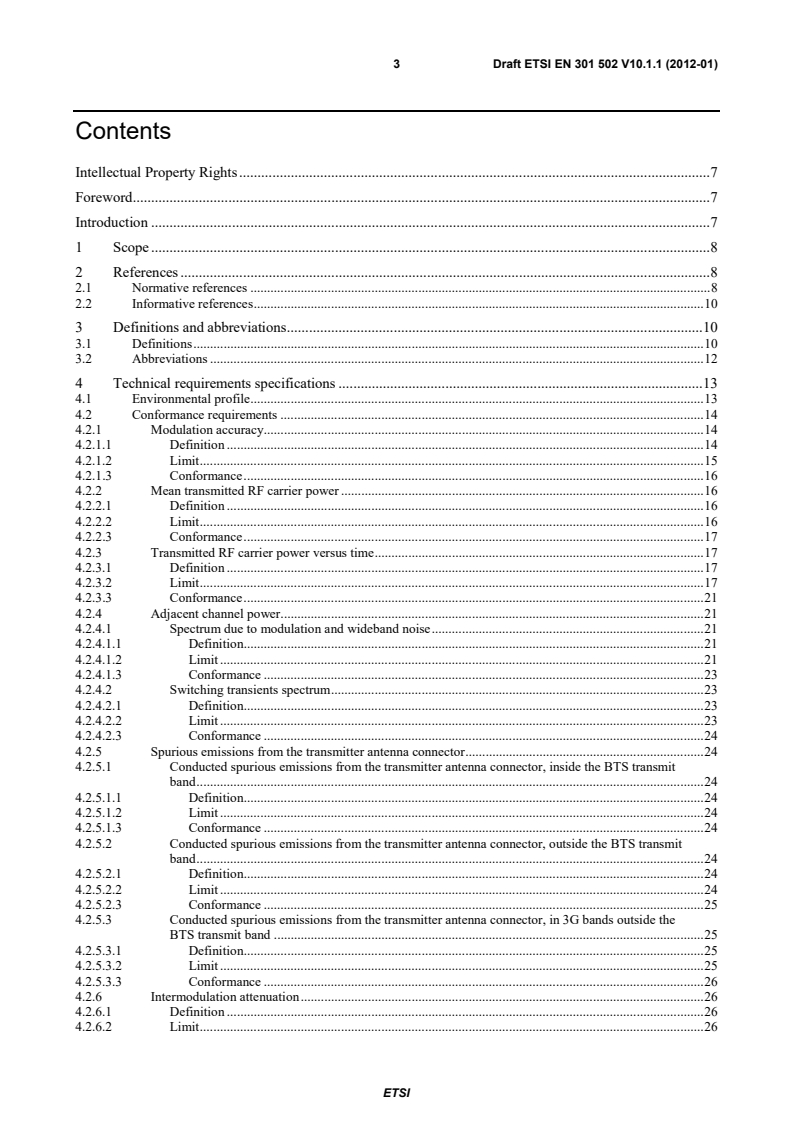
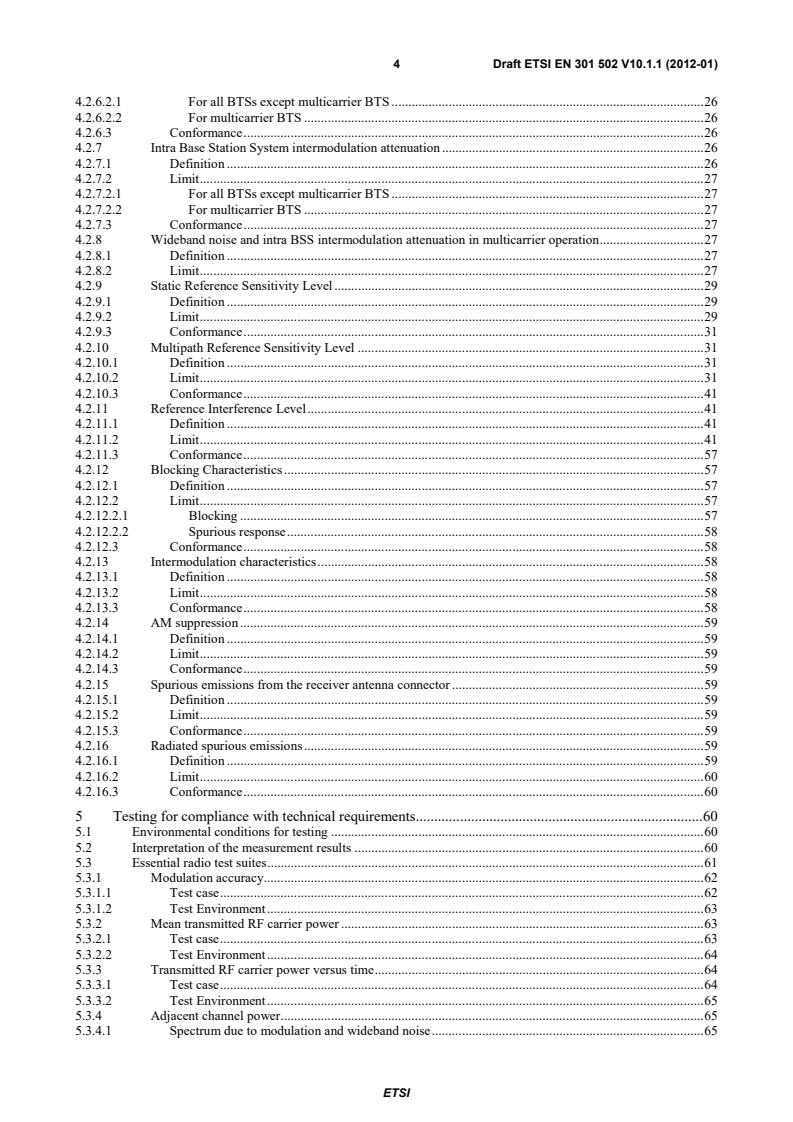
en_301502v100101c - Global System for Mobile communications (GSM); Harmonized EN for Base Station Equipment covering the essential requirements of article 3.2 of the R&TTE Directive
en_301502v100200v - Global System for Mobile communications (GSM); Harmonized EN for Base Station Equipment covering the essential requirements of article 3.2 of the R&TTE Directive
ETSI EN 301 502 V10.2.1 (2012-11) - Global System for Mobile communications (GSM); Harmonized EN for Base Station Equipment covering the essential requirements of article 3.2 of the R&TTE Directive

Overview
ETSI EN 301 502 V10.2.1 (2012-11) (ETSI EN 301 502 V10.2.1) is the harmonized European standard for GSM base station equipment that addresses the essential requirement of Article 3.2 of the R&TTE Directive (Directive 1999/5/EC). Its primary aim is to ensure GSM base stations use spectrum efficiently and avoid harmful interference to adjacent and nearby radio systems. The standard is intended for manufacturers, test laboratories, network operators and conformity assessors involved with GSM base station equipment design, testing and certification.
Key Topics and Technical Requirements
The standard defines technical requirements, test methods and conformance criteria covering the radio performance and interference behaviour of GSM base stations. Major topics include:
- Modulation accuracy - definitions, limits and conformance tests to verify transmitted signal quality.
- Mean transmitted RF carrier power and power versus time - measurement definitions and test procedures for transmitter power control and stability.
- Adjacent channel power (ACP) - spectrum due to modulation, wideband noise, and switching transients with conformance methods to limit interference to adjacent bands.
- Spurious emissions - conducted emissions at the transmitter and receiver antenna connectors, and radiated spurious emissions outside the BTS transmit band.
- Intermodulation and intra-BSS intermodulation attenuation - requirements for single-carrier and multicarrier BTS to limit intermodulation products.
- Receiver performance characteristics - static and multipath reference sensitivity levels, blocking, spurious responses and AM suppression.
- Reference interference level and testing - definitions and conformance procedures for reference interference and how to interpret measurement results.
- Environmental profile and test conditions - prescribed environmental conditions and essential radio test suites with test cases and test environments.
The document also outlines conformance procedures and test suites, enabling consistent laboratory measurement and certification.
Practical Applications and Who Uses This Standard
SIST EN 301 502 is applied in practical settings including:
- Product design: GSM base station manufacturers use it to design transmitters and receivers that meet regulatory interference limits.
- Compliance & certification: Test labs and notified bodies apply the conformance tests when certifying equipment against the R&TTE essential requirements.
- Network planning and deployment: Mobile network operators use the standard’s interference limits and test methods to reduce mutual interference between sites and adjacent-band systems.
- Regulatory enforcement: National regulators reference the harmonized EN when enforcing spectrum protection and market access.
Related Standards
- Directive 1999/5/EC (R&TTE Directive) - Article 3.2 is the legal requirement this EN covers.
- ECC Report 146 - referenced guidance for adjacent-band interference, especially for single-carrier and multicarrier BTS.
- Other harmonized ENs - may apply for essential requirements under other parts of Article 3 of the R&TTE Directive (e.g., EMC, safety).
Keywords: GSM base station standard, harmonized EN, ETSI EN 301 502, R&TTE Directive, adjacent channel interference, spurious emissions, modulation accuracy, base station certification.
Buy Documents
en_301502v100101c - Global System for Mobile communications (GSM); Harmonized EN for Base Station Equipment covering the essential requirements of article 3.2 of the R&TTE Directive
en_301502v100200v - Global System for Mobile communications (GSM); Harmonized EN for Base Station Equipment covering the essential requirements of article 3.2 of the R&TTE Directive
ETSI EN 301 502 V10.2.1 (2012-11) - Global System for Mobile communications (GSM); Harmonized EN for Base Station Equipment covering the essential requirements of article 3.2 of the R&TTE Directive
Frequently Asked Questions
ETSI EN 301 502 V10.2.1 (2012-11) is a standard published by the European Telecommunications Standards Institute (ETSI). Its full title is "Global System for Mobile communications (GSM); Harmonized EN for Base Station Equipment covering the essential requirements of article 3.2 of the R&TTE Directive". This standard covers: REN/MSG-0006
REN/MSG-0006
ETSI EN 301 502 V10.2.1 (2012-11) is associated with the following European legislation: Standardization Mandates: M/284. When a standard is cited in the Official Journal of the European Union, products manufactured in conformity with it benefit from a presumption of conformity with the essential requirements of the corresponding EU directive or regulation.
ETSI EN 301 502 V10.2.1 (2012-11) is available in PDF format for immediate download after purchase. The document can be added to your cart and obtained through the secure checkout process. Digital delivery ensures instant access to the complete standard document.
Standards Content (Sample)
Draft ETSI EN 301 502 V10.1.1 (2012-01)
Harmonized European Standard
Global System for Mobile communications (GSM);
Harmonized EN for Base Station Equipment covering the
essential requirements of article 3.2 of the R&TTE Directive
2 Draft ETSI EN 301 502 V10.1.1 (2012-01)
Reference
REN/MSG-0006
Keywords
base station, cellular, GSM
ETSI
650 Route des Lucioles
F-06921 Sophia Antipolis Cedex - FRANCE
Tel.: +33 4 92 94 42 00 Fax: +33 4 93 65 47 16
Siret N° 348 623 562 00017 - NAF 742 C
Association à but non lucratif enregistrée à la
Sous-Préfecture de Grasse (06) N° 7803/88
Important notice
Individual copies of the present document can be downloaded from:
http://www.etsi.org
The present document may be made available in more than one electronic version or in print. In any case of existing or
perceived difference in contents between such versions, the reference version is the Portable Document Format (PDF).
In case of dispute, the reference shall be the printing on ETSI printers of the PDF version kept on a specific network drive
within ETSI Secretariat.
Users of the present document should be aware that the document may be subject to revision or change of status.
Information on the current status of this and other ETSI documents is available at
http://portal.etsi.org/tb/status/status.asp
If you find errors in the present document, please send your comment to one of the following services:
http://portal.etsi.org/chaircor/ETSI_support.asp
Copyright Notification
No part may be reproduced except as authorized by written permission.
The copyright and the foregoing restriction extend to reproduction in all media.
© European Telecommunications Standards Institute 2012.
All rights reserved.
TM TM TM
DECT , PLUGTESTS , UMTS and the ETSI logo are Trade Marks of ETSI registered for the benefit of its Members.
TM
3GPP and LTE™ are Trade Marks of ETSI registered for the benefit of its Members and
of the 3GPP Organizational Partners.
GSM® and the GSM logo are Trade Marks registered and owned by the GSM Association.
ETSI
3 Draft ETSI EN 301 502 V10.1.1 (2012-01)
Contents
Intellectual Property Rights . 7
Foreword . 7
Introduction . 7
1 Scope . 8
2 References . 8
2.1 Normative references . 8
2.2 Informative references . 10
3 Definitions and abbreviations . 10
3.1 Definitions . 10
3.2 Abbreviations . 12
4 Technical requirements specifications . 13
4.1 Environmental profile . 13
4.2 Conformance requirements . 14
4.2.1 Modulation accuracy. 14
4.2.1.1 Definition . 14
4.2.1.2 Limit . 15
4.2.1.3 Conformance . 16
4.2.2 Mean transmitted RF carrier power . 16
4.2.2.1 Definition . 16
4.2.2.2 Limit . 16
4.2.2.3 Conformance . 17
4.2.3 Transmitted RF carrier power versus time . 17
4.2.3.1 Definition . 17
4.2.3.2 Limit . 17
4.2.3.3 Conformance . 21
4.2.4 Adjacent channel power . 21
4.2.4.1 Spectrum due to modulation and wideband noise . 21
4.2.4.1.1 Definition. 21
4.2.4.1.2 Limit . 21
4.2.4.1.3 Conformance . 23
4.2.4.2 Switching transients spectrum . 23
4.2.4.2.1 Definition. 23
4.2.4.2.2 Limit . 23
4.2.4.2.3 Conformance . 24
4.2.5 Spurious emissions from the transmitter antenna connector . 24
4.2.5.1 Conducted spurious emissions from the transmitter antenna connector, inside the BTS transmit
band . 24
4.2.5.1.1 Definition. 24
4.2.5.1.2 Limit . 24
4.2.5.1.3 Conformance . 24
4.2.5.2 Conducted spurious emissions from the transmitter antenna connector, outside the BTS transmit
band . 24
4.2.5.2.1 Definition. 24
4.2.5.2.2 Limit . 24
4.2.5.2.3 Conformance . 25
4.2.5.3 Conducted spurious emissions from the transmitter antenna connector, in 3G bands outside the
BTS transmit band . 25
4.2.5.3.1 Definition. 25
4.2.5.3.2 Limit . 25
4.2.5.3.3 Conformance . 26
4.2.6 Intermodulation attenuation . 26
4.2.6.1 Definition . 26
4.2.6.2 Limit . 26
ETSI
4 Draft ETSI EN 301 502 V10.1.1 (2012-01)
4.2.6.2.1 For all BTSs except multicarrier BTS . 26
4.2.6.2.2 For multicarrier BTS . 26
4.2.6.3 Conformance . 26
4.2.7 Intra Base Station System intermodulation attenuation . 26
4.2.7.1 Definition . 26
4.2.7.2 Limit . 27
4.2.7.2.1 For all BTSs except multicarrier BTS . 27
4.2.7.2.2 For multicarrier BTS . 27
4.2.7.3 Conformance . 27
4.2.8 Wideband noise and intra BSS intermodulation attenuation in multicarrier operation . 27
4.2.8.1 Definition . 27
4.2.8.2 Limit . 27
4.2.9 Static Reference Sensitivity Level . 29
4.2.9.1 Definition . 29
4.2.9.2 Limit . 29
4.2.9.3 Conformance . 31
4.2.10 Multipath Reference Sensitivity Level . 31
4.2.10.1 Definition . 31
4.2.10.2 Limit . 31
4.2.10.3 Conformance . 41
4.2.11 Reference Interference Level . 41
4.2.11.1 Definition . 41
4.2.11.2 Limit . 41
4.2.11.3 Conformance . 57
4.2.12 Blocking Characteristics . 57
4.2.12.1 Definition . 57
4.2.12.2 Limit . 57
4.2.12.2.1 Blocking . 57
4.2.12.2.2 Spurious response . 58
4.2.12.3 Conformance . 58
4.2.13 Intermodulation characteristics . 58
4.2.13.1 Definition . 58
4.2.13.2 Limit . 58
4.2.13.3 Conformance . 58
4.2.14 AM suppression . 59
4.2.14.1 Definition . 59
4.2.14.2 Limit . 59
4.2.14.3 Conformance . 59
4.2.15 Spurious emissions from the receiver antenna connector . 59
4.2.15.1 Definition . 59
4.2.15.2 Limit . 59
4.2.15.3 Conformance . 59
4.2.16 Radiated spurious emissions . 59
4.2.16.1 Definition . 59
4.2.16.2 Limit . 60
4.2.16.3 Conformance . 60
5 Testing for compliance with technical requirements . 60
5.1 Environmental conditions for testing . 60
5.2 Interpretation of the measurement results . 60
5.3 Essential radio test suites . 61
5.3.1 Modulation accuracy. 62
5.3.1.1 Test case . 62
5.3.1.2 Test Environment . 63
5.3.2 Mean transmitted RF carrier power . 63
5.3.2.1 Test case . 63
5.3.2.2 Test Environment . 64
5.3.3 Transmitted RF carrier power versus time . 64
5.3.3.1 Test case . 64
5.3.3.2 Test Environment . 65
5.3.4 Adjacent channel power . 65
5.3.4.1 Spectrum due to modulation and wideband noise . 65
ETSI
5 Draft ETSI EN 301 502 V10.1.1 (2012-01)
5.3.4.1.1 Test case . 65
5.3.4.1.2 Test Environment . 65
5.3.4.2 Switching transients spectrum . 66
5.3.4.2.1 Test case . 66
5.3.4.2.2 Test Environment . 67
5.3.5 Spurious emissions from the transmitter antenna connector . 67
5.3.5.1 Conducted spurious emissions from the transmitter antenna connector, inside the BTS transmit
band . 67
5.3.5.1.1 Test case . 67
5.3.5.1.2 Test Environment . 68
5.3.5.2 Conducted spurious emissions from the transmitter antenna connector, outside the BTS transmit
band . 68
5.3.5.2.1 All base stations except multicarrier BTS . 68
5.3.5.2.2 Multicarrier BTS . 69
5.3.5.3 Conducted spurious emissions from the transmitter antenna connector, in 3G bands outside the
BTS transmit band . 71
5.3.5.3.1 Test case . 71
5.3.5.3.2 Test Environment . 71
5.3.6 Intermodulation attenuation . 72
5.3.6.1 Test case . 72
5.3.6.2 Test Environment . 73
5.3.7 Intra Base Station System intermodulation attenuation . 74
5.3.7.1 Test case . 74
5.3.7.2 Test Environment . 75
5.3.8 Wideband noise and intra BSS intermodulation attenuation in multicarrier operation . 75
5.3.8.1 Test case . 75
5.3.8.2 Test Environment . 77
5.3.9 Static reference sensitivity level . 77
5.3.9.1 Test case . 77
5.3.9.2 Test Environment . 79
5.3.10 Multipath Reference Sensitivity Level . 80
5.3.10.1 Test case . 80
5.3.10.2 Test Environment . 85
5.3.11 Reference Interference Level . 85
5.3.11.1 Test case . 85
5.3.11.2 Test Environment . 95
5.3.12 Blocking Characteristics . 95
5.3.12.1 Test case . 95
5.3.12.2 Test Environment . 99
5.3.13 Intermodulation characteristics . 99
5.3.13.1 Test case . 99
5.3.13.2 Test Environment . 101
5.3.14 AM suppression . 101
5.3.14.1 Test case . 101
5.3.14.2 Test Environment . 103
5.3.15 Spurious emissions from the receiver antenna connector . 103
5.3.15.1 Test case . 103
5.3.15.2 Test Environment . 104
5.3.16 Radiated spurious emissions . 104
5.3.16.1 Test case . 104
5.3.16.2 Test Environment . 106
Annex A (normative): HS Requirements and conformance Test specifications Table
(HS-RTT) . 107
Annex B (normative): General test conditions and declarations . 109
B.1 Declaration by manufacturer . 109
B.1.1 Output power and determination of power class . 109
B.1.2 Specified frequency range . 109
B.1.3 Frequency hopping . 110
B.1.4 RF power control . 110
ETSI
6 Draft ETSI EN 301 502 V10.1.1 (2012-01)
B.1.5 Downlink discontinuous transmission (DTX) . 110
B.2 BTS Configurations . 110
B.2.1 Receiver diversity . 111
B.2.2 Duplexers . 111
B.2.3 Power supply options . 112
B.2.4 Ancillary RF amplifiers . 112
B.2.5 BSS using antenna arrays . 112
B.2.6 BTS supporting 8-PSK modulation . 114
B.2.7 BTS supporting additional modulations in EGPRS2 . 114
B.2.8 Supported Symbol Rate . 114
B.2.9 Support of RTTI and/or FANR . 114
B.2.10 Multicarrier BTS . 114
B.2.11 BTS supporting VAMOS . 116
Annex C (normative): Test environments . 117
C.1 Normal test environment . 117
C.2 Extreme test environment . 117
C.2.1 Extreme temperature . 118
C.3 Vibration . 118
C.4 Power supply . 118
Annex D (informative): The EN title in the official languages . 119
Annex E (informative): Bibliography . 120
History . 121
ETSI
7 Draft ETSI EN 301 502 V10.1.1 (2012-01)
Intellectual Property Rights
IPRs essential or potentially essential to the present document may have been declared to ETSI. The information
pertaining to these essential IPRs, if any, is publicly available for ETSI members and non-members, and can be found
in ETSI SR 000 314: "Intellectual Property Rights (IPRs); Essential, or potentially Essential, IPRs notified to ETSI in
respect of ETSI standards", which is available from the ETSI Secretariat. Latest updates are available on the ETSI Web
server (http://ipr.etsi.org).
Pursuant to the ETSI IPR Policy, no investigation, including IPR searches, has been carried out by ETSI. No guarantee
can be given as to the existence of other IPRs not referenced in ETSI SR 000 314 (or the updates on the ETSI Web
server) which are, or may be, or may become, essential to the present document.
Foreword
This draft Harmonized European Standard (EN) has been produced by ETSI Technical Committee Mobile Standards
Group (MSG), and is now submitted for the Public Enquiry phase of the ETSI standards Two-step Approval Procedure.
The present document has been produced by ETSI in response to a mandate from the European Commission issued
under Directive 98/34/EC [i.1] as amended by Directive 98/48/EC [i.7].
The title and reference to the present document are intended to be included in the publication in the Official Journal of
the European Union of titles and references of Harmonized Standard under the Directive 1999/5/EC [i.2].
See article 5.1 of Directive 1999/5/EC [i.2] for information on presumption of conformity and Harmonised Standards or
parts thereof the references of which have been published in the Official Journal of the European Union.
The requirements relevant to Directive 1999/5/EC [i.2] are summarised in annex A.
Proposed national transposition dates
Date of latest announcement of this EN (doa): 3 months after ETSI publication
Date of latest publication of new National Standard
or endorsement of this EN (dop/e): 6 months after doa
Date of withdrawal of any conflicting National Standard (dow): 18 months after doa
Introduction
The present document is part of a set of standards developed by ETSI and is designed to fit in a modular structure to
cover all radio and telecommunications terminal equipment within the scope of the R&TTE Directive [i.2]. The
modular structure is shown in EG 201 399 [i.3].
Figure 1: Void
ETSI
8 Draft ETSI EN 301 502 V10.1.1 (2012-01)
1 Scope
The present document applies to the following radio equipment type:
1) GSM base stations.
Table 1-1: GSM Base Station System frequency bands
GSM band Direction of GSM Base Station System relevant frequency bands
transmission
P-GSM 900 Transmit 935 MHz to 960 MHz
Receive 890 MHz to 915 MHz
E-GSM 900 Transmit 925 MHz to 960 MHz
Receive 880 MHz to 915 MHz
R-GSM 900 Transmit 921 MHz to 960 MHz
Receive 876 MHz to 915 MHz
DCS 1 800 Transmit 1 805 MHz to 1 880 MHz
Receive 1 710 MHz to 1 785 MHz
GSM 450 Transmit 460,4 MHz to 467,6 MHz
Receive 450,4 MHz to 457,6 MHz
GSM 480 Transmit 488,8 MHz to 496 MHz
Receive 478,8 MHz to 486 MHz
The present document is intended to cover the provisions of Directive 1999/5/EC (R&TTE Directive), Article 3.2,
which states that "…. radio equipment shall be so constructed that it effectively uses the spectrum allocated to
terrestrial/space radio communications and orbital resources so as to avoid harmful interference".
In regards to interference to systems operating in adjacent bands guidance for single carrier BTS and multicarrier BTS
is provided in ECC Report 146 [i.4].
In addition to the present document, other ENs that specify technical requirements in respect of essential requirements
under other parts of article 3 of the R&TTE Directive [i.2] may apply to equipment within the scope of the present
document.
NOTE: A list of such ENs is included on the web site http://www.newapproach.org.
2 References
References are either specific (identified by date of publication and/or edition number or version number) or
non-specific. For specific references, only the cited version applies. For non-specific references, the latest version of the
referenced document (including any amendments) applies.
Referenced documents which are not found to be publicly available in the expected location might be found at
http://docbox.etsi.org/Reference.
NOTE: While any hyperlinks included in this clause were valid at the time of publication, ETSI cannot guarantee
their long term validity.
2.1 Normative references
The following referenced documents are necessary for the application of the present document.
[1] ETSI TR 121 905 (V9.4.0): "Digital cellular telecommunications system (Phase 2+); Universal
Mobile Telecommunications System (UMTS); LTE; Vocabulary for 3GPP Specifications (3GPP
TR 21.905 version 9.4.0 Release 9)".
[2] ETSI TS 151 021 (V9.8.0): "Digital cellular telecommunications system (Phase 2+); Base Station
System (BSS) equipment specification; Radio aspects (3GPP TS 51.021 version 9.8.0 Release 9)".
ETSI
9 Draft ETSI EN 301 502 V10.1.1 (2012-01)
[3] ETSI TS 145 002 (V9.5.0): "Digital cellular telecommunications system (Phase 2+); Multiplexing
and multiple access on the radio path (3GPP TS 45.002 version 9.5.0 Release 9)".
[4] ETSI TS 145 004 (V9.1.0): "Digital cellular telecommunications system (Phase 2+); Modulation
(3GPP TS 45.004 version 9.1.0 Release 9)".
[5] ETSI TS 145 005 (V9.9.0): "Digital cellular telecommunications system (Phase 2+); Radio
Transmission and reception (3GPP TS 45.005 version 9.9.0 Release 9)".
[6] Void.
[7] ETSI TS 145 010 (V9.0.0): "Digital cellular telecommunications system (Phase 2+); Radio
subsystem synchronization (3GPP TS 45.010 version 9.0.0 Release 9)".
[8] ETSI TS 144 060 (V9.10.0): "Digital cellular telecommunications system (Phase 2+); General
Packet Radio Service (GPRS); Mobile Station (MS) - Base Station System (BSS) interface; Radio
Link Control/Medium Access Control (RLC/MAC) protocol (3GPP TS 44.060 version 9.10.0
Release 9)".
[9] ETSI TR 100 028 (all parts) (V1.4.1): "Electromagnetic compatibility and Radio spectrum Matters
(ERM); Uncertainties in the measurement of mobile radio equipment characteristics".
[10] ETSI EN 300 019-1-0 (V2.1.2): "Environmental Engineering (EE); Environmental conditions and
environmental tests for telecommunications equipment; Part 1-0: Classification of environmental
conditions; Introduction".
[11] ETSI EN 300 019-1-3 (V2.3.2): "Environmental Engineering (EE); Environmental conditions and
environmental tests for telecommunications equipment; Part 1-3: Classification of environmental
conditions; Stationary use at weatherprotected locations".
[12] ETSI EN 300 019-1-4 (V2.1.2): "Environmental Engineering (EE); Environmental conditions and
environmental tests for telecommunications equipment; Part 1-4: Classification of environmental
conditions; Stationary use at non-weatherprotected locations".
[13] IEC 60068-2 (2007): "Environmental testing procedures; Part 2: Tests".
[14] IEC 60721 (2002): "Classification of environmental conditions".
[15] ETSI TS 124 022 (V9.0.0): "Digital cellular telecommunications system (Phase 2+); Universal
Mobile Telecommunications System (UMTS); Radio Link Protocol (RLP) for circuit switched
bearer and teleservices (3GPP TS 24.022 version 9.0.0 Release 9)".
[16] ETSI TS 148 020 (V9.0.0): "Digital cellular telecommunications system (Phase 2+); Rate adaption
on the Base Station System - Mobile-services Switching Centre (BSS-MSC) interface
(3GPP TS 48.020 version 9.0.0 Release 9)".
[17] ITU-T Recommendation O.153 (1992): "Basic Parameters for the measurement of error
performance at bit rates below the primary rate".
[18] ITU-R Recommendation SM.329-10 (2003): "Unwanted emissions in the spurious domain".
[19] ETSI TS 145 001 (V9.4.0): "Digital cellular telecommunications system (Phase 2+); Physical
layer on the radio path; General description (3GPP TS 45.001 version 9.4.0 Release 9)".
[20] ITU-T Recommendation O.151 (1992): "Error performance measuring equipment operating a the
primary rate and above".
[21] CEPT/ERC/Recommendation 74-01E: "Unwanted emissions in the spurious domain".
ETSI
10 Draft ETSI EN 301 502 V10.1.1 (2012-01)
2.2 Informative references
The following referenced documents are not necessary for the application of the present document but they assist the
user with regard to a particular subject area.
[i.1] Directive 98/34/EC of the European Parliament and of the Council of 22 June 1998 laying down a
procedure for the provision of information in the field of technical standards and regulations.
[i.2] Directive 1999/5/EC of the European Parliament and of the Council of 9 March 1999 on radio
equipment and telecommunications terminal equipment and the mutual recognition of their
conformity (R&TTE Directive).
[i.3] ETSI EG 201 399: "Electromagnetic compatibility and Radio spectrum Matters (ERM); A guide to
the production of Harmonized Standards for application under the R&TTE Directive".
[i.4] ECC Report 146: "Compatibility between GSM MCBTS and other services (TRR, RSBN/PRMG,
HC-SDMA, GSM-R, DME, MIDS, DECT) operating in the 900 and 1800 MHz frequency bands",
6th July 2010.
[i.5] ETSI EN 301 908-1: "Electromagnetic compatibility and Radio spectrum Matters (ERM); Base
Stations (BS), Repeaters and User Equipment (UE) for IMT-2000 Third-Generation cellular
networks; Part 1: Harmonized EN for IMT-2000, introduction and common requirements,
covering the essential requirements of article 3.2 of the R&TTE Directive".
[i.6] ETSI EN 301 908-18: "Electromagnetic compatibility and Radio spectrum Matters (ERM); Base
Stations (BS), Repeaters and User Equipment (UE) for IMT-2000 Third-Generation cellular
networks; Part 18: Harmonized EN for E-UTRA, UTRA and GSM/EDGE Multi-Standard Radio
(MSR) Base Station (BS) covering the essential requirements of article 3.2 of the R&TTE
Directive".
[i.7] Directive 98/48/EC of the European Parliament and of the Council of 20 July 1998 amending
Directive 98/34/EC laying down a procedure for the provision of information in the field of
technical standards and regulations.
3 Definitions and abbreviations
3.1 Definitions
For the purposes of the present document, the terms and definitions given in TR 121 905 [1] and the following apply:
8-PSK: modulation type as defined in TS 145 004 [4], clause 3
16-QAM: modulation type as defined in TS 145 004 [4], clause 4 for EGPRS2-A and clause 5 for EGRPS2-B
32-QAM: modulation type as defined in TS 145 004 [4], clause 4 for EGPRS2-A and clause 5 for EGRPS2-B
ancillary RF amplifier: piece of equipment, which when connected by RF coaxial cables to the BTS, has the primary
function to provide amplification between the transmit and/or receive antenna connector of a BTS and an antenna
without requiring any control signal to fulfil its amplifying function
AQPSK: modulation type as defined in TS 145 004 [4] clause 6
base station RF bandwidth: instantaneous bandwidth in which a multicarrier BTS transmits or transmits and receives
multiple carriers simultaneously
BSS: in the present document, the term BSS (or base station subsystem) applies to both a BTS and integrated BSS
NOTE: If a separate BSC is required to perform tests on a BTS, the BSC may be regarded as test equipment and
the environmental conditions of the BSC
...
Final draft ETSI EN 301 502 V10.2.0 (2012-09)
Harmonized European Standard
Global System for Mobile communications (GSM);
Harmonized EN for Base Station Equipment covering the
essential requirements of article 3.2 of the R&TTE Directive
2 Final draft ETSI EN 301 502 V10.2.0 (2012-09)
Reference
REN/MSG-0006
Keywords
base station, cellular, GSM
ETSI
650 Route des Lucioles
F-06921 Sophia Antipolis Cedex - FRANCE
Tel.: +33 4 92 94 42 00 Fax: +33 4 93 65 47 16
Siret N° 348 623 562 00017 - NAF 742 C
Association à but non lucratif enregistrée à la
Sous-Préfecture de Grasse (06) N° 7803/88
Important notice
Individual copies of the present document can be downloaded from:
http://www.etsi.org
The present document may be made available in more than one electronic version or in print. In any case of existing or
perceived difference in contents between such versions, the reference version is the Portable Document Format (PDF).
In case of dispute, the reference shall be the printing on ETSI printers of the PDF version kept on a specific network drive
within ETSI Secretariat.
Users of the present document should be aware that the document may be subject to revision or change of status.
Information on the current status of this and other ETSI documents is available at
http://portal.etsi.org/tb/status/status.asp
If you find errors in the present document, please send your comment to one of the following services:
http://portal.etsi.org/chaircor/ETSI_support.asp
Copyright Notification
No part may be reproduced except as authorized by written permission.
The copyright and the foregoing restriction extend to reproduction in all media.
© European Telecommunications Standards Institute 2012.
All rights reserved.
TM TM TM
DECT , PLUGTESTS , UMTS and the ETSI logo are Trade Marks of ETSI registered for the benefit of its Members.
TM
3GPP and LTE™ are Trade Marks of ETSI registered for the benefit of its Members and
of the 3GPP Organizational Partners.
GSM® and the GSM logo are Trade Marks registered and owned by the GSM Association.
ETSI
3 Final draft ETSI EN 301 502 V10.2.0 (2012-09)
Contents
Intellectual Property Rights . 7
Foreword . 7
Introduction . 7
1 Scope . 8
2 References . 8
2.1 Normative references . 8
2.2 Informative references . 10
3 Definitions and abbreviations . 10
3.1 Definitions . 10
3.2 Abbreviations . 13
4 Technical requirements specifications . 14
4.1 Environmental profile . 14
4.2 Conformance requirements . 14
4.2.1 Modulation accuracy. 15
4.2.1.1 Definition . 15
4.2.1.2 Limit . 16
4.2.1.3 Conformance . 17
4.2.2 Mean transmitted RF carrier power . 17
4.2.2.1 Definition . 17
4.2.2.2 Limit . 17
4.2.2.3 Conformance . 18
4.2.3 Transmitted RF carrier power versus time . 18
4.2.3.1 Definition . 18
4.2.3.2 Limit . 18
4.2.3.3 Conformance . 22
4.2.4 Adjacent channel power . 22
4.2.4.1 Spectrum due to modulation and wideband noise . 22
4.2.4.1.1 Definition. 22
4.2.4.1.2 Limit . 22
4.2.4.1.3 Conformance . 24
4.2.4.2 Switching transients spectrum . 24
4.2.4.2.1 Definition. 24
4.2.4.2.2 Limit . 24
4.2.4.2.3 Conformance . 25
4.2.5 Spurious emissions from the transmitter antenna connector . 25
4.2.5.1 Conducted spurious emissions from the transmitter antenna connector, inside the BTS transmit
band . 25
4.2.5.1.1 Definition. 25
4.2.5.1.2 Limit . 25
4.2.5.1.3 Conformance . 25
4.2.5.2 Conducted spurious emissions from the transmitter antenna connector, outside the BTS transmit
band . 25
4.2.5.2.1 Definition. 25
4.2.5.2.2 Limit . 25
4.2.5.2.3 Conformance . 26
4.2.5.3 Conducted spurious emissions from the transmitter antenna connector, in 3G bands outside the
BTS transmit band . 26
4.2.5.3.1 Definition. 26
4.2.5.3.2 Limit . 27
4.2.5.3.3 Conformance . 27
4.2.6 Intermodulation attenuation . 27
4.2.6.1 Definition . 27
4.2.6.2 Limit . 27
ETSI
4 Final draft ETSI EN 301 502 V10.2.0 (2012-09)
4.2.6.2.1 For BTS not belonging to the multicarrier BTS class. 27
4.2.6.2.2 For BTS belonging to the multicarrier BTS class . 27
4.2.6.3 Conformance . 28
4.2.7 Intra Base Station System intermodulation attenuation . 28
4.2.7.1 Definition . 28
4.2.7.2 Limit . 28
4.2.7.2.1 For BTS not belonging to the multicarrier BTS class. 28
4.2.7.2.2 For BTS belonging to the multicarrier BTS class . 28
4.2.7.3 Conformance . 28
4.2.8 Wideband noise and intra BSS intermodulation attenuation in multicarrier operation . 29
4.2.8.1 Definition . 29
4.2.8.2 Limit . 29
4.2.9 Static Reference Sensitivity Level . 30
4.2.9.1 Definition . 30
4.2.9.2 Limit . 30
4.2.9.3 Conformance . 33
4.2.10 Multipath Reference Sensitivity Level . 33
4.2.10.1 Definition . 33
4.2.10.2 Limit . 33
4.2.10.3 Conformance . 42
4.2.11 Reference Interference Level . 42
4.2.11.1 Definition . 42
4.2.11.2 Limit . 42
4.2.11.3 Conformance . 57
4.2.12 Blocking Characteristics . 58
4.2.12.1 Definition . 58
4.2.12.2 Limit . 58
4.2.12.2.1 Blocking . 58
4.2.12.2.2 Spurious response . 59
4.2.12.3 Conformance . 59
4.2.13 Intermodulation characteristics . 59
4.2.13.1 Definition . 59
4.2.13.2 Limit . 59
4.2.13.3 Conformance . 59
4.2.14 AM suppression . 59
4.2.14.1 Definition . 59
4.2.14.2 Limit . 60
4.2.14.3 Conformance . 60
4.2.15 Spurious emissions from the receiver antenna connector . 60
4.2.15.1 Definition . 60
4.2.15.2 Limit . 60
4.2.15.3 Conformance . 60
4.2.16 Radiated spurious emissions . 60
4.2.16.1 Definition . 60
4.2.16.2 Limit . 61
4.2.16.3 Conformance . 61
5 Testing for compliance with technical requirements . 61
5.1 Environmental conditions for testing . 61
5.2 Interpretation of the measurement results . 61
5.3 Essential radio test suites . 62
5.3.1 Modulation accuracy. 63
5.3.1.1 Test case . 63
5.3.1.2 Test Environment . 64
5.3.2 Mean transmitted RF carrier power . 64
5.3.2.1 Test case . 64
5.3.2.2 Test Environment . 65
5.3.3 Transmitted RF carrier power versus time . 65
5.3.3.1 Test case . 65
5.3.3.2 Test Environment . 66
5.3.4 Adjacent channel power . 66
5.3.4.1 Spectrum due to modulation and wideband noise . 66
ETSI
5 Final draft ETSI EN 301 502 V10.2.0 (2012-09)
5.3.4.1.1 Test case . 66
5.3.4.1.2 Test Environment . 67
5.3.4.2 Switching transients spectrum . 67
5.3.4.2.1 Test case . 67
5.3.4.2.2 Test Environment . 68
5.3.5 Spurious emissions from the transmitter antenna connector . 68
5.3.5.1 Conducted spurious emissions from the transmitter antenna connector, inside the BTS transmit
band . 68
5.3.5.1.1 Test case . 68
5.3.5.1.2 Test Environment . 69
5.3.5.2 Conducted spurious emissions from the transmitter antenna connector, outside the BTS transmit
band . 69
5.3.5.2.1 For BTS not belonging to the multicarrier BTS class. 69
5.3.5.2.2 For BTS belonging to the multicarrier BTS class . 70
5.3.5.3 Conducted spurious emissions from the transmitter antenna connector, in 3G bands outside the
BTS transmit band . 72
5.3.5.3.1 Test case . 72
5.3.5.3.2 Test Environment . 72
5.3.6 Intermodulation attenuation . 72
5.3.6.1 Test case . 72
5.3.6.2 Test Environment . 74
5.3.7 Intra Base Station System intermodulation attenuation . 74
5.3.7.1 Test case . 74
5.3.7.2 Test Environment . 75
5.3.8 Wideband noise and intra BSS intermodulation attenuation in multicarrier operation . 75
5.3.8.1 Test case . 75
5.3.8.2 Test Environment . 77
5.3.9 Static reference sensitivity level . 78
5.3.9.1 Test case . 78
5.3.9.2 Test Environment . 80
5.3.10 Multipath Reference Sensitivity Level . 80
5.3.10.1 Test case . 80
5.3.10.2 Test Environment . 85
5.3.11 Reference Interference Level . 85
5.3.11.1 Test case . 85
5.3.11.2 Test Environment . 94
5.3.12 Blocking Characteristics . 95
5.3.12.1 Test case . 95
5.3.12.2 Test Environment . 99
5.3.13 Intermodulation characteristics . 99
5.3.13.1 Test case . 99
5.3.13.2 Test Environment . 101
5.3.14 AM suppression . 101
5.3.14.1 Test case . 101
5.3.14.2 Test Environment . 103
5.3.15 Spurious emissions from the receiver antenna connector . 103
5.3.15.1 Test case . 103
5.3.15.2 Test Environment . 104
5.3.16 Radiated spurious emissions . 104
5.3.16.1 Test case . 105
5.3.16.2 Test Environment . 107
Annex A (normative): HS Requirements and conformance Test specifications Table
(HS-RTT) . 108
Annex B (normative): General test conditions and declarations . 110
B.1 Declaration by manufacturer . 110
B.1.1 Output power and determination of power class . 110
B.1.2 Specified frequency range . 110
B.1.3 Frequency hopping . 111
B.1.4 RF power control . 111
ETSI
6 Final draft ETSI EN 301 502 V10.2.0 (2012-09)
B.1.5 Downlink discontinuous transmission (DTX) . 111
B.2 BTS Configurations . 111
B.2.1 Receiver diversity . 112
B.2.2 Duplexers . 112
B.2.3 Power supply options . 113
B.2.4 Ancillary RF amplifiers . 113
B.2.5 BSS using antenna arrays . 113
B.2.6 BTS supporting 8-PSK modulation . 115
B.2.7 BTS supporting additional modulations in EGPRS2 . 115
B.2.8 Supported Symbol Rate . 115
B.2.9 Support of RTTI and/or FANR . 115
B.2.10 Multicarrier BTS . 115
B.2.11 BTS supporting VAMOS . 117
Annex C (normative): Test environments . 118
C.1 Normal test environment . 118
C.2 Extreme test environment . 118
C.2.1 Extreme temperature . 119
C.3 Vibration . 119
C.4 Power supply . 119
Annex D: Void . 120
Annex E (informative): Bibliography . 121
History . 122
ETSI
7 Final draft ETSI EN 301 502 V10.2.0 (2012-09)
Intellectual Property Rights
IPRs essential or potentially essential to the present document may have been declared to ETSI. The information
pertaining to these essential IPRs, if any, is publicly available for ETSI members and non-members, and can be found
in ETSI SR 000 314: "Intellectual Property Rights (IPRs); Essential, or potentially Essential, IPRs notified to ETSI in
respect of ETSI standards", which is available from the ETSI Secretariat. Latest updates are available on the ETSI Web
server (http://ipr.etsi.org).
Pursuant to the ETSI IPR Policy, no investigation, including IPR searches, has been carried out by ETSI. No guarantee
can be given as to the existence of other IPRs not referenced in ETSI SR 000 314 (or the updates on the ETSI Web
server) which are, or may be, or may become, essential to the present document.
Foreword
This final draft Harmonized European Standard (EN) has been produced by ETSI Technical Committee Mobile
Standards Group (MSG), and is now submitted for the Vote phase of the ETSI standards Two-step Approval Procedure.
The present document has been produced by ETSI in response to a mandate from the European Commission issued
under Directive 98/34/EC [i.1] as amended by Directive 98/48/EC [i.7].
The title and reference to the present document are intended to be included in the publication in the Official Journal of
the European Union of titles and references of Harmonized Standard under the Directive 1999/5/EC [i.2].
See article 5.1 of Directive 1999/5/EC [i.2] for information on presumption of conformity and Harmonised Standards or
parts thereof the references of which have been published in the Official Journal of the European Union.
The requirements relevant to Directive 1999/5/EC [i.2] are summarised in annex A.
Proposed national transposition dates
Date of latest announcement of this EN (doa): 3 months after ETSI publication
Date of latest publication of new National Standard
or endorsement of this EN (dop/e): 6 months after doa
Date of withdrawal of any conflicting National Standard (dow): 18 months after doa
Introduction
The present document is part of a set of standards developed by ETSI and is designed to fit in a modular structure to
cover all radio and telecommunications terminal equipment within the scope of the R&TTE Directive [i.2]. The
modular structure is shown in EG 201 399 [i.3].
ETSI
8 Final draft ETSI EN 301 502 V10.2.0 (2012-09)
1 Scope
The present document applies to the following radio equipment type:
1) GSM base stations.
Table 1-1: GSM Base Station System frequency bands
GSM band Direction of GSM Base Station System relevant frequency bands
transmission
P-GSM 900 Transmit 935 MHz to 960 MHz
Receive 890 MHz to 915 MHz
E-GSM 900 Transmit 925 MHz to 960 MHz
Receive 880 MHz to 915 MHz
R-GSM 900 Transmit 921 MHz to 960 MHz
Receive 876 MHz to 915 MHz
DCS 1 800 Transmit 1 805 MHz to 1 880 MHz
Receive 1 710 MHz to 1 785 MHz
GSM 450 Transmit 460,4 MHz to 467,6 MHz
Receive 450,4 MHz to 457,6 MHz
GSM 480 Transmit 488,8 MHz to 496 MHz
Receive 478,8 MHz to 486 MHz
The present document is intended to cover the provisions of Directive 1999/5/EC [i.2] (R&TTE Directive), Article 3.2,
which states that "…. radio equipment shall be so constructed that it effectively uses the spectrum allocated to
terrestrial/space radio communications and orbital resources so as to avoid harmful interference".
In regards to interference to systems operating in adjacent bands guidance for single carrier BTS and multicarrier BTS
is provided in ECC Report 146 [i.4].
In addition to the present document, other ENs that specify technical requirements in respect of essential requirements
under other parts of article 3 of the R&TTE Directive [i.2] may apply to equipment within the scope of the present
document.
NOTE: A list of such ENs is included on the web site http://www.newapproach.org.
2 References
References are either specific (identified by date of publication and/or edition number or version number) or
non-specific. For specific references, only the cited version applies. For non-specific references, the latest version of the
referenced document (including any amendments) applies.
Referenced documents which are not found to be publicly available in the expected location might be found at
http://docbox.etsi.org/Reference.
NOTE: While any hyperlinks included in this clause were valid at the time of publication, ETSI cannot guarantee
their long term validity.
2.1 Normative references
The following referenced documents are necessary for the application of the present document.
[1] ETSI TR 121 905 (V10.3.0) (03/2011): "Digital cellular telecommunications system (Phase 2+);
Universal Mobile Telecommunications System (UMTS); LTE; Vocabulary for 3GPP
Specifications (3GPP TR 21.905 version 10.3.0 Release 10)".
ETSI
9 Final draft ETSI EN 301 502 V10.2.0 (2012-09)
[2] ETSI TS 151 021 (V10.4.0) (03/2012): "Digital cellular telecommunications system (Phase 2+);
Base Station System (BSS) equipment specification; Radio aspects (3GPP TS 51.021
version 10.4.0 Release 10)".
[3] ETSI TS 145 002 (V10.3.0) (03/2012): "Digital cellular telecommunications system (Phase 2+);
Multiplexing and multiple access on the radio path (3GPP TS 45.002 version 10.3.0 Release 10)".
[4] ETSI TS 145 004 (V10.0.0) (04/2011): "Digital cellular telecommunications system (Phase 2+);
Modulation (3GPP TS 45.004 version 10.0.0 Release 10)".
[5] ETSI TS 145 005 (V10.4.0) (03/2012): "Digital cellular telecommunications system (Phase 2+);
Radio Transmission and reception (3GPP TS 45.005 version 10.4.0 Release 10)".
[6] Void.
[7] ETSI TS 145 010 (V10.1.0) (04/2011): "Digital cellular telecommunications system (Phase 2+);
Radio subsystem synchronization (3GPP TS 45.010 version 10.1.0 Release 10)".
[8] ETSI TS 144 060 (V10.8.0) (03/2012): "Digital cellular telecommunications system (Phase 2+);
General Packet Radio Service (GPRS); Mobile Station (MS) - Base Station System (BSS)
interface; Radio Link Control / Medium Access Control (RLC/MAC) protocol (3GPP TS 44.060
version 10.8.0 Release 10)".
[9] ETSI TR 100 028 (all parts) (V1.4.1) (12/2001): "Electromagnetic compatibility and Radio
spectrum Matters (ERM); Uncertainties in the measurement of mobile radio equipment
characteristics".
[10] ETSI EN 300 019-1-0 (V2.1.2) (09/2003): "Environmental Engineering (EE); Environmental
conditions and environmental tests for telecommunications equipment; Part 1-0: Classification of
environmental conditions; Introduction".
[11] ETSI EN 300 019-1-3 (V2.3.2) (11/2009): "Environmental Engineering (EE); Environmental
conditions and environmental tests for telecommunications equipment; Part 1-3: Classification of
environmental conditions; Stationary use at weatherprotected locations".
[12] ETSI EN 300 019-1-4 (V2.1.2) (04/2003): "Environmental Engineering (EE); Environmental
conditions and environmental tests for telecommunications equipment; Part 1-4: Classification of
environmental conditions; Stationary use at non-weatherprotected locations".
[13] IEC 60068-2: "Environmental testing procedures:
Part 2-1 (ed.6, 3/2007): Tests - Test A: Cold;
Part 2-2 (ed. 5, 7/2007): Tests - Test B: Dry heat;
Part 2-6 (ed.7, 12/2007): Tests - Test Fc: Vibration (sinusoidal);
Part 2-64 (ed. 2, 4/2008): Tests - Test Fh: Vibration, broadband random and guidance".
[14] IEC 60721: "Classification of environmental conditions:
Part 1 (ed.2.2, 10/2002): Environmental parameters and their severities;
Part 2-1 (ed.1.1, 10/2002): Environmental conditions appearing in nature - Temperature and
humidity;
Part 2-4 (ed.1.1, 10/2002): Environmental conditions appearing in nature - Solar radiation and
temperature;
Part 3-0 (ed.1.1, 10/2002): Classification of groups of environmental parameters and their
severities – Introduction".
[15] ETSI TS 124 022 (V10.0.1) (04/2011): "Digital cellular telecommunications system (Phase 2+);
Universal Mobile Telecommunications System (UMTS); Radio Link Protocol (RLP) for circuit
switched bearer and teleservices (3GPP TS 24.022 version 10.0.1 Release 10)".
[16] ETSI TS 148 020 (V10.0.1) (05/2011): "Digital cellular telecommunications system (Phase 2+);
Rate adaption on the Base Station System - Mobile-services Switching Centre (BSS-MSC)
interface (3GPP TS 48.020 version 10.0.1 Release 10)".
[17] ITU-T Recommendation O.153 (10/1992): "Basic Parameters for the measurement of error
performance at bit rates below the primary rate".
ETSI
10 Final draft ETSI EN 301 502 V10.2.0 (2012-09)
[18] ITU-R Recommendation SM.329-11 (01/2011): "Unwanted emissions in the spurious domain".
[19] ETSI TS 145 001 (V10.1.0) (01/2012): "Digital cellular telecommunications system (Phase 2+);
Physical layer on the radio path; General description (3GPP TS 45.001 version 10.1.0
Release 10)".
[20] ITU-T Recommendation O.151 (10/1992): "Error performance measuring equipment operating at
the primary rate and above".
[21] CEPT/ERC/Recommendation 74-01E (01/2011): "Unwanted emissions in the spurious domain".
2.2 Informative references
The following referenced documents are not necessary for the application of the present document but they assist the
user with regard to a particular subject area.
[i.1] Directive 98/34/EC of the European Parliament and of the Council of 22 June 1998 laying down a
procedure for the provision of information in the field of technical standards and regulations.
[i.2] Directive 1999/5/EC of the European Parliament and of the Council of 9 March 1999 on radio
equipment and telecommunications terminal equipment and the mutual recognition of their
conformity (R&TTE Directive).
[i.3] ETSI EG 201 399: "Electromagnetic compatibility and Radio spectrum Matters (ERM); A guide to
the production of Harmonized Standards for application under the R&TTE Directive".
[i.4] ECC Report 146: "Compatibility between GSM MCBTS and other services (TRR, RSBN/PRMG,
HC-SDMA, GSM-R, DME, MIDS, DECT) operating in the 900 and 1800 MHz frequency bands",
6th July 2010.
[i.5] ETSI EN 301 908-1: "IMT cellular networks; Harmonized EN covering the essential requirements
of article 3.2 of the R&TTE Directive; Part 1: Introduction and common requirements".
[i.6] ETSI EN 301 908-18: "IMT cellular networks; Harmonized EN covering the essential
requirements of article 3.2 of the R&TTE Directive; Part 18: E-UTRA, UTRA and GSM/EDGE
Multi-Standard Radio (MSR) Base Station (BS)".
[i.7] Directive 98/48/EC of the European Parliament and of the Council of 20 July 1998 amending
Directive 98/34/EC laying down a procedure for the provision of information in the field of
technical standards and regulations.
3 Definitions and abbreviations
3.1 Definitions
For the purposes of the present document, the terms and definitions given in TR 121 905 [1] and the following apply:
8-PSK: modulation type as defined in TS 145 004 [4], clause 3
16-QAM: modulation type as defined in TS 145 004 [4], clause 4 for EGPRS2-A and clause 5 for EGRPS2-B
32-QAM: modulation type as defined in TS 145 004 [4], clause 4 for EGPRS2-A and clause 5 for EGRPS2-B
ancillary RF amplifier: piece of equipment, which when connected by RF coaxial cables to the BTS, has the primary
function to provide amplification between the transmit and/or receive antenna connector of a BTS and an antenna
without requiring any control s
...
Harmonized European Standard
Global System for Mobile communications (GSM);
Harmonized EN for Base Station Equipment covering the
essential requirements of article 3.2 of the R&TTE Directive
2 ETSI EN 301 502 V10.2.1 (2012-11)
Reference
REN/MSG-0006
Keywords
base station, cellular, GSM
ETSI
650 Route des Lucioles
F-06921 Sophia Antipolis Cedex - FRANCE
Tel.: +33 4 92 94 42 00 Fax: +33 4 93 65 47 16
Siret N° 348 623 562 00017 - NAF 742 C
Association à but non lucratif enregistrée à la
Sous-Préfecture de Grasse (06) N° 7803/88
Important notice
Individual copies of the present document can be downloaded from:
http://www.etsi.org
The present document may be made available in more than one electronic version or in print. In any case of existing or
perceived difference in contents between such versions, the reference version is the Portable Document Format (PDF).
In case of dispute, the reference shall be the printing on ETSI printers of the PDF version kept on a specific network drive
within ETSI Secretariat.
Users of the present document should be aware that the document may be subject to revision or change of status.
Information on the current status of this and other ETSI documents is available at
http://portal.etsi.org/tb/status/status.asp
If you find errors in the present document, please send your comment to one of the following services:
http://portal.etsi.org/chaircor/ETSI_support.asp
Copyright Notification
No part may be reproduced except as authorized by written permission.
The copyright and the foregoing restriction extend to reproduction in all media.
© European Telecommunications Standards Institute 2012.
All rights reserved.
TM TM TM
DECT , PLUGTESTS , UMTS and the ETSI logo are Trade Marks of ETSI registered for the benefit of its Members.
TM
3GPP and LTE™ are Trade Marks of ETSI registered for the benefit of its Members and
of the 3GPP Organizational Partners.
GSM® and the GSM logo are Trade Marks registered and owned by the GSM Association.
ETSI
3 ETSI EN 301 502 V10.2.1 (2012-11)
Contents
Intellectual Property Rights . 7
Foreword . 7
Introduction . 7
1 Scope . 8
2 References . 8
2.1 Normative references . 8
2.2 Informative references . 10
3 Definitions and abbreviations . 10
3.1 Definitions . 10
3.2 Abbreviations . 13
4 Technical requirements specifications . 14
4.1 Environmental profile . 14
4.2 Conformance requirements . 14
4.2.1 Modulation accuracy. 15
4.2.1.1 Definition . 15
4.2.1.2 Limit . 16
4.2.1.3 Conformance . 17
4.2.2 Mean transmitted RF carrier power . 17
4.2.2.1 Definition . 17
4.2.2.2 Limit . 17
4.2.2.3 Conformance . 18
4.2.3 Transmitted RF carrier power versus time . 18
4.2.3.1 Definition . 18
4.2.3.2 Limit . 18
4.2.3.3 Conformance . 22
4.2.4 Adjacent channel power . 22
4.2.4.1 Spectrum due to modulation and wideband noise . 22
4.2.4.1.1 Definition. 22
4.2.4.1.2 Limit . 22
4.2.4.1.3 Conformance . 24
4.2.4.2 Switching transients spectrum . 24
4.2.4.2.1 Definition. 24
4.2.4.2.2 Limit . 24
4.2.4.2.3 Conformance . 25
4.2.5 Spurious emissions from the transmitter antenna connector . 25
4.2.5.1 Conducted spurious emissions from the transmitter antenna connector, inside the BTS transmit
band . 25
4.2.5.1.1 Definition. 25
4.2.5.1.2 Limit . 25
4.2.5.1.3 Conformance . 25
4.2.5.2 Conducted spurious emissions from the transmitter antenna connector, outside the BTS transmit
band . 25
4.2.5.2.1 Definition. 25
4.2.5.2.2 Limit . 25
4.2.5.2.3 Conformance . 26
4.2.5.3 Conducted spurious emissions from the transmitter antenna connector, in 3G bands outside the
BTS transmit band . 26
4.2.5.3.1 Definition. 26
4.2.5.3.2 Limit . 27
4.2.5.3.3 Conformance . 27
4.2.6 Intermodulation attenuation . 27
4.2.6.1 Definition . 27
4.2.6.2 Limit . 27
ETSI
4 ETSI EN 301 502 V10.2.1 (2012-11)
4.2.6.2.1 For BTS not belonging to the multicarrier BTS class. 27
4.2.6.2.2 For BTS belonging to the multicarrier BTS class . 27
4.2.6.3 Conformance . 28
4.2.7 Intra Base Station System intermodulation attenuation . 28
4.2.7.1 Definition . 28
4.2.7.2 Limit . 28
4.2.7.2.1 For BTS not belonging to the multicarrier BTS class. 28
4.2.7.2.2 For BTS belonging to the multicarrier BTS class . 28
4.2.7.3 Conformance . 28
4.2.8 Wideband noise and intra BSS intermodulation attenuation in multicarrier operation . 29
4.2.8.1 Definition . 29
4.2.8.2 Limit . 29
4.2.9 Static Reference Sensitivity Level . 30
4.2.9.1 Definition . 30
4.2.9.2 Limit . 30
4.2.9.3 Conformance . 33
4.2.10 Multipath Reference Sensitivity Level . 33
4.2.10.1 Definition . 33
4.2.10.2 Limit . 33
4.2.10.3 Conformance . 42
4.2.11 Reference Interference Level . 42
4.2.11.1 Definition . 42
4.2.11.2 Limit . 42
4.2.11.3 Conformance . 57
4.2.12 Blocking Characteristics . 58
4.2.12.1 Definition . 58
4.2.12.2 Limit . 58
4.2.12.2.1 Blocking . 58
4.2.12.2.2 Spurious response . 59
4.2.12.3 Conformance . 59
4.2.13 Intermodulation characteristics . 59
4.2.13.1 Definition . 59
4.2.13.2 Limit . 59
4.2.13.3 Conformance . 59
4.2.14 AM suppression . 59
4.2.14.1 Definition . 59
4.2.14.2 Limit . 60
4.2.14.3 Conformance . 60
4.2.15 Spurious emissions from the receiver antenna connector . 60
4.2.15.1 Definition . 60
4.2.15.2 Limit . 60
4.2.15.3 Conformance . 60
4.2.16 Radiated spurious emissions . 60
4.2.16.1 Definition . 60
4.2.16.2 Limit . 61
4.2.16.3 Conformance . 61
5 Testing for compliance with technical requirements . 61
5.1 Environmental conditions for testing . 61
5.2 Interpretation of the measurement results . 61
5.3 Essential radio test suites . 62
5.3.1 Modulation accuracy. 63
5.3.1.1 Test case . 63
5.3.1.2 Test Environment . 64
5.3.2 Mean transmitted RF carrier power . 64
5.3.2.1 Test case . 64
5.3.2.2 Test Environment . 65
5.3.3 Transmitted RF carrier power versus time . 65
5.3.3.1 Test case . 65
5.3.3.2 Test Environment . 66
5.3.4 Adjacent channel power . 66
5.3.4.1 Spectrum due to modulation and wideband noise . 66
ETSI
5 ETSI EN 301 502 V10.2.1 (2012-11)
5.3.4.1.1 Test case . 66
5.3.4.1.2 Test Environment . 67
5.3.4.2 Switching transients spectrum . 67
5.3.4.2.1 Test case . 67
5.3.4.2.2 Test Environment . 68
5.3.5 Spurious emissions from the transmitter antenna connector . 68
5.3.5.1 Conducted spurious emissions from the transmitter antenna connector, inside the BTS transmit
band . 68
5.3.5.1.1 Test case . 68
5.3.5.1.2 Test Environment . 69
5.3.5.2 Conducted spurious emissions from the transmitter antenna connector, outside the BTS transmit
band . 69
5.3.5.2.1 For BTS not belonging to the multicarrier BTS class. 69
5.3.5.2.2 For BTS belonging to the multicarrier BTS class . 70
5.3.5.3 Conducted spurious emissions from the transmitter antenna connector, in 3G bands outside the
BTS transmit band . 72
5.3.5.3.1 Test case . 72
5.3.5.3.2 Test Environment . 72
5.3.6 Intermodulation attenuation . 72
5.3.6.1 Test case . 72
5.3.6.2 Test Environment . 74
5.3.7 Intra Base Station System intermodulation attenuation . 74
5.3.7.1 Test case . 74
5.3.7.2 Test Environment . 75
5.3.8 Wideband noise and intra BSS intermodulation attenuation in multicarrier operation . 75
5.3.8.1 Test case . 75
5.3.8.2 Test Environment . 77
5.3.9 Static reference sensitivity level . 78
5.3.9.1 Test case . 78
5.3.9.2 Test Environment . 80
5.3.10 Multipath Reference Sensitivity Level . 80
5.3.10.1 Test case . 80
5.3.10.2 Test Environment . 85
5.3.11 Reference Interference Level . 85
5.3.11.1 Test case . 85
5.3.11.2 Test Environment . 94
5.3.12 Blocking Characteristics . 95
5.3.12.1 Test case . 95
5.3.12.2 Test Environment . 99
5.3.13 Intermodulation characteristics . 99
5.3.13.1 Test case . 99
5.3.13.2 Test Environment . 101
5.3.14 AM suppression . 101
5.3.14.1 Test case . 101
5.3.14.2 Test Environment . 103
5.3.15 Spurious emissions from the receiver antenna connector . 103
5.3.15.1 Test case . 103
5.3.15.2 Test Environment . 104
5.3.16 Radiated spurious emissions . 104
5.3.16.1 Test case . 105
5.3.16.2 Test Environment . 107
Annex A (normative): HS Requirements and conformance Test specifications Table
(HS-RTT) . 108
Annex B (normative): General test conditions and declarations . 110
B.1 Declaration by manufacturer . 110
B.1.1 Output power and determination of power class . 110
B.1.2 Specified frequency range . 110
B.1.3 Frequency hopping . 111
B.1.4 RF power control . 111
ETSI
6 ETSI EN 301 502 V10.2.1 (2012-11)
B.1.5 Downlink discontinuous transmission (DTX) . 111
B.2 BTS Configurations . 111
B.2.1 Receiver diversity . 112
B.2.2 Duplexers . 112
B.2.3 Power supply options . 113
B.2.4 Ancillary RF amplifiers . 113
B.2.5 BSS using antenna arrays . 113
B.2.6 BTS supporting 8-PSK modulation . 115
B.2.7 BTS supporting additional modulations in EGPRS2 . 115
B.2.8 Supported Symbol Rate . 115
B.2.9 Support of RTTI and/or FANR . 115
B.2.10 Multicarrier BTS . 115
B.2.11 BTS supporting VAMOS . 117
Annex C (normative): Test environments . 118
C.1 Normal test environment . 118
C.2 Extreme test environment . 118
C.2.1 Extreme temperature . 119
C.3 Vibration . 119
C.4 Power supply . 119
Annex D: Void . 120
Annex E (informative): Bibliography . 121
History . 122
ETSI
7 ETSI EN 301 502 V10.2.1 (2012-11)
Intellectual Property Rights
IPRs essential or potentially essential to the present document may have been declared to ETSI. The information
pertaining to these essential IPRs, if any, is publicly available for ETSI members and non-members, and can be found
in ETSI SR 000 314: "Intellectual Property Rights (IPRs); Essential, or potentially Essential, IPRs notified to ETSI in
respect of ETSI standards", which is available from the ETSI Secretariat. Latest updates are available on the ETSI Web
server (http://ipr.etsi.org).
Pursuant to the ETSI IPR Policy, no investigation, including IPR searches, has been carried out by ETSI. No guarantee
can be given as to the existence of other IPRs not referenced in ETSI SR 000 314 (or the updates on the ETSI Web
server) which are, or may be, or may become, essential to the present document.
Foreword
This Harmonized European Standard (EN) has been produced by ETSI Technical Committee Mobile Standards Group
(MSG).
The present document has been produced by ETSI in response to a mandate from the European Commission issued
under Directive 98/34/EC [i.1] as amended by Directive 98/48/EC [i.7].
The title and reference to the present document are intended to be included in the publication in the Official Journal of
the European Union of titles and references of Harmonized Standard under the Directive 1999/5/EC [i.2].
See article 5.1 of Directive 1999/5/EC [i.2] for information on presumption of conformity and Harmonised Standards or
parts thereof the references of which have been published in the Official Journal of the European Union.
The requirements relevant to Directive 1999/5/EC [i.2] are summarised in annex A.
National transposition dates
Date of adoption of this EN: 2 November 2012
Date of latest announcement of this EN (doa): 28 February 2013
Date of latest publication of new National Standard
or endorsement of this EN (dop/e): 31 August 2013
Date of withdrawal of any conflicting National Standard (dow): 31 August 2014
Introduction
The present document is part of a set of standards developed by ETSI and is designed to fit in a modular structure to
cover all radio and telecommunications terminal equipment within the scope of the R&TTE Directive [i.2]. The
modular structure is shown in EG 201 399 [i.3].
ETSI
8 ETSI EN 301 502 V10.2.1 (2012-11)
1 Scope
The present document applies to the following radio equipment type:
1) GSM base stations.
Table 1-1: GSM Base Station System frequency bands
GSM band Direction of GSM Base Station System relevant frequency bands
transmission
P-GSM 900 Transmit 935 MHz to 960 MHz
Receive 890 MHz to 915 MHz
E-GSM 900 Transmit 925 MHz to 960 MHz
Receive 880 MHz to 915 MHz
R-GSM 900 Transmit 921 MHz to 960 MHz
Receive 876 MHz to 915 MHz
DCS 1 800 Transmit 1 805 MHz to 1 880 MHz
Receive 1 710 MHz to 1 785 MHz
GSM 450 Transmit 460,4 MHz to 467,6 MHz
Receive 450,4 MHz to 457,6 MHz
GSM 480 Transmit 488,8 MHz to 496 MHz
Receive 478,8 MHz to 486 MHz
The present document is intended to cover the provisions of Directive 1999/5/EC [i.2] (R&TTE Directive), Article 3.2,
which states that "…. radio equipment shall be so constructed that it effectively uses the spectrum allocated to
terrestrial/space radio communications and orbital resources so as to avoid harmful interference".
In regards to interference to systems operating in adjacent bands guidance for single carrier BTS and multicarrier BTS
is provided in ECC Report 146 [i.4].
In addition to the present document, other ENs that specify technical requirements in respect of essential requirements
under other parts of article 3 of the R&TTE Directive [i.2] may apply to equipment within the scope of the present
document.
NOTE: A list of such ENs is included on the web site http://www.newapproach.org.
2 References
References are either specific (identified by date of publication and/or edition number or version number) or
non-specific. For specific references, only the cited version applies. For non-specific references, the latest version of the
referenced document (including any amendments) applies.
Referenced documents which are not found to be publicly available in the expected location might be found at
http://docbox.etsi.org/Reference.
NOTE: While any hyperlinks included in this clause were valid at the time of publication, ETSI cannot guarantee
their long term validity.
2.1 Normative references
The following referenced documents are necessary for the application of the present document.
[1] ETSI TR 121 905 (V10.3.0) (03/2011): "Digital cellular telecommunications system (Phase 2+);
Universal Mobile Telecommunications System (UMTS); LTE; Vocabulary for 3GPP
Specifications (3GPP TR 21.905 version 10.3.0 Release 10)".
ETSI
9 ETSI EN 301 502 V10.2.1 (2012-11)
[2] ETSI TS 151 021 (V10.4.0) (03/2012): "Digital cellular telecommunications system (Phase 2+);
Base Station System (BSS) equipment specification; Radio aspects (3GPP TS 51.021
version 10.4.0 Release 10)".
[3] ETSI TS 145 002 (V10.3.0) (03/2012): "Digital cellular telecommunications system (Phase 2+);
Multiplexing and multiple access on the radio path (3GPP TS 45.002 version 10.3.0 Release 10)".
[4] ETSI TS 145 004 (V10.0.0) (04/2011): "Digital cellular telecommunications system (Phase 2+);
Modulation (3GPP TS 45.004 version 10.0.0 Release 10)".
[5] ETSI TS 145 005 (V10.4.0) (03/2012): "Digital cellular telecommunications system (Phase 2+);
Radio Transmission and reception (3GPP TS 45.005 version 10.4.0 Release 10)".
[6] Void.
[7] ETSI TS 145 010 (V10.1.0) (04/2011): "Digital cellular telecommunications system (Phase 2+);
Radio subsystem synchronization (3GPP TS 45.010 version 10.1.0 Release 10)".
[8] ETSI TS 144 060 (V10.8.0) (03/2012): "Digital cellular telecommunications system (Phase 2+);
General Packet Radio Service (GPRS); Mobile Station (MS) - Base Station System (BSS)
interface; Radio Link Control / Medium Access Control (RLC/MAC) protocol (3GPP TS 44.060
version 10.8.0 Release 10)".
[9] ETSI TR 100 028 (all parts) (V1.4.1) (12/2001): "Electromagnetic compatibility and Radio
spectrum Matters (ERM); Uncertainties in the measurement of mobile radio equipment
characteristics".
[10] ETSI EN 300 019-1-0 (V2.1.2) (09/2003): "Environmental Engineering (EE); Environmental
conditions and environmental tests for telecommunications equipment; Part 1-0: Classification of
environmental conditions; Introduction".
[11] ETSI EN 300 019-1-3 (V2.3.2) (11/2009): "Environmental Engineering (EE); Environmental
conditions and environmental tests for telecommunications equipment; Part 1-3: Classification of
environmental conditions; Stationary use at weatherprotected locations".
[12] ETSI EN 300 019-1-4 (V2.1.2) (04/2003): "Environmental Engineering (EE); Environmental
conditions and environmental tests for telecommunications equipment; Part 1-4: Classification of
environmental conditions; Stationary use at non-weatherprotected locations".
[13] IEC 60068-2: "Environmental testing procedures:
Part 2-1 (ed.6, 3/2007): Tests - Test A: Cold;
Part 2-2 (ed. 5, 7/2007): Tests - Test B: Dry heat;
Part 2-6 (ed.7, 12/2007): Tests - Test Fc: Vibration (sinusoidal);
Part 2-64 (ed. 2, 4/2008): Tests - Test Fh: Vibration, broadband random and guidance".
[14] IEC 60721: "Classification of environmental conditions:
Part 1 (ed.2.2, 10/2002): Environmental parameters and their severities;
Part 2-1 (ed.1.1, 10/2002): Environmental conditions appearing in nature - Temperature and
humidity;
Part 2-4 (ed.1.1, 10/2002): Environmental conditions appearing in nature - Solar radiation and
temperature;
Part 3-0 (ed.1.1, 10/2002): Classification of groups of environmental parameters and their
severities – Introduction".
[15] ETSI TS 124 022 (V10.0.1) (04/2011): "Digital cellular telecommunications system (Phase 2+);
Universal Mobile Telecommunications System (UMTS); Radio Link Protocol (RLP) for circuit
switched bearer and teleservices (3GPP TS 24.022 version 10.0.1 Release 10)".
[16] ETSI TS 148 020 (V10.0.1) (05/2011): "Digital cellular telecommunications system (Phase 2+);
Rate adaption on the Base Station System - Mobile-services Switching Centre (BSS-MSC)
interface (3GPP TS 48.020 version 10.0.1 Release 10)".
[17] ITU-T Recommendation O.153 (10/1992): "Basic Parameters for the measurement of error
performance at bit rates below the primary rate".
ETSI
10 ETSI EN 301 502 V10.2.1 (2012-11)
[18] ITU-R Recommendation SM.329-11 (01/2011): "Unwanted emissions in the spurious domain".
[19] ETSI TS 145 001 (V10.1.0) (01/2012): "Digital cellular telecommunications system (Phase 2+);
Physical layer on the radio path; General description (3GPP TS 45.001 version 10.1.0
Release 10)".
[20] ITU-T Recommendation O.151 (10/1992): "Error performance measuring equipment operating at
the primary rate and above".
[21] CEPT/ERC/Recommendation 74-01E (01/2011): "Unwanted emissions in the spurious domain".
2.2 Informative references
The following referenced documents are not necessary for the application of the present document but they assist the
user with regard to a particular subject area.
[i.1] Directive 98/34/EC of the European Parliament and of the Council of 22 June 1998 laying down a
procedure for the provision of information in the field of technical standards and regulations.
[i.2] Directive 1999/5/EC of the European Parliament and of the Council of 9 March 1999 on radio
equipment and telecommunications terminal equipment and the mutual recognition of their
conformity (R&TTE Directive).
[i.3] ETSI EG 201 399: "Electromagnetic compatibility and Radio spectrum Matters (ERM); A guide to
the production of Harmonized Standards for application under the R&TTE Directive".
[i.4] ECC Report 146: "Compatibility between GSM MCBTS and other services (TRR, RSBN/PRMG,
HC-SDMA, GSM-R, DME, MIDS, DECT) operating in the 900 and 1800 MHz frequency bands",
6th July 2010.
[i.5] ETSI EN 301 908-1: "IMT cellular networks; Harmonized EN covering the essential requirements
of article 3.2 of the R&TTE Directive; Part 1: Introduction and common requirements".
[i.6] ETSI EN 301 908-18: "IMT cellular networks; Harmonized EN covering the essential
requirements of article 3.2 of the R&TTE Directive; Part 18: E-UTRA, UTRA and GSM/EDGE
Multi-Standard Radio (MSR) Base Station (BS)".
[i.7] Directive 98/48/EC of the European Parliament and of the Council of 20 July 1998 amending
Directive 98/34/EC laying down a procedure for the provision of information in the field of
technical standards and regulations.
3 Definitions and abbreviations
3.1 Definitions
For the purposes of the present document, the terms and definitions given in TR 121 905 [1] and the following apply:
8-PSK: modulation type as defined in TS 145 004 [4], clause 3
16-QAM: modulation type as defined in TS 145 004 [4], clause 4 for EGPRS2-A and clause 5 for EGRPS2-B
32-QAM: modulation type as defined in TS 145 004 [4], clause 4 for EGPRS2-A and clause 5 for EGRPS2-B
ancillary RF amplifier: piece of equipment, which when connected by RF coaxial cables to the BTS, has the primary
function to provide amplification between the transmit and/or receive antenna connector of a BTS and an antenna
without requiring any control signal to fulfil its amplifying function
AQPSK: modulation type as defined in TS 145 004 [4], clause 6
base station RF bandwidth: instantaneous bandwidth in which a BTS belonging to the multicarrier B
...
2003-01.Slovenski inštitut za standardizacijo. Razmnoževanje celote ali delov tega standarda ni dovoljeno.7(Global System for Mobile communications (GSM) - Harmonized EN for Base Station Equipment covering the essential requirements of article 3.2 of the R&TTE Directive33.070.50Globalni sistem za mobilno telekomunikacijo (GSM)Global System for Mobile Communication (GSM)ICS:Ta slovenski standard je istoveten z:EN 301 502 Version 10.2.1SIST EN 301 502 V10.2.1:2013en01-februar-2013SIST EN 301 502 V10.2.1:2013SLOVENSKI
STANDARD
Harmonized European Standard SIST EN 301 502 V10.2.1:2013
ETSI ETSI EN 301 502 V10.2.1 (2012-11) 2
Reference REN/MSG-0006 Keywords base station, cellular, GSM ETSI 650 Route des Lucioles F-06921 Sophia Antipolis Cedex - FRANCE
Tel.: +33 4 92 94 42 00
Fax: +33 4 93 65 47 16
Siret N° 348 623 562 00017 - NAF 742 C Association à but non lucratif enregistrée à la Sous-Préfecture de Grasse (06) N° 7803/88
Important notice Individual copies of the present document can be downloaded from: http://www.etsi.org The present document may be made available in more than one electronic version or in print. In any case of existing or perceived difference in contents between such versions, the reference version is the Portable Document Format (PDF). In case of dispute, the reference shall be the printing on ETSI printers of the PDF version kept on a specific network drive within ETSI Secretariat. Users of the present document should be aware that the document may be subject to revision or change of status. Information on the current status of this and other ETSI documents is available at http://portal.etsi.org/tb/status/status.asp If you find errors in the present document, please send your comment to one of the following services: http://portal.etsi.org/chaircor/ETSI_support.asp Copyright Notification No part may be reproduced except as authorized by written permission. The copyright and the foregoing restriction extend to reproduction in all media.
© European Telecommunications Standards Institute 2012. All rights reserved.
DECTTM, PLUGTESTSTM, UMTSTM and the ETSI logo are Trade Marks of ETSI registered for the benefit of its Members. 3GPPTM and LTE™ are Trade Marks of ETSI registered for the benefit of its Members and of the 3GPP Organizational Partners. GSM® and the GSM logo are Trade Marks registered and owned by the GSM Association. SIST EN 301 502 V10.2.1:2013
ETSI ETSI EN 301 502 V10.2.1 (2012-11) 3 Contents Intellectual Property Rights . 7 Foreword . 7 Introduction . 7 1 Scope . 8 2 References . 8 2.1 Normative references . 8 2.2 Informative references . 10 3 Definitions and abbreviations . 10 3.1 Definitions . 10 3.2 Abbreviations . 13 4 Technical requirements specifications . 14 4.1 Environmental profile . 14 4.2 Conformance requirements . 14 4.2.1 Modulation accuracy. 15 4.2.1.1 Definition . 15 4.2.1.2 Limit . 16 4.2.1.3 Conformance . 17 4.2.2 Mean transmitted RF carrier power . 17 4.2.2.1 Definition . 17 4.2.2.2 Limit . 17 4.2.2.3 Conformance . 18 4.2.3 Transmitted RF carrier power versus time . 18 4.2.3.1 Definition . 18 4.2.3.2 Limit . 18 4.2.3.3 Conformance . 22 4.2.4 Adjacent channel power . 22 4.2.4.1 Spectrum due to modulation and wideband noise . 22 4.2.4.1.1 Definition. 22 4.2.4.1.2 Limit . 22 4.2.4.1.3 Conformance . 24 4.2.4.2 Switching transients spectrum . 24 4.2.4.2.1 Definition. 24 4.2.4.2.2 Limit . 24 4.2.4.2.3 Conformance . 25 4.2.5 Spurious emissions from the transmitter antenna connector . 25 4.2.5.1 Conducted spurious emissions from the transmitter antenna connector, inside the BTS transmit band . 25 4.2.5.1.1 Definition. 25 4.2.5.1.2 Limit . 25 4.2.5.1.3 Conformance . 25 4.2.5.2 Conducted spurious emissions from the transmitter antenna connector, outside the BTS transmit band . 25 4.2.5.2.1 Definition. 25 4.2.5.2.2 Limit . 25 4.2.5.2.3 Conformance . 26 4.2.5.3 Conducted spurious emissions from the transmitter antenna connector, in 3G bands outside the BTS transmit band . 26 4.2.5.3.1 Definition. 26 4.2.5.3.2 Limit . 27 4.2.5.3.3 Conformance . 27 4.2.6 Intermodulation attenuation . 27 4.2.6.1 Definition . 27 4.2.6.2 Limit . 27 SIST EN 301 502 V10.2.1:2013
ETSI ETSI EN 301 502 V10.2.1 (2012-11) 4 4.2.6.2.1 For BTS not belonging to the multicarrier BTS class. 27 4.2.6.2.2 For BTS belonging to the multicarrier BTS class . 27 4.2.6.3 Conformance . 28 4.2.7 Intra Base Station System intermodulation attenuation . 28 4.2.7.1 Definition . 28 4.2.7.2 Limit . 28 4.2.7.2.1 For BTS not belonging to the multicarrier BTS class. 28 4.2.7.2.2 For BTS belonging to the multicarrier BTS class . 28 4.2.7.3 Conformance . 28 4.2.8 Wideband noise and intra BSS intermodulation attenuation in multicarrier operation . 29 4.2.8.1 Definition . 29 4.2.8.2 Limit . 29 4.2.9 Static Reference Sensitivity Level . 30 4.2.9.1 Definition . 30 4.2.9.2 Limit . 30 4.2.9.3 Conformance . 33 4.2.10 Multipath Reference Sensitivity Level . 33 4.2.10.1 Definition . 33 4.2.10.2 Limit . 33 4.2.10.3 Conformance . 42 4.2.11 Reference Interference Level . 42 4.2.11.1 Definition . 42 4.2.11.2 Limit . 42 4.2.11.3 Conformance . 57 4.2.12 Blocking Characteristics . 58 4.2.12.1 Definition . 58 4.2.12.2 Limit . 58 4.2.12.2.1 Blocking . 58 4.2.12.2.2 Spurious response . 59 4.2.12.3 Conformance . 59 4.2.13 Intermodulation characteristics . 59 4.2.13.1 Definition . 59 4.2.13.2 Limit . 59 4.2.13.3 Conformance . 59 4.2.14 AM suppression . 59 4.2.14.1 Definition . 59 4.2.14.2 Limit . 60 4.2.14.3 Conformance . 60 4.2.15 Spurious emissions from the receiver antenna connector . 60 4.2.15.1 Definition . 60 4.2.15.2 Limit . 60 4.2.15.3 Conformance . 60 4.2.16 Radiated spurious emissions . 60 4.2.16.1 Definition . 60 4.2.16.2 Limit . 61 4.2.16.3 Conformance . 61 5 Testing for compliance with technical requirements . 61 5.1 Environmental conditions for testing . 61 5.2 Interpretation of the measurement results . 61 5.3 Essential radio test suites . 62 5.3.1 Modulation accuracy. 63 5.3.1.1 Test case . 63 5.3.1.2 Test Environment . 64 5.3.2 Mean transmitted RF carrier power . 64 5.3.2.1 Test case . 64 5.3.2.2 Test Environment . 65 5.3.3 Transmitted RF carrier power versus time . 65 5.3.3.1 Test case . 65 5.3.3.2 Test Environment . 66 5.3.4 Adjacent channel power . 66 5.3.4.1 Spectrum due to modulation and wideband noise . 66 SIST EN 301 502 V10.2.1:2013
ETSI ETSI EN 301 502 V10.2.1 (2012-11) 5 5.3.4.1.1 Test case . 66 5.3.4.1.2 Test Environment . 67 5.3.4.2 Switching transients spectrum . 67 5.3.4.2.1 Test case . 67 5.3.4.2.2 Test Environment . 68 5.3.5 Spurious emissions from the transmitter antenna connector . 68 5.3.5.1 Conducted spurious emissions from the transmitter antenna connector, inside the BTS transmit band . 68 5.3.5.1.1 Test case . 68 5.3.5.1.2 Test Environment . 69 5.3.5.2 Conducted spurious emissions from the transmitter antenna connector, outside the BTS transmit band . 69 5.3.5.2.1 For BTS not belonging to the multicarrier BTS class. 69 5.3.5.2.2 For BTS belonging to the multicarrier BTS class . 70 5.3.5.3 Conducted spurious emissions from the transmitter antenna connector, in 3G bands outside the BTS transmit band . 72 5.3.5.3.1 Test case . 72 5.3.5.3.2 Test Environment . 72 5.3.6 Intermodulation attenuation . 72 5.3.6.1 Test case . 72 5.3.6.2 Test Environment . 74 5.3.7 Intra Base Station System intermodulation attenuation . 74 5.3.7.1 Test case . 74 5.3.7.2 Test Environment . 75 5.3.8 Wideband noise and intra BSS intermodulation attenuation in multicarrier operation . 75 5.3.8.1 Test case . 75 5.3.8.2 Test Environment . 77 5.3.9 Static reference sensitivity level . 78 5.3.9.1 Test case . 78 5.3.9.2 Test Environment . 80 5.3.10 Multipath Reference Sensitivity Level . 80 5.3.10.1 Test case . 80 5.3.10.2 Test Environment . 85 5.3.11 Reference Interference Level . 85 5.3.11.1 Test case . 85 5.3.11.2 Test Environment . 94 5.3.12 Blocking Characteristics . 95 5.3.12.1 Test case . 95 5.3.12.2 Test Environment . 99 5.3.13 Intermodulation characteristics . 99 5.3.13.1 Test case . 99 5.3.13.2 Test Environment . 101 5.3.14 AM suppression . 101 5.3.14.1 Test case . 101 5.3.14.2 Test Environment . 103 5.3.15 Spurious emissions from the receiver antenna connector . 103 5.3.15.1 Test case . 103 5.3.15.2 Test Environment . 104 5.3.16 Radiated spurious emissions . 104 5.3.16.1 Test case . 105 5.3.16.2 Test Environment . 107 Annex A (normative): HS Requirements and conformance Test specifications Table (HS-RTT) . 108 Annex B (normative): General test conditions and declarations . 110 B.1 Declaration by manufacturer . 110 B.1.1 Output power and determination of power class . 110 B.1.2 Specified frequency range . 110 B.1.3 Frequency hopping . 111 B.1.4 RF power control . 111 SIST EN 301 502 V10.2.1:2013
ETSI ETSI EN 301 502 V10.2.1 (2012-11) 6 B.1.5 Downlink discontinuous transmission (DTX) . 111 B.2 BTS Configurations . 111 B.2.1 Receiver diversity . 112 B.2.2 Duplexers . 112 B.2.3 Power supply options . 113 B.2.4 Ancillary RF amplifiers . 113 B.2.5 BSS using antenna arrays . 113 B.2.6 BTS supporting 8-PSK modulation . 115 B.2.7 BTS supporting additional modulations in EGPRS2 . 115 B.2.8 Supported Symbol Rate . 115 B.2.9 Support of RTTI and/or FANR . 115 B.2.10 Multicarrier BTS . 115 B.2.11 BTS supporting VAMOS . 117 Annex C (normative): Test environments . 118 C.1 Normal test environment . 118 C.2 Extreme test environment . 118 C.2.1 Extreme temperature . 119 C.3 Vibration . 119 C.4 Power supply . 119 Annex D: Void . 120 Annex E (informative): Bibliography . 121 History . 122
ETSI ETSI EN 301 502 V10.2.1 (2012-11) 7 Intellectual Property Rights IPRs essential or potentially essential to the present document may have been declared to ETSI. The information pertaining to these essential IPRs, if any, is publicly available for ETSI members and non-members, and can be found in ETSI SR 000 314: "Intellectual Property Rights (IPRs); Essential, or potentially Essential, IPRs notified to ETSI in respect of ETSI standards", which is available from the ETSI Secretariat. Latest updates are available on the ETSI Web server (http://ipr.etsi.org). Pursuant to the ETSI IPR Policy, no investigation, including IPR searches, has been carried out by ETSI. No guarantee can be given as to the existence of other IPRs not referenced in ETSI SR 000 314 (or the updates on the ETSI Web server) which are, or may be, or may become, essential to the present document. Foreword This Harmonized European Standard (EN) has been produced by ETSI Technical Committee Mobile Standards Group (MSG). The present document has been produced by ETSI in response to a mandate from the European Commission issued under Directive 98/34/EC [i.1] as amended by Directive 98/48/EC [i.7]. The title and reference to the present document are intended to be included in the publication in the Official Journal of the European Union of titles and references of Harmonized Standard under the Directive 1999/5/EC [i.2]. See article 5.1 of Directive 1999/5/EC [i.2] for information on presumption of conformity and Harmonised Standards or parts thereof the references of which have been published in the Official Journal of the European Union. The requirements relevant to Directive 1999/5/EC [i.2] are summarised in annex A.
National transposition dates Date of adoption of this EN: 2 November 2012 Date of latest announcement of this EN (doa): 28 February 2013 Date of latest publication of new National Standard or endorsement of this EN (dop/e):
31 August 2013 Date of withdrawal of any conflicting National Standard (dow): 31 August 2014
Introduction The present document is part of a set of standards developed by ETSI and is designed to fit in a modular structure to cover all radio and telecommunications terminal equipment within the scope of the R&TTE Directive [i.2]. The modular structure is shown in EG 201 399 [i.3]. SIST EN 301 502 V10.2.1:2013
ETSI ETSI EN 301 502 V10.2.1 (2012-11) 8 1 Scope The present document applies to the following radio equipment type: 1) GSM base stations. Table 1-1: GSM Base Station System frequency bands GSM band Direction of transmission GSM Base Station System relevant frequency bands P-GSM 900 Transmit
935 MHz to 960 MHz Receive
890 MHz to 915 MHz E-GSM 900 Transmit
925 MHz to 960 MHz Receive
880 MHz to 915 MHz R-GSM 900 Transmit
921 MHz to 960 MHz Receive 876 MHz to 915 MHz DCS 1 800
Transmit 1 805 MHz to 1 880 MHz Receive 1 710 MHz to 1 785 MHz GSM 450 Transmit 460,4 MHz to 467,6 MHz Receive 450,4 MHz to 457,6 MHz GSM 480 Transmit 488,8 MHz to 496 MHz Receive 478,8 MHz to 486 MHz
The present document is intended to cover the provisions of Directive 1999/5/EC [i.2] (R&TTE Directive), Article 3.2, which states that "…. radio equipment shall be so constructed that it effectively uses the spectrum allocated to terrestrial/space radio communications and orbital resources so as to avoid harmful interference". In regards to interference to systems operating in adjacent bands guidance for single carrier BTS and multicarrier BTS is provided in ECC Report 146 [i.4]. In addition to the present document, other ENs that specify technical requirements in respect of essential requirements under other parts of article 3 of the R&TTE Directive [i.2] may apply to equipment within the scope of the present document. NOTE: A list of such ENs is included on the web site http://www.newapproach.org. 2 References References are either specific (identified by date of publication and/or edition number or version number) or non-specific. For specific references, only the cited version applies. For non-specific references, the latest version of the referenced document (including any amendments) applies. Referenced documents which are not found to be publicly available in the expected location might be found at http://docbox.etsi.org/Reference. NOTE: While any hyperlinks included in this clause were valid at the time of publication, ETSI cannot guarantee their long term validity. 2.1 Normative references The following referenced documents are necessary for the application of the present document. [1] ETSI TR 121 905 (V10.3.0) (03/2011): "Digital cellular telecommunications system (Phase 2+); Universal Mobile Telecommunications System (UMTS); LTE; Vocabulary for 3GPP Specifications (3GPP TR 21.905 version 10.3.0 Release 10)". SIST EN 301 502 V10.2.1:2013
ETSI ETSI EN 301 502 V10.2.1 (2012-11) 9 [2] ETSI TS 151 021 (V10.4.0) (03/2012): "Digital cellular telecommunications system (Phase 2+); Base Station System (BSS) equipment specification; Radio aspects (3GPP TS 51.021 version 10.4.0 Release 10)". [3] ETSI TS 145 002 (V10.3.0) (03/2012): "Digital cellular telecommunications system (Phase 2+); Multiplexing and multiple access on the radio path (3GPP TS 45.002 version 10.3.0 Release 10)". [4] ETSI TS 145 004 (V10.0.0) (04/2011): "Digital cellular telecommunications system (Phase 2+); Modulation (3GPP TS 45.004 version 10.0.0 Release 10)". [5] ETSI TS 145 005 (V10.4.0) (03/2012): "Digital cellular telecommunications system (Phase 2+); Radio Transmission and reception (3GPP TS 45.005 version 10.4.0 Release 10)". [6] Void. [7] ETSI TS 145 010 (V10.1.0) (04/2011): "Digital cellular telecommunications system (Phase 2+); Radio subsystem synchronization (3GPP TS 45.010 version 10.1.0 Release 10)". [8] ETSI TS 144 060 (V10.8.0) (03/2012): "Digital cellular telecommunications system (Phase 2+); General Packet Radio Service (GPRS); Mobile Station (MS) - Base Station System (BSS) interface; Radio Link Control / Medium Access Control (RLC/MAC) protocol (3GPP TS 44.060 version 10.8.0 Release 10)". [9] ETSI TR 100 028 (all parts) (V1.4.1) (12/2001): "Electromagnetic compatibility and Radio spectrum Matters (ERM); Uncertainties in the measurement of mobile radio equipment characteristics". [10] ETSI EN 300 019-1-0 (V2.1.2) (09/2003): "Environmental Engineering (EE); Environmental conditions and environmental tests for telecommunications equipment; Part 1-0: Classification of environmental conditions; Introduction". [11] ETSI EN 300 019-1-3 (V2.3.2) (11/2009): "Environmental Engineering (EE); Environmental conditions and environmental tests for telecommunications equipment; Part 1-3: Classification of environmental conditions; Stationary use at weatherprotected locations". [12] ETSI EN 300 019-1-4 (V2.1.2) (04/2003): "Environmental Engineering (EE); Environmental conditions and environmental tests for telecommunications equipment; Part 1-4: Classification of environmental conditions; Stationary use at non-weatherprotected locations". [13] IEC 60068-2: "Environmental testing procedures: Part 2-1 (ed.6, 3/2007): Tests - Test A: Cold; Part 2-2 (ed. 5, 7/2007): Tests - Test B: Dry heat; Part 2-6 (ed.7, 12/2007): Tests - Test Fc: Vibration (sinusoidal); Part 2-64 (ed. 2, 4/2008): Tests - Test Fh: Vibration, broadband random and guidance". [14] IEC 60721: "Classification of environmental conditions: Part 1 (ed.2.2, 10/2002): Environmental parameters and their severities; Part 2-1 (ed.1.1, 10/2002): Environmental conditions appearing in nature - Temperature and humidity; Part 2-4 (ed.1.1, 10/2002): Environmental conditions appearing in nature - Solar radiation and temperature; Part 3-0 (ed.1.1, 10/2002): Classification of groups of environmental parameters and their severities – Introduction". [15] ETSI TS 124 022 (V10.0.1) (04/2011): "Digital cellular telecommunications system (Phase 2+); Universal Mobile Telecommunications System (UMTS); Radio Link Protocol (RLP) for circuit switched bearer and teleservices (3GPP TS 24.022 version 10.0.1 Release 10)". [16] ETSI TS 148 020 (V10.0.1) (05/2011): "Digital cellular telecommunications system (Phase 2+); Rate adaption on the Base Station System - Mobile-services Switching Centre (BSS-MSC) interface (3GPP TS 48.020 version 10.0.1 Release 10)". [17] ITU-T Recommendation O.153 (10/1992): "Basic Parameters for the measurement of error performance at bit rates below the primary rate". SIST EN 301 502 V10.2.1:2013
ETSI ETSI EN 301 502 V10.2.1 (2012-11) 10 [18] ITU-R Recommendation SM.329-11 (01/2011): "Unwanted emissions in the spurious domain". [19] ETSI TS 145 001 (V10.1.0) (01/2012): "Digital cellular telecommunications system (Phase 2+); Physical layer on the radio path; General description (3GPP TS 45.001 version 10.1.0 Release 10)". [20] ITU-T Recommendation O.151 (10/1992): "Error performance measuring equipment operating at the primary rate and above". [21] CEPT/ERC/Recommendation 74-01E (01/2011): "Unwanted emissions in the spurious domain". 2.2 Informative references The following referenced documents are not necessary for the application of the present document but they assist the user with regard to a particular subject area. [i.1] Directive 98/34/EC of the European Parliament and of the Council of 22 June 1998 laying down a procedure for the provision of information in the field of technical standards and regulations. [i.2] Directive 1999/5/EC of the European Parliament and of the Council of 9 March 1999 on radio equipment and telecommunications terminal equipment and the mutual recognition of their conformity (R&TTE Directive). [i.3] ETSI EG 201 399: "Electromagnetic compatibility and Radio spectrum Matters (ERM); A guide to the production of Harmonized Standards for application under the R&TTE Directive". [i.4] ECC Report 146: "Compatibility between GSM MCBTS and other services (TRR, RSBN/PRMG, HC-SDMA, GSM-R, DME, MIDS, DECT) operating in the 900 and 1800 MHz frequency bands", 6th July 2010. [i.5] ETSI EN 301 908-1: "IMT cellular networks; Harmonized EN covering the essential requirements of article 3.2 of the R&TTE Directive; Part 1: Introduction and common requirements". [i.6] ETSI EN 301 908-18: "IMT cellular networks; Harmonized EN covering the essential requirements of article 3.2 of the R&TTE Directive; Part 18: E-UTRA, UTRA and GSM/EDGE Multi-Standard Radio (MSR) Base Station (BS)". [i.7] Directive 98/48/EC of the European Parliament and of the Council of 20 July 1998 amending Directive 98/34/EC laying down a procedure for the provision of information in the field of technical standards and regulations. 3 Definitions and abbreviations 3.1 Definitions For the purposes of the present document, the terms and definitions given in TR 121 905 [1] and the following apply: 8-PSK: modulation type as defined in TS 145 004 [4], clause 3 16-QAM: modulation type as defined in TS 145 004 [4], clause 4 for EGPRS2-A and clause 5 for EGRPS2-B 32-QAM: modulation type as defined in TS 145 004 [4], clause 4 for EGPRS2-A and clause 5 for EGRPS2-B ancillary RF amplifier: piece of equipment, which when connected by RF coaxial cables to the BTS, has the primary function to provide amplification between the transmit and/or receive antenna connector of a BTS and an antenna without requiring any control signal to fulfil its amplifying function AQPSK: modulation type as defined in TS 145 004 [4], clause 6 base station RF bandwidth: instantaneous bandwidth in which a BTS belonging to the multicarrier BTS class transmits or transmits and receives multiple carriers simultaneously SIST EN 301 502 V10.2.1:2013
ETSI
...