

ETSI EN 301 908-7 V5.2.1 (2011-07)
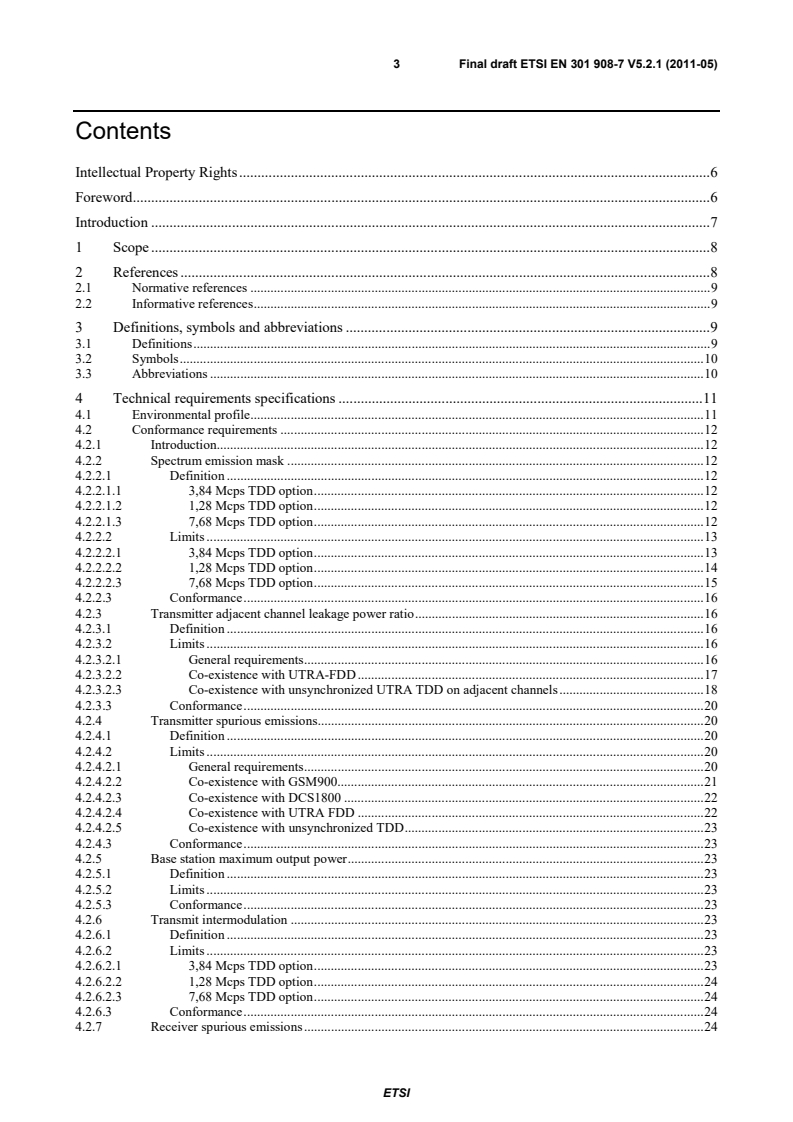
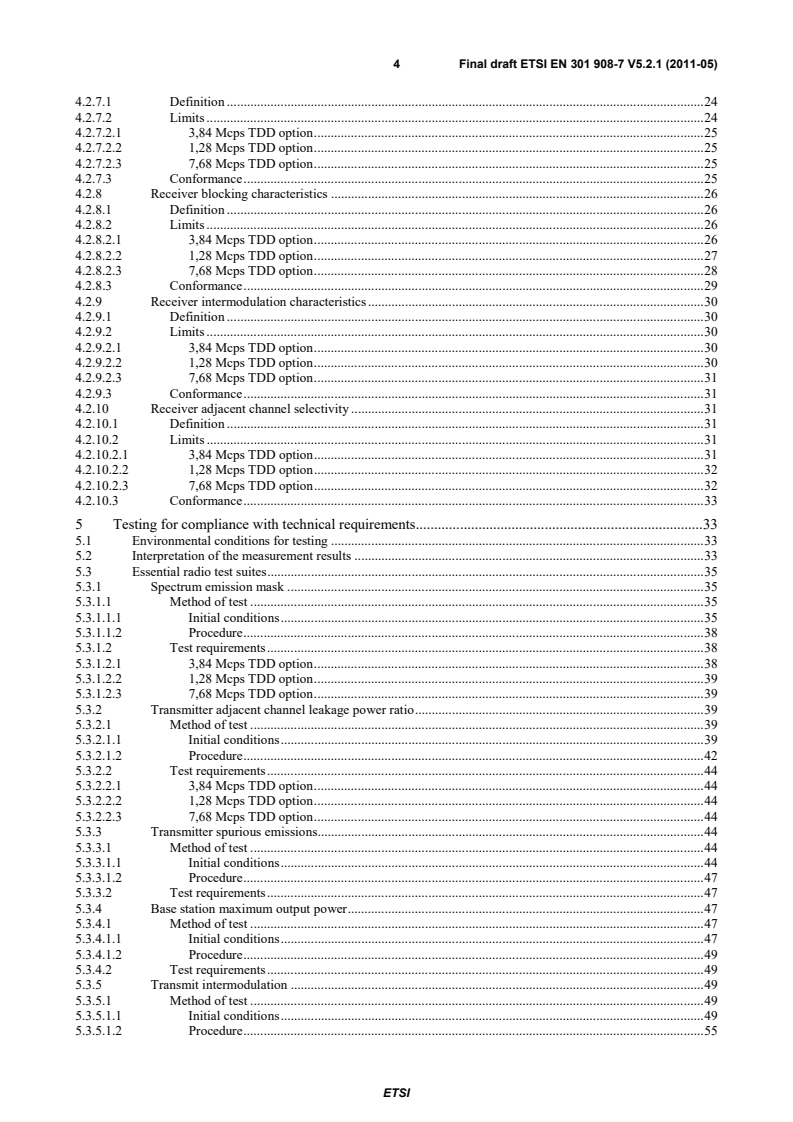
IMT cellular networks; Harmonized EN covering the essential requirements of article 3.2 of the R&TTE Directive; Part 7: CDMA TDD (UTRA TDD) Base Stations (BS)
General Information
- Abstract
REN/MSG-TFES-006-7
- Status
- Published
- Publication Date
- 20-Sep-2011
- Technical Committee
- MSG TFES - Task Force for European Standards for IMT-2000
- Current Stage
- 12 - Completion
- Due Date
- 18-Jul-2011
- Completion Date
- 19-Jul-2011
Buy Documents
en_30190807v050101c - Base Stations (BS), Repeaters and User Equipment (UE) for IMT-2000 Third-Generation cellular networks; Part 7: Harmonized EN for IMT-2000, CDMA TDD (UTRA TDD and E-UTRA TDD) (BS) covering the essential requirements of article 3.2 of the R&TTE Directive
en_30190807v050201p - IMT cellular networks; Harmonized EN covering the essential requirements of article 3.2 of the R&TTE Directive; Part 7: CDMA TDD (UTRA TDD) Base Stations (BS)
en_30190807v050201v - IMT cellular networks; Harmonized EN covering the essential requirements of article 3.2 of the R&TTE Directive; Part 7: CDMA TDD (UTRA TDD) Base Stations (BS)

Overview
ETSI EN 301 908-7 V5.2.1 (2011-07) is a harmonized European Standard (ETSI) that specifies radio technical requirements for IMT-2000 CDMA TDD (UTRA TDD) Base Stations (BS). It implements the essential requirement of Article 3.2 of the R&TTE Directive (1999/5/EC) - ensuring radio equipment “effectively uses the spectrum … so as to avoid harmful interference.” The standard applies to both Wide Area Base Stations and Local Area Base Stations and covers UTRA TDD options with chip rates of 3.84 Mcps, 1.28 Mcps and 7.68 Mcps, across the IMT frequency bands listed in the standard.
Key topics and technical requirements
This EN focuses on spectrum use, coexistence and radio performance. Major technical topics include:
- Spectrum emission mask requirements for the 3.84, 1.28 and 7.68 Mcps TDD options
- Transmitter adjacent channel leakage power ratio (ACLR) and coexistence rules (including coexistence with UTRA-FDD and unsynchronized TDD)
- Transmitter spurious emissions and specific coexistence limits with legacy systems (GSM900, DCS1800, UTRA-FDD)
- Base station maximum output power, transmit intermodulation and spurious limits
- Receiver characteristics: spurious emissions, blocking, intermodulation and adjacent channel selectivity
- Conformance and test methods, including environmental test profiles and essential radio test suites (measurement procedures and interpretation of results)
- Coverage across 3GPP Releases: the standard lists applicable requirements for Releases 99, 4–9 depending on the TDD option
These topics are defined with test methods and conformance criteria to demonstrate compliance with Article 3.2 spectrum-efficiency and interference-avoidance obligations.
Practical applications and users
Who uses this standard:
- Base station manufacturers designing and certifying UTRA TDD BS equipment for the European market
- Test laboratories conducting spectrum emission, ACLR, spurious emission and receiver performance tests
- Network operators and integrators validating site equipment for coexistence with existing networks (GSM, DCS, UTRA-FDD)
- Regulatory and compliance engineers demonstrating conformity with the R&TTE essential requirements
- Consultants and RF planners assessing interference risks and spectrum sharing strategies
Using this EN helps ensure interoperable, spectrum-efficient IMT cellular networks and smooth regulatory approvals.
Related standards
- Other parts of the EN 301 908 series (covering different IMT-2000 base station types and FDD modes) and additional ENs addressing other parts of Article 3 of the R&TTE Directive may apply to equipment within the scope of this document. For authoritative references consult ETSI and national standards bodies.
Buy Documents
en_30190807v050101c - Base Stations (BS), Repeaters and User Equipment (UE) for IMT-2000 Third-Generation cellular networks; Part 7: Harmonized EN for IMT-2000, CDMA TDD (UTRA TDD and E-UTRA TDD) (BS) covering the essential requirements of article 3.2 of the R&TTE Directive
en_30190807v050201p - IMT cellular networks; Harmonized EN covering the essential requirements of article 3.2 of the R&TTE Directive; Part 7: CDMA TDD (UTRA TDD) Base Stations (BS)
en_30190807v050201v - IMT cellular networks; Harmonized EN covering the essential requirements of article 3.2 of the R&TTE Directive; Part 7: CDMA TDD (UTRA TDD) Base Stations (BS)
Frequently Asked Questions
ETSI EN 301 908-7 V5.2.1 (2011-07) is a standard published by the European Telecommunications Standards Institute (ETSI). Its full title is "IMT cellular networks; Harmonized EN covering the essential requirements of article 3.2 of the R&TTE Directive; Part 7: CDMA TDD (UTRA TDD) Base Stations (BS)". This standard covers: REN/MSG-TFES-006-7
REN/MSG-TFES-006-7
ETSI EN 301 908-7 V5.2.1 (2011-07) is associated with the following European legislation: Standardization Mandates: M/284, M/406. When a standard is cited in the Official Journal of the European Union, products manufactured in conformity with it benefit from a presumption of conformity with the essential requirements of the corresponding EU directive or regulation.
ETSI EN 301 908-7 V5.2.1 (2011-07) is available in PDF format for immediate download after purchase. The document can be added to your cart and obtained through the secure checkout process. Digital delivery ensures instant access to the complete standard document.
Standards Content (Sample)
Draft ETSI EN 301 908-7 V5.1.1 (2010-10)
Harmonized European Standard (Telecommunications series)
Base Stations (BS), Repeaters and User Equipment (UE)
for IMT-2000 Third-Generation cellular networks;
Part 7: Harmonized EN for IMT-2000,
CDMA TDD (UTRA TDD and E-UTRA TDD) (BS)
covering the essential requirements
of article 3.2 of the R&TTE Directive
2 Draft ETSI EN 301 908-7 V5.1.1 (2010-10)
Reference
REN/MSG-TFES-006-7
Keywords
3G, 3GPP, cellular, digital, IMB, IMT-2000,
MBSFN, mobile, radio, regulation, TD-CDMA,
TDD, UMTS
ETSI
650 Route des Lucioles
F-06921 Sophia Antipolis Cedex - FRANCE
Tel.: +33 4 92 94 42 00 Fax: +33 4 93 65 47 16
Siret N° 348 623 562 00017 - NAF 742 C
Association à but non lucratif enregistrée à la
Sous-Préfecture de Grasse (06) N° 7803/88
Important notice
Individual copies of the present document can be downloaded from:
http://www.etsi.org
The present document may be made available in more than one electronic version or in print. In any case of existing or
perceived difference in contents between such versions, the reference version is the Portable Document Format (PDF).
In case of dispute, the reference shall be the printing on ETSI printers of the PDF version kept on a specific network drive
within ETSI Secretariat.
Users of the present document should be aware that the document may be subject to revision or change of status.
Information on the current status of this and other ETSI documents is available at
http://portal.etsi.org/tb/status/status.asp
If you find errors in the present document, please send your comment to one of the following services:
http://portal.etsi.org/chaircor/ETSI_support.asp
Copyright Notification
No part may be reproduced except as authorized by written permission.
The copyright and the foregoing restriction extend to reproduction in all media.
© European Telecommunications Standards Institute 2010.
All rights reserved.
TM TM TM TM
DECT , PLUGTESTS , UMTS , TIPHON , the TIPHON logo and the ETSI logo are Trade Marks of ETSI registered
for the benefit of its Members.
TM
3GPP is a Trade Mark of ETSI registered for the benefit of its Members and of the 3GPP Organizational Partners.
LTE™ is a Trade Mark of ETSI currently being registered
for the benefit of its Members and of the 3GPP Organizational Partners.
GSM® and the GSM logo are Trade Marks registered and owned by the GSM Association.
ETSI
3 Draft ETSI EN 301 908-7 V5.1.1 (2010-10)
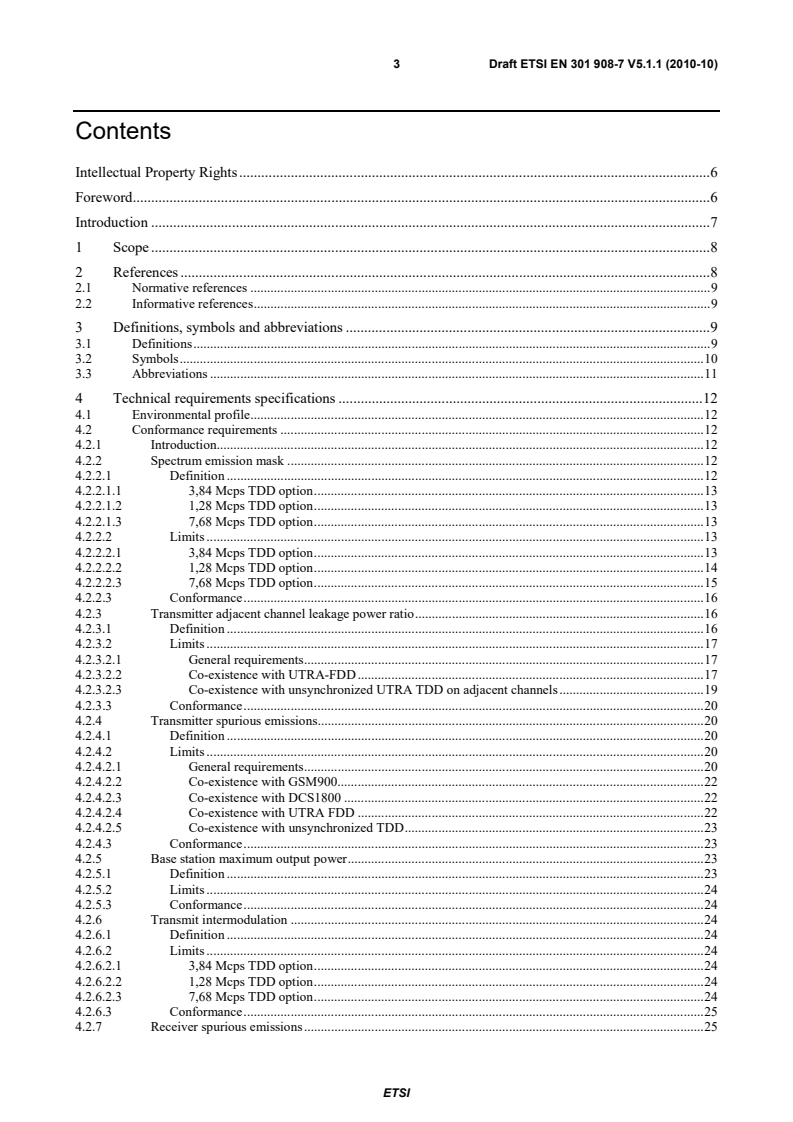
Contents
Intellectual Property Rights . 6
Foreword . 6
Introduction . 7
1 Scope . 8
2 References . 8
2.1 Normative references . 9
2.2 Informative references . 9
3 Definitions, symbols and abbreviations . 9
3.1 Definitions . 9
3.2 Symbols . 10
3.3 Abbreviations . 11
4 Technical requirements specifications . 12
4.1 Environmental profile . 12
4.2 Conformance requirements . 12
4.2.1 Introduction. 12
4.2.2 Spectrum emission mask . 12
4.2.2.1 Definition . 12
4.2.2.1.1 3,84 Mcps TDD option . 13
4.2.2.1.2 1,28 Mcps TDD option . 13
4.2.2.1.3 7,68 Mcps TDD option . 13
4.2.2.2 Limits . 13
4.2.2.2.1 3,84 Mcps TDD option . 13
4.2.2.2.2 1,28 Mcps TDD option . 14
4.2.2.2.3 7,68 Mcps TDD option . 15
4.2.2.3 Conformance . 16
4.2.3 Transmitter adjacent channel leakage power ratio . 16
4.2.3.1 Definition . 16
4.2.3.2 Limits . 17
4.2.3.2.1 General requirements . 17
4.2.3.2.2 Co-existence with UTRA-FDD . 17
4.2.3.2.3 Co-existence with unsynchronized UTRA TDD on adjacent channels . 19
4.2.3.3 Conformance . 20
4.2.4 Transmitter spurious emis sions . 20
4.2.4.1 Definition . 20
4.2.4.2 Limits . 20
4.2.4.2.1 General requirements . 20
4.2.4.2.2 Co-existence with GSM900. 22
4.2.4.2.3 Co-existence with DCS1800 . 22
4.2.4.2.4 Co-existence with UTRA FDD . 22
4.2.4.2.5 Co-existence with unsynchronized TDD . 23
4.2.4.3 Conformance . 23
4.2.5 Base station maximum output power . 23
4.2.5.1 Definition . 23
4.2.5.2 Limits . 24
4.2.5.3 Conformance . 24
4.2.6 Transmit intermodulation . 24
4.2.6.1 Definition . 24
4.2.6.2 Limits . 24
4.2.6.2.1 3,84 Mcps TDD option . 24
4.2.6.2.2 1,28 Mcps TDD option . 24
4.2.6.2.3 7,68 Mcps TDD option . 24
4.2.6.3 Conformance . 25
4.2.7 Receiver spurious emissions . 25
ETSI
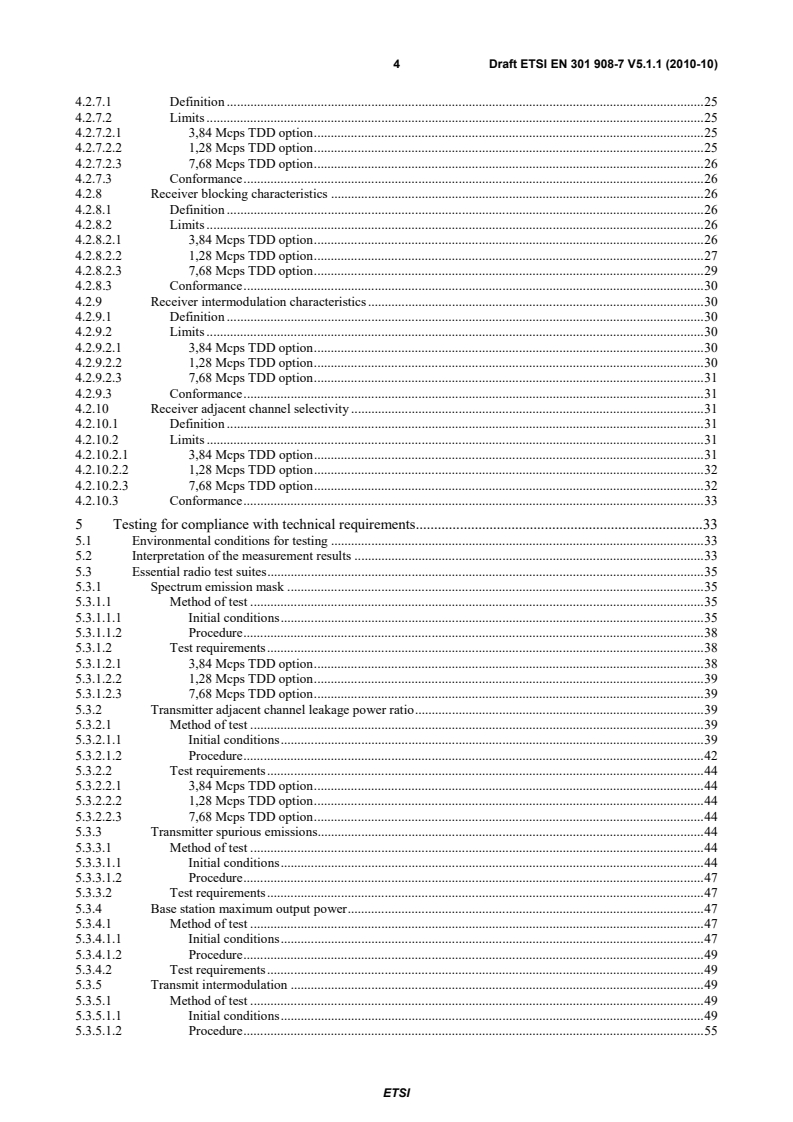
4 Draft ETSI EN 301 908-7 V5.1.1 (2010-10)
4.2.7.1 Definition . 25
4.2.7.2 Limits . 25
4.2.7.2.1 3,84 Mcps TDD option . 25
4.2.7.2.2 1,28 Mcps TDD option . 25
4.2.7.2.3 7,68 Mcps TDD option . 26
4.2.7.3 Conformance . 26
4.2.8 Receiver blocking characteristics . 26
4.2.8.1 Definition . 26
4.2.8.2 Limits . 26
4.2.8.2.1 3,84 Mcps TDD option . 26
4.2.8.2.2 1,28 Mcps TDD option . 27
4.2.8.2.3 7,68 Mcps TDD option . 29
4.2.8.3 Conformance . 30
4.2.9 Receiver intermodulation characteristics . 30
4.2.9.1 Definition . 30
4.2.9.2 Limits . 30
4.2.9.2.1 3,84 Mcps TDD option . 30
4.2.9.2.2 1,28 Mcps TDD option . 30
4.2.9.2.3 7,68 Mcps TDD option . 31
4.2.9.3 Conformance . 31
4.2.10 Receiver adjacent channel selectivity . 31
4.2.10.1 Definition . 31
4.2.10.2 Limits . 31
4.2.10.2.1 3,84 Mcps TDD option . 31
4.2.10.2.2 1,28 Mcps TDD option . 32
4.2.10.2.3 7,68 Mcps TDD option . 32
4.2.10.3 Conformance . 33
5 Testing for compliance with technical requirements . 33
5.1 Environmental conditions for testing . 33
5.2 Interpretation of the measurement results . 33
5.3 Essential radio test suites . 35
5.3.1 Spectrum emission mask . 35
5.3.1.1 Method of test . 35
5.3.1.1.1 Initial conditions . 35
5.3.1.1.2 Procedure . 38
5.3.1.2 Test requirements . 38
5.3.1.2.1 3,84 Mcps TDD option . 38
5.3.1.2.2 1,28 Mcps TDD option . 39
5.3.1.2.3 7,68 Mcps TDD option . 39
5.3.2 Transmitter adjacent channel leakage power ratio . 39
5.3.2.1 Method of test . 39
5.3.2.1.1 Initial conditions . 39
5.3.2.1.2 Procedure . 42
5.3.2.2 Test requirements . 44
5.3.2.2.1 3,84 Mcps TDD option . 44
5.3.2.2.2 1,28 Mcps TDD option . 44
5.3.2.2.3 7,68 Mcps TDD option . 44
5.3.3 Transmitter spurious emis sions . 44
5.3.3.1 Method of test . 44
5.3.3.1.1 Initial conditions . 44
5.3.3.1.2 Procedure . 47
5.3.3.2 Test requirements . 47
5.3.4 Base station maximum output power . 47
5.3.4.1 Method of test . 47
5.3.4.1.1 Initial conditions . 47
5.3.4.1.2 Procedure . 49
5.3.4.2 Test requirements . 49
5.3.5 Transmit intermodulation . 49
5.3.5.1 Method of test . 49
5.3.5.1.1 Initial conditions . 49
5.3.5.1.2 Procedure . 55
ETSI
5 Draft ETSI EN 301 908-7 V5.1.1 (2010-10)
5.3.5.2 Test requirements . 55
5.3.6 Receiver spurious emissions . 55
5.3.6.1 Method of test . 55
5.3.6.1.1 Initial conditions . 55
5.3.6.1.2 Procedure . 56
5.3.6.2 Test requirements . 58
5.3.7 Receiver blocking characteristics . 58
5.3.7.1 Method of test . 58
5.3.7.1.1 Initial conditions . 58
5.3.7.1.2 Procedure . 59
5.3.7.2 Test requirements . 60
5.3.8 Receiver intermodulation characteristics . 60
5.3.8.1 Method of test . 60
5.3.8.1.1 Initial conditions . 60
5.3.8.1.2 Procedure . 61
5.3.8.2 Test requirements . 61
5.3.9 Receiver adjacent channel selectivity . 61
5.3.9.1 Method of test . 61
5.3.9.1.1 Initial conditions . 61
5.3.9.1.2 Procedure . 63
5.3.9.1.3 Test requirements . 63
Annex A (normative): HS Requirements and conformance Test specifications Table
(HS-RTT) . 64
Annex B (normative): BS configurations . 66
B.1 Receiver Diversity . 66
B.2 Power Supply options . 66
B.3 Ancillary RF amplifiers . 66
B.4 BS using antenna arrays . 66
B.4.1 Receiver tests . 67
B.4.2 Transmitter tests . 67
Annex C (informative): Environmental profile specification . 68
Annex D (informative): The EN title in the official languages . 69
Annex E (informative): Bibliography . 70
History . 71
ETSI
6 Draft ETSI EN 301 908-7 V5.1.1 (2010-10)
Intellectual Property Rights
IPRs essential or potentially essential to the present document may have been declared to ETSI. The information
pertaining to these essential IPRs, if any, is publicly available for ETSI members and non-members, and can be found
in ETSI SR 000 314: "Intellectual Property Rights (IPRs); Essential, or potentially Essential, IPRs notified to ETSI in
respect of ETSI standards", which is available from the ETSI Secretariat. Latest updates are available on the ETSI Web
server (http://webapp.etsi.org/IPR/home.asp).
Pursuant to the ETSI IPR Policy, no investigation, including IPR searches, has been carried out by ETSI. No guarantee
can be given as to the existence of other IPRs not referenced in ETSI SR 000 314 (or the updates on the ETSI Web
server) which are, or may be, or may become, essential to the present document.
Foreword
This Harmonized European Standard (Telecommunications series) has been produced by ETSI Technical Committee
Mobile Standards Group (MSG), and is now submitted for the Public Enquiry phase of the ETSI standards Two-step
Approval Procedure.
The present document has been produced by ETSI in response to mandate M/284 from the European Commission
issued under Council Directive 98/34/EC [i.1] (as amended) laying down a procedure for the provision of information
in the field of technical standards and regulations.
The present document is intended to become a Harmonized Standard, the reference of which will be published in the
Official Journal of the European Union referencing the Directive 1999/5/EC [i.2] of the European Parliament and of the
Council of 9 March 1999 on radio equipment and telecommunications terminal equipment and the mutual recognition
of their conformity ("the R&TTE Directive").
The requirements relevant to Directive 1999/5/EC [i.2] are summarised in annex A.
The present document is part 7 of a multi-part deliverable covering the Base Stations (BS), Repeaters and User
Equipment (UE) for IMT-2000 Third-Generation cellular networks, as identified below:
Part 1: "Harmonized EN for IMT-2000, introduction and common requirements, covering the essential
requirements of article 3.2 of the R&TTE Directive";
Part 2: "Harmonized EN for IMT-2000, CDMA Direct Spread (UTRA FDD and E-UTRA FDD) (UE) covering
the essential requirements of article 3.2 of the R&TTE Directive";
Part 3: "Harmonized EN for IMT-2000, CDMA Direct Spread (UTRA FDD and E-UTRA FDD) (BS) covering
the essential requirements of article 3.2 of the R&TTE Directive";
Part 4: "Harmonized EN for IMT-2000, CDMA Multi-Carrier (cdma2000) and Evolved CDMA Multi-Carrier
Ultra Mobile Broadband (UMB) (UE) covering the essential requirements of article 3.2 of the R&TTE
Directive";
Part 5: "Harmonized EN for IMT-2000, CDMA Multi-Carrier (cdma2000) and Evolved CDMA Multi-Carrier
Ultra Mobile Broadband (UMB) (BS) covering the essential requirements of article 3.2 of the R&TTE
Directive";
Part 6: "Harmonized EN for IMT-2000, CDMA TDD (UTRA TDD and E-UTRA TDD) (UE) covering the
essential requirements of article 3.2 of the R&TTE Directive";
Part 7: "Harmonized EN for IMT-2000, CDMA TDD (UTRA TDD and E-UTRA TDD) (BS) covering the
essential requirements of article 3.2 of the R&TTE Directive";
Part 8: "Harmonized EN for IMT-2000, TDMA Single-Carrier (UWC 136) (UE) covering essential requirements
of article 3.2 of the R&TTE Directive";
Part 9: "Harmonized EN for IMT-2000, TDMA Single-Carrier (UWC 136) (BS) covering essential requirements
of article 3.2 of the R&TTE Directive";
ETSI
7 Draft ETSI EN 301 908-7 V5.1.1 (2010-10)
Part 10: "Harmonized EN for IMT-2000, FDMA/TDMA (DECT) covering essential requirements of article 3.2 of
the R&TTE Directive";
Part 11: "Harmonized EN for IMT-2000, CDMA Direct Spread (UTRA FDD and E-UTRA FDD) (Repeaters)
covering the essential requirements of article 3.2 of the R&TTE Directive";
Part 12: "Harmonized EN for IMT-2000, CDMA Multi-Carrier (cdma2000) (Repeaters) covering the essential
requirements of article 3.2 of the R&TTE Directive";
Part 13: "Harmonized EN for IMT-2000, Evolved Universal Terrestrial Radio Access (E-UTRA) (UE) covering
the essential requirements of article 3.2 of the R&TTE Directive";
Part 14: "Harmonized EN for IMT-2000, Evolved Universal Terrestrial Radio Access (E-UTRA) (BS) covering
the essential requirements of article 3.2 of the R&TTE Directive";
Part 15: "Harmonized EN for IMT-2000, Evolved Universal Terrestrial Radio Access (E-UTRA) (FDD
Repeaters) covering the essential requirements of article 3.2 of the R&TTE Directive";
Part 16: "Harmonized EN for IMT-2000, Evolved CDMA Multi-Carrier Ultra Mobile Broadband (UMB) (UE)
covering the essential requirements of article 3.2 of the R&TTE Directive";
Part 17: "Harmonized EN for IMT-2000, Evolved CDMA Multi-Carrier Ultra Mobile Broadband (UMB) (BS)
covering the essential requirements of article 3.2 of the R&TTE Directive";
Part 18: "Harmonized EN for Multi-Standard Radio (UTRA, E-UTRA, GSM/EDGE) Base Stations (BS) covering
the essential requirements of article 3.2 of the R&TTE Directive";
Part 19: "Harmonized EN for IMT-2000 OFDMA TDD WMAN (Mobile WiMAX) TDD User Equipment (UE)
covering the essential requirements of article 3.2 of the R&TTE Directive";
Part 20: "Harmonized EN for IMT-2000, OFDMA TDD WMAN (Mobile WiMAX) TDD Base Station (BS)
covering the essential requirements of article 3.2 of the R&TTE Directive";
Part 21: "Harmonized EN for IMT-2000, OFDMA TDD WMAN (Mobile WiMAX) FDD User Equipment (UE)
covering the essential requirements of article 3.2 of the R&TTE Directive";
Part 22: "Harmonized EN for IMT-2000, OFDMA TDD WMAN (Mobile WiMAX) FDD Base Stations (BS)
covering the essential requirements of article 3.2 of the R&TTE Directive".
Proposed national transposition dates
Date of latest announcement of this EN (doa): 3 months after ETSI publication
Date of latest publication of new National Standard
or endorsement of this EN (dop/e): 6 months after doa
Date of withdrawal of any conflicting National Standard (dow): 18 months after doa
Introduction
The present document is part of a set of standards developed by ETSI and is designed to fit in a modular structure to
cover all radio and telecommunications terminal equipment within the scope of the R&TTE Directive [i.2]. The
modular structure is shown in EG 201 399 [i.3].
ETSI
8 Draft ETSI EN 301 908-7 V5.1.1 (2010-10)
1 Scope
The present document applies to the following radio equipment type:
• Base stations for IMT-2000 CDMA TDD (UTRA TDD and E-UTRA TDD).
This radio equipment type is capable of operating in all or any part of the frequency bands given in table 1-1.
Table 1-1: CDMA TDD Base Station frequency bands
UTRA TDD Band Direction of transmission IMT-2000 CDMA TDD service operating
bands
Transmit and Receive 1 900 MHz to 1 920 MHz
a
Transmit and Receive 2 010 MHz to 2 025 MHz
d Transmit and Receive 2 570 MHz to 2 620 MHz
The requirements in the present document apply to both Wide Area Base Stations and Local Area Base Stations unless
otherwise stated.
The UTRA TDD component of IMT-2000 CDMA TDD supports three options of the TDD mode with the chip rates of
3,84 Mchip/s, 1,28 Mchip/s and 7,68 Mchip/s. These three options are called the 3,84 Mcps TDD option, the
1,28 Mchip/s TDD option and the 7,68 Mcps TDD option respectively. The requirements are listed in different clauses
only if the parameters deviate.
The present document covers requirements for:
• 3,84 Mcps TDD option Base Station for Releases 99, 4, 5, 6, 7, 8 and 9;
• 1,28 Mcps TDD option Base Stations for Releases 4, 5, 6, 7, 8 and 9;
• 7,68 Mcps TDD option Base Stations for Releases 7, 8 and 9;
• E-UTRA TDD Base Stations for Release 8 and 9.
For the case of IMB, only the 3,84Mcps UTRA TDD option shall apply.
For general purpose Base Stations of Releases 99 and 4 only the requirements for Wide Area Base Stations shall apply.
The present document is intended to cover the provisions of Directive 1999/5/EC [i.2] (R&TTE Directive) article 3.2,
which states that "… radio equipment shall be so constructed that it effectively uses the spectrum allocated to
terrestrial/space radio communications and orbital resources so as to avoid harmful interference".
In addition to the present document, other ENs that specify technical requirements in respect of essential requirements
under other parts of article 3 of the R&TTE Directive [i.2] may apply to equipment within the scope of the present
document.
NOTE: A list of such ENs is included on the web site: http://www.newapproach.org/.
2 References
References are either specific (identified by date of publication and/or edition number or version number) or
non-specific. For specific references, only the cited version applies. For non-specific references, the latest version of the
reference document (including any amendments) applies.
Referenced documents which are not found to be publicly available in the expected location might be found at
http://docbox.etsi.org/Reference.
NOTE: While any hyperlinks included in this clause were valid at the time of publication ETSI cannot guarantee
their long term validity.
ETSI
9 Draft ETSI EN 301 908-7 V5.1.1 (2010-10)
2.1 Normative references
The following referenced documents are necessary for the application of the present document.
[1] Void.
[2] ETSI TS 125 105 (V8.6.0): "Universal Mobile Telecommunications System (UMTS); Base
Station (BS) radio transmission and reception (TDD) (3GPP TS 25.105 version 8.6.0 Release 8)".
[3] ETSI TS 125 142 (V8.5.0): "Universal Mobile Telecommunications System (UMTS); Base
Station (BS) conformance testing (TDD) (3GPP TS 25.142 version 8.5.0 Release 8)".
[4] ITU-R Recommendation SM.329-10 (2003): "Unwanted emissions in the spurious domain".
[5] ETSI EN 301 908-1 (V5.1.1): "Electromagnetic compatibility and Radio spectrum Matters (ERM);
Base Stations (BS), Repeaters and User Equipment (UE) for IMT-2000 Third-Generation cellular
networks; Part 1: Harmonized EN for IMT-2000, introduction and common requirements,
covering the essential requirements of article 3.2 of the R&TTE Directive".
[6] ETSI EN 301 908-14 (V5.1.1): "Electromagnetic compatibility and Radio spectrum Matters
(ERM); Base Stations (BS), Repeaters and User Equipment (UE) for IMT-2000 Third-Generation
cellular networks; Part 14: Harmonized EN for IMT-2000, Evolved Universal Terrestrial Radio
Access (E-UTRA) (BS) covering the essential requirements of article 3.2 of the R&TTE
Directive".
2.2 Informative references
The following referenced documents are not necessary for the application of the present document but they assist the
user with regard to a particular subject area.
[i.1] Directive 98/34/EC of the European Parliament and of the Council of 22 June 1998 laying down a
procedure for the provision of information in the field of technical standards and regulations.
[i.2] Directive 1999/5/EC of the European Parliament and of the Council of 9 March 1999 on radio
equipment and telecommunications terminal equipment and the mutual recognition of their
conformity (R&TTE Directive).
[i.3] ETSI EG 201 399: "Electromagnetic compatibility and Radio spectrum Matters (ERM); A guide to
the production of Harmonized Standards for application under the R&TTE Directive".
[i.4] ETSI TR 100 028 (V1.4.1) (all parts): "Electromagnetic compatibility and Radio spectrum Matters
(ERM); Uncertainties in the measurement of mobile radio equipment characteristics".
3 Definitions, symbols and abbreviations
3.1 Definitions
For the purposes of the present document, the following terms and definitions apply:
ancillary RF amplifier: piece of equipment, which when connected by RF coaxial cables to the BS, has the primary
function to provide amplification between the transmit and/or receive antenna connector of a BS and an antenna without
requiring any control signal to fulfil its amplifying function
B: appropriate frequency in the Bottom of the operating frequency band of the BS: "RF channel"
Base Station class: wide area Base Station or local area Base Station, as declared by the manufacturer
chip rate: rate of "chips" (modulated symbols after spreading) per second
DPCHo: mechanism used to simulate an individual intracell interferer in the cell with one code and a spreading factor
of 16
ETSI
10 Draft ETSI EN 301 908-7 V5.1.1 (2010-10)
environmental profile: range of environmental conditions under which equipment within the scope of the present
document is required to comply with the provisions of the present document
F : frequency offset of the unwanted interfering signal from the assigned channel frequency of the wanted signal
uw
local area Base Station: Base Station, characterized by requirements derived from Pico Cell scenarios with a BS to UE
coupling loss equals to 45 dB
M: appropriate frequency in the Middle of the operating frequency band of the BS: "RF channel"
maximum output power (Pmax): mean power level per carrier of the Base Station measured at the antenna connector
in a specific reference condition, where the period of measurement shall be a transmit timeslot excluding the guard
period
MBSFN-only UE: UE operable in receive mode only (for the purpose of MBSFN reception)
mean power: when applied to a CDMA modulated signal this is the power (transmitted or received) in a bandwidth of
at least (1 + α) times the chip rate of the radio access mode, where the period of measurement shall be a transmit
timeslot excluding the guard period unless otherwise stated
operating band: frequency range that is defined with a specific set of technical requirements, in which UTRA TDD
operates
NOTE: The operating band(s) for a UTRA TDD BS is declared by the manufacturer according to the designations
in table 1-1. Operating bands for UTRA are designated with Roman numerals, while the corresponding
operating bands for E-UTRA are designated with Arabic numerals.
output power: mean power of one carrier of the Base Station, delivered to a load with resistance equal to the nominal
load impedance of the transmitter
RATed output Power (PRAT): mean power level per carrier that the manufacturer has declared to be available at the
antenna connector
RRC filtered mean power: mean power as measured through a root raised cosine filter with roll-off factor α and a
bandwidth equal to the chip rate of the radio access mode
T: appropriate frequency in the Top of the operating frequency band of the BS: "RF channel"
wide area Base Stations: Base Station, characterized by requirements derived from macrocell and microcell scenarios
with BS to UE coupling losses equal to 70 dB and 53 dB
3.2 Symbols
For the purposes of the present document, the following symbols apply:
α roll-off factor, α = 0,22
Ω electrical impedance
DPCH _ E
o c
ratio of the average transmits energy per PN chip for the DPCH to the total transmit power
o
I
or
spectral density in one time slot
F Frequency (of the assigned channel frequency of the wanted signal)
F the frequency offset of the unwanted interfering signal from the assigned channel frequency of the
uw
wanted signal
P power of the signal at antenna connector i
i
P sum of the power for all antenna connectors
s
ETSI
11 Draft ETSI EN 301 908-7 V5.1.1 (2010-10)
3.3 Abbreviations
For the purposes of the present document, the following abbreviations apply:
16QAM 16 - Quadrature Amplitude Modulation
rd
3GPP 3 Generation Partnership Project
ACLR Adjacent Channel Leakage power Ratio
ACS Adjacent Channel Selectivity
BER Bit Error Ratio
BS Base Station
BTS Base Transceiver Station
CDMA Code Division Multiple Access
CW Continuous Wave
NOTE: Unmodulated signal.
dB deciBel
dBm deciBel relative to 1 milliwatt
DC Direct Current
DCS Digital Cellular System
DL Down Link (forward link)
DPCH Dedicated Physical CHannel
DUT Device Under Test
EUT Equipment Under Test
E-UTRA Evolved Universal Terrestrial Radio Access
FDD Frequency Division Duplexing
GSM Global System for Mobile
HS-PDSCH High Speed Physical Downlink Shared Channel
IMB Integrated Mobile Broadcast
IMT-2000 International Mobile Telecommunications 2000
MBMS Multimedia Broadcast and Multicast Service
MBSFN MBMS over a Single Frequency Network
MS Mobile Station
P output Power
Pmax Maximum output power of the Base Station
PRAT RATed output Power of the Base Station
R&TTE Radio and Telecommunications Terminal Equipment
RF Radio Frequency
RMS Root-Mean Square
RRC Root-Raised Cosine
Rx Receiver
SCH Synchronization CHannel
TDD Time Division Duplexing
TRX Transmitter-Receiver
TS Time Slot
Tx Transmitter
UARFCN UTRA Absolute Radio Frequency Channel Number
UE User Equipment
UL Up Link (reverse link)
UMTS Universal Mobile Telecommunications System
UTRA Universal Terrestrial Radio Access
WCDMA Wideband Code Division Multiple Access
ETSI
12 Draft ETSI EN 301 908-7 V5.1.1 (2010-10)
4 Technical requirements specifications
4.1 Environmental profile
The technical requirements of the present document apply under the environmental profile for operation of the
equipment, which shall be declared by the supplier. The equipment shall comply with all the technical requirements of
the present document at all times when operating within the boundary limits of the required operational environmental
profile.
For guidance on how a supplier can declare the environmental profile see annex C.
4.2 Conformance requirements
This clause describes the conformance requirements for UTRA TDD. E-UTRA Base Station conformance requirements
are given in EN 301 908-14 [6].
4.2.1 Introduction
To meet the essential requirement under article 3.2 of the R&TTE Directive [i.2] for IMT-2000 Base Stations (BS)
seven essential parameters in addition to those in EN 301 908-1 [5] have been identified. Table 4.2.1-1 provides a cross
reference between these seven essential parameters and the corresponding nine technical requirements for equipment
within the scope of the present document.
To fulfil an essential parameter the compliance with all the corresponding technical requirements in table 4.2.1-1 must
be verified. For the case of an MBSFN-only BS the technical requirements in clauses 4.2.2, 4.2.3, 4.2.4, 4.2.5 and 4.2.6
shall apply.
Table 4.2.1-1: Cross references
Essential parameter Corresponding technical
...
Harmonized European Standard
IMT cellular networks;
Harmonized EN covering the essential requirements
of article 3.2 of the R&TTE Directive;
Part 7: CDMA TDD (UTRA TDD) Base Stations (BS)
2 ETSI EN 301 908-7 V5.2.1 (2011-07)
Reference
REN/MSG-TFES-006-7
Keywords
3G, 3GPP, cellular, digital, IMB, IMT, IMT-2000,
MBSFN, mobile, radio, regulation, TD-CDMA,
TDD, UMTS
ETSI
650 Route des Lucioles
F-06921 Sophia Antipolis Cedex - FRANCE
Tel.: +33 4 92 94 42 00 Fax: +33 4 93 65 47 16
Siret N° 348 623 562 00017 - NAF 742 C
Association à but non lucratif enregistrée à la
Sous-Préfecture de Grasse (06) N° 7803/88
Important notice
Individual copies of the present document can be downloaded from:
http://www.etsi.org
The present document may be made available in more than one electronic version or in print. In any case of existing or
perceived difference in contents between such versions, the reference version is the Portable Document Format (PDF).
In case of dispute, the reference shall be the printing on ETSI printers of the PDF version kept on a specific network drive
within ETSI Secretariat.
Users of the present document should be aware that the document may be subject to revision or change of status.
Information on the current status of this and other ETSI documents is available at
http://portal.etsi.org/tb/status/status.asp
If you find errors in the present document, please send your comment to one of the following services:
http://portal.etsi.org/chaircor/ETSI_support.asp
Copyright Notification
No part may be reproduced except as authorized by written permission.
The copyright and the foregoing restriction extend to reproduction in all media.
© European Telecommunications Standards Institute 2011.
All rights reserved.
TM TM TM
DECT , PLUGTESTS , UMTS and the ETSI logo are Trade Marks of ETSI registered for the benefit of its Members.
TM
3GPP and LTE™ are Trade Marks of ETSI registered for the benefit of its Members and
of the 3GPP Organizational Partners.
GSM® and the GSM logo are Trade Marks registered and owned by the GSM Association.
ETSI
3 ETSI EN 301 908-7 V5.2.1 (2011-07)
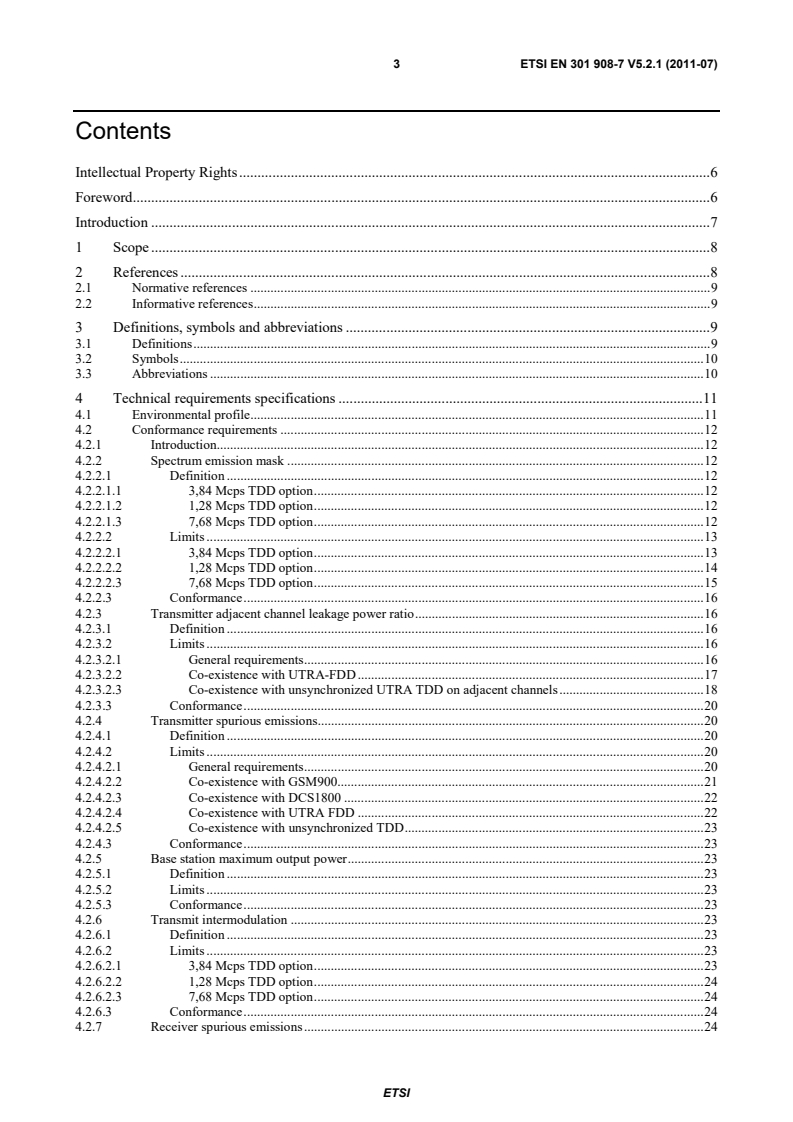
Contents
Intellectual Property Rights . 6
Foreword . 6
Introduction . 7
1 Scope . 8
2 References . 8
2.1 Normative references . 9
2.2 Informative references . 9
3 Definitions, symbols and abbreviations . 9
3.1 Definitions . 9
3.2 Symbols . 10
3.3 Abbreviations . 10
4 Technical requirements specifications . 11
4.1 Environmental profile . 11
4.2 Conformance requirements . 12
4.2.1 Introduction. 12
4.2.2 Spectrum emission mask . 12
4.2.2.1 Definition . 12
4.2.2.1.1 3,84 Mcps TDD option . 12
4.2.2.1.2 1,28 Mcps TDD option . 12
4.2.2.1.3 7,68 Mcps TDD option . 12
4.2.2.2 Limits . 13
4.2.2.2.1 3,84 Mcps TDD option . 13
4.2.2.2.2 1,28 Mcps TDD option . 14
4.2.2.2.3 7,68 Mcps TDD option . 15
4.2.2.3 Conformance . 16
4.2.3 Transmitter adjacent channel leakage power ratio . 16
4.2.3.1 Definition . 16
4.2.3.2 Limits . 16
4.2.3.2.1 General requirements . 16
4.2.3.2.2 Co-existence with UTRA-FDD . 17
4.2.3.2.3 Co-existence with unsynchronized UTRA TDD on adjacent channels . 18
4.2.3.3 Conformance . 20
4.2.4 Transmitter spurious emis sions . 20
4.2.4.1 Definition . 20
4.2.4.2 Limits . 20
4.2.4.2.1 General requirements . 20
4.2.4.2.2 Co-existence with GSM900. 21
4.2.4.2.3 Co-existence with DCS1800 . 22
4.2.4.2.4 Co-existence with UTRA FDD . 22
4.2.4.2.5 Co-existence with unsynchronized TDD . 23
4.2.4.3 Conformance . 23
4.2.5 Base station maximum output power . 23
4.2.5.1 Definition . 23
4.2.5.2 Limits . 23
4.2.5.3 Conformance . 23
4.2.6 Transmit intermodulation . 23
4.2.6.1 Definition . 23
4.2.6.2 Limits . 23
4.2.6.2.1 3,84 Mcps TDD option . 23
4.2.6.2.2 1,28 Mcps TDD option . 24
4.2.6.2.3 7,68 Mcps TDD option . 24
4.2.6.3 Conformance . 24
4.2.7 Receiver spurious emissions . 24
ETSI
4 ETSI EN 301 908-7 V5.2.1 (2011-07)
4.2.7.1 Definition . 24
4.2.7.2 Limits . 24
4.2.7.2.1 3,84 Mcps TDD option . 25
4.2.7.2.2 1,28 Mcps TDD option . 25
4.2.7.2.3 7,68 Mcps TDD option . 25
4.2.7.3 Conformance . 25
4.2.8 Receiver blocking characteristics . 26
4.2.8.1 Definition . 26
4.2.8.2 Limits . 26
4.2.8.2.1 3,84 Mcps TDD option . 26
4.2.8.2.2 1,28 Mcps TDD option . 27
4.2.8.2.3 7,68 Mcps TDD option . 28
4.2.8.3 Conformance . 29
4.2.9 Receiver intermodulation characteristics . 30
4.2.9.1 Definition . 30
4.2.9.2 Limits . 30
4.2.9.2.1 3,84 Mcps TDD option . 30
4.2.9.2.2 1,28 Mcps TDD option . 30
4.2.9.2.3 7,68 Mcps TDD option . 31
4.2.9.3 Conformance . 31
4.2.10 Receiver adjacent channel selectivity . 31
4.2.10.1 Definition . 31
4.2.10.2 Limits . 31
4.2.10.2.1 3,84 Mcps TDD option . 31
4.2.10.2.2 1,28 Mcps TDD option . 32
4.2.10.2.3 7,68 Mcps TDD option . 32
4.2.10.3 Conformance . 33
5 Testing for compliance with technical requirements . 33
5.1 Environmental conditions for testing . 33
5.2 Interpretation of the measurement results . 33
5.3 Essential radio test suites . 35
5.3.1 Spectrum emission mask . 35
5.3.1.1 Method of test . 35
5.3.1.1.1 Initial conditions . 35
5.3.1.1.2 Procedure . 38
5.3.1.2 Test requirements . 38
5.3.1.2.1 3,84 Mcps TDD option . 38
5.3.1.2.2 1,28 Mcps TDD option . 39
5.3.1.2.3 7,68 Mcps TDD option . 39
5.3.2 Transmitter adjacent channel leakage power ratio . 39
5.3.2.1 Method of test . 39
5.3.2.1.1 Initial conditions . 39
5.3.2.1.2 Procedure . 42
5.3.2.2 Test requirements . 44
5.3.2.2.1 3,84 Mcps TDD option . 44
5.3.2.2.2 1,28 Mcps TDD option . 44
5.3.2.2.3 7,68 Mcps TDD option . 44
5.3.3 Transmitter spurious emis sions . 44
5.3.3.1 Method of test . 44
5.3.3.1.1 Initial conditions . 44
5.3.3.1.2 Procedure . 47
5.3.3.2 Test requirements . 47
5.3.4 Base station maximum output power . 47
5.3.4.1 Method of test . 47
5.3.4.1.1 Initial conditions . 47
5.3.4.1.2 Procedure . 49
5.3.4.2 Test requirements . 49
5.3.5 Transmit intermodulation . 49
5.3.5.1 Method of test . 49
5.3.5.1.1 Initial conditions . 49
5.3.5.1.2 Procedure . 55
ETSI
5 ETSI EN 301 908-7 V5.2.1 (2011-07)
5.3.5.2 Test requirements . 55
5.3.6 Receiver spurious emissions . 55
5.3.6.1 Method of test . 55
5.3.6.1.1 Initial conditions . 55
5.3.6.1.2 Procedure . 56
5.3.6.2 Test requirements . 58
5.3.7 Receiver blocking characteristics . 58
5.3.7.1 Method of test . 58
5.3.7.1.1 Initial conditions . 58
5.3.7.1.2 Procedure . 59
5.3.7.2 Test requirements . 60
5.3.8 Receiver intermodulation characteristics . 60
5.3.8.1 Method of test . 60
5.3.8.1.1 Initial conditions . 60
5.3.8.1.2 Procedure . 61
5.3.8.2 Test requirements . 61
5.3.9 Receiver adjacent channel selectivity . 61
5.3.9.1 Method of test . 61
5.3.9.1.1 Initial conditions . 61
5.3.9.1.2 Procedure . 63
5.3.9.1.3 Test requirements . 63
Annex A (normative): HS Requirements and conformance Test specifications Table
(HS-RTT) . 64
Annex B (normative): BS configurations . 66
B.1 Receiver Diversity . 66
B.2 Power Supply options . 66
B.3 Ancillary RF amplifiers . 66
B.4 BS using antenna arrays . 66
B.4.1 Receiver tests . 67
B.4.2 Transmitter tests . 67
Annex C (informative): Environmental profile specification . 68
Annex D (informative): The EN title in the official languages . 69
Annex E (informative): Bibliography . 70
History . 71
ETSI
6 ETSI EN 301 908-7 V5.2.1 (2011-07)
Intellectual Property Rights
IPRs essential or potentially essential to the present document may have been declared to ETSI. The information
pertaining to these essential IPRs, if any, is publicly available for ETSI members and non-members, and can be found
in ETSI SR 000 314: "Intellectual Property Rights (IPRs); Essential, or potentially Essential, IPRs notified to ETSI in
respect of ETSI standards", which is available from the ETSI Secretariat. Latest updates are available on the ETSI Web
server (http://ipr.etsi.org).
Pursuant to the ETSI IPR Policy, no investigation, including IPR searches, has been carried out by ETSI. No guarantee
can be given as to the existence of other IPRs not referenced in ETSI SR 000 314 (or the updates on the ETSI Web
server) which are, or may be, or may become, essential to the present document.
Foreword
This Harmonized European Standard (EN) has been produced by ETSI Technical Committee Mobile Standards Group
(MSG).
The present document has been produced by ETSI in response to mandate M/284 from the European Commission
issued under Council Directive 98/34/EC [i.1] (as amended) laying down a procedure for the provision of information
in the field of technical standards and regulations.
The title and reference to the present document are intended to included in the publication in the Official Journal of the
European Union of titles and references of Harmonized Standard under the Directive 1999/5/EC [i.2].
See article 5.1 of Directive 1999/5/EC [i.2] for information on presumption of conformity and Harmonised Standards or
parts thereof the references of which have been published in the Official Journal of the European Union.
The requirements relevant to Directive 1999/5/EC [i.2] are summarised in annex A.
The present document is part 7 of a multi-part deliverable covering the essential requirements under article 3.2 of
Directive 1999/5/EC [i.2] (R&TTE Directive) for Base Stations (BS), Repeaters and User Equipment (UE) for IMT
cellular networks, as identified below:
Part 1: "Introduction and common requirements";
Part 2: "CDMA Direct Spread (UTRA FDD) User Equipment (UE)";
Part 3: "CDMA Direct Spread (UTRA FDD) Base Stations (BS)";
Part 4: "CDMA Multi-Carrier (cdma2000) User Equipment (UE)";
Part 5: "CDMA Multi-Carrier (cdma2000) Base Stations (BS)";
Part 6: "CDMA TDD (UTRA TDD) User Equipment (UE)";
Part 7: "CDMA TDD (UTRA TDD) Base Stations (BS)";
Part 8: "Harmonized EN for IMT-2000, TDMA Single-Carrier (UWC 136) (UE) covering essential requirements
of article 3.2 of the R&TTE Directive";
Part 9: "Harmonized EN for IMT-2000, TDMA Single-Carrier (UWC 136) (BS) covering essential requirements
of article 3.2 of the R&TTE Directive";
Part 10: "Harmonized EN for IMT-2000, FDMA/TDMA (DECT) covering essential requirements of article 3.2 of
the R&TTE Directive";
Part 11: "CDMA Direct Spread (UTRA FDD) (Repeaters)";
Part 12: "Harmonized EN for IMT-2000, CDMA Multi-Carrier (cdma2000) (Repeaters) covering the essential
requirements of article 3.2 of the R&TTE Directive";
Part 13: "Evolved Universal Terrestrial Radio Access (E-UTRA) User Equipment (UE)";
ETSI
7 ETSI EN 301 908-7 V5.2.1 (2011-07)
Part 14: "Evolved Universal Terrestrial Radio Access (E-UTRA) Base Stations (BS)";
Part 15: "Evolved Universal Terrestrial Radio Access (E-UTRA FDD) (Repeaters)";
Part 16: "Harmonized EN for IMT-2000, Evolved CDMA Multi-Carrier Ultra Mobile Broadband (UMB) (UE)
covering the essential requirements of article 3.2 of the R&TTE Directive";
Part 17: "Harmonized EN for IMT-2000, Evolved CDMA Multi-Carrier Ultra Mobile Broadband (UMB) (BS)
covering the essential requirements of article 3.2 of the R&TTE Directive";
Part 18: "E-UTRA, UTRA and GSM/EDGE Multi-Standard Radio (MSR) Base Station (BS)";
Part 19: "OFDMA TDD WMAN (Mobile WiMAX) TDD User Equipment (UE)";
Part 20: "OFDMA TDD WMAN (Mobile WiMAX) TDD Base Stations (BS)";
Part 21: "OFDMA TDD WMAN (Mobile WiMAX) FDD User Equipment (UE)";
Part 22: "OFDMA TDD WMAN (Mobile WiMAX) FDD Base Stations (BS)".
National transposition dates
Date of adoption of this EN: 4 July 2011
Date of latest announcement of this EN (doa): 31 October 2011
Date of latest publication of new National Standard
or endorsement of this EN (dop/e): 30 April 2012
Date of withdrawal of any conflicting National Standard (dow): 30 April 2013
Introduction
The present document is part of a set of standards developed by ETSI and is designed to fit in a modular structure to
cover all radio and telecommunications terminal equipment within the scope of the R&TTE Directive [i.2]. The
modular structure is shown in EG 201 399 [i.3].
ETSI
8 ETSI EN 301 908-7 V5.2.1 (2011-07)
1 Scope
The present document applies to the following radio equipment type:
• Base stations for IMT-2000 CDMA TDD (UTRA TDD).
This radio equipment type is capable of operating in all or any part of the frequency bands given in table 1-1.
Table 1-1: CDMA TDD Base Station frequency bands
UTRA TDD Band Direction of transmission IMT-2000 CDMA TDD service operating
bands
Transmit and Receive 1 900 MHz to 1 920 MHz
a
Transmit and Receive 2 010 MHz to 2 025 MHz
d Transmit and Receive 2 570 MHz to 2 620 MHz
The requirements in the present document apply to both Wide Area Base Stations and Local Area Base Stations unless
otherwise stated.
The UTRA TDD component of IMT-2000 CDMA TDD supports three options of the TDD mode with the chip rates of
3,84 Mchip/s, 1,28 Mchip/s and 7,68 Mchip/s. These three options are called the 3,84 Mcps TDD option, the
1,28 Mchip/s TDD option and the 7,68 Mcps TDD option respectively. The requirements are listed in different clauses
only if the parameters deviate.
The present document covers requirements for:
• 3,84 Mcps TDD option Base Station for Releases 99, 4, 5, 6, 7, 8 and 9;
• 1,28 Mcps TDD option Base Stations for Releases 4, 5, 6, 7, 8 and 9;
• 7,68 Mcps TDD option Base Stations for Releases 7, 8 and 9.
For the case of IMB, only the 3,84 Mcps UTRA TDD option applies.
For general purpose Base Stations of Releases 99 and 4 only the requirements for Wide Area Base Stations apply.
The present document is intended to cover the provisions of Directive 1999/5/EC [i.2] (R&TTE Directive) article 3.2,
which states that "… radio equipment shall be so constructed that it effectively uses the spectrum allocated to
terrestrial/space radio communications and orbital resources so as to avoid harmful interference".
In addition to the present document, other ENs that specify technical requirements in respect of essential requirements
under other parts of article 3 of the R&TTE Directive [i.2] may apply to equipment within the scope of the present
document.
NOTE: A list of such ENs is included on the web site: http://www.newapproach.org/.
2 References
References are either specific (identified by date of publication and/or edition number or version number) or
non-specific. For specific references, only the cited version applies. For non-specific references, the latest version of the
reference document (including any amendments) applies.
Referenced documents which are not found to be publicly available in the expected location might be found at
http://docbox.etsi.org/Reference.
NOTE: While any hyperlinks included in this clause were valid at the time of publication ETSI cannot guarantee
their long term validity.
ETSI
9 ETSI EN 301 908-7 V5.2.1 (2011-07)
2.1 Normative references
The following referenced documents are necessary for the application of the present document.
[1] Void.
[2] ETSI TS 125 105 (V9.2.0): "Universal Mobile Telecommunications System (UMTS); Base
Station (BS) radio transmission and reception (TDD) (3GPP TS 25.105 version 9.2.0 Release 9)".
[3] ETSI TS 125 142 (V9.4.0): "Universal Mobile Telecommunications System (UMTS); Base
Station (BS) conformance testing (TDD) (3GPP TS 25.142 version 9.4.0 Release 9)".
[4] ITU-R Recommendation SM.329-11 (2011): "Unwanted emissions in the spurious domain".
[5] ETSI EN 301 908-1 (V5.2.1): "IMT cellular networks; Harmonized EN covering the essential
requirements of article 3.2 of the R&TTE Directive Part 1: Introduction and common
requirements".
2.2 Informative references
The following referenced documents are not necessary for the application of the present document but they assist the
user with regard to a particular subject area.
[i.1] Directive 98/34/EC of the European Parliament and of the Council of 22 June 1998 laying down a
procedure for the provision of information in the field of technical standards and regulations.
[i.2] Directive 1999/5/EC of the European Parliament and of the Council of 9 March 1999 on radio
equipment and telecommunications terminal equipment and the mutual recognition of their
conformity (R&TTE Directive).
[i.3] ETSI EG 201 399: "Electromagnetic compatibility and Radio spectrum Matters (ERM); A guide to
the production of Harmonized Standards for application under the R&TTE Directive".
[i.4] ETSI TR 100 028 (V1.4.1) (all parts): "Electromagnetic compatibility and Radio spectrum Matters
(ERM); Uncertainties in the measurement of mobile radio equipment characteristics".
3 Definitions, symbols and abbreviations
3.1 Definitions
For the purposes of the present document, the following terms and definitions apply:
ancillary RF amplifier: piece of equipment, which when connected by RF coaxial cables to the BS, has the primary
function to provide amplification between the transmit and/or receive antenna connector of a BS and an antenna without
requiring any control signal to fulfil its amplifying function
B: appropriate frequency in the Bottom of the operating frequency band of the BS: "RF channel"
Base Station class: wide area Base Station or local area Base Station, as declared by the manufacturer
chip rate: rate of "chips" (modulated symbols after spreading) per second
DPCHo: mechanism used to simulate an individual intracell interferer in the cell with one code and a spreading factor
of 16
environmental profile: range of environmental conditions under which equipment within the scope of the present
document is required to comply with the provisions of the present document
F : frequency offset of the unwanted interfering signal from the assigned channel frequency of the wanted signal
uw
ETSI
10 ETSI EN 301 908-7 V5.2.1 (2011-07)
local area Base Station: Base Station, characterized by requirements derived from Pico Cell scenarios with a BS to UE
coupling loss equals to 45 dB
M: appropriate frequency in the Middle of the operating frequency band of the BS: "RF channel"
maximum output power (Pmax): mean power level per carrier of the Base Station measured at the antenna connector
in a specific reference condition, where the period of measurement is a transmit timeslot excluding the guard period
MBSFN-only UE: UE operable in receive mode only (for the purpose of MBSFN reception)
mean power: when applied to a CDMA modulated signal this is the power (transmitted or received) in a bandwidth of
at least (1 + α) times the chip rate of the radio access mode, where the period of measurement is a transmit timeslot
excluding the guard period unless otherwise stated
operating band: frequency range that is defined with a specific set of technical requirements, in which UTRA TDD
operates
NOTE: The operating band(s) for a UTRA TDD BS is declared by the manufacturer according to the designations
in table 1-1. Operating bands for UTRA are designated with Roman numerals, while the corresponding
operating bands for E-UTRA are designated with Arabic numerals.
output power: mean power of one carrier of the Base Station, delivered to a load with resistance equal to the nominal
load impedance of the transmitter
RATed output Power (PRAT): mean power level per carrier that the manufacturer has declared to be available at the
antenna connector
RRC filtered mean power: mean power as measured through a root raised cosine filter with roll-off factor α and a
bandwidth equal to the chip rate of the radio access mode
T: appropriate frequency in the Top of the operating frequency band of the BS: "RF channel"
wide area Base Stations: Base Station, characterized by requirements derived from macrocell and microcell scenarios
with BS to UE coupling losses equal to 70 dB and 53 dB
3.2 Symbols
For the purposes of the present document, the following symbols apply:
α roll-off factor, α = 0,22
Ω electrical impedance
DPCH _ E
o c
ratio of the average transmits energy per PN chip for the DPCH to the total transmit power
o
I
or
spectral density in one time slot
F Frequency (of the assigned channel frequency of the wanted signal)
F the frequency offset of the unwanted interfering signal from the assigned channel frequency of the
uw
wanted signal
P power of the signal at antenna connector i
i
P sum of the power for all antenna connectors
s
3.3 Abbreviations
For the purposes of the present document, the following abbreviations apply:
16QAM 16 - Quadrature Amplitude Modulation
rd
3GPP 3 Generation Partnership Project
ACLR Adjacent Channel Leakage power Ratio
ACS Adjacent Channel Selectivity
BER Bit Error Ratio
ETSI
11 ETSI EN 301 908-7 V5.2.1 (2011-07)
BS Base Station
BTS Base Transceiver Station
CDMA Code Division Multiple Access
CW Continuous Wave
NOTE: Unmodulated signal.
dB deciBel
dBm deciBel relative to 1 milliwatt
DC Direct Current
DCS Digital Cellular System
DL Down Link (forward link)
DPCH Dedicated Physical CHannel
DUT Device Under Test
ERM Electromagnetic compatibility and Radio spectrum Matters
EUT Equipment Under Test
E-UTRA Evolved Universal Terrestrial Radio Access
FDD Frequency Division Duplexing
GSM Global System for Mobile
HS-PDSCH High Speed Physical Downlink Shared Channel
IMB Integrated Mobile Broadcast
IMT-2000 International Mobile Telecommunications 2000
MBMS Multimedia Broadcast and Multicast Service
MBSFN MBMS over a Single Frequency Network
MS Mobile Station
MSG Mobile Standards Group
P output Power
Pmax Maximum output power of the Base Station
PRAT RATed output Power of the Base Station
R&TTE Radio and Telecommunications Terminal Equipment
RF Radio Frequency
RMS Root-Mean Square
RRC Root-Raised Cosine
Rx Receiver
SCH Synchronization CHannel
TDD Time Division Duplexing
TFES Task Force for European Standards for IMT
TRX Transmitter-Receiver
TS Time Slot
Tx Transmitter
UARFCN UTRA Absolute Radio Frequency Channel Number
UE User Equipment
UL Up Link (reverse link)
UMTS Universal Mobile Telecommunications System
UTRA Universal Terrestrial Radio Access
WCDMA Wideband Code Division Multiple Access
4 Technical requirements specifications
4.1 Environmental profile
The technical requirements of the present document apply under the environmental profile for operation of the
equipment, which shall be declared by the supplier. The equipment shall comply with all the technical requirements of
the present document at all times when operating within the boundary limits of the required operational environmental
profile.
For guidance on how a supplier can declare the environmental profile see annex C.
ETSI
12 ETSI EN 301 908-7 V5.2.1 (2011-07)
4.2 Conformance requirements
This clause describes the conformance requirements for UTRA TDD.
4.2.1 Introduction
To meet the essential requirement under article 3.2 of the R&TTE Directive [i.2] for IMT Base Stations (BS) seven
essential parameters in addition to those in EN 301 908-1 [5] have been identified. Table 4.2.1-1 provides a cross
reference between these seven essential parameters and the corresponding nine technical requirements for equipment
within the scope of the present document.
To fulfil an essential parameter the compliance with all the corresponding technical requirements in table 4.2.1-1 must
be verified. For the case of an MBSFN-only BS the technical requirements in clauses 4.2.2, 4.2.3, 4.2.4, 4.2.5 and 4.2.6
shall apply.
Table 4.2.1-1: Cross references
Essential parameter Corresponding technical requirements
Spectrum emissions mask 4.2.2 Spectrum emission mask
4.2.3 Transmitter Adjacent Channel Leakage power
Ratio (ACLR)
Conducted spurious emissions from the 4.2.4 Transmitter spurious emissions
transmitter antenna connector
Accuracy of maximum output power 4.2.5 Base station maximum output power
Intermodulation attenuation of the transmitter 4.2.6 Transmit intermodulation
Conducted spurious emissions from the receiver 4.2.7 Receiver spurious emissions
antenna connector
Impact of interference on receiver performance 4.2.8 Receiver blocking characteristics
4.2.9 Receiver intermodulation characteristics
Receiver adjacent channel selectivity 4.2.10 Receiver Adjacent Channel Selectivity (ACS)
The technical requirements in the present document apply for Base Stations supporting UTRA TDD. The technical
requirements also apply to the BS configurations described in annex B.
4.2.2 Spectrum emission mask
4.2.2.1 Definition
Spectrum emission mask defines an out of band emission requirement for the Base Station transmitter. These out of
band emissions are emissions immediately outside the channel bandwidth resulting from the modulation process and
non-linearity in the transmitter but excluding spurious emissions.
4.2.2.1.1 3,84 Mcps TDD option
The spectrum emission mask specifies the limit of the transmitter out of band emissions at frequency offsets from the
assigned channel frequency of the wanted signal between 2,5 MHz and 12,5 MHz.
4.2.2.1.2 1,28 Mcps TDD option
The spectrum emission mask specifies the limit of the transmitter out of band emissions at frequency offsets from the
assigned channel frequency of the wanted signal between 0,8 MHz and 4 MHz.
4.2.2.1.3 7,68 Mcps TDD option
The spectrum emission mask specifies the limit of the transmitter out of band emissions at frequency offsets from the
assigned channel frequency of the wanted signal between 5 MHz and 25 MHz.
ETSI
13 ETSI EN 301 908-7 V5.2.1 (2011-07)
4.2.2.2 Limits
4.2.2.2.1 3,84 Mcps TDD option
The requirement shall apply to both Wide Area BS and Local Area BS. The requirement shall be met by a Base Station
transmitting on a single RF carrier configured in accordance with the manufacturer's specification. Emissions shall not
exceed the maximum level specified in tables 4.2.2.2.1-1 to 4.2.2.2.1-4 in the frequency range of f_offset from
2 515 MHz to f_offset from the carrier frequency, where:
• f_offset is the separation between the carrier frequency and the centre frequency of the measuring filter;
...
Final draft ETSI EN 301 908-7 V5.2.1 (2011-05)
Harmonized European Standard
IMT cellular networks;
Harmonized EN covering the essential requirements
of article 3.2 of the R&TTE Directive;
Part 7: CDMA TDD (UTRA TDD) Base Stations (BS)
2 Final draft ETSI EN 301 908-7 V5.2.1 (2011-05)
Reference
REN/MSG-TFES-006-7
Keywords
3G, 3GPP, cellular, digital, IMB, IMT, IMT-2000,
MBSFN, mobile, radio, regulation, TD-CDMA,
TDD, UMTS
ETSI
650 Route des Lucioles
F-06921 Sophia Antipolis Cedex - FRANCE
Tel.: +33 4 92 94 42 00 Fax: +33 4 93 65 47 16
Siret N° 348 623 562 00017 - NAF 742 C
Association à but non lucratif enregistrée à la
Sous-Préfecture de Grasse (06) N° 7803/88
Important notice
Individual copies of the present document can be downloaded from:
http://www.etsi.org
The present document may be made available in more than one electronic version or in print. In any case of existing or
perceived difference in contents between such versions, the reference version is the Portable Document Format (PDF).
In case of dispute, the reference shall be the printing on ETSI printers of the PDF version kept on a specific network drive
within ETSI Secretariat.
Users of the present document should be aware that the document may be subject to revision or change of status.
Information on the current status of this and other ETSI documents is available at
http://portal.etsi.org/tb/status/status.asp
If you find errors in the present document, please send your comment to one of the following services:
http://portal.etsi.org/chaircor/ETSI_support.asp
Copyright Notification
No part may be reproduced except as authorized by written permission.
The copyright and the foregoing restriction extend to reproduction in all media.
© European Telecommunications Standards Institute 2011.
All rights reserved.
TM TM TM TM
DECT , PLUGTESTS , UMTS , TIPHON , the TIPHON logo and the ETSI logo are Trade Marks of ETSI registered
for the benefit of its Members.
TM
3GPP is a Trade Mark of ETSI registered for the benefit of its Members and of the 3GPP Organizational Partners.
LTE™ is a Trade Mark of ETSI currently being registered
for the benefit of its Members and of the 3GPP Organizational Partners.
GSM® and the GSM logo are Trade Marks registered and owned by the GSM Association.
ETSI
3 Final draft ETSI EN 301 908-7 V5.2.1 (2011-05)
Contents
Intellectual Property Rights . 6
Foreword . 6
Introduction . 7
1 Scope . 8
2 References . 8
2.1 Normative references . 9
2.2 Informative references . 9
3 Definitions, symbols and abbreviations . 9
3.1 Definitions . 9
3.2 Symbols . 10
3.3 Abbreviations . 10
4 Technical requirements specifications . 11
4.1 Environmental profile . 11
4.2 Conformance requirements . 12
4.2.1 Introduction. 12
4.2.2 Spectrum emission mask . 12
4.2.2.1 Definition . 12
4.2.2.1.1 3,84 Mcps TDD option . 12
4.2.2.1.2 1,28 Mcps TDD option . 12
4.2.2.1.3 7,68 Mcps TDD option . 12
4.2.2.2 Limits . 13
4.2.2.2.1 3,84 Mcps TDD option . 13
4.2.2.2.2 1,28 Mcps TDD option . 14
4.2.2.2.3 7,68 Mcps TDD option . 15
4.2.2.3 Conformance . 16
4.2.3 Transmitter adjacent channel leakage power ratio . 16
4.2.3.1 Definition . 16
4.2.3.2 Limits . 16
4.2.3.2.1 General requirements . 16
4.2.3.2.2 Co-existence with UTRA-FDD . 17
4.2.3.2.3 Co-existence with unsynchronized UTRA TDD on adjacent channels . 18
4.2.3.3 Conformance . 20
4.2.4 Transmitter spurious emis sions . 20
4.2.4.1 Definition . 20
4.2.4.2 Limits . 20
4.2.4.2.1 General requirements . 20
4.2.4.2.2 Co-existence with GSM900. 21
4.2.4.2.3 Co-existence with DCS1800 . 22
4.2.4.2.4 Co-existence with UTRA FDD . 22
4.2.4.2.5 Co-existence with unsynchronized TDD . 23
4.2.4.3 Conformance . 23
4.2.5 Base station maximum output power . 23
4.2.5.1 Definition . 23
4.2.5.2 Limits . 23
4.2.5.3 Conformance . 23
4.2.6 Transmit intermodulation . 23
4.2.6.1 Definition . 23
4.2.6.2 Limits . 23
4.2.6.2.1 3,84 Mcps TDD option . 23
4.2.6.2.2 1,28 Mcps TDD option . 24
4.2.6.2.3 7,68 Mcps TDD option . 24
4.2.6.3 Conformance . 24
4.2.7 Receiver spurious emissions . 24
ETSI
4 Final draft ETSI EN 301 908-7 V5.2.1 (2011-05)
4.2.7.1 Definition . 24
4.2.7.2 Limits . 24
4.2.7.2.1 3,84 Mcps TDD option . 25
4.2.7.2.2 1,28 Mcps TDD option . 25
4.2.7.2.3 7,68 Mcps TDD option . 25
4.2.7.3 Conformance . 25
4.2.8 Receiver blocking characteristics . 26
4.2.8.1 Definition . 26
4.2.8.2 Limits . 26
4.2.8.2.1 3,84 Mcps TDD option . 26
4.2.8.2.2 1,28 Mcps TDD option . 27
4.2.8.2.3 7,68 Mcps TDD option . 28
4.2.8.3 Conformance . 29
4.2.9 Receiver intermodulation characteristics . 30
4.2.9.1 Definition . 30
4.2.9.2 Limits . 30
4.2.9.2.1 3,84 Mcps TDD option . 30
4.2.9.2.2 1,28 Mcps TDD option . 30
4.2.9.2.3 7,68 Mcps TDD option . 31
4.2.9.3 Conformance . 31
4.2.10 Receiver adjacent channel selectivity . 31
4.2.10.1 Definition . 31
4.2.10.2 Limits . 31
4.2.10.2.1 3,84 Mcps TDD option . 31
4.2.10.2.2 1,28 Mcps TDD option . 32
4.2.10.2.3 7,68 Mcps TDD option . 32
4.2.10.3 Conformance . 33
5 Testing for compliance with technical requirements . 33
5.1 Environmental conditions for testing . 33
5.2 Interpretation of the measurement results . 33
5.3 Essential radio test suites . 35
5.3.1 Spectrum emission mask . 35
5.3.1.1 Method of test . 35
5.3.1.1.1 Initial conditions . 35
5.3.1.1.2 Procedure . 38
5.3.1.2 Test requirements . 38
5.3.1.2.1 3,84 Mcps TDD option . 38
5.3.1.2.2 1,28 Mcps TDD option . 39
5.3.1.2.3 7,68 Mcps TDD option . 39
5.3.2 Transmitter adjacent channel leakage power ratio . 39
5.3.2.1 Method of test . 39
5.3.2.1.1 Initial conditions . 39
5.3.2.1.2 Procedure . 42
5.3.2.2 Test requirements . 44
5.3.2.2.1 3,84 Mcps TDD option . 44
5.3.2.2.2 1,28 Mcps TDD option . 44
5.3.2.2.3 7,68 Mcps TDD option . 44
5.3.3 Transmitter spurious emis sions . 44
5.3.3.1 Method of test . 44
5.3.3.1.1 Initial conditions . 44
5.3.3.1.2 Procedure . 47
5.3.3.2 Test requirements . 47
5.3.4 Base station maximum output power . 47
5.3.4.1 Method of test . 47
5.3.4.1.1 Initial conditions . 47
5.3.4.1.2 Procedure . 49
5.3.4.2 Test requirements . 49
5.3.5 Transmit intermodulation . 49
5.3.5.1 Method of test . 49
5.3.5.1.1 Initial conditions . 49
5.3.5.1.2 Procedure . 55
ETSI
5 Final draft ETSI EN 301 908-7 V5.2.1 (2011-05)
5.3.5.2 Test requirements . 55
5.3.6 Receiver spurious emissions . 55
5.3.6.1 Method of test . 55
5.3.6.1.1 Initial conditions . 55
5.3.6.1.2 Procedure . 56
5.3.6.2 Test requirements . 58
5.3.7 Receiver blocking characteristics . 58
5.3.7.1 Method of test . 58
5.3.7.1.1 Initial conditions . 58
5.3.7.1.2 Procedure . 59
5.3.7.2 Test requirements . 60
5.3.8 Receiver intermodulation characteristics . 60
5.3.8.1 Method of test . 60
5.3.8.1.1 Initial conditions . 60
5.3.8.1.2 Procedure . 61
5.3.8.2 Test requirements . 61
5.3.9 Receiver adjacent channel selectivity . 61
5.3.9.1 Method of test . 61
5.3.9.1.1 Initial conditions . 61
5.3.9.1.2 Procedure . 63
5.3.9.1.3 Test requirements . 63
Annex A (normative): HS Requirements and conformance Test specifications Table
(HS-RTT) . 64
Annex B (normative): BS configurations . 66
B.1 Receiver Diversity . 66
B.2 Power Supply options . 66
B.3 Ancillary RF amplifiers . 66
B.4 BS using antenna arrays . 66
B.4.1 Receiver tests . 67
B.4.2 Transmitter tests . 67
Annex C (informative): Environmental profile specification . 68
Annex D (informative): The EN title in the official languages . 69
Annex E (informative): Bibliography . 70
History . 71
ETSI
6 Final draft ETSI EN 301 908-7 V5.2.1 (2011-05)
Intellectual Property Rights
IPRs essential or potentially essential to the present document may have been declared to ETSI. The information
pertaining to these essential IPRs, if any, is publicly available for ETSI members and non-members, and can be found
in ETSI SR 000 314: "Intellectual Property Rights (IPRs); Essential, or potentially Essential, IPRs notified to ETSI in
respect of ETSI standards", which is available from the ETSI Secretariat. Latest updates are available on the ETSI Web
server (http://webapp.etsi.org/IPR/home.asp).
Pursuant to the ETSI IPR Policy, no investigation, including IPR searches, has been carried out by ETSI. No guarantee
can be given as to the existence of other IPRs not referenced in ETSI SR 000 314 (or the updates on the ETSI Web
server) which are, or may be, or may become, essential to the present document.
Foreword
This final draft Harmonized European Standard (EN) has been produced by ETSI Technical Committee Mobile
Standards Group (MSG), and is now submitted for the Vote phase of the ETSI standards Two-step Approval Procedure.
The present document has been produced by ETSI in response to mandate M/284 from the European Commission
issued under Council Directive 98/34/EC [i.1] (as amended) laying down a procedure for the provision of information
in the field of technical standards and regulations.
The title and reference to the present document are intended to included in the publication in the Official Journal of the
European Union of titles and references of Harmonized Standard under the Directive 1999/5/EC [i.2].
See article 5.1 of Directive 1999/5/EC [i.2] for information on presumption of conformity and Harmonised Standards or
parts thereof the references of which have been published in the Official Journal of the European Union.
The requirements relevant to Directive 1999/5/EC [i.2] are summarised in annex A.
The present document is part 7 of a multi-part deliverable covering the essential requirements under article 3.2 of
Directive 1999/5/EC [i.2] (R&TTE Directive) for Base Stations (BS), Repeaters and User Equipment (UE) for IMT
cellular networks, as identified below:
Part 1: "Introduction and common requirements";
Part 2: "CDMA Direct Spread (UTRA FDD) User Equipment (UE)";
Part 3: "CDMA Direct Spread (UTRA FDD) Base Stations (BS)";
Part 4: "CDMA Multi-Carrier (cdma2000) User Equipment (UE)";
Part 5: "CDMA Multi-Carrier (cdma2000) Base Stations (BS)";
Part 6: "CDMA TDD (UTRA TDD) User Equipment (UE)";
Part 7: "CDMA TDD (UTRA TDD) Base Stations (BS)";
Part 8: "Harmonized EN for IMT-2000, TDMA Single-Carrier (UWC 136) (UE) covering essential requirements
of article 3.2 of the R&TTE Directive";
Part 9: "Harmonized EN for IMT-2000, TDMA Single-Carrier (UWC 136) (BS) covering essential requirements
of article 3.2 of the R&TTE Directive";
Part 10: "Harmonized EN for IMT-2000, FDMA/TDMA (DECT) covering essential requirements of article 3.2 of
the R&TTE Directive";
Part 11: "CDMA Direct Spread (UTRA FDD) (Repeaters)";
Part 12: "Harmonized EN for IMT-2000, CDMA Multi-Carrier (cdma2000) (Repeaters) covering the essential
requirements of article 3.2 of the R&TTE Directive";
Part 13: "Evolved Universal Terrestrial Radio Access (E-UTRA) User Equipment (UE)";
ETSI
7 Final draft ETSI EN 301 908-7 V5.2.1 (2011-05)
Part 14: "Evolved Universal Terrestrial Radio Access (E-UTRA) Base Stations (BS)";
Part 15: "Evolved Universal Terrestrial Radio Access (E-UTRA FDD) (Repeaters)";
Part 16: "Harmonized EN for IMT-2000, Evolved CDMA Multi-Carrier Ultra Mobile Broadband (UMB) (UE)
covering the essential requirements of article 3.2 of the R&TTE Directive";
Part 17: "Harmonized EN for IMT-2000, Evolved CDMA Multi-Carrier Ultra Mobile Broadband (UMB) (BS)
covering the essential requirements of article 3.2 of the R&TTE Directive";
Part 18: "E-UTRA, UTRA and GSM/EDGE Multi-Standard Radio (MSR) Base Station (BS)";
Part 19: "OFDMA TDD WMAN (Mobile WiMAX) TDD User Equipment (UE)";
Part 20: "OFDMA TDD WMAN (Mobile WiMAX) TDD Base Stations (BS)";
Part 21: "OFDMA TDD WMAN (Mobile WiMAX) FDD User Equipment (UE)";
Part 22: "OFDMA TDD WMAN (Mobile WiMAX) FDD Base Stations (BS)".
Proposed national transposition dates
Date of latest announcement of this EN (doa): 3 months after ETSI publication
Date of latest publication of new National Standard
or endorsement of this EN (dop/e): 6 months after doa
Date of withdrawal of any conflicting National Standard (dow): 18 months after doa
Introduction
The present document is part of a set of standards developed by ETSI and is designed to fit in a modular structure to
cover all radio and telecommunications terminal equipment within the scope of the R&TTE Directive [i.2]. The
modular structure is shown in EG 201 399 [i.3].
ETSI
8 Final draft ETSI EN 301 908-7 V5.2.1 (2011-05)
1 Scope
The present document applies to the following radio equipment type:
• Base stations for IMT-2000 CDMA TDD (UTRA TDD).
This radio equipment type is capable of operating in all or any part of the frequency bands given in table 1-1.
Table 1-1: CDMA TDD Base Station frequency bands
UTRA TDD Band Direction of transmission IMT-2000 CDMA TDD service operating
bands
Transmit and Receive 1 900 MHz to 1 920 MHz
a
Transmit and Receive 2 010 MHz to 2 025 MHz
d Transmit and Receive 2 570 MHz to 2 620 MHz
The requirements in the present document apply to both Wide Area Base Stations and Local Area Base Stations unless
otherwise stated.
The UTRA TDD component of IMT-2000 CDMA TDD supports three options of the TDD mode with the chip rates of
3,84 Mchip/s, 1,28 Mchip/s and 7,68 Mchip/s. These three options are called the 3,84 Mcps TDD option, the
1,28 Mchip/s TDD option and the 7,68 Mcps TDD option respectively. The requirements are listed in different clauses
only if the parameters deviate.
The present document covers requirements for:
• 3,84 Mcps TDD option Base Station for Releases 99, 4, 5, 6, 7, 8 and 9;
• 1,28 Mcps TDD option Base Stations for Releases 4, 5, 6, 7, 8 and 9;
• 7,68 Mcps TDD option Base Stations for Releases 7, 8 and 9.
For the case of IMB, only the 3,84 Mcps UTRA TDD option applies.
For general purpose Base Stations of Releases 99 and 4 only the requirements for Wide Area Base Stations apply.
The present document is intended to cover the provisions of Directive 1999/5/EC [i.2] (R&TTE Directive) article 3.2,
which states that "… radio equipment shall be so constructed that it effectively uses the spectrum allocated to
terrestrial/space radio communications and orbital resources so as to avoid harmful interference".
In addition to the present document, other ENs that specify technical requirements in respect of essential requirements
under other parts of article 3 of the R&TTE Directive [i.2] may apply to equipment within the scope of the present
document.
NOTE: A list of such ENs is included on the web site: http://www.newapproach.org/.
2 References
References are either specific (identified by date of publication and/or edition number or version number) or
non-specific. For specific references, only the cited version applies. For non-specific references, the latest version of the
reference document (including any amendments) applies.
Referenced documents which are not found to be publicly available in the expected location might be found at
http://docbox.etsi.org/Reference.
NOTE: While any hyperlinks included in this clause were valid at the time of publication ETSI cannot guarantee
their long term validity.
ETSI
9 Final draft ETSI EN 301 908-7 V5.2.1 (2011-05)
2.1 Normative references
The following referenced documents are necessary for the application of the present document.
[1] Void.
[2] ETSI TS 125 105 (V9.2.0): "Universal Mobile Telecommunications System (UMTS); Base
Station (BS) radio transmission and reception (TDD) (3GPP TS 25.105 version 9.2.0 Release 9)".
[3] ETSI TS 125 142 (V9.4.0): "Universal Mobile Telecommunications System (UMTS); Base
Station (BS) conformance testing (TDD) (3GPP TS 25.142 version 9.4.0 Release 9)".
[4] ITU-R Recommendation SM.329-11 (2011): "Unwanted emissions in the spurious domain".
[5] ETSI EN 301 908-1 (V5.2.1): "IMT cellular networks; Harmonized EN covering the essential
requirements of article 3.2 of the R&TTE Directive Part 1: Introduction and common
requirements".
2.2 Informative references
The following referenced documents are not necessary for the application of the present document but they assist the
user with regard to a particular subject area.
[i.1] Directive 98/34/EC of the European Parliament and of the Council of 22 June 1998 laying down a
procedure for the provision of information in the field of technical standards and regulations.
[i.2] Directive 1999/5/EC of the European Parliament and of the Council of 9 March 1999 on radio
equipment and telecommunications terminal equipment and the mutual recognition of their
conformity (R&TTE Directive).
[i.3] ETSI EG 201 399: "Electromagnetic compatibility and Radio spectrum Matters (ERM); A guide to
the production of Harmonized Standards for application under the R&TTE Directive".
[i.4] ETSI TR 100 028 (V1.4.1) (all parts): "Electromagnetic compatibility and Radio spectrum Matters
(ERM); Uncertainties in the measurement of mobile radio equipment characteristics".
3 Definitions, symbols and abbreviations
3.1 Definitions
For the purposes of the present document, the following terms and definitions apply:
ancillary RF amplifier: piece of equipment, which when connected by RF coaxial cables to the BS, has the primary
function to provide amplification between the transmit and/or receive antenna connector of a BS and an antenna without
requiring any control signal to fulfil its amplifying function
B: appropriate frequency in the Bottom of the operating frequency band of the BS: "RF channel"
Base Station class: wide area Base Station or local area Base Station, as declared by the manufacturer
chip rate: rate of "chips" (modulated symbols after spreading) per second
DPCHo: mechanism used to simulate an individual intracell interferer in the cell with one code and a spreading factor
of 16
environmental profile: range of environmental conditions under which equipment within the scope of the present
document is required to comply with the provisions of the present document
F : frequency offset of the unwanted interfering signal from the assigned channel frequency of the wanted signal
uw
ETSI
10 Final draft ETSI EN 301 908-7 V5.2.1 (2011-05)
local area Base Station: Base Station, characterized by requirements derived from Pico Cell scenarios with a BS to UE
coupling loss equals to 45 dB
M: appropriate frequency in the Middle of the operating frequency band of the BS: "RF channel"
maximum output power (Pmax): mean power level per carrier of the Base Station measured at the antenna connector
in a specific reference condition, where the period of measurement is a transmit timeslot excluding the guard period
MBSFN-only UE: UE operable in receive mode only (for the purpose of MBSFN reception)
mean power: when applied to a CDMA modulated signal this is the power (transmitted or received) in a bandwidth of
at least (1 + α) times the chip rate of the radio access mode, where the period of measurement is a transmit timeslot
excluding the guard period unless otherwise stated
operating band: frequency range that is defined with a specific set of technical requirements, in which UTRA TDD
operates
NOTE: The operating band(s) for a UTRA TDD BS is declared by the manufacturer according to the designations
in table 1-1. Operating bands for UTRA are designated with Roman numerals, while the corresponding
operating bands for E-UTRA are designated with Arabic numerals.
output power: mean power of one carrier of the Base Station, delivered to a load with resistance equal to the nominal
load impedance of the transmitter
RATed output Power (PRAT): mean power level per carrier that the manufacturer has declared to be available at the
antenna connector
RRC filtered mean power: mean power as measured through a root raised cosine filter with roll-off factor α and a
bandwidth equal to the chip rate of the radio access mode
T: appropriate frequency in the Top of the operating frequency band of the BS: "RF channel"
wide area Base Stations: Base Station, characterized by requirements derived from macrocell and microcell scenarios
with BS to UE coupling losses equal to 70 dB and 53 dB
3.2 Symbols
For the purposes of the present document, the following symbols apply:
α roll-off factor, α = 0,22
Ω electrical impedance
DPCH _ E
o c
ratio of the average transmits energy per PN chip for the DPCH to the total transmit power
o
I
or
spectral density in one time slot
F Frequency (of the assigned channel frequency of the wanted signal)
F the frequency offset of the unwanted interfering signal from the assigned channel frequency of the
uw
wanted signal
P power of the signal at antenna connector i
i
P sum of the power for all antenna connectors
s
3.3 Abbreviations
For the purposes of the present document, the following abbreviations apply:
16QAM 16 - Quadrature Amplitude Modulation
rd
3GPP 3 Generation Partnership Project
ACLR Adjacent Channel Leakage power Ratio
ACS Adjacent Channel Selectivity
BER Bit Error Ratio
ETSI
11 Final draft ETSI EN 301 908-7 V5.2.1 (2011-05)
BS Base Station
BTS Base Transceiver Station
CDMA Code Division Multiple Access
CW Continuous Wave
NOTE: Unmodulated signal.
dB deciBel
dBm deciBel relative to 1 milliwatt
DC Direct Current
DCS Digital Cellular System
DL Down Link (forward link)
DPCH Dedicated Physical CHannel
DUT Device Under Test
ERM Electromagnetic compatibility and Radio spectrum Matters
EUT Equipment Under Test
E-UTRA Evolved Universal Terrestrial Radio Access
FDD Frequency Division Duplexing
GSM Global System for Mobile
HS-PDSCH High Speed Physical Downlink Shared Channel
IMB Integrated Mobile Broadcast
IMT-2000 International Mobile Telecommunications 2000
MBMS Multimedia Broadcast and Multicast Service
MBSFN MBMS over a Single Frequency Network
MS Mobile Station
MSG Mobile Standards Group
P output Power
Pmax Maximum output power of the Base Station
PRAT RATed output Power of the Base Station
R&TTE Radio and Telecommunications Terminal Equipment
RF Radio Frequency
RMS Root-Mean Square
RRC Root-Raised Cosine
Rx Receiver
SCH Synchronization CHannel
TDD Time Division Duplexing
TFES Task Force for European Standards for IMT
TRX Transmitter-Receiver
TS Time Slot
Tx Transmitter
UARFCN UTRA Absolute Radio Frequency Channel Number
UE User Equipment
UL Up Link (reverse link)
UMTS Universal Mobile Telecommunications System
UTRA Universal Terrestrial Radio Access
WCDMA Wideband Code Division Multiple Access
4 Technical requirements specifications
4.1 Environmental profile
The technical requirements of the present document apply under the environmental profile for operation of the
equipment, which shall be declared by the supplier. The equipment shall comply with all the technical requirements of
the present document at all times when operating within the boundary limits of the required operational environmental
profile.
For guidance on how a supplier can declare the environmental profile see annex C.
ETSI
12 Final draft ETSI EN 301 908-7 V5.2.1 (2011-05)
4.2 Conformance requirements
This clause describes the conformance requirements for UTRA TDD.
4.2.1 Introduction
To meet the essential requirement under article 3.2 of the R&TTE Directive [i.2] for IMT Base Stations (BS) seven
essential parameters in addition to those in EN 301 908-1 [5] have been identified. Table 4.2.1-1 provides a cross
reference between these seven essential parameters and the corresponding nine technical requirements for equipment
within the scope of the present document.
To fulfil an essential parameter the compliance with all the corresponding technical requirements in table 4.2.1-1 must
be verified. For the case of an MBSFN-only BS the technical requirements in clauses 4.2.2, 4.2.3, 4.2.4, 4.2.5 and 4.2.6
shall apply.
Table 4.2.1-1: Cross references
Essential parameter Corresponding technical requirements
Spectrum emissions mask 4.2.2 Spectrum emission mask
4.2.3 Transmitter Adjacent Channel Leakage power
Ratio (ACLR)
Conducted spurious emissions from the 4.2.4 Transmitter spurious emissions
transmitter antenna connector
Accuracy of maximum output power 4.2.5 Base station maximum output power
Intermodulation attenuation of the transmitter 4.2.6 Transmit intermodulation
Conducted spurious emissions from the receiver 4.2.7 Receiver spurious emissions
antenna connector
Impact of interference on receiver performance 4.2.8 Receiver blocking characteristics
4.2.9 Receiver intermodulation characteristics
Receiver adjacent channel selectivity 4.2.10 Receiver Adjacent Channel Selectivity (ACS)
The technical requirements in the present document apply for Base Stations supporting UTRA TDD. The technical
requirements also apply to the BS configurations described in annex B.
4.2.2 Spectrum emission mask
4.2.2.1 Definition
Spectrum emission mask defines an out of band emission requirement for the Base Station transmitter. These out of
band emissions are emissions immediately outside the channel bandwidth resulting from the modulation process and
non-linearity in the transmitter but excluding spurious emissions.
4.2.2.1.1 3,84 Mcps TDD option
The spectrum emission mask specifies the limit of the transmitter out of band emissions at frequency offsets from the
assigned channel frequency of the wanted signal between 2,5 MHz and 12,5 MHz.
4.2.2.1.2 1,28 Mcps TDD option
The spectrum emission mask specifies the limit of the transmitter out of band emissions at frequency offsets from the
assigned channel frequency of the wanted signal between 0,8 MHz and 4 MHz.
4.2.2.1.3 7,68 Mcps TDD option
The spectrum emission mask specifies the limit of the transmitter out of band emissions at frequency offsets from the
assigned channel frequency of the wanted signal between 5 MHz and 25 MHz.
ETSI
13 Final draft ETSI EN 301 908-7 V5.2.1 (2011-05)
4.2.2.2 Limits
4.2.2.2.1 3,84 Mcps TDD option
The requirement shall apply to both Wide Area BS and Local Area BS. The requirement shall be met b
...
2003-01.Slovenski inštitut za standardizacijo. Razmnoževanje celote ali delov tega standarda ni dovoljeno.IMT cellular networks - Harmonized EN covering the essential requirements of article 3.2 of the R&TTE Directive - Part 7: CDMA TDD (UTRA TDD) Base Stations (BS)33.060.99Druga oprema za radijske komunikacijeOther equipment for radiocommunicationsICS:Ta slovenski standard je istoveten z:EN 301 908-7 Version 5.2.1SIST EN 301 908-7 V5.2.1:2011en01-september-2011SIST EN 301 908-7 V5.2.1:2011SLOVENSKI
STANDARD
ETSI ETSI EN 301 908-7 V5.2.1 (2011-07) 2
Reference REN/MSG-TFES-006-7 Keywords 3G, 3GPP, cellular, digital, IMB, IMT, IMT-2000, MBSFN, mobile, radio, regulation, TD-CDMA, TDD, UMTS ETSI 650 Route des Lucioles F-06921 Sophia Antipolis Cedex - FRANCE
Tel.: +33 4 92 94 42 00
Fax: +33 4 93 65 47 16
Siret N° 348 623 562 00017 - NAF 742 C Association à but non lucratif enregistrée à la Sous-Préfecture de Grasse (06) N° 7803/88
Important notice Individual copies of the present document can be downloaded from: http://www.etsi.org The present document may be made available in more than one electronic version or in print. In any case of existing or perceived difference in contents between such versions, the reference version is the Portable Document Format (PDF). In case of dispute, the reference shall be the printing on ETSI printers of the PDF version kept on a specific network drive within ETSI Secretariat. Users of the present document should be aware that the document may be subject to revision or change of status. Information on the current status of this and other ETSI documents is available at http://portal.etsi.org/tb/status/status.asp If you find errors in the present document, please send your comment to one of the following services: http://portal.etsi.org/chaircor/ETSI_support.asp Copyright Notification No part may be reproduced except as authorized by written permission. The copyright and the foregoing restriction extend to reproduction in all media.
© European Telecommunications Standards Institute 2011. All rights reserved.
DECTTM, PLUGTESTSTM, UMTSTM and the ETSI logo are Trade Marks of ETSI registered for the benefit of its Members. 3GPPTM and LTE™ are Trade Marks of ETSI registered for the benefit of its Members and of the 3GPP Organizational Partners. GSM® and the GSM logo are Trade Marks registered and owned by the GSM Association. SIST EN 301 908-7 V5.2.1:2011
ETSI ETSI EN 301 908-7 V5.2.1 (2011-07) 3 Contents Intellectual Property Rights . 6 Foreword . 6 Introduction . 7 1 Scope . 8 2 References . 8 2.1 Normative references . 9 2.2 Informative references . 9 3 Definitions, symbols and abbreviations . 9 3.1 Definitions . 9 3.2 Symbols . 10 3.3 Abbreviations . 10 4 Technical requirements specifications . 11 4.1 Environmental profile . 11 4.2 Conformance requirements . 12 4.2.1 Introduction. 12 4.2.2 Spectrum emission mask . 12 4.2.2.1 Definition . 12 4.2.2.1.1 3,84 Mcps TDD option . 12 4.2.2.1.2 1,28 Mcps TDD option . 12 4.2.2.1.3 7,68 Mcps TDD option . 12 4.2.2.2 Limits . 13 4.2.2.2.1 3,84 Mcps TDD option . 13 4.2.2.2.2 1,28 Mcps TDD option . 14 4.2.2.2.3 7,68 Mcps TDD option . 15 4.2.2.3 Conformance . 16 4.2.3 Transmitter adjacent channel leakage power ratio . 16 4.2.3.1 Definition . 16 4.2.3.2 Limits . 16 4.2.3.2.1 General requirements . 16 4.2.3.2.2 Co-existence with UTRA-FDD . 17 4.2.3.2.3 Co-existence with unsynchronized UTRA TDD on adjacent channels . 18 4.2.3.3 Conformance . 20 4.2.4 Transmitter spurious emissions . 20 4.2.4.1 Definition . 20 4.2.4.2 Limits . 20 4.2.4.2.1 General requirements . 20 4.2.4.2.2 Co-existence with GSM900. 21 4.2.4.2.3 Co-existence with DCS1800 . 22 4.2.4.2.4 Co-existence with UTRA FDD . 22 4.2.4.2.5 Co-existence with unsynchronized TDD . 23 4.2.4.3 Conformance . 23 4.2.5 Base station maximum output power . 23 4.2.5.1 Definition . 23 4.2.5.2 Limits . 23 4.2.5.3 Conformance . 23 4.2.6 Transmit intermodulation . 23 4.2.6.1 Definition . 23 4.2.6.2 Limits . 23 4.2.6.2.1 3,84 Mcps TDD option . 23 4.2.6.2.2 1,28 Mcps TDD option . 24 4.2.6.2.3 7,68 Mcps TDD option . 24 4.2.6.3 Conformance . 24 4.2.7 Receiver spurious emissions . 24 SIST EN 301 908-7 V5.2.1:2011
ETSI ETSI EN 301 908-7 V5.2.1 (2011-07) 4 4.2.7.1 Definition . 24 4.2.7.2 Limits . 24 4.2.7.2.1 3,84 Mcps TDD option . 25 4.2.7.2.2 1,28 Mcps TDD option . 25 4.2.7.2.3 7,68 Mcps TDD option . 25 4.2.7.3 Conformance . 25 4.2.8 Receiver blocking characteristics . 26 4.2.8.1 Definition . 26 4.2.8.2 Limits . 26 4.2.8.2.1 3,84 Mcps TDD option . 26 4.2.8.2.2 1,28 Mcps TDD option . 27 4.2.8.2.3 7,68 Mcps TDD option . 28 4.2.8.3 Conformance . 29 4.2.9 Receiver intermodulation characteristics . 30 4.2.9.1 Definition . 30 4.2.9.2 Limits . 30 4.2.9.2.1 3,84 Mcps TDD option . 30 4.2.9.2.2 1,28 Mcps TDD option . 30 4.2.9.2.3 7,68 Mcps TDD option . 31 4.2.9.3 Conformance . 31 4.2.10 Receiver adjacent channel selectivity . 31 4.2.10.1 Definition . 31 4.2.10.2 Limits . 31 4.2.10.2.1 3,84 Mcps TDD option . 31 4.2.10.2.2 1,28 Mcps TDD option . 32 4.2.10.2.3 7,68 Mcps TDD option . 32 4.2.10.3 Conformance . 33 5 Testing for compliance with technical requirements . 33 5.1 Environmental conditions for testing . 33 5.2 Interpretation of the measurement results . 33 5.3 Essential radio test suites . 35 5.3.1 Spectrum emission mask . 35 5.3.1.1 Method of test . 35 5.3.1.1.1 Initial conditions . 35 5.3.1.1.2 Procedure . 38 5.3.1.2 Test requirements . 38 5.3.1.2.1 3,84 Mcps TDD option . 38 5.3.1.2.2 1,28 Mcps TDD option . 39 5.3.1.2.3 7,68 Mcps TDD option . 39 5.3.2 Transmitter adjacent channel leakage power ratio . 39 5.3.2.1 Method of test . 39 5.3.2.1.1 Initial conditions . 39 5.3.2.1.2 Procedure . 42 5.3.2.2 Test requirements . 44 5.3.2.2.1 3,84 Mcps TDD option . 44 5.3.2.2.2 1,28 Mcps TDD option . 44 5.3.2.2.3 7,68 Mcps TDD option . 44 5.3.3 Transmitter spurious emissions . 44 5.3.3.1 Method of test . 44 5.3.3.1.1 Initial conditions . 44 5.3.3.1.2 Procedure . 47 5.3.3.2 Test requirements . 47 5.3.4 Base station maximum output power . 47 5.3.4.1 Method of test . 47 5.3.4.1.1 Initial conditions . 47 5.3.4.1.2 Procedure . 49 5.3.4.2 Test requirements . 49 5.3.5 Transmit intermodulation . 49 5.3.5.1 Method of test . 49 5.3.5.1.1 Initial conditions . 49 5.3.5.1.2 Procedure . 55 SIST EN 301 908-7 V5.2.1:2011
ETSI ETSI EN 301 908-7 V5.2.1 (2011-07) 5 5.3.5.2 Test requirements . 55 5.3.6 Receiver spurious emissions . 55 5.3.6.1 Method of test . 55 5.3.6.1.1 Initial conditions . 55 5.3.6.1.2 Procedure . 56 5.3.6.2 Test requirements . 58 5.3.7 Receiver blocking characteristics . 58 5.3.7.1 Method of test . 58 5.3.7.1.1 Initial conditions . 58 5.3.7.1.2 Procedure . 59 5.3.7.2 Test requirements . 60 5.3.8 Receiver intermodulation characteristics . 60 5.3.8.1 Method of test . 60 5.3.8.1.1 Initial conditions . 60 5.3.8.1.2 Procedure . 61 5.3.8.2 Test requirements . 61 5.3.9 Receiver adjacent channel selectivity . 61 5.3.9.1 Method of test . 61 5.3.9.1.1 Initial conditions . 61 5.3.9.1.2 Procedure . 63 5.3.9.1.3 Test requirements . 63 Annex A (normative): HS Requirements and conformance Test specifications Table (HS-RTT) . 64 Annex B (normative): BS configurations . 66 B.1 Receiver Diversity . 66 B.2 Power Supply options . 66 B.3 Ancillary RF amplifiers . 66 B.4 BS using antenna arrays . 66 B.4.1 Receiver tests . 67 B.4.2 Transmitter tests . 67 Annex C (informative): Environmental profile specification . 68 Annex D (informative): The EN title in the official languages . 69 Annex E (informative): Bibliography . 70 History . 71
ETSI ETSI EN 301 908-7 V5.2.1 (2011-07) 6 Intellectual Property Rights IPRs essential or potentially essential to the present document may have been declared to ETSI. The information pertaining to these essential IPRs, if any, is publicly available for ETSI members and non-members, and can be found in ETSI SR 000 314: "Intellectual Property Rights (IPRs); Essential, or potentially Essential, IPRs notified to ETSI in respect of ETSI standards", which is available from the ETSI Secretariat. Latest updates are available on the ETSI Web server (http://ipr.etsi.org). Pursuant to the ETSI IPR Policy, no investigation, including IPR searches, has been carried out by ETSI. No guarantee can be given as to the existence of other IPRs not referenced in ETSI SR 000 314 (or the updates on the ETSI Web server) which are, or may be, or may become, essential to the present document. Foreword This Harmonized European Standard (EN) has been produced by ETSI Technical Committee Mobile Standards Group (MSG). The present document has been produced by ETSI in response to mandate M/284 from the European Commission issued under Council Directive 98/34/EC [i.1] (as amended) laying down a procedure for the provision of information in the field of technical standards and regulations. The title and reference to the present document are intended to included in the publication in the Official Journal of the European Union of titles and references of Harmonized Standard under the Directive 1999/5/EC [i.2]. See article 5.1 of Directive 1999/5/EC [i.2] for information on presumption of conformity and Harmonised Standards or parts thereof the references of which have been published in the Official Journal of the European Union. The requirements relevant to Directive 1999/5/EC [i.2] are summarised in annex A. The present document is part 7 of a multi-part deliverable covering the essential requirements under article 3.2 of Directive 1999/5/EC [i.2] (R&TTE Directive) for Base Stations (BS), Repeaters and User Equipment (UE) for IMT cellular networks, as identified below: Part 1: "Introduction and common requirements"; Part 2: "CDMA Direct Spread (UTRA FDD) User Equipment (UE)"; Part 3: "CDMA Direct Spread (UTRA FDD) Base Stations (BS)"; Part 4: "CDMA Multi-Carrier (cdma2000) User Equipment (UE)"; Part 5: "CDMA Multi-Carrier (cdma2000) Base Stations (BS)"; Part 6: "CDMA TDD (UTRA TDD) User Equipment (UE)"; Part 7: "CDMA TDD (UTRA TDD) Base Stations (BS)"; Part 8: "Harmonized EN for IMT-2000, TDMA Single-Carrier (UWC 136) (UE) covering essential requirements of article 3.2 of the R&TTE Directive"; Part 9: "Harmonized EN for IMT-2000, TDMA Single-Carrier (UWC 136) (BS) covering essential requirements of article 3.2 of the R&TTE Directive"; Part 10: "Harmonized EN for IMT-2000, FDMA/TDMA (DECT) covering essential requirements of article 3.2 of the R&TTE Directive"; Part 11: "CDMA Direct Spread (UTRA FDD) (Repeaters)"; Part 12: "Harmonized EN for IMT-2000, CDMA Multi-Carrier (cdma2000) (Repeaters) covering the essential requirements of article 3.2 of the R&TTE Directive"; Part 13:
"Evolved Universal Terrestrial Radio Access (E-UTRA) User Equipment (UE)"; SIST EN 301 908-7 V5.2.1:2011
ETSI ETSI EN 301 908-7 V5.2.1 (2011-07) 7 Part 14:
"Evolved Universal Terrestrial Radio Access (E-UTRA) Base Stations (BS)"; Part 15:
"Evolved Universal Terrestrial Radio Access (E-UTRA FDD) (Repeaters)"; Part 16:
"Harmonized EN for IMT-2000, Evolved CDMA Multi-Carrier Ultra Mobile Broadband (UMB) (UE) covering the essential requirements of article 3.2 of the R&TTE Directive"; Part 17:
"Harmonized EN for IMT-2000, Evolved CDMA Multi-Carrier Ultra Mobile Broadband (UMB) (BS) covering the essential requirements of article 3.2 of the R&TTE Directive"; Part 18:
"E-UTRA, UTRA and GSM/EDGE Multi-Standard Radio (MSR) Base Station (BS)"; Part 19:
"OFDMA TDD WMAN (Mobile WiMAX) TDD User Equipment (UE)"; Part 20:
"OFDMA TDD WMAN (Mobile WiMAX) TDD Base Stations (BS)"; Part 21:
"OFDMA TDD WMAN (Mobile WiMAX) FDD User Equipment (UE)"; Part 22:
"OFDMA TDD WMAN (Mobile WiMAX) FDD Base Stations (BS)".
National transposition dates Date of adoption of this EN: 4 July 2011 Date of latest announcement of this EN (doa): 31 October 2011 Date of latest publication of new National Standard or endorsement of this EN (dop/e):
30 April 2012 Date of withdrawal of any conflicting National Standard (dow): 30 April 2013
Introduction The present document is part of a set of standards developed by ETSI and is designed to fit in a modular structure to cover all radio and telecommunications terminal equipment within the scope of the R&TTE Directive [i.2]. The modular structure is shown in EG 201 399 [i.3]. SIST EN 301 908-7 V5.2.1:2011
ETSI ETSI EN 301 908-7 V5.2.1 (2011-07) 8 1 Scope The present document applies to the following radio equipment type: • Base stations for IMT-2000 CDMA TDD (UTRA TDD). This radio equipment type is capable of operating in all or any part of the frequency bands given in table 1-1. Table 1-1: CDMA TDD Base Station frequency bands UTRA TDD Band Direction of transmission IMT-2000 CDMA TDD service operating bands a Transmit and Receive 1 900 MHz to 1 920 MHz Transmit and Receive 2 010 MHz to 2 025 MHz d Transmit and Receive 2 570 MHz to 2 620 MHz
The requirements in the present document apply to both Wide Area Base Stations and Local Area Base Stations unless otherwise stated. The UTRA TDD component of IMT-2000 CDMA TDD supports three options of the TDD mode with the chip rates of 3,84 Mchip/s, 1,28 Mchip/s and 7,68 Mchip/s. These three options are called the 3,84 Mcps TDD option, the 1,28 Mchip/s TDD option and the 7,68 Mcps TDD option respectively. The requirements are listed in different clauses only if the parameters deviate. The present document covers requirements for: • 3,84 Mcps TDD option Base Station for Releases 99, 4, 5, 6, 7, 8 and 9; • 1,28 Mcps TDD option Base Stations for Releases 4, 5, 6, 7, 8 and 9; • 7,68 Mcps TDD option Base Stations for Releases 7, 8 and 9. For the case of IMB, only the 3,84 Mcps UTRA TDD option applies. For general purpose Base Stations of Releases 99 and 4 only the requirements for Wide Area Base Stations apply. The present document is intended to cover the provisions of Directive 1999/5/EC [i.2] (R&TTE Directive) article 3.2, which states that "… radio equipment shall be so constructed that it effectively uses the spectrum allocated to terrestrial/space radio communications and orbital resources so as to avoid harmful interference". In addition to the present document, other ENs that specify technical requirements in respect of essential requirements under other parts of article 3 of the R&TTE Directive [i.2] may apply to equipment within the scope of the present document. NOTE: A list of such ENs is included on the web site: http://www.newapproach.org/. 2 References References are either specific (identified by date of publication and/or edition number or version number) or non-specific. For specific references, only the cited version applies. For non-specific references, the latest version of the reference document (including any amendments) applies. Referenced documents which are not found to be publicly available in the expected location might be found at http://docbox.etsi.org/Reference. NOTE: While any hyperlinks included in this clause were valid at the time of publication ETSI cannot guarantee their long term validity. SIST EN 301 908-7 V5.2.1:2011
ETSI ETSI EN 301 908-7 V5.2.1 (2011-07) 9 2.1 Normative references The following referenced documents are necessary for the application of the present document. [1] Void. [2] ETSI TS 125 105 (V9.2.0): "Universal Mobile Telecommunications System (UMTS); Base Station (BS) radio transmission and reception (TDD) (3GPP TS 25.105 version 9.2.0 Release 9)". [3] ETSI TS 125 142 (V9.4.0): "Universal Mobile Telecommunications System (UMTS); Base Station (BS) conformance testing (TDD) (3GPP TS 25.142 version 9.4.0 Release 9)". [4] ITU-R Recommendation SM.329-11 (2011): "Unwanted emissions in the spurious domain". [5] ETSI EN 301 908-1 (V5.2.1): "IMT cellular networks; Harmonized EN covering the essential requirements of article 3.2 of the R&TTE Directive Part 1: Introduction and common requirements". 2.2 Informative references The following referenced documents are not necessary for the application of the present document but they assist the user with regard to a particular subject area. [i.1] Directive 98/34/EC of the European Parliament and of the Council of 22 June 1998 laying down a procedure for the provision of information in the field of technical standards and regulations. [i.2] Directive 1999/5/EC of the European Parliament and of the Council of 9 March 1999 on radio equipment and telecommunications terminal equipment and the mutual recognition of their conformity (R&TTE Directive). [i.3] ETSI EG 201 399: "Electromagnetic compatibility and Radio spectrum Matters (ERM); A guide to the production of Harmonized Standards for application under the R&TTE Directive". [i.4] ETSI TR 100 028 (V1.4.1) (all parts): "Electromagnetic compatibility and Radio spectrum Matters (ERM); Uncertainties in the measurement of mobile radio equipment characteristics". 3 Definitions, symbols and abbreviations 3.1 Definitions For the purposes of the present document, the following terms and definitions apply: ancillary RF amplifier: piece of equipment, which when connected by RF coaxial cables to the BS, has the primary function to provide amplification between the transmit and/or receive antenna connector of a BS and an antenna without requiring any control signal to fulfil its amplifying function B: appropriate frequency in the Bottom of the operating frequency band of the BS: "RF channel" Base Station class: wide area Base Station or local area Base Station, as declared by the manufacturer chip rate: rate of "chips" (modulated symbols after spreading) per second DPCHo: mechanism used to simulate an individual intracell interferer in the cell with one code and a spreading factor of 16 environmental profile: range of environmental conditions under which equipment within the scope of the present document is required to comply with the provisions of the present document Fuw: frequency offset of the unwanted interfering signal from the assigned channel frequency of the wanted signal SIST EN 301 908-7 V5.2.1:2011
ETSI ETSI EN 301 908-7 V5.2.1 (2011-07) 10 local area Base Station: Base Station, characterized by requirements derived from Pico Cell scenarios with a BS to UE coupling loss equals to 45 dB M: appropriate frequency in the Middle of the operating frequency band of the BS: "RF channel" maximum output power (Pmax): mean power level per carrier of the Base Station measured at the antenna connector in a specific reference condition, where the period of measurement is a transmit timeslot excluding the guard period MBSFN-only UE: UE operable in receive mode only (for the purpose of MBSFN reception) mean power: when applied to a CDMA modulated signal this is the power (transmitted or received) in a bandwidth of at least (1 + α) times the chip rate of the radio access mode, where the period of measurement is a transmit timeslot excluding the guard period unless otherwise stated operating band: frequency range that is defined with a specific set of technical requirements, in which UTRA TDD operates NOTE: The operating band(s) for a UTRA TDD BS is declared by the manufacturer according to the designations in table 1-1. Operating bands for UTRA are designated with Roman numerals, while the corresponding operating bands for E-UTRA are designated with Arabic numerals. output power: mean power of one carrier of the Base Station, delivered to a load with resistance equal to the nominal load impedance of the transmitter RATed output Power (PRAT): mean power level per carrier that the manufacturer has declared to be available at the antenna connector RRC filtered mean power: mean power as measured through a root raised cosine filter with roll-off factor α and a bandwidth equal to the chip rate of the radio access mode T: appropriate frequency in the Top of the operating frequency band of the BS: "RF channel" wide area Base Stations: Base Station, characterized by requirements derived from macrocell and microcell scenarios with BS to UE coupling losses equal to 70 dB and 53 dB 3.2 Symbols For the purposes of the present document, the following symbols apply: α roll-off factor, α = 0,22 Ω electrical impedance orcoIEDPCH_ ratio of the average transmits energy per PN chip for the DPCHo to the total transmit power spectral density in one time slot F Frequency (of the assigned channel frequency of the wanted signal) Fuw the frequency offset of the unwanted interfering signal from the assigned channel frequency of the wanted signal Pi power of the signal at antenna connector i Ps sum of the power for all antenna connectors 3.3 Abbreviations For the purposes of the present document, the following abbreviations apply: 16QAM 16 - Quadrature Amplitude Modulation 3GPP 3rd Generation Partnership Project ACLR Adjacent Channel Leakage power Ratio ACS Adjacent Channel Selectivity BER Bit Error Ratio SIST EN 301 908-7 V5.2.1:2011
ETSI ETSI EN 301 908-7 V5.2.1 (2011-07) 11 BS Base Station BTS Base Transceiver Station CDMA Code Division Multiple Access CW Continuous Wave NOTE: Unmodulated signal. dB deciBel dBm deciBel relative to 1 milliwatt DC Direct Current DCS Digital Cellular System DL Down Link (forward link) DPCH Dedicated Physical CHannel DUT Device Under Test ERM Electromagnetic compatibility and Radio spectrum Matters EUT Equipment Under Test E-UTRA Evolved Universal Terrestrial Radio Access FDD Frequency Division Duplexing GSM Global System for Mobile HS-PDSCH High Speed Physical Downlink Shared Channel IMB Integrated Mobile Broadcast IMT-2000 International Mobile Telecommunications 2000 MBMS Multimedia Broadcast and Multicast Service MBSFN MBMS over a Single Frequency Network MS Mobile Station MSG Mobile Standards Group P output Power Pmax Maximum output power of the Base Station PRAT RATed output Power of the Base Station R&TTE Radio and Telecommunications Terminal Equipment RF Radio Frequency RMS Root-Mean Square RRC Root-Raised Cosine Rx Receiver SCH Synchronization CHannel TDD Time Division Duplexing TFES Task Force for European Standards for IMT TRX Transmitter-Receiver TS Time Slot Tx Transmitter UARFCN UTRA Absolute Radio Frequency Channel Number UE User Equipment UL Up Link (reverse link) UMTS Universal Mobile Telecommunications System UTRA Universal Terrestrial Radio Access WCDMA Wideband Code Division Multiple Access 4 Technical requirements specifications 4.1 Environmental profile The technical requirements of the present document apply under the environmental profile for operation of the equipment, which shall be declared by the supplier. The equipment shall comply with all the technical requirements of the present document at all times when operating within the boundary limits of the required operational environmental profile. For guidance on how a supplier can declare the environmental profile see annex C. SIST EN 301 908-7 V5.2.1:2011
ETSI ETSI EN 301 908-7 V5.2.1 (2011-07) 12 4.2 Conformance requirements This clause describes the conformance requirements for UTRA TDD. 4.2.1 Introduction To meet the essential requirement under article 3.2 of the R&TTE Directive [i.2] for IMT Base Stations (BS) seven essential parameters in addition to those in EN 301 908-1 [5] have been identified. Table 4.2.1-1 provides a cross reference between these seven essential parameters and the corresponding nine technical requirements for equipment within the scope of the present document. To fulfil an essential parameter the compliance with all the corresponding technical requirements in table 4.2.1-1 must be verified. For the case of an MBSFN-only BS the technical requirements in clauses 4.2.2, 4.2.3, 4.2.4, 4.2.5 and 4.2.6 shall apply. Table 4.2.1-1: Cross references Essential parameter Corresponding technical requirements Spectrum emissions mask 4.2.2 Spectrum emission mask 4.2.3 Transmitter Adjacent Channel Leakage power
Ratio (ACLR) Conducted spurious emissions from the transmitter antenna connector 4.2.4 Transmitter spurious emissions Accuracy of maximum output power 4.2.5 Base station maximum output power Intermodulation attenuation of the transmitter 4.2.6 Transmit intermodulation Conducted spurious emissions from the receiver antenna connector 4.2.7 Receiver spurious emissions Impact of interference on receiver performance 4.2.8 Receiver blocking characteristics 4.2.9 Receiver intermodulation characteristics Receiver adjacent channel selectivity 4.2.10 Receiver Adjacent Channel Selectivity (ACS)
The technical requirements in the present document apply for Base Stations supporting UTRA TDD. The technical requirements also apply to the BS configurations described in annex B. 4.2.2 Spectrum emission mask 4.2.2.1 Definition Spectrum emission mask defines an out of band emission requirement for the Base Station transmitter. These out of band emissions are emissions immediately outside the channel bandwidth resulting from the modulation process and non-linearity in the transmitter but excluding spurious emissions. 4.2.2.1.1 3,84 Mcps TDD option The spectrum emission mask specifies the limit of the transmitter out of band emissions at frequency offsets from the assigned channel frequency of the wanted signal between 2,5 MHz and 12,5 MHz. 4.2.2.1.2 1,28 Mcps TDD option The spectrum emission mask specifies the limit of the transmitter out of band emissions at frequency offsets from the assigned channel frequency of the wanted signal between 0,8 MHz and 4 MHz. 4.2.2.1.3 7,68 Mcps TDD option The spectrum emission mask specifies the limit of the transmitter out of band emissions at frequency offsets from the assigned channel frequency of the wanted signal between 5 MHz and 25 MHz. SIST EN 301 908-7 V5.2.1:2011
ETSI ETSI EN 301 908-7 V5.2.1 (2011-07) 13 4.2.2.2 Limits 4.2.2.2.1 3,84 Mcps TDD option The requirement shall apply to both Wide Area BS and Local Area BS. The requirement shall be met by a Base Station transmitting on a single RF carrier configured in accordance with the manufacturer's specification. Emissions shall not exceed the maximum level specified in tables 4.2.2.2.1-1 to 4.2.2.2.1-4 in the frequency range of f_offset from 2 515 MHz to f_offset from the carrier frequency, where: • f_offset is the separation between the carrier frequency and the centre frequency of the measuring filter; • f_offsetmax is either 12,5 MHz or the offset to the UMTS Tx band edge (DL transmission in the following bands: 1 900 MHz to 1 920 MHz, 2 010 MHz to 2 025 MHz and 2 570 MHz to 2 620 MHz), whichever is the greater. The spectrum emissions measured according to clause 5.3.1.1.2 shall not exceed
...