

ETSI EN 302 686 V2.1.0 (2026-10)
Intelligent Transport Systems (ITS); Radiocommunications equipment operating in the 63,72 GHz to 65,88 GHz frequency band; Harmonised Standard for access to radio spectrum
- Abstract
REN/ERM-WG37-25
- Status
- Not Published
- Technical Committee
- ERM WG37 - ERM Intelligent Transport Systems
- Current Stage
- 12 - Citation in the OJ (auto-insert)
- Due Date
- 31-Aug-2027
Buy Documents
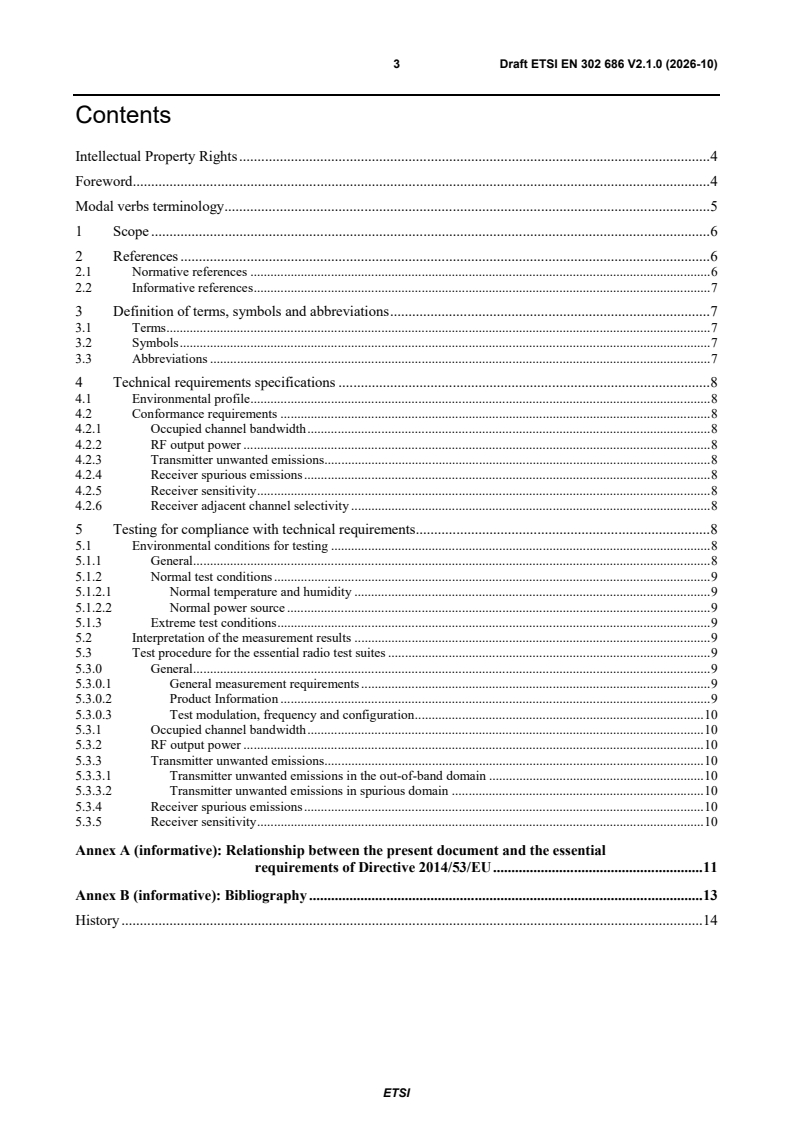
ETSI EN 302 686 V2.1.0 (2026-10) - Intelligent Transport Systems (ITS); Radiocommunications equipment operating in the 63,72 GHz to 65,88 GHz frequency band; Harmonised Standard for access to radio spectrum

Buy Documents
ETSI EN 302 686 V2.1.0 (2026-10) - Intelligent Transport Systems (ITS); Radiocommunications equipment operating in the 63,72 GHz to 65,88 GHz frequency band; Harmonised Standard for access to radio spectrum
Frequently Asked Questions
ETSI EN 302 686 V2.1.0 (2026-10) is a standard published by the European Telecommunications Standards Institute (ETSI). Its full title is "Intelligent Transport Systems (ITS); Radiocommunications equipment operating in the 63,72 GHz to 65,88 GHz frequency band; Harmonised Standard for access to radio spectrum". This standard covers: REN/ERM-WG37-25
REN/ERM-WG37-25
ETSI EN 302 686 V2.1.0 (2026-10) is available in PDF format for immediate download after purchase. The document can be added to your cart and obtained through the secure checkout process. Digital delivery ensures instant access to the complete standard document.
Standards Content (Sample)
Contents
- 1 Scope
- 2 References
- 2.1 Normative references
- 7 Draft ETSI EN 302 686 V2.1.0 (2026-10)
- 2.2 Informative references
- 3 Definition of terms, symbols and abbreviations
- 3.1 Terms
- 3.2 Symbols
- 3.3 Abbreviations
- 8 Draft ETSI EN 302 686 V2.1.0 (2026-10)
- 4 Technical requirements specifications
- 4.1 Environmental profile
- 4.2 Conformance requirements
- 5 Testing for compliance with technical requirements
- 5.1 Environmental conditions for testing
- 9 Draft ETSI EN 302 686 V2.1.0 (2026-10)
- 5.2 Interpretation of the measurement results
- 5.3 Test procedure for the essential radio test suites
- 10 Draft ETSI EN 302 686 V2.1.0 (2026-10)
- 11 Draft ETSI EN 302 686 V2.1.0 (2026-10)
- 1 Occupied channel 3.2 4.2.1 C For equipment with a
- 2 RF output power 3.2 4.2.2 C For equipment with a
- 3 Transmitter unwanted 3.2 4.2.3 C For equipment with a
- 4 Receiver spurious 3.2 4.2.4 C For equipment with a
- 5 Receiver sensitivity 3.2 4.2.5 C For equipment with a
- 6 Receiver adjacent channel 3.2 4.2.6 C For equipment with a
- 12 Draft ETSI EN 302 686 V2.1.0 (2026-10)
- 13 Draft ETSI EN 302 686 V2.1.0 (2026-10)
- Bibliography
- 14 Draft ETSI EN 302 686 V2.1.0 (2026-10)
1 Scope
The present document applies to cooperative communications using radio transmitters and receivers for Intelligent Transport Systems (ITS). ITS communications may comprise vehicle-to-vehicle, vehicle-to-infrastructure and infrastructure-to-vehicle.
The equipment is comprised of a transmitter and associated encoder and modulator and/or a receiver and associated demodulator and decoder. The types of equipment covered by the present document are as follows:
- OnBoard Equipment (OBE) fitted with an integral or dedicated antenna(s), intended for use in vehicles, e.g. a road or a rail vehicle.
- RoadSide Equipment (RSE) fitted with an antenna socket, integral or dedicated antenna(s), normally used as a fixed station, e.g. a road or rail infrastructure.
These networks operate over a short range with very wideband communications using a variety of directional medium and high gain antennas to enable a high degree of spectrum reuse, and may use a flexible bandwidth scheme under which they normally operate in a wideband mode, and periodically reduce their bandwidth (e.g. for antenna training and other activities).
The technical characteristics of these applications are described in ETSI TR 102 400 [i.3], where ITS applications in the 63,72 GHz to 65,88 GHz band is described. The present document is also in line with the results of the spectrum compatibility study in the CEPT ECC Report 113 [i.4].
These radio equipment types are capable of operating in all or any part of the frequency bands given in table 1. Table 1: Equipment operating frequency bands Equipment operating frequency bands Transmit 63,72 GHz to 65,88 GHz Receive 63,72 GHz to 65,88 GHz
NOTE: The relationship between the present document and essential requirements of article 3.2 of Directive 2014/53/EU [i.2] is given in Annex A.
2 References
2.1 Normative references
References are either specific (identified by date of publication and/or edition number or version number) or nonspecific. For specific references, only the cited version applies. For non-specific references, the latest version of the referenced document (including any amendments) applies.
Referenced documents which are not found to be publicly available in the expected location might be found in the ETSI docbox.
NOTE: While any hyperlinks included in this clause were valid at the time of publication, ETSI cannot guarantee their long-term validity.
The following referenced documents are necessary for the application of the present document. [1] ETSI EN 303 753 (V1.1.1) (05-2024): "Wideband Data Transmission Systems (WDTS) for Mobile and Fixed Radio Equipment operating in the 57 - 71 GHz band; Harmonised Standard for access to radio spectrum".
ETSI
7 Draft ETSI EN 302 686 V2.1.0 (2026-10)
2.2 Informative references
References are either specific (identified by date of publication and/or edition number or version number) or non-specific. For specific references, only the cited version applies. For non-specific references, the latest version of the referenced document (including any amendments) applies.
NOTE: While any hyperlinks included in this clause were valid at the time of publication, ETSI cannot guarantee their long-term validity.
The following referenced documents may be useful in implementing an ETSI deliverable or add to the reader's understanding, but are not required for conformance to the present document. [i.1] Commission Implementing Decision C(2015) 5376 final of 4.8.2015 on a standardisation request to the European Committee for Electrotechnical Standardisation and to the European Telecommunications Standards Institute as regards radio equipment in support of Directive 2014/53/EU of the European Parliament and of the Council.
[i.2] Directive 2014/53/EU of the European Parliament and of the Council of 16 April 2014 on the harmonisation of the laws of the Member States relating to the making available on the market of radio equipment and repealing Directive 1999/5/EC.
[i.3] ETSI TR 102 400 (V1.2.1): "Electromagnetic compatibility and Radio spectrum Matters (ERM); Short Range Devices (SRD); Intelligent Transport Systems (ITS); Road Traffic and Transport Telematics (RTTT); Technical characteristics for communications equipment in the frequency band from 63 GHz to 64 GHz; System Reference Document".
[i.4] CEPT ECC Report 113: "Compatibility studies around 63 GHz between Intelligent Transportation Systems (ITS) and other systems".
3 Definition of terms, symbols and abbreviations
3.1 Terms
For the purposes of the present document, the terms given in Directive 2014/53/EU [i.2] and ETSI EN 303 753 [1] apply.
3.2 Symbols
For the purposes of the present document, the symbols given in ETSI EN 303 753 [1] apply.
3.3 Abbreviations
For the purposes of the present document, the abbreviations given in ETSI EN 303 753 [1] and the following apply:
ITS Intelligent Transport Systems OBE OnBoard Equipment RSE RoadSide Equipment ETSI
8 Draft ETSI EN 302 686 V2.1.0 (2026-10)
4 Technical requirements specifications
4.1 Environmental profile
The technical requirements of the present document apply under the environmental profile for operation of the equipment, which shall be in accordance with its intended use, but as a minimum, shall be that specified in the test conditions contained in the present document. The equipment shall comply with all the technical requirements of the present document at all times when operating within the boundary limits of the operational environmental profile defined by its intended use.
4.2 Conformance requirements
4.2.1 Occupied channel bandwidth
The definition, limits and conformance given in ETSI EN 303 753 [1], clause 4.2.1 shall apply.
4.2.2 RF output power
The definition, limits and conformance given in ETSI EN 303 753 [1], clause 4.2.2 shall apply.
...
Contents
- 1 Scope
- 2 References
- 2.1 Normative references
- 7 Draft ETSI EN 302 686 V2.1.0 (2026-10)
- 2.2 Informative references
- 3 Definition of terms, symbols and abbreviations
- 3.1 Terms
- 3.2 Symbols
- 3.3 Abbreviations
- 8 Draft ETSI EN 302 686 V2.1.0 (2026-10)
- 4 Technical requirements specifications
- 4.1 Environmental profile
- 4.2 Conformance requirements
- 5 Testing for compliance with technical requirements
- 5.1 Environmental conditions for testing
- 9 Draft ETSI EN 302 686 V2.1.0 (2026-10)
- 5.2 Interpretation of the measurement results
- 5.3 Test procedure for the essential radio test suites
- 10 Draft ETSI EN 302 686 V2.1.0 (2026-10)
- 11 Draft ETSI EN 302 686 V2.1.0 (2026-10)
- 1 Occupied channel 3.2 4.2.1 C For equipment with a
- 2 RF output power 3.2 4.2.2 C For equipment with a
- 3 Transmitter unwanted 3.2 4.2.3 C For equipment with a
- 4 Receiver spurious 3.2 4.2.4 C For equipment with a
- 5 Receiver sensitivity 3.2 4.2.5 C For equipment with a
- 6 Receiver adjacent channel 3.2 4.2.6 C For equipment with a
- 12 Draft ETSI EN 302 686 V2.1.0 (2026-10)
- 13 Draft ETSI EN 302 686 V2.1.0 (2026-10)
- Bibliography
- 14 Draft ETSI EN 302 686 V2.1.0 (2026-10)
1 Scope
The present document applies to cooperative communications using radio transmitters and receivers for Intelligent Transport Systems (ITS). ITS communications may comprise vehicle-to-vehicle, vehicle-to-infrastructure and infrastructure-to-vehicle.
The equipment is comprised of a transmitter and associated encoder and modulator and/or a receiver and associated demodulator and decoder. The types of equipment covered by the present document are as follows:
- OnBoard Equipment (OBE) fitted with an integral or dedicated antenna(s), intended for use in vehicles, e.g. a road or a rail vehicle.
- RoadSide Equipment (RSE) fitted with an antenna socket, integral or dedicated antenna(s), normally used as a fixed station, e.g. a road or rail infrastructure.
These networks operate over a short range with very wideband communications using a variety of directional medium and high gain antennas to enable a high degree of spectrum reuse, and may use a flexible bandwidth scheme under which they normally operate in a wideband mode, and periodically reduce their bandwidth (e.g. for antenna training and other activities).
The technical characteristics of these applications are described in ETSI TR 102 400 [i.3], where ITS applications in the 63,72 GHz to 65,88 GHz band is described. The present document is also in line with the results of the spectrum compatibility study in the CEPT ECC Report 113 [i.4].
These radio equipment types are capable of operating in all or any part of the frequency bands given in table 1. Table 1: Equipment operating frequency bands Equipment operating frequency bands Transmit 63,72 GHz to 65,88 GHz Receive 63,72 GHz to 65,88 GHz
NOTE: The relationship between the present document and essential requirements of article 3.2 of Directive 2014/53/EU [i.2] is given in Annex A.
2 References
2.1 Normative references
References are either specific (identified by date of publication and/or edition number or version number) or nonspecific. For specific references, only the cited version applies. For non-specific references, the latest version of the referenced document (including any amendments) applies.
Referenced documents which are not found to be publicly available in the expected location might be found in the ETSI docbox.
NOTE: While any hyperlinks included in this clause were valid at the time of publication, ETSI cannot guarantee their long-term validity.
The following referenced documents are necessary for the application of the present document. [1] ETSI EN 303 753 (V1.1.1) (05-2024): "Wideband Data Transmission Systems (WDTS) for Mobile and Fixed Radio Equipment operating in the 57 - 71 GHz band; Harmonised Standard for access to radio spectrum".
ETSI
oSIST prEN 302 686 V2.1.0:2026
7 Draft ETSI EN 302 686 V2.1.0 (2026-10)
2.2 Informative references
References are either specific (identified by date of publication and/or edition number or version number) or non-specific. For specific references, only the cited version applies. For non-specific references, the latest version of the referenced document (including any amendments) applies.
NOTE: While any hyperlinks included in this clause were valid at the time of publication, ETSI cannot guarantee their long-term validity.
The following referenced documents may be useful in implementing an ETSI deliverable or add to the reader's understanding, but are not required for conformance to the present document. [i.1] Commission Implementing Decision C(2015) 5376 final of 4.8.2015 on a standardisation request to the European Committee for Electrotechnical Standardisation and to the European Telecommunications Standards Institute as regards radio equipment in support of Directive 2014/53/EU of the European Parliament and of the Council.
[i.2] Directive 2014/53/EU of the European Parliament and of the Council of 16 April 2014 on the harmonisation of the laws of the Member States relating to the making available on the market of radio equipment and repealing Directive 1999/5/EC.
[i.3] ETSI TR 102 400 (V1.2.1): "Electromagnetic compatibility and Radio spectrum Matters (ERM); Short Range Devices (SRD); Intelligent Transport Systems (ITS); Road Traffic and Transport Telematics (RTTT); Technical characteristics for communications equipment in the frequency band from 63 GHz to 64 GHz; System Reference Document".
[i.4] CEPT ECC Report 113: "Compatibility studies around 63 GHz between Intelligent Transportation Systems (ITS) and other systems".
3 Definition of terms, symbols and abbreviations
3.1 Terms
For the purposes of the present document, the terms given in Directive 2014/53/EU [i.2] and ETSI EN 303 753 [1] apply.
3.2 Symbols
For the purposes of the present document, the symbols given in ETSI EN 303 753 [1] apply.
3.3 Abbreviations
For the purposes of the present document, the abbreviations given in ETSI EN 303 753 [1] and the following apply:
ITS Intelligent Transport Systems OBE OnBoard Equipment RSE RoadSide Equipment ETSI
oSIST prEN 302 686 V2.1.0:2026
8 Draft ETSI EN 302 686 V2.1.0 (2026-10)
4 Technical requirements specifications
4.1 Environmental profile
The technical requirements of the present document apply under the environmental profile for operation of the equipment, which shall be in accordance with its intended use, but as a minimum, shall be that specified in the test conditions contained in the present document. The equipment shall comply with all the technical requirements of the present document at all times when operating within the boundary limits of the operational environmental profile defined by its intended use.
4.2 Conformance requirements
4.2.1 Occupied channel bandwidth
The definition, limits and conformance given in ETSI EN 303 753 [1], clause 4.2.1 shall apply.
4.2.2 RF output power
The definition, limits and conformance given in ETSI EN 303 753 [1], clause 4.2.2 shall apply.
4.2.3 Transmitter unwanted emissions
The definition, limits and conformance given in ETSI EN 303 753 [1], clause 4.2.4 shall apply.
...