

oSIST prEN 302 686 V2.1.0:2026
(Main)Intelligent Transport Systems (ITS) - Radiocommunications equipment operating in the 63,72 GHz to 65,88 GHz frequency band - Harmonised Standard for access to radio spectrum
- Abstract
REN/ERM-WG37-25
- Status
- Not Published
- Public Enquiry End Date
- 31-Dec-2026
- Technical Committee
- MOC - Mobile Communications
- Current Stage
- 4020 - Public enquire (PE) (Adopted Project)
- Start Date
- 19-Oct-2026
- Due Date
- 08-Mar-2027
Buy Documents
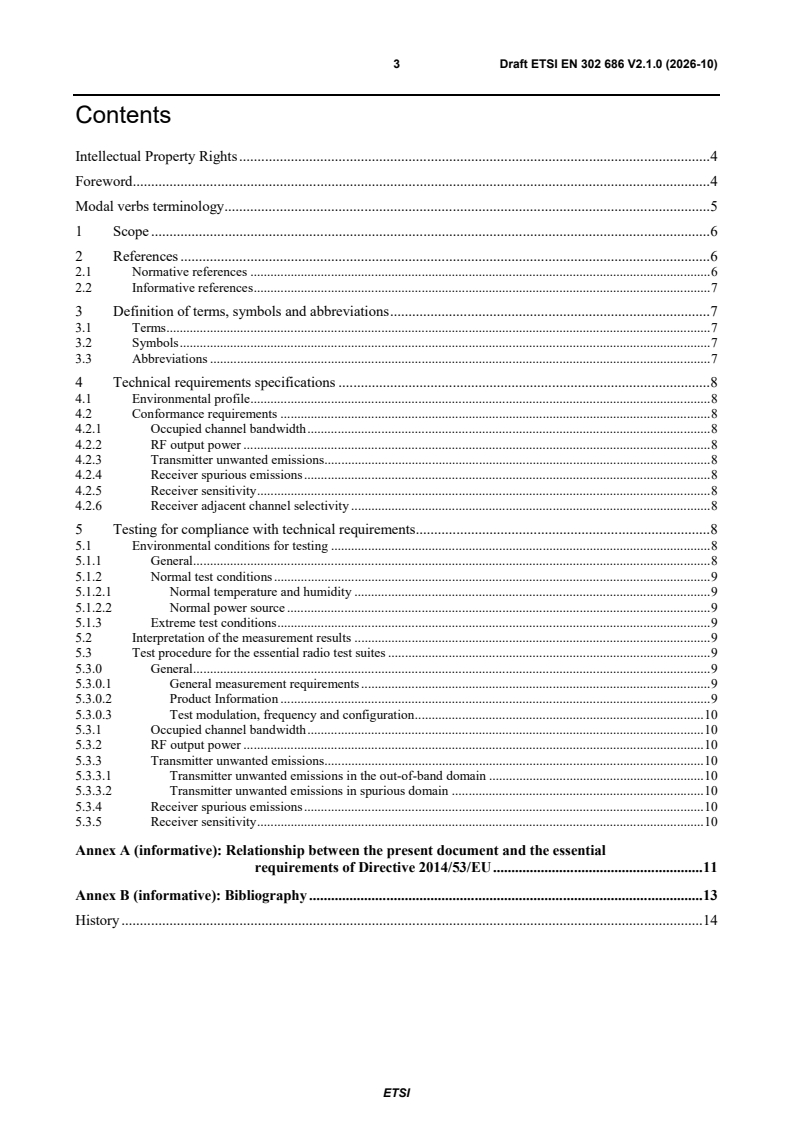
ETSI EN 302 686 V2.1.0 (2026-10) - Intelligent Transport Systems (ITS); Radiocommunications equipment operating in the 63,72 GHz to 65,88 GHz frequency band; Harmonised Standard for access to radio spectrum

oSIST prEN 302 686 V2.1.0:2026 is a Slovenian standard published by SIST and identical to ETSI EN 302 686 V2.1.0 (2026-10). It covers Intelligent Transport Systems (ITS) radiocommunications equipment operating in the 63,72 GHz to 65,88 GHz band and sets the harmonised requirements used to assess access to radio spectrum.
What does oSIST prEN 302 686 V2.1.0:2026 specify?
oSIST prEN 302 686 V2.1.0:2026 specifies technical requirements and test methods for cooperative ITS radio transmitters and receivers in the 63,72 GHz to 65,88 GHz band. It is written for two equipment types: OnBoard Equipment (OBE) used in vehicles and RoadSide Equipment (RSE) used as fixed infrastructure.
The document is organised into:
- Clause 1 - Scope
- Clause 2 - References
- Clause 3 - Definition of terms, symbols and abbreviations
- Clause 4 - Technical requirements specifications
- Clause 5 - Testing for compliance with technical requirements
- Annex A - Relationship with Directive 2014/53/EU
- Annex B - Bibliography
| Annex | What it covers |
|---|---|
| Annex A | How the standard relates to the essential requirements of Directive 2014/53/EU and which clauses give presumption of conformity |
| Annex B | Bibliographic references for related legislation and technical documents |
What are the key requirements of oSIST prEN 302 686 V2.1.0:2026?
oSIST prEN 302 686 V2.1.0:2026 ties spectrum compliance to the equipment's intended operating environment, then points most detailed RF limits and methods back to ETSI EN 303 753. In practice, a manufacturer or test lab uses this document together with the companion standard to prove conformance for transmit and receive functions.
Operating environment and compliance profile
Clause 4.1 says the equipment has to meet the technical requirements across its intended environmental profile, and at minimum within the test conditions in the document. This matters because compliance is not only a lab result at one convenient setting - it has to hold over the conditions the product is meant to face.
Main conformance items
Clause 4.2 covers the radio parameters that matter for spectrum use:
- occupied channel bandwidth
- RF output power
- transmitter unwanted emissions
- receiver spurious emissions
- receiver sensitivity
- receiver adjacent channel selectivity
Each of these is defined, limited and assessed by reference to ETSI EN 303 753. That means the present standard is the harmonised access-to-spectrum layer, while the companion standard carries the detailed limits and test approach.
Test conditions
Clause 5.1 requires tests to be done at representative points in the environmental profile. Normal test conditions are +15 °C to +35 °C and 20 % to 75 % relative humidity, with the normal power source being the equipment's nominal voltage.
Where extreme testing is required, measurements are taken at the lower and upper extreme temperatures. Unless the intended use states otherwise, those extremes are -10 °C and +55 °C. The test report has to record the actual temperatures used, so the compliance record is traceable.
Test set-up and selection of channels
Clause 5.3 requires radiated measurements for all tests. The test report also has to record the channel plan, modulation, antenna gain information, nominal channel bandwidth, and any operating temperature range different from the default extremes.
Tests are run on the lowest channel, the highest channel, and the channel closest to the midpoint of the operating range. If the equipment supports multiple nominal channel bandwidths, each one is tested. If RF power is adjustable, measurements use the highest available power level; for smart antenna systems, the configuration must deliver the highest RF output power to the measuring equipment.
Measurement uncertainty
Clause 5.2 sends the reader to ETSI EN 303 753, Annex B, for measurement uncertainty. That matters because pass or fail decisions in radio testing depend on how uncertainty is treated.
What terms does oSIST prEN 302 686 V2.1.0:2026 define?
The standard uses the terms from Directive 2014/53/EU and ETSI EN 303 753, and it also uses these abbreviations:
- Intelligent Transport Systems (ITS) - cooperative transport communications between vehicles and infrastructure.
- OnBoard Equipment (OBE) - equipment fitted in a vehicle, with integral or dedicated antenna(s).
- RoadSide Equipment (RSE) - equipment used as a fixed station in road or rail infrastructure, with an antenna socket or integral/dedicated antenna(s).
- TX functionality - the transmit capability of the equipment; Annex A uses this to decide when transmit requirements apply.
- RX functionality - the receive capability of the equipment; Annex A uses this to decide when receive requirements apply.
Who uses oSIST prEN 302 686 V2.1.0:2026?
Manufacturers of ITS radio equipment use this standard to design and declare compliance for OBE and RSE operating in the 60 GHz range. Test laboratories use it to set up radiated measurements, choose channels, record operating conditions, and report the results in a way that matches the harmonised requirements.
It is also relevant to conformity assessment teams, market surveillance bodies, and buyers who need to check whether a product's radio interface is designed for access to spectrum under the cited European framework.
What changed in oSIST prEN 302 686 V2.1.0:2026 from the previous edition?
The document history shows V2.1.0 as the current version and V1.1.1 as the earlier publication from February 2011. The current document is the later edition under the SRdAP process.
Which standards are used with oSIST prEN 302 686 V2.1.0:2026?
ETSI EN 303 753 is the key normative reference. oSIST prEN 302 686 V2.1.0:2026 uses it for the definitions, limits, conformance criteria, test methods, and measurement uncertainty that this harmonised standard relies on.
Other documents named in the standard are informative, not normative. They provide context on the radio band, compatibility studies, and the EU legal framework for the harmonised standard.
What does the oSIST prEN 302 686 V2.1.0:2026 document contain?
The document contains the scope, references, terminology, technical requirements, and compliance test procedures for ITS radio equipment in the 63,72 GHz to 65,88 GHz band. It also includes a table of equipment operating frequency bands and a mapping table in Annex A that links the clauses of the standard to the essential requirements of Directive 2014/53/EU.
Clause 5 gives the practical test setup: environmental conditions, reported product information, channel selection, power level selection, and the use of radiated measurements. Annex B collects related legal and technical references for further reading and implementation work.
Buy Documents
ETSI EN 302 686 V2.1.0 (2026-10) - Intelligent Transport Systems (ITS); Radiocommunications equipment operating in the 63,72 GHz to 65,88 GHz frequency band; Harmonised Standard for access to radio spectrum
Get Certified
Connect with accredited certification bodies for this standard

BSI Group
BSI (British Standards Institution) is the business standards company that helps organizations make excellence a habit.

NYCE
Mexican standards and certification body.

ANCE
Mexican certification and testing association.
Sponsored listings
Frequently Asked Questions
oSIST prEN 302 686 V2.1.0:2026 is a standard published by the Slovenian Institute for Standardization (SIST). Its full title is "Intelligent Transport Systems (ITS) - Radiocommunications equipment operating in the 63,72 GHz to 65,88 GHz frequency band - Harmonised Standard for access to radio spectrum". This standard covers: REN/ERM-WG37-25
REN/ERM-WG37-25
oSIST prEN 302 686 V2.1.0:2026 is classified under the following ICS (International Classification for Standards) categories: 33.060.01 - Radiocommunications in general; 35.240.60 - IT applications in transport. The ICS classification helps identify the subject area and facilitates finding related standards.
oSIST prEN 302 686 V2.1.0:2026 is available in PDF format for immediate download after purchase. The document can be added to your cart and obtained through the secure checkout process. Digital delivery ensures instant access to the complete standard document.
Standards Content (Sample)
Contents
- 1 Scope
- 2 References
- 2.1 Normative references
- 7 Draft ETSI EN 302 686 V2.1.0 (2026-10)
- 2.2 Informative references
- 3 Definition of terms, symbols and abbreviations
- 3.1 Terms
- 3.2 Symbols
- 3.3 Abbreviations
- 8 Draft ETSI EN 302 686 V2.1.0 (2026-10)
- 4 Technical requirements specifications
- 4.1 Environmental profile
- 4.2 Conformance requirements
- 5 Testing for compliance with technical requirements
- 5.1 Environmental conditions for testing
- 9 Draft ETSI EN 302 686 V2.1.0 (2026-10)
- 5.2 Interpretation of the measurement results
- 5.3 Test procedure for the essential radio test suites
- 10 Draft ETSI EN 302 686 V2.1.0 (2026-10)
- 11 Draft ETSI EN 302 686 V2.1.0 (2026-10)
- 1 Occupied channel 3.2 4.2.1 C For equipment with a
- 2 RF output power 3.2 4.2.2 C For equipment with a
- 3 Transmitter unwanted 3.2 4.2.3 C For equipment with a
- 4 Receiver spurious 3.2 4.2.4 C For equipment with a
- 5 Receiver sensitivity 3.2 4.2.5 C For equipment with a
- 6 Receiver adjacent channel 3.2 4.2.6 C For equipment with a
- 12 Draft ETSI EN 302 686 V2.1.0 (2026-10)
- 13 Draft ETSI EN 302 686 V2.1.0 (2026-10)
- Bibliography
- 14 Draft ETSI EN 302 686 V2.1.0 (2026-10)
1 Scope
The present document applies to cooperative communications using radio transmitters and receivers for Intelligent Transport Systems (ITS). ITS communications may comprise vehicle-to-vehicle, vehicle-to-infrastructure and infrastructure-to-vehicle.
The equipment is comprised of a transmitter and associated encoder and modulator and/or a receiver and associated demodulator and decoder. The types of equipment covered by the present document are as follows:
- OnBoard Equipment (OBE) fitted with an integral or dedicated antenna(s), intended for use in vehicles, e.g. a road or a rail vehicle.
- RoadSide Equipment (RSE) fitted with an antenna socket, integral or dedicated antenna(s), normally used as a fixed station, e.g. a road or rail infrastructure.
These networks operate over a short range with very wideband communications using a variety of directional medium and high gain antennas to enable a high degree of spectrum reuse, and may use a flexible bandwidth scheme under which they normally operate in a wideband mode, and periodically reduce their bandwidth (e.g. for antenna training and other activities).
The technical characteristics of these applications are described in ETSI TR 102 400 [i.3], where ITS applications in the 63,72 GHz to 65,88 GHz band is described. The present document is also in line with the results of the spectrum compatibility study in the CEPT ECC Report 113 [i.4].
These radio equipment types are capable of operating in all or any part of the frequency bands given in table 1. Table 1: Equipment operating frequency bands Equipment operating frequency bands Transmit 63,72 GHz to 65,88 GHz Receive 63,72 GHz to 65,88 GHz
NOTE: The relationship between the present document and essential requirements of article 3.2 of Directive 2014/53/EU [i.2] is given in Annex A.
2 References
2.1 Normative references
References are either specific (identified by date of publication and/or edition number or version number) or nonspecific. For specific references, only the cited version applies. For non-specific references, the latest version of the referenced document (including any amendments) applies.
Referenced documents which are not found to be publicly available in the expected location might be found in the ETSI docbox.
NOTE: While any hyperlinks included in this clause were valid at the time of publication, ETSI cannot guarantee their long-term validity.
The following referenced documents are necessary for the application of the present document. [1] ETSI EN 303 753 (V1.1.1) (05-2024): "Wideband Data Transmission Systems (WDTS) for Mobile and Fixed Radio Equipment operating in the 57 - 71 GHz band; Harmonised Standard for access to radio spectrum".
ETSI
7 Draft ETSI EN 302 686 V2.1.0 (2026-10)
2.2 Informative references
References are either specific (identified by date of publication and/or edition number or version number) or non-specific. For specific references, only the cited version applies. For non-specific references, the latest version of the referenced document (including any amendments) applies.
NOTE: While any hyperlinks included in this clause were valid at the time of publication, ETSI cannot guarantee their long-term validity.
The following referenced documents may be useful in implementing an ETSI deliverable or add to the reader's understanding, but are not required for conformance to the present document. [i.1] Commission Implementing Decision C(2015) 5376 final of 4.8.2015 on a standardisation request to the European Committee for Electrotechnical Standardisation and to the European Telecommunications Standards Institute as regards radio equipment in support of Directive 2014/53/EU of the European Parliament and of the Council.
[i.2] Directive 2014/53/EU of the European Parliament and of the Council of 16 April 2014 on the harmonisation of the laws of the Member States relating to the making available on the market of radio equipment and repealing Directive 1999/5/EC.
[i.3] ETSI TR 102 400 (V1.2.1): "Electromagnetic compatibility and Radio spectrum Matters (ERM); Short Range Devices (SRD); Intelligent Transport Systems (ITS); Road Traffic and Transport Telematics (RTTT); Technical characteristics for communications equipment in the frequency band from 63 GHz to 64 GHz; System Reference Document".
[i.4] CEPT ECC Report 113: "Compatibility studies around 63 GHz between Intelligent Transportation Systems (ITS) and other systems".
3 Definition of terms, symbols and abbreviations
3.1 Terms
For the purposes of the present document, the terms given in Directive 2014/53/EU [i.2] and ETSI EN 303 753 [1] apply.
3.2 Symbols
For the purposes of the present document, the symbols given in ETSI EN 303 753 [1] apply.
3.3 Abbreviations
For the purposes of the present document, the abbreviations given in ETSI EN 303 753 [1] and the following apply:
ITS Intelligent Transport Systems OBE OnBoard Equipment RSE RoadSide Equipment ETSI
8 Draft ETSI EN 302 686 V2.1.0 (2026-10)
4 Technical requirements specifications
4.1 Environmental profile
The technical requirements of the present document apply under the environmental profile for operation of the equipment, which shall be in accordance with its intended use, but as a minimum, shall be that specified in the test conditions contained in the present document. The equipment shall comply with all the technical requirements of the present document at all times when operating within the boundary limits of the operational environmental profile defined by its intended use.
4.2 Conformance requirements
4.2.1 Occupied channel bandwidth
The definition, limits and conformance given in ETSI EN 303 753 [1], clause 4.2.1 shall apply.
4.2.2 RF output power
The definition, limits and conformance given in ETSI EN 303 753 [1], clause 4.2.2 shall apply.
...
Contents
- 1 Scope
- 2 References
- 2.1 Normative references
- 7 Draft ETSI EN 302 686 V2.1.0 (2026-10)
- 2.2 Informative references
- 3 Definition of terms, symbols and abbreviations
- 3.1 Terms
- 3.2 Symbols
- 3.3 Abbreviations
- 8 Draft ETSI EN 302 686 V2.1.0 (2026-10)
- 4 Technical requirements specifications
- 4.1 Environmental profile
- 4.2 Conformance requirements
- 5 Testing for compliance with technical requirements
- 5.1 Environmental conditions for testing
- 9 Draft ETSI EN 302 686 V2.1.0 (2026-10)
- 5.2 Interpretation of the measurement results
- 5.3 Test procedure for the essential radio test suites
- 10 Draft ETSI EN 302 686 V2.1.0 (2026-10)
- 11 Draft ETSI EN 302 686 V2.1.0 (2026-10)
- 1 Occupied channel 3.2 4.2.1 C For equipment with a
- 2 RF output power 3.2 4.2.2 C For equipment with a
- 3 Transmitter unwanted 3.2 4.2.3 C For equipment with a
- 4 Receiver spurious 3.2 4.2.4 C For equipment with a
- 5 Receiver sensitivity 3.2 4.2.5 C For equipment with a
- 6 Receiver adjacent channel 3.2 4.2.6 C For equipment with a
- 12 Draft ETSI EN 302 686 V2.1.0 (2026-10)
- 13 Draft ETSI EN 302 686 V2.1.0 (2026-10)
- Bibliography
- 14 Draft ETSI EN 302 686 V2.1.0 (2026-10)
1 Scope
The present document applies to cooperative communications using radio transmitters and receivers for Intelligent Transport Systems (ITS). ITS communications may comprise vehicle-to-vehicle, vehicle-to-infrastructure and infrastructure-to-vehicle.
The equipment is comprised of a transmitter and associated encoder and modulator and/or a receiver and associated demodulator and decoder. The types of equipment covered by the present document are as follows:
- OnBoard Equipment (OBE) fitted with an integral or dedicated antenna(s), intended for use in vehicles, e.g. a road or a rail vehicle.
- RoadSide Equipment (RSE) fitted with an antenna socket, integral or dedicated antenna(s), normally used as a fixed station, e.g. a road or rail infrastructure.
These networks operate over a short range with very wideband communications using a variety of directional medium and high gain antennas to enable a high degree of spectrum reuse, and may use a flexible bandwidth scheme under which they normally operate in a wideband mode, and periodically reduce their bandwidth (e.g. for antenna training and other activities).
The technical characteristics of these applications are described in ETSI TR 102 400 [i.3], where ITS applications in the 63,72 GHz to 65,88 GHz band is described. The present document is also in line with the results of the spectrum compatibility study in the CEPT ECC Report 113 [i.4].
These radio equipment types are capable of operating in all or any part of the frequency bands given in table 1. Table 1: Equipment operating frequency bands Equipment operating frequency bands Transmit 63,72 GHz to 65,88 GHz Receive 63,72 GHz to 65,88 GHz
NOTE: The relationship between the present document and essential requirements of article 3.2 of Directive 2014/53/EU [i.2] is given in Annex A.
2 References
2.1 Normative references
References are either specific (identified by date of publication and/or edition number or version number) or nonspecific. For specific references, only the cited version applies. For non-specific references, the latest version of the referenced document (including any amendments) applies.
Referenced documents which are not found to be publicly available in the expected location might be found in the ETSI docbox.
NOTE: While any hyperlinks included in this clause were valid at the time of publication, ETSI cannot guarantee their long-term validity.
The following referenced documents are necessary for the application of the present document. [1] ETSI EN 303 753 (V1.1.1) (05-2024): "Wideband Data Transmission Systems (WDTS) for Mobile and Fixed Radio Equipment operating in the 57 - 71 GHz band; Harmonised Standard for access to radio spectrum".
ETSI
oSIST prEN 302 686 V2.1.0:2026
7 Draft ETSI EN 302 686 V2.1.0 (2026-10)
2.2 Informative references
References are either specific (identified by date of publication and/or edition number or version number) or non-specific. For specific references, only the cited version applies. For non-specific references, the latest version of the referenced document (including any amendments) applies.
NOTE: While any hyperlinks included in this clause were valid at the time of publication, ETSI cannot guarantee their long-term validity.
The following referenced documents may be useful in implementing an ETSI deliverable or add to the reader's understanding, but are not required for conformance to the present document. [i.1] Commission Implementing Decision C(2015) 5376 final of 4.8.2015 on a standardisation request to the European Committee for Electrotechnical Standardisation and to the European Telecommunications Standards Institute as regards radio equipment in support of Directive 2014/53/EU of the European Parliament and of the Council.
[i.2] Directive 2014/53/EU of the European Parliament and of the Council of 16 April 2014 on the harmonisation of the laws of the Member States relating to the making available on the market of radio equipment and repealing Directive 1999/5/EC.
[i.3] ETSI TR 102 400 (V1.2.1): "Electromagnetic compatibility and Radio spectrum Matters (ERM); Short Range Devices (SRD); Intelligent Transport Systems (ITS); Road Traffic and Transport Telematics (RTTT); Technical characteristics for communications equipment in the frequency band from 63 GHz to 64 GHz; System Reference Document".
[i.4] CEPT ECC Report 113: "Compatibility studies around 63 GHz between Intelligent Transportation Systems (ITS) and other systems".
3 Definition of terms, symbols and abbreviations
3.1 Terms
For the purposes of the present document, the terms given in Directive 2014/53/EU [i.2] and ETSI EN 303 753 [1] apply.
3.2 Symbols
For the purposes of the present document, the symbols given in ETSI EN 303 753 [1] apply.
3.3 Abbreviations
For the purposes of the present document, the abbreviations given in ETSI EN 303 753 [1] and the following apply:
ITS Intelligent Transport Systems OBE OnBoard Equipment RSE RoadSide Equipment ETSI
oSIST prEN 302 686 V2.1.0:2026
8 Draft ETSI EN 302 686 V2.1.0 (2026-10)
4 Technical requirements specifications
4.1 Environmental profile
The technical requirements of the present document apply under the environmental profile for operation of the equipment, which shall be in accordance with its intended use, but as a minimum, shall be that specified in the test conditions contained in the present document. The equipment shall comply with all the technical requirements of the present document at all times when operating within the boundary limits of the operational environmental profile defined by its intended use.
4.2 Conformance requirements
4.2.1 Occupied channel bandwidth
The definition, limits and conformance given in ETSI EN 303 753 [1], clause 4.2.1 shall apply.
4.2.2 RF output power
The definition, limits and conformance given in ETSI EN 303 753 [1], clause 4.2.2 shall apply.
4.2.3 Transmitter unwanted emissions
The definition, limits and conformance given in ETSI EN 303 753 [1], clause 4.2.4 shall apply.
...