

IEC 62912:2015
(Main)Railway applications - Direct current signalling monostable relays of type N and type C
General Information
- Abstract
IEC 62912:2015 gives requirements for direct current relays intended for safety-related applications in railway signalling installations. This International Standard is applicable to monostable relays of type N and type C.
- Status
- Published
- Publication Date
- 23-Jul-2015
- Technical Committee
- TC 9 - Electrical equipment and systems for railways
- Drafting Committee
- PT 62912 - TC 9/PT 62912
- Current Stage
- PPUB - Publication issued
- Start Date
- 24-Jul-2015
- Completion Date
- 31-Aug-2015
Overview
IEC 62912:2015 is an International Standard published by the International Electrotechnical Commission (IEC) that specifies requirements for direct current (DC) signalling monostable relays used in railway applications. This standard focuses specifically on type N and type C relays designed for safety-critical railway signalling systems. It provides comprehensive technical requirements regarding relay construction, contact performance, insulation, and operation under environmental stresses.
By standardizing these key components, IEC 62912:2015 ensures reliability, safety, and interoperability of railway signaling equipment worldwide. It supports electrical engineers, manufacturers, and railway operators by detailing performance criteria and design guidelines critical for maintaining safe railway signaling operation.
Key Topics
Scope and Applicability
IEC 62912:2015 applies to DC monostable relays of type N and type C intended for safety-related railway signalling installations. It focuses on relays used for “all-or-nothing” operation, essential in fail-safe signalling circuits.Relay Classification
Defines relay types based on their design and contact configurations specific to signalling purposes.Mechanical and Electrical Construction
Outlines requirements for relay armature design, magnetic systems, contact materials and arrangements, and connecting devices to ensure mechanical robustness and consistent electrical performance.Contact Requirements
Specifies criteria such as contact force, minimum contact gap, bounce time, contact heating, and contact wear (service life). These factors affect relay responsiveness and reliability in signalling circuits.Insulation and Overvoltage Protection
Defines insulation coordination principles including minimum clearances, creepage distances, and tests to withstand typical railway environment stresses and overvoltage scenarios.Environmental Resistance
Addresses resistance to vibrations, shocks, and other harsh conditions commonly encountered in railway installations to ensure relay durability and functionality.Forcibly Guided Contacts
Mandates mechanical linking of contacts (forcibly guided) to satisfy safety requirements by ensuring predictable relay contact operation and enhancing diagnostic capabilities within signalling systems.
Applications
IEC 62912:2015 standardized relays are crucial components within railway signalling systems. They serve safety-related functions including:
- Control and indication circuits in trackside and onboard signalling installations.
- Interface relays ensuring fail-safe signal switching under direct current operation.
- Integration in relay interlocking systems, track circuits, and level crossing controls where reliable and precise relay operation is mandatory.
- Used in safety systems requiring forcibly guided contacts to prevent false signalling states.
Railway manufacturers and system integrators rely on this standard to select compliant DC relays that meet stringent safety and durability criteria vital for maintaining uninterrupted and safe rail traffic management.
Related Standards
For a comprehensive approach to railway relay and signalling equipment, IEC 62912:2015 is coordinated with several other standards:
- IEC 60664-1: Insulation coordination principles for low-voltage systems, essential for defining relay insulation performance.
- IEC 61810-3:2015: Requirements for electromechanical elementary relays including mechanical linking of contacts.
- IEC 62497-1: Railway applications – Basic insulation coordination requirements for clearances and creepage distances.
- IEC 62498-3:2010: Environmental conditions for signalling and telecommunications equipment in railway environments.
These complementary standards support the design, testing, and certification of railway signalling relays and equipment to ensure international safety and interoperability.
Keywords: IEC 62912, railway signalling relays, direct current relays, monostable relays, type N relay, type C relay, railway safety, forcibly guided contacts, insulation coordination, railway relay standards, electromechanical relays, railway signalling standard, railway equipment compliance.
Get Certified
Connect with accredited certification bodies for this standard

IRIS Certification (UNIFE)
International Railway Industry Standard certification.

TÜV SÜD Rail GmbH
TÜV SÜD railway certification services.

Bureau Veritas Railway Certification
Railway and transportation certification.
Sponsored listings
Frequently Asked Questions
IEC 62912:2015 is a standard published by the International Electrotechnical Commission (IEC). Its full title is "Railway applications - Direct current signalling monostable relays of type N and type C". This standard covers: IEC 62912:2015 gives requirements for direct current relays intended for safety-related applications in railway signalling installations. This International Standard is applicable to monostable relays of type N and type C.
IEC 62912:2015 gives requirements for direct current relays intended for safety-related applications in railway signalling installations. This International Standard is applicable to monostable relays of type N and type C.
IEC 62912:2015 is classified under the following ICS (International Classification for Standards) categories: 45.060.01 - Railway rolling stock in general. The ICS classification helps identify the subject area and facilitates finding related standards.
IEC 62912:2015 is available in PDF format for immediate download after purchase. The document can be added to your cart and obtained through the secure checkout process. Digital delivery ensures instant access to the complete standard document.
Standards Content (Sample)
IEC 62912 ®
Edition 1.0 2015-07
INTERNATIONAL
STANDARD
NORME
INTERNATIONALE
Railway applications – Direct current signalling monostable relays of type N and
type C
Applications ferroviaires – Relais monostables de signalisation en courant
continu de type N et de type C
All rights reserved. Unless otherwise specified, no part of this publication may be reproduced or utilized in any form
or by any means, electronic or mechanical, including photocopying and microfilm, without permission in writing from
either IEC or IEC's member National Committee in the country of the requester. If you have any questions about IEC
copyright or have an enquiry about obtaining additional rights to this publication, please contact the address below or
your local IEC member National Committee for further information.
Droits de reproduction réservés. Sauf indication contraire, aucune partie de cette publication ne peut être reproduite
ni utilisée sous quelque forme que ce soit et par aucun procédé, électronique ou mécanique, y compris la photocopie
et les microfilms, sans l'accord écrit de l'IEC ou du Comité national de l'IEC du pays du demandeur. Si vous avez des
questions sur le copyright de l'IEC ou si vous désirez obtenir des droits supplémentaires sur cette publication, utilisez
les coordonnées ci-après ou contactez le Comité national de l'IEC de votre pays de résidence.
IEC Central Office Tel.: +41 22 919 02 11
3, rue de Varembé Fax: +41 22 919 03 00
CH-1211 Geneva 20 info@iec.ch
Switzerland www.iec.ch
About the IEC
The International Electrotechnical Commission (IEC) is the leading global organization that prepares and publishes
International Standards for all electrical, electronic and related technologies.
About IEC publications
The technical content of IEC publications is kept under constant review by the IEC. Please make sure that you have the
latest edition, a corrigenda or an amendment might have been published.
IEC Catalogue - webstore.iec.ch/catalogue Electropedia - www.electropedia.org
The stand-alone application for consulting the entire The world's leading online dictionary of electronic and
bibliographical information on IEC International Standards, electrical terms containing more than 30 000 terms and
Technical Specifications, Technical Reports and other definitions in English and French, with equivalent terms in 15
documents. Available for PC, Mac OS, Android Tablets and additional languages. Also known as the International
iPad. Electrotechnical Vocabulary (IEV) online.
IEC publications search - www.iec.ch/searchpub IEC Glossary - std.iec.ch/glossary
The advanced search enables to find IEC publications by a More than 60 000 electrotechnical terminology entries in
variety of criteria (reference number, text, technical English and French extracted from the Terms and Definitions
committee,…). It also gives information on projects, replaced clause of IEC publications issued since 2002. Some entries
and withdrawn publications. have been collected from earlier publications of IEC TC 37,
77, 86 and CISPR.
IEC Just Published - webstore.iec.ch/justpublished
Stay up to date on all new IEC publications. Just Published IEC Customer Service Centre - webstore.iec.ch/csc
details all new publications released. Available online and If you wish to give us your feedback on this publication or
also once a month by email. need further assistance, please contact the Customer Service
Centre: csc@iec.ch.
A propos de l'IEC
La Commission Electrotechnique Internationale (IEC) est la première organisation mondiale qui élabore et publie des
Normes internationales pour tout ce qui a trait à l'électricité, à l'électronique et aux technologies apparentées.
A propos des publications IEC
Le contenu technique des publications IEC est constamment revu. Veuillez vous assurer que vous possédez l’édition la
plus récente, un corrigendum ou amendement peut avoir été publié.
Catalogue IEC - webstore.iec.ch/catalogue Electropedia - www.electropedia.org
Application autonome pour consulter tous les renseignements
Le premier dictionnaire en ligne de termes électroniques et
bibliographiques sur les Normes internationales,
électriques. Il contient plus de 30 000 termes et définitions en
Spécifications techniques, Rapports techniques et autres
anglais et en français, ainsi que les termes équivalents dans
documents de l'IEC. Disponible pour PC, Mac OS, tablettes
15 langues additionnelles. Egalement appelé Vocabulaire
Android et iPad.
Electrotechnique International (IEV) en ligne.
Recherche de publications IEC - www.iec.ch/searchpub
Glossaire IEC - std.iec.ch/glossary
La recherche avancée permet de trouver des publications IEC Plus de 60 000 entrées terminologiques électrotechniques, en
en utilisant différents critères (numéro de référence, texte, anglais et en français, extraites des articles Termes et
comité d’études,…). Elle donne aussi des informations sur les Définitions des publications IEC parues depuis 2002. Plus
projets et les publications remplacées ou retirées. certaines entrées antérieures extraites des publications des
CE 37, 77, 86 et CISPR de l'IEC.
IEC Just Published - webstore.iec.ch/justpublished
Service Clients - webstore.iec.ch/csc
Restez informé sur les nouvelles publications IEC. Just
Published détaille les nouvelles publications parues. Si vous désirez nous donner des commentaires sur cette
Disponible en ligne et aussi une fois par mois par email. publication ou si vous avez des questions contactez-nous:
csc@iec.ch.
IEC 62912 ®
Edition 1.0 2015-07
INTERNATIONAL
STANDARD
NORME
INTERNATIONALE
Railway applications – Direct current signalling monostable relays of type N and
type C
Applications ferroviaires – Relais monostables de signalisation en courant
continu de type N et de type C
INTERNATIONAL
ELECTROTECHNICAL
COMMISSION
COMMISSION
ELECTROTECHNIQUE
INTERNATIONALE
ICS 45.060 ISBN 978-2-8322-2818-0
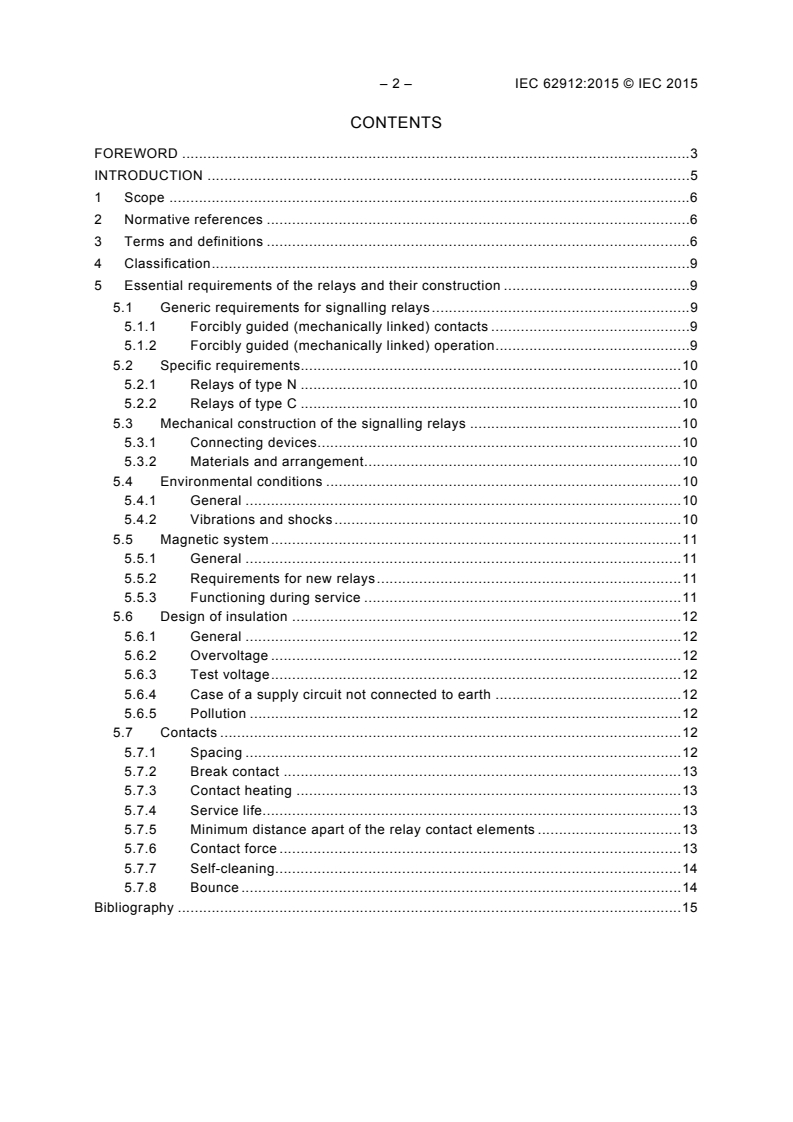
– 2 – IEC 62912:2015 © IEC 2015
CONTENTS
FOREWORD .3
INTRODUCTION .5
1 Scope .6
2 Normative references .6
3 Terms and definitions .6
4 Classification .9
5 Essential requirements of the relays and their construction .9
5.1 Generic requirements for signalling relays .9
5.1.1 Forcibly guided (mechanically linked) contacts .9
5.1.2 Forcibly guided (mechanically linked) operation .9
5.2 Specific requirements. 10
5.2.1 Relays of type N . 10
5.2.2 Relays of type C . 10
5.3 Mechanical construction of the signalling relays . 10
5.3.1 Connecting devices . 10
5.3.2 Materials and arrangement. 10
5.4 Environmental conditions . 10
5.4.1 General . 10
5.4.2 Vibrations and shocks . 10
5.5 Magnetic system . 11
5.5.1 General . 11
5.5.2 Requirements for new relays . 11
5.5.3 Functioning during service . 11
5.6 Design of insulation . 12
5.6.1 General . 12
5.6.2 Overvoltage . 12
5.6.3 Test voltage . 12
5.6.4 Case of a supply circuit not connected to earth . 12
5.6.5 Pollution . 12
5.7 Contacts . 12
5.7.1 Spacing . 12
5.7.2 Break contact . 13
5.7.3 Contact heating . 13
5.7.4 Service life. 13
5.7.5 Minimum distance apart of the relay contact elements . 13
5.7.6 Contact force . 13
5.7.7 Self-cleaning . 14
5.7.8 Bounce . 14
Bibliography . 15
INTERNATIONAL ELECTROTECHNICAL COMMISSION
____________
RAILWAY APPLICATIONS – DIRECT CURRENT SIGNALLING
MONOSTABLE RELAYS OF TYPE N AND TYPE C
FOREWORD
1) The International Electrotechnical Commission (IEC) is a worldwide organization for standardization comprising
all national electrotechnical committees (IEC National Committees). The object of IEC is to promote
international co-operation on all questions concerning standardization in the electrical and electronic fields. To
this end and in addition to other activities, IEC publishes International Standards, Technical Specifications,
Technical Reports, Publicly Available Specifications (PAS) and Guides (hereafter referred to as “IEC
Publication(s)”). Their preparation is entrusted to technical committees; any IEC National Committee interested
in the subject dealt with may participate in this preparatory work. International, governmental and non-
governmental organizations liaising with the IEC also participate in this preparation. IEC collaborates closely
with the International Organization for Standardization (ISO) in accordance with conditions determined by
agreement between the two organizations.
2) The formal decisions or agreements of IEC on technical matters express, as nearly as possible, an
international consensus of opinion on the relevant subjects since each technical committee has representation
from all interested IEC National Committees.
3) IEC Publications have the form of recommendations for international use and are accepted by IEC National
Committees in that sense. While all reasonable efforts are made to ensure that the technical content of IEC
Publications is accurate, IEC cannot be held responsible for the way in which they are used or for any
misinterpretation by any end user.
4) In order to promote international uniformity, IEC National Committees undertake to apply IEC Publications
transparently to the maximum extent possible in their national and regional publications. Any divergence
between any IEC Publication and the corresponding national or regional publication shall be clearly indicated in
the latter.
5) IEC itself does not provide any attestation of conformity. Independent certification bodies provide conformity
assessment services and, in some areas, access to IEC marks of conformity. IEC is not responsible for any
services carried out by independent certification bodies.
6) All users should ensure that they have the latest edition of this publication.
7) No liability shall attach to IEC or its directors, employees, servants or agents including individual experts and
members of its technical committees and IEC National Committees for any personal injury, property damage or
other damage of any nature whatsoever, whether direct or indirect, or for costs (including legal fees) and
expenses arising out of the publication, use of, or reliance upon, this IEC Publication or any other IEC
Publications.
8) Attention is drawn to the Normative references cited in this publication. Use of the referenced publications is
indispensable for the correct application of this publication.
9) Attention is drawn to the possibility that some of the elements of this IEC Publication may be the subject of
patent rights. IEC shall not be held responsible for identifying any or all such patent rights.
International Standard IEC 62912 has been prepared by IEC technical committee 9: Electrical
equipment and systems for railways.
This standard is derived from EN 50578.
The text of this standard is based on the following documents:
FDIS Report on voting
9/2039/FDIS 9/2061/RVD
Full information on the voting for the approval of this standard can be found in the report on
voting indicated in the above table.
This publication has been drafted in accordance with the ISO/IEC Directives, Part 2.
– 4 – IEC 62912:2015 © IEC 2015
The committee has decided that the contents of this publication will remain unchanged until
the stability date indicated on the IEC website under "http://webstore.iec.ch" in the data
related to the specific publication. At this date, the publication will be
• reconfirmed,
• withdrawn,
• replaced by a revised edition, or
• amended.
INTRODUCTION
This International Standard gives a set of generic and specific requirements for direct current
signalling relays.
This International Standard introduces a set of recommendations and requirements for
signalling relay characteristics, construction, magnetic system, contacts and insulation.
Requirements are coordinated with current international standards on all-or-nothing relays.
– 6 – IEC 62912:2015 © IEC 2015
RAILWAY APPLICATIONS – DIRECT CURRENT SIGNALLING
MONOSTABLE RELAYS OF TYPE N AND TYPE C
1 Scope
This International Standard gives requirements for direct current relays intended for safety-
related applications in railway signalling installations.
This International Standard is applicable to monostable relays of type N and type C.
2 Normative references
The following documents, in whole or in part, are normatively referenced in this document
and are indispensable for its application. For dated references, only the edition cited applies.
For undated references, the latest edition of the referenced document (including any
amendments) applies.
IEC 60664-1, Insulation coordination for equipment within low-voltage systems – Part 1:
Principles, requirements and tests
IEC 61810-3:2015, Electromechanical elementary relays − Part 3: Relays with forcibly guided
(mechanically linked) contacts
IEC 62497-1, Railway applications – Insulation coordination – Part 1: Basic requirements –
Clearances and creepage distances for all electrical and electronic equipment
IEC 62498-3: 2010, Railway applications – Environmental conditions for equipment – Part 3:
Equipment for signalling and telecommunications
3 Terms and definitions
For the purposes of this document, the following terms and definitions apply.
3.1
all-or-nothing relay
electrical relay, which is intended to be energised by a quantity, the value of which is either
within its operative range or effectively zero
Note 1 to entry: "All-or-nothing relays" include both "elementary relays" and "time relays".
[SOURCE: IEC 60050-444:2002, 444-01-02]
3.2
armature
moveable part of a relay that controls contact members
3.3
bistable relay
electrical relay which, having responded to an energising quantity and having changed its
condition, remains in that condition after the quantity has been removed; a further appropriate
energisation is required to make it change its condition
[SOURCE: IEC 60050-444:2002, 444-01-08]
3.4
bounce time
for a contact which is closing/opening its circuit, time interval between the instant when the
contact circuit first closes/opens and the instant when the circuit is finally closed/opened
[SOURCE: IEC 60050-444:2002, 444-05-04]
3.5
break contact
contact which is open when the relay is in its operate condition and which is closed when the
relay is in its release condition
[SOURCE: IEC 60050-444:2002, 444-04-18]
3.6
change-over contact
combination of two contact circuits with three contact members, one of which is common to
the two contact circuits; such that when one of these contact circuits is open, the other is
closed
[SOURCE: IEC 60050-444:2002, 444-04-19]
3.7
contact gap
gap between the contact points when the contact circuit is open
[SOURCE: IEC 60050-444:2002, 444-04-09]
3.8
contact member
conductive part designed to co-act with another to close or open the output circuit
[SOURCE: IEC 60050-444:2002, 444-04-05]
3.9
contact force
force which two contact members exert against each other at their contact points in the
closed position
[SOURCE: IEC 60050-444:2002, 444-04-10]
3.10
contact point
part of a contact member at which the contact circuit closes or opens
[SOURCE: IEC 60050-444:2002, 444-04-06]
3.11
contact wipe
relative rubbing movement of contact points after they have touched
[SOURCE: IEC 60050-444:2002, 444-04-12]
– 8 – IEC 62912:2015 © IEC 2015
3.12
drop-away current
maximum current through the coil that, starting from the nominal current value, produces the
opening of all the make contacts
3.13
electromechanical relay
electrical relay in which the intended response results mainly from the movement of
mechanical elements
[SOURCE: IEC 60050-444:2002, 444-01-04]
3.14
elementary relay
all-or-nothing relay which operates and releases without any intentional time delay
[SOURCE: IEC 60050-444:2002, 444-01-03]
3.15
make contact
contact which is closed when the relay is in its operate condition and which is opened when
the relay is in its release condition
[SOURCE: IEC 60050-444:2002, 444-04-17]
3.16
monostable relay
electrical relay which, having responded to an energising quantity and having changed its
condition, returns to its previous condition when that quantity is removed
[SOURCE: IEC 60050-444:2002, 444-01-07]
3.17
nominal current
current passing through the coil of the relay when the coil is supplied with nominal voltage
3.18
operate condition
for a monostable relay, specified condition of the relay when it is energised by the specified
energising quantity and has responded to that quantity; for a bistable relay, the condition
other than the release condition as declared by the manufacturer
[SOURCE: IEC 60050-444:2002, 444-02-02]
3.19
pick-up current
minimum current through the coil that, starting from a null value, is necessary to move the
armature from the release position to the operate position and apply the specified contact
force, closing all the make contacts
3.20
pick-up current
minimum current through the coil that, starting from a null value, is able to move the armature
closing all the make contacts
3.21
relay with forcibly guided contacts
relay with forcibly guided mechanically linked contacts
elementary relay with at least one make contact and at least one break contact and including
mechanical measures to prevent any make contact(s) and any break contact(s) being in the
closed position simultaneously
[SOURCE: IEC 61810-3:2015, 3.3]
3.22
release condition
for a monostable relay, specified condition of the relay when it is not energised; for a bistable
relay, one of the conditions, as declared by the manufacturer
[SOURCE: IEC 60050-444:2002, 444-02-01]
4 Classification
The requirements of the various categories of signalling relays required to guarantee
installation with the degree of reliability and safety desirable for operating purposes, depend
on the functions to be fulfilled by the relays and the type of circuit with which they are to be
used.
Bearing in mind these characteristics, a distinction may be made between the following types
of signalling relays:
• Type N (non-proved relays)
Relays themselves fulfilling all the safety conditions without the aid of other relays or
without control of operations in the circuit.
• Type C (proved relays)
Relays for which the safety conditions are guaranteed by control of operations in the
circuit.
5 Essential requirements of the relays and their construction
5.1 Generic requirements for signalling relays
5.1.1 Forcibly guided (mechanically linked) contacts
Signalling relays shall be equipped with forcibly guided (mechanically linked) contacts. The
forcibly guided (mechanically linked) contacts shall be designed in such a way that it is
ensured by mechanical means that make and break contacts can never be in the closed
position simultaneously.
If one of the make contacts is closed, none of the break contacts is closed. If one of the
break contacts remains closed, none of the make contacts closes (assuming that nominal
power conditions apply – see also 5.6.2). Operation of forcibly guided (linked) contacts
means that if, for example, any given make contact fails to open and the relay is de-
energised, none of the break contacts closes. The same principle applies to the failure-to-
open of a break contact with energisation of the relay, i.e. in this case, no make contact shall
close (IEC 61810-3).
5.1.2 Forcibly guided (mechanically linked) operation
The efficiency of forcibly guided (mechanically linked) contact operation shall be maintained
as long as the relay operates, even when beyond the specified endurance. This applies both
to loaded and unloaded contacts. Forcibly guided (mechanically linked) operation shall be
– 10 – IEC 62912:2015 © IEC 2015
maintained even if individual parts of the relay fail. Under such circumstances, it is irrelevant
whether this failure is due to wear or breakage.
Use of change-over contacts is permitted for signalling relays in safety-relevant circuits.
5.2 Specific requirements
5.2.1 Relays of type N
5.2.1.1 These shall be characterised by their non-weldable make contact points, through
the use of a suitable contact point material (for example, silver-carbon for which there is no
risk of welding above a certain percentage of carbon), or by the introduction of special
constructional conditions preventing risks of welding of the contact points (for example,
fusing, contacts in series).
5.2.1.2 The relays shall open the make contacts by falling of the armature under its own
weight, when the current is interrupted in the coil.
NOTE The relays that open the make contacts by only the force of return springs when the current is interrupted
in the coil are not included in this subclause.
5.2.1.3 The relays may also be equipped with return springs. These return springs shall
only be used to increase the contact force of break contacts and ensure that the required
time parameters for the armature to fall are met. They shall not be used for the opening of the
make contacts.
5.2.2 Relays of type C
This type of relay shall be that the falling of the armature of the relay is proved during
operation; for this reason, no special qualities of non-weldability are required for the material
that contact points are made of.
5.3 Mechanical construction of the signalling relays
5.3.1 Connecting devices
The connecting devices for relays of the plug-in type (or groups of connectable relays) shall
be constructed so that it is not possible for any errors in assembly or connection to occur
(e.g. protection against coding errors).
5.3.2 Materials and arrangement
Sufficient space shall be left between the moving parts of the relays and the detachable case
or cover of the relay (or group of relays), to avoid interfering with its operation.
The material, the shape, arrangement and control of the contacts shall be chosen to
guarantee normal and safe operation specified in environmental conditions including
transport.
5.4 Environmental conditions
5.4.1 General
The relays shall comply to IEC 62498-3 regarding environmental conditions. Environmental
conditions not covered by IEC 62498-3 shall be agreed between the manufacturer and the
user.
5.4.2 Vibrations and shocks
In addition to the compliance to IEC 62498-3, for type N relays the following requirement
applies. When in the normal position, a relay shall still function correctly when subjected to
sinusoidal vibrations applied either in the direction of movement of the armature or in the
direction of movement of the contacts, in which the oscillations have a frequency of between
5 Hz and 22 Hz and a maximum amplitude of 1 mm, together with a frequency of between
22 Hz and 50 Hz and an acceleration of 2 g. Closed contacts shall not open longer than the
bounce time and open contacts shall not close on their own, whether the relays are energised
or not.
If the signalling relays do not comply with these requirements it is allowed to take special
measures, for example spring suspension of the relay, groups of relays or framework.
For type C relays, IEC 62498-3:2010, 4.13, can be used. The values specified for use in 1 m
to 3 m from the rail shall be used even when outside this area.
5.5 Magnetic system
5.5.1 General
The travel of the moving armature can be limited by means of stops at the energised and de-
energised positions. If stops are used these elements shall be made of anti-residual and anti-
corrosive material.
During the entire service life prescribed, the air gap, in the energised position of the relay,
shall not be less than 0,1 mm, to avoid residual sticking of the armature. A smaller dimension
is allowed, if the air gap is completely filled with non-residual material, as long as the
requirements of 5.5.3 have been met.
5.5.2 Requirements for new relays
The choice of material and the construction shall guarantee the following:
• The pick-up current shall not exceed a given value and the drop-away current shall not
fall below a given value.
• The factor K for all new relays of a given type shall not vary by more than ± 15 % in
relation to that obtained from the quotient of the values fixed for the drop-away current
and the pick-up current,
with:
I
d
K=
I
P
where:
I is the drop-away current;
d
I is the pick-up current (service value).
P
5.5.3 Functioning during service
During the minimum mechanical service life (10 × 10 movements without contact load), the
following variations can be accepted in relation to the initial value:
• a maximum increase of 10 % in the pick-up current (service value),
• a maximum decrease of 15 % of the drop-away current,
• a maximum decrease of 20 % of the factor K.
The drop-away current is measured after magnetising of the relays by a current equivalent to
2,5 times the nominal current. In addition, when a current equivalent to 2,5 times the nominal
current energises the relay and the reverse pick-up current is measured, the latter shall not
exceed 110 % of the pick-up current.
– 12 – IEC 62912:2015 © IEC 2015
Alternatively the degradation of the pick-up current (service value) and drop away current can
be given as an absolute value. These values shall be specified and considered as a safety
value and during lifetime may never be exceeded.
5.6 Design of insulation
5.6.1 General
Design of insulation with regard to electrical stress and environmental conditions, as well as
insulation tests shall be carried out according to IEC 60664-1. Compliance to IEC 62497-1
shall be satisfied depending on application relay specifications (i.e. connection to outdoor or
indoor circuit allowed, working voltage, pollution).
5.6.2 Overvoltage
Overvoltage category III according to IEC 60664-1 shall apply when determining the
clearances between the following voltage-carrying, electrically-conducting parts:
• the various windings of a coil,
• the windings of the coil and the other parts of the relay,
• the contacts themselves,
• the contacts and earth.
NOTE Overvoltage category III applies to equipment in fixed installations, and for cases where a higher degree of
availability of the equipment is expected.
5.6.3 Test voltage
Railways may decide to choose another overvoltage category keeping as a minimum a test
voltage equal to 2 000 V rms at 50 Hz or 60 Hz.
This dielectric strength may, in the case of a supply circuit not connected to earth, also be
required for functional combinations (for example, groups of relays), i.e. all the output
terminals of a combination are tested against earth by applying a voltage of 2 000 V rms,
50 Hz or 60 Hz.
5.6.4 Case of a supply circuit not connected to earth
In the case of a supply circuit not connected to earth, the insulation between the various
windings of a coil shall be able to withstand a test voltage of 750 V rms, 50 Hz or 60 Hz, for
1 min.
5.6.5 Pollution
Unless otherwise explicitly specified by the manufacturer, pollution degree 3 to IEC 60664-1
shall be assumed for determining the creepage distances between the voltage-carrying,
electrically-conducting parts.
NOTE Pollution degree 3 designates conductive pollution or dry non-conductive pollution, which can be predicted
to become conductive due to condensation.
5.7 Contacts
5.7.1 Spacing
The contacts may comprise:
• single spacing with a single contact point,
• single spacing with double contact points (two contacts points in parallel),
• double spacing (two contacts in series),
• double spacing with double contact points (two set of parallel contacts points in series).
5.7.2 Break contact
If a break contact remains accidentally closed, none of the make contacts shall close, even
when the relay is energised at 1,5 times its nominal supply voltage.
5.7.3 Contact heating
Adequate construction of the contacts ensures that, when in the closed position and under
normal contact force, they shall not become overheated to an unacceptable extent under the
effect of the specified current intensity.
5.7.4 Service life
The minimum service life under the prescribed intensity shall be 2 × 10 movements.
For specific applications a lower value is allowed, but shall be documented.
5.7.5 Minimum distance apart of the relay contact elements
5.7.5.1 The values given below shall not vary by more than 40 % during the service life,
on the understanding that the distance between two make contact elements is never less
than its initial value.
The values given below are distances between the contact points of the break contacts when
the make contacts close and between the contact points of the make contacts when the break
contacts close.
5.7.5.2 Non-weldable contact points:
• 0,5 mm when attraction of the moving armature takes place,
• 1,2 mm when attraction of the moving armature ceases.
5.7.5.3 Single or double contact points of weldable material used in equipment concerned
with safety:
• 0,7 mm when attraction of the moving armature takes place,
• 1,2 mm when attraction of the moving armature ceases.
5.7.5.4 Contacts with double spacing of weldable material used in equipment concerned
with safety:
• 0,5 mm when attraction of the moving armature takes place,
• 0,9 mm when attraction of the moving armature ceases.
5.7.6 Contact force
The compression force of the contacts on completion of the movement of the moveable
armature shall not be less than the following:
a) Relays of type N
1) 0,245 N (25 g) in the case of silver-carbon contact points,
2) 0,196 N (20 g) in the case of silver-silver contact points.
b) Relays of type C
1) 0,147 N (15 g) in the case of silver-silver contact points.
– 14 – IEC 62912:2015 © IEC 2015
For contacts with double contact points, half the contact force suffices per contact point. For
double spacing contacts, full force is necessary at each contact point.
Compression force applicable for other combination of contact material shall be specified by
the product specification.
5.7.7 Self-cleaning
The minimum contact wipe of the contact shall be:
• 0,2 mm for type N,
• 0,1 mm for type C (in the case of double spacing contacts, a smaller contact wipe is
considered sufficient).
5.7.8 Bounce
The following maximum bounce times are allowed on closing and opening of the contact:
• 20 ms in the case of type N,
• 10 ms in the case of type C.
Bibliography
IEC 60050-444:2002, International Electrotechnical Vocabulary (IEV) – Part 444: Elementary
relays
IEC 61810-1:2015, Electromechanical elementary relays − Part 1: General and safety
requirements
th
UIC 736 (4 edition, June 2004), Signalling relays
_____________
– 16 – IEC 62912:2015 © IEC 2015
SOMMAIRE
AVANT-PROPOS . 17
INTRODUCTION . 19
1 Domaine d'application . 20
2 Références normatives . 20
3 Termes et définitions . 20
4 Classification . 23
5 Exigences essentielles des relais et de leur construction . 23
5.1 Exigences génériques relatives aux relais de signalisation . 23
5.1.1 Contacts guidés (liés mécaniquement) . 23
5.1.2 Fonctionnement par guidage (liaison mécanique) . 24
5.2 Exigences spécifiques . 24
5.2.1 Relais du type N . 24
5.2.2 Relais du type C . 24
5.3 Construction mécanique des relais de signalisation . 24
5.3.1 Dispositifs de connexion . 24
5.3.2 Matériaux et disposition . 24
5.4 Conditions d'environnement . 25
5.4.1 Généralités . 25
5.4.2 Vibrations et chocs . 25
5.5 Système magnétique . 25
5.5.1 Généralités . 25
5.5.2 Exigences pour les relais neufs . 25
5.5.3 Comportement pendant le service . 26
5.6 Conception de l’isolation . 26
5.6.1 Généralités . 26
5.6.2 Surtension . 26
5.6.3 Tension d'essai . 26
5.6.4 Cas de circuit électrique non relié à la terre . 26
5.6.5 Pollution . 27
5.7 Contacts . 27
5.7.1 Ecartement . 27
5.7.2 Contact de repos . 27
5.7.3 Echauffement des contacts . 27
5.7.4 Durée de vie . 27
5.7.5 Intervalle minimal des éléments de contact des relais . 27
5.7.6 Force de contact . 28
5.7.7 Autonettoyage . 28
5.7.8 Rebondissement . 28
Bibliographie . 29
COMMISSION ÉLECTROTECHNIQUE INTERNATIONALE
____________
APPLICATIONS FERROVIAIRES – RELAIS MONOSTABLES DE
SIGNALISATION EN COURANT CONTINU DE TYPE N ET DE TYPE C
AVANT-PROPOS
1) La Commission Electrotechnique Internationale (IEC) est une organisation mondiale de normalisation
composée de l'ensemble des comités électrotechniques nationaux (Comités nationaux de l’IEC). L’IEC a pour
objet de favoriser la coopération internationale pour toutes les questions de normalisation dans les domaines
de l'électricité et de l'électronique. A cet effet, l’IEC – entre autres activités – publie des Normes
internationales, des Spécifications techniques, des Rapports techniques, des Spécifications accessibles au
public (PAS) et des Guides (ci-après dénommés "Publication(s) de l’IEC"). Leur élaboration est confiée à des
comités d'études, aux travaux desquels tout Comité national intéressé par le sujet traité peut participer. Les
organisations internationales, gouvernementales et non gouvernementales, en liaison avec l’IEC, participent
également aux travaux. L’IEC collabore étroitement avec l'Organisation Internationale de Normalisation (ISO),
selon des conditions fixées par accord entre les deux organisations.
2) Les décisions ou accords officiels de l’IEC concernant les questions techniques représentent, dans la mesure
du possible, un accord international sur les sujets étudiés, étant donné que les Comités nationaux de l’IEC
intéressés sont représentés dans chaque comité d’études.
3) Les Publications de l’IEC se présentent sous la forme de recommandations internationales et sont agréées
comme telles par les Comités nationaux de l’IEC. Tous les efforts raisonnables sont entrepris afin que l’IEC
s'assure de l'exactitude du contenu technique de ses publications; l’IEC ne peut pas être tenue responsable de
l'éventuelle mauvaise utilisation ou interprétation qui en est faite par un quelconque utilisateur final.
4) Dans le but d'encourager l'uniformité internationale, les Comités nationaux de l’IEC s'engagent, dans toute la
mesure possible, à appliquer de façon transparente les Publications de l’IEC dans leurs publications nationales
et régionales. Toutes divergences entre toutes Publications de l’IEC et toutes publications nationales ou
régionales correspondantes doivent être indiquées en termes clairs dans ces dernières.
5) L’IEC elle-même ne fournit aucune attestation de conformité. Des organismes de certification indépendants
fournissent des services d'évaluation de conformité et, dans certains secteurs, accèdent aux marques de
conformité de l’IEC. L’IEC n'est responsable d'aucun des services effectués par les organismes de certification
indépendants.
6) Tous les utilisateurs doivent s'assurer qu'ils sont en possession de la dernière édition de cette publication.
7) Aucune responsabilité ne doit être imputée à l’IEC, à ses administrateurs, employés, auxiliaires ou
mandataires, y compris ses experts particuliers et les membres de ses comités d'études et des Comités
nationaux de l’IEC, pour tout préjudice causé en cas de dommages corporels et matériels, ou de tout autre
dommage de quelque nature que ce soit, directe ou indirecte, ou pour supporter les coûts (y compris les frais
de justice) et les dépenses découlant de la publication ou de l'utilisation de cette Publication de l’IEC ou de
toute autre Publication de l’IEC, ou au crédit qui lui est accordé.
8) L'attention est attirée sur les références normatives citées dans cette publication. L'utilisation de publications
référencées est obligatoire pour une application correcte de la présente publication.
9) L’attention est attirée sur le fait que certains des éléments de la présente Publication de l’IEC peuvent faire
l’objet de droits de brevet. L’IEC ne saurait être tenue pour responsable de ne pas avoir identifié de tels droits
de brevets et de ne pas avoir signalé leur existence.
La Norme internationale IEC 62912 a été établie par le comité d'études 9 de l'IEC: Matériels
et systèmes électriques ferroviaires.
La présente norme est dérivée de l'EN 50578.
Le texte de cette norme est issu des doc
...