


IEC 61300-3-3:2009
(Main)Fibre optic interconnecting devices and passive components - Basic test and measurement procedures - Part 3-3: Examinations and measurements - Active monitoring of changes in attenuation and return loss
Fibre optic interconnecting devices and passive components - Basic test and measurement procedures - Part 3-3: Examinations and measurements - Active monitoring of changes in attenuation and return loss
IEC 61300-3-3:2009 describes the procedure to monitor changes in attenuation and/or return loss of a component or an interconnecting device, when subjected to an environmental or mechanical test. Such a procedure is commonly referred to as active monitoring. In many instances, it is more efficient to monitor attenuation and return loss at the same time. This edition constitutes a minor revision. The change with respect to the previous edition is the structure of the document.
Dispositifs d'interconnexion et composants passifs à fibres optiques - Méthodes fondamentales d'essais et de mesures - Partie 3-3: Examens et mesures - Contrôle actif des variations de l'affaiblissement et de l'affaiblissement de réflexion
La CEI 61300-3-3:2009 décrit la procédure destinée à contrôler les modifications d'affaiblissement et/ou de l'affaiblissement de réflexion d'un composant ou d'un dispositif d'interconnexion, lorsqu'il est soumis à un essai d'environnement ou mécanique. Une telle procédure est communément désignée contrôle actif. Dans de nombreux cas, il est plus efficace de contrôler l'affaiblissement et l'affaiblissement de réflexion en même temps. Cette édition constitue une révision mineure. Les modifications par rapport à l'édition précédentes du document sont relatives à la structure du document.
General Information
- Status
- Published
- Publication Date
- 09-Mar-2009
- Technical Committee
- SC 86B - Fibre optic interconnecting devices and passive components
- Drafting Committee
- WG 4 - TC 86/SC 86B/WG 4
- Current Stage
- PPUB - Publication issued
- Start Date
- 10-Mar-2009
- Completion Date
- 15-Apr-2009
Relations
- Effective Date
- 05-Sep-2023
Overview
IEC 61300-3-3:2009 is an international standard published by the International Electrotechnical Commission (IEC). It specifies procedures for the active monitoring of changes in attenuation and return loss within fibre optic interconnecting devices and passive components during environmental or mechanical testing. These procedures are important for ensuring the reliability and performance stability of components used in optical communication systems. The 2009 edition includes structural updates for greater clarity and usability, reflecting ongoing IEC efforts to enhance standardization in fibre optics.
Active monitoring is a robust approach to continuously assess the performance of components under test conditions, providing real-time data on how attenuation (signal loss) and return loss (reflection loss) fluctuate across single or multiple samples.
Key Topics
- Active Monitoring Procedures: The standard details methods for real-time measurement and tracking of attenuation and return loss, essential for identifying performance changes caused by mechanical or environmental stress.
- Applicable Devices: Covers fibre optic connectors, adapters, couplers, and other passive components in optical networks.
- Test Methods: Multiple methods are described for monitoring single or multiple samples, including the use of branching devices, optical switches, and optical time domain reflectometers (OTDR).
- Simultaneous Monitoring: Advocates for the concurrent measurement of attenuation and return loss to improve testing efficiency.
- Measurement Precision: Emphasizes stability, repeatability, and calibration of test equipment to maintain high accuracy, supporting measurement resolutions down to 0.01 dB.
- Precautions: Defines requirements to minimize test errors, such as managing cladding modes, stabilizing equipment, and proper sample cleaning and inspection.
Applications
IEC 61300-3-3:2009 provides critical test procedures for:
- Product Qualification: Ensures optical connectors and passive components can withstand environmental and mechanical stresses, verifying compliance before deployment in field networks.
- Quality Assurance: Enables manufacturers and testing laboratories to detect performance degradation early, leading to more reliable products and reduced network outages.
- Research and Development: Supports the evaluation of new fibre optic components during prototyping and materials testing, assisting in material and design optimization.
- Field Testing: Used by network operators and installers to validate or prove the integrity of installed fibre optic links and interconnects, particularly in environments with fluctuating conditions (temperature, humidity, mechanical vibration).
- Failure Analysis: By tracking changes in attenuation and return loss, the procedures help pinpoint failure modes and assess longevity under simulated real-world stresses.
Related Standards
To ensure comprehensive evaluation of fibre optic interconnects and passive components, IEC 61300-3-3:2009 should be used alongside related standards, including:
- IEC 61300-1: General guidance and overarching test and measurement procedures for fibre optic interconnecting devices and passive components.
- IEC 61300-3-1: Procedures for visual examination to detect physical defects or contamination.
- IEC 61300-3-6: Focuses on detailed return loss examinations.
- IEC 61300-3-35: Visual and automated inspection methods for connector endfaces.
These standards collectively set the benchmark for optical component reliability and interoperability across global optical networks.
IEC 61300-3-3:2009 is a foundational reference for anyone involved in the design, testing, and quality assurance of fibre optic passive components. By standardizing active monitoring methods for attenuation and return loss, it enhances the dependability of optical networks and supports the rapid expansion of high-speed communications infrastructure.
Keywords: IEC 61300-3-3, fibre optic testing, active monitoring, attenuation, return loss, optical connectors, passive components, quality assurance, fibre optic standards.
Buy Documents

IEC 61300-3-3:2009 - Fibre optic interconnecting devices and passive components - Basic test and measurement procedures - Part 3-3: Examinations and measurements - Active monitoring of changes in attenuation and return loss Released:3/10/2009


IEC 61300-3-3:2009 - Fibre optic interconnecting devices and passive components - Basic test and measurement procedures - Part 3-3: Examinations and measurements - Active monitoring of changes in attenuation and return loss Released:3/10/2009
Get Certified
Connect with accredited certification bodies for this standard

ANCE
Mexican certification and testing association.

Intertek Slovenia
Intertek testing, inspection, and certification services in Slovenia.

LNE (Laboratoire National de Métrologie et d'Essais)
French national laboratory for metrology and testing.
Sponsored listings
Frequently Asked Questions
IEC 61300-3-3:2009 is a standard published by the International Electrotechnical Commission (IEC). Its full title is "Fibre optic interconnecting devices and passive components - Basic test and measurement procedures - Part 3-3: Examinations and measurements - Active monitoring of changes in attenuation and return loss". This standard covers: IEC 61300-3-3:2009 describes the procedure to monitor changes in attenuation and/or return loss of a component or an interconnecting device, when subjected to an environmental or mechanical test. Such a procedure is commonly referred to as active monitoring. In many instances, it is more efficient to monitor attenuation and return loss at the same time. This edition constitutes a minor revision. The change with respect to the previous edition is the structure of the document.
IEC 61300-3-3:2009 describes the procedure to monitor changes in attenuation and/or return loss of a component or an interconnecting device, when subjected to an environmental or mechanical test. Such a procedure is commonly referred to as active monitoring. In many instances, it is more efficient to monitor attenuation and return loss at the same time. This edition constitutes a minor revision. The change with respect to the previous edition is the structure of the document.
IEC 61300-3-3:2009 is classified under the following ICS (International Classification for Standards) categories: 33.180.20 - Fibre optic interconnecting devices. The ICS classification helps identify the subject area and facilitates finding related standards.
IEC 61300-3-3:2009 has the following relationships with other standards: It is inter standard links to IEC 61300-3-3:2003. Understanding these relationships helps ensure you are using the most current and applicable version of the standard.
IEC 61300-3-3:2009 is available in PDF format for immediate download after purchase. The document can be added to your cart and obtained through the secure checkout process. Digital delivery ensures instant access to the complete standard document.
Standards Content (Sample)
IEC 61300-3-3 ®
Edition 3.0 2009-03
INTERNATIONAL
STANDARD
Fibre optic interconnecting devices and passive components – Basic test and
measurement procedures –
Part 3-3: Examinations and measurements – Active monitoring of changes in
attenuation and return loss
All rights reserved. Unless otherwise specified, no part of this publication may be reproduced or utilized in any form
or by any means, electronic or mechanical, including photocopying and microfilm, without permission in writing from
either IEC or IEC's member National Committee in the country of the requester.
If you have any questions about IEC copyright or have an enquiry about obtaining additional rights to this publication,
please contact the address below or your local IEC member National Committee for further information.
IEC Central Office
3, rue de Varembé
CH-1211 Geneva 20
Switzerland
Email: inmail@iec.ch
Web: www.iec.ch
About the IEC
The International Electrotechnical Commission (IEC) is the leading global organization that prepares and publishes
International Standards for all electrical, electronic and related technologies.
About IEC publications
The technical content of IEC publications is kept under constant review by the IEC. Please make sure that you have the
latest edition, a corrigenda or an amendment might have been published.
ƒ Catalogue of IEC publications: www.iec.ch/searchpub
The IEC on-line Catalogue enables you to search by a variety of criteria (reference number, text, technical committee,…).
It also gives information on projects, withdrawn and replaced publications.
ƒ IEC Just Published: www.iec.ch/online_news/justpub
Stay up to date on all new IEC publications. Just Published details twice a month all new publications released. Available
on-line and also by email.
ƒ Electropedia: www.electropedia.org
The world's leading online dictionary of electronic and electrical terms containing more than 20 000 terms and definitions
in English and French, with equivalent terms in additional languages. Also known as the International Electrotechnical
Vocabulary online.
ƒ Customer Service Centre: www.iec.ch/webstore/custserv
If you wish to give us your feedback on this publication or need further assistance, please visit the Customer Service
Centre FAQ or contact us:
Email: csc@iec.ch
Tel.: +41 22 919 02 11
Fax: +41 22 919 03 00
IEC 61300-3-3 ®
Edition 3.0 2009-03
INTERNATIONAL
STANDARD
Fibre optic interconnecting devices and passive components – Basic test and
measurement procedures –
Part 3-3: Examinations and measurements – Active monitoring of changes in
attenuation and return loss
INTERNATIONAL
ELECTROTECHNICAL
COMMISSION
PRICE CODE
R
ICS 33.180.20 ISBN 978-2-88910-496-3
– 2 – 61300-3-3 © IEC:2009(E)
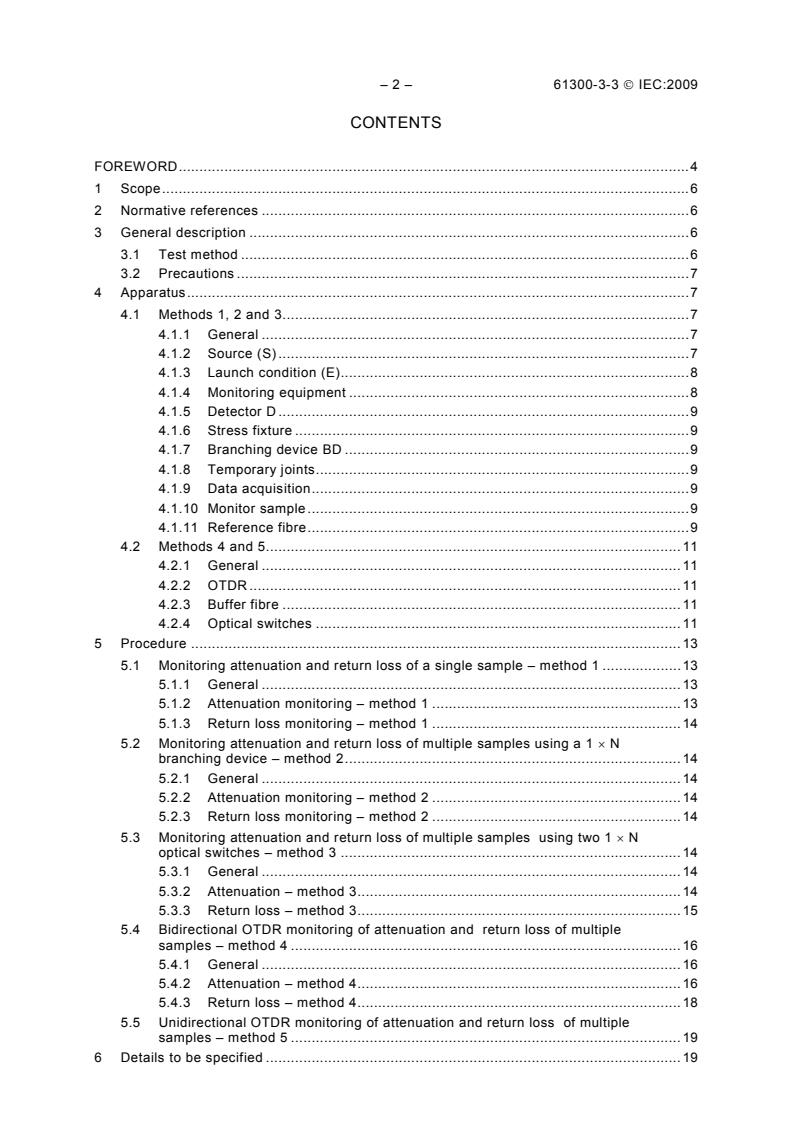
CONTENTS
FOREWORD.4
1 Scope.6
2 Normative references .6
3 General description .6
3.1 Test method .6
3.2 Precautions .7
4 Apparatus.7
4.1 Methods 1, 2 and 3.7
4.1.1 General .7
4.1.2 Source (S) .7
4.1.3 Launch condition (E).8
4.1.4 Monitoring equipment .8
4.1.5 Detector D .9
4.1.6 Stress fixture .9
4.1.7 Branching device BD .9
4.1.8 Temporary joints.9
4.1.9 Data acquisition.9
4.1.10 Monitor sample.9
4.1.11 Reference fibre.10
4.2 Methods 4 and 5.11
4.2.1 General .11
4.2.2 OTDR .11
4.2.3 Buffer fibre .11
4.2.4 Optical switches .11
5 Procedure .13
5.1 Monitoring attenuation and return loss of a single sample – method 1 .13
5.1.1 General .13
5.1.2 Attenuation monitoring – method 1 .13
5.1.3 Return loss monitoring – method 1 .14
5.2 Monitoring attenuation and return loss of multiple samples using a 1 × N
branching device – method 2.14
5.2.1 General .14
5.2.2 Attenuation monitoring – method 2 .14
5.2.3 Return loss monitoring – method 2 .14
5.3 Monitoring attenuation and return loss of multiple samples using two 1 × N
optical switches – method 3 .14
5.3.1 General .14
5.3.2 Attenuation – method 3.14
5.3.3 Return loss – method 3.15
5.4 Bidirectional OTDR monitoring of attenuation and return loss of multiple
samples – method 4 .16
5.4.1 General .16
5.4.2 Attenuation – method 4.16
5.4.3 Return loss – method 4.18
5.5 Unidirectional OTDR monitoring of attenuation and return loss of multiple
samples – method 5 .19
6 Details to be specified .19
61300-3-3 © IEC:2009(E) – 3 –
6.1 Method 1 .19
6.2 Methods 2 and 3.20
6.3 Methods 4 and 5.20
Figure 1 – Method 1 – Monitoring attenuation and return loss of a single sample
undergoing stress testing.10
Figure 2 – Method 2 – Monitoring attenuation and return loss of multiple samples
using a 1 × N branching device .10
Figure 3 – Method 3 – Monitoring attenuation and return loss of multiple samples
using two 1 × N optical switches .11
Figure 4 – Method 4 – Bidirectional OTDR monitoring of attenuation
and return loss of multiple samples.12
Figure 5 – Method 5 – Unidirectional OTDR monitoring of attenuation and return loss
of multiple samples .13
Figure 6 – Cut-back measurement location (transmission) .15
Figure 7 – Typical OTDR trace caused by the reflection from a DUT.17
Figure 8 – Cut-back measurement location (OTDR) .18
Table 1 – Example values for Rayleigh backscatter coefficient.19
– 4 – 61300-3-3 © IEC:2009(E)
INTERNATIONAL ELECTROTECHNICAL COMMISSION
____________
FIBRE OPTIC INTERCONNECTING DEVICES
AND PASSIVE COMPONENTS –
BASIC TEST AND MEASUREMENT PROCEDURES –
Part 3-3: Examinations and measurements –
Active monitoring of changes in attenuation and return loss
FOREWORD
1) The International Electrotechnical Commission (IEC) is a worldwide organization for standardization comprising
all national electrotechnical committees (IEC National Committees). The object of IEC is to promote
international co-operation on all questions concerning standardization in the electrical and electronic fields. To
this end and in addition to other activities, IEC publishes International Standards, Technical Specifications,
Technical Reports, Publicly Available Specifications (PAS) and Guides (hereafter referred to as “IEC
Publication(s)”). Their preparation is entrusted to technical committees; any IEC National Committee interested
in the subject dealt with may participate in this preparatory work. International, governmental and non-
governmental organizations liaising with the IEC also participate in this preparation. IEC collaborates closely
with the International Organization for Standardization (ISO) in accordance with conditions determined by
agreement between the two organizations.
2) The formal decisions or agreements of IEC on technical matters express, as nearly as possible, an international
consensus of opinion on the relevant subjects since each technical committee has representation from all
interested IEC National Committees.
3) IEC Publications have the form of recommendations for international use and are accepted by IEC National
Committees in that sense. While all reasonable efforts are made to ensure that the technical content of IEC
Publications is accurate, IEC cannot be held responsible for the way in which they are used or for any
misinterpretation by any end user.
4) In order to promote international uniformity, IEC National Committees undertake to apply IEC Publications
transparently to the maximum extent possible in their national and regional publications. Any divergence
between any IEC Publication and the corresponding national or regional publication shall be clearly indicated in
the latter.
5) IEC provides no marking procedure to indicate its approval and cannot be rendered responsible for any
equipment declared to be in conformity with an IEC Publication.
6) All users should ensure that they have the latest edition of this publication.
7) No liability shall attach to IEC or its directors, employees, servants or agents including individual experts and
members of its technical committees and IEC National Committees for any personal injury, property damage or
other damage of any nature whatsoever, whether direct or indirect, or for costs (including legal fees) and
expenses arising out of the publication, use of, or reliance upon, this IEC Publication or any other IEC
Publications.
8) Attention is drawn to the Normative references cited in this publication. Use of the referenced publications is
indispensable for the correct application of this publication.
9) Attention is drawn to the possibility that some of the elements of this IEC Publication may be the subject of
patent rights. IEC shall not be held responsible for identifying any or all such patent rights.
International Standard IEC 61300-3 has been prepared by subcommittee 86B: Fibre optic
interconnecting devices and passive components, of IEC technical committee 86: Fibre optics.
This third edition cancels and replaces the second edition published in 2003. This edition
constitutes a minor revision.
The change with respect to the previous edition is the structure of the document.
61300-3-3 © IEC:2009(E) – 5 –
The text of this standard is based on the following documents:
FDIS Report on voting
86B/2808/FDIS 86B/2830/RVD
Full information on the voting for the approval of this standard can be found in the report on
voting indicated in the above table.
This publication has been drafted in accordance with the ISO/IEC Directives, Part 2.
A list of all parts of IEC 61300 series, published under the general title Fibre optic
interconnecting devices and passive components – Basic test and measurement procedures,,
can be found on the IEC website.
The committee has decided that the contents of this publication will remain unchanged until
the maintenance result date indicated on the IEC web site under "http://webstore.iec.ch" in
the data related to the specific publication. At this date, the publication will be
• reconfirmed,
• withdrawn,
• replaced by a revised edition, or
• amended.
A bilingual version of this publication may be issued at a later date.
– 6 – 61300-3-3 © IEC:2009(E)
FIBRE OPTIC INTERCONNECTING DEVICES
AND PASSIVE COMPONENTS –
BASIC TEST AND MEASUREMENT PROCEDURES –
Part 3-3: Examinations and measurements –
Active monitoring of changes in attenuation and return loss
1 Scope
This part of IEC 61300 describes the procedure to monitor changes in attenuation and/or
return loss of a component or an interconnecting device, when subjected to an environmental
or mechanical test. Such a procedure is commonly referred to as active monitoring. In many
instances, it is more efficient to monitor attenuation and return loss at the same time.
The procedure may be applied to measurements on single samples or to simultaneous
measurements on multiple samples, both at single wavelengths and multiple wavelengths, by
using branching devices and/or switches as appropriate.
2 Normative references
The following referenced documents are indispensable for the application of this document.
For dated references, only the edition cited applies. For undated references, the latest edition
of the referenced document (including any amendments) applies.
IEC 61300-1, Fibre optic interconnecting devices and passive components – Basic test and
measurement procedures – Part 1: General and guidance
IEC 61300-3-1, Fibre optic interconnecting devices and passive components – Basic test and
measurement procedures – Part 3-1: Examinations and measurements – Visual examination
IEC 61300-3-6, Fibre optic interconnecting devices and passive components – Basic test and
measurement procedures – Part 3-6: Examinations and measurements – Return loss
IEC 61300-3-35, Fibre optic interconnecting devices and passive components – Basic test
and measurement procedures – Part 3-35: Examinations and measurements – Fibre optic
cylindrical connector endface visual and automated inspection
3 General description
3.1 Test method
The procedure describes a number of active monitoring measurement methods. Method 1
describes the situation where a single sample is subject to mechanical or environmental
stress testing. Methods 2 and 3 describe methods for monitoring changes in the optical
performance of multiple samples. Methods 4 and 5 measure changes in the optical
performance of samples using an OTDR. Methods 4 and 5 may be used only when the OTDR
averaging time is much less than the variation time of the test conditions. Where there is any
form of uncertainty over the measurement method used, method 1 shall be considered to be
the reference method.
—————————
To be published.
61300-3-3 © IEC:2009(E) – 7 –
All methods are capable of being configured to monitor changes in attenuation and return loss
at the same time. The required optical test parameters shall be defined in the relevant
specification.
Where a group of samples is being monitored over a period of time, say several days or
weeks, it is usual to employ some form of automated data acquisition. Also, since the
changes in optical performance can be very small, it is important to ensure high measurement
stability over time.
3.2 Precautions
The following requirements shall be met.
a) Precautions shall be taken to ensure that cladding modes do not affect the measurement.
b) Precautions shall be taken to prevent movement in the position of the fibre cables
between the sample(s) and the test apparatus, to avoid changes in optical performance
caused by bending losses.
c) The stability performance of the test equipment shall be ≤ 0,05 dB or 10 % of the
attenuation to be measured, whichever is the lower value. The stability shall be
maintained over the measurement time. The required measurement resolution shall be
0,01 dB for both multimode and single-mode.
d) To achieve consistent results, clean and inspect all samples prior to measurement
in accordance with the manufacturer’s instructions. Visual examination shall be
undertaken in accordance with IEC 61300-3-1 and IEC 61300-3-35.
e) The power in the fibre shall be at a level that does not generate non-linear scattering
effects (typically < 3 mW).
f) It is common to be monitoring changes in optical performance that are small in comparison
with the polarization dependence of the components under test (DUT) and of parts of the
test apparatus such as branching devices, switches and detectors. Therefore, it is usually
necessary to specify light sources with a low degree of polarization or to couple the source
to low polarization-inducing optics.
g) Particularly, when measuring wavelength dependent components such as multiplexers or
attenuators, it is necessary to use a light source that does not emit light at extraneous
wavelengths at levels that can affect the measurement accuracy.
h) Reflected powers from the test apparatus shall be at a level that does not affect the
measurement accuracy.
i) Care must be taken when using switches or branching devices for multimode
measurements. In many cases, these devices will modify the launched mode power
distribution or result in modal detection non-uniformity, which will give rise to
measurement inaccuracies.
4 Apparatus
4.1 Methods 1, 2 and 3
4.1.1 General
The apparatus used for methods 1, 2 and 3 of this procedure is shown in Figures 1, 2 and 3.
The apparatus consists of the following.
4.1.2 Source (S)
The source consists of an optical emitter, the means to connect to it, and associated drive
electronics. In addition to meeting the stability and power level requirements, the source shall
have the following characteristics.
Centre wavelength: as detailed in the performance and product standard
– 8 – 61300-3-3 © IEC:2009(E)
Spectral width: filtered LED ≤ 150 nm full width at half maximum (FWHM)
Spectral width: LD < 10 nm FWHM
For multimode fibres, broadband sources such as an LED shall be used.
NOTE 1 The interference of modes from a coherent source will create speckle patterns in multimode fibre. These
speckle patterns give rise to speckle or modal noise and are observed as power fluctuations, since their
characteristic times are longer than the resolution time of the detector. As a result, it may be impossible to achieve
stable launch conditions using coherent sources for multimode measurements. Consequently, lasers should be
avoided in favour of LEDs or other incoherent sources for measuring multimode components.
For single-mode fibres, either an LED or an LD may be used.
There are a number of methods of monitoring performance at multiple wavelengths. One
method, illustrated in Figure 3, shows independent light sources joined by an optical
switch SW3.
NOTE 2 It is particularly important to consider the wavelength dependence of the test apparatus when monitoring
multiple wavelengths. For example, different switch ports may not have the same wavelength dependence. This
can affect comparative measurements made between any channel “i” and the reference channel, since they will be
connected to different switch ports. It is therefore necessary, in such circumstances, to complete an accurate
spectral characterization of the test set-up prior to use.
4.1.3 Launch condition (E)
The launch condition shall be specified in accordance with Annex B of IEC 61300-1.
4.1.4 Monitoring equipment
Where multiple measurements are made, suitable apparatus is required to permit monitoring
of the light through the multiple paths.
In Figure 2, individu
...
IEC 61300-3-3 ®
Edition 3.0 2009-03
INTERNATIONAL
STANDARD
NORME
INTERNATIONALE
Fibre optic interconnecting devices and passive components – Basic test and
measurement procedures –
Part 3-3: Examinations and measurements – Active monitoring of changes in
attenuation and return loss
Dispositifs d'interconnexion et composants passifs à fibres optiques –
Méthodes fondamentales d'essais et de mesures –
Partie 3-3: Examens et mesures – Contrôle actif des variations de
l'affaiblissement et de l'affaiblissement de réflexion
All rights reserved. Unless otherwise specified, no part of this publication may be reproduced or utilized in any form
or by any means, electronic or mechanical, including photocopying and microfilm, without permission in writing from
either IEC or IEC's member National Committee in the country of the requester.
If you have any questions about IEC copyright or have an enquiry about obtaining additional rights to this publication,
please contact the address below or your local IEC member National Committee for further information.
Droits de reproduction réservés. Sauf indication contraire, aucune partie de cette publication ne peut être reproduite ni
utilisée sous quelque forme que ce soit et par aucun procédé, électronique ou mécanique, y compris la photocopie et les
microfilms, sans l'accord écrit de la CEI ou du Comité national de la CEI du pays du demandeur.
Si vous avez des questions sur le copyright de la CEI ou si vous désirez obtenir des droits supplémentaires sur cette
publication, utilisez les coordonnées ci-après ou contactez le Comité national de la CEI de votre pays de résidence.
IEC Central Office Tel.: +41 22 919 02 11
3, rue de Varembé Fax: +41 22 919 03 00
CH-1211 Geneva 20 info@iec.ch
Switzerland www.iec.ch
About the IEC
The International Electrotechnical Commission (IEC) is the leading global organization that prepares and publishes
International Standards for all electrical, electronic and related technologies.
About IEC publications
The technical content of IEC publications is kept under constant review by the IEC. Please make sure that you have the
latest edition, a corrigenda or an amendment might have been published.
Useful links:
IEC publications search - www.iec.ch/searchpub Electropedia - www.electropedia.org
The advanced search enables you to find IEC publications The world's leading online dictionary of electronic and
by a variety of criteria (reference number, text, technical electrical terms containing more than 30 000 terms and
committee,…). definitions in English and French, with equivalent terms in
It also gives information on projects, replaced and additional languages. Also known as the International
withdrawn publications. Electrotechnical Vocabulary (IEV) on-line.
IEC Just Published - webstore.iec.ch/justpublished Customer Service Centre - webstore.iec.ch/csc
Stay up to date on all new IEC publications. Just Published If you wish to give us your feedback on this publication
details all new publications released. Available on-line and or need further assistance, please contact the
also once a month by email. Customer Service Centre: csc@iec.ch.
A propos de la CEI
La Commission Electrotechnique Internationale (CEI) est la première organisation mondiale qui élabore et publie des
Normes internationales pour tout ce qui a trait à l'électricité, à l'électronique et aux technologies apparentées.
A propos des publications CEI
Le contenu technique des publications de la CEI est constamment revu. Veuillez vous assurer que vous possédez
l’édition la plus récente, un corrigendum ou amendement peut avoir été publié.
Liens utiles:
Recherche de publications CEI - www.iec.ch/searchpub Electropedia - www.electropedia.org
La recherche avancée vous permet de trouver des Le premier dictionnaire en ligne au monde de termes
publications CEI en utilisant différents critères (numéro de électroniques et électriques. Il contient plus de 30 000
référence, texte, comité d’études,…). termes et définitions en anglais et en français, ainsi que
Elle donne aussi des informations sur les projets et les les termes équivalents dans les langues additionnelles.
publications remplacées ou retirées. Egalement appelé Vocabulaire Electrotechnique
International (VEI) en ligne.
Just Published CEI - webstore.iec.ch/justpublished
Service Clients - webstore.iec.ch/csc
Restez informé sur les nouvelles publications de la CEI.
Just Published détaille les nouvelles publications parues. Si vous désirez nous donner des commentaires sur
Disponible en ligne et aussi une fois par mois par email. cette publication ou si vous avez des questions
contactez-nous: csc@iec.ch.
IEC 61300-3-3 ®
Edition 3.0 2009-03
INTERNATIONAL
STANDARD
NORME
INTERNATIONALE
Fibre optic interconnecting devices and passive components – Basic test and
measurement procedures –
Part 3-3: Examinations and measurements – Active monitoring of changes in
attenuation and return loss
Dispositifs d'interconnexion et composants passifs à fibres optiques –
Méthodes fondamentales d'essais et de mesures –
Partie 3-3: Examens et mesures – Contrôle actif des variations de
l'affaiblissement et de l'affaiblissement de réflexion
INTERNATIONAL
ELECTROTECHNICAL
COMMISSION
COMMISSION
ELECTROTECHNIQUE
PRICE CODE
INTERNATIONALE
R
CODE PRIX
ICS 33.180.20 ISBN 978-2-88912-853-2
– 2 – 61300-3-3 IEC:2009
CONTENTS
FOREWORD . 4
1 Scope . 6
2 Normative references . 6
3 General description . 6
3.1 Test method . 6
3.2 Precautions . 7
4 Apparatus . 7
4.1 Methods 1, 2 and 3 . 7
4.1.1 General . 7
4.1.2 Source (S) . 7
4.1.3 Launch condition (E) . 8
4.1.4 Monitoring equipment . 8
4.1.5 Detector D . 9
4.1.6 Stress fixture . 9
4.1.7 Branching device BD . 9
4.1.8 Temporary joints . 9
4.1.9 Data acquisition . 9
4.1.10 Monitor sample . 9
4.1.11 Reference fibre . 9
4.2 Methods 4 and 5. 11
4.2.1 General . 11
4.2.2 OTDR . 11
4.2.3 Buffer fibre . 11
4.2.4 Optical switches . 11
5 Procedure . 13
5.1 Monitoring attenuation and return loss of a single sample – method 1 . 13
5.1.1 General . 13
5.1.2 Attenuation monitoring – method 1 . 13
5.1.3 Return loss monitoring – method 1 . 14
5.2 Monitoring attenuation and return loss of multiple samples using a 1 × N
branching device – method 2 . 14
5.2.1 General . 14
5.2.2 Attenuation monitoring – method 2 . 14
5.2.3 Return loss monitoring – method 2 . 14
5.3 Monitoring attenuation and return loss of multiple samples using two 1 × N
optical switches – method 3 . 14
5.3.1 General . 14
5.3.2 Attenuation – method 3 . 14
5.3.3 Return loss – method 3 . 15
5.4 Bidirectional OTDR monitoring of attenuation and return loss of multiple
samples – method 4 . 16
5.4.1 General . 16
5.4.2 Attenuation – method 4 . 16
5.4.3 Return loss – method 4 . 18
5.5 Unidirectional OTDR monitoring of attenuation and return loss of multiple
samples – method 5 . 19
6 Details to be specified . 19
61300-3-3 IEC:2009 – 3 –
6.1 Method 1 . 19
6.2 Methods 2 and 3. 20
6.3 Methods 4 and 5. 20
Figure 1 – Method 1 – Monitoring attenuation and return loss of a single sample
undergoing stress testing . 10
Figure 2 – Method 2 – Monitoring attenuation and return loss of multiple samples
using a 1 × N branching device . 10
Figure 3 – Method 3 – Monitoring attenuation and return loss of multiple samples
using two 1 × N optical switches . 11
Figure 4 – Method 4 – Bidirectional OTDR monitoring of attenuation
and return loss of multiple samples . 12
Figure 5 – Method 5 – Unidirectional OTDR monitoring of attenuation and return loss
of multiple samples . 13
Figure 6 – Cut-back measurement location (transmission) . 15
Figure 7 – Typical OTDR trace caused by the reflection from a DUT . 17
Figure 8 – Cut-back measurement location (OTDR) . 18
Table 1 – Example values for Rayleigh backscatter coefficient. 19
– 4 – 61300-3-3 IEC:2009
INTERNATIONAL ELECTROTECHNICAL COMMISSION
____________
FIBRE OPTIC INTERCONNECTING DEVICES
AND PASSIVE COMPONENTS –
BASIC TEST AND MEASUREMENT PROCEDURES –
Part 3-3: Examinations and measurements –
Active monitoring of changes in attenuation and return loss
FOREWORD
1) The International Electrotechnical Commission (IEC) is a worldwide organization for standardization comprising
all national electrotechnical committees (IEC National Committees). The object of IEC is to promote
international co-operation on all questions concerning standardization in the electrical and electronic fields. To
this end and in addition to other activities, IEC publishes International Standards, Technical Specifications,
Technical Reports, Publicly Available Specifications (PAS) and Guides (hereafter referred to as “IEC
Publication(s)”). Their preparation is entrusted to technical committees; any IEC National Committee interested
in the subject dealt with may participate in this preparatory work. International, governmental and non-
governmental organizations liaising with the IEC also participate in this preparation. IEC collaborates closely
with the International Organization for Standardization (ISO) in accordance with conditions determined by
agreement between the two organizations.
2) The formal decisions or agreements of IEC on technical matters express, as nearly as possible, an international
consensus of opinion on the relevant subjects since each technical committee has representation from all
interested IEC National Committees.
3) IEC Publications have the form of recommendations for international use and are accepted by IEC National
Committees in that sense. While all reasonable efforts are made to ensure that the technical content of IEC
Publications is accurate, IEC cannot be held responsible for the way in which they are used or for any
misinterpretation by any end user.
4) In order to promote international uniformity, IEC National Committees undertake to apply IEC Publications
transparently to the maximum extent possible in their national and regional publications. Any divergence
between any IEC Publication and the corresponding national or regional publication shall be clearly indicated in
the latter.
5) IEC provides no marking procedure to indicate its approval and cannot be rendered responsible for any
equipment declared to be in conformity with an IEC Publication.
6) All users should ensure that they have the latest edition of this publication.
7) No liability shall attach to IEC or its directors, employees, servants or agents including individual experts and
members of its technical committees and IEC National Committees for any personal injury, property damage or
other damage of any nature whatsoever, whether direct or indirect, or for costs (including legal fees) and
expenses arising out of the publication, use of, or reliance upon, this IEC Publication or any other IEC
Publications.
8) Attention is drawn to the Normative references cited in this publication. Use of the referenced publications is
indispensable for the correct application of this publication.
9) Attention is drawn to the possibility that some of the elements of this IEC Publication may be the subject of
patent rights. IEC shall not be held responsible for identifying any or all such patent rights.
International Standard IEC 61300-3 has been prepared by subcommittee 86B: Fibre optic
interconnecting devices and passive components, of IEC technical committee 86: Fibre optics.
This third edition cancels and replaces the second edition published in 2003. This edition
constitutes a minor revision.
The change with respect to the previous edition is the structure of the document.
61300-3-3 IEC:2009 – 5 –
This bilingual version (2012-01) corresponds to the monolingual English version, published in
2009-03.
The text of this standard is based on the following documents:
FDIS Report on voting
86B/2808/FDIS 86B/2830/RVD
Full information on the voting for the approval of this standard can be found in the report on
voting indicated in the above table.
The French version of this standard has not been voted upon.
This publication has been drafted in accordance with the ISO/IEC Directives, Part 2.
A list of all parts of IEC 61300 series, published under the general title Fibre optic
interconnecting devices and passive components – Basic test and measurement procedures,,
can be found on the IEC website.
The committee has decided that the contents of this publication will remain unchanged until
the maintenance result date indicated on the IEC web site under "http://webstore.iec.ch" in
the data related to the specific publication. At this date, the publication will be
• reconfirmed,
• withdrawn,
• replaced by a revised edition, or
• amended.
– 6 – 61300-3-3 IEC:2009
FIBRE OPTIC INTERCONNECTING DEVICES
AND PASSIVE COMPONENTS –
BASIC TEST AND MEASUREMENT PROCEDURES –
Part 3-3: Examinations and measurements –
Active monitoring of changes in attenuation and return loss
1 Scope
This part of IEC 61300 describes the procedure to monitor changes in attenuation and/or
return loss of a component or an interconnecting device, when subjected to an environmental
or mechanical test. Such a procedure is commonly referred to as active monitoring. In many
instances, it is more efficient to monitor attenuation and return loss at the same time.
The procedure may be applied to measurements on single samples or to simultaneous
measurements on multiple samples, both at single wavelengths and multiple wavelengths, by
using branching devices and/or switches as appropriate.
2 Normative references
The following referenced documents are indispensable for the application of this document.
For dated references, only the edition cited applies. For undated references, the latest edition
of the referenced document (including any amendments) applies.
IEC 61300-1, Fibre optic interconnecting devices and passive components – Basic test and
measurement procedures – Part 1: General and guidance
IEC 61300-3-1, Fibre optic interconnecting devices and passive components – Basic test and
measurement procedures – Part 3-1: Examinations and measurements – Visual examination
IEC 61300-3-6, Fibre optic interconnecting devices and passive components – Basic test and
measurement procedures – Part 3-6: Examinations and measurements – Return loss
IEC 61300-3-35, Fibre optic interconnecting devices and passive components – Basic test
and measurement procedures – Part 3-35: Examinations and measurements – Fibre optic
connector endface visual and automated inspection
3 General description
3.1 Test method
The procedure describes a number of active monitoring measurement methods. Method 1
describes the situation where a single sample is subject to mechanical or environmental
stress testing. Methods 2 and 3 describe methods for monitoring changes in the optical
performance of multiple samples. Methods 4 and 5 measure changes in the optical
performance of samples using an OTDR. Methods 4 and 5 may be used only when the OTDR
averaging time is much less than the variation time of the test conditions. Where there is any
form of uncertainty over the measurement method used, method 1 shall be considered to be
the reference method.
All methods are capable of being configured to monitor changes in attenuation and return loss
at the same time. The required optical test parameters shall be defined in the relevant
specification.
61300-3-3 IEC:2009 – 7 –
Where a group of samples is being monitored over a period of time, say several days or
weeks, it is usual to employ some form of automated data acquisition. Also, since the
changes in optical performance can be very small, it is important to ensure high measurement
stability over time.
3.2 Precautions
The following requirements shall be met.
a) Precautions shall be taken to ensure that cladding modes do not affect the measurement.
b) Precautions shall be taken to prevent movement in the position of the fibre cables
between the sample(s) and the test apparatus, to avoid changes in optical performance
caused by bending losses.
c) The stability performance of the test equipment shall be ≤ 0,05 dB or 10 % of the
attenuation to be measured, whichever is the lower value. The stability shall be
maintained over the measurement time. The required measurement resolution shall be
0,01 dB for both multimode and single-mode.
d) To achieve consistent results, clean and inspect all samples prior to measurement
in accordance with the manufacturer’s instructions. Visual examination shall be
undertaken in accordance with IEC 61300-3-1 and IEC 61300-3-35.
e) The power in the fibre shall be at a level that does not generate non-linear scattering
effects (typically < 3 mW).
f) It is common to be monitoring changes in optical performance that are small in comparison
with the polarization dependence of the components under test (DUT) and of parts of the
test apparatus such as branching devices, switches and detectors. Therefore, it is usually
necessary to specify light sources with a low degree of polarization or to couple the source
to low polarization-inducing optics.
g) Particularly, when measuring wavelength dependent components such as multiplexers or
attenuators, it is necessary to use a light source that does not emit light at extraneous
wavelengths at levels that can affect the measurement accuracy.
h) Reflected powers from the test apparatus shall be at a level that does not affect the
measurement accuracy.
i) Care must be taken when using switches or branching devices for multimode
measurements. In many cases, these devices will modify the launched mode power
distribution or result in modal detection non-uniformity, which will give rise to
measurement inaccuracies.
4 Apparatus
4.1 Methods 1, 2 and 3
4.1.1 General
The apparatus used for methods 1, 2 and 3 of this procedure is shown in Figures 1, 2 and 3.
The apparatus consists of the following.
4.1.2 Source (S)
The source consists of an optical emitter, the means to connect to it, and associated drive
electronics. In addition to meeting the stability and power level requirements, the source shall
have the following characteristics.
Centre wavelength: as detailed in the performance and product standard
Spectral width: filtered LED ≤ 150 nm full width at half maximum (FWHM)
Spectral width: LD < 10 nm FWHM
For multimode fibres, broadband sources such as an LED shall be used.
– 8 – 61300-3-3 IEC:2009
NOTE 1 The interference of modes from a coherent source will create speckle patterns in multimode fibre. These
speckle patterns give rise to speckle or modal noise and are observed as power fluctuations, since their
characteristic times are longer than the resolution time of the detector. As a result, it may be impossible to achieve
stable launch conditions using coherent sources for multimode measurements. Consequently, lasers should be
avoided in favour of LEDs or other incoherent sources for measuring multimode components.
For single-mode fibres, either an LED or an LD may be used.
There are a number of methods of monitoring performance at multiple wavelengths. One
method, illustrated in Figure 3, shows independent light sources joined by an optical
switch SW3.
NOTE 2 It is particularly important to consider the wavelength dependence of the test apparatus when monitoring
multiple wavelengths. For example, different switch ports may not have the same wavelength dependence. This
can affect comparative measurements made between any channel “i” and the reference channel, since they will be
connected to different switch ports. It is therefore necessary, in such circumstances, to complete an accurate
spectral characterization of the test set-up prior to use.
4.1.3 Launch condition (E)
The launch condition shall be specified in accordance with Annex B of IEC 61300-1.
4.1.4 Monitoring equipment
Where multiple measurements are made, suitable apparatus is required to permit monitoring
of the light through the multiple paths.
In Figure 2, individual monitoring channels are established by dividing the light into N paths
using a 1 × N branching device (BD). This method is practical for a small number of DUTs,
since it requires a multiplicity of branching devices and detectors.
In Figure 3, active switching of the light paths through the DUTs is used. The apparatus
consists of a directional branching device and two 1 × N computer-controlled optical switches.
The channel number of these switches is sufficiently large to accommodate the DUTs under
test, one or more reference lines, and a reference reflectance channel.
NOTE The design of systems to test multiple samples requires the trade-off of a number of factors such as cost
and measurement capability. When testing multimode samples, for example, it may be inappropriate to use
branching devices and/or optical switches, due to the problems surrounding modal losses and the associated cost
of the test apparatus. However, optical switches may be cost-effective for testing single-mode samples, particularly
when the cost of suitable sources and detectors and the measurement stability requirements are considered.
Switch parameters which shall be considered for this test include the following.
a) Repeatability
The switches shall be capable of high repeatability in per-channel insertion loss, since this
parameter will directly detract from the accuracy of the measurement of attenuation or
return loss of the DUT. Furthermore, since environmental tests are generally carried out
over extended periods the switch repeatability shall be considered over the full duration of
the test.
b) Return loss
The return loss characteristics of the switch shall be such that they do not unduly
influence the measurement in methods 2 and 3.
c) Wavelength dependence
When undertaking multiple wavelength measurements, the wavelength dependence
characteristics of the switch shall be taken into account, to ensure they do not unduly
influence the measurement in methods 2 and 3.
61300-3-3 IEC:2009 – 9 –
4.1.5 Detector (D)
The detector consists of an optical detector, the means to connect to it, and associated
electronics. The connection to the detector will be an adaptor that accepts a connector plug of
the appropriate design. The detector shall capture all light emitted by the connector plug.
In addition to meeting the stability and resolution requirements, the detector shall have the
following characteristics.
Linearity: Multimode ±0,25 dB (over –5 dBm to –60 dBm)
Single-mode ±0,1 dB (over –5 dBm to –60 dBm)
NOTE The power meter linearity should be referenced to a power level of –23 dBm at the operational wavelength.
The detectors shall have a high dynamic range with an operational wavelength range
consistent with that of the DUT and the capability to zero the reference level.
4.1.6 Stress fixture
The stress fixture consists of a suitable mechanism for applying the required stress level(s) to
the DUTs. In the case of environmental stress testing, the fixture will typically consist of an
environmental chamber capable of meeting the required temperature and/or humidity
extremes. In the case of mechanical stress testing, a number of different fixtures will often be
required depending on the requirements of the relevant specification, for example, impact rigs,
tensile testers, vibration beds, etc.
4.1.7 Branching device (BD)
The splitting ratio of the BD shall be stable. It shall also be insensitive to polarization. The
directivity should be at least 10 dB higher than the maximum return loss to be measured.
4.1.8 Temporary joints
Temporary joints are typically used for connecting the DUTs to the test apparatus. Generally,
the stability requirements of a test will require that the temporary joints be mechanical or
fusion splices.
4.1.9 Data acquisition
Data recording may be done either manually or automatically. Measurements shall be made at
intervals as defined in the relevant specification. Appropriate data acquisition apparatus shall
be used where measurements are performed automatically.
4.1.10 Monitor sample
A monitor sample provides a direct performance comparison with the sample(s) under test
and shall be used for environmental testing of samples. The monitor sample is similar to those
under test, except that it does not contain a DUT. For example, where the DUT is a connector,
the monitor sample is simply a length of fibre cable of the same type, located in the
same environment as the DUT. The monitor sample shall be placed as close as possible
to the DUT(s).
4.1.11 Reference fibre
A reference fibre is typically employed for the purpose of monitoring and compensating for
source instability. Reference fibres shall be used where there is no monitor sample and
the source does not have sufficient stability to give the required measurement accuracy.
– 10 – 61300-3-3 IEC:2009
TJ
S E BD D
DUT 1
x x
D D
2 3
Stress fixture
IEC 377/09
Figure 1 – Method 1 – Monitoring attenuation and return loss
of a single sample undergoing stress testing
TJ
1 × N
BD
BD DUT D
S 1
X
X
.
D D
2 3
.
.
.
.
N
Stress chamber
IEC 378/09
Figure 2 – Method 2 – Monitoring attenuation and return loss of
multiple samples using a 1 × N branching device
61300-3-3 IEC:2009 – 11 –
TJ
Mode filters
S
Switch 3
λ
Switch 1
Switch 2
Sources
1 X DUT X 1
S
Branching
X
λ DUT X 2
device
3 X DUT X 3
X
4 DUT X 4
D
≈ ≈ ≈ ≈
14 X DUT X
15 X 15
DUT X
m
m X X X
Monitoring sample
X
r
Reference
Stress chamber
return loss
X
X X
X
Reference fibre rev
IEC 024/03
Figure 3 – Method 3 – Monitoring attenuation and return loss of
multiple samples using two 1 × N optical switches
4.2 Methods 4 and 5
4.2.1 General
The apparatus for these methods and its arrangement to monitor multiple DUTs is shown in
Figures 4 and 5. Additional or alternative apparatus required to conduct these tests consists
of the following elements.
4.2.2 OTDR
In these methods, an OTDR is employed as an automated test set. The OTDR shall be
capable of producing one or more pulse durations and pulse repetition rates. The precise
characteristics shall be compatible with the measurement requirements and shall be specified
in the relevant specification.
NOTE The long averaging times required for return-loss measurements may limit the minimum time period for
sequential measurements.
4.2.3 Buffer fibre
Lengths of fibre are used to permit spatial discrimination of the DUT(s) by the OTDR.
4.2.4 Optical switches
The key differences from those switches described in methods 2 and 3 are as follows.
a) Repeatability
There is less need in methods 4 and 5 for extremely high levels of long-term repeatability
of per-channel attenuation, since the OTDR is able to distinguish the switches from
the DUT(s).
b) Return loss
In methods 3 and 4 very high values of switch return loss are required, since these
reflections can, depending on the particular OTDR, obscure the measurement.
– 12 – 61300-3-3 IEC:2009
Buffer fibre
TJ
Mode filters
Switch 1 Switch 2
1 1
DUT
X X
2 2
DUT
X X
3 3
DUT
X X
4 4
DUT
X
OTDR X
≈ ≈ ≈ ≈
14 DUT 14
X X
15 15
DUT
X X
m m
X X X
Monitoring sample
rev
Stress chamber
IEC 025/03
Figure 4 – Method 4 – Bidirectional OTDR monitoring of attenuation
and return loss of multiple samples
61300-3-3 IEC:2009 – 13 –
Buffer fibre
TJ
Mode filters
Switch 1
DUT
X X
DUT
X
X
3 DUT
X X
DUT
OTDR X
X
≈ ≈
DUT
14 X
X
DUT
X
X
m
X
X
X
Monitoring sample
Stress chamber
IEC 026/03
Figure 5 – Method 5 – Unidirectional OTDR monitoring of attenuation
and return loss of multiple samples
5 Procedure
5.1 Monitoring attenuation and return loss of a single sample – method 1
5.1.1 General
This method involves the monitoring of attenuation and/or return loss of a DUT in a stress
fixture, by using a branching device. The measured throughput power (measured at D ) and
reflected power (measured at D ) are compared with the reference power level measured
at D .
NOTE For short-term monitoring of attenuation only, it is possible to eliminate the BD. In this case, care must be
exercised to ensure that changes in attenuation are a result of stress-testing the DUT and are not due to variation
in the test apparatus. It is recommended that such measurements of the DUT be made in accordance with
IEC 61300-3-4.
5.1.2 Attenuation monitoring – method 1
Take readings of D and D at the specified periods. The common logarithm of the ratio of
1 3
these readings is proportional to the attenuation (in dB) of the DUT. Changes in this ratio are
monitored to determine any variation in the attenuation of the DUT due to the stress test. The
typical method for presentation of the test results is to plot changes in the ratio of D and D
1 3
against time.
—————————
IEC 61300-3-4, Fibre optic connecting devices and passive components – Basic test and measurement
procedures – Part 3-4: Examinations and measures – Attenuation.
– 14 – 61300-3-3 IEC:2009
5.1.3 Return loss monitoring – method 1
Take the readings of D and D at the specified periods. The common logarithm of the ratio of
2 3
these readings is proportional to the return loss (in dB) of the DUT. Changes in this ratio are
monitored to determine any variation in the return loss of the DUT due to the stress test. The
typical method for presentation of the test results is to plot changes in the ratio of D and D
2 3
against time.
5.2 Monitoring attenuation and return loss of multiple samples using a 1 × N
branching device – method 2
5.2.1 General
This method involves the monitoring of attenuation and/or return loss of multiple DUTs in a
stress fixture, by using a 1 × N branching device and a number of 1 × 2 or 2 × 2 branching
devices, depending on the number of samples being tested. The measured through-put power
(measured at D ) and reflected power (measured at D ) are compared with the reference
1 2
power level measured at D for each of the samples.
The combination of the light source, S, and the 1 × N branching device should be
characterized for stability of splitting ratio to each of the output ports since this constancy will
determine the accuracy of the monitoring measurements.
5.2.2 Attenuation monitoring – method 2
Take readings of D and D for each of the DUTs at the specified periods. The common
1 3
logarithm of the ratio of these readings is proportional to the attenuation (in dB) of the DUT.
Changes in this ratio are monitored to determine any variation in the attenuation of each DUT
due to the stress test. The typical method for presentation of the test results is to plot
changes in the ratio of D and D for each sample against time.
1 3
5.2.3 Return loss monitoring – method 2
Take readings of D and D for each of the DUTs at the specified periods. The common
2 3
logarithm of the ratio of these readings is proportional to the return loss (in dB) of the DUT.
Changes in this ratio are monitored to determine any variation in the return loss of each DUT
due to the stress test. The typical method for presentation of the test results is to plot
changes in the ratio of D and D for each sample against time.
2 3
5.3 Monitoring attenuation and return loss of multiple samples
using two 1 × N optical switches – method 3
5.3.1 General
Due to the complexity of the test set-up, it is typical for the various parts of the apparatus to
be computer-controlled. This control ensures that the 1 × N switches are stepped
synchronously and that the sources are switched at the appropriate time to make the
necessary number of measurements. The control also ensures that the sequence is repeated
periodically as defined in the relevant specification for the duration of the stress test.
5.3.2 Attenuation – method 3
A measurement of attenuation of the component under test in channel “i” at time “t” is as
follows:
= J – P (1)
L
i,t i i,t
where
P = p – p is the normalized power, in decibels (dB);
i,t i,t m,t
61300-3-3 IEC:2009 – 15 –
p is the power through the monitor channel, in decibels referenced to one
m,t
miliwatt (dBm);
p is the power measured with switches 1 and 2 both set to channel “i”,
i,t
in decibels referenced to miliwatt (dBm);
J is the constant for channel “i”, in decibels (dB).
i
Where more than one reference channel is used, the value of p is the average of all
m,t
reference channels.
NOTE 1 Upper-case letters are used to denote normalized power and lower-case letters to denote measured
values. Normalized power in channel “i” is the power transmitted through channel “i”, minus the average of the
power transmitted through the reference channels. The use of normalized power allows the determination of loss to
be independent of variations in source intensity.
NOTE 2 Subscript “t” refers to a set of measurements, i.e. the measurement set at a specific test condition.
NOTE 3 In the apparatus of Figures 3, 4 and 5, the monitor sample denoted as “m” is used to monitor for changes
which may occur in the fibre itself as opposed to the DUT in the stress chamber.
During the time in which a set of measurements for the determination of p is being made,
i,t
care must be taken that no change that would alter power levels in the system is made.
The constant J is determined with a cut-back measurement (see Figure 6) made at the
i
completion of the test sequence.
J = B – A + P (2)
i i i i,c
where
A is the cut-back measurement of power in fibre “i” at point “a” (see Figure 6);
i
B is the cut-back measurement of power in fibre “i” at point “b” (see Figure 6);
i
P is the value of P at the time when the cut-back measurements are made.
i,c i,t
TJ
Mode filters
Fibre from Fibre from
switch 1 switch 2
DUT
X X
b
a
IEC 027/03
Figure 6 – Cut-back measurement location (transmission)
The sequence of measurements in the determination of J is: first, make the measurements for
i
P , then make the cut-back measurement A and then B . The measurements of A and B are
i,c i i i i
made using a power meter with a bare fibre adapter.
5.3.3 Return loss – method 3
Set switch 1 to channel “i” and switch 2 to channel “rev”. A measurement of return loss of a
component under test in channel “i” at time “t” is as follows.
– 16 – 61300-3-3 IEC:2009
−∆P/10
RL = P – G + 10 × log (1 – 10 ) (3)
i,t i,t i
where
P = p – p is the normalized power in channel “i”, in decibels (dB);
i,t i,t r,t
G is a constant.
i
NOTE In calculations for return loss, normalized power is the power in channel “i” minus the power in channel “r”.
p is the power, measured with switch 1 on channel “r” and switch 2 on channel “rev”, in decibels referenced to
r,t
one milliwatt (dBm);
∆P = p – p (4)
i,t i,o
where
P = p – p is the normalized reflected power, measured with the fibres from channel “i” of switches 1 and 2
i,o i,o r,o
spliced directly together without a component between the switches, in decibels (dB);
When |∆P| > 10 dB, the following approximation for return loss may be used.
RL ≅ P – G (5)
i,t i,t i
The constant G is evaluated using measurements made with the fibre from channel “i” of
i
switch 1 terminated with a reference return loss. The reference return loss is a length of fibre
one end of which is terminated with a known return loss.
/10
−∆P
= P – S + 10 × log (1 – 10 ) (6)
G
i i,r
where
S is the reference return loss, in decibels (dB);
P is the normalized power in channel “i” terminated with reference return loss S,
i,s
in decibels (dB);
∆ P = P – P′ (7)
i,s i,o
where
P′ is the normalized reflected power with a high attenuation in the fibre using, for example,
i,o
a mandrel wrap between the reference return loss S and SW1.
5.4 Bidirectional OTDR monitoring of attenuation and
return loss of multiple samples – method 4
5.4.1 General
Due to the complexity of the test set-up, it is typical for the various parts of the apparatus,
including the OTDR, to be computer-controlled. This control ensures that the 1 × N switches
are stepped synchronously and that the sources are switched at the appropriate time to make
the necessary number of measurements. The control also ensures that the sequence is
repeated periodically as defined in the relevant specification for the duration of the stress test.
5.4.2 Attenuation – method 4
A measurement of attenuation of the DUT in channel “i” at time “t” is carried out as follows:
Xf + Xr
i,t i,t
(8)
L = + J
i,t i
where
61300-3-3 IEC:2009 – 17 –
Xf is the change in power in the OTDR display for the component under test with switch 1
i,t
set on channel “i”;
Xr is the same as Xf except that switch 2 is set on channel “i”, and switch 1 is set on
i,t i,t
channel “rev”;
J is a constant for channel “i”.
i
The values of Xf and Xr are values of loss as seen in both the forward and reverse directions
of transmission plus loss in the temporary joints (see Figure 7).
OTDR
Signal dB
H
Xf, Xr
Distance
IEC 028/03
Figure 7 – Typical OTDR trace caused by the reflection from a DUT
NOTE Since this is a monitoring experiment, only the change in attenuation is considered significant. Thus the
change in L from the initial measurement is the important factor, rather than the absolute value of L
i,t i,t.
The constant J is determined with a cut-back measurement made at the completion of the test
i
sequence.
The sequence of measurements in the determination of J is, first, to make the measurements
i
Xf and Xr , replace the OTDR with a dual-wavelength source, make cut-back measurement
i,c i,c
A and then cut-back measurement B . The measurements of A and B are made using a bare
i i i i
fibre adapter and power meter. These are the only measurements that are not made with
the OTDR.
Xf + Xr
i,c i,c
J = B – A – (9)
i i i
where
A is a cut-back measurement of power in fibre “i” at point “a” (see Figure 8);
i
B is a cut-back measurement of power in fibre “i” at point “b” (see Figure 8);
i
Xf and Xr are the measurements made at the time of the cut-back measurements.
i,c i,c
– 18 –
...
Questions, Comments and Discussion
Ask us and Technical Secretary will try to provide an answer. You can facilitate discussion about the standard in here.
Loading comments...