


IEC 62616:2010
(Main)Maritime navigation and radiocommunication equipment and systems - Bridge navigational watch alarm system (BNWAS)
Maritime navigation and radiocommunication equipment and systems - Bridge navigational watch alarm system (BNWAS)
IEC 62616:2010 specifies the minimum performance requirements, technical characteristics and methods of testing, and required test results, for a bridge navigational watch alarm system (BNWAS) as required by Chapter V of the International Convention for the Safety of Life at Sea (SOLAS), as amended. Takes account of the general requirements given in IMO resolution A.694(17) and is associated with IEC 60945. The contents of the corrigendum of July 2012 have been included in this copy.
Equipements et systèmes de navigation et de radiocommunication maritimes - Système d'alarme pour la surveillance de l'activité de navigation sur le pont
L'IEC 62616:2010 spécifie les exigences de performance, caractéristiques techniques et méthodes d essai minimales, ainsi que les résultats requis pour les essais, pour un système d alarme à surveillance d activité de navigation sur le pont (BNWAS), tels que les requiert le Chapitre V de la Convention internationale pour la sauvegarde de la vie humaine en mer (SOLAS - International Convention for the Safety of Life at Sea), amendée. Elle prend en compte les exigences générales de la résolution OMI A.694(17) et est associée à l'IEC 60945. Le contenu du corrigendum de Juillet 2012 est inclus dans cette copie.
General Information
- Status
- Published
- Publication Date
- 10-Feb-2010
- Technical Committee
- TC 80 - Maritime navigation and radiocommunication equipment and systems
- Current Stage
- PPUB - Publication issued
- Start Date
- 11-Feb-2010
- Completion Date
- 15-Feb-2010
Relations
- Effective Date
- 05-Sep-2023
Overview
IEC 62616:2010 specifies minimum performance requirements, technical characteristics, testing methods and required test results for a Bridge Navigational Watch Alarm System (BNWAS). Published by the IEC for compliance with SOLAS Chapter V, this standard defines how a BNWAS must monitor bridge activity and detect Officer of the Watch (OOW) disability, initiate alarms, and provide emergency call/transfer functions. The edition includes the July 2012 corrigendum and is associated with IEC 60945.
Key topics and technical requirements
- Purpose: Monitor bridge activity to detect OOW incapacity and automatically alert the Master or backup OOW.
- Operational modes:
- Automatic (activated with heading/track control systems)
- Manual ON (always active)
- Manual OFF (deactivated)
- Note: Automatic mode may not be suitable for ships required to keep BNWAS active whenever underway.
- Alarm sequence and timing:
- Dormant period (Td): selectable between 3 and 12 minutes.
- At end of Td → visual indication on bridge.
- If not reset: first-stage bridge audible alarm after ~15 s.
- If still not reset: second-stage remote audible alarm (Master/back-up) after another ~15 s (~30 s total).
- If still not reset: third-stage remote alarm follows after approximately 2 minutes (per standard alarm sequence).
- Reset and emergency features: Reset function descriptions, initiation methods, and an emergency call facility and alarm transfer mechanism are specified.
- Performance and safety: Requirements for accuracy, security, malfunction handling, audible/visual indications and ergonomic controls.
- Design, installation and interfacing: Physical integrity, power supply, installation documentation and digital interfaces (e.g., IEC 61162) are covered.
- Testing: Detailed methods of testing and required test results for operational modes, alarms, interfaces, power and documentation.
Applications and users
IEC 62616 is essential for:
- Shipowners and operators ensuring SOLAS compliance
- Shipyards and system integrators installing bridge equipment
- Marine electronics manufacturers designing BNWAS or integrated bridge systems (radar, ECDIS)
- Classification societies, flag state authorities and surveyors validating installations
- Maritime safety officers and technical procurement teams specifying alarm system performance
Related standards and references
- IEC 60945 - general maritime equipment requirements
- IEC 61162 (all parts) - digital interfaces for shipborne equipment
- IEC 62288 - presentation of navigation information
- IMO resolutions: A.694(17), A.813(19), A.830(19) and MSC.128(75) (BNWAS performance recommendation)
Keywords: IEC 62616, BNWAS, Bridge Navigational Watch Alarm System, SOLAS, maritime safety, bridge alarm, officer of the watch, marine standards, alarm sequence.
Buy Documents


IEC 62616:2010 - Maritime navigation and radiocommunication equipment and systems - Bridge navigational watch alarm system (BNWAS) Released:2/11/2010
IEC 62616:2010 - Maritime navigation and radiocommunication equipment and systems - Bridge navigational watch alarm system (BNWAS) Released:2/11/2010
Get Certified
Connect with accredited certification bodies for this standard

DNV
DNV is an independent assurance and risk management provider.

Lloyd's Register
Lloyd's Register is a global professional services organisation specialising in engineering and technology.

ABS Quality Evaluations Inc.
American Bureau of Shipping quality certification.
Sponsored listings
Frequently Asked Questions
IEC 62616:2010 is a standard published by the International Electrotechnical Commission (IEC). Its full title is "Maritime navigation and radiocommunication equipment and systems - Bridge navigational watch alarm system (BNWAS)". This standard covers: IEC 62616:2010 specifies the minimum performance requirements, technical characteristics and methods of testing, and required test results, for a bridge navigational watch alarm system (BNWAS) as required by Chapter V of the International Convention for the Safety of Life at Sea (SOLAS), as amended. Takes account of the general requirements given in IMO resolution A.694(17) and is associated with IEC 60945. The contents of the corrigendum of July 2012 have been included in this copy.
IEC 62616:2010 specifies the minimum performance requirements, technical characteristics and methods of testing, and required test results, for a bridge navigational watch alarm system (BNWAS) as required by Chapter V of the International Convention for the Safety of Life at Sea (SOLAS), as amended. Takes account of the general requirements given in IMO resolution A.694(17) and is associated with IEC 60945. The contents of the corrigendum of July 2012 have been included in this copy.
IEC 62616:2010 is classified under the following ICS (International Classification for Standards) categories: 47.020.70 - Navigation and control equipment. The ICS classification helps identify the subject area and facilitates finding related standards.
IEC 62616:2010 has the following relationships with other standards: It is inter standard links to IEC 62616:2010/COR1:2012. Understanding these relationships helps ensure you are using the most current and applicable version of the standard.
IEC 62616:2010 is available in PDF format for immediate download after purchase. The document can be added to your cart and obtained through the secure checkout process. Digital delivery ensures instant access to the complete standard document.
Standards Content (Sample)
IEC 62616 ®
Edition 1.0 2010-02
INTERNATIONAL
STANDARD
Maritime navigation and radiocommunication equipment and systems – Bridge
navigational watch alarm system (BNWAS)
All rights reserved. Unless otherwise specified, no part of this publication may be reproduced or utilized in any form
or by any means, electronic or mechanical, including photocopying and microfilm, without permission in writing from
either IEC or IEC's member National Committee in the country of the requester.
If you have any questions about IEC copyright or have an enquiry about obtaining additional rights to this publication,
please contact the address below or your local IEC member National Committee for further information.
IEC Central Office
3, rue de Varembé
CH-1211 Geneva 20
Switzerland
Email: inmail@iec.ch
Web: www.iec.ch
About the IEC
The International Electrotechnical Commission (IEC) is the leading global organization that prepares and publishes
International Standards for all electrical, electronic and related technologies.
About IEC publications
The technical content of IEC publications is kept under constant review by the IEC. Please make sure that you have the
latest edition, a corrigenda or an amendment might have been published.
ƒ Catalogue of IEC publications: www.iec.ch/searchpub
The IEC on-line Catalogue enables you to search by a variety of criteria (reference number, text, technical committee,…).
It also gives information on projects, withdrawn and replaced publications.
ƒ IEC Just Published: www.iec.ch/online_news/justpub
Stay up to date on all new IEC publications. Just Published details twice a month all new publications released. Available
on-line and also by email.
ƒ Electropedia: www.electropedia.org
The world's leading online dictionary of electronic and electrical terms containing more than 20 000 terms and definitions
in English and French, with equivalent terms in additional languages. Also known as the International Electrotechnical
Vocabulary online.
ƒ Customer Service Centre: www.iec.ch/webstore/custserv
If you wish to give us your feedback on this publication or need further assistance, please visit the Customer Service
Centre FAQ or contact us:
Email: csc@iec.ch
Tel.: +41 22 919 02 11
Fax: +41 22 919 03 00
IEC 62616 ®
Edition 1.0 2010-02
INTERNATIONAL
STANDARD
Maritime navigation and radiocommunication equipment and systems – Bridge
navigational watch alarm system (BNWAS)
INTERNATIONAL
ELECTROTECHNICAL
COMMISSION
PRICE CODE
Q
ICS 47.020.70 ISBN 978-2-88910-774-2
– 2 – 62616 © IEC:2010(E)
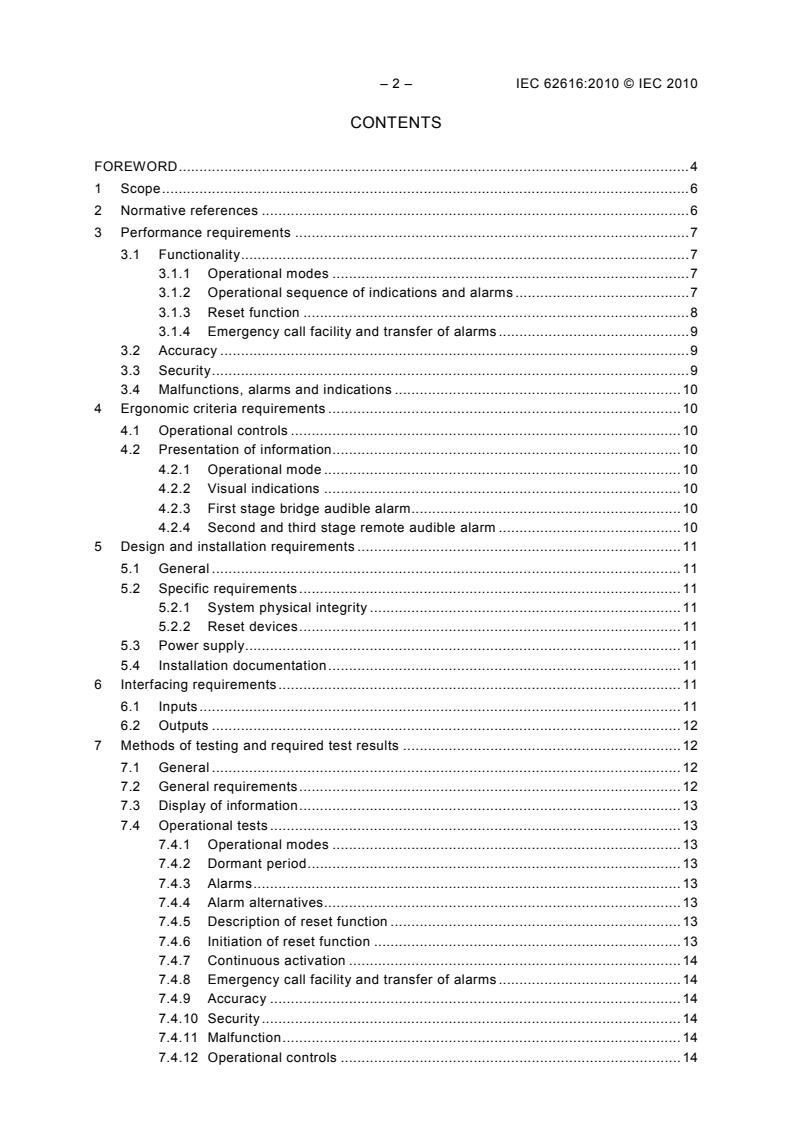
CONTENTS
FOREWORD.4
1 Scope.6
2 Normative references .6
3 Performance requirements .7
3.1 Functionality.7
3.1.1 Operational modes .7
3.1.2 Operational sequence of indications and alarms .7
3.1.3 Reset function .8
3.1.4 Emergency call facility and transfer of alarms.9
3.2 Accuracy .9
3.3 Security.9
3.4 Malfunctions, alarms and indications .10
4 Ergonomic criteria requirements .10
4.1 Operational controls .10
4.2 Presentation of information.10
4.2.1 Operational mode .10
4.2.2 Visual indications .10
4.2.3 First stage bridge audible alarm.10
4.2.4 Second and third stage remote audible alarm .10
5 Design and installation requirements .11
5.1 General .11
5.2 Specific requirements.11
5.2.1 System physical integrity .11
5.2.2 Reset devices.11
5.3 Power supply.11
5.4 Installation documentation.11
6 Interfacing requirements.11
6.1 Inputs.11
6.2 Outputs .12
7 Methods of testing and required test results .12
7.1 General .12
7.2 General requirements.12
7.3 Display of information.13
7.4 Operational tests .13
7.4.1 Operational modes .13
7.4.2 Dormant period.13
7.4.3 Alarms.13
7.4.4 Alarm alternatives.13
7.4.5 Description of reset function .13
7.4.6 Initiation of reset function .13
7.4.7 Continuous activation .14
7.4.8 Emergency call facility and transfer of alarms.14
7.4.9 Accuracy .14
7.4.10 Security.14
7.4.11 Malfunction.14
7.4.12 Operational controls .14
62616 © IEC:2010(E) – 3 –
7.4.13 Operational mode .14
7.4.14 Visual indications .15
7.4.15 First stage bridge audible alarm.15
7.4.16 Second and third stage remote audible alarm .15
7.4.17 Design and installation general.15
7.4.18 System physical integrity .15
7.4.19 Reset devices.15
7.4.20 Power supply.15
7.4.21 Installation documentation .15
7.4.22 Interfacing .15
Annex A (normative) Installation considerations.16
Bibliography.17
Figure 1 – Alarm sequence without acknowledgements.7
– 4 – 62616 © IEC:2010(E)
INTERNATIONAL ELECTROTECHNICAL COMMISSION
____________
MARITIME NAVIGATION AND
RADIOCOMMUNICATION EQUIPMENT AND SYSTEMS –
BRIDGE NAVIGATIONAL WATCH ALARM SYSTEM (BNWAS)
FOREWORD
1) The International Electrotechnical Commission (IEC) is a worldwide organization for standardization comprising
all national electrotechnical committees (IEC National Committees). The object of IEC is to promote
international co-operation on all questions concerning standardization in the electrical and electronic fields. To
this end and in addition to other activities, IEC publishes International Standards, Technical Specifications,
Technical Reports, Publicly Available Specifications (PAS) and Guides (hereafter referred to as “IEC
Publication(s)”). Their preparation is entrusted to technical committees; any IEC National Committee interested
in the subject dealt with may participate in this preparatory work. International, governmental and non-
governmental organizations liaising with the IEC also participate in this preparation. IEC collaborates closely
with the International Organization for Standardization (ISO) in accordance with conditions determined by
agreement between the two organizations.
2) The formal decisions or agreements of IEC on technical matters express, as nearly as possible, an international
consensus of opinion on the relevant subjects since each technical committee has representation from all
interested IEC National Committees.
3) IEC Publications have the form of recommendations for international use and are accepted by IEC National
Committees in that sense. While all reasonable efforts are made to ensure that the technical content of IEC
Publications is accurate, IEC cannot be held responsible for the way in which they are used or for any
misinterpretation by any end user.
4) In order to promote international uniformity, IEC National Committees undertake to apply IEC Publications
transparently to the maximum extent possible in their national and regional publications. Any divergence
between any IEC Publication and the corresponding national or regional publication shall be clearly indicated in
the latter.
5) IEC itself does not provide any attestation of conformity. Independent certification bodies provide conformity
assessment services and, in some areas, access to IEC marks of conformity. IEC is not responsible for any
services carried out by independent certification bodies.
6) All users should ensure that they have the latest edition of this publication.
7) No liability shall attach to IEC or its directors, employees, servants or agents including individual experts and
members of its technical committees and IEC National Committees for any personal injury, property damage or
other damage of any nature whatsoever, whether direct or indirect, or for costs (including legal fees) and
expenses arising out of the publication, use of, or reliance upon, this IEC Publication or any other IEC
Publications.
8) Attention is drawn to the Normative references cited in this publication. Use of the referenced publications is
indispensable for the correct application of this publication.
9) Attention is drawn to the possibility that some of the elements of this IEC Publication may be the subject of
patent rights. IEC shall not be held responsible for identifying any or all such patent rights.
International Standard IEC 62616 has been prepared by IEC technical committee 80: Maritime
navigation and radiocommunication equipment and systems.
The text of this standard is based on the following documents:
FDIS Report on voting
80/577/FDIS 80/588/RVD
Full information on the voting for the approval of this standard can be found in the report on
voting indicated in the above table.
This publication has been drafted in accordance with the ISO/IEC Directives, Part 2.
62616 IEC:2010(E) – 5 –
The committee has decided that the contents of this publication will remain unchanged until
the stability date indicated on the IEC web site under "http://webstore.iec.ch" in the data
related to the specific publication. At this date, the publication will be
• reconfirmed,
• withdrawn,
• replaced by a revised edition, or
• amended.
A bilingual version of this document may be issued at a later date.
The contents of the corrigendum of July 2012 have been included in this copy.
– 6 – 62616 © IEC:2010(E)
MARITIME NAVIGATION AND
RADIOCOMMUNICATION EQUIPMENT AND SYSTEMS –
BRIDGE NAVIGATIONAL WATCH ALARM SYSTEM (BNWAS)
1 Scope
This International Standard specifies the minimum performance requirements, technical
characteristics and methods of testing, and required test results, for a bridge navigational
watch alarm system (BNWAS) as required by Chapter V of the International Convention for
the Safety of Life at Sea (SOLAS), as amended. It takes account of the general requirements
given in IMO resolution A.694(17) and is associated with IEC 60945. When a requirement in
this International Standard is different from IEC 60945, the requirement in this standard takes
precedence.
This standard incorporates the parts of the performance standards included in IMO resolution
MSC.128(75).
NOTE 1 All text of this standard, whose wording is identical to that of IMO resolution MSC.128(75), is printed in
italics, and the resolution and associated performance standard paragraph numbers are indicated in brackets.
(128/A1) The purpose of a bridge navigational watch alarm system (BNWAS) is to monitor
bridge activity and detect operator disability which could lead to marine accidents. The system
monitors the awareness of the Officer of the Watch (OOW) and automatically alerts the Master or
another qualified OOW if for any reason the OOW becomes incapable of performing the
OOW's duties. This purpose is achieved by a series of indications and alarms to alert first the
OOW and, if he is not responding, then to alert the Master or another qualified OOW.
Additionally, the BNWAS may provide the OOW with a means of calling for immediate
assistance, if required. The BNWAS should be operational whenever the ship is underway at
sea (SOLAS V/19.2.2.3).
NOTE 2 BNWAS may not, in practice, be realised as a stand alone equipment. It may be integrated in other
equipment such as radar, ECDIS, etc.
2 Normative references
The following referenced documents are indispensable for the application of this document.
For dated references, only the edition cited applies. For undated references, the latest edition
of the referenced document (including any amendments) applies.
IEC 60945, Maritime navigation and radiocommunication equipment and systems – General
requirements – Methods of testing and required test results
IEC 61162 (all parts), Maritime navigation and radiocommunication equipment and
systems – Digital interfaces
IEC 61162-1, Maritime navigation and radiocommunication equipment and systems – Digital
interfaces – Part 1: Single talker and multiple listeners
IEC 62288, Maritime navigation and radiocommunication equipment and systems –
Presentation of navigation-related information on shipborne navigational displays – General
requirements – Methods of testing and required results
IMO Resolution A.694(17), General requirements for shipborne radio equipment forming part
of the Global maritime distress and safety system and for electronic navigational aids
62616 © IEC:2010(E) – 7 –
IMO Resolution A.813(19), General requirements for electromagnetic compatibility (EMC) for
all electrical and electronic ship’s equipment
IMO Resolution A.830(19), Code on alarms and indicators
IMO Resolution MSC.128(75), Recommendation on performance standards for a bridge
navigational watch alarm system (BNWAS)
IMO MSC/Circ.982, Guidelines on Ergonomic Criteria for Bridge equipment and Layout
3 Performance requirements
3.1 Functionality
3.1.1 Operational modes
(See 7.4.1)
(128/A4.1.1.1) The BNWAS shall incorporate the following operational modes:
• Automatic (Automatically brought into operation whenever the ship's heading or track
control system is activated and inhibited when this system is not activated)
• Manual ON (In operation constantly)
• Manual OFF (Does not operate under any circumstances)
NOTE The Automatic mode is not suitable for use on a ship conforming with regulation SOLAS V/19.2.2.3 which
requires the BWNAS to be in operation whenever the ship is underway at sea.
3.1.2 Operational sequence of indications and alarms
3.1.2.1 Dormant period
(See 7.4.2)
(128/A4.1.2.1) Once operational, the alarm system shall remain dormant for a period of
between 3 and 12 min (Td). See Figure 1.
(128/A4.1.2.2) At the end of this dormant period, the alarm system shall initiate a visual
indication on the bridge.
Third stage remote alarm
Second stage remote audible alarm
First stage bridge audible alarm
Visual indication
Min
Td Td Td Td
+ 0,25 + 0,50 + 2,0
(Td = selected dormant period)
IEC 043/10
Figure 1 – Alarm sequence without acknowledgements
– 8 – 62616 © IEC:2010(E)
3.1.2.2 First stage bridge audible alarm
(See 7.4.3)
(128/A4.1.2.3) If not reset, the BNWAS shall additionally sound a first stage audible alarm on
the bridge 15 s after the visual indication is initiated.
3.1.2.3 Second stage remote audible alarm
(See 7.4.3)
(128/A4.1.2.4) If not reset, the BNWAS shall additionally sound a second stage remote audible
alarm in the back-up officer's and/or Master's location 15 s after the first stage audible alarm
is initiated.
3.1.2.4 Third stage remote
...
IEC 62616 ®
Edition 1.0 2010-02
INTERNATIONAL
STANDARD
NORME
INTERNATIONALE
Maritime navigation and radiocommunication equipment and systems – Bridge
navigational watch alarm system (BNWAS)
Équipements et systèmes de navigation et de radiocommunication maritimes –
Système d’alarme pour la surveillance de l’activité de navigation sur le pont
All rights reserved. Unless otherwise specified, no part of this publication may be reproduced or utilized in any form
or by any means, electronic or mechanical, including photocopying and microfilm, without permission in writing from
either IEC or IEC's member National Committee in the country of the requester. If you have any questions about IEC
copyright or have an enquiry about obtaining additional rights to this publication, please contact the address below or
your local IEC member National Committee for further information.
Droits de reproduction réservés. Sauf indication contraire, aucune partie de cette publication ne peut être reproduite
ni utilisée sous quelque forme que ce soit et par aucun procédé, électronique ou mécanique, y compris la photocopie
et les microfilms, sans l'accord écrit de l'IEC ou du Comité national de l'IEC du pays du demandeur. Si vous avez des
questions sur le copyright de l'IEC ou si vous désirez obtenir des droits supplémentaires sur cette publication, utilisez
les coordonnées ci-après ou contactez le Comité national de l'IEC de votre pays de résidence.
IEC Central Office Tel.: +41 22 919 02 11
3, rue de Varembé Fax: +41 22 919 03 00
CH-1211 Geneva 20 info@iec.ch
Switzerland www.iec.ch
About the IEC
The International Electrotechnical Commission (IEC) is the leading global organization that prepares and publishes
International Standards for all electrical, electronic and related technologies.
About IEC publications
The technical content of IEC publications is kept under constant review by the IEC. Please make sure that you have the
latest edition, a corrigenda or an amendment might have been published.
IEC Catalogue - webstore.iec.ch/catalogue Electropedia - www.electropedia.org
The stand-alone application for consulting the entire The world's leading online dictionary of electronic and
bibliographical information on IEC International Standards, electrical terms containing more than 30 000 terms and
Technical Specifications, Technical Reports and other definitions in English and French, with equivalent terms in 14
documents. Available for PC, Mac OS, Android Tablets and additional languages. Also known as the International
iPad. Electrotechnical Vocabulary (IEV) online.
IEC publications search - www.iec.ch/searchpub IEC Glossary - std.iec.ch/glossary
The advanced search enables to find IEC publications by a More than 55 000 electrotechnical terminology entries in
variety of criteria (reference number, text, technical English and French extracted from the Terms and Definitions
committee,…). It also gives information on projects, replaced clause of IEC publications issued since 2002. Some entries
and withdrawn publications. have been collected from earlier publications of IEC TC 37,
77, 86 and CISPR.
IEC Just Published - webstore.iec.ch/justpublished
Stay up to date on all new IEC publications. Just Published IEC Customer Service Centre - webstore.iec.ch/csc
details all new publications released. Available online and If you wish to give us your feedback on this publication or
also once a month by email. need further assistance, please contact the Customer Service
Centre: csc@iec.ch.
A propos de l'IEC
La Commission Electrotechnique Internationale (IEC) est la première organisation mondiale qui élabore et publie des
Normes internationales pour tout ce qui a trait à l'électricité, à l'électronique et aux technologies apparentées.
A propos des publications IEC
Le contenu technique des publications IEC est constamment revu. Veuillez vous assurer que vous possédez l’édition la
plus récente, un corrigendum ou amendement peut avoir été publié.
Catalogue IEC - webstore.iec.ch/catalogue Electropedia - www.electropedia.org
Application autonome pour consulter tous les renseignements
Le premier dictionnaire en ligne de termes électroniques et
bibliographiques sur les Normes internationales,
électriques. Il contient plus de 30 000 termes et définitions en
Spécifications techniques, Rapports techniques et autres
anglais et en français, ainsi que les termes équivalents dans
documents de l'IEC. Disponible pour PC, Mac OS, tablettes
14 langues additionnelles. Egalement appelé Vocabulaire
Android et iPad.
Electrotechnique International (IEV) en ligne.
Recherche de publications IEC - www.iec.ch/searchpub
Glossaire IEC - std.iec.ch/glossary
Plus de 55 000 entrées terminologiques électrotechniques, en
La recherche avancée permet de trouver des publications IEC
en utilisant différents critères (numéro de référence, texte, anglais et en français, extraites des articles Termes et
comité d’études,…). Elle donne aussi des informations sur les Définitions des publications IEC parues depuis 2002. Plus
projets et les publications remplacées ou retirées. certaines entrées antérieures extraites des publications des
CE 37, 77, 86 et CISPR de l'IEC.
IEC Just Published - webstore.iec.ch/justpublished
Service Clients - webstore.iec.ch/csc
Restez informé sur les nouvelles publications IEC. Just
Published détaille les nouvelles publications parues. Si vous désirez nous donner des commentaires sur cette
Disponible en ligne et aussi une fois par mois par email. publication ou si vous avez des questions contactez-nous:
csc@iec.ch.
IEC 62616 ®
Edition 1.0 2010-02
INTERNATIONAL
STANDARD
NORME
INTERNATIONALE
Maritime navigation and radiocommunication equipment and systems – Bridge
navigational watch alarm system (BNWAS)
Équipements et systèmes de navigation et de radiocommunication maritimes –
Système d’alarme pour la surveillance de l’activité de navigation sur le pont
INTERNATIONAL
ELECTROTECHNICAL
COMMISSION
COMMISSION
ELECTROTECHNIQUE
PRICE CODE
INTERNATIONALE
CODE PRIX Q
ICS 47.020.70 ISBN 978-2-8322-1975-1
– 2 – IEC 62616:2010 © IEC 2010
CONTENTS
FOREWORD . 4
1 Scope . 6
2 Normative references . 6
3 Performance requirements . 7
3.1 Functionality . 7
3.1.1 Operational modes . 7
3.1.2 Operational sequence of indications and alarms . 7
3.1.3 Reset function . 8
3.1.4 Emergency call facility and transfer of alarms . 9
3.2 Accuracy . 9
3.3 Security . 9
3.4 Malfunctions, alarms and indications . 10
4 Ergonomic criteria requirements . 10
4.1 Operational controls . 10
4.2 Presentation of information . 10
4.2.1 Operational mode . 10
4.2.2 Visual indications . 10
4.2.3 First stage bridge audible alarm. 10
4.2.4 Second and third stage remote audible alarm . 10
5 Design and installation requirements . 11
5.1 General . 11
5.2 Specific requirements . 11
5.2.1 System physical integrity . 11
5.2.2 Reset devices . 11
5.3 Power supply . 11
5.4 Installation documentation . 11
6 Interfacing requirements . 11
6.1 Inputs . 11
6.2 Outputs . 12
7 Methods of testing and required test results . 12
7.1 General . 12
7.2 General requirements . 12
7.3 Display of information . 13
7.4 Operational tests . 13
7.4.1 Operational modes . 13
7.4.2 Dormant period . 13
7.4.3 Alarms . 13
7.4.4 Alarm alternatives . 13
7.4.5 Description of reset function . 13
7.4.6 Initiation of reset function . 13
7.4.7 Continuous activation . 14
7.4.8 Emergency call facility and transfer of alarms . 14
7.4.9 Accuracy . 14
7.4.10 Security . 14
7.4.11 Malfunction . 14
7.4.12 Operational controls . 14
7.4.13 Operational mode . 14
7.4.14 Visual indications . 15
7.4.15 First stage bridge audible alarm. 15
7.4.16 Second and third stage remote audible alarm . 15
7.4.17 Design and installation general . 15
7.4.18 System physical integrity . 15
7.4.19 Reset devices . 15
7.4.20 Power supply . 15
7.4.21 Installation documentation . 15
7.4.22 Interfacing . 15
Annex A (normative) Installation considerations . 16
Bibliography . 17
Figure 1 – Alarm sequence without acknowledgements. 7
– 4 – IEC 62616:2010 © IEC 2010
INTERNATIONAL ELECTROTECHNICAL COMMISSION
____________
MARITIME NAVIGATION AND
RADIOCOMMUNICATION EQUIPMENT AND SYSTEMS –
BRIDGE NAVIGATIONAL WATCH ALARM SYSTEM (BNWAS)
FOREWORD
1) The International Electrotechnical Commission (IEC) is a worldwide organization for standardization comprising
all national electrotechnical committees (IEC National Committees). The object of IEC is to promote
international co-operation on all questions concerning standardization in the electrical and electronic fields. To
this end and in addition to other activities, IEC publishes International Standards, Technical Specifications,
Technical Reports, Publicly Available Specifications (PAS) and Guides (hereafter referred to as “IEC
Publication(s)”). Their preparation is entrusted to technical committees; any IEC National Committee interested
in the subject dealt with may participate in this preparatory work. International, governmental and non-
governmental organizations liaising with the IEC also participate in this preparation. IEC collaborates closely
with the International Organization for Standardization (ISO) in accordance with conditions determined by
agreement between the two organizations.
2) The formal decisions or agreements of IEC on technical matters express, as nearly as possible, an international
consensus of opinion on the relevant subjects since each technical committee has representation from all
interested IEC National Committees.
3) IEC Publications have the form of recommendations for international use and are accepted by IEC National
Committees in that sense. While all reasonable efforts are made to ensure that the technical content of IEC
Publications is accurate, IEC cannot be held responsible for the way in which they are used or for any
misinterpretation by any end user.
4) In order to promote international uniformity, IEC National Committees undertake to apply IEC Publications
transparently to the maximum extent possible in their national and regional publications. Any divergence
between any IEC Publication and the corresponding national or regional publication shall be clearly indicated in
the latter.
5) IEC itself does not provide any attestation of conformity. Independent certification bodies provide conformity
assessment services and, in some areas, access to IEC marks of conformity. IEC is not responsible for any
services carried out by independent certification bodies.
6) All users should ensure that they have the latest edition of this publication.
7) No liability shall attach to IEC or its directors, employees, servants or agents including individual experts and
members of its technical committees and IEC National Committees for any personal injury, property damage or
other damage of any nature whatsoever, whether direct or indirect, or for costs (including legal fees) and
expenses arising out of the publication, use of, or reliance upon, this IEC Publication or any other IEC
Publications.
8) Attention is drawn to the Normative references cited in this publication. Use of the referenced publications is
indispensable for the correct application of this publication.
9) Attention is drawn to the possibility that some of the elements of this IEC Publication may be the subject of
patent rights. IEC shall not be held responsible for identifying any or all such patent rights.
International Standard IEC 62616 has been prepared by IEC technical committee 80: Maritime
navigation and radiocommunication equipment and systems.
This bilingual version (2014-12) corresponds to the English version, published in 2010-02.
The text of this standard is based on the following documents:
FDIS Report on voting
80/577/FDIS 80/588/RVD
Full information on the voting for the approval of this standard can be found in the report on
voting indicated in the above table.
The French version of this standard has not been voted upon.
This publication has been drafted in accordance with the ISO/IEC Directives, Part 2.
The committee has decided that the contents of this publication will remain unchanged until
the stability date indicated on the IEC web site under "http://webstore.iec.ch" in the data
related to the specific publication. At this date, the publication will be
• reconfirmed,
• withdrawn,
• replaced by a revised edition, or
• amended.
The contents of the corrigendum of July 2012 have been included in this copy.
– 6 – IEC 62616:2010 © IEC 2010
MARITIME NAVIGATION AND
RADIOCOMMUNICATION EQUIPMENT AND SYSTEMS –
BRIDGE NAVIGATIONAL WATCH ALARM SYSTEM (BNWAS)
1 Scope
This International Standard specifies the minimum performance requirements, technical
characteristics and methods of testing, and required test results, for a bridge navigational
watch alarm system (BNWAS) as required by Chapter V of the International Convention for
the Safety of Life at Sea (SOLAS), as amended. It takes account of the general requirements
given in IMO resolution A.694(17) and is associated with IEC 60945. When a requirement in
this International Standard is different from IEC 60945, the requirement in this standard takes
precedence.
This standard incorporates the parts of the performance standards included in IMO resolution
MSC.128(75).
NOTE 1 All text of this standard, whose wording is identical to that of IMO resolution MSC.128(75), is printed in
italics, and the resolution and associated performance standard paragraph numbers are indicated in brackets.
(128/A1) The purpose of a bridge navigational watch alarm system (BNWAS) is to monitor
bridge activity and detect operator disability which could lead to marine accidents. The system
monitors the awareness of the Officer of the Watch (OOW) and automatically alerts the Master or
another qualified OOW if for any reason the OOW becomes incapable of performing the
OOW's duties. This purpose is achieved by a series of indications and alarms to alert first the
OOW and, if he is not responding, then to alert the Master or another qualified OOW.
Additionally, the BNWAS may provide the OOW with a means of calling for immediate
assistance, if required. The BNWAS should be operational whenever the ship is underway at
sea (SOLAS V/19.2.2.3).
NOTE 2 BNWAS may not, in practice, be realised as a stand alone equipment. It may be integrated in other
equipment such as radar, ECDIS, etc.
2 Normative references
The following referenced documents are indispensable for the application of this document.
For dated references, only the edition cited applies. For undated references, the latest edition
of the referenced document (including any amendments) applies.
IEC 60945, Maritime navigation and radiocommunication equipment and systems – General
requirements – Methods of testing and required test results
IEC 61162 (all parts), Maritime navigation and radiocommunication equipment and
systems – Digital interfaces
IEC 61162-1, Maritime navigation and radiocommunication equipment and systems – Digital
interfaces – Part 1: Single talker and multiple listeners
IEC 62288, Maritime navigation and radiocommunication equipment and systems –
Presentation of navigation-related information on shipborne navigational displays – General
requirements – Methods of testing and required results
IMO Resolution A.694(17), General requirements for shipborne radio equipment forming part
of the Global maritime distress and safety system and for electronic navigational aids
IMO Resolution A.813(19), General requirements for electromagnetic compatibility (EMC) for
all electrical and electronic ship’s equipment
IMO Resolution A.830(19), Code on alarms and indicators
IMO Resolution MSC.128(75), Recommendation on performance standards for a bridge
navigational watch alarm system (BNWAS)
IMO MSC/Circ.982, Guidelines on Ergonomic Criteria for Bridge equipment and Layout
3 Performance requirements
3.1 Functionality
3.1.1 Operational modes
(See 7.4.1)
(128/A4.1.1.1) The BNWAS shall incorporate the following operational modes:
• Automatic (Automatically brought into operation whenever the ship's heading or track
control system is activated and inhibited when this system is not activated)
• Manual ON (In operation constantly)
• Manual OFF (Does not operate under any circumstances)
NOTE The Automatic mode is not suitable for use on a ship conforming with regulation SOLAS V/19.2.2.3 which
requires the BWNAS to be in operation whenever the ship is underway at sea.
3.1.2 Operational sequence of indications and alarms
3.1.2.1 Dormant period
(See 7.4.2)
(128/A4.1.2.1) Once operational, the alarm system shall remain dormant for a period of
between 3 and 12 min (Td). See Figure 1.
(128/A4.1.2.2) At the end of this dormant period, the alarm system shall initiate a visual
indication on the bridge.
Third stage remote alarm
Second stage remote audible alarm
First stage bridge audible alarm
Visual indication
Min
Td Td Td Td
+ 0,25 + 0,50 + 2,0
(Td = selected dormant period)
IEC 043/10
Figure 1 – Alarm sequence without acknowledgements
– 8 – IEC 62616:2010 © IEC 2010
3.1.2.2 First stage bridge audible alarm
(See 7.4.3)
(128/A4.1.2.3) If not reset, the BNWAS shall additionally sound a first stage audible alarm on
the bridge 15 s after the visual indication is initiated.
3.1.2.3 Second stage remote audible alarm
(See 7.4.3)
(128/A4.1.2.4) If not reset, the BNWAS shall additionally sound a second stage remote audible
alarm in the back-up officer's and/or Master's location 15 s after the first stage audible alarm
is initiated.
3.1.2.4 Third stage remote audible alarm
(See 7.4.3)
(128/A4.1.2.5) If not reset, the BNWAS shall additionally sound a third stage remote audible
alarm at the locations of further crew members capable of taking corrective actions 90 s after
the second stage remote audible alarm is initiated.
3.1.2.5 Alarm alternatives
(See 7.4.4)
(128/A4.1.2.6) In vessels other than passenger vessels, the second or third stage remote
audible alarms may sound in all the above locations at the same time. If the second stage
audible alarm is sounded in this way, the third stage alarm may be omitted.
(128/A4.1.2.7) In larger vessels, the delay between the second and third stage alarms may be
set to a longer value on installation, up to a maximum of 3 min, to allow sufficient time for the
back-up officer and/or Master to reach the bridge.
Installation set-up facilities shall be provided to inhibit the third stage alarm and to increase
the delay between the second and third stage alarms to 3 min.
3.1.3 Reset function
3.1.3.1 Description of reset function
(See 7.4.5)
(128/A4.1.3.2) The reset function shall, by a single operator action, cancel the visual
indication and all audible alarms and initiate a further dormant period. If the reset function is
activated before the end of the dormant period, the period shall be re-initiated to run for its full
duration from the time of the reset.
Single operator action is defined as activating a hard-key or soft-key including any necessary
cursor movement.
3.1.3.2 Initiation of reset function
(See 7.4.6)
(128/A4.1.3.3) To initiate the reset function, an input representing a single operator action by
the OOW is required. This input may be generated by reset devices forming an integral part of
the BNWAS or by external inputs from other equipment capable of registering physical activity
and mental alertness of the OOW.
For the purposes of this standard, mental alertness means consciously intended operations or
movements for which there is no risk of automatic generation by vibration or by movement of
the ship.
th
NOTE The IMO subcommittee on the safety of navigation at its 55 session (NAV 55/21) described three methods
for the reset function as follows:
1) by a single operator action from a device forming an integral part of the BNWAS, for example a manually
operated button or a touch screen; or
2) by external inputs from other equipment registering physical activity, for example sensors preferably detecting the
presence and movements of a human body or floor pressure pads detecting movement of a human; or
3) by external inputs from other equipment registering mental alertness of the OOW, for example speech recognition
sensors or changes in the operation of the manual controls of bridge equipment.
3.1.3.3 Continuous activation
(See 7.4.7)
(128/A4.1.3.4) A continuous activation of any reset device shall not prolong the dormant
period or cause a suppression of the sequence of indications and alarms.
3.1.4 Emergency call facility and transfer of alarms
(See 7.4.8)
(128/A4.1.4) Means may be provided on the bridge to immediately activate the second, and
subsequently third, stage remote audible alarms by means of an "Emergency Call" push
button or similar.
Installation set-up facilities shall be provided for an “Emergency Call” system.
Facilities shall also be provided to immediately actuate the “Emergency Call” system from
other equipment capable of transferring an unacknowledged alarm by contact closure or
equivalent circuit, or an IEC 61162 interface using the ALR sentence.
NOTE Examples of equipment which are capable of transferring alarms include Integrated Navigation Systems
and Track Control Systems.
IMO Resolution MSC.252(83), paragraph 20.5.1 states: After a time defined by the user unless otherwise specified
by IMO, an unacknowledged alarm should be transferred to the bridge navigational watch alarm system (BNWAS),
if available. The unacknowledged alarm should remain visible and audible.
IMO Resolution MSC.74(69) annex 2, paragraph 5.3.4 states: In the case of any failure or alarm status received
from the position-fixing sensor, the heading sensor or the speed sensor in use: 1) an alarm should be generated
at the track control system; 2) the system should automatically provide guidance to the user of a safe steering
mode; and 3) a back-up navigator alarm should be given if a failure or alarm status is not acknowledged by the
officer of the watch (user) within 30 s.
3.2 Accuracy
(See 7.4.9)
(128/A4.2) The alarm system shall be capable of achieving the timings stated in 3.1.2 with an
accuracy of 5 % or 5 s, whichever is less, under all environmental conditions.
3.3 Security
(See 7.4.10)
(128/A4.3) The means of selecting the Operational Mode and the duration of the Dormant Period
(Td) shall be security protected so that access to these controls should be restricted to the
Master only.
– 10 – IEC 62616:2010 © IEC 2010
3.4 Malfunctions, alarms and indications
(See 7.4.11)
(128/A4.4.1) If a malfunction of, or power supply failure to, the BNWAS is detected, this shall
be indicated. Means shall be provided to allow the repeat of this indication on a central alarm
panel if fitted.
NOTE See also 5.3 where there is a requirement for this indication to be powered from a battery maintained
supply.
4 Ergonomic criteria requirements
4.1 Operational controls
(See 7.4.12)
The following controls are required:
a) (128/A5.1.1) A protected means of selecting the operational mode of the BNWAS.
b) (128/A5.1.2) A protected means of selecting the duration of the dormant period of the
BNWAS.
c) (128/A5.1.3) A means of activating the "Emergency Call" function if this facility is
incorporated within the BNWAS.
4.2 Presentation of information
4.2.1 Operational mode
(See 7.4.13)
(128/A5.2.1) The operational mode of the equipment shall be indicated to the OOW.
4.2.2 Visual indications
(See 7.4.14)
(128/A5.2.2, see also Annex A) The visual indication initiated at the end of the dormant period
shall take the form of a flashing indication. The colour of the indication(s) shall be chosen so as
not to impair night vision and dimming facilities (although not to extinction) shall be incorporated.
4.2.3 First stage bridge audible alarm
(See 7.4.15)
(128/A5.2.3, see also Annex A) The first stage audible alarm which sounds on the bridge at
the end of the visual indication period shall have its own characteristic tone or modulation intended
to alert, but not to startle, the OOW. This function may be engineered using one or more
sounding devices. Tone/modulation characteristics and volume level shall be selectable during
commissioning of the system.
4.2.4 Second and third stage remote audible alarm
(See 7.4.16)
(128/A5.2.4) The remote audible alarm which sounds in the locations of the Master, officers and
further crew members capable of taking corrective action at the end of the bridge audible
alarm period shall be easily identifiable by its sound and should indicate urgency. The volume of this
alarm shall be sufficient for it to be heard throughout the locations above and to wake
sleeping persons as described in IMO resolution A.830(19).
5 Design and installation requirements
5.1 General
(See 7.4.17)
(128/A6.1) The equipment shall comply with IMO resolutions A.694(17), A.813(19), their
associated international standard IEC 60945 and MSC/Circ.982 regarding Guidelines for
Ergonomic Criteria for Bridge Equipment and Layout.
5.2 Specific requirements
5.2.1 System physical integrity
(See 7.4.18)
(128/A6.2.1) All items of equipment forming part of the BNWAS shall be tamper-proof so that
no member of the crew may interfere with the system's operation.
5.2.2 Reset devices
(See 7.4.19)
(128/A6.2.2) Reset devices shall be designed and installed so as to minimise the possibility of
their operation by any means other than activation by the OOW. Manual reset devices shall all be
of a uniform design and shall be illuminated for identification at night.
(128/A6.2.3) Alternative reset arrangements may be incorporated to initiate the reset function
from other equipment on the bridge capable of registering operator actions in positions giving
proper look out.
5.3 Power supply
(See 7.4.20)
(128/A6.3) The BNWAS shall be powered from the ship's main power supply. The malfunction
indication, and all elements of the Emergency Call facility, if incorporated, shall be powered
from a battery maintained supply.
5.4 Installation documentation
(See 7.4.21)
The installation documentation shall include appropriate information so that the requirements
of Annex A can be fulfilled by the installer of the equipment.
6 Interfacing requirements
(See 7.4.22)
6.1 Inputs
(128/A7.1) Inputs shall be available for additional reset devices or for connection to bridge
equipment capable of generating a reset signal by contacts, equivalent circuits or serial data
as described in IEC 61162.
Additionally, inputs shall be available for operating the emergency call system as described in
3.1.4.
– 12 – IEC 62616:2010 © IEC 2010
6.2 Outputs
(128/A7.2) Output(s) shall be available for connection of additional bridge visual indications
and audible alarms and remote audible alarms.
An output shall also be available for connection to central alarm panels to repeat the
malfunction indication as required in 3.4 by contacts, equivalent circuits or an IEC 61162
compliant interface.
Additionally, the BNWAS shall provide an interface according to IEC 61162-1, ALR sentence,
with the following message content:
– hhmmss.ss: this part may be left blank if the BNWAS does not include UTC time
information
– xxx: Designation of source of alarm or source of reset command. This message is
designated as “000”.
– A: A = Dormant period exceeded
V = Dormant period not exceeded
– A: A = Alarm acknowledged
V = Alarm unacknowledged
– c - - c: BNWAS mode (see 3.1.1): c ; c ; c
1 2 3
c = AUT or MAN or OFF
c = Dormant period in min, (03 – 12)
c = Alarm stage: 1, 2 or 3.
Example
$BNALR,,000,A,V,C1=AUT;C2=03;C3=1*hh
The alarm message shall be sent with any change of the BNWAS settings for mode or
dormant period, and with any activated and reset alarm.
NOTE IMO Resolution A.861(20), paragraph 5.4.9 states: This should include the status of all mandatory alarms
on the bridge.
7 Methods of testing and required test results
7.1 General
For the purpose of testing, a BNWAS is required comprising a visual indication (4.2.2),
examples of first (4.2.3), second and third stage alarm equipment (4.2.4), examples of reset
devices (5.2.2), an Emergency Call function (4.1 c)) and Installation documentation (5.4). It
will be necessary for testing to have access to the means of selecting the operation mode
(4.1 a)) and the means of selecting the duration of the dormant period (4.1 b)).
The BWNAS shall be installed in the test facility using interconnection and input cabling and
methods representative of a normal installation.
7.2 General requirements
The BNWAS shall be tested against the general requirements contained in IEC 60945 for the
equipment category “protected” or “exposed”, as applicable. For the purposes of IEC 60945
the following definitions apply:
Performance test: Operation of the BNWAS without acknowledgement including
measurement of the timings shown in Figure 1. The required result is that the BNWAS
operates correctly producing the first, second and third stage alarms and that the timings are
achieved with an accuracy of 5 % or 5 s whichever is less.
Performance check: Operation of the BNWAS with acknowledgement after the first stage
bridge audible alarm. The required result is that the BNWAS correctly produces the first stage
bridge audible alarm and then resets.
7.3 Display of information
The BNWAS shall be tested as applicable against the general requirements for all displays
contained in IEC 62288.
7.4 Operational tests
The requirements given in Clauses 3, 4, 5 and 6 shall be verified as follows.
7.4.1 Operational modes
(See 3.1.1)
Confirm by observation.
7.4.2 Dormant period
(See 3.1.2.1)
Set the BWNAS to Manual ON. Set the dormant period (Td) to 3 min and check that a visual
indication is produced at the end of this period. Repeat the procedure for a dormant period
(Td) of 6 min and 12 min.
Check that the Td can not be set to less than 3 min and more than 12 min.
7.4.3 Alarms
(See 3.1.2.2 to 3.1.2.4)
These requirements are confirmed by the IEC 60945 tests in 7.2.
7.4.4 Alarm alternatives
(See 3.1.2.5)
Confirm by inspection of documented evidence.
7.4.5 Description of reset function
(See 3.1.3.1)
Set the BNWAS to Manual ON. Set the dormant period (Td) to 3 min and initiate the
equipment and allow the equipment to produce the third stage alarm. Check that with a single
operator action it is possible to cancel the visual indication and all audible alarms. Check that
the equipment has reset and produces a visual indication after a further period of 3 min.
Reset the equipment to cancel this indication. After a period of 2 min reset the equipment.
Check that the equipment produces a visual indication after a further period of 3 min.
7.4.6 Initiation of reset function
(See 3.1.3.2)
Confirm by inspection of documented evidence that a single operator action will initiate a
reset of the BWNAS.
Confirm by inspection of documented evidence that input ports are available for connection of
external reset devices from other equipment capable of registering physical activity and
mental alertness of the OOW for example motion detectors.
– 14 – IEC 62616:2010 © IEC 2010
If these input ports are digital interfaces conforming to IEC 61162 confirm by inspection of
documented evidence that the reset operates only if the information has been derived from a
physical activity.
NOTE The sentence EVE (General event message) is designed to transmit actions by the crew on the bridge. The
tag code field should be set as “BNWAS” and the event description field should be set as “Operator activity”.
Example $RAEVE,,BNWAS,Operator activity*hh
7.4.7 Continuous activation
(See 3.1.3.3)
Set the BNWAS to manual ON. Set the dormant period (Td) to 3 min and initiate the
equipment and allow the equipment to produce a visual indication. Reset the equipment to
cancel this indication and continually activate all the examples provided of the reset devices.
Check that a visual indication is produced after a period of 3 min.
7.4.8 Emergency call facility and transfer of alarms
(See 3.1.4)
Confirm by inspection of documented evidence.
7.4.9 Accuracy
(See 3.2)
This requirement is confirmed by the IEC 60945 tests in 7.2.
7.4.10 Security
(See 3.3)
Confirm by observation that selection of the operational mode and dormant period is
protected by unauthorised access such as by a password or a key-lock.
7.4.11 Malfunction
(See 3.4)
Remove the power supply to the equipment and check that there is an indication that the
equipment is not operational.
Confirm by inspection of documented evidence that facilities are provided for the repeat of
this information through relay contacts or an IEC 61162 interface.
Check documented evidence for any facilities provided to check malfunction of the equipment
such as time clock errors, serial interface errors, lack of continuity through remote alarms,
reset devices, battery failure etc. and confirm by inspection or measurement that an indication
is provided to show that the equipment is not operational.
7.4.12 Operational controls
(See 4.1)
Confirm by observation. (See also 7.4.10.)
7.4.13 Operational mode
(See 4.2.1)
Confirm by observation.
7.4.14 Visual indications
(See 4.2.2)
Confirm by observation.
7.4.15 First stage bridge audible alarm
(See 4.2.3)
Confirm by observation and measurement of the sound pressure level. The sound pressure
level 1 m from the source shall be at least 75 dB(A) but not greater than 85 dB(A).
NOTE This test derives from IEC 60945 and has been carried out in 7.2.
Confirm by inspection of documented evidence that the tone/modulation characteristics and
volume level are capable of being selectable.
7.4.16 Second and third stage remote audible alarm
(See 4.2.4)
Confirm by observation and measurement of the sound pressure level. The sound pressure
level 1 m from the source shall be at least 75 dB(A) but not greater than 120 dB(A).
NOTE These sound pressure levels are defined in IMO Resolution A.830(19).
7.4.17 Design and installation general
(See 5.1)
These requirements have been confirmed by tests to IEC 60945 and IEC 62288. (See 7.2 and
7.3.)
7.4.18 System physical integrity
(See 5.2.1)
Confirm by inspection of documented evidence. (See also 7.4.10.)
7.4.19 Reset devices
(See 5.2.2)
Confirm by inspection of documented evidence. (See also 7.4.6.)
7.4.20 Power supply
(See 5.3)
Confirm by inspection of documented evidence and measurement that when the supply of
power is removed from the equipment the malfunction indication and Emergency Call facility
operates for a period of 6 h.
7.4.21 Installation documentation
(See 5.4)
Confirm by inspection that appropriate installation requirements are included.
7.4.22 Interfacing
(See Clause 6)
Confirm by inspection of documented evidence.
– 16 – IEC 62616:2010 © IEC 2010
Annex A
(normative)
Installation considerations
A.1 General
The following requirements are included in IMO resolution MSC.128(75) concerning the
installation of the BNWAS.
A.2 Location of reset function
(128/A4.1.3.1) It shall not be possible to initiate the reset function or cancel any audible alarm
from any device, equipment or system not physically located in areas of the bridge providing
proper look out.
A.3 Reset facilities
(128/A5.1.4) Means of activating the reset function shall only be available in positions on the
bridge giving proper look out and preferably adjacent to visual indications. Means of activating
the reset function shall be easily accessible from the conning position, the workstation for
navigating and manoeuvring, the workstation for monitoring and the bridge wings.
A.4 Visual indications
(128/A5.2.2 part) Flashing indications shall be visible from all operational positions on the
bridge where the OOW may reasonably be expected to be stationed.
A.5 First stage bridge audible alarm
(128/A5.2.3 part) This alarm shall be audible from all operational positions on the bridge
where the OOW may reasonably be expected to be stationed.
NOTE Bridge includes wheelhouse and bridge wings.
Bibliography
IMO Resolution MSC.74(69), Performance standards for track control systems
IMO Resolution MSC.252(83), Performance standards for Integrated Navigation Systems
(INS)
IMO Resolution A.861(20), Performance standards for shipborne voyage data recorders
(VDRs)
____________
– 18 – IEC 62616:2010 © IEC 2010
SOMMAIRE
AVANT-PROPOS . 20
1 Domaine d'application . 22
2 Références normatives . 22
3 Exigences concernant les performances . 23
3.1 Fonctionnalités . 23
3.1.1 Modes opérationnels . 23
3.1.2 Séquence opérationnelle des indications et des alarmes . 23
3.1.3 Fonction de réinitialisation . 25
3.1.4 Fonction d’appel d’urgence et transfert des alarmes . 25
3.2 Précision .
...
Questions, Comments and Discussion
Ask us and Technical Secretary will try to provide an answer. You can facilitate discussion about the standard in here.
Loading comments...