


IEC 61479:2001+AMD1:2002 CSV
(Main)Live working - Flexible conductor covers (line hoses) of insulating material
Live working - Flexible conductor covers (line hoses) of insulating material
Is applicable to flexible insulating covers (line hoses) for the protection of workers from accidental contact with live or earthed electrical conductors and for the avoidance of short circuits during live working. This consolidated version consists of the first edition (2001) and its amendment 1 (2002). Therefore, no need to order amendment in addition to this publication.
Travaux sous tension - Protecteurs de conducteurs flexibles en matériau isolant
Est applicable aux protecteurs flexibles isolants destinés à protéger les travailleurs d'un contact accidentel avec des conducteurs électriques sous tension ou à la terre et à éviter les courts-circuits pendant les travaux sous tension. Cette version consolidée comprend la première édition (2001) et son amendement 1 (2002). Il n'est donc pas nécessaire de commander l'amendement avec cette publication.
General Information
- Status
- Published
- Publication Date
- 25-Jun-2002
- Technical Committee
- TC 78 - Live working
- Current Stage
- PPUB - Publication issued
- Start Date
- 26-Jun-2002
- Completion Date
- 26-Jun-2002
Overview
IEC 61479:2001+AMD1:2002 CSV is an international standard published by the International Electrotechnical Commission (IEC) focused on live working safety. It specifically applies to flexible conductor covers, commonly known as line hoses, made from insulating materials. These covers are designed to protect workers from accidental contact with live or earthed electrical conductors and to prevent short circuits during live electrical work.
This consolidated standard includes the original 2001 edition and the 2002 amendment, providing comprehensive requirements without needing separate purchase of amendments. It ensures that flexible insulating covers meet essential mechanical, dielectric, and thermal performance criteria for reliable worker safety.
Key Topics
Scope and Application: Defines the use of flexible insulating covers for live working environments aimed at electrical safety and minimizing electrical hazards.
Classification:
- Classes, Categories, and Styles: Details on different types of conductor covers based on insulation properties, environmental resistance, and application methods.
Physical Requirements:
- Shape, dimensions, thickness, workmanship, marking, and packaging standards to ensure consistent quality and traceability.
Testing Procedures:
- Mechanical Tests: Puncture resistance, tensile strength, elongation, tear resistance, and mechanical placement tests.
- Dielectric Tests: AC/DC voltage tests, electrode configurations, and failure indicators to verify insulating effectiveness.
- Ageing and Thermal Tests: Assessing durability, resistance to fusion, and behavior under temperature extremes.
- Special Properties Tests: Resistance to acid, oil, ozone, moisture, and temperature extremes tailored for specific workplace conditions.
Marking and Packaging:
- Requirements to provide clear product identification, safety information, and protection during transport/storage.
Quality Assurance and Sampling:
- Procedures and records management to maintain manufacturing quality aligned with IEC requirements.
Annexes:
- Detailed testing symbols, sampling plans, electrical limits in use, and safety precautions.
Applications
IEC 61479 standard is key for manufacturers, suppliers, and users of flexible insulating covers used in live electrical work environments, such as:
- Electrical utilities performing maintenance or repair on energized power lines.
- Industrial and construction settings requiring temporary or mobile protection for exposed conductors.
- Safety equipment designers for live working to develop compliant insulating covers.
- Regulatory bodies and safety inspectors establishing compliance with international electrical safety norms.
Using conductor covers certified to IEC 61479 enhances worker protection against electric shock and reduces the risk of short circuits during operations on live conductors, thereby improving workplace electrical safety and operational reliability.
Related Standards
IEC 61479 is part of a broader suite of live working standards developed by IEC, which includes but is not limited to:
- IEC 60903 – Live working - Insulating gloves for electrical purposes
- IEC 61300 series – Live working - Tools and devices for working on or near live electrical conductors
- IEC 60034-1 – Rotating electrical machines (referenced for electrical equipment testing and numbering)
Organizations involved with electrical safety and preventive equipment can benefit from cross-referencing IEC 61479 with these standards to develop a comprehensive protection strategy and ensure full compliance.
By adhering to IEC 61479:2001+AMD1:2002 CSV, stakeholders can implement proven standards for flexible conductor covers, ensuring enhanced safety and performance in live electrical working conditions. This contributes to minimizing electrical hazards and maintaining safe operational practices internationally.
Frequently Asked Questions
IEC 61479:2001+AMD1:2002 CSV is a standard published by the International Electrotechnical Commission (IEC). Its full title is "Live working - Flexible conductor covers (line hoses) of insulating material". This standard covers: Is applicable to flexible insulating covers (line hoses) for the protection of workers from accidental contact with live or earthed electrical conductors and for the avoidance of short circuits during live working. This consolidated version consists of the first edition (2001) and its amendment 1 (2002). Therefore, no need to order amendment in addition to this publication.
Is applicable to flexible insulating covers (line hoses) for the protection of workers from accidental contact with live or earthed electrical conductors and for the avoidance of short circuits during live working. This consolidated version consists of the first edition (2001) and its amendment 1 (2002). Therefore, no need to order amendment in addition to this publication.
IEC 61479:2001+AMD1:2002 CSV is classified under the following ICS (International Classification for Standards) categories: 13.260 - Protection against electric shock. Live working; 29.240.20 - Power transmission and distribution lines; 29.260.99 - Other electrical equipment for working in special conditions. The ICS classification helps identify the subject area and facilitates finding related standards.
IEC 61479:2001+AMD1:2002 CSV is available in PDF format for immediate download after purchase. The document can be added to your cart and obtained through the secure checkout process. Digital delivery ensures instant access to the complete standard document.
Standards Content (Sample)
NORME CEI
INTERNATIONALE IEC
INTERNATIONAL
Edition 1.1
STANDARD
2002-06
Edition 1:2001 consolidée par l'amendement 1:2002
Edition 1:2001 consolidated with amendment 1:2002
Travaux sous tension –
Protecteurs de conducteurs flexibles
en matériau isolant
Live working –
Flexible conductor covers (line hoses)
of insulating material
Numéro de référence
Reference number
CEI/IEC 61479:2001+A1:2002
Numérotation des publications Publication numbering
Depuis le 1er janvier 1997, les publications de la CEI As from 1 January 1997 all IEC publications are
sont numérotées à partir de 60000. Ainsi, la CEI 34-1 issued with a designation in the 60000 series. For
devient la CEI 60034-1. example, IEC 34-1 is now referred to as IEC 60034-1.
Editions consolidées Consolidated editions
Les versions consolidées de certaines publications de la The IEC is now publishing consolidated versions of its
CEI incorporant les amendements sont disponibles. Par publications. For example, edition numbers 1.0, 1.1
exemple, les numéros d’édition 1.0, 1.1 et 1.2 indiquent and 1.2 refer, respectively, to the base publication,
respectivement la publication de base, la publication de the base publication incorporating amendment 1 and
base incorporant l’amendement 1, et la publication de the base publication incorporating amendments 1
base incorporant les amendements 1 et 2. and 2.
Informations supplémentaires Further information on IEC publications
sur les publications de la CEI
Le contenu technique des publications de la CEI est The technical content of IEC publications is kept
constamment revu par la CEI afin qu'il reflète l'état under constant review by the IEC, thus ensuring that
actuel de la technique. Des renseignements relatifs à the content reflects current technology. Information
cette publication, y compris sa validité, sont dispo- relating to this publication, including its validity, is
nibles dans le Catalogue des publications de la CEI available in the IEC Catalogue of publications
(voir ci-dessous) en plus des nouvelles éditions, (see below) in addition to new editions, amendments
amendements et corrigenda. Des informations sur les and corrigenda. Information on the subjects under
sujets à l’étude et l’avancement des travaux entrepris consideration and work in progress undertaken by the
par le comité d’études qui a élaboré cette publication, technical committee which has prepared this
ainsi que la liste des publications parues, sont publication, as well as the list of publications issued,
également disponibles par l’intermédiaire de: is also available from the following:
• Site web de la CEI (www.iec.ch) • IEC Web Site (www.iec.ch)
• Catalogue des publications de la CEI • Catalogue of IEC publications
Le catalogue en ligne sur le site web de la CEI The on-line catalogue on the IEC web site
(www.iec.ch/catlg-f.htm) vous permet de faire des (www.iec.ch/catlg-e.htm) enables you to search
recherches en utilisant de nombreux critères, by a variety of criteria including text searches,
comprenant des recherches textuelles, par comité technical committees and date of publication. On-
d’études ou date de publication. Des informations line information is also available on recently
en ligne sont également disponibles sur les issued publications, withdrawn and replaced
nouvelles publications, les publications rempla- publications, as well as corrigenda.
cées ou retirées, ainsi que sur les corrigenda.
• IEC Just Published
• IEC Just Published
Ce résumé des dernières publications parues
This summary of recently issued publications
(www.iec.ch/JP.htm) est aussi disponible par
(www.iec.ch/JP.htm) is also available by email.
courrier électronique. Veuillez prendre contact
Please contact the Customer Service Centre (see
avec le Service client (voir ci-dessous) pour plus
below) for further information.
d’informations.
• Service clients
• Customer Service Centre
Si vous avez des questions au sujet de cette
If you have any questions regarding this
publication ou avez besoin de renseignements
publication or need further assistance, please
supplémentaires, prenez contact avec le Service
contact the Customer Service Centre:
clients:
Email: custserv@iec.ch
Email: custserv@iec.ch
Tél: +41 22 919 02 11
Tel: +41 22 919 02 11
Fax: +41 22 919 03 00
Fax: +41 22 919 03 00
.
NORME CEI
INTERNATIONALE IEC
INTERNATIONAL
Edition 1.1
STANDARD
2002-06
Edition 1:2001 consolidée par l'amendement 1:2002
Edition 1:2001 consolidated with amendment 1:2002
Travaux sous tension –
Protecteurs de conducteurs flexibles
en matériau isolant
Live working –
Flexible conductor covers (line hoses)
of insulating material
IEC 2002 Droits de reproduction réservés Copyright - all rights reserved
Aucune partie de cette publication ne peut être reproduite ni No part of this publication may be reproduced or utilized in
utilisée sous quelque forme que ce soit et par aucun procédé, any form or by any means, electronic or mechanical,
électronique ou mécanique, y compris la photocopie et les including photocopying and microfilm, without permission in
microfilms, sans l'accord écrit de l'éditeur. writing from the publisher.
International Electrotechnical Commission 3, rue de Varembé Geneva, Switzerland
Telefax: +41 22 919 0300 e-mail: inmail@iec.ch IEC web site http://www.iec.ch
CODE PRIX
Commission Electrotechnique Internationale
CM
PRICE CODE
International Electrotechnical Commission
Pour prix, voir catalogue en vigueur
For price, see current catalogue
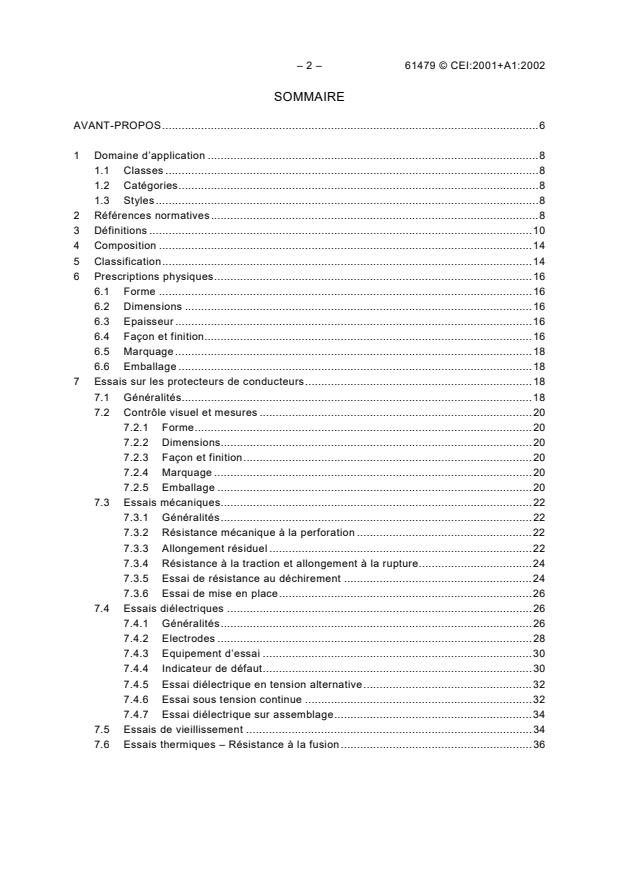
– 2 – 61479 © CEI:2001+A1:2002
SOMMAIRE
AVANT-PROPOS.6
1 Domaine d’application .8
1.1 Classes .8
1.2 Catégories.8
1.3 Styles.8
2 Références normatives.8
3 Définitions .10
4 Composition .14
5 Classification.14
6 Prescriptions physiques.16
6.1 Forme .16
6.2 Dimensions .16
6.3 Epaisseur .16
6.4 Façon et finition.16
6.5 Marquage.18
6.6 Emballage .18
7 Essais sur les protecteurs de conducteurs.18
7.1 Généralités.18
7.2 Contrôle visuel et mesures .20
7.2.1 Forme.20
7.2.2 Dimensions.20
7.2.3 Façon et finition.20
7.2.4 Marquage .20
7.2.5 Emballage .20
7.3 Essais mécaniques.22
7.3.1 Généralités.22
7.3.2 Résistance mécanique à la perforation .22
7.3.3 Allongement résiduel .22
7.3.4 Résistance à la traction et allongement à la rupture.24
7.3.5 Essai de résistance au déchirement .24
7.3.6 Essai de mise en place.26
7.4 Essais diélectriques .26
7.4.1 Généralités.26
7.4.2 Electrodes .28
7.4.3 Equipement d’essai .30
7.4.4 Indicateur de défaut.30
7.4.5 Essai diélectrique en tension alternative.32
7.4.6 Essai sous tension continue .32
7.4.7 Essai diélectrique sur assemblage.34
7.5 Essais de vieillissement .34
7.6 Essais thermiques – Résistance à la fusion.36
61479 © IEC:2001:A1:2002 – 3 –
CONTENTS
FOREWORD.7
1 Scope.9
1.1 Classes .9
1.2 Categories.9
1.3 Styles.9
2 Normative references .9
3 Definitions .11
4 Composition .15
5 Classification.15
6 Physical requirements .17
6.1 Shape .17
6.2 Dimensions .17
6.3 Thickness.17
6.4 Workmanship and finish .17
6.5 Marking .19
6.6 Packaging .19
7 Tests on conductor covers.19
7.1 General .19
7.2 Visual inspection and measurements.21
7.2.1 Shape.21
7.2.2 Dimensions.21
7.2.3 Workmanship and finish.21
7.2.4 Marking .21
7.2.5 Packaging .21
7.3 Mechanical tests .23
7.3.1 General .23
7.3.2 Mechanical puncture resistance.23
7.3.3 Tension set.23
7.3.4 Tensile strength and elongation at break .25
7.3.5 Tear resistance test.25
7.3.6 Mechanical positioning test.27
7.4 Dielectric tests .27
7.4.1 General .27
7.4.2 Electrodes .29
7.4.3 Test equipment.31
7.4.4 Failure indicator.31
7.4.5 AC voltage dielectric test .33
7.4.6 DC voltage test.33
7.4.7 Dielectric test on assembly.35
7.5 Ageing tests .35
7.6 Thermal – Melting resistance.37
– 4 – 61479 © CEI:2001+A1:2002
8 Essais des protecteurs de conducteurs avec propriétés spéciales .36
8.1 Généralités.36
8.2 Catégorie A – Résistance à l’acide .36
8.3 Catégorie H – Résistance à l’huile.38
8.4 Catégorie C – Très basses températures.38
8.5 Catégorie W – Très hautes températures .38
8.6 Catégorie Z – Résistance à l’ozone .38
8.6.1 Méthode A.38
8.6.2 Méthode B.38
8.7 Catégorie P – Conditions humides.40
9 Plan d’assurance de qualité et procédure d'échantillonnage .40
9.1 Généralités.40
9.2 Enregistrements .40
Annexe A (normative) Symbole de marquage – Double triangle .56
Annexe B (normative) Classification des essais .58
Annexe C (normative) Huile pour essais sur protecteurs de conducteurs de catégorie H –
Résistance à l’huile.60
Annexe D (normative) Plans d’échantillonnage et procédures .62
Annexe E (informative) Limites électriques d'emploi des protecteurs de conducteur en
matériau isolant .66
Annexe F (informative) Essais de réception .70
Annexe G (informative) Précautions d’utilisation .72
Bibliographie.74
Figure 1 – Styles typiques de protecteurs de conducteur .42
Figure 2 – Electrodes pour essai d’épreuve A1 .44
Figure 2a – Disposition de l’électrode extérieure pour essai d’épreuve A1 .44
Figure 3 – Electrodes pour essai d’épreuve A2 .44
Figure 3a – Disposition de l’électrode extérieure pour essai d’épreuve A2 .44
Figure 4 – Disposition de l’électrode extérieure et montage pour essai de tenue B .46
Figure 5 – Dispositif d’essai mécanique de perforation (voir 7.3.2).48
Figure 6 – Eprouvette en forme d’haltères (voir 7.3.3).50
Figure 7 – Essais de résistance au déchirement (voir 7.3.5) .52
Figure 8 – Résistance à la fusion – pour protecteurs en plastique uniquement (voir 7.6).54
Figure A.1 – Symboles et emplacement des symboles .56
Tableau 1 – Désignation des propriétés spéciales .14
Tableau 2 – Dimensions recommandées et tolérances.16
Tableau 3 – Prescriptions en tension alternative .30
Tableau 4 – Prescriptions en tension continue .32
Tableau B.1 – Procédure générale d’essai.58
Tableau C.1 – Caractéristiques de l’huile.60
Tableau D.1 – Classification des défauts .62
Tableau D.2 – Plan d’échantillonnage pour défauts mineurs .64
Tableau D.3 – Plan d’échantillonnage pour défauts majeurs .64
Tableau E.1 – Limites électriques .68
61479 © IEC:2001:A1:2002 – 5 –
8 Tests on conductor covers with special properties .37
8.1 General .37
8.2 Category A – Acid resistance .37
8.3 Category H – Oil resistance.39
8.4 Category C – Extremely low temperature.39
8.5 Category W – Extremely high temperature.39
8.6 Category Z – Ozone resistance .39
8.6.1 Method A.39
8.6.2 Method B.39
8.7 Category P – Humid condition .41
9 Quality assurance plan and sampling procedure.41
9.1 General .41
9.2 Records.41
Annex A (normative) Symbol for marking – Double triangle.57
Annex B (normative) Classification of tests .59
Annex C (normative) Oil for tests on category H conductor covers – Oil resistance.61
Annex D (normative) Sampling plans and procedures .63
Annex E (informative) Electrical limits for the use of conductor covers (line hoses) of
insulating material.67
Annex F (informative) Acceptance tests .71
Annex G (informative) Recommendations for in-service care .73
Bibliography.75
Figure 1 – Typical styles of conductor covers.43
Figure 2 – Electrodes for proof-test A1 .45
Figure 2a – Outer electrode design for proof-test A1.45
Figure 3 – Electrodes for proof-test A2 .45
Figure 3a – Outer electrode design for proof-test A2.45
Figure 4 – Outer electrode design and test arrangement for withstand test B .47
Figure 5 – Mechanical puncture (see 7.3.2) .49
Figure 6 – Dumb-bell test piece (see 7.3.3).51
Figure 7 – Tear resistance test (see 7.3.5).53
Figure 8 – Melting resistance – Plastic covers only (see 7.6) .55
Figure A.1 – Symbols and symbol location.57
Table 1 – Designation of special properties.15
Table 2 – Recommended dimensions and tolerances.17
Table 3 – AC voltage requirements .31
Table 4 – DC voltage requirements .33
Table B.1 – General test procedure .59
Table C.1 – Characteristics of the oil .61
Table D.1 – Classification of defects .63
Table D.2 – Sampling plan for minor defects.65
Table D.3 – Sampling plan for major defects.65
Table E.1 – Electrical limits.69
– 6 – 61479 © CEI:2001+A1:2002
COMMISSION ÉLECTROTECHNIQUE INTERNATIONALE
____________
TRAVAUX SOUS TENSION –
PROTECTEURS DE CONDUCTEURS FLEXIBLES
EN MATÉRIAU ISOLANT
AVANT-PROPOS
1) La CEI (Commission Electrotechnique Internationale) est une organisation mondiale de normalisation
composée de l'ensemble des comités électrotechniques nationaux (Comités nationaux de la CEI). La CEI a
pour objet de favoriser la coopération internationale pour toutes les questions de normalisation dans les
domaines de l'électricité et de l'électronique. A cet effet, la CEI, entre autres activités, publie des Normes
internationales. Leur élaboration est confiée à des comités d'études, aux travaux desquels tout Comité national
intéressé par le sujet traité peut participer. Les organisations internationales, gouvernementales et non
gouvernementales, en liaison avec la CEI, participent également aux travaux. La CEI collabore étroitement
avec l'Organisation Internationale de Normalisation (ISO), selon des conditions fixées par accord entre les
deux organisations.
2) Les décisions ou accords officiels de la CEI concernant les questions techniques représentent, dans la mesure
du possible, un accord international sur les sujets étudiés, étant donné que les Comités nationaux intéressés
sont représentés dans chaque comité d’études.
3) Les documents produits se présentent sous la forme de recommandations internationales. Ils sont publiés
comme normes, spécifications techniques, rapports techniques ou guides et agréés comme tels par les
Comités nationaux.
4) Dans le but d'encourager l'unification internationale, les Comités nationaux de la CEI s'engagent à appliquer de
façon transparente, dans toute la mesure possible, les Normes internationales de la CEI dans leurs normes
nationales et régionales. Toute divergence entre la norme de la CEI et la norme nationale ou régionale
correspondante doit être indiquée en termes clairs dans cette dernière.
5) La CEI n’a fixé aucune procédure concernant le marquage comme indication d’approbation et sa responsabilité
n’est pas engagée quand un matériel est déclaré conforme à l’une de ses normes.
6) L’attention est attirée sur le fait que certains des éléments de la présente Norme internationale peuvent faire
l’objet de droits de propriété intellectuelle ou de droits analogues. La CEI ne saurait être tenue pour
responsable de ne pas avoir identifié de tels droits de propriété et de ne pas avoir signalé leur existence.
La Norme internationale CEI 61479 a été établie par le comité d'études 78 de la CEI: Travaux
sous tension.
La présente version consolidée de la CEI 61479 comprend la première édition (2001)
[documents 78/350/FDIS et 78/363/RVD], et son amendement 1 (2002) [documents
78/428/FDIS et 78/454/RVD].
Le contenu technique de cette version consolidée est donc identique à celui de l'édition de
base et à son amendement; cette version a été préparée par commodité pour l'utilisateur.
Elle porte le numéro d'édition 1.1.
Une ligne verticale dans la marge indique où la publication de base a été modifiée par
l'amendement 1.
Cette publication a été rédigée selon les Directives ISO/CEI, Partie 3.
Les annexes A, B, C et D font partie intégrante de cette norme.
Les annexes E, F et G sont données uniquement à titre d’information.
Le comité a décidé que le contenu de la publication de base et de son amendement ne sera
pas modifié avant 2005. A cette date, la publication sera
• reconduite;
• supprimée;
• remplacée par une édition révisée, ou
• amendée.
61479 © IEC:2001:A1:2002 – 7 –
INTERNATIONAL ELECTROTECHNICAL COMMISSION
___________
LIVE WORKING –
FLEXIBLE CONDUCTOR COVERS (LINE HOSES)
OF INSULATING MATERIAL
FOREWORD
1) The IEC (International Electrotechnical Commission) is a worldwide organization for standardization
comprising all national electrotechnical committees (IEC National Committees). The object of the IEC is to
promote international co-operation on all questions concerning standardization in the electrical and electronic
fields. To this end and in addition to other activities, the IEC publishes International Standards. Their
preparation is entrusted to technical committees; any IEC National Committee interested in the subject dealt
with may participate in this preparatory work. International, governmental and non-governmental organizations
liaising with the IEC also participate in this preparation. The IEC collaborates closely with the International
Organization for Standardization (ISO) in accordance with conditions determined by agreement between the
two organizations.
2) The formal decisions or agreements of the IEC on technical matters express, as nearly as possible, an
international consensus of opinion on the relevant subjects since each technical committee has representation
from all interested National Committees.
3) The documents produced have the form of recommendations for international use and are published in the
form of standards, technical specifications, technical reports or guides and they are accepted by the National
Committees in that sense.
4) In order to promote international unification, IEC National Committees undertake to apply IEC International
Standards transparently to the maximum extent possible in their national and regional standards. Any
divergence between the IEC Standard and the corresponding national or regional standard shall be clearly
indicated in the latter.
5) The IEC provides no marking procedure to indicate its approval and cannot be rendered responsible for any
equipment declared to be in conformity with one of its standards.
6) Attention is drawn to the possibility that some of the elements of this International Standard may be the
subject of patent rights. The IEC shall not be held responsible for identifying any or all such patent rights.
International Standard IEC 61479 has been prepared by IEC technical committee 78: Live
working.
This consolidated version of IEC 61479 consists of the first edition (2001) [documents
78/350/FDIS and 78/363/RVD] and its amendment 1 (2002) [documents 78/428/FDIS and
78/454/RVD].
The technical content is therefore identical to the base edition and its amendment and has
been prepared for user convenience.
It bears the edition number 1.1.
A vertical line in the margin shows where the base publication has been modified by
amendment 1.
This publication has been drafted in accordance with the ISO/IEC Directives, Part 3.
Annexes A, B, C, and D form an integral part of this standard.
Annexes E, F and G are for information only.
The committee has decided that the contents of the base publication and its amendment will
remain unchanged until 2005. At this date, the publication will be
• reconfirmed;
• withdrawn;
• replaced by a revised edition, or
• amended.
– 8 – 61479 © CEI:2001+A1:2002
TRAVAUX SOUS TENSION –
PROTECTEURS DE CONDUCTEURS FLEXIBLES
EN MATÉRIAU ISOLANT
1 Domaine d’application
La présente Norme internationale est applicable aux protecteurs flexibles isolants destinés à
protéger les travailleurs d’un contact accidentel avec des conducteurs électriques sous
tension ou à la terre et à éviter les courts-circuits pendant les travaux sous tension.
1.1 Classes
Cinq classes de protecteurs de conducteurs, de caractéristiques électriques différentes, sont
disponibles sous la désignation de classe 0, classe 1, classe 2, classe 3 et classe 4.
1.2 Catégories
Six catégories de protecteurs de conducteurs, ayant une composition et des propriétés
différentes sont disponibles: catégorie A – pour la résistance à l'acide, catégorie H – pour la
résistance à l'huile, catégorie C – pour les environnements de très basses températures,
catégorie W – pour les environnements de très hautes températures, catégorie Z – pour la
résistance à l'ozone et catégorie P – pour l’environnement humide.
NOTE Les matériaux de type II et III de l'ASTM D-1050 seraient de catégorie Z.
1.3 Styles
Des styles de protecteurs de conducteurs, différents par leurs caractéristiques constructives,
sont disponibles et six de ces styles sont désignés comme style A, style B, style C, style D,
style E, (voir figure 1), et style F.
2 Références normatives
Les documents de référence suivants sont indispensables pour l'application du présent
document. Pour les références datées, seule l'édition citée s'applique. Pour les références
non datées, la dernière édition du document de référence s'applique (y compris les éventuels
amendements).
CEI 60050(151):1978, Vocabulaire Electrotechnique International (VEI) – Chapitre 151:
Dispositifs électriques et magnétiques
CEI 60050(212):1990, Vocabulaire Electrotechnique International (VEI) – Chapitre 212:
Isolants solides, liquides et gazeux
CEI 60050(601):1985, Vocabulaire Electrotechnique International (VEI) – Chapitre 601:
Production, transport et distribution de l'énergie électrique – Généralités
CEI 60050(651):1999, Vocabulaire Electrotechnique International (VEI) – Chapitre 651:
Travaux sous tension
61479 © IEC:2001:A1:2002 – 9 –
LIVE WORKING –
FLEXIBLE CONDUCTOR COVERS (LINE HOSES)
OF INSULATING MATERIAL
1 Scope
This International Standard is applicable to flexible insulating covers (line hoses) for the
protection of workers from accidental contact with live or earthed electrical conductors and for
the avoidance of short circuits during live working.
1.1 Classes
Five classes of conductor covers, differing in electrical characteristics, are provided and
designated as class 0, class 1, class 2, class 3, and class 4.
1.2 Categories
Six categories of conductor covers differing in composition and properties are provided:
category A – acid resistant, category H – oil resistant, category C – formulated for extreme low
temperature environments, category W – formulated for extreme high temperature environ-
ments, category Z – ozone resistant, and category P – formulated for humid environment.
NOTE Types II and III material of ASTM D-1050 would be category Z.
1.3 Styles
Various styles of conductor covers, differing in construction characteristics are available and
six of these are designated as style A, style B, style C, style D, style E, (see figure 1), and
style F.
2 Normative references
The following referenced documents are indispensable for the application of this document.
For dated references, only the edition cited applies. For undated references, the latest edition
of the referenced document (including any amendments) applies.
IEC 60050(151):1978, International Electrotechnical Vocabulary (IEV) – Chapter 151:
Electrical and magnetic devices
IEC 60050(212):1990, International Electrotechnical Vocabulary (IEV) – Chapter 212:
Insulating solids, liquids and gases
IEC 60050(601):1985, International Electrotechnical Vocabulary (IEV) – Chapter 601:
Generation, transmission and distribution of electricity – General
IEC 60050(651):1999, International Electrotechnical Vocabulary (IEV) – Chapter 651: Live
working
– 10 – 61479 © CEI:2001+A1:2002
CEI 60060-1:1989, Techniques des essais à haute tension. Première partie: Définitions et
prescriptions générales relatives aux essais
CEI 60060-2:1994, Techniques des essais à haute tension – Partie 2: Systèmes de mesure
CEI 60212:1971, Conditions normales à observer avant et pendant les essais de matériaux
isolants électriques solides
CEI 60417 (toutes les parties), Symboles graphiques utilisables sur le matériel
CEI 61318:1994, Travaux sous tension – Guide pour les plans d’assurance de la qualité
ISO 472:1999, Plastiques – Vocabulaire
ISO 1817:1999, Caoutchouc, vulcanisé – Détermination de l'action des liquides (disponible en
anglais seulement)
ISO 2592:2000, Détermination des points d'éclair et de feu – Méthode Cleveland à vase
ouvert
ISO 2859-1:1999, Règles d'échantillonnage pour les contrôles par attributs – Partie 1:
Procédures d'échantillonnage pour les contrôles lot par lot, indexés d'après le niveau de
qualité acceptable (NQA)
ISO 2977:1997, Produits pétroliers et solvants hydrocarbonés – Détermination du point
d'aniline et du point d'aniline en mélange
ISO 3104:1994, Produits pétroliers – Liquides opaques et transparents – Détermination de la
viscosité cinématique et calcul de la viscosité dynamique
ISO 9001:1994, Systèmes qualité – Modèle pour l'assurance de la qualité en conception,
développement, production, installation et prestations associées
ISO 9002:1994, Systèmes qualité – Modèle pour l'assurance de la qualité en production,
installation et prestations associées
ISO 9003:1994, Systèmes qualité – Modèle pour l'assurance de la qualité en contrôle et
essais finals
3 Définitions
Pour les besoins de la présente Norme internationale, les définitions suivantes s'appliquent.
3.1
protecteur
protecteur rigide ou souple réalisé en matériau isolant utilisé pour recouvrir les parties sous
tension ou hors tension ou les parties adjacentes mises à la terre de manière à prévenir tout
contact avec ces parties
NOTE Un protecteur est généralement conçu pour procurer un niveau d’isolation requis qui lui permet de fournir
une protection uniquement lorsqu’un travailleur entre par inadvertance en contact avec le protecteur et ce
seulement pendant une courte durée.
[VEI 651-04-01, modifiée]
61479 © IEC:2001:A1:2002 – 11 –
IEC 60060-1:1989, High-voltage test techniques – Part 1: General definitions and test
requirements
IEC 60060-2:1994, High-voltage test techniques – Part 2: Measuring systems
IEC 60212:1971, Standard conditions for use prior to and during the testing of solid electrical
insulating materials
IEC 60417 (all parts), Graphical symbols for use on equipment
IEC 61318:1994, Live working – Guidelines for quality assurance plans
ISO 472:1999, Plastics – Vocabulary
ISO 1817:1999, Rubber, vulcanized – Determination of the effect of liquids
ISO 2592:2000, Determination of flash and fire points – Cleveland open cup method
ISO 2859-1:1999, Sampling procedures for inspection by attributes – Part 1: Sampling
schemes indexed by acceptance quality limit (AQL) for lot-by-lot inspection
ISO 2977:1997, Petroleum products and hydrocarbon solvents – Determination of aniline
point and mixed aniline point
ISO 3104:1994, Petroleum products – Transparent and opaque liquids – Determination of
kinematic viscosity and calculation of dynamic viscosity
ISO 9001:1994, Quality systems – Model for quality assurance in design, development,
production, installation and servicing
ISO 9002:1994, Quality systems – Model for quality assurance in production, installation and
servicing
ISO 9003:1994, Quality systems – Model for quality assurance in final inspection and test
3 Definitions
For the purpose of this International Standard, the following definitions apply.
3.1
protective cover
rigid or flexible cover made of insulating material used to cover energized and/or dead parts
and/or adjacent earthed (grounded) parts in order to prevent contact
NOTE A protective cover is generally designed to provide a required insulation level which makes it able to
provide protection only when a worker inadvertently comes into contact with the protective cover and for only a
short duration.
[IEV 651-04-01, modified]
– 12 – 61479 © CEI:2001+A1:2002
3.2
protecteur de conducteur
protecteur utilisé pour recouvrir un conducteur
NOTE Ces protecteurs peuvent être souples ou rigides. Ils sont généralement appelés «protecteur de conducteur
souple» ou «protecteur de conducteur rigide».
[VEI 651-04-03]
3.3
élastomère
terme général comprenant les caoutchoucs, les latex et les composés élastomères pouvant
être soit naturels, soit synthétiques ou un mélange ou combinaison des deux
3.4
plastique
matière qui contient comme ingrédient essentiel un haut polymère et qui à une certaine étape
de sa transformation en produit fini peut être mise en forme par fluage
[ISO 472 modifiée]
3.5
tension d’épreuve
tension appliquée à un dispositif pendant un temps défini dans des conditions données pour
vérifier que le niveau d'isolation électrique est au-dessus d'une valeur donnée
3.6
contournement
claquage entre des électrodes, dans un gaz, un liquide ou le vide, au moins en partie le long
de la surface d’une isolation solide
[VEI 212-01-37 ]
3.7
perforation
chemin formé à travers un solide par un claquage qui a produit une destruction permanente.
Ce terme est aussi utilisé comme synonyme de claquage électrique dans les solides
[VEI 212-01-38]
3.8
essai de réception – essai d'acceptation
essai contractuel ayant pour objet de prouver au client que le dispositif répond à certaines
conditions de sa spécification
[VEI 151-04-20]
3.9
essai individuel de série
essai auquel est soumis chaque dispositif en cours ou en fin de fabrication pour vérifier qu'il
satisfait à des critères définis
[VEI 151-04-16]
3.10
essai (de série) sur prélèvement
essai effectué sur un certain nombre de dispositifs prélevés au hasard dans un lot
[VEI 151-04-17]
61479 © IEC:2001:A1:2002 – 13 –
3.2
conductor cover
protective cover made of insulating material and used to shroud the conductor
NOTE These covers can be either flexible or rigid. In general, they are commonly called "line hose" or "line
guards".
[IEV 651-04-03]
3.3
elastomer
generic term that includes rubber, latex and elastomeric compounds that may be natural or
synthetic or a mixture or a combination of both
3.4
plastic
material which contains as an essential ingredient a high polymer and which at some stage of
its processing into finished products can be shaped by flow
[ISO 472 modified]
3.5
proof test voltage
the specified voltage that is applied to a device for the time defined under specific conditions
to assure that the electrical strength of the insulation is above a specific value
3.6
flashover
breakdown between electrodes in a gas or a liquid or in vacuum, at least partly along the
surface of solid insulation
[IEV 212-01-37]
3.7
puncture
path produced through a solid by a breakdown producing permanent damage. The term is
also used as a synonym for electrical breakdown in solids
[IEV 212-01-38]
3.8
acceptance test
contractual test to prove to the customer that the device meets certain conditions of its
specification
[IEV 151-04-20]
3.9
routine test
test to which each device is subjected during or after manufacture to ascertain whether it
complies with certain criteria
[IEV 151-04-16]
3.10
sampling test
test on a number of devices taken at random from a batch
[IEV 151-04-17]
– 14 – 61479 © CEI:2001+A1:2002
3.11
essai de type
essai effectué sur un ou plusieurs dispositifs réalisés selon une conception donnée pour
vérifier que cette conception répond à cert
...
Questions, Comments and Discussion
Ask us and Technical Secretary will try to provide an answer. You can facilitate discussion about the standard in here.
Loading comments...