


IEC 62580-1:2015
(Main)Electronic railway equipment - On-board multimedia and telematic subsystems for railways - Part 1: General architecture
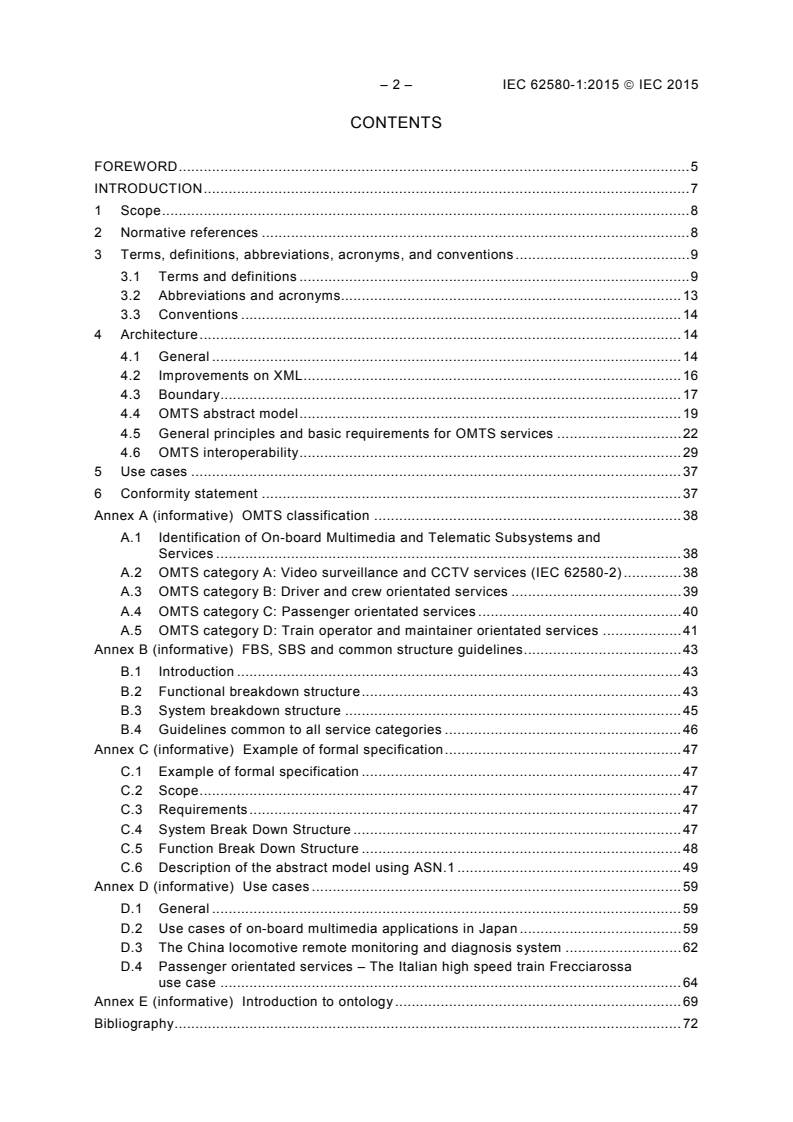
Electronic railway equipment - On-board multimedia and telematic subsystems for railways - Part 1: General architecture
IEC 62580-1:2015 specifies the general architecture of the On-board Multimedia and Telematic Subsystem (OMTS), which includes four categories of multimedia and telematic subsystems identified as: - Video surveillance;CCTV, - driver and crew orientated services, - passenger orientated services and - train operator and maintainer orientated services. This part establishes: - the boundary between the OMTS and the on-board communication system, as described by the IEC 61375 series, - the methodology to describe an OMTS in terms of abstract model, - the general principles and the basic requirements to specify the services provided;needed by each category, - the approach to ensure interoperability between services.
Matériel électronique ferroviaire - Sous-systèmes ferroviaires multimédias et télématiques embarqués - Partie 1: Architecture générale
L'IEC 62580-1:2015 spécifie l'architecture générale du sous-système multimédia et télématique embarqué (OMTS), qui comporte quatre catégories de sous-systèmes multimédias et télématiques identifiés comme étant: - vidéosurveillance/CCTV, - services orientés conducteur et personnel roulant, - services orientés voyageur, - services orientés opérateur de train et chargé de maintenance. La présente partie établit: - la frontière entre l'OMTS et le système de communication embarqué, telle que décrite par la série IEC 61375, - la méthodologie de description d'un OMTS en termes de modèle abstrait, - les principes généraux et les exigences de base pour spécifier les services fournis/requis par chaque catégorie, - l'approche pour assurer l'interopérabilité entre les services.
General Information
- Status
- Published
- Publication Date
- 16-Feb-2015
- Technical Committee
- TC 9 - Electrical equipment and systems for railways
- Drafting Committee
- WG 46 - TC 9/WG 46
- Current Stage
- PPUB - Publication issued
- Start Date
- 17-Feb-2015
- Completion Date
- 15-Feb-2015
Overview
IEC 62580-1:2015 is an international standard published by the International Electrotechnical Commission (IEC) focusing on electronic railway equipment, specifically on-board multimedia and telematic subsystems (OMTS) for railways. This Part 1 document defines the general architecture of OMTS, setting the foundational framework to facilitate the integration and interoperability of various on-board multimedia and telematic services in modern train systems.
The standard covers four primary categories of OMTS services:
- Video surveillance and CCTV systems
- Driver and crew-oriented services
- Passenger-oriented services
- Train operator and maintainer-oriented services
IEC 62580-1 also establishes the interface boundaries between the OMTS and on-board communication systems, such as those specified by the IEC 61375 series. It promotes a methodology to describe subsystems via an abstract model and introduces principles and requirements for service specification, ensuring seamless interoperability across services.
Key Topics
- OMTS Architecture: Describes a generic architecture that integrates multiple multimedia and telematic services, enabling modularity and scalability in on-board railway systems.
- Abstract Modeling: Introduces a formal abstract model concept based on standardized methodologies to uniformly define OMTS components and services.
- Service Specification Principles: Defines fundamental requirements necessary for each OMTS service category, ensuring clarity in functionality and performance expectations.
- System Boundaries and Interoperability: Clarifies the separation between OMTS and the wider train communication system, ensuring consistency and cooperation between subsystems.
- Middleware Approach: Advocates for middleware solutions facilitating communication and data exchange among various OMTS components.
- Service-Oriented Architecture (SOA): Supports SOA principles for dynamic and flexible service interaction, improvement in maintainability and evolvability.
- Use Cases and Practical Applications: Provides real-world examples including passenger information systems, remote monitoring, video surveillance, and crew services to demonstrate standard implementation.
- Classification and Functional Breakdown: Categorizes OMTS into specific groups and defines system and functional breakdown structures to guide design and development.
Applications
IEC 62580-1:2015 is essential for railway system designers, manufacturers, and operators aiming to implement advanced multimedia and telematic solutions on trains. Its practical applications include:
- Enhanced Passenger Services: Providing real-time passenger information, infotainment, and connectivity through integrated multimedia systems.
- Safety and Security: Incorporation of video surveillance (CCTV) systems to monitor onboard environments and enhance security measures.
- Driver and Crew Support: Delivering critical information and communication tools to train staff, improving operational safety and efficiency.
- Maintenance and Operations: Enabling train operators and maintenance teams to access telematic data, allowing for predictive maintenance and reduced downtime.
- Interoperability in Multi-Vendor Environments: Ensuring that systems from various suppliers work seamlessly together through standardized interfaces and protocols.
- Data Exchange with Ground Systems: Supporting communication between onboard systems and ground control centers to optimize train management.
Related Standards
- IEC 61375 Series: Defines train communication network (TCN) standards forming the communication backbone between OMTS and other onboard systems.
- IEC 62580-2 and Subsequent Parts: Detail specific service categories such as video surveillance (Part 2) and other multimedia services.
- ISO/IEC 27001 (Security): Relevant for safeguarding telematic data and multimedia content in railway applications.
- IEEE 802.11 / Wi-Fi Standards: Often used in passenger-oriented services for wireless connectivity onboard.
- ETSI Standards: For mobile communication and telematic data exchange relevant to on-board and train-to-ground communications.
Implementing IEC 62580-1:2015 ensures a cohesive, interoperable foundation for the next generation of on-board multimedia and telematic railway systems. It promotes safety, efficiency, passenger comfort, and operational reliability, addressing the evolving demands of modern rail transport infrastructure.

Get Certified
Connect with accredited certification bodies for this standard

Bureau Veritas Railway Certification
Railway and transportation certification.

Deutsch Quality Systems (India) Pvt. Ltd. (DQS India)
Subsidiary of DQS Holding GmbH, founding member of IQNet. CDSCO Notified Body.

Excellence Ireland Quality Association (EIQA)
Irish quality certification organization.
Sponsored listings
Frequently Asked Questions
IEC 62580-1:2015 is a standard published by the International Electrotechnical Commission (IEC). Its full title is "Electronic railway equipment - On-board multimedia and telematic subsystems for railways - Part 1: General architecture". This standard covers: IEC 62580-1:2015 specifies the general architecture of the On-board Multimedia and Telematic Subsystem (OMTS), which includes four categories of multimedia and telematic subsystems identified as: - Video surveillance;CCTV, - driver and crew orientated services, - passenger orientated services and - train operator and maintainer orientated services. This part establishes: - the boundary between the OMTS and the on-board communication system, as described by the IEC 61375 series, - the methodology to describe an OMTS in terms of abstract model, - the general principles and the basic requirements to specify the services provided;needed by each category, - the approach to ensure interoperability between services.
IEC 62580-1:2015 specifies the general architecture of the On-board Multimedia and Telematic Subsystem (OMTS), which includes four categories of multimedia and telematic subsystems identified as: - Video surveillance;CCTV, - driver and crew orientated services, - passenger orientated services and - train operator and maintainer orientated services. This part establishes: - the boundary between the OMTS and the on-board communication system, as described by the IEC 61375 series, - the methodology to describe an OMTS in terms of abstract model, - the general principles and the basic requirements to specify the services provided;needed by each category, - the approach to ensure interoperability between services.
IEC 62580-1:2015 is classified under the following ICS (International Classification for Standards) categories: 45.060.01 - Railway rolling stock in general. The ICS classification helps identify the subject area and facilitates finding related standards.
IEC 62580-1:2015 is available in PDF format for immediate download after purchase. The document can be added to your cart and obtained through the secure checkout process. Digital delivery ensures instant access to the complete standard document.
Standards Content (Sample)
IEC 62580-1 ®
Edition 1.0 2015-02
INTERNATIONAL
STANDARD
NORME
INTERNATIONALE
colour
inside
Electronic railway equipment – On-board multimedia and telematic subsystems
for railways –
Part 1: General architecture
Matériel électronique ferroviaire – Sous-systèmes ferroviaires multimédias et
télématiques embarqués –
Partie 1: Architecture générale
All rights reserved. Unless otherwise specified, no part of this publication may be reproduced or utilized in any form
or by any means, electronic or mechanical, including photocopying and microfilm, without permission in writing from
either IEC or IEC's member National Committee in the country of the requester. If you have any questions about IEC
copyright or have an enquiry about obtaining additional rights to this publication, please contact the address below or
your local IEC member National Committee for further information.
Droits de reproduction réservés. Sauf indication contraire, aucune partie de cette publication ne peut être reproduite
ni utilisée sous quelque forme que ce soit et par aucun procédé, électronique ou mécanique, y compris la photocopie
et les microfilms, sans l'accord écrit de l'IEC ou du Comité national de l'IEC du pays du demandeur. Si vous avez des
questions sur le copyright de l'IEC ou si vous désirez obtenir des droits supplémentaires sur cette publication, utilisez
les coordonnées ci-après ou contactez le Comité national de l'IEC de votre pays de résidence.
IEC Central Office Tel.: +41 22 919 02 11
3, rue de Varembé Fax: +41 22 919 03 00
CH-1211 Geneva 20 info@iec.ch
Switzerland www.iec.ch
About the IEC
The International Electrotechnical Commission (IEC) is the leading global organization that prepares and publishes
International Standards for all electrical, electronic and related technologies.
About IEC publications
The technical content of IEC publications is kept under constant review by the IEC. Please make sure that you have the
latest edition, a corrigenda or an amendment might have been published.
IEC Catalogue - webstore.iec.ch/catalogue Electropedia - www.electropedia.org
The stand-alone application for consulting the entire The world's leading online dictionary of electronic and
bibliographical information on IEC International Standards, electrical terms containing more than 30 000 terms and
Technical Specifications, Technical Reports and other definitions in English and French, with equivalent terms in 15
documents. Available for PC, Mac OS, Android Tablets and additional languages. Also known as the International
iPad. Electrotechnical Vocabulary (IEV) online.
IEC publications search - www.iec.ch/searchpub IEC Glossary - std.iec.ch/glossary
The advanced search enables to find IEC publications by a More than 60 000 electrotechnical terminology entries in
variety of criteria (reference number, text, technical English and French extracted from the Terms and Definitions
committee,…). It also gives information on projects, replaced clause of IEC publications issued since 2002. Some entries
and withdrawn publications. have been collected from earlier publications of IEC TC 37,
77, 86 and CISPR.
IEC Just Published - webstore.iec.ch/justpublished
Stay up to date on all new IEC publications. Just Published IEC Customer Service Centre - webstore.iec.ch/csc
details all new publications released. Available online and If you wish to give us your feedback on this publication or
also once a month by email. need further assistance, please contact the Customer Service
Centre: csc@iec.ch.
A propos de l'IEC
La Commission Electrotechnique Internationale (IEC) est la première organisation mondiale qui élabore et publie des
Normes internationales pour tout ce qui a trait à l'électricité, à l'électronique et aux technologies apparentées.
A propos des publications IEC
Le contenu technique des publications IEC est constamment revu. Veuillez vous assurer que vous possédez l’édition la
plus récente, un corrigendum ou amendement peut avoir été publié.
Catalogue IEC - webstore.iec.ch/catalogue Electropedia - www.electropedia.org
Application autonome pour consulter tous les renseignements
Le premier dictionnaire en ligne de termes électroniques et
bibliographiques sur les Normes internationales,
électriques. Il contient plus de 30 000 termes et définitions en
Spécifications techniques, Rapports techniques et autres
anglais et en français, ainsi que les termes équivalents dans
documents de l'IEC. Disponible pour PC, Mac OS, tablettes
15 langues additionnelles. Egalement appelé Vocabulaire
Android et iPad.
Electrotechnique International (IEV) en ligne.
Recherche de publications IEC - www.iec.ch/searchpub
Glossaire IEC - std.iec.ch/glossary
Plus de 60 000 entrées terminologiques électrotechniques, en
La recherche avancée permet de trouver des publications IEC
en utilisant différents critères (numéro de référence, texte, anglais et en français, extraites des articles Termes et
comité d’études,…). Elle donne aussi des informations sur les Définitions des publications IEC parues depuis 2002. Plus
projets et les publications remplacées ou retirées. certaines entrées antérieures extraites des publications des
CE 37, 77, 86 et CISPR de l'IEC.
IEC Just Published - webstore.iec.ch/justpublished
Service Clients - webstore.iec.ch/csc
Restez informé sur les nouvelles publications IEC. Just
Published détaille les nouvelles publications parues. Si vous désirez nous donner des commentaires sur cette
Disponible en ligne et aussi une fois par mois par email. publication ou si vous avez des questions contactez-nous:
csc@iec.ch.
IEC 62580-1 ®
Edition 1.0 2015-02
INTERNATIONAL
STANDARD
NORME
INTERNATIONALE
colour
inside
Electronic railway equipment – On-board multimedia and telematic subsystems
for railways –
Part 1: General architecture
Matériel électronique ferroviaire – Sous-systèmes ferroviaires multimédias et
télématiques embarqués –
Partie 1: Architecture générale
INTERNATIONAL
ELECTROTECHNICAL
COMMISSION
COMMISSION
ELECTROTECHNIQUE
INTERNATIONALE
ICS 45.060 ISBN 978-2-8322-2225-6
– 2 – IEC 62580-1:2015 IEC 2015
CONTENTS
FOREWORD . 5
INTRODUCTION . 7
1 Scope . 8
2 Normative references . 8
3 Terms, definitions, abbreviations, acronyms, and conventions . 9
3.1 Terms and definitions . 9
3.2 Abbreviations and acronyms . 13
3.3 Conventions . 14
4 Architecture . 14
4.1 General . 14
4.2 Improvements on XML . 16
4.3 Boundary . 17
4.4 OMTS abstract model . 19
4.5 General principles and basic requirements for OMTS services . 22
4.6 OMTS interoperability . 29
5 Use cases . 37
6 Conformity statement . 37
Annex A (informative) OMTS classification . 38
A.1 Identification of On-board Multimedia and Telematic Subsystems and
Services . 38
A.2 OMTS category A: Video surveillance and CCTV services (IEC 62580-2) . 38
A.3 OMTS category B: Driver and crew orientated services . 39
A.4 OMTS category C: Passenger orientated services . 40
A.5 OMTS category D: Train operator and maintainer orientated services . 41
Annex B (informative) FBS, SBS and common structure guidelines . 43
B.1 Introduction . 43
B.2 Functional breakdown structure . 43
B.3 System breakdown structure . 45
B.4 Guidelines common to all service categories . 46
Annex C (informative) Example of formal specification . 47
C.1 Example of formal specification . 47
C.2 Scope . 47
C.3 Requirements . 47
C.4 System Break Down Structure . 47
C.5 Function Break Down Structure . 48
C.6 Description of the abstract model using ASN.1 . 49
Annex D (informative) Use cases . 59
D.1 General . 59
D.2 Use cases of on-board multimedia applications in Japan . 59
D.3 The China locomotive remote monitoring and diagnosis system . 62
D.4 Passenger orientated services – The Italian high speed train Frecciarossa
use case . 64
Annex E (informative) Introduction to ontology . 69
Bibliography . 72
Figure 1 – OMTS categories and structure of the IEC 62580 series . 7
Figure 2 – Overview of the generic OMTS architecture . 14
Figure 3 – Middleware concept . 17
Figure 4 – Relationship between IEC 61375 and IEC 62580 . 18
Figure 5 – ETB on-board network and board-ground link through MCG-GCG pairs . 19
Figure 6 – Concept of abstract model . 19
Figure 7 – Conceptual model . 20
Figure 8 – Principle of abstract model definition . 21
Figure 9 – Methodology for abstract model definition . 21
Figure 10 – SOA approach . 23
Figure 11 – Clients and devices arrangements . 24
Figure 12 – Service concept . 25
Figure 13 – Block diagram of the service based interface . 26
Figure 14 – Principle of the ontology based Information Exchange Format 2 . 28
Figure 15 – Compatibility map . 28
Figure 16 – Service interfaces . 30
Figure 17 – Subsystem breakdown structure . 31
Figure 18 – Coupling of two consists and related subsystems . 31
Figure 19 – Function mapping and role arbitration . 32
Figure 20 – Function and service mapping on consist network . 32
Figure 21 – Function and service role arbitration . 33
Figure 22 – Uncoupled functional breakdown structure . 34
Figure 23 – Coupled functional breakdown structure . 35
Figure 24 – Service space . 36
Figure 25 – Interaction between on-board services and ground services . 37
Figure C.1 – Display management . 47
Figure C.2 – Display system breakdown structure . 48
Figure C.3 – Display functional breakdown structure . 49
Figure D.1 – Passenger information system structure . 60
Figure D.2 – On board video surveillance system structure . 61
Figure D.3 – Driver Only Operation CCTV System structure . 61
Figure D.4 – China locomotive remote monitoring and diagnosis system structure . 62
Figure D.5 – CMD system structure . 62
Figure D.6 – Data flow of the remote monitoring and diagnosis system . 63
Figure D.7 – Integrated IT network structure . 64
Figure D.8 – Radio mobile cellular network coverage . 65
Figure D.9 – Geometry of the ground cells . 66
Figure D.10 – Mobile network structure . 66
Figure D.11 – Download and upload performance . 67
Figure D.12 – On-board WiFi and UMTS communication . 67
Figure D.13 – On-board back bone and wireless board to ground communication . 68
Figure D.14 – Performance test arrangement . 68
Figure E.1 – Traditional approach . 69
– 4 – IEC 62580-1:2015 IEC 2015
Figure E.2 – Ontology based approach . 69
Figure E.3 – Benefits of ontology based approach . 70
Figure E.4 – Screen shot of Protégé interface . 71
Table 1 – Relationships in the conceptual model. 20
Table B.1 – Example of FBS . 44
Table D.1 – PIS applications in Japan . 60
INTERNATIONAL ELECTROTECHNICAL COMMISSION
____________
ELECTRONIC RAILWAY EQUIPMENT –
ON-BOARD MULTIMEDIA AND TELEMATIC
SUBSYSTEMS FOR RAILWAYS –
Part 1: General architecture
FOREWORD
1) The International Electrotechnical Commission (IEC) is a worldwide organization for standardization comprising
all national electrotechnical committees (IEC National Committees). The object of IEC is to promote
international co-operation on all questions concerning standardization in the electrical and electronic fields. To
this end and in addition to other activities, IEC publishes International Standards, Technical Specifications,
Technical Reports, Publicly Available Specifications (PAS) and Guides (hereafter referred to as “IEC
Publication(s)”). Their preparation is entrusted to technical committees; any IEC National Committee interested
in the subject dealt with may participate in this preparatory work. International, governmental and non-
governmental organizations liaising with the IEC also participate in this preparation. IEC collaborates closely
with the International Organization for Standardization (ISO) in accordance with conditions determined by
agreement between the two organizations.
2) The formal decisions or agreements of IEC on technical matters express, as nearly as possible, an international
consensus of opinion on the relevant subjects since each technical committee has representation from all
interested IEC National Committees.
3) IEC Publications have the form of recommendations for international use and are accepted by IEC National
Committees in that sense. While all reasonable efforts are made to ensure that the technical content of IEC
Publications is accurate, IEC cannot be held responsible for the way in which they are used or for any
misinterpretation by any end user.
4) In order to promote international uniformity, IEC National Committees undertake to apply IEC Publications
transparently to the maximum extent possible in their national and regional publications. Any divergence
between any IEC Publication and the corresponding national or regional publication shall be clearly indicated in
the latter.
5) IEC itself does not provide any attestation of conformity. Independent certification bodies provide conformity
assessment services and, in some areas, access to IEC marks of conformity. IEC is not responsible for any
services carried out by independent certification bodies.
6) All users should ensure that they have the latest edition of this publication.
7) No liability shall attach to IEC or its directors, employees, servants or agents including individual experts and
members of its technical committees and IEC National Committees for any personal injury, property damage or
other damage of any nature whatsoever, whether direct or indirect, or for costs (including legal fees) and
expenses arising out of the publication, use of, or reliance upon, this IEC Publication or any other IEC
Publications.
8) Attention is drawn to the Normative references cited in this publication. Use of the referenced publications is
indispensable for the correct application of this publication.
9) Attention is drawn to the possibility that some of the elements of this IEC Publication may be the subject of
patent rights. IEC shall not be held responsible for identifying any or all such patent rights.
International Standard IEC 62580-1 has been prepared by IEC technical committee 9:
Electrical equipment and systems for railways.
The text of this standard is based on the following documents:
FDIS Report on voting
9/1990/FDIS 9/2005/RVD
This publication has been drafted in accordance with the ISO/IEC Directives, Part 2.
A list of all parts of IEC 62580 series, under the general title Electronic railway equipment –
On-board multimedia and telematic subsystems for railways, can be found on the IEC
website.
– 6 – IEC 62580-1:2015 IEC 2015
The committee has decided that the contents of this publication will remain unchanged until
the stability date indicated on the IEC web site under "http://webstore.iec.ch" in the data
related to the specific publication. At this date, the publication will be
• reconfirmed,
• withdrawn,
• replaced by a revised edition, or
• amended.
IMPORTANT – The 'colour inside' logo on the cover page of this publication indicates
that it contains colours which are considered to be useful for the correct
understanding of its contents. Users should therefore print this document using a
colour printer.
INTRODUCTION
IEC 62580-1 defines the general architecture of the On-board Multimedia and Telematic
Subsystems (OMTS), so as to achieve compatibility between subsystems in the same vehicle
and between subsystems on-board of different vehicles in the same train.
NOTE 1 The acronym OMTS replaces the previous OMMS (On-board MultiMedia Subsystem) definition, due to a
change in the title of this standard.
The multimedia and telematic system is composed of but not limited to:
A Video surveillance/CCTV
B Driver and crew orientated services
C Passenger orientated services
D Train operator and maintainer orientated services
OMTSs installed in the same vehicle (consist) communicate by means of the consist network.
OMTSs, installed in different vehicle (consist) in the same train, communicate by means of
the train network.
It is likely that each OMTS exchanges information with applications installed on-ground by
means of a wireless communication gateway.
The on-board communication and the on-board to ground communication are specified by the
IEC 61375 series.
NOTE 2 Board-to-ground communication is intended as a generic link, with no assumption on the underlying
technology (radio, satellite or other).
As illustrated in Figure 1, the IEC 62580 series is structured as follows:
IEC 62580-1: General architecture
IEC 62580-2: Video surveillance/CCTV services
Driver and crew orientated services, passenger orientated services and train
operator/maintainer orientated services are matters of standardisation which can be
addressed in the future.
General
architecture
B – Driver and crew
A – Video
orientated services
surveillance/CCTV
D – Train operator and
C – Passenger orientated
maintainer orientated services
services
IEC
Figure 1 – OMTS categories and structure of the IEC 62580 series
– 8 – IEC 62580-1:2015 IEC 2015
ELECTRONIC RAILWAY EQUIPMENT –
ON-BOARD MULTIMEDIA AND TELEMATIC
SUBSYSTEMS FOR RAILWAYS –
Part 1: General architecture
1 Scope
This part of IEC 62580 specifies the general architecture of the On-board Multimedia and
Telematic Subsystem, which includes four categories of multimedia and telematic subsystems
identified as:
A Video surveillance/CCTV
B Driver and crew orientated services
C Passenger orientated services
D Train operator and maintainer orientated services
This part establishes:
• the boundary between the OMTS and the on-board communication system, as described
by the IEC 61375 series
• the methodology to describe an OMTS in terms of abstract model
• the general principles and the basic requirements to specify the services provided/needed
by each category
• the approach to ensure interoperability between services
This part gives guidelines for:
• OMTS classification
• functional breakdown structuring
• system breakdown structuring
• formal specification of an OMTS
This part is applicable to any type of train, e.g. open trains, multiple unit trains and closed
trains.
NOTE The general architecture provides a common basis for the application categories defined in part 2 and
possible future parts of this series of standards. Consequently, the approach is homogeneous for all multimedia
and telematic subsystems addressed by this series of standards.
2 Normative references
The following documents, in whole or in part, are normatively referenced in this document and
are indispensable for its application. For dated references, only the edition cited applies. For
undated references, the latest edition of the referenced document (including any
amendments) applies.
IEC 61375 (all parts), Electronic railway equipment – Train communication network (TCN)
IEC 61375-2-3, Electronic railway equipment – Train communication network (TCN) – Part 2-
3: TCN communication profile
IEC 61375-2-4, Electronic railway equipment – Train communication network (TCN) –
Part 2-4: TCN application profile
IEC 61375-2-6, Electronic railway equipment – Train communication network – Part 2-6: On-
board to ground communication
IEC 62280, Railway applications – Communication, signalling and processing systems –
Safety related communication in transmission systems
ISO/IEC 8824 (all parts), Information technology – Abstract Syntax Notation One (ASN.1)
ISO/IEC 8825, Information technology – ASN.1 encoding rules: Specification of Basic
Encoding Rules (BER), Canonical Encoding Rules (CER) and Distinguished Encoding Rules
(DER)
ISO/IEC 9646 (all parts), Information technology – Open Systems Interconnection –
Conformance testing methodology and framework
ISO/IEC 42010:2011, Systems and software engineering – Architecture description
EN15380-4, Railway applications – Classification system for railway vehicles – Part 4:
Function groups
3 Terms, definitions, abbreviations, acronyms, and conventions
3.1 Terms and definitions
For the purposes of this document, the following terms and definitions apply.
3.1.1
communication
capability to transfer information between different parts of a system or subsystem
Note 1 to entry: Communication may refer to on-board, train-ground, train-train or ground-ground transmission.
3.1.2
entity
any concrete or abstract thing of interest
Note 1 to entry: While in general the word entity can be used to refer to anything, in the context of modelling it is
reserved to refer to things in the universe of discourse being modelled (ISO/IEC 10746-2).
3.1.3
function
specific purpose or objective to be accomplished, which can be specified or described without
reference to the physical means of achieving it
Note 1 to entry: A function transfers (considered as a black box) input parameters (material, energy, information)
into aim related output parameters (material, energy, information).
3.1.4
Functional Breakdown Structure
FBS
hierarchical structure summarizing a set of functions leading to the same general focus or
service, organized in function levels
___________
To be published.
– 10 – IEC 62580-1:2015 IEC 2015
3.1.5
function carriers
physical unit of observation to fulfil or partly fulfil one or more required functions
Note 1 to entry: Function carriers are considered as black box while describing the function.
3.1.6
function follower
application process which exchanges messages with the outside world only by means of a
function leader
3.1.7
function leader
application process which manages exchanged messages with the outside world, routing
them appropriately to and from the function follower(s) in a coordinated way
3.1.8
function level
hierarchy level to group functions of equal purpose. The first three levels are defined herein
under:
1st level function
functional domain that encompasses a set of functions related to a same general focus or
service for the considered (rolling stock) system
Note 1 to entry: Example for a 1st level function is:
– Provide appropriate conditions to passengers, train crew and payload.
2nd level function
related to a specific set of activities which contributes to the completion of the functional
domain defined at the first level
Note 1 to entry: Examples for a 2nd level function are:
– Provide proper climate.
– Provide passenger information and entertainment.
Note 2 to entry: At this level, it is not said how a 2nd level function is to be implemented.
Note 3 to entry: A specific 2nd level function often is related to an engineering discipline and might be
supported by one or a minimum number of subsystems.
Note 4 to entry: Each function at level 2 or level 3 has one or several transverse functions as sub-functions.
3rd level function
related to a specific activity within the related set of interconnected activities, it
encompasses a set of tasks
Note 1 to entry: A function at least at level 3 should be supported as much as possible by one single
subsystem.
Note 2 to entry: An example for 3rd level function is:
– Provide and support multimedia for passenger entertainment.
Note 3 to entry: Each function at level 2 or 3 has one or several transverse functions as sub-functions.
3.1.9
model
abstraction or representation of some aspect of a system.
3.1.10
multimedia
electronic production, coding/decoding, processing, delivery and consuming of information
using a combination of one or more media including video, still images, audio, text in such a
way that can be dynamically updated and/or interactively accessed
3.1.11
ontology
structure of concepts or entities within a domain, organized by relationships; a system model
Note 1 to entry: An ontology is a methodology which allows to specify knowledge within a specific domain in
terms of concepts and the relationships which occur between them, so as to unambiguously define the meaning of
each concept within a certain context. An ontology can be implemented using a semantic formal language which is
machine-interpretable, building a model of the knowledge domain which can be automatically processed by
computers.
3.1.12
operation
all functions which deal with the safety and regular exploitation of the transportation service
Note 1 to entry: Operational services are related to traction, braking and door management.
3.1.13
requirement
necessary condition or ability to constrain the solutions of a task or an aim
Note 1 to entry: A requirement describes for example, performance characteristics, operational conditions and
quality attributes, expressed as measurable and testable technical parameters or indicators.
Note 2 to entry: Requirements are usually summarized in a specification.
Note 3 to entry: Beside requirements allocated to functions there are additional requirements allocated to other
features (e.g. design, manufacturing).
The requirements are classified, but not only, into the following categories:
functional requirement
expresses the requirements on a certain functionality
Note 1 to entry: Functional requirements and use cases come from passenger/pay load and operator
request rather than from integrator and supplier. They express the requirements on a certain functionality
given in the FBS regarding interoperability (with other functions), operation, function/ behaviour, or functional
architecture/design constraints.
The functional designation usually is additionally stated more precisely by detail properties, that provide more
information referring to reliability, availability, performance, quality, documentation, input, output, real-time.
These higher-level functional goals pointed out for ambient conditions, design features and selected target
groups/target objects are “requirements to a function”.
system requirement
requirement on a subsystem or device
Note 1 to entry: Requirement on a subsystem or device regarding the requested technical compatibility,
reliability, availability, maintainability, environmental impact/conditions (recyclables, emissions, EMC, climate,
vibration), LCC, performance, quality, documentation, real-time behaviour, physical limits (dimension,
weight), electrical interface (plugs, voltage, physical layer), or mechanical interface (fixing points, fixing
method).
3.1.14
service
railways perform (transportation) services which are implemented by means of systems and
subsystems
Note 1 to entry: In ICT, a service is a set of one or more functions provided by an application to another one.
Note 2 to entry: A service has some type of underlying computer system that supports the connection offered.
– 12 – IEC 62580-1:2015 IEC 2015
Note 3 to entry: A service provision is based on one or several functions each supported by a system (or
subsystem). A service can also reuse other services. A service provider is able to perform a useful task for a
service consumer, on request of the latter.
Note 4 to entry: The difference between service and function is blurry: in order to have the correct understanding,
the following views are considered: behavioural, structural, external, internal. See Figure 7 for details.
3.1.15
service follower
application process which exchanges messages in a coordinated way with another
application process in a SOA environment
3.1.16
service leader
application process in a SOA environment which manages exchanged messages in a
coordinated way with other service follower(s)
3.1.17
Service Oriented Architecture
SOA
essentially a collection of services. These services communicate with each other. The
communication can involve either simple data passing or it could involve two or more services
coordinating some activity. Some means of connecting services to each other is needed
3.1.18
system
set of components organized to accomplish a specific function or set of functions
3.1.19
System Breakdown Structure
SBS
hierarchy of elements which can represent the structure of a system at different levels of
detail. Structure here means the organisation of relations among the system constituents
3.1.20
subsystem
part of a larger system and set of elements, a coherent and somewhat independent
component of a larger system
Note 1 to entry: A subsystem is a system itself. Therefore, a subsystem can be divided into further subsystems.
Note 2 to entry: A subsystem can be described in terms of functional blocks and interfaces. In a simple case, the
functional blocks only exchange data. Often they need a more complex interaction in terms of services.
Note 3 to entry: A (sub)system is generally defined with a view to achieve a given objective.
3.1.21
telematic
applications which allow to seamlessly use remote objects, information or services, accessing
them by means of a suitable communication system
Note 1 to entry: Telematics is the science of sending, receiving and storing information via telecommunication
devices.
3.1.22
transverse function
function destined for the use together with several level 2 and level 3 functions of the
Functional Breakdown Structure (FBS) at the same time
Note 1 to entry: The transverse functions are not part of the FBS but are implicit, for example ”provide diagnosis”
or “communicate with train bus”.
3.1.23
Web Services
the most likely connection technology of service-oriented architectures, they essentially use
XML to create a robust connection
3.2 Abbreviations and acronyms
3G Third Generation
ASN.1 Abstract Syntax Notation One
ATP Automatic Train Protection
BD Blue-ray Disk
CCTV Closed Circuit Television
CMD China locomotive remote Monitoring and Diagnosis system
CN Consist Network
CRH China Railway High-speed
DOO Driver Only Operation
DPWS Device Profile for Web Services
DVD Digital Versatile Disk
ECN Ethernet Consist Network
ETB Ethernet Train Backbone
ETBN Ethernet Train Backbone Node
FBS Functional Breakdown Structure
GCG Ground Communication Gateway
GMTS Ground Multimedia and Telematic Subsystem
GPRS General Packet Radio Service
GSM Global System for Mobile Communications
HMI Human Machine Interface
ICT Information and Communication Technology
IEF Information Exchange Format
IT Information Technology
LCD Liquid Cristal Display
LDP Locomotive on-board general Data monitoring
MCG Mobile Communication Gateway
MP3 Moving Picture Expert Group-1/2 Audio Layer 3
NOC Network Operation Centre
OASIS Organization for the Advancement of Structured Information Standards
OMMS On board MultiMedia Subsystem
OMTS On board Multimedia and Telematic Subsystem
OWL Ontology Web Language
PA Public Address
PDA Personal Digital Assistant
PIS Passenger Information System
RDF Resource Description Framework
RM Reference Model
SBS System Breakdown Structure
– 14 – IEC 62580-1:2015 IEC 2015
SOA Service Oriented Architecture
SysML System Modelling Language
TCMS Train Control and Monitoring System
UML Unified Modelling Language
UMTS Universal Mobile Telecommunications System
URI Uniform Resource Identifier
UTC Coordinated Universal Time
WiMAX Worldwide Interoperability for Microwave Access
WLAN Wireless Local Area Network
WS Web Service
WSDL Web Service Description Language
WTB Wired Train Bus
XML eXtensible Mark-up Language
3.3 Conventions
State diagrams are defined following the notation of UML 2.0 state machines.
4 Architecture
4.1 General
Consistently with the scope of this standard (see Clause 1), the General architecture at the
basis of On-board MultiMedia Subsystems (OMTS) is specified in terms of services (see
Figure 2).
IEC 62580-2
OMMS OMMS OMMS OMMS
Category A Category B Category C Category D
Video surveillance/ Driver and crew Passenger Train operator/
IEC 62580
CCTV maintainer
Service Service Service Service
definitions definitions definitions definitions
IEC 62580-1
Service orientated framework
Communication profile
IEC 61375-2-3
IEC 61375
TCN Stack
(ETB − ECN − WTB)
IEC
Figure 2 – Overview of the generic OMTS architecture
The main benefit of the service approach is to decouple applications from communication
aspects, so as to ensure that applications compliant with IEC 62580 series are compatible
with the protocols compliant with IEC 61375 series irrespective of possible amendments of
the two series of standards.
NOTE 1 WTB is not well suitable for supporting a service oriented application interface, due to bandwidth
limitation.
NOTE 2 Even if this standard is focused on on-board multimedia applications, it is well understood that many
OMTSs can also have components on ground (see also 4.3.2).
Services provide access to functions and offer them through a standard interface, according
to a general model for each subsystem, but shall not go into the details of implementation of
the functions and of the subsystems themselves.
This standard defines an application profile for On-board Multimedia Subsystems (see also
4.3 for more details).
This standard specifies how to define an on-board multimedia application in terms of specific
services and the messages they can produce/consume. This specification assumes that a
communication mechanism is in place, allowing to transfer messages between services, as
needed. Consequently this standard covers no specification of the communication
mechanism, assuming that it is specified by IEC 61375 series. Obviously some minimum
requirements of the OMTS services shall be fulfilled by such mechanism.
Based on an abstract model of the application, the application profile defines functions
relevant for interoperability and maps them to a number of reusable services, which represent
the application interface.
As the standard deals with services, it appears a logical choice to found it on a well-
established architecture specifically based on services, as it is the Service Oriented
Architecture (SOA). According to SOA, the interaction between applications happens by
means of services, provided by the participating subsystems and their components. Several
SOA specifications and implementations are available. In order to take into account
performance and complexity concerns, a simplified protocol should be considered, which is
suitable for implementation on embedded systems.
The services to be specified can be defined considering an abstract model of the subsystem,
so as to have a generally applicable definition which is not tied to any specific
implementation. Moreover, the identified services shall be relevant for subsystem
interoperability.
Two levels of interoperability are considered:
Interoperability between subsystems – this is the case when a subsystem is considered as a
black box, without any assumption about how it is broken down into components and how
they work together in order to provide the needed functionality. In this case services are
defined at subsystem level and the scope is limited to interoperability between subsystems:
e.g. a passenger information system on train A can exchange messages with a passenger
information system on train B; in this case, the functional model only exposes external
interfaces and data.
Interoperability between components – this is the case when a subsystems is broken down
into a few basic components: in such case services and interfaces between the components
are defined as well and interoperability between components can be achieved as well: e.g. a
public display system (text and graphic message system) from manufacturer A and an
announcement generator (e.g. next station and connection announcement) from manufacturer
B can work together to set up a passenger information system. This approach implies to
define also internal interfaces between functional blocks (components).
Clearly, the level of detail of the subsystem abstract model is different.
It is important that the model will clearly specify which functions are involved and which
information they exchange. Moreover it is essential to clarify how information shall be used
(produced/consumed) by the functions. The interaction mechanisms and information flow
should be described by formal methods, e.g. using UML 2.0 diagrams.
– 16 – IEC 62580-1:2015 IEC 2015
This standard specifies a general mechanism which allows subsystems and components to
provide and/or consume services.
In order to do this:
• services shall exchange messages;
• a common definition of contents shall be agree
...
Questions, Comments and Discussion
Ask us and Technical Secretary will try to provide an answer. You can facilitate discussion about the standard in here.
Loading comments...